






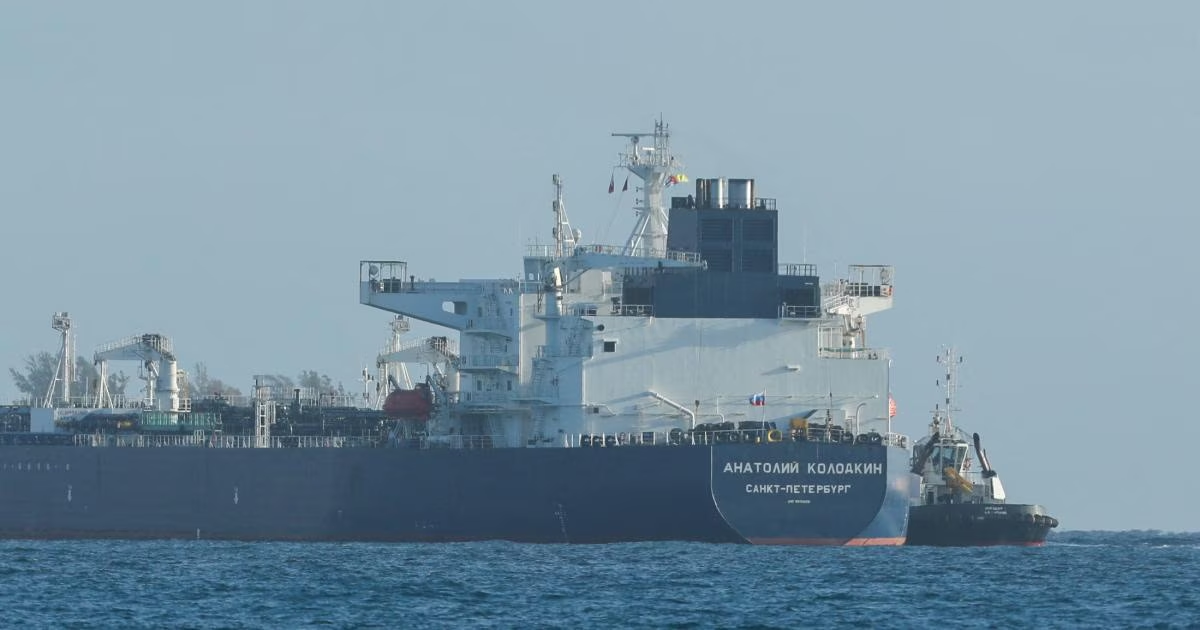
The international arena has witnessed a remarkable shift in the strained relations between the United States and Cuba, as the Russian oil tanker 'Anatoly Kolodkin' docked at the Matanzas oil port. The sanctioned vessel unloaded a massive cargo of 700,000 barrels of crude oil, a move that revealed a surprising retreat in the strict blockade policy.
This development comes after months of firm statements by US President Donald Trump, in which he affirmed preventing any energy supplies from reaching the island. However, the White House's tone has recently changed, with Trump showing unexpected flexibility to journalists, indicating his current non-objection to the passage of oil shipments bound for Havana.
Coinciding with the arrival of oil supplies, the Cuban government took a step it described as 'humanitarian,' releasing 2010 prisoners on the occasion of Easter. International observers believe that this timing is not a mere coincidence, but rather a link in a series of broader understandings taking place behind the scenes between the historical adversaries.
Diplomatic sources reported that these mutual movements reflect the desire of both parties to build bridges of trust to save the ailing Cuban economy. The oil blockade has led to a near-complete paralysis of the tourism sector and the cessation of major international airlines' flights to the island, exacerbating living crises.
Cuba is currently suffering from daily power outages and the closure of most gas stations, which has driven nearly two million people to emigrate over the past five years. Only 9.5 million people remain on the island, facing the most difficult economic conditions in decades, amid government insistence on not touching the political system.
Political analyst William LeoGrande points out that exchanging goodwill gestures is a classic strategy to advance stalled talks. He believes that allowing the Russian tanker to pass in exchange for the release of prisoners represents tangible progress in the de-escalation path sought by international and regional parties.
In a related context, satellites detected movements of another tanker called 'Sea Horse' carrying Russian fuel in the Atlantic Ocean. Instead of heading to Cuba, it changed its course towards Venezuela, in a maneuver interpreted by experts as part of complex economic incentives managed by Washington in the region.
Recently, a new economic class has emerged in Cuba, consisting of more than 10,000 small and medium-sized private companies. These companies, known as 'Mipymes,' have begun to change the face of the local economy and create a new financial elite closely linked to the interests of the influential military establishment.
Raúl Guillermo Rodríguez Castro, the former president's grandson, leads the economic negotiations with the American side. By virtue of his position in the military's economic arm, 'GAESA,' he possesses wide influence that allows him to formulate understandings that ensure the survival of the ruling elite while opening up to foreign investments.
Statements by Sandro Castro, the grandson of the late leader Fidel Castro, sparked widespread controversy after he expressed a clear desire to cooperate with American investors. Sandro, described as a successful businessman, did not hesitate to criticize the performance of the current president, Miguel Díaz-Canel, in an unprecedented move in Cuban political circles.
Havana diplomats believe that Sandro's public criticism of the presidency could be a green light for a new transitional phase. Washington has set the dismissal of Díaz-Canel as one of the unannounced conditions for the continuation of negotiations, which could pave the way for an open economic model under family control.
This path aligns with Trump's vision, which he described as a 'friendly acquisition,' aiming to transform Cuba into an American investment arena while neutralizing political adversaries. This approach resembles what happened in other regional issues, where military confrontation is replaced by soft economic dominance.
Informed sources confirm that the current Cuban elite is reaping huge profits from the limited opening, and is ready to expand this scope to include American companies. The required quid pro quo is to ensure the protection of their commercial and political interests, which Washington seems to be beginning to accept as a practical reality.
While Iran continues to defy American ambitions, Trump is looking for a quick diplomatic victory in the Caribbean to bolster his domestic standing. It appears that the 'oil for prisoners deal' is the first step on a long road that could end with the lifting of the historical blockade on Cuba in exchange for structural changes in the hierarchy of power.
If a country wants to send some oil to Cuba now, I have no objection.
شارك برأيك
Sudden Breakthrough Between Washington and Havana: Russian Oil Tankers and Prisoner Release Pave the Way for a Major Settlement