






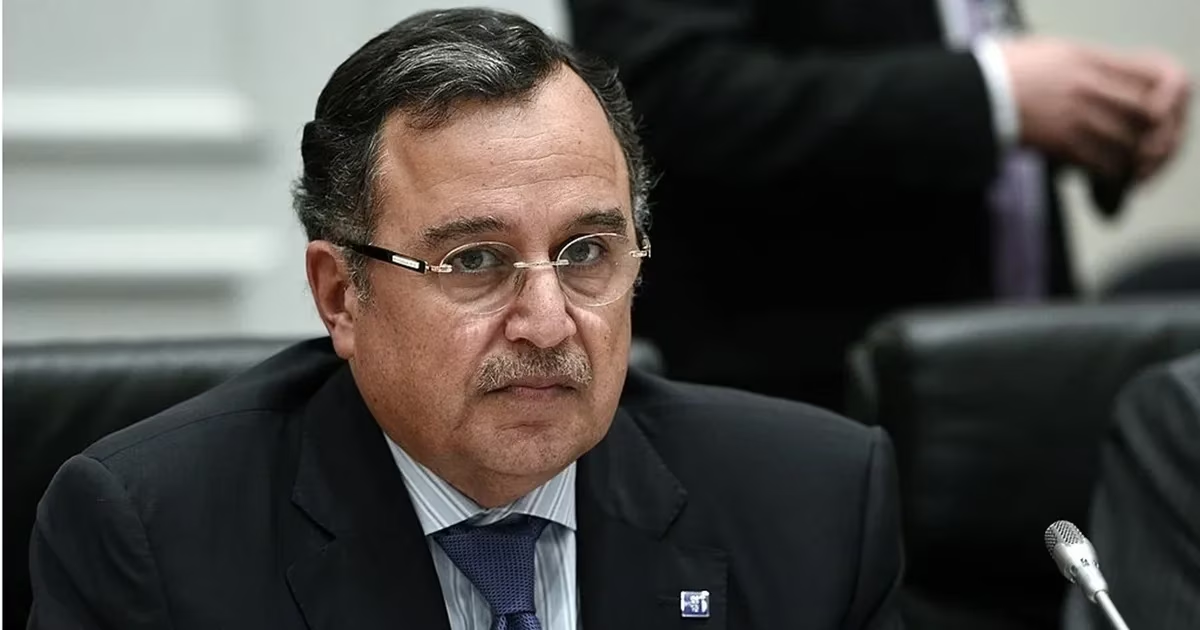
The Arab League officially announced from its headquarters in the Egyptian capital, Cairo, the selection of diplomat and former minister Nabil Fahmy for the position of the new Secretary-General. This selection makes Fahmy the ninth in the League's history since its inception in 1945, and he is scheduled to officially assume his duties next July, succeeding the current Secretary-General Ahmed Aboul Gheit.
Fahmy's selection was unanimous and without any objection from member states, which surprised political observers. The recent period witnessed urgent Arab demands, led by countries such as Saudi Arabia, Algeria, and Qatar, for the necessity of breaking Egypt's monopoly on the position and changing the prevailing custom that links the nationality of the Secretary-General to the host country.
Analysts believe that the Arab concession on claiming the position is due to the general state of frustration with the effectiveness of the Arab League amidst escalating regional wars. Sources indicated that Arab Gulf states, which have recently been subjected to security and military pressures, now see the position of Secretary-General as a lost luster not worth the political struggle at the present time.
Gulf officials clearly expressed this trend, with former Emirati minister Anwar Gargash questioning the usefulness of the League's role in protecting regional security. In the same context, Kuwaiti Foreign Minister Jarrah Jaber Al-Ahmad affirmed that the regional organization has completely failed to play an effective role in preserving Arab national security in the face of external threats.
For his part, Ambassador Abdullah Al-Ash'al, former Assistant Egyptian Foreign Minister, described Nabil Fahmy's selection as an 'excellent choice' given his extensive diplomatic experience and professional integrity. However, Al-Ash'al warned that success in this mission depends on the ability to balance international and regional pressures, especially regarding the relationship with the Israeli occupation.
Egyptian academic Dr. Mostafa El-Gamal pointed out that the sharp Arab divisions in this difficult circumstance made the 'Egyptian solution' an available and customary option to avoid conflict. He explained that agreement on a candidate from the Gulf or the Maghreb would have required complex understandings that are not permitted by the current political conditions in the region.
In a different reading, researcher Yasser Abdel Aziz considered the acceptance of the Egyptian personality as a result of the decline in the League's role itself, where the organization's weakness coincided with the state of political decline of some active countries. He added that the Arab decision in recent years has been subject to financial and political power balances, making the Secretary-General's position more coordinative than leadership-oriented.
Historically, the position of Secretary-General has been associated with Egypt, with the exception of a short period when the headquarters moved to Tunisia after the signing of the Camp David Accords. Despite Saudi Arabia's previous attempts to propose names such as Adel Al-Jubeir for the position, Riyadh ultimately preferred to maintain coordination with Cairo to face the changing geopolitical challenges in the Middle East.
Nabil Fahmy faces thorny issues starting from the raging war in Sudan, extending to the crises in Libya, Yemen, and Somalia. The Palestinian issue and the Israeli aggression on Gaza and Lebanon also emerge as a top priority requiring action that goes beyond the traditional statements of condemnation and denunciation that the League has accustomed to issuing.
Nabil Fahmy, born in New York in 1951, has a distinguished resume, having served as Egypt's ambassador to Japan and the United States. He is the son of the late minister Ismail Fahmy, who made a historical stand by resigning in protest against Sadat's approach to peace negotiations, which places the son under the scrutiny of popular and diplomatic testing.
Fahmy's previous stances, especially during his tenure as Foreign Minister after 2013, raise some controversy in human rights and political circles. His term was associated with diplomatic statements describing Egypt's relationship with Washington as a 'legitimate marriage,' and he faced criticism due to media reports about the internal situation in Egypt at the time.
In his first statement after the selection, Fahmy expressed his gratitude to the Egyptian leadership, emphasizing the enormity of the responsibility in light of the 'flagrant violations of international law' that the nation is subjected to. He stressed the need to confront schemes aimed at dominating Arab resources and undermining the stability of member states.
Journalistic observers believe that Egypt categorically rejected the idea of rotating the position, considering it a moral and political right associated with the host country. Although the Gulf states are the largest funders of the League's activities, Cairo succeeded in mobilizing support for its candidate through intensive diplomatic tours that preceded the voting process.
The biggest challenge facing the new Secretary-General remains to revive an entity that some describe as 'in the intensive care unit.' This will not be achieved, according to experts, without a genuine political will from member states aimed at reforming the League's basic system and activating binding decision-making mechanisms.
The League has failed to play an effective role in preserving Arab security amidst current challenges.
شارك برأيك
Nabil Fahmy Unanimously Appointed Secretary-General of the Arab League: A Necessary Consensus Amidst Turbulent Regional Crises