






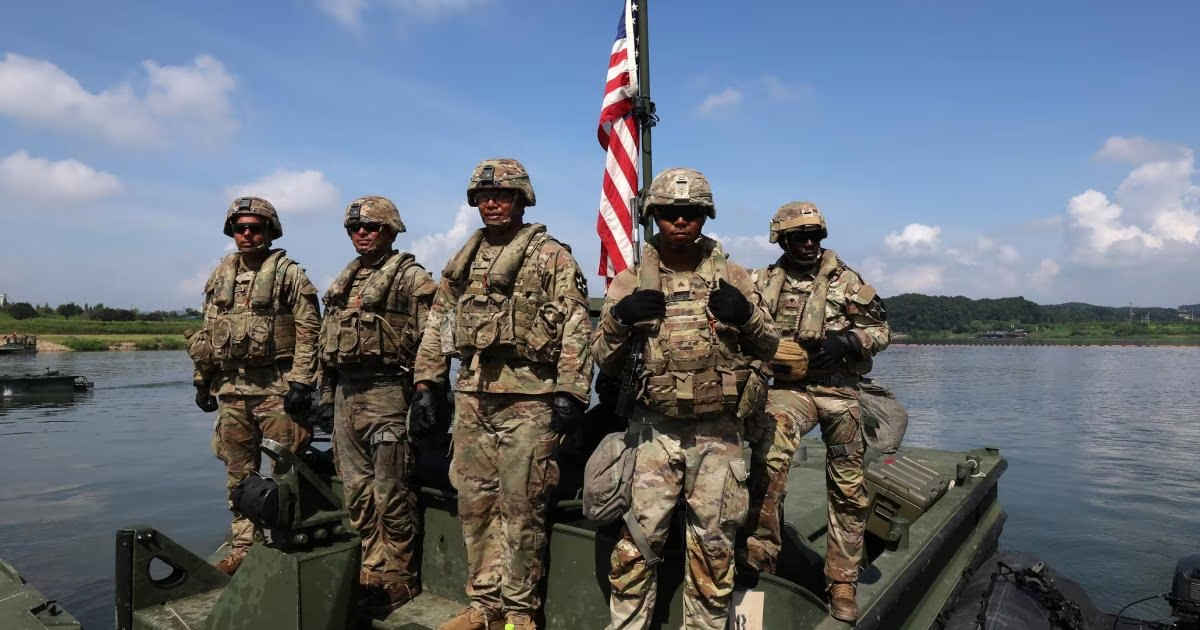
Recent attention has been drawn to the accelerating American military movements in the Middle East, with reports indicating the possibility of limited ground operations. This buildup does not appear to be a prelude to an all-out war, but rather reflects a strategy based on rapid and precise intervention against specific targets.
At the forefront of these movements is the 31st Marine Expeditionary Unit (MEU), which represents a model of an integrated amphibious force. This unit comprises approximately 2,200 personnel trained to operate from warships without the need for permanent and fixed land bases in the region.
The 31st MEU relies on the USS Tripoli for its operations, giving it a high degree of maneuverability and the ability to launch swift coastal raids. These movements aim to secure ready platforms for launching immediate operations should military orders be issued by Central Command.
Alongside the 31st MEU, the 11th Marine Expeditionary Unit is moving with similar capabilities to enhance the joint operational pattern. These two units work in parallel to ensure full control over coastal targets and secure a foothold for subsequent forces in the theater of operations.
Tasks are distributed between the two units, with one undertaking the initial assault and control of the vital objective, while the other establishes military presence. This coordination ensures the expansion of field control and prevents any counterattacks that might target advancing forces in the early stages.
On the aerial front, the 82nd Airborne Division stands out as one of the fastest and most lethal deployment forces in the world. Estimates indicate the deployment of up to 4,000 soldiers from this division to the region, including combat units and logistical and command support elements.
The 82nd Division's combat doctrine relies on heavy parachute drops into enemy territory to seize vital installations. Its primary objective is to secure airports and strategic infrastructure within a record time of no more than 24 hours from the start of the operation.
When these amphibious and airborne forces are combined, what military sources describe as a 'rapid intervention package' is formed. This combat mix combines the flexibility of the Marines at sea with the power of the airborne division to penetrate the geographical depth of targeted areas.
In this operational model, Marine forces conduct coastal assaults to secure vital waterways and ports. Simultaneously, the airborne division advances into strategic depth to ensure the neutralization of the adversary's movement and control of logistical strongpoints.
International media sources reported that this pattern of deployment is usually associated with short-term operations not exceeding several weeks. The goal of these operations is not permanent occupation, but rather to deliver qualitative strikes to specific locations and then withdraw quickly after achieving objectives.
This military buildup comes as part of preparations for military options that may be implemented in the coming weeks, according to intelligence assessments. Washington, in this context, focuses on surprise and integration between different branches of the armed forces to minimize human and material losses.
Regional powers are observing these movements with great caution, especially with escalating tensions that could lead to a limited confrontation. The question remains about the extent to which these 'combat packages' can achieve their objectives without sliding into a widespread regional conflict.
This pattern of deployment is not typically used in large-scale wars, but rather is associated with limited-objective and rapidly executed operations that rely on surprise.
شارك برأيك
'Rapid Intervention Package' Strategy: How Washington Mobilizes Its Forces for Potential Ground Operations?