






Prominent American writer Thomas Friedman expressed deep doubts about the possibility of improving conditions in the Middle East through the option of militarily destroying Iran. In an article for the New York Times, he explained that historical facts have proven there is no such thing as a 'final' solution to the complex conflicts in this region of the world.
Friedman considered that relying on the phrase 'once and for all' represents a dangerous slippery slope, as military threats cannot be completely eliminated without combining force with a clear political path. He pointed out that this path always requires painful and complex political concessions that current parties refuse to engage in.
As an example, the writer cited Israel's assassination approach against the Hamas movement since the 1990s, where it managed to eliminate three generations of historical leaders. Despite this, this policy did not succeed in ending the movement's existence, which is now led by a fourth generation in large areas of the Gaza Strip.
Friedman explained Hamas's resilience by stating that it is a movement deeply rooted in the Palestinian social fabric, making its military eradication almost impossible. He also criticized Benjamin Netanyahu's government's refusal to cooperate with the Palestinian Authority as a political alternative, considering that this refusal aims to obstruct the two-state solution and maintain permanent control over the West Bank.
Regarding the Iranian issue, Friedman believes that Washington and Tel Aviv are repeating the same mistake by targeting leaders, only for new leaders to replace them in the absence of a unified opposition. He stressed that eliminating the Iranian leadership through airstrikes from long distances will not achieve the desired stability but may exacerbate chaos.
The article warned against the policy of stripping an enemy of their dignity to the extent that they feel they have nothing left to lose, describing this as lost wisdom. He considered that pushing adversaries into a corner without a political horizon will inevitably lead to major explosions whose regional repercussions cannot be controlled.
Friedman touched upon the situation in the West Bank, emphasizing that the settlement policy eliminates the chances of establishing a Palestinian state, which puts Israel in a historical dilemma. Either it transforms into a binational state and loses its identity, or it becomes an apartheid state and loses its alleged democracy.
As for Lebanon, the writer believes that destroying infrastructure and occupying territories will not eliminate Hezbollah as a military and political force. He explained that the only way to weaken the party's influence is through an internal political process led by a strong Lebanese government, which is hindered by ongoing military operations.
Friedman criticized US Defense Secretary Pete Hegseth's statements boasting about absolute military power against Tehran, questioning the effectiveness of this power in the face of economic consequences. He pointed out that Iran, even in a state of weakness, is capable of shaking the stability of the global economy by targeting energy supplies.
He explained that launching a single drone from a simple truck is enough to disrupt navigation in the Strait of Hormuz and raise oil, gas, and fertilizer prices to record levels. This reality proves that military force alone does not provide protection for strategic interests in a closely interconnected global economy.
The writer described what is currently happening as a 'global tragedy' that will not end with the killing of leaders or the stripping of factions of their missile arsenals. Wars not followed by a political vision turn into a permanent drain on lives and resources without achieving real security for any party to the conflict.
Friedman called for adopting a strategy aimed at weakening adversaries enough to open the way for 'real politics' in Gaza, Lebanon, and Iran. He believes that pressure should be directed to force these powers to consider their peoples' desire to live in peace and enjoy the benefits of modernity and economic prosperity.
He concluded his article by emphasizing that politics, not total war, is the only way to sustainably and definitively end these conflicts. History proves that military force may win battles, but it rarely creates lasting peace in a region teeming with historical and religious contradictions.
The vision put forward by Friedman reflects growing concern among the American intellectual elite about being drawn into promises of swift military decisive action. The question remains open as to how willing the current US administration and the Israeli government are to heed these warnings before it is too late.
The most dangerous words in the Middle East are those found in the phrase 'once and for all,' because the conflicts in the region will never end, no matter how much the parties pledge to resolve them definitively.
شارك برأيك
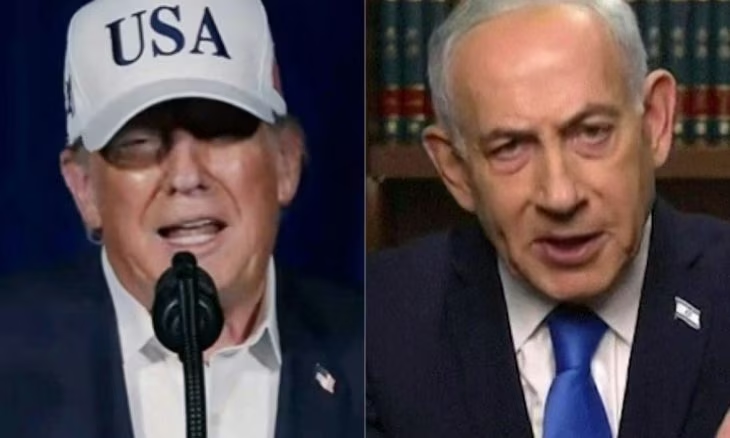
Thomas Friedman: Destroying Iran is not a final solution, and relying on military decisive action is an 'illusion'