






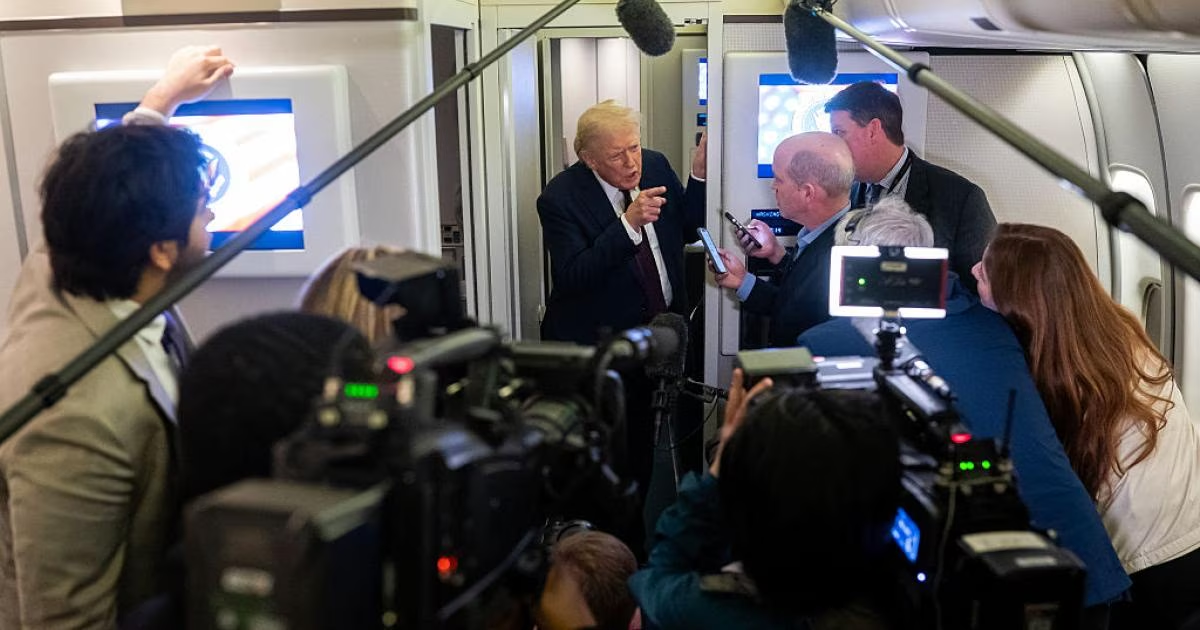
US President Donald Trump announced today, Monday, his conviction that the leadership in Tehran seeks to reach an agreement that ends the current military confrontation with the United States and Israel. Trump explained during his speech at the White House that the problem lies in the lack of clarity regarding who represents the Iranian state at present, noting that there are parties wishing to negotiate without revealing their official identity.
The US President touched upon the ambiguity surrounding the leadership structure in Iran, stressing that Washington does not know precisely who makes the final decisions. These statements come at a sensitive time when the region is witnessing dramatic transformations following the initial strikes of the war that targeted power centers in the Iranian capital.
Regarding the successor to the Supreme Leader, Trump referred to conflicting reports about the health condition of Ayatollah Mojtaba Khamenei, who was appointed successor to his late father. Trump mentioned that there are reports of him suffering severe injuries or severe deformities, while some estimates suggest the possibility of his death as a result of the airstrikes that targeted leadership positions.
US Secretary of Defense Pete Hegseth reinforced these doubts last week when he stated that the new leader has not appeared publicly since his alleged injury. Trump affirmed that the absence of any speech or official appearance by Mojtaba Khamenei fuels questions about his ability to perform his duties, or whether he is still alive.
Regarding international navigation, Trump renewed his call for the international community to effectively contribute to securing and reopening the Strait of Hormuz to global shipping traffic. The US President considered that the stability of navigation in this vital waterway represents a common international interest that requires broader cooperation from regional and international powers affected by its closure.
Trump did not hide his displeasure with the stance of some allies, as he strongly criticized countries that did not show sufficient enthusiasm to support US efforts in securing the strait. He pointed out that Washington has provided protection for many years to certain countries against external threats, but found a 'coldness' in the response of those countries when their field contribution was needed.
In a related context, specialized sources monitoring maritime navigation observed the passage of the first non-Iranian oil tanker through the Strait of Hormuz, broadcasting its identification signals clearly. This development is the first of its kind since the outbreak of hostilities on February 28, which may indicate a partial breakthrough in maritime traffic.
For his part, Iranian Foreign Minister Abbas Araghchi responded to the American statements by emphasizing the steadfastness of his country's position in confronting military pressures. Araghchi said that Washington and Tel Aviv must realize that Iran will not hesitate to defend its sovereignty, and that it is prepared to continue the war to the maximum extent imposed by national necessities.
These reciprocal statements reflect a state of complexity in the political and military scene, where positions oscillate between hinting at negotiation and insisting on confrontation. While Trump seeks a clear Iranian partner to strike a deal, Tehran insists on demonstrating its resilience despite the severe blows that have affected its leadership hierarchy.
We don't know who we are dealing with... We don't know who their current Iranian leader is, and there are parties that want to negotiate but we don't know their identity.
شارك برأيك
Trump reveals Iranian desire for 'deal' and questions fate of Mojtaba Khamenei