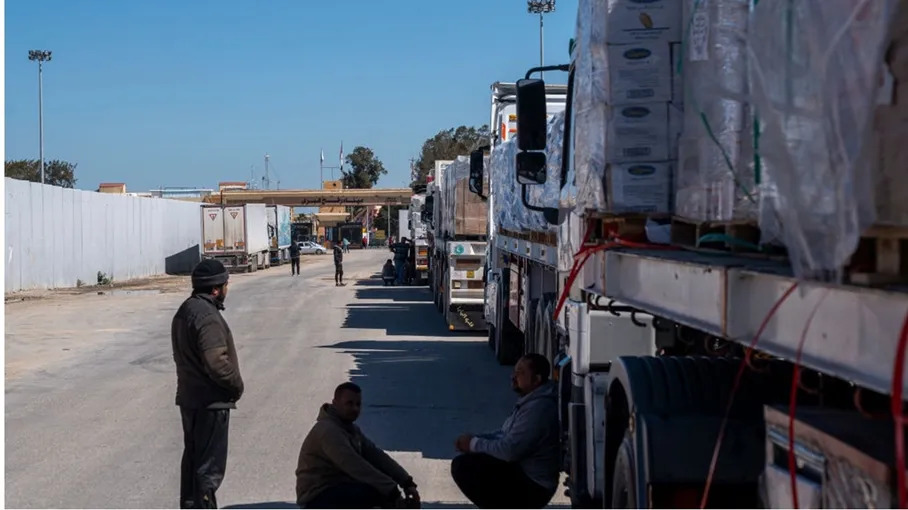







The government media office in the Gaza Strip stated on Tuesday that only 986 aid trucks have entered the territory since the ceasefire with Israel came into effect, out of 6,600 trucks that were supposed to enter by Monday evening according to the agreement.
The government media office confirmed in a statement that "the total number of aid trucks that have entered the Gaza Strip since the ceasefire decision came into effect is only 986 humanitarian aid trucks out of 6,600 trucks that were supposed to enter by Monday evening, October 20, 2025, according to what was agreed upon in the texts of the decision."
It added that "the average number of trucks entering the territory daily since the ceasefire came into effect does not exceed 89 trucks, out of 600 trucks that are supposed to enter daily."
It viewed this as "reflecting the continued policy of strangulation, starvation, and humanitarian blackmail practiced by the occupation against more than two million and 400 thousand citizens in Gaza."
The government office emphasized that these limited quantities reaching the territory "do not cover the minimum of humanitarian and living needs."
It reiterated the urgent need for the territory to have "a regular flow of no less than 600 aid trucks daily, including food, medical, and relief materials, as well as operational fuel and cooking gas, to ensure the minimum requirements for life."
On Monday, the spokesperson for Hamas, Hazem Qassem, accused the occupation of "exploiting the aid file to blackmail the political situation while threatening starvation once again."
In this regard, he stated in a press statement: "The occupation has not abandoned its policy of starvation against our Palestinian people in the Gaza Strip."
The first emergency coordinator at the United Nations Children's Fund (UNICEF), Hamish Young, described the situation in the Gaza Strip as "catastrophic."
He confirmed that UNICEF needs a significant amount of food supplies to address the effects of famine in northern Gaza.
The meager humanitarian aid reaching the territory under the ceasefire agreement, which came into effect on October 10, has failed to break the famine or begin to address its effects, especially as this coincides with a sharp deterioration in the economic conditions of most Palestinians, preventing them from purchasing food supplies.
The ongoing Israeli extermination for two years has turned Palestinians in the Gaza Strip into "poor," according to previous data from the World Bank.
The occupation has not abandoned its policy of starvation against our Palestinian people in the Gaza Strip.



شارك برأيك
Of the thousands of trucks scheduled, only 16% of the aid has entered Gaza.