






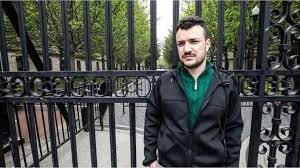
The Trump administration missed a Friday morning deadline to appeal the release of Mahmoud Khalil from the Louisiana detention center where he has been held since March 8, prompting lawyers for the Palestinian student activist at Columbia University to demand his immediate release. On Wednesday, New Jersey federal judge Michael Farbiarz granted Khalil's request to block the government from detaining and deporting him—for now—based on Secretary of State Marco Rubio's ruling that his advocacy for the Palestinian cause harms a "compelling" U.S. foreign policy interest, namely U.S. support for Israel.
The judge said the order would not take effect until 9:30 a.m. on Friday, giving the government time to file a notice of appeal to challenge his decision, a deadline that has passed.
Khalil noted in a press statement that the US administration's deadline has passed, and Mahmoud Khalil must be released immediately. Anything else is an attempt to prolong his unconstitutional, arbitrary, and cruel detention.
It is also noted that in the filings in which the lawyers asked the judge to order his release, they stated that "the government did not file a notice of appeal against this court's order before the deadline set by the court for the initial injunction to take effect. The government also did not state that Mr. Khalil was being detained for any reason other than the reason [prohibited] by the court."
The lawyers attached their email correspondence with Immigration and Customs Enforcement on Thursday, in which the agency's New Orleans field director said they had "no information" about Khalil's release or a timeline.
After submitting the files on Friday morning, Farbiarz gave the government until 1:30 p.m. to respond.
The government has not yet commented on the demand for Mahmoud Khalil's release, although in a statement issued Wednesday, Assistant Secretary of Homeland Security Tricia McLaughlin indicated that the government would appeal Farbiarz's order, saying it "delays justice and seeks to undermine Trump's constitutional powers."
McLaughlin added that the green card is a privilege that should be revoked for people who support terrorist activity, an allegation the Trump administration has leveled against Khalil without any evidence.
The 30-year-old Palestinian graduate student and legal permanent resident has been detained in Jena, Louisiana, since March 9, the day after he was detained by Department of Homeland Security agents at his Columbia-owned apartment. In the weeks since, the government has invoked an obscure provision of the 1952 Immigration Act, which states that the Secretary of State can order the deportation of a person if their beliefs might adversely affect the foreign relations of the United States. This is the government's policy to combat anti-Semitism. Mahmoud Khalil, a Palestinian who grew up in a Syrian refugee camp, rejects the notion that his advocacy for civilians in the war-torn Gaza and West Bank is motivated by bigotry.
His lawyers pointed to public statements he made long before his arrest, in which he condemned anti-Semitism.
Farbiarz's opinion and order issued Wednesday concluded that his detention endangers his reputation and right to freedom of expression.
"The court finds, in effect, that Khalil's career and reputation are being harmed, and that his freedom of expression is being stifled, adding to the already irreparable harm," Farbiarz wrote on Wednesday.
The government also cited another basis for Khalil's deportation, alleging that he failed to accurately complete residency forms when applying for residency. Farbiarz noted Wednesday that the government "almost never" detains people based on such claims, and that Khalil's continued detention is, by all accounts, driven by Rubio's unconstitutional policies. The student activist, whose American wife accepted his degree from Columbia University on his behalf last month, is fighting for his detention and deportation in a writ of mandamus filed in New Jersey, where he was quickly transferred after being detained.
Mahmoud Khalil played a prominent role in campus protests against Israeli military activity in Gaza and the West Bank and Columbia University's financial ties to Israel, serving as a mediator between students and the school administration.
Separately, he faced immigration proceedings in Louisiana, where Judge Jimmy Comans sided with the government in ordering his deportation. Before a hearing in that case last month, where Khalil and other witnesses sought to convince Comans that his deportation could lead to his death, he met his one-month-old son, Dean, for the first time, who was born weeks after his detention.
شارك برأيك
Mahmoud Khalil's lawyers demand his immediate release after Trump misses crucial deadline