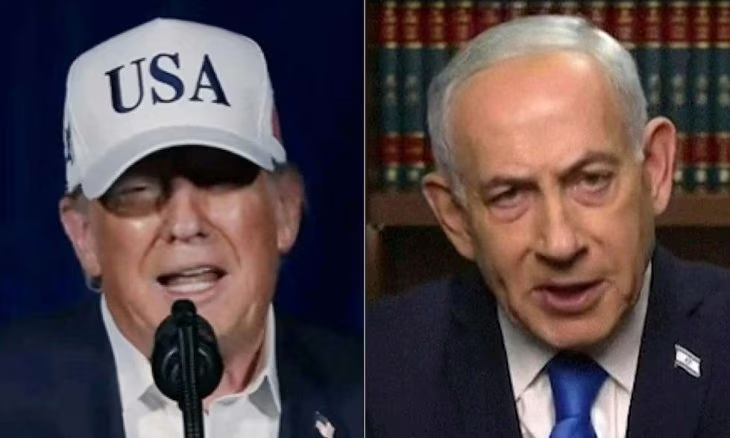







The US administration and the Israeli government are currently engaged in intensive negotiations to draft a new memorandum of understanding on foreign aid, with expectations that it will mark a historic turning point in the nature of the bilateral relationship. The current security agreement is set to expire in 2028, prompting both parties to seek a formula that differs radically from the three previous memoranda that have governed US support for decades.
In a notable statement, US Ambassador to Israel Mike Huckabee acknowledged that the upcoming security memorandum would put an end to the direct financial aid that Washington has consistently provided. Huckabee explained that the new approach would prioritize strengthening joint trade and investment relations, rather than relying on the traditional security grants that characterized past decades.
Documents from the US Congressional Research Service indicate that Israeli Prime Minister Benjamin Netanyahu has begun promoting the idea that Israel has reached economic 'adulthood.' Accordingly, Netanyahu has called for a gradual reduction in direct military aid, replacing it with massive investment projects in cybersecurity and advanced technological defense.
According to official data, the total value of US aid to Israel since 1948 has exceeded $174 billion at current prices. If these amounts are calculated according to the purchasing power of the dollar in 2024, the figure jumps to approximately $298 billion, an unprecedented level of support for any other country in the world.
Reports reveal that US aid has taken on a purely military character since 2021, with economic grants completely absent from approved budgets. The year 2024 recorded a historical peak in direct military support, with aid amounting to $12.5 billion, followed by allocations of $3.8 billion for 2025.
Israel's defense structure relies fundamentally on American technology, with its air force comprising almost entirely US-manufactured fighter fleets. Missile defense systems, including the Iron Dome, also depend on close partnership with Washington for their funding and development, making disengagement from US supply chains a complex and long-term matter.
Informed sources indicate that the current memorandum of understanding, signed during the Obama administration, guarantees Israel $38 billion over ten years. This package includes $33 billion in foreign military financing, in addition to $5 billion exclusively allocated for joint missile defense programs between the two countries.
The US State Department affirms that supporting Israel's security remains a constant pillar of US foreign policy regardless of the ruling party. Israel is the world's leading recipient of security assistance under foreign military financing programs, which ensures its maintenance of what is called 'qualitative military superiority' in the region.
As of April 2025, the value of active deals between the two sides under the Foreign Military Sales program amounted to approximately $39.2 billion, distributed across 751 deals. These purchases vary to include the latest F-35 fighter jets, as well as turbine engines, guided missiles, and smart munitions.
In addition to financial aid, the United States provides Israel with direct access to the American War Reserve Stockpile located in the occupied territories. This stockpile can be used to enhance the occupation's defensive and offensive capabilities in major military emergencies, providing an immediate logistical safety net.
The partnership extends beyond material aspects to include extensive intelligence and research cooperation in the development of weapons and emerging technologies. The US and Israeli armies also participate in large periodic exercises aimed at improving field coordination, such as the 'Juniper Oak' exercises, which are among the largest joint drills.
US law grants Israel the status of a 'major non-NATO ally,' a legal status that provides exceptional advantages in defense trade. This designation facilitates the transfer of sensitive technology and allows for security cooperation not available to other countries, enhancing Israel's position as Washington's primary strategic partner.
Should direct aid be phased out, experts believe that Israel may gain greater flexibility in purchasing equipment from other global suppliers. However, the organic link to American systems makes it difficult to abandon the technical and logistical support provided by major American defense companies.
In conclusion, these figures and new trends reflect a transitional phase in US-Israeli relations, where both parties seek to transform support from a 'grant' format to a 'partnership' format. The ultimate goal of these policies remains to ensure Israeli military superiority while alleviating the direct burden on the US general budget.
The upcoming security memorandum of understanding between Washington and Jerusalem will end direct financial aid to Israel, prioritizing trade and economic relations.
שתף את דעתך
$174 Billion in US Aid to Israel Since the Nakba: Trends Towards Ending Direct Grants