






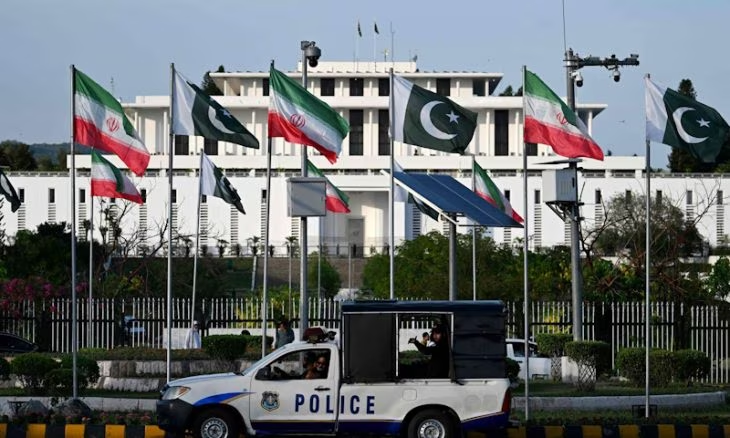
The memorandum of understanding signed by the United States and Iran in the Pakistani capital, Islamabad, last week brought an end to a military conflict that lasted nearly 15 weeks, amidst a cautious sense of relief in international circles. Under this agreement, brokered jointly by Pakistan and Qatar, the Strait of Hormuz was reopened for international navigation, with a 60-day timeframe set for the start of in-depth negotiations on Iran's nuclear program and the issue of easing economic sanctions.
Observers and diplomats, including Eldar Mamedov, political advisor to the European Parliament, believe that this memorandum not only aims to halt hostilities but also establishes a radical shift in the strategic structure of the Middle East. This shift raises serious questions about the possibility of replicating a new 'Nixonian moment,' reminiscent of American policies in the late 1960s that focused on delegating regional security to local allies.
This analysis is based on the 'Nixon Doctrine' announced in 1969, which relies on an 'offshore balancing' strategy after Washington realized its inability to unilaterally play the role of the world's policeman. At that time, the United States relied on the 'twin pillars' policy of Saudi Arabia and Iran to ensure stability in the Gulf, which the current US administration seems to be trying to revive in an updated form suitable for the realities of the 21st century.
However, the currently emerging system does not seem to be based on a single regional power or just two pillars, but rather consists of a broad bloc of independent regional powers. Informed sources clarified that the memorandum was not a traditional bilateral agreement, but rather the product of multilateral diplomacy actively involving countries such as Saudi Arabia, Turkey, Egypt, and Oman, indicating that Washington has become a partner to a regional alliance rather than the sole ruler.
Pakistan's role in this process emerged as a remarkable diplomatic achievement, as Islamabad succeeded in solidifying its position as a trusted mediator between Washington and Tehran. This role reflects regional powers taking on strategic responsibilities that were previously exclusive to the United States, sending a clear signal that the era of direct American hegemony is giving way to a more distributed system of influence and responsibilities.
In line with this new approach, Washington recognizes that supporting its partners requires cooperation that goes beyond traditional military aspects to include intelligence and diplomatic coordination. In the Pakistani case, for example, it may require assisting Islamabad in confronting internal security threats from armed groups, an approach that achieves strategic balance and reduces the need for permanent deployment of American combat forces on the ground.
Saudi Arabia's participation in this new bloc is a fundamental turning point, given the history of zero-sum competition that characterized its relationship with Tehran for decades. Saudi Arabia's agreement to engage in a framework leading to regional stability and economic integration for Iran reflects a desire to end chronic crises and focus on joint economic development away from direct confrontation policies.
For its part, Turkey adds additional military and diplomatic weight to this regional alliance, as a major NATO power increasingly adopting an independent foreign policy. This bloc, comprising Pakistan, Saudi Arabia, and Turkey, possesses the necessary ingredients to impose a new geopolitical reality, where the interests of these countries intersect with American interests in achieving stability, without necessarily coinciding in all details.
Signs of this shift were clearly evident in the strong American stance against sharp Israeli criticism of the agreement, as the Trump administration openly defended the de-escalation path. Vice President J.D. Vance's statements clarified the situation, reminding Israeli leaders that their security fundamentally depends on American weapons and funding, emphasizing that Washington's strategic goals would not be subject to the preferences of regional partners.
In conclusion, it appears that the 'Islamabad Memorandum' may be the historical moment when the Middle East began its transition from an era of absolute American hegemony to an era of regional power blocs. Although the basic logic of the Nixon Doctrine remains present, the multiplicity and independence of actors make the new system more complex and pluralistic, imposing a new role on Washington as a balancing power that supports stability from afar.
If I were a member of the Israeli government, I would not attack the only strong ally I have left in the entire world.
שתף את דעתך
The Return of 'Nixon Doctrine': Will the Islamabad Memorandum Reshape American Influence in the Middle East?