






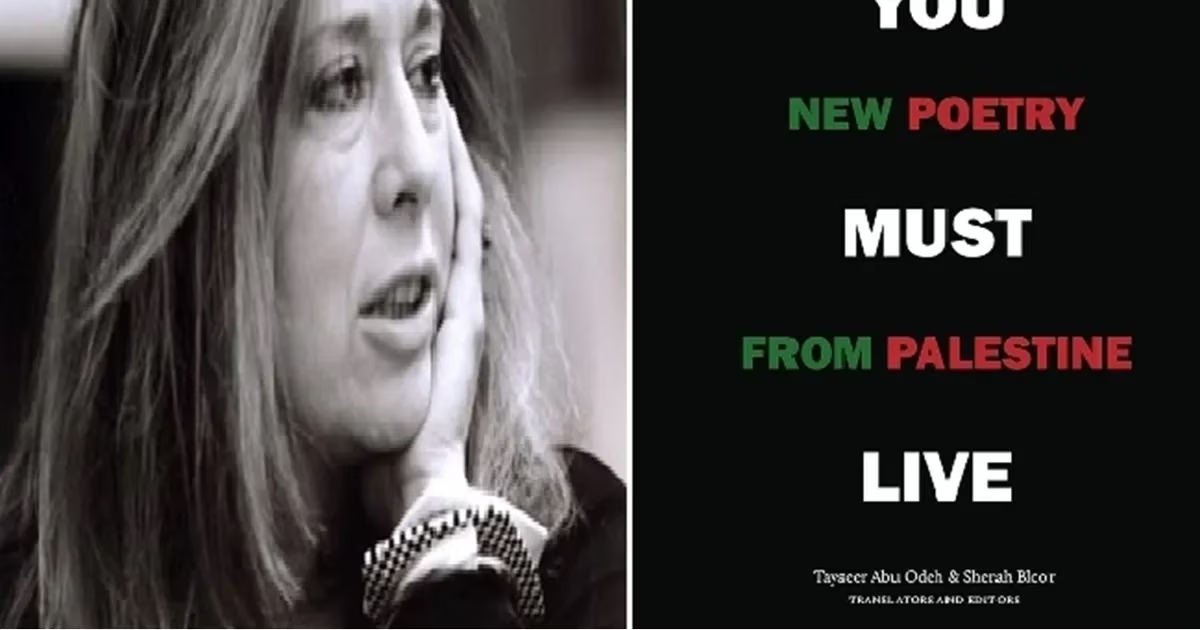
Amidst the major wars ravaging the Palestinian existence, poetry is no longer merely a literary luxury or a means to record pain, but has transformed into a vital tool for survival and symbolic resistance. This truth is clearly evident in the new poetic anthology titled 'You Must Live: New Poetry from Palestine,' edited by the esteemed American poet Jorie Graham.
These selections include young and veteran poetic voices from the Gaza Strip and the West Bank, who documented their experiences amidst one of the bloodiest periods in contemporary Palestinian history. These texts do not merely present a literary image of reality, but raise fundamental questions about the efficacy of the word and its ability to withstand the bombing and destruction machine that attempts to erase identity.
Palestinian literature has long been associated with the idea of testimony and national commitment since the generation of Mahmoud Darwish and Samih al-Qasim, yet this publication reveals a qualitative shift in the writing of the new generation. These poets, who grew up under digital siege and repeated wars, now write from the heart of concrete human experience, far from classical rhetorical slogans.
The poems in the anthology are concerned with the small details that form the essence of life under occupation, such as home, mother, the road, and feelings of fear and love. It is writing that starts from daily concerns to reach universal human horizons, where preserving personal memory becomes a political act par excellence in the face of attempts at cancellation and exile.
One of the most prominent features of these selections is the breaking of the stereotypical image of the Palestinian poet as a strict political voice, as the texts highlight aspects of human fragility and weakness. The Palestinian human appears here as an ordinary being trying to survive and preserve their dreams amidst a collapsing world, which brings the issue from the realm of political abstraction to the realm of concrete human experience.
Death is present in the anthology's texts in a direct and daily manner, but it lacks the romanticism or celebratory tone that characterized previous war literature. Death here seems 'banal' due to its frequent repetition, which prompts poets to focus on its profound impact on the living and on places that suddenly turn into desolate voids requiring lamentation and documentation.
Despite the intense presence of loss, the title 'You Must Live' represents a philosophical and ethical declaration that challenges the logic of genocide. Life in these poems is not merely a biological state, but a continuous act of resistance that requires a strong will to extract meaning from the heart of the destruction and devastation surrounding the Palestinian human being.
Dark humor emerges in the selections as a psychological and aesthetic defense mechanism resorted to by poets to understand the absurdity around them. When reality exceeds the bounds of imagination in its cruelty, sarcasm becomes a means of maintaining psychological balance, where poetic images merge tragedy and shocking humor to reveal humanity's capacity for resilience.
The anthology also indicates profound transformations in the structure of Palestinian poetry, moving away from traditional rhythm and direct language towards more free and deconstructed forms. Diaries, narratives, and philosophical reflections intertwine in these texts, reflecting an influence from global poetic schools while maintaining national specificity and identity.
The great value of this work lies in its being a human archive that protects memory and narrative from the systematic erasure practiced by the occupation. Writing here is a form of cultural resistance that refuses to turn victims into mere numbers in news bulletins, and affirms their right to be seen and heard as creative human beings.
The editor, Jorie Graham, a Pulitzer Prize winner, is considered one of the most important poetic voices in the United States, known for her interest in major existential and ethical issues. Her involvement in editing this book reflects her vision of poetry as a tool for ethical testimony that is inseparable from issues of human justice and global political changes.
Graham was never a political activist in the traditional sense, but her stance on Palestine stemmed from a deep belief in the necessity of conveying the voices of creators living in exceptional circumstances. Through this project, she sought to bring Palestinian poetry into the heart of the global literary scene, considering it a living literature with independent aesthetic value.
Graham emphasizes in her introduction to the selections that Palestinian poems represent a desperate defense of human dignity in the face of excessive violence. She believes that the primary task of literature is to protect human experience from reduction, and to give voice to those whom major powers try to silence or marginalize their deep existential experiences.
Ultimately, the book 'You Must Live' represents a cultural bridge connecting the tragedy of Gaza and the West Bank with the global reader in a refined human language. It is a constant reminder that behind every political news story there are people who continue to love, dream, and write, and that poetry remains the last fortress of memory in the face of oblivion and erasure.
Life here is not a natural given, but a daily act of resistance embodied in the word and the poem.
שתף את דעתך
'You Must Live' Anthology: The Cry of Palestinian Poets in the Face of Genocide and Erasure