






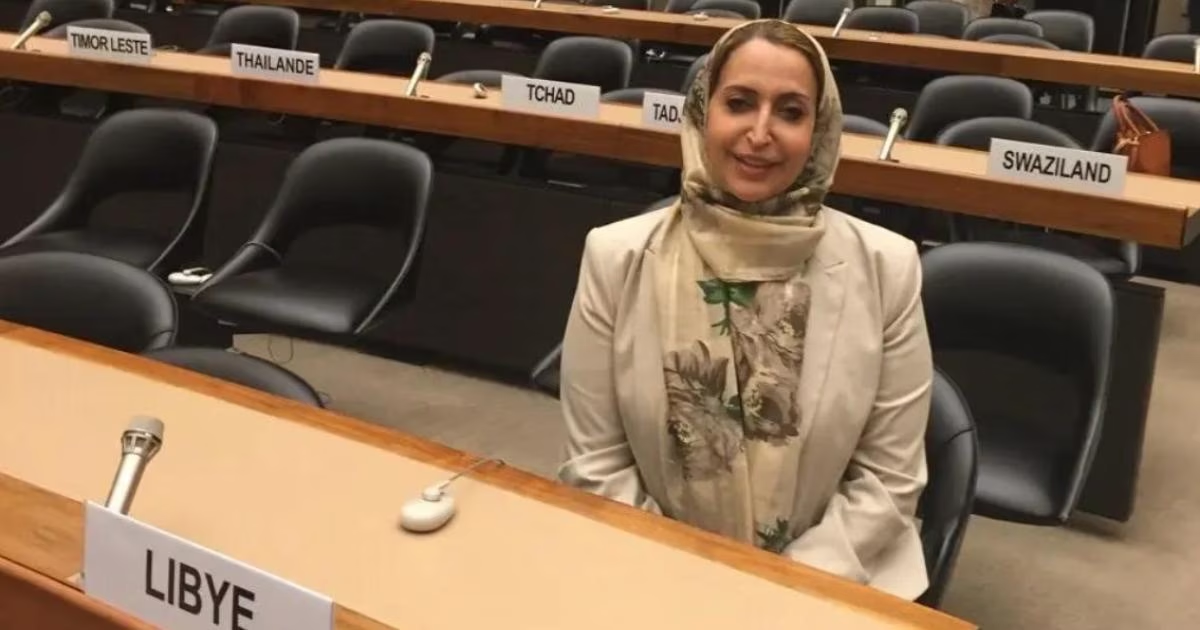
The case of Libyan parliamentarian and doctor Siham Sergewa enters its sixth year without satisfactory answers, as her fate remains unknown since that bloody night in July 2019. The incident, which began with an armed raid on her home in Benghazi, has become one of the most prominent cases of enforced disappearance that troubles the political and human rights scene in Libya.
The roots of the tragedy date back to July 17, 2019, when armed groups stormed Sergewa's home a few hours after a television interview in which she criticized the war on the capital, Tripoli. The armed men not only abducted the MP but also shot her husband and assaulted one of her sons before taking her to an unknown location.
Siham Sergewa, who hails from a prominent family in Derna, was not just a fleeting political figure, but a distinguished academic who obtained her doctorate in clinical psychology from the University of London. She returned to her homeland to contribute to the establishment of the first autism association in Benghazi, dedicating years of her life to academic and humanitarian work before entering the political arena.
Sergewa's political star rose after the February 17 revolution, where she was one of the strong female voices advocating for democracy and political participation. In 2014, she successfully secured her seat in the House of Representatives for Benghazi, receiving thousands of votes, reflecting widespread popular trust in her balanced approach.
The abducted MP was known for her bold stances, demanding the unification of sovereign institutions and the full civilian oversight of the military establishment. In October 2018, she went further by demanding accountability for the leadership of eastern Libya's forces before parliament, emphasizing the separation between military action and political ambition.
Sources close to the family confirm that Sergewa's opposition to the military offensive on Tripoli in April 2019 was a dangerous turning point in her path. From Cairo, she explicitly announced her rejection of military solutions and called for a return to the negotiating table, which her opponents considered a transgression of the red lines drawn in the eastern region.
The night of the abduction witnessed terrifying details, as the abductors left clear threatening messages on the walls of the house with phrases like 'The army is a red line.' These signs were linked by international organizations, including Amnesty International, to armed groups operating under the cover of the forces controlling Benghazi at that time.
Despite the parliamentary immunity Sergewa enjoyed, official investigations have not yielded any concrete results or revealed the identity of the perpetrators. The absence of surveillance camera footage and the failure to identify the military vehicles that surrounded the house raised widespread suspicions about a desire to obscure the traces of the crime.
In 2020, an audio leak attributed to MP Issa Al-Oraibi sparked widespread controversy after he indicated that the group that abducted and killed Sergewa belonged to security agencies in the east. Despite the seriousness of these statements, they remained within the framework of political debate without turning into a judicial path that would bring justice to the victim.
International pressure did not stop, as the European Union mission and embassies of 12 countries issued statements demanding Sergewa's immediate release. Former UN advisor Stephanie Williams also repeatedly called for revealing her fate, considering that her vacant seat in parliament represents a stain on the face of Libyan justice.
As 2025 approaches, the case has resurfaced after unconfirmed photos, said to be of the abducted MP, circulated in a detention center. However, international human rights organizations such as Human Rights Watch quickly demanded a transparent investigation to verify these claims, warning against misleading public opinion.
Political analysts believe that Sergewa's case reflects the heavy price paid by dissenting voices in armed conflict environments. The disappearance was not just a targeting of her person, but a message of intimidation to all voices calling for a civil state and rejecting the militarization of the state in Libya.
Sergewa's family, specifically her husband Ali Rabie, still cling to hope of knowing the truth despite the long years. Rabie confirms in his testimonies that his wife always believed that dialogue was the only way to save Libya from bloodshed, a principle for which she paid with her life.
Siham Sergewa's story remains a bleeding wound in the memory of Libyans and a testament to an era of grave human rights violations. While calls for accountability for those responsible continue, the question remains: Where is Siham Sergewa? This is a question awaiting a legal and moral answer that will end the suffering of her family and her nation.
Siham Sergewa's seat in the House of Representatives remains vacant, a constant reminder of the crime of enforced disappearance.
שתף את דעתך
The Mystery of Siham Sergewa's Disappearance: Years of Ambiguity Haunt the Fate of the Libyan Parliamentarian