






By: Said Arikat
April 12, 2026
News Analysis
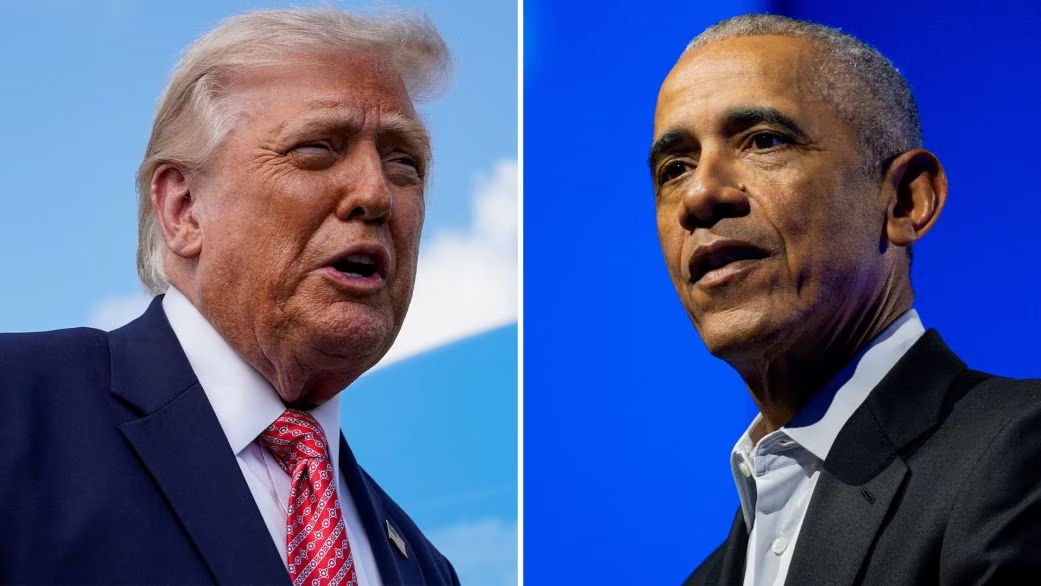
Washington, D.C- The contrasts between Barack Obama and Donald Trump are not just striking but clarifying. One president invested in diplomacy, coalition building, and negotiated restraint. The other has repeatedly chosen confrontation, escalation, and ultimately war. Yet the real story behind the current crisis with Iran is not simply about policy differences. It is about Trump’s enduring fixation on dismantling Obama’s legacy and proving that everything his predecessor built was fundamentally wrong.
At the center of this rivalry stands the Joint Comprehensive Plan of Action, the 2015 Iran nuclear deal negotiated by Obama and major world powers. The agreement placed strict limits on Iran’s nuclear activities and allowed international inspections in exchange for sanctions relief. For Obama, it was a pragmatic solution to prevent war. For Trump, it became a symbol of weakness and capitulation.
From the beginning of his political rise, Trump treated Obama’s achievements as targets for elimination. The Iran deal became his most consistent obsession. He did not merely argue that it was flawed. He portrayed it as a betrayal of American interests and of Israel, echoing the objections of Israeli Prime Minister Benjamin Netanyahu. But where Netanyahu’s opposition was strategic, Trump’s often sounded personal.
Trump repeatedly invoked Obama’s name when attacking the deal, framing its existence as proof of failed leadership. He insisted that Obama had empowered Iran and endangered allies. In doing so, Trump transformed a complex diplomatic agreement into a political grievance. Ending it was not simply policy. It was a declaration that Obama had been wrong.
That declaration came in 2018, when Trump withdrew the United States from the agreement despite international verification that Iran was largely complying. European allies opposed the move and tried to preserve the deal. But Trump was unmoved. The priority was clear: dismantle Obama’s signature foreign policy achievement regardless of the consequences.
Those consequences arrived quickly. Within a year, Iran began expanding its nuclear activities, enriching more uranium and reducing cooperation with inspectors. The limits that had constrained its program eroded. Instead of eliminating the threat, Trump’s decision accelerated it. Yet his rhetoric did not change. He continued to describe the deal as a path to a nuclear weapon, reinforcing his long standing narrative.
That narrative now shapes the war itself. After abandoning negotiations for a revised agreement, Trump turned to military action. Reports indicate that Netanyahu played a key role in pushing the U.S to wage the war, reinforcing a dynamic in which Israeli concerns aligned with Trump’s instincts. But the decision to escalate also reflected Trump’s impatience with diplomacy, particularly diplomacy associated with Obama.
The war, however, has not produced a clean resolution. While U.S. and Israeli forces damaged Iranian capabilities, they did not eliminate its nuclear potential. More importantly, Iran has gained leverage by tightening control over the Strait of Hormuz, a critical route for global energy supplies. This new reality complicates any effort to claim decisive victory.
Now Washington once again needs negotiations. Talks aimed at stabilizing the situation underscore an uncomfortable truth: diplomacy remains unavoidable. Yet the context has changed. Iran enters discussions with greater leverage, and the United States faces higher costs. The very outcome Obama sought to prevent—greater instability and reduced oversight—has become reality.
Still, Trump appears determined to secure an agreement of his own. The distinction matters deeply to him. Any deal must not only resolve the crisis but also surpass Obama’s achievement. This is the core of his approach: dismantle first, then rebuild in a way that asserts personal and political superiority.
That approach carries risks. Trump’s maximalist demands, including calls for Iran to abandon enrichment entirely, are far more rigid than the incremental limits of the original agreement. Such positions may satisfy political instincts, but they reduce the chances of a workable compromise. Iran is unlikely to accept terms that appear to erase its sovereignty.
The result is a cycle in which confrontation leads back to negotiation, but on worse terms. Trump may eventually reach a deal, yet it will reflect the realities created by his own decisions. In that sense, Obama’s legacy remains unavoidable. It continues to define the baseline against which success is measured.
In trying to erase Obama, Trump has instead ensured his predecessor’s influence endures. The Iran crisis is not just a geopolitical conflict. It is also a political echo, shaped by one president’s determination to undo another. And that determination may prove to be the most consequential decision of all.
The missed opportunities before the war further highlight this dynamic. Mediators indicated that Iran had been prepared to accept significant limits on its nuclear activities, including tighter verification and reduced stockpiles. Yet these openings failed to gain traction in Washington. Critics argued that Trump’s team lacked either the patience or the technical focus to recognize what was on the table. Whether that assessment is entirely fair or not, the result is clear: a potential diplomatic offramp was bypassed in favor of escalation. That choice again reflects a broader pattern in which rejecting Obama era frameworks took precedence over refining them. It is a pattern that continues to shape events today.
Ultimately, Trump’s Iran policy cannot be separated from his view of Obama. It is driven as much by rivalry as by strategy. Until that changes, American policy risks repeating the same cycle of rupture, escalation, and reluctant return to diplomacy with higher costs and fewer options.
שתף את דעתך
Trump’s Iran War Is Much About Obama