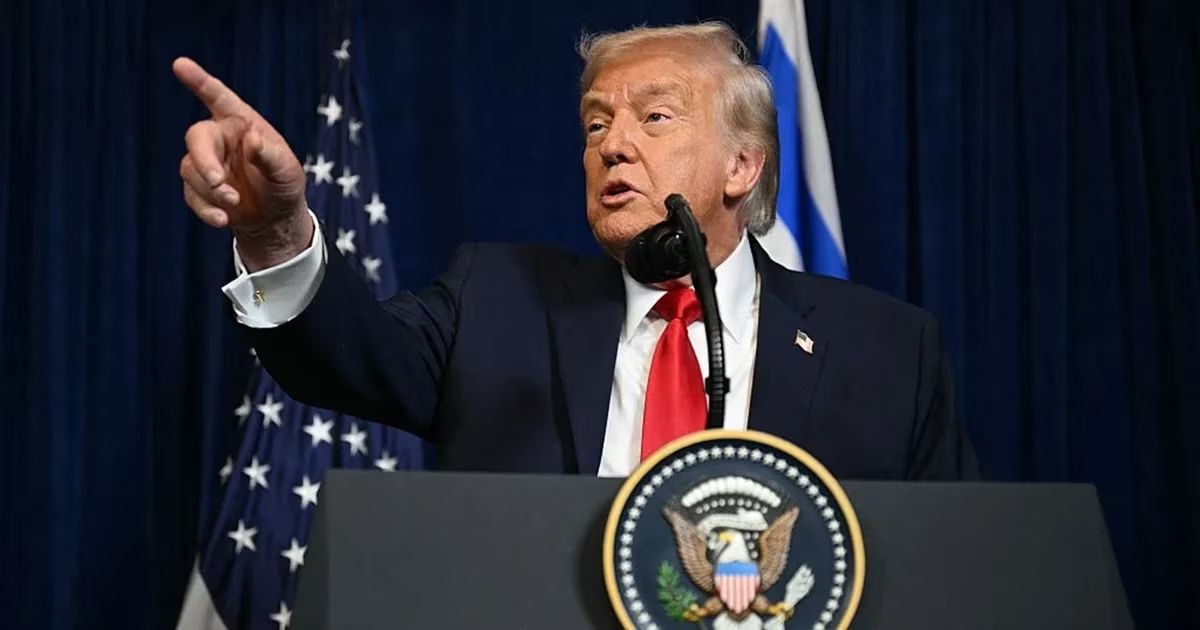







British journalist David Hearst warned US President Donald Trump against making a 'fatal mistake' in his foreign policy by attempting to force Iran to surrender under the threat of military action. In an analytical article, Hearst noted that Trump, emboldened by supposed diplomatic and military successes in the NATO, Venezuela, and Gaza files, misjudges the true strength of the Islamic Republic and its strategic depth.
The analysis revealed details of a plan promoted by Trump's envoy Steve Witkoff and his son-in-law Jared Kushner, which relies on a 'swift and limited' air strike targeting regime leaders to force them to sign a deal that would grant Washington a monopoly over Iranian oil in exchange for the return of American companies like Boeing to operate there. Hearst described this notion as 'political madness' that ignores the reality on the ground.
Hearst explained that Trump's assessment of Iran's weakness relies on 'dysfunctional' Israeli and American intelligence sources, emphasizing that Tehran possesses a surplus of regional cards, ranging from its spiritual influence in Iraq, Lebanon, and Bahrain, to the Revolutionary Guard's ability to close the Strait of Hormuz, through which 20 million barrels of oil pass daily, which could cripple the global economy and directly clash with Chinese interests.
On the military front, the article indicated that Iran would not be content with a limited response, as happened after the assassination of Qassem Soleimani in 2020, but might instead use its arsenal of more than 3,000 ballistic missiles to strike targets including Israel's partners in the region. Hearst stressed that the Revolutionary Guard, which controls half of oil exports and manages a parallel economic system, would not hand over the country's budget to the US Treasury, as some in Washington delude themselves.
Regarding the diplomatic track, Hearst pointed out a divergence in views; Turkey seeks to establish a regional forum for negotiations, while Tehran insists on direct talks in Oman limited to the nuclear file and on the condition that the 'sword hanging over its neck' is lifted. Hearst concluded his article by calling on Trump to read Iranian history, asserting that Tehran, which has survived wars and sanctions for decades, will not accept a return to an era of foreign hegemony.
The British journalist concluded that Trump and Netanyahu have the ability to ignite a 'third Gulf war,' but completely lack the ability to extinguish it, considering that the chance of successful talks avoiding confrontation is no more than one in ten given the current mindset of the US administration.
Iran is not Venezuela; and any attack on it will not be interpreted as a preliminary rebuke for negotiation, but rather as an existential threat that will ignite a third Gulf war that cannot be extinguished.
שתף את דעתך
David Hearst warns Trump: Plan to force Iran to surrender 'a fatal mistake'