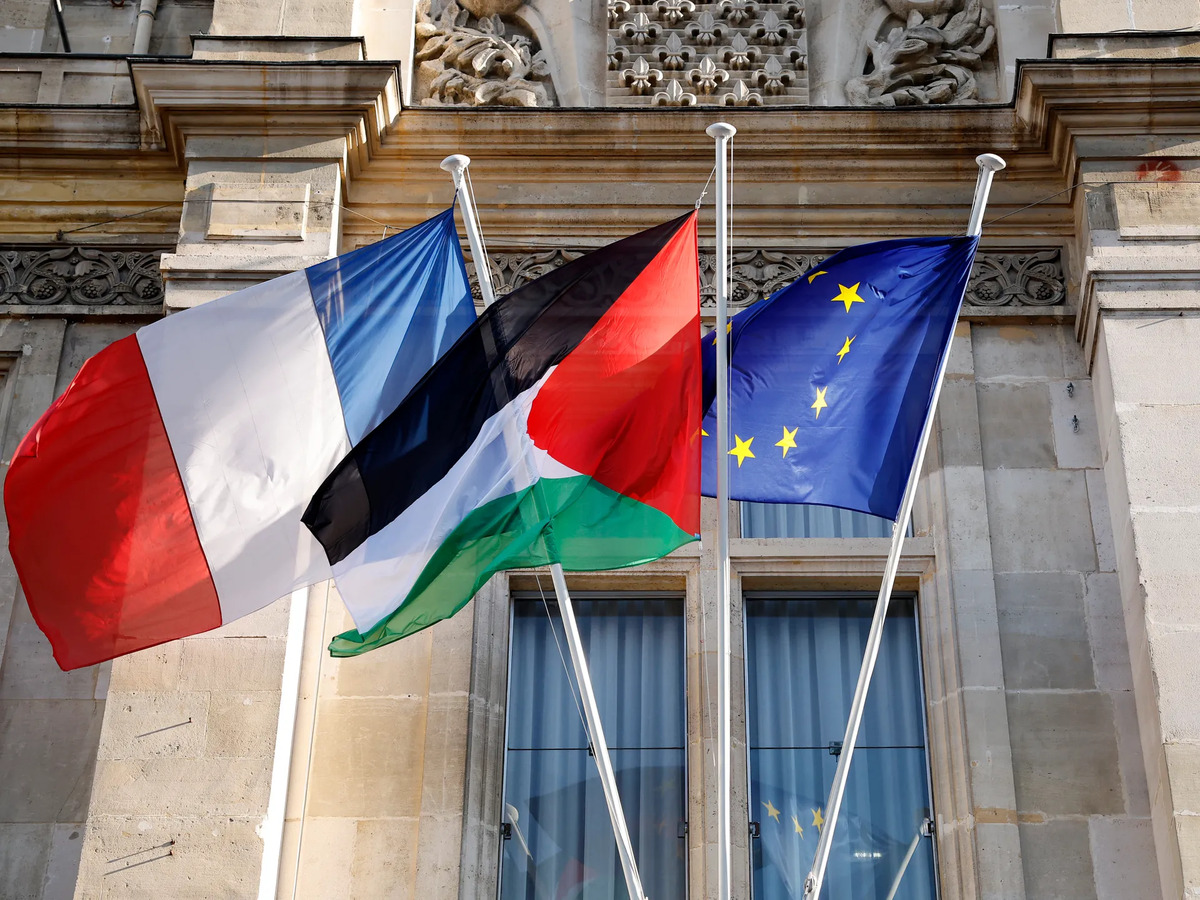







Israel is facing increasing isolation in the world due to the genocide and starvation war it is waging on the Gaza Strip, prompting European and Western countries to recognize a Palestinian state, which has raised questions about the limits of the old continent's escalation with Tel Aviv.
In this context, Ziad Majed, a professor of political science at the American University in Paris, states that the decisions of European governments came as a result of rising pressure from public opinion, academic circles, political parties, trade unions, and popular movements, in addition to Israeli arrogance in dealing with Europeans.
According to Majed's comments on the program "Beyond the News," the sacrifices of the Palestinians have changed the European public's stance, which has reflected a change in the political course, emphasizing that the new generation in Europe is aware and is not only demanding a political path but also the imposition of punitive measures, including sanctions on Israel.
Moreover, legal action in Europe may include activating a legal path against settlers and Israeli soldiers with dual nationality, but Majed expressed his conviction that the economic issue will remain suspended, ruling out that Europe will impose economic sanctions.
However, the professor of political science at the American University in Paris confirms that the boycott of Israel is evolving, as it has been adopted by European associations and unions, in the face of a German position that hinders the imposition of European sanctions on Israel.
Attention is also turning to Italy to persuade it to agree to a package of sanctions against Israel, which complicates Germany's position and makes it more flexible, according to Majed, amid European estimates that Prime Minister Benjamin Netanyahu may close some European consulates in East Jerusalem.
Bloomberg reported that the European Union is preparing to launch the most extensive economic and political sanctions against Israel in decades, against the backdrop of what Europeans describe as the catastrophic deterioration of the humanitarian situation in Gaza.
Meanwhile, writer specializing in Israeli affairs Ihab Jabareen sees that the European recognitions are the beginning of a trend, but "the crossroads will be a year from now," awaiting the outcomes of the Israeli elections and the shape of the next government.
Europe is betting on the departure of Netanyahu's government, making the confrontation "less severe and costly" in dealing with Israel, according to Jabareen, who stated that "Israel has not yet seen European fangs."
According to this assessment, Europe is dealing with Israel as a "guardian wanting to correct the course where it errs, not to punish it and abandon it," citing the lack of economic sanctions and the cessation of arms supplies.
Unless the recognitions turn into binding conditions - Jabareen adds - they will remain symbolic without any strategic cost to Israel, pointing to Netanyahu's manipulation and exploitation of the rift between Europeans and Americans.
In a related context, Mustafa Barghouti, the Secretary-General of the Palestinian National Initiative, expressed his conviction that the South African scenario will be repeated in Palestine, as peoples change first, then pressure their parliaments, and then their governments, leading to a change in the United States.
According to Barghouti, this transformation would not have been possible without the legendary steadfastness of the people of the Gaza Strip, as their sacrifices have not gone in vain, but he emphasized the necessity of translating this into sanctions on Israel initiated by Arab and Islamic countries.
He also rejected the conditions imposed by Europeans regarding the Palestinian state, considering them unacceptable, while simultaneously calling for the necessity of having a unified Palestinian leadership to undertake a liberating struggle project to end the apartheid system and the settler colonial system.
Several municipalities in France have raised the Palestinian flag on their buildings, reaching a total of 52 municipalities, affirming the French position of recognizing the state of Palestine.
Demonstrations were also held in the Italian capital Rome and several cities, called for by labor unions, protesting the Israeli war on Gaza and rejecting the Italian government's policies regarding the continued assaults of the occupation.
The sacrifices of the Palestinians have changed the European public's stance, which has reflected a change in the political course.
שתף את דעתך
To what extent will the rift between Europe and Israel deepen regarding Palestine?