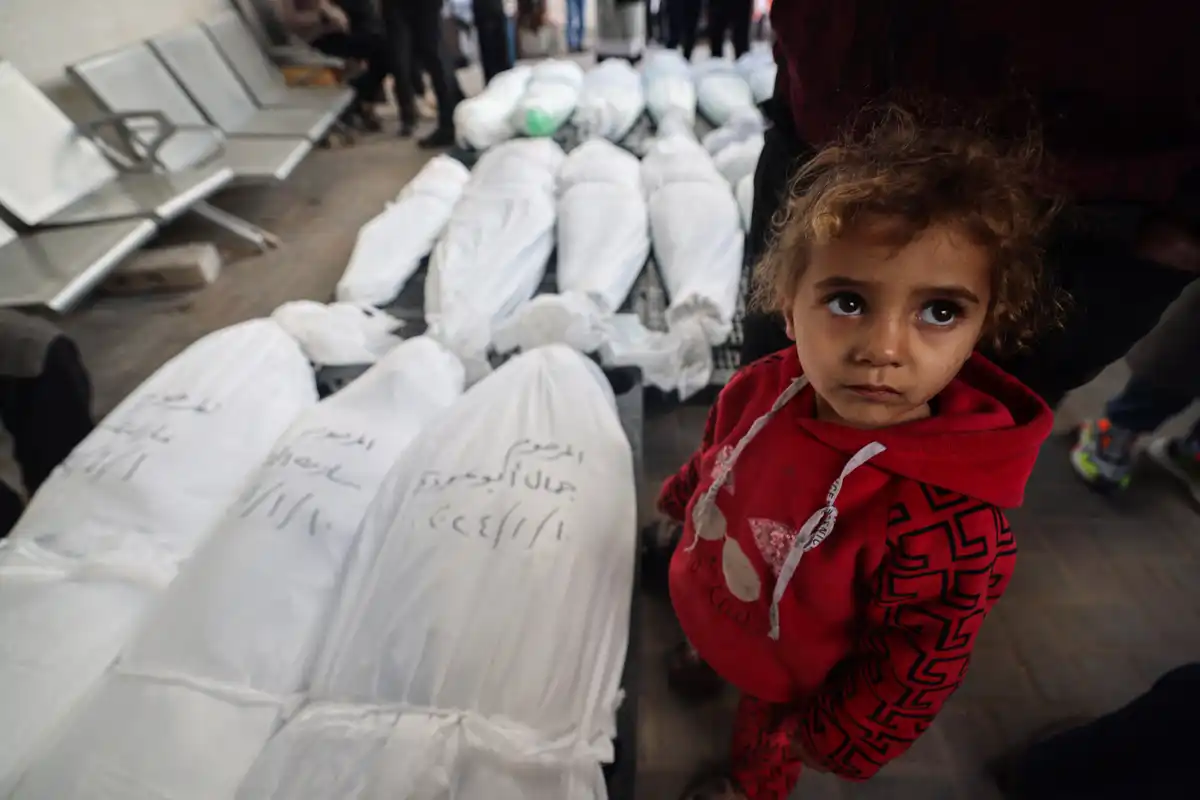
PALESTINE

Fri 30 May 2025 3:32 pm - Jerusalem Time

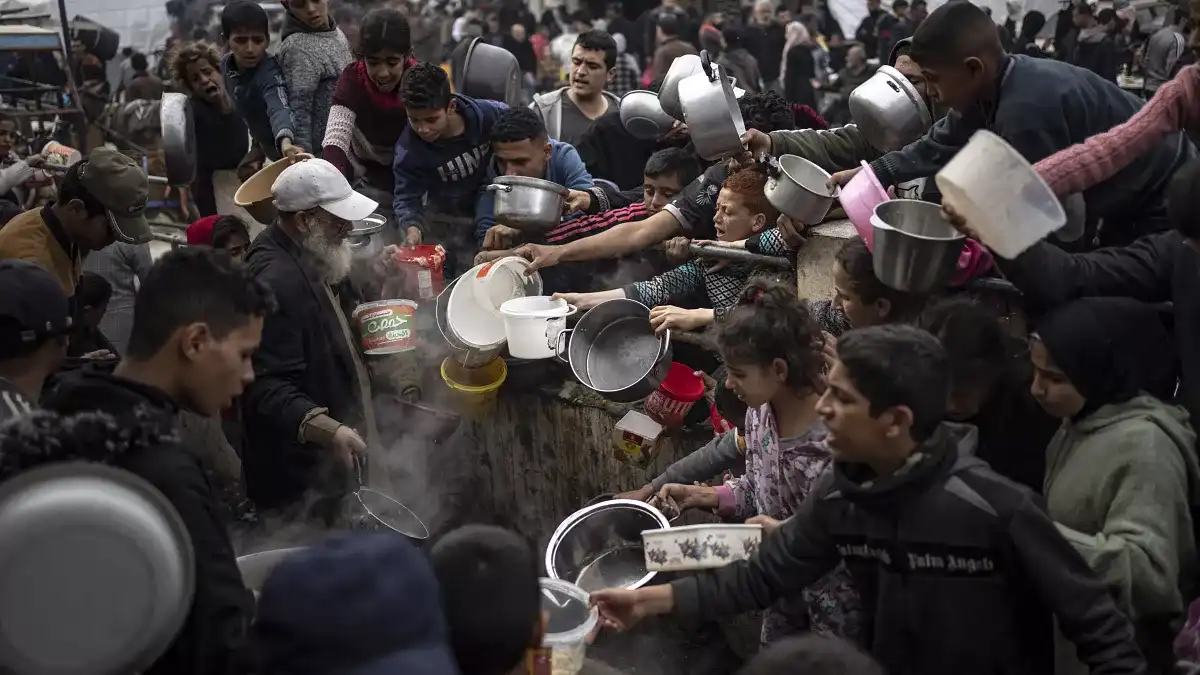
UN: Gaza is the hungriest place in the world, with 100% of its population at risk of starvation.

Jens Laerke, spokesman for the United Nations Office for the Coordination of Humanitarian Affairs (OCHA), confirmed on Friday that "Gaza is the hungriest place in the world," with "100 percent of the population at risk of famine."

"It's the only specific area, the only specific country or sector within a country, where the entire population is at risk of famine. 100 percent of the population is at risk of famine," Laerke told a regular UN press conference in Geneva.

Lark spoke about the difficulties the United Nations faces in delivering humanitarian aid to Gaza, which Israel only allows in small quantities after a strict blockade that began in early March, before the war on Gaza resumed.

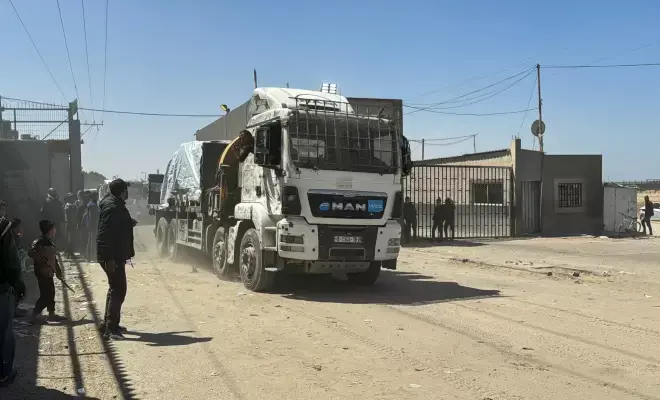
He reported that Israel has allowed the entry of 900 trucks loaded with humanitarian aid since the partial lifting of the blockade, but so far, only 600 trucks have entered the unloading area in Gaza, and only a small portion of these have been transported into the Strip.

Laerke stressed that this limited number of trucks "is just a drop in the ocean," saying that the aid distribution mission faced "operational constraints that made it one of the most challenging aid operations not only in the world today, but in modern history."

For its part, the Ben & Jerry's Board of Directors described the war on Gaza as genocide, and stated in a statement, "Ben & Jerry's believes in human rights and advocates for peace, and we join with all those around the world who condemn the genocide in Gaza."

The statement added, "We stand with everyone who raises their voice against the genocide in Gaza, from those who sign petitions to those who demonstrate in the streets to those who face the threat of arrest."

Ben & Jerry's filed a lawsuit against its parent company, Unilever, last year, accusing it of trying to silence it over Gaza. Today's statement on Gaza is unusual for a major American brand.

PALESTINE

Fri 30 May 2025 3:14 pm - Jerusalem Time

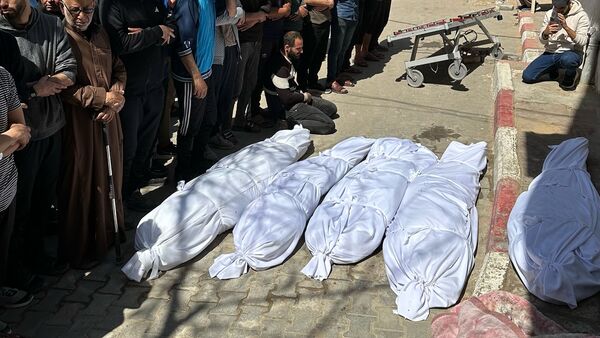
28 dead in the Gaza Strip since dawn today

Twenty-eight civilians were killed as the Israeli army continued its raids on various areas in the Gaza Strip since dawn on Friday.

In the latest developments: Two martyrs and several wounded in a bombing on Deir al-Balah in the central Gaza Strip.

The Israeli army continues to bomb residential buildings and buildings after being warned in Gaza City.


PALESTINE

Fri 30 May 2025 3:01 pm - Jerusalem Time

Katz to Macron: You recognize a Palestinian state on paper and will be consigned to history.

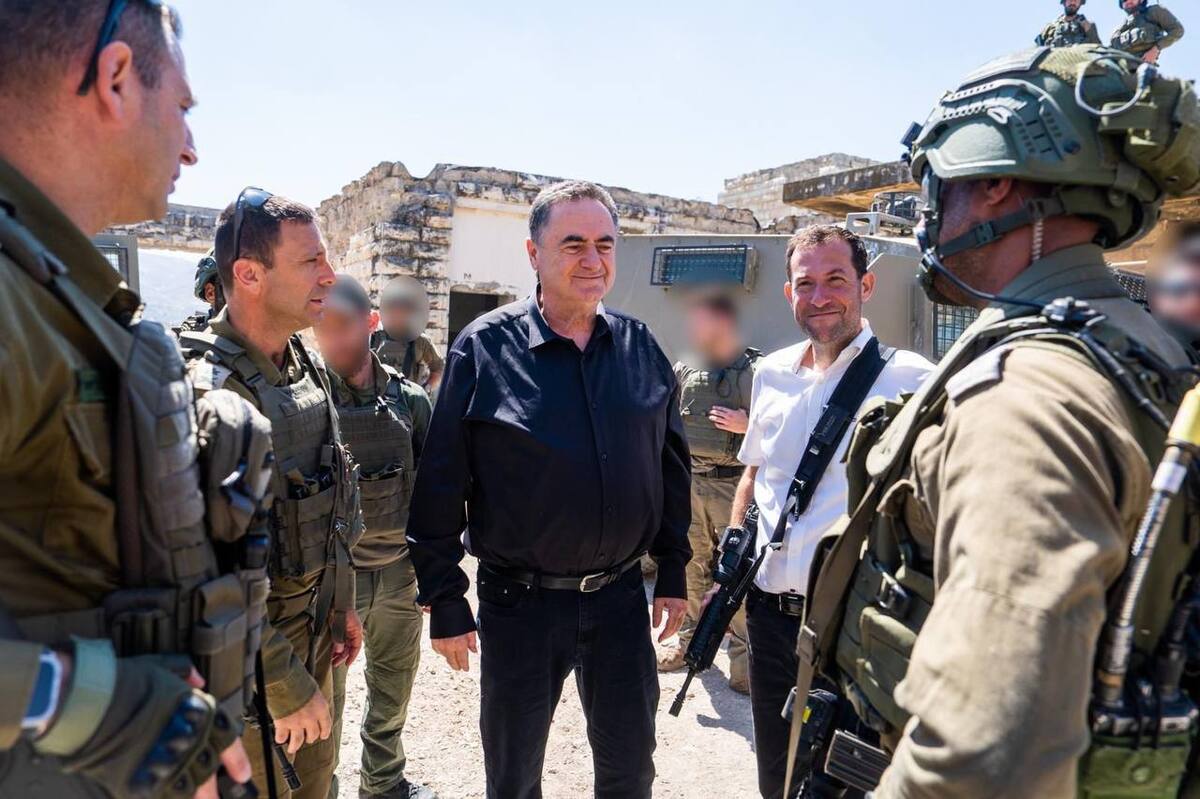
Israeli Defense Minister Yisrael Katz described his raid on Friday into the northern West Bank, where the settlement of Sa Nur was located before its evacuation and dismantling in 2005, as a "historic moment in favor of settlements," a response to Palestinian resistance factions, and a message to French President Emmanuel Macron, who has been calling for the recognition of a Palestinian state.

Katz claimed that the message to Macron is: "You recognize a Palestinian state on paper, and that paper will be consigned to the dustbin of history. Settlements in the West Bank will grow and Israel will prosper. Don't threaten us with sanctions, you won't make us kneel, and we won't bow our heads because of threats."

PALESTINE

Fri 30 May 2025 2:52 pm - Jerusalem Time

Hamas official: The movement is still conducting a comprehensive review of the Witkoff proposal.

A Hamas official said on Friday that "the Israeli response to Witkoff's proposal aims to consolidate the occupation," stressing that the movement is conducting a comprehensive review of the matter.

"The Israeli response does not meet the demands of our people," the official told Reuters.

He pointed out that the movement received an Israeli response to Witkoff's proposal.

He stressed that, despite this, the Hamas leadership is currently conducting a comprehensive review of the new proposal.

PALESTINE

Fri 30 May 2025 2:50 pm - Jerusalem Time

Katz storms the "Tarsla" site near Jaba', south of Jenin

Israeli Defense Minister Yisrael Katz and head of the Northern West Bank Settlements Council, Yossi Dagan, stormed the Tarsala site near the town of Jaba', south of Jenin, on Friday.

Local sources reported that a large force of the occupation army stormed the "Tarsala" site, accompanied by two helicopters, which landed in the plain area of the town of Ajja, near the site. Meanwhile, the occupation forces set up a checkpoint at the entrance to the town of Ajja, near Jaba', obstructing the movement of vehicles and searching them.

She pointed out that the "Tarsla" site, which was a colony called "Sanur", was evacuated in 2005, in addition to the "Homesh", "Ganim" and "Kadim" colonies and the "Dotan-Arava" camp.

PALESTINE

Fri 30 May 2025 2:43 pm - Jerusalem Time

A citizen and his two daughters were injured by Israeli occupation forces' bullets south of Jenin.

A citizen and his two daughters were injured by Israeli occupation forces' bullets on Friday during their raid on the village of Sanur, south of Jenin.

The Palestinian Red Crescent Society said its crews dealt with injuries to two girls (10 and 12 years old) and their father (45 years old) who were injured by live bullet shrapnel in the head. They were transferred to Jenin Governmental Hospital.

Paramedic Murad Khamayseh told WAFA that Israeli forces opened fire on a vehicle inside the village, wounding the father and his two daughters with shrapnel while they were inside the vehicle. They were taken to a health center at the entrance to the village, before Red Crescent ambulances transported them to the hospital, where their injuries were described as minor.

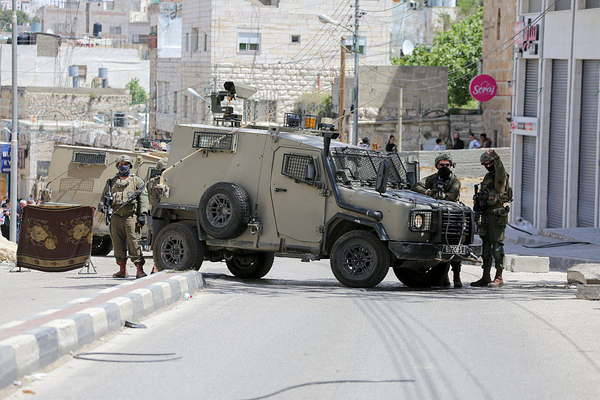
Local sources reported that occupation forces stormed the village in several military vehicles, fired live ammunition at a vehicle, and raided and searched several homes. No arrests were reported.

The occupation forces are intensifying their raids on towns and villages in the Jenin Governorate, coinciding with their ongoing aggression on the city of Jenin and its refugee camp, which has been ongoing for 129 days. They are launching house raids and arrest campaigns against citizens.

A large force of the occupation army stormed the "Tarsala" site south of Jenin this morning, a settlement evacuated in 2005. Helicopters also landed twice at the site.

PALESTINE

Fri 30 May 2025 11:55 am - Jerusalem Time

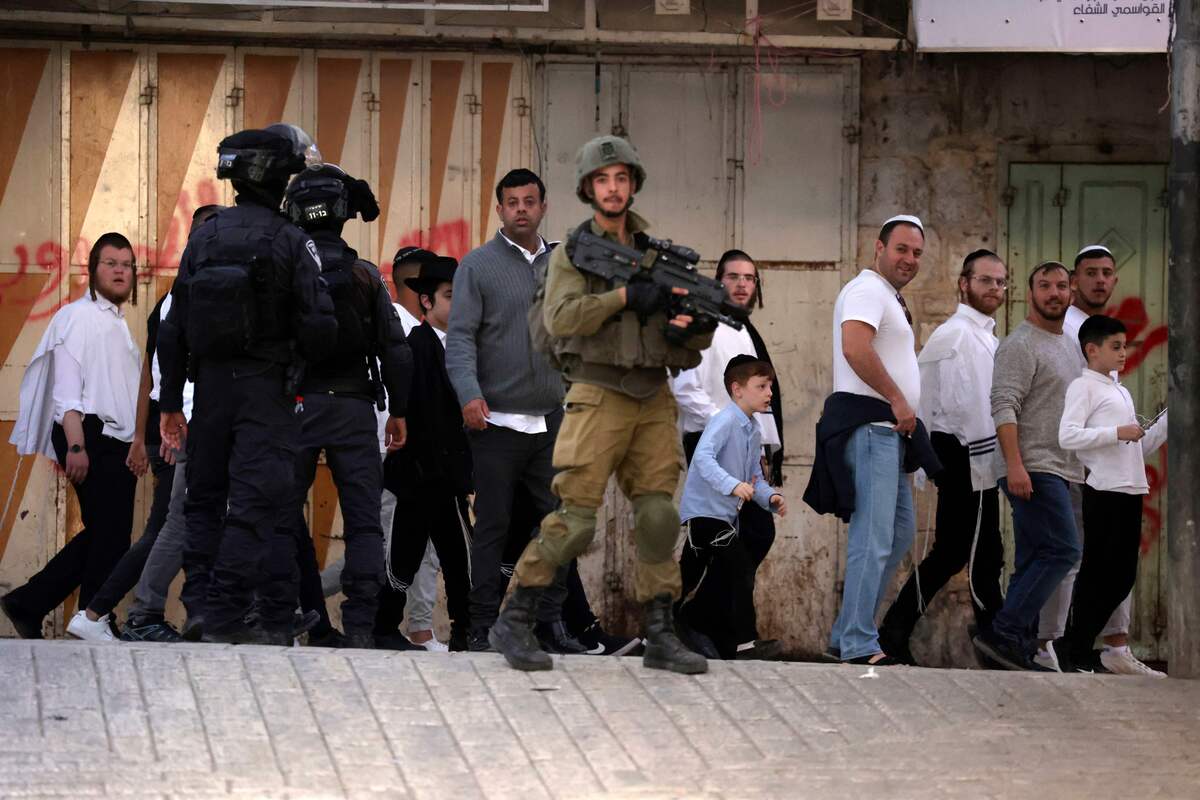
The occupation forces arrested a citizen in Hebron, and a provocative march by settlers took place northwest of Hebron.

Israeli occupation forces arrested a citizen and searched several homes in the city of Hebron, south of the West Bank, on Friday.

Security sources reported that the occupation forces arrested citizen Muhammad Diaa al-Ja'bari, searched his home and several other homes, and ransacked their contents, including the homes of citizens Suhaib Qafisha and Anas Qafisha.

Settlers from the settlements of "Telem" and "Adora", built on citizens' lands northwest of Hebron, organized a provocative march on the so-called "35" colonial road, reaching the entrance to the town of Idhna, west of Hebron. It is noteworthy that the occupation closed all the side roads of the town yesterday with earth mounds, and hindered the movement of citizens.

ARAB AND WORLD

Fri 30 May 2025 10:37 am - Jerusalem Time

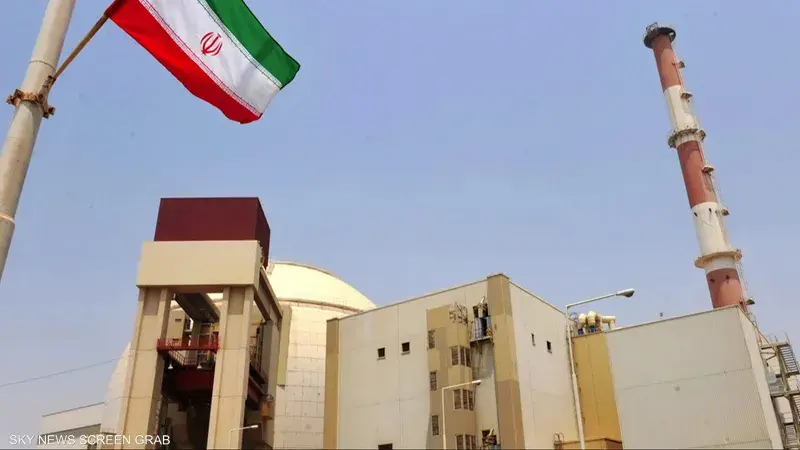
Israeli officials: Strike on Iranian nuclear sites is necessary

While reports and sources indicate the possibility of reaching some kind of agreement on the Iranian nuclear issue, Israeli security officials believe that a strike on Iranian nuclear sites is both possible and necessary.


In detail, Al-Monitor reported, citing American and regional sources, that there is optimism about the possibility of reaching some kind of agreement on the Iranian nuclear issue.

The website quoted a regional source as saying, "The atmosphere is positive regarding the Iranian nuclear issue, and it appears that the United States has offered a solution regarding uranium enrichment."

However, Israeli officials said that a good nuclear agreement between the United States and Iran is impossible because of Tehran's refusal to dismantle its nuclear program, according to the Israeli newspaper Yedioth Ahronoth.

The newspaper said, "Senior Israeli security officials believe that a strike on Iranian nuclear sites is both possible and necessary."

For its part, the Israeli newspaper Maariv reported on a secret meeting held by Israeli ministries, during which preparations for a possible Israeli attack on Iran or an Iranian attack on Israel were discussed.

The newspaper said that there are "estimates that any Israeli attack on Iran could lead to a round of fighting lasting an unknown period and resulting in thousands of missiles falling on Israel."

She added, "If Iran responds to any Israeli attack, the Israeli economy is expected to come to a near-complete standstill for a few days, then return to operating under a state of emergency."

Stopping US coordination with Israel

US President Donald Trump ordered the Pentagon and the military to halt coordination with Israel regarding a joint attack on Iranian nuclear facilities, Israel's Channel 12 reported on Thursday.

The channel's report aligns with Trump's admission that he warned Israeli Prime Minister Benjamin Netanyahu against launching an attack on Iran, as nuclear negotiations between Washington and Tehran reached an advanced stage.

On Wednesday, Trump told reporters, "I want to be honest, yes I did," when asked if he had asked Netanyahu during a call last week to refrain from military action.

PALESTINE

Fri 30 May 2025 10:33 am - Jerusalem Time

UNRWA: Supplies must be allowed to flow into Gaza without hindrance or interruption.

The United Nations Relief and Works Agency for Palestine Refugees (UNRWA) called for the unimpeded flow of humanitarian supplies into the Gaza Strip, following the worsening humanitarian catastrophe resulting from the genocide perpetrated by the Israeli occupation authorities over the past 20 months.

The agency said in a statement on Friday that its warehouse in the Jordanian capital, Amman, contains enough aid for more than 200,000 citizens for a full month, including flour, food parcels, hygiene supplies, blankets, and medicine, and that the aid is ready for immediate dispatch.

She explained that "the warehouse is only a three-hour drive from Gaza," referring to the stifling Israeli blockade that hinders the arrival of supplies.

UNRWA stressed that the humanitarian needs in Gaza are enormous and require urgent intervention, calling for the opening of crossings and ensuring the regular and continuous flow of aid to save lives.

"Gaza needs massive aid, and supplies must be allowed to flow without hindrance or interruption," she said.

The Gaza Strip has been suffering from a catastrophic humanitarian and relief crisis since Israel closed the crossings on March 2, preventing the entry of food, medicine, aid, and fuel.

OPINIONS

Fri 30 May 2025 10:27 am - Jerusalem Time

State postponed until further notice!

Amin Al-Hajj

Amin Al-Hajj

Opinion Writer

By deciding to establish 22 new settlements across the occupied West Bank, the far-right government has left no room for doubt regarding its true intentions regarding the Palestinian territories, or even the entire national project. This is no longer a matter of mere settlement expansion or security pretexts, but rather a clear and direct declaration that the very idea of an independent Palestinian state, regardless of its form or location, is being undermined. It is transforming the West Bank into a permanent arena of settlement influence, managed with a declared and irreversible annexation mentality.

The decision, described by the ruling right in Tel Aviv as a once-in-a-generation decision, came at the height of the aggression on Gaza, at a time when the so-called international community was talking about the need to return to the so-called “political process,” the negotiating table, and the “two-state solution” option. While Riyadh and Paris were at the forefront of calling for an international conference in June to revive this option, a June that carries a painful memory, the anniversary of the Naksa, the fall of Jerusalem, and its Judaization, the settler government preempted those efforts, and today it is drawing on the ground a new reality, in which there is no room for any independent Palestinian entity, but rather a maze of settlements, expanding like a cancer from the north of the West Bank to its south, in the Jordan Valley, in an engineering plan aimed at dismembering the Palestinian land and isolating its regions from one another.

The profound significance of what happened goes beyond the geographic or demographic dimensions, but extends to the political and legal structure of the occupation. In Tel Aviv, the discussion is no longer about security or dictating terms, but rather about an alleged "religious right," about reclaiming the "ancestral heritage," and formally imposing sovereignty over occupied territory, in direct defiance of all international laws and resolutions, and indeed the entire UN system.

In light of the clear support of the Zionist right, and the decline of real international pressure, the Netanyahu government is no longer hiding its intentions. Rather, we see it baring its fangs and announcing its project: to consolidate settlements, make them a lived reality, and prevent any possibility of establishing a viable Palestinian state. This constitutes a strategic blow to any Palestinian effort to establish a state, and leads, among other things, to a series of major risks, the first of which is the swallowing of geography and the elimination of any chance of establishing a Palestinian state, by fragmenting the land and turning it into isolated enclaves surrounded by settlements and bypass roads.

This also leads to the effective erosion of the remaining role of the Palestinian Authority, making it appear more like a service-oriented administration operating under actual Israeli "sovereignty," rather than a national leadership leading a liberation project.

The risks do not stop there, but extend to the entrenchment of an apartheid regime in the West Bank, where settlers are governed by civil laws, while Palestinians are governed by military laws.

Faced with this scenario, the Palestinian Authority has not demonstrated any effective strategy for confrontation, whatever its form. For years, it has actually and gradually retreated from supporting peaceful popular resistance, even if the public discourse continues to repeat this without interruption. Rather, it has slipped into complete dependence on the international system, raising the slogan of turning to the United Nations, international courts, and the international community. However, it has not prepared a cumulative plan for this path, nor has it developed real pressure tools. Rather, it has used these cards intermittently and separately, to the point that it no longer frightens Tel Aviv or moves the international community. With each new violation, it is content with issuing statements of condemnation and threatening to review the agreements, without taking practical steps on the ground.

Today, the Palestinian Authority appears toothless, without real legitimacy, and without a political project capable of mobilizing the Palestinians, or even confronting the occupation, even peacefully. Its excessive reliance on external powers has emptied its tools of any substance. The international community, which it calls upon morning and evening to come to its aid, is paralyzed and lacks the will, or even the desire, to impose any cost on the occupation. The system of international law has become powerless in the face of the balance of power, the use of the American veto, and the selectivity in implementing international resolutions.

The authority's bet on this system has become futile. Rather, it is like waiting for a mirage in the desert. The "new" settlements are not just a link in an ongoing crime, but they are an official obituary for the two-state solution and the undermining of the Palestinian national project in its form since Oslo. With every settlement that is established, the dream fades into the labyrinths of imaginary lines. Unless this reality is boldly acknowledged, and the national project and its tools are not redefined, what will remain of Palestine will be a shadow of a homeland, an echo of a dream, and with it an authority suspended in the air, guarding a map without a land, devoured by settlements, and drowned in the silence of the world and the blood of innocents.


OPINIONS

Fri 30 May 2025 10:27 am - Jerusalem Time

The Hostage Deal and the Fate of Hamas

Essam Abu Bakr

Essam Abu Bakr

Opinion Writer

Israel's Channel 12 revealed on Friday that the new head of the Shin Bet, David Zinni, appointed by Israeli Prime Minister Benjamin Netanyahu, has a "firm position" against the hostage deal being negotiated with Hamas. It is clear that the hostage deal has become clear and its weakness and fragility have become apparent, especially after David Zinni was appointed as the new head of the Shin Bet, succeeding Ronen Bar. The channel also quoted officials as saying that Zinni repeated in the General Staff discussions the phrase: "I am against hostage deals. This is an eternal war." This is in addition to the ongoing bombing of the Gaza Strip by the occupation air force.

Israeli Defense Minister Yisrael Katz warned Hamas leaders against responding positively to the US proposal to release all Israeli hostages in the Gaza Strip. He stressed, "If they (Hamas leaders) do not respond positively to the US proposal to release the hostages, the Israeli army will continue to strike them hard until all the hostages are released and they surrender completely."

Katz announced an expansion of the military operation in Gaza, indicating plans to seize control of vast areas of the Strip and incorporate them into what he described as a "defensive security zone" in the southern Gaza Strip.

What the Netanyahu government seeks is clear: First, the return of all Israeli hostages, both living and dead, to calm the angry Israeli public. After that, Israel will work to impose a new political reality that includes the complete disappearance of Hamas from the political scene. It is clear that the primary goal currently is to recover all Israeli hostages, whether alive or dead, and beyond that, by military force alone, without resorting to negotiations regarding prisoners or sacrificing them to achieve the greater war objectives, from Israel's perspective. Talk of future negotiations is merely an illusion. After the Israeli hostages are handed over or found, there will be no room for any voice or influence from Hamas leaders.

Most of the Palestinian prisoners who will be released, should a prisoner exchange agreement be reached between Hamas and Israel, although this is unlikely, will reflect the reality facing Israel: Israeli prisons are no longer able to accommodate any more prisoners, making them a burden on the prison administration.

Anyone who thought that even a deal would end the war in Gaza was mistaken. Unfortunately, the war will not end and the Israeli army will not withdraw. On the contrary, military strikes will become more intense and focused, especially with the exposure of the limited number of living Israeli hostages held by Hamas and Palestinian factions. Even the bodies of deceased hostages may have been mixed with the bodies of Palestinians and buried under the rubble of destroyed buildings, making it difficult to retrieve them and hand them over to Israel.

It's clear that the negotiations so far are proceeding exactly as Israel wants, with no obstacle to their implementation other than logistical and security-related procrastination. The goal here is to arrange the distribution of Gaza's population into separate, enclosed blocks, with no geographical extension between them. This distribution ensures the lack of movement, ease of aid access, control of the Strip, and ease of displacement.

Even if a deal is reached, which I believe is unlikely, Israel will not release political prisoners with long sentences. Rather, it will release civilian prisoners from the Gaza Strip, children and women from Jerusalem and the West Bank, the 1948 Arabs, and workers who do not have security files. Israel will also release administrative prisoners, prisoners of war accused of incitement, and sick people with long sentences who are not useful in prison and may need special care. Israeli prisons are overcrowded, but that does not mean that it will not re-arrest some of them, if necessary, and it may release some in exchange for house arrest for a period of time under supervision.

As for the residents of northern Gaza, it will be difficult for them to return to their areas. Those who do will find themselves forced to flee again or face death, especially since northern Gaza has been completely destroyed. According to Israel's vision, this area may become a buffer zone. Israel will not occupy Gaza, but will instead be content with achieving economic interests there, and will manage the situation there for a temporary period in coordination with the Americans, Europeans, and some Arab countries. Within this framework, the Palestinians will have a partial role limited to managing logistical services through institutions based in Ramallah. As for Gaza's future, a detailed post-war scenario has been prepared, which includes a strong international and American presence to ensure arrangements for the next phase.

What is happening in Gaza now is not just a comprehensive war against Hamas, but rather a process aimed at redrawing the demographic map of the Strip. The strikes aim to force residents to gather in specific areas and isolate them from the rest of Gaza, paving the way for the gradual depopulation of the Strip. The Strip has become uninhabitable, and Gaza's residents will not be allowed to return to the status quo they were in before October 7, 2023.

All of this will take place far from the media and in complete silence. All media outlets and social media platforms will be banned from discussing Gaza, and the displacement phase will begin in silence in what has been dubbed the "silent war," the most dangerous phase. News about it will gradually disappear. No one will hear the voices of the people of Gaza except through occasional light news. The media echo will cease, and the people of Gaza will suffer their harsh reality in silence and leave Gaza without fanfare.

But Netanyahu, by appointing Zinni, did not want negotiations. He wanted negotiations to end the popular pressure on him, on the one hand, by releasing the living Israeli prisoners, and, secondly, to complete his mission in Gaza with specific objectives so that he could devote himself to the West Bank and arrange for the return of Judea and Samaria to the Israeli fold and the expulsion of President Mahmoud Abbas and those around him from Palestine.

What is happening in Gaza now is not just a comprehensive war against Hamas, but rather a process aimed at redrawing the demographic map of the Strip. The strikes aim to force residents to congregate in specific areas, isolating them from the rest of Gaza, paving the way for the gradual depopulation of the Strip. The Strip has become uninhabitable, and Gaza's residents will not be allowed to return to the status quo they were in before October 7.


The broader goal is to destroy what remains of Gaza's infrastructure, particularly in the north and central regions, while transferring the Strip's population to specific areas in the south, and then gradually forcing them to emigrate by various means, as part of a systematic plan that leads to "no return." As for talk of support for the Palestinians by the "Aryan race" or the recognition of a Palestinian state by some Western countries, it is often nothing more than a soft cover for another aspect of immoral colonialism.

As for Hamas's fate, it is clear that Hamas committed a strategic error a year ago when it refused to conclude a deal with Israel, despite having greater negotiating power and a larger number of living hostages. Hamas's procrastination and ill-considered evasion led it to a situation that was almost doomed.

Hamas is currently facing political and military collapse. It has lost its bargaining chips, and possesses little information about the hostages, and even that information may be partial. What it is negotiating for now is limited information about those still alive, and perhaps the burial sites of the bodies, which may already have decomposed.

In the global political landscape, there is no longer a place for movements like Hamas, Hezbollah, or the Houthis. Israel, on the other hand, possesses many sources of power and is not obliged to make any concessions, while Hamas is forced to accept any conditions imposed on it before it receives the final blow that would eliminate its remaining leaders, all of whom are vulnerable to assassination.

Israel may currently need some of these leaders to address issues related to the whereabouts of living hostages and the bodies of those killed, but once that is achieved, it will not hesitate to implement scenarios to eliminate them. Israel's strategic goal is to wipe out Hamas, not only within the borders of Palestine but also abroad, while preventing any chance of its reconstitution. Therefore, eliminating the leaders is inevitable, even if it is not tied to a specific timetable.

Countries hosting Hamas leaders, such as Qatar and Turkey, will likely pressure them to sign any agreement that would end their political presence before Donald Trump makes more escalatory decisions against them, possibly even leading to the assassination of leaders in those territories. In the same vein, Iran may soon be a target of these plans.

Hamas today suffers from local, regional, and international rejection, and its return as a political force has become almost impossible, no matter how hard it tries to spread absurd victory slogans through the media. The Palestinian people understand the truth and are well aware of their reality. Hamas and Hezbollah rely primarily on Iranian support, but Iran is currently in a difficult situation and will be unable to restore the influence of political Islam in the Middle East. Iran itself is also facing internal and external crises, and with the end of Khamenei's rule approaching, it will suffer a severe blockade and possibly military strikes.

The October 7 scenarios are still ongoing, and Hamas leaders will certainly eventually leave the Middle East as part of the deal after the hostages are handed over. This will serve as Hamas's last bargaining chip, after which it will have no negotiating role. Russia may be the last resort for many of its leaders, and it seems that the fate of all Hamas leaders residing in Qatar, Turkey, or any other country will be similar to that of Haniyeh, Sinwar, Nasrallah, and other Hamas and Hezbollah leaders. Mossad may be avoiding targeting them in Qatar to preserve Qatari-Israeli relations, but the idea of Israel leaving them alone is not likely, not because of their danger, but because of Israel's desire to eliminate them, even if they seek refuge with major powers like Russia.

OPINIONS

Fri 30 May 2025 10:24 am - Jerusalem Time

Salfit: A geography devoured by settlements, from Sarta to Bruqin

Dr. Omar Al-Salakhi

Dr. Omar Al-Salakhi

Opinion Writer

In the Salfit Governorate, specifically in the towns of Sarta, Bruqin, Kafr ad-Dik, and Haris, one cannot discuss daily life without relating it to fear, siege, and the sight of bulldozers, which has become part of the morning routine. These villages are not treated as human communities, but rather as temporary obstacles in the path of the Israeli settlement project, to be overcome by any means necessary. Sarta: Devouring Land Under the Protection of Arms On Monday morning, the residents of the village of Sarta, west of Salfit, woke up to the sound of heavily armed settler bulldozers continuing to raze their lands on the southern side of the village. Less than 200 meters from the residents' homes, land is being seized and trees uprooted under the protection of the occupation army, as part of a new expansion project that is feared to be an extension of an integrated settlement plan linking the settlements and outposts around the so-called "Trans-Samaria" road. The head of the Sarta village council, Alaa Salah, says that what is happening is not just an encroachment on private property, but rather "a systematic attempt to impose a new settlement reality, forcing residents to slowly leave under pressure of fear, persecution, and harassment." Haris and Kafr ad-Dik: Closing Entrances... and Collective Punishment On the northern side of Salfit, the village of Haris and the western side of Kafr ad-Dik are not immune to the same repression. The entrance to Haris has been closed for more than two months, and the historic western entrance to Kafr ad-Dik has been closed with an iron gate since October 7, for no apparent reason other than what is known as "collective punishment," a common Israeli approach to dealing with Palestinian communities. Palestinians in Haris and Kafr ad-Dik, as in other villages, are forced to travel long distances and take rough detours, wasting their time and fuel, while settlers are granted wide, well-lit, and safe roads that pass through the same Palestinian lands. Israel, under clear orders from the settlement councils, has transformed the villages and towns of the Salfit Governorate into cantons, closed at will and forgotten for months. This scene embodies the absence of even the most basic standards of humanity and the complete absence of international accountability.

In Bruqin, the scene is even more vivid, revealing the depth and openness of the settlement project. Decisions are made on crucial issues related to land and the future in a tent erected by Yossi Dagan, head of the Northern West Bank Settlement Council, among Palestinian homes. This tent is not merely a site for protest or political pressure; it serves as a comprehensive settlement planning center, from which Dagan runs a quasi-command center to realize his declared dream: a million settlers in Samaria alone. Days earlier, inside this tent, Dagan signed an agreement with the Israeli Minister of Construction and Housing to establish 15 new settlements and five industrial zones, amidst the sound of bulldozers continuing to level Bruqin lands to pave the way for settlement construction. The strategy that repels Palestinians and attracts settlers is clear and complex: displacing Palestinians through blockades, preventing construction, revoking permits, closing roads, and demolishing homes. Attracting settlers is achieved through road construction, infrastructure development, providing the world's fastest internet, and opening tourist areas within Palestinian nature reserves. Among the most prominent projects overseen by Dagan, which are changing the landscape of the West Bank, are: the Huwara bypass road; the Al-Fondaq bypass road; a bus station east of the Ariel settlement; technological and infrastructure connectivity projects; support for pastoral settlements to control the mountains and expel Palestinian shepherds; a silent and systematic settlement project. Between a bulldozer in Sarta, a closed road in Haris and Kafr ad-Dik, and a decision-making tent in Bruqin, Israel is drawing the borders of its future existence, not through negotiations or law, but rather through a fait accompli backed by force. While Palestinians are prevented from building a home, a settlement is built on their land. While the entrance to their village is blocked, a new road is opened for the settler. What is required today is not only to record these attacks, but also to launch a comprehensive popular movement on the ground and a comprehensive political, legal, and media campaign, locally and internationally, to reopen the debate about the future of Palestinians in their homeland, before talk of land becomes mere memories documented in old map books.

PALESTINE

Fri 30 May 2025 10:08 am - Jerusalem Time

A provocative march by settlers northwest of Ramallah

Dozens of settlers participated in a provocative march on Friday, starting from the Ateret settlement and ending at the Halamish settlement, northwest of Ramallah.

Local sources reported that dozens of settlers carrying Israeli flags gathered since the morning hours at the entrance to the Ateret settlement, before setting out on a march, protected by the Israeli army and police, towards the Halamish settlement, passing through the main street adjacent to the village of Umm Safa.

She noted that the occupation forces closed the road between the village of Nabi Saleh and Rawabi Roundabout to citizens' vehicles, forcing them to take long, detoured routes.

OPINIONS

Fri 30 May 2025 9:57 am - Jerusalem Time

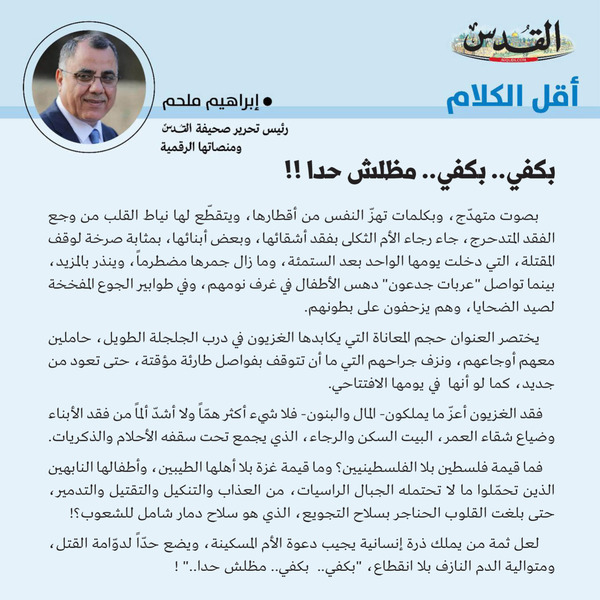
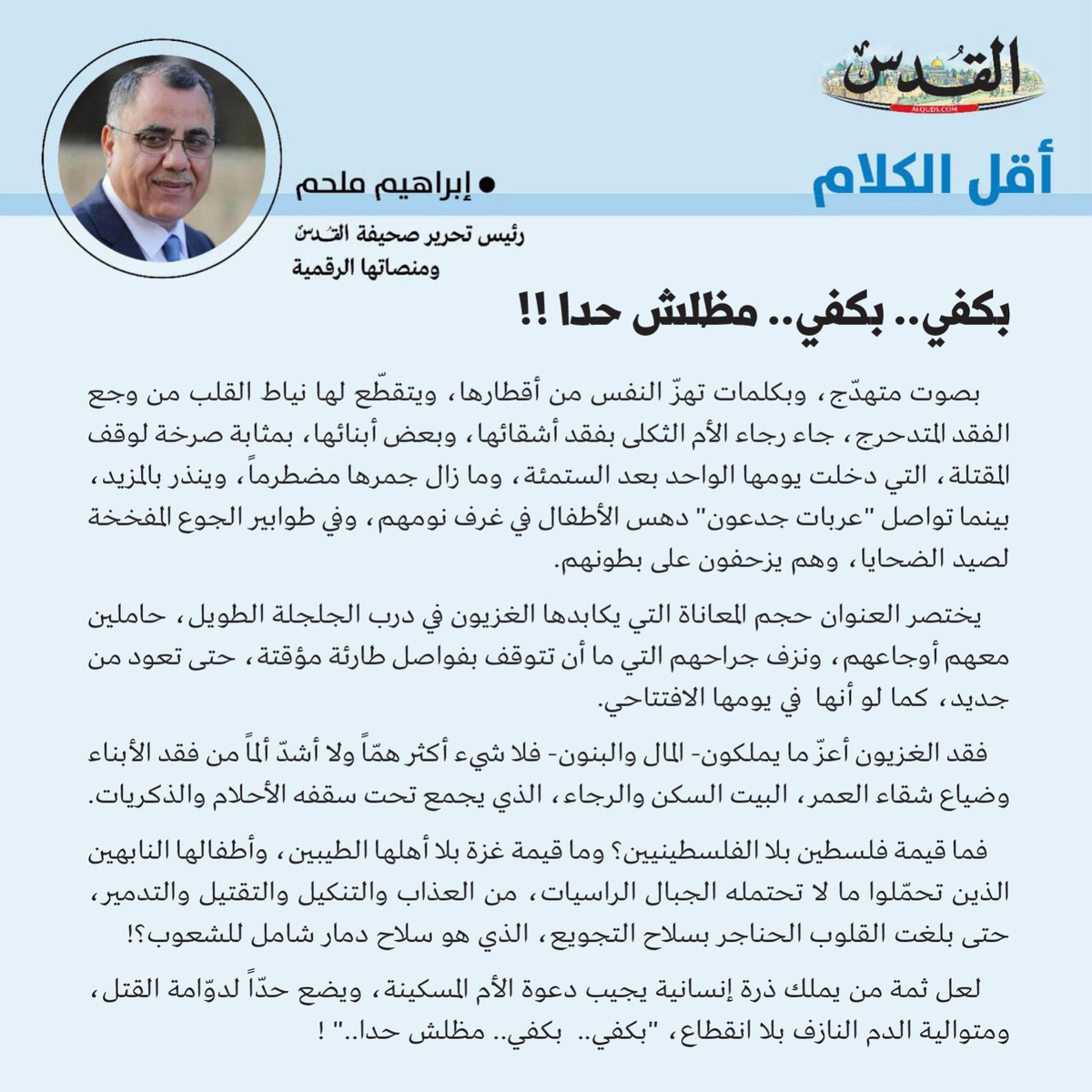
Enough.. Enough.. No one will be left behind!!

Ibrahim Melhem

Ibrahim Melhem

Opinion Writer

In a trembling voice, and with words that shake the soul to its core, and whose heart is torn apart by the pain of the rolling loss, the bereaved mother's plea for the loss of her siblings and some of her children came as a cry to stop the massacre, which has entered its six hundredth day, and its embers are still burning, and portend more, while the "Gideon's Chariots" continue to crush children in their bedrooms, and in the hunger lines rigged to catch victims, as they crawl on their stomachs.

The title sums up the suffering endured by the Gazans on the long path of Calvary, carrying with them their pain and the bleeding of their wounds, which, once stopped by temporary, emergency breaks, reappear again, as if on their opening day.


The Gazans lost their most precious possessions - their money and children. Nothing is more worrying and more painful than losing children and wasting a lifetime of hardship, a home, a place of residence and hope, under whose roof dreams and memories are gathered.

What is the value of Palestine without the Palestinians? What is the value of Gaza without its good people and its brilliant children who have endured more than even towering mountains can bear: torture, abuse, killing, and destruction, until hearts reached throats with the weapon of starvation, which is a weapon of total destruction for peoples?!

Perhaps there is someone who possesses an ounce of humanity who will answer the poor mother’s call and put an end to the cycle of killing and the endless flow of blood. “Enough… enough… no one remains…”

PALESTINE

Fri 30 May 2025 9:50 am - Jerusalem Time

Witkov is optimistic about a deal in Gaza: a real hope for an end to the war or a temporary truce?

Dr. Hussein Al-Deek: Witkov is seeking to reach an agreement, but he clashes with Netanyahu's approach regarding a temporary truce and the continuation of the war.

Awni al-Mashni: Although Netanyahu is able to "create justifications" to thwart any agreement, his margin for maneuver has become "extremely narrow."

Dr. Jamal Harfoush: The failure to identify a legal guarantor for the implementation of the provisions of the Witkoff proposal before a competent international court or body undermines its credibility.

Suleiman Basharat: Witkov's efforts aim to reach an interim agreement that goes beyond a temporary truce, but falls short of a complete end to the war.

Dr. Dalal Erekat: The continued military escalation, in parallel with talk of a ceasefire, reveals Israel's use of Gaza as a tool for regional and international pressure.

Dr. Abdul Majeed Sweilem: American seriousness and Hamas' flexibility make it likely that an agreement will be reached soon to avoid a regional explosion.


All eyes are on the US efforts led by Middle East Special Envoy Steve Witkoff and his optimism about reaching an agreement on the Gaza Strip, raising questions about whether there is any real hope of ending the war or whether it is merely a temporary truce.

In separate interviews with Al-Quds, writers, political analysts, experts, university professors, and specialists say that this proposal comes amid mounting international and regional pressure to avoid a wider regional explosion, especially with ongoing tensions between Israel and parties such as Yemen and Iran.

They point out that while Hamas has announced a general framework including a ceasefire and prisoner exchange, challenges remain due to the divergent approaches between the parties, raising questions about the seriousness of the agreement and its ability to achieve a permanent solution.

They believe the main dilemma lies in the Israeli approach, which seeks a temporary truce focused on releasing prisoners while military operations continue, while the Palestinian approach calls for a comprehensive and permanent cessation of hostilities, along with the reconstruction of Gaza and the launch of a political process.

These efforts are viewed by writers, analysts, specialists, and university professors as an attempt to mitigate international criticism of Israel and restore its image, while maintaining regional stability that serves American interests, especially in light of other regional issues such as Yemen and Iran.

However, analyses highlight the seriousness of US efforts to advance the agreement, supported by Palestinian flexibility demonstrated by Hamas in dealing with mediators, which increases the likelihood of reaching a compromise. However, the absence of binding international guarantees and clear accountability mechanisms raises concerns that the agreement is merely a temporary truce serving Israeli political and military objectives, without a solution that ends the war. The question remains: Will Witkoff's proposal be a step toward a just peace, or merely another stage in managing the crisis?

The Palestinian Approach: Stop the War and Reconstruct

Dr. Hussein Al-Deek, a writer and political analyst specializing in American affairs, says that intensive efforts led by US Middle East envoy Steve Witkoff are seeking to reach an agreement to stop the war in the Gaza Strip. However, these efforts are clashing with Israeli Prime Minister Benjamin Netanyahu's political approach.

Al-Deek points out that Netanyahu is seeking a temporary truce aimed at releasing Israeli prisoners only, while the war continues. Meanwhile, the Palestinian approach calls for a permanent and comprehensive cessation of hostilities, the reconstruction of the Gaza Strip, and the launching of a Palestinian political process.

Al-Deek points out that the main problem lies in the conflict between the two approaches, with the US administration exerting pressure on the Palestinian side, which he described as the "weaker party," while avoiding pressuring Netanyahu and his government.

Al-Deek explains that Washington is exploiting its regional actions, including in Syria, Iran, Yemen, and Lebanon, to ease pressure on Israel in the Palestinian-Israeli conflict. This weakens its position vis-à-vis Netanyahu and limits its ability to impose a comprehensive and lasting agreement to end the war.

Al-Deek believes that this trade-off between regional issues reflects an American strategy that prioritizes Israeli interests over just solutions.

Al-Deek points out Hamas's flexibility in dealing with international initiatives, responding to pressure from Qatari and Egyptian mediators. However, the fundamental dilemma remains the position of Netanyahu and his government.

Al-Deek points out that Israel seeks escalation and control, as it continues its military operations in the Gaza Strip and the West Bank, including massacres and unilateral measures such as land confiscation and annexation decisions, particularly in Area C, which aim to eliminate any future Palestinian political entity.

Continuing negotiations... and war, destruction, and genocide

According to Al-Deek, Israel is adopting a traditional strategy that combines continuing negotiations for many years while maintaining other military and political options, including war, destruction, and annihilation in Gaza.

Al-Deek explains that this strategy is not new, but has been repeated since the signing of the Oslo Accords with the Palestine Liberation Organization, as Israel continues to negotiate without abandoning its options of aggression.

Al-Deek believes that the current negotiations could extend for a year or more, while military operations in Gaza continue, revealing a systematic evasion.

Al-Deek asserts that Netanyahu is not facing a dilemma in stopping the war itself, but rather in achieving the goal of displacement, which enjoys the support of the majority of Israeli society, according to opinion polls, which support resuming the war after the release of Israeli prisoners.

Al-Deek points out that this position reflects a deeply rooted ideological vision within the Israeli right, supported by currents within the American right that embrace religious and historical narratives about the "Promised Land" and the "return of the Messiah."

Al-Deek asserts that Israel, as a civil institutional state, adopts a future strategic vision that combines all options—negotiation, war, and annexation—to achieve its supreme national interests, without ruling out any option.

Al-Deek explains that what is happening is not merely a maneuver, but rather a combination of multiple options aimed at strengthening Israeli hegemony, making reaching a fair agreement difficult in light of weak American support for the Palestinian cause.

The war in the Gaza Strip has reached its "final outcome."

For his part, writer and political analyst Awni Al-Mashni asserts that the war in the Gaza Strip has reached its "final outcome," noting that all political and security data indicate that its objectives have been exhausted.

Al-Mashni explains that Israeli security leaders acknowledged that "nothing else could be done" in Gaza, while Israel's allies, including the US administration, reached a similar conclusion: the war must be stopped immediately.

According to Mishni's analysis, the sole motivation for the continuation of the war lies in the adherence of Israeli far-right leaders, led by Prime Minister Benjamin Netanyahu and Finance Minister Bezalel Smotrich and National Security Minister Itamar Ben-Gvir, to the idea of displacing the Palestinians.

Al-Mashni points out that these leaders refuse to acknowledge the failure of the displacement plans, which they considered a "historic opportunity" that would not be repeated for decades.

Al-Mashni points out that ending the war without achieving displacement means, for them, confronting an inevitable reality: the establishment of a Palestinian state.

Netanyahu faces international and domestic pressure

Al-Mashni asserts that Netanyahu is facing increasing international and domestic pressure, along with the position of the Israeli security establishment and the United States, which makes it difficult for him to continue his evasiveness.

Despite Netanyahu's ability to "create justifications" to thwart any agreement, Al-Mashni believes that the margin for maneuver has become "extremely narrow," as neither the world nor the Israeli domestic situation can tolerate the continuation of the war.

Al-Mashni notes that the region is approaching an imminent agreement within "critical hours or days," warning that the "ideological blindness" of the racist Israeli right is the only justification for the continuation of the war.

Al-Mashni points out that any surprises Netanyahu might create will not be able to change the reality that requires a ceasefire as the most realistic option.

A temporary political truce in favor of Israel and America

For his part, Professor Jamal Harfoush, Professor of Scientific Research Methods and Political Studies at the University of Brazil's Academic Research Center, warns that any agreement that does not include accountability for perpetrators of crimes under international law and does not put a definitive end to the war in Gaza cannot be considered a "true end to the war of extermination." Rather, it is merely a "temporary political truce" that serves American and Israeli political interests.

Harfoush asserts that US Special Envoy Steve Witkoff's statements expressing optimism about the imminent conclusion of an agreement, along with Hamas's announcement of a "general framework" including a ceasefire, an Israeli withdrawal from Gaza, and a prisoner exchange, are part of Witkoff's amended proposal. However, the proposal suffers from the absence of a clear international legal framework governing the agreement.

Harfoush points out that the failure to identify a legal guarantor for the implementation of the provisions of the Witkoff proposal before a competent international court or body undermines its credibility.

Harfoush explains that similar conflicts are usually subject to binding international guarantees, something the current agreement lacks, leaving it vulnerable to violations.

Harfoush points out that the announced framework does not include any clause regarding holding Israel accountable for crimes documented in UN reports, such as the report of the Human Rights Council's Commission of Inquiry and the Amnesty International report.

Harfoush questions whether "stopping the killing" necessarily means "ending the genocide" without achieving justice, emphasizing that any agreement that ignores criminal accountability remains incomplete and fails to address the roots of the conflict.

In analyzing the American role, Harfoush explains that the administration of President Donald Trump is adopting a mix of overt diplomacy and tactical positions biased toward "Israel's security."

Unprecedented internal pressures in Israel

Harfoush believes that Witkoff's statements do not necessarily reflect a unified position of the US administration, but rather are being used as a tool to alleviate domestic and international pressure, especially with the rise of voices opposing support for the Israeli war.

Harfoush points out that the Trump administration, through this agreement, seeks to restore the United States' image in the eyes of global public opinion, which has been negatively affected by its open support for Israel in a war that has left more than 100,000 dead and wounded.

Harfoush discusses the Israeli political situation, noting that Benjamin Netanyahu's government is facing unprecedented domestic pressure from the extremist religious Zionist movement, making the agreement a tool for recalibrating Israeli internal discourse rather than a step toward genuine peace.

Harfoush explains that there is a rejection within the Israeli security cabinet, led by figures such as National Security Minister Itamar Ben-Gvir and Finance Minister Bezalel Smotrich, of any agreement that includes a comprehensive cessation of operations without the "complete eradication of Hamas," rendering the agreement unworkable.

Despite leaks about the terms of the agreement, Harfoush asserts that Israeli military operations have not ceased, with massacres continuing in Rafah and the Gaza Strip environs, indicating that the "intent to calm" does not reflect a change in systematic military behavior.

Hamas and the "steadfastness tactic"

Harfoush believes this reality confirms that the proposed agreement is a "conditional political truce project" that lacks legal transparency and elements of transitional justice.

Regarding Hamas, Harfoush explains that it is adopting a "steadfastness tactic," appearing positive toward mediators and declaring its readiness for a ceasefire, but it is aware that Israel is not negotiating in good faith.

Harfoush points out that the movement considers any agreement that is not internationally guaranteed to be interpreted later as a surrender, not a political victory.

In the short term, Harfoush expects a conditional, time-limited humanitarian truce agreement, with the opening of aid crossings. In the medium term, there is an attempt to float the Netanyahu government by announcing an agreement that will never be implemented. In the long term, indirect negotiations may continue, cementing the status quo, while ruling out a "final agreement" without UN and Security Council intervention with guarantees under Chapter VII.

Harfoush points out that the current scene is complex, with American interests, the Zionist security vision, resistance tactics, and global popular pressure intertwining.

Harfoush asserts that what is being proposed now is a "restricted negotiation process" rather than a just peace agreement, emphasizing the continuation of "genocide in a new political guise" in the absence of accountability and justice.

Improving Israel's deteriorating international image

For his part, writer and political analyst Suleiman Basharat believes the United States is seeking to reframe the war on the Gaza Strip in order to obscure the bloody and tragic humanitarian situation that has become a source of sharp criticism of Israel, thus affecting its international image and relations with European countries.

Basharat explains that this motivation is leading Washington, under the administration of President Donald Trump, to seek alternative channels to break the war equation while preserving American and Israeli interests in the region.

According to Basharat, the United States is seeking to improve Israel's deteriorating international image as a result of the military operations in Gaza, which have drawn widespread criticism due to the human losses and extensive destruction.

Basharat points out that the continuation of the war in its current form could jeopardize American interests, prompting the United States to implement plans to resolve regional issues such as the agreement with the Houthi Ansar Allah in Yemen and negotiations with Iran.

Basharat asserts that keeping the war in Gaza unresolved will negatively impact America's strategic vision in the region.

Basharat explains that US efforts, led by envoy Steve Witkoff, aim to reach an interim agreement that goes beyond a temporary truce but falls short of a complete end to the war.

War turns into other forms

Basharat points out that the war may not cease in its traditional form, but may morph into other forms, with its effects continuing to impact key issues such as the resistance's weapons, the humanitarian situation, the entry of aid, and the Israeli military presence in Gaza. Furthermore, the displacement plan remains present in the Israeli and American imagination, but Palestinian steadfastness is confronting it.

Basharat asserts that the Trump administration will not bypass Benjamin Netanyahu's government, but will instead work to strengthen Israel's ability to impose its power and restore its deterrent image.

Basharat explains that this support reflects an American desire to preserve Israel's regional standing, even if this requires continuing the war in various forms, such as concentrated bombing operations or the elimination of resistance leaders.

In contrast, Basharat points out that the Palestinian resistance, led by Hamas, is seeking to alleviate the humanitarian crisis in Gaza, where Israel and the United States have attempted to create a rift between the resistance and Palestinian society through policies of starvation and withholding aid.

Brakes to prevent mass displacement

Basharat says that the resistance is working to put in place restraints to prevent a mass exodus, realizing that the success of this plan could lead to the elimination of the resistance.

Basharat believes the success rate of the interim agreement is high at the present time, but he warns that this agreement resembles the interim agreements adopted by Israel and the United States with the Palestine Liberation Organization after the Madrid Conference.

Basharat explains that prolonged negotiations allow Israel to establish a new reality in Gaza while pressuring the resistance to make concessions, particularly regarding its weapons.

Basharat believes that the United States and Israel are seeking to change the nature of the war without ending it, focusing on achieving long-term goals such as displacement and weakening the resistance.

Basharat believes that the proposed interim agreement may temporarily mitigate the bloodshed, but it will not completely halt the war, which will only intensify the conflict in new forms that serve Israeli and American interests.

Three basic conditions for any agreement to be considered "real"

Dr. Dalal Erekat, professor of diplomacy and conflict resolution at the Arab American University, cautions against the expressed optimism of US envoy Steve Witkoff regarding a near-term ceasefire agreement in Gaza, and Hamas's announcement that it has reached a preliminary agreement with him and is awaiting Israel's response.

Erekat says that past experience shows that Israel often uses truce negotiations as a cover for redeploying its forces, rather than as a gateway to ending the aggression.

Erekat outlines three basic conditions for any agreement to be considered "real": first, an immediate and comprehensive cessation of aggression against both Gaza and the West Bank; second, the establishment of a clear mechanism to hold perpetrators of crimes accountable and prevent their recurrence; and third, a commitment to a political roadmap that establishes a fundamental solution to the conflict rather than merely managing the crisis.

Erekat explains that declaring "optimism" or an "approaching agreement" is not enough in light of the ongoing aggression, systematic destruction, and targeting of civilians without accountability. She emphasizes that any agreement lacking these elements will be nothing more than a temporary truce that serves the continuation of Israel's hegemonic project.

Erekat points out that Israel is declaring through its actions, not its words, that it is above international law and that it is capable of imposing facts on the ground without deterrence.

No safe haven, no international protection

Erekat explains that the continued military escalation amid talk of a ceasefire reveals Israel's use of Gaza as a tool for regional and international pressure.

Erekat believes that Israel is sending two messages: the first to the Palestinians, that there is no safe haven or international protection, and that the options are limited to displacement or acceptance of the imposed reality; and the second to the world, that "Israel's security" justifies crimes against humanity.

Erekat asserts that the Israeli escalation is not merely military, but rather part of a narrative war aimed at delegitimizing Palestinian identity and existence.

Erekat warns that international silence constitutes complicity paving the way for a replication of the Nakba through contemporary mechanisms. She calls for a decisive international stance that shifts from a crisis management logic to a just solution that ends the occupation and restores full Palestinian rights. She points out that the proposal of an international peace coalition could be an opportunity if it is serious and practical.

US fears of a regional explosion

For his part, writer and political analyst Dr. Abdul Majeed Sweilem believes that the United States is making strenuous efforts to impose a ceasefire agreement in the Gaza Strip, driven by fears of a regional explosion that could threaten its interests.

Suwailem explains that Washington realizes that failure to reach an agreement could lead to an escalation of tensions in the region, especially with the increasing exchange of shelling between Yemen and Israel, and the possibility that Israeli Prime Minister Benjamin Netanyahu will launch a limited strike against an Iranian reactor, which could prompt an Iranian response that would conflict with American interests at this stage.

Suwailem points out that the United States seeks to avoid the risk of regional escalation, particularly with Yemen and Iran, and believes a ceasefire in Gaza is necessary to protect its strategic interests.

Suwailem explains that the Americans are pressuring Netanyahu to accept an agreement, but at the same time, they are trying to meet his conditions and ambitions, which are "unfulfillable" demands that are difficult to agree to.

However, Suwailem expects a compromise between the demands of Hamas and Israel, noting that the optimism expressed by US envoy Steve Witkoff reflects the seriousness of US efforts.

The US administration is serious about pushing the agreement forward.

Suwailem believes that the American efforts are not evasive, emphasizing that time does not permit manipulation, as the Americans view the situation with Yemen and Iran as a major threat that requires an urgent solution.

Suwailem explains that the US administration is serious about pushing the agreement forward, while Netanyahu may resort to evasion, but he will not be able to evade it for long due to mounting US pressure.

Suwailem believes that Netanyahu will face a "big problem" with the Americans if he continues to refuse, because the agreement serves American interests more than Palestinian ones.

Suwailem points out that Hamas supports a balanced and acceptable solution, and that the movement is prepared to reach an agreement that ends the aggression.

Suwailem believes that American seriousness, coupled with Hamas's flexibility, makes it likely that an agreement will be reached soon, one that will avoid a regional explosion and achieve temporary stability, despite the challenges posed by Netanyahu's position.


PALESTINE

Fri 30 May 2025 9:24 am - Jerusalem Time

A new US plan for Gaza proposes a ceasefire agreement guaranteed by Trump.

A US plan for Gaza, seen by Reuters on Friday, proposes a 60-day ceasefire and the release of 28 living and dead Israeli hostages within the first week in exchange for 125 Palestinian prisoners serving life sentences and the remains of 180 dead Palestinians.

The plan, which US President Donald Trump and mediators Egypt and Qatar will ensure its implementation, includes sending aid to Gaza immediately after Hamas signs a ceasefire agreement.

The plan calls for Hamas to release the remaining 30 hostages once a permanent ceasefire is in place. The White House announced Thursday that Israel has agreed to the US ceasefire proposal.

Hamas told Reuters it was reviewing the plan and would respond to it on Friday or Saturday. Deep divisions between Hamas and Israel have thwarted previous attempts to restore the ceasefire that collapsed in March.

Israel insists on Hamas's complete disarmament, the dismantling of its military force, and the end of its administration in Gaza, in addition to the release of all 58 remaining hostages in the Strip, before it will agree to end the war.

Hamas refuses to give up its weapons and says Israel must withdraw its forces from Gaza and commit to ending the war.

Israel launched its military operation in Gaza in response to a Hamas-led attack on southern Israel on October 7, 2023, which, according to statistics, resulted in the deaths of approximately 1,200 people and the capture of 251 hostages in the Strip.

Gaza health officials say that since its inception, the Israeli military operations have killed more than 54,000 Palestinians and devastated the Strip.

PALESTINE

Fri 30 May 2025 9:22 am - Jerusalem Time

Italy announces its readiness to receive the surviving child from the family of Dr. Alaa Al-Najjar.

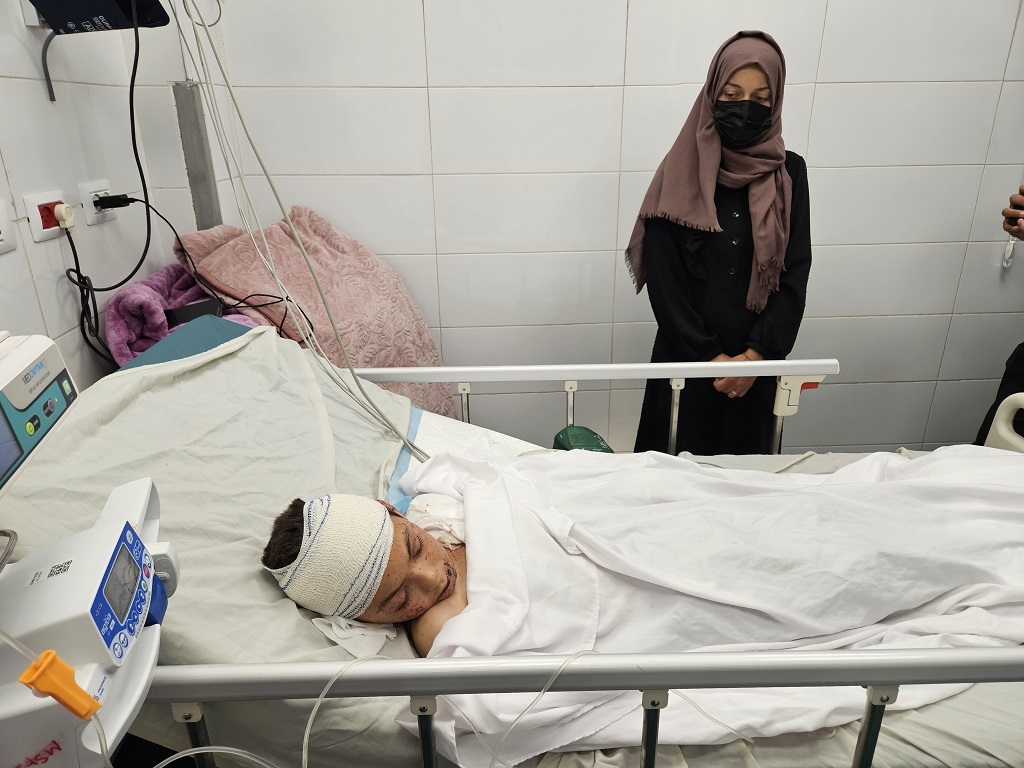
The Italian government has announced its willingness to receive the only surviving child from the family of Dr. Alaa al-Najjar, who lost nine of her children in an Israeli airstrike on her home in the Qizan al-Najjar area south of Khan Yunis last week.

"Foreign Minister Antonio Tajani is closely monitoring the situation of Dr. Alaa al-Najjar, whose family was targeted in an Israeli attack in recent days," the Italian Foreign Ministry said in a statement.

She added, "The husband was seriously injured, and the doctor lost nine of her ten children. The only surviving child, Adam, is receiving treatment in a hospital in Khan Yunis," in the southern Gaza Strip.

He continued, "The Italian government is prepared to transfer the injured Adam to Italy. Based on Minister Tajani's instructions, the ministry is taking steps to transfer the child, while respecting the wishes of the doctor and her family."

In addition to Italy, Malta also announced its willingness to provide shelter for the Palestinian doctor and her family.

Pediatrician Alaa Al-Najjar was shocked to learn that the bodies of nine of her children arrived at Nasser Hospital in Khan Yunis while she was working there. They had been burned to death after the Israeli occupation forces shelled her home. Adam, her only surviving child, and her husband, Dr. Hamdi Al-Najjar, were also injured.

The occupation's targeting of Dr. al-Najjar's family home came three days after Moshe Feiglin, leader of the far-right Israeli Zehut party, called on Israel's Channel 14 to eliminate children and infants in Gaza.

Feiglin, a former Knesset member for the Likud party led by Israeli Prime Minister Benjamin Netanyahu, told the right-wing channel: "Every child, every infant in Gaza, is an enemy," he said.

PALESTINE

Fri 30 May 2025 9:20 am - Jerusalem Time

The occupation forces arrest a citizen, raid homes, and bulldoze lands in Nablus.

Israeli occupation forces arrested a citizen from Nablus at dawn on Friday and searched a number of homes in the town of Al-Lubban Al-Sharqiya, to the south.

Security and local sources reported that Israeli jeeps stormed several neighborhoods of the city, raided homes in the village of Zawata to the west and Jabal al-Shamali, searched them, ransacked their contents, and arrested Badr Shams Halawa, a resident of Jabal al-Shamali.

The sources added that Israeli jeeps stormed the eastern town of Al-Lubban, raided a number of homes, attempted to assault their residents, and took photos of them.

In the village of Duma, since the early hours of the morning, occupation bulldozers have been paving a road alongside the town's main street, bulldozing agricultural land, and uprooting trees.

Yesterday, Thursday, the occupation bulldozers carried out razing operations on the village's infrastructure and agricultural lands.

The village of Duma is constantly subjected to raids and bulldozing by the occupation, as well as repeated attacks by settlers on citizens, their lands, and their property.

PALESTINE

Fri 30 May 2025 9:15 am - Jerusalem Time

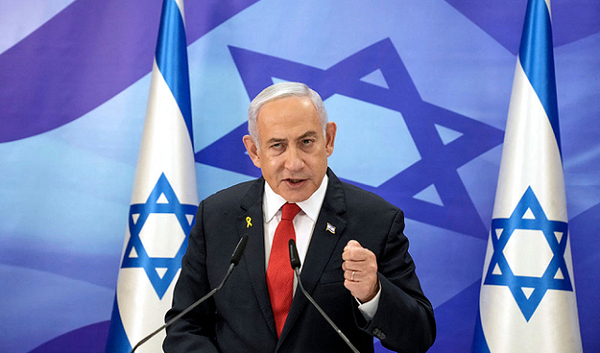
Netanyahu undergoes surgery, Levin assumes acting prime minister role

Israeli Prime Minister Benjamin Netanyahu is undergoing a "routine medical checkup" at Hadassah-Ein Kerem Hospital in Jerusalem on Friday, after undergoing prostatectomy surgery at the same hospital five months ago.

At the time, the surgeon, Professor Ofer Gofret, announced after the surgery that "there is no fear of a tumor or cancer."

Due to Netanyahu's medical procedure, today, Israeli ministers approved, through a telephone referendum, the appointment of Justice Minister Yariv Levin as acting prime minister, starting at six o'clock this morning until the completion of the medical procedures.

According to the government's decision, Levin is authorized to call and chair government meetings whenever necessary. It was also decided to appoint Defense Minister Yisrael Katz as acting head of the Ministerial Committee for Security Affairs, i.e., the political-security cabinet, due to Netanyahu's surgery.

Netanyahu's surgery comes as his trial moves into the cross-examination phase by the prosecution next week, after the first phase focused on his testimony and his responses to his lawyers' questions.

Following the surgery, Netanyahu had asked the court to suspend his trial. However, a few days later, he participated in a Knesset vote, after which the court decided to postpone his trial for two weeks on the condition that he remain at home.

Netanyahu's surgery.

PALESTINE

Fri 30 May 2025 9:13 am - Jerusalem Time

Dead and wounded in Israeli raids on the Gaza Strip

Fifteen civilians were killed and others injured on Friday as a result of continued Israeli airstrikes on the Gaza Strip.

Local sources reported that the occupation forces targeted a group of citizens in the Saftawi neighborhood in the northern Gaza Strip, resulting in the deaths of three citizens.

The sources added that a number of citizens were injured by Israeli gunfire as they attempted to reach an aid center in central Gaza.

The occupation forces' artillery also shelled and fired heavily at the town of Al-Qarara, north of Khan Yunis.

Local sources reported that at least seven civilians were killed and others injured when the occupation forces bombed a home belonging to the Nasr family in Jabalia al-Nazla, north of the Gaza Strip.

It added that three other citizens were killed when the occupation forces bombed two tents housing displaced persons west of Khan Yunis, and they were transferred to Nasser Medical Complex.

It pointed out that two citizens were martyred and others were injured when the occupation bombed a civilian vehicle in the town of Abasan al-Kabira, east of Khan Yunis.

It noted that a citizen was killed and others were injured by Israeli occupation forces' bullets in the Al-Shakoush area, northwest of Rafah, in the southern Gaza Strip.

The occupation forces also blew up residential homes in the Al-Tuffah neighborhood, east of Gaza City, and in the town of Al-Qarara, north of Khan Yunis.

Last night, the occupation issued new "evacuation orders" to citizens in Jabalia al-Balad and al-Atatra in North Gaza Governorate, and in the Shuja'iyya, al-Daraj, and al-Zeitoun neighborhoods in Gaza City.

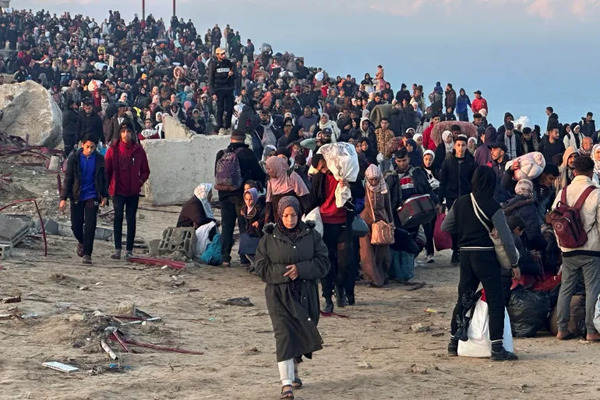
The Gaza Strip has been suffering from a catastrophic humanitarian and relief crisis and a severe famine since the occupation closed the crossings on March 2, preventing the entry of food, medicine, aid, and fuel. Approximately 1.5 million citizens, out of a population of approximately 2.4 million, have been rendered homeless after their homes were destroyed in the war of extermination.

Since October 7, 2023, the Israeli occupation has been committing genocide in the Gaza Strip, leaving more than 177,000 dead and wounded, most of them children and women, and more than 11,000 missing.

PALESTINE

Thu 29 May 2025 10:41 pm - Jerusalem Time

Netanyahu concludes mini-security meeting to discuss Gaza prisoner swap deal

Israeli Prime Minister Benjamin Netanyahu concluded a three-hour security meeting Thursday evening, devoted to discussing a potential prisoner swap deal with Palestinian factions in Gaza, according to Hebrew media.


Channel 12 reported that the meeting was attended by several members of the Israeli government, including Defense Minister Yisrael Katz, Foreign Minister Gideon Sa'ar, Finance Minister Bezalel Smotrich, and National Security Minister Itamar Ben-Gvir.


Earlier Thursday, the same channel claimed that Netanyahu informed the families of the Israeli prisoners that Tel Aviv had agreed to a new proposal by US Middle East envoy Steve Witkoff to release their relatives.


The channel reported that Netanyahu informed the families during a meeting he held with them today that Israel had agreed to the proposal presented by Witkoff as part of efforts to reach a prisoner exchange deal.

ARAB AND WORLD

Thu 29 May 2025 9:25 pm - Jerusalem Time

Washington: We presented Hamas with a ceasefire proposal that has Israeli support.

White House spokeswoman Caroline Levitt said that Washington has presented Hamas with a proposal for a ceasefire in Gaza that has Israeli support.

This came during a press conference held on Thursday, in which she evaluated potential truce negotiations in the Gaza Strip, which is being subjected to Israeli genocide with US support.

In this regard, she said: "I can confirm that Special Envoy Steve Witkoff and President Donald Trump have presented Hamas with a ceasefire proposal, which Israel supports and agrees to."

She added, "This proposal was approved by Israel before being presented to Hamas, and I confirm that discussions on this issue are still ongoing."

The White House spokeswoman expressed her hope for a ceasefire in Gaza and the return of all Israeli prisoners to their homes.

Asked whether Hamas had accepted the proposal, she said, "Frankly, I don't know about that. If that happens and the ceasefire goes into effect, you'll hear about it either from me, the president, or Witkov."

Earlier, the private Israeli Channel 12 reported that Prime Minister Benjamin Netanyahu informed the families of Israeli prisoners in the Gaza Strip that Tel Aviv had agreed to Witkoff's new proposal for the release of their relatives.

The channel reported that Netanyahu informed the families during a meeting he held with them today that Israel had agreed to the proposal presented by US Middle East envoy Steve Witkoff as part of efforts to reach a prisoner exchange deal.

Tel Aviv estimates that there are 58 Israeli prisoners in Gaza, 20 of whom are still alive. Meanwhile, more than 10,100 Palestinians are languishing in its prisons, suffering torture, starvation, and medical neglect, many of whom have died, according to Palestinian and Israeli human rights and media reports.

Hamas has repeatedly affirmed its willingness to release Israeli prisoners "in one batch" in exchange for an end to the war of extermination, the withdrawal of the Israeli army from Gaza, and the release of Palestinian prisoners.

But Netanyahu, who is wanted by international justice, insists on partial deals and evades the possibility of new conditions, including the disarmament of Palestinian factions. He is currently insisting on reoccupying Gaza.

The Israeli opposition and prisoners' families assert that Netanyahu is continuing the war in deference to the more extreme right-wing faction within his government, to advance his personal political interests, particularly his continued hold on power.

PALESTINE

Thu 29 May 2025 8:48 pm - Jerusalem Time

Al Jazeera Net obtains detailed information about Witkoff's new proposal on Gaza.

The Israeli government has approved US envoy Steve Witkoff's proposal for a ceasefire and prisoner exchange in Gaza, while Hamas is currently studying the proposal. Israeli media reported that the new proposal is more biased toward Tel Aviv than previous proposals.

Al Jazeera Net obtained detailed information about the new American proposal. Here are the most important points:

Duration: 60-day ceasefire. President Trump guarantees Israel's commitment to the ceasefire for the agreed-upon period.

Hostage Release: 10 living Israeli hostages and 18 deceased hostages, from the list of "58 hostages" scheduled to be released on the first and seventh days. Half of the living and deceased hostages (5 living and 9 deceased) will be released on the first day of the agreement. The remaining half of the hostages (5 living and 9 deceased) will be released on the seventh day.

Humanitarian Aid: Aid will be delivered to Gaza immediately upon Hamas's acceptance of a ceasefire agreement. Any agreement reached regarding aid to the civilian population will be respected for the duration of the agreement. Aid will be distributed through agreed channels, including the United Nations and the Red Crescent.

Israeli Military Activities: All Israeli offensive military activities in Gaza will cease upon the entry into force of this Agreement.

During the ceasefire period, airspace (military and reconnaissance) will be suspended in the Gaza Strip for 10 hours per day, or 12 hours per day during the days of prisoner and missing persons exchange.

Redeployment of the Israeli army: On the first day, after the release of the Israeli prisoners (5 living and 9 dead), redeployment will take place in the northern part of the Gaza Strip and in the Netzarim corridor, in accordance with Article 3 regarding humanitarian aid, and on the basis of agreed-upon maps.

On the seventh day, following the release of the Israeli prisoners (5 living and 9 dead), redeployment will take place in the southern part of the Gaza Strip in accordance with Article III regarding humanitarian aid, based on agreed-upon maps. Technical teams will work to determine the final redeployment boundaries during proximity negotiations.

Negotiations: On the first day, negotiations will begin under the auspices of the guarantor mediators on the arrangements necessary for a permanent ceasefire, including:

Keys and terms for exchanging all remaining Israeli prisoners for an agreed-upon number of Palestinian prisoners in Israeli jails.

Issues related to the redeployment and withdrawal of Israeli forces, and long-term security arrangements within the Gaza Strip.

The "day after" arrangements in the Gaza Strip that either side will raise.

Declaration of a permanent ceasefire.

Presidential Support: US President Donald Trump attaches serious importance to the parties' adherence to the ceasefire agreement and insists that negotiations during the temporary ceasefire, if successfully concluded by agreement between the parties, will lead to a permanent solution to the conflict.

Release of Palestinian prisoners: In exchange for the release of the ten living Israeli prisoners, and in accordance with the terms of the first phase of the January 19, 2025, agreement on hostages and prisoners, Israel will release 180 prisoners serving life sentences and 1,111 prisoners from Gaza arrested after October 7, 2023. In exchange for the release of the remains of 18 Israeli prisoners, Israel will release 180 deceased Gazans.

They will be released simultaneously according to an agreed-upon mechanism, without any public parades or ceremonies. Half of these releases will take place on the first day, and the other half on the seventh day.

Status of Hostages and Prisoners: On the tenth day, Hamas will provide full information (proof of life and medical report/proof of death) for each remaining prisoner. In return, Israel will provide full information on Palestinian prisoners arrested from the Gaza Strip since October 7, and the number of deceased Gazans held in Israeli custody. Hamas will commit to ensuring the health, welfare, and security of the hostages during the ceasefire period.

Release of the remaining hostages by agreement: Negotiations on arrangements for a permanent ceasefire must be completed within 60 days. Following the agreement, the remaining prisoners (living and dead) from the list of 58 presented by Israel will be released. If negotiations on arrangements for a permanent ceasefire are not concluded within the aforementioned time period, the temporary ceasefire may be extended on terms and for a period agreed upon by the parties, as long as they negotiate in good faith.

Guarantors: The mediators (the United States, Egypt, Qatar) will guarantee the continuation of the ceasefire for 60 days, and for any agreed-upon extension, will ensure that serious discussions are held on the agreements necessary for a permanent ceasefire, and will make every effort to ensure the completion of the above-mentioned negotiations.

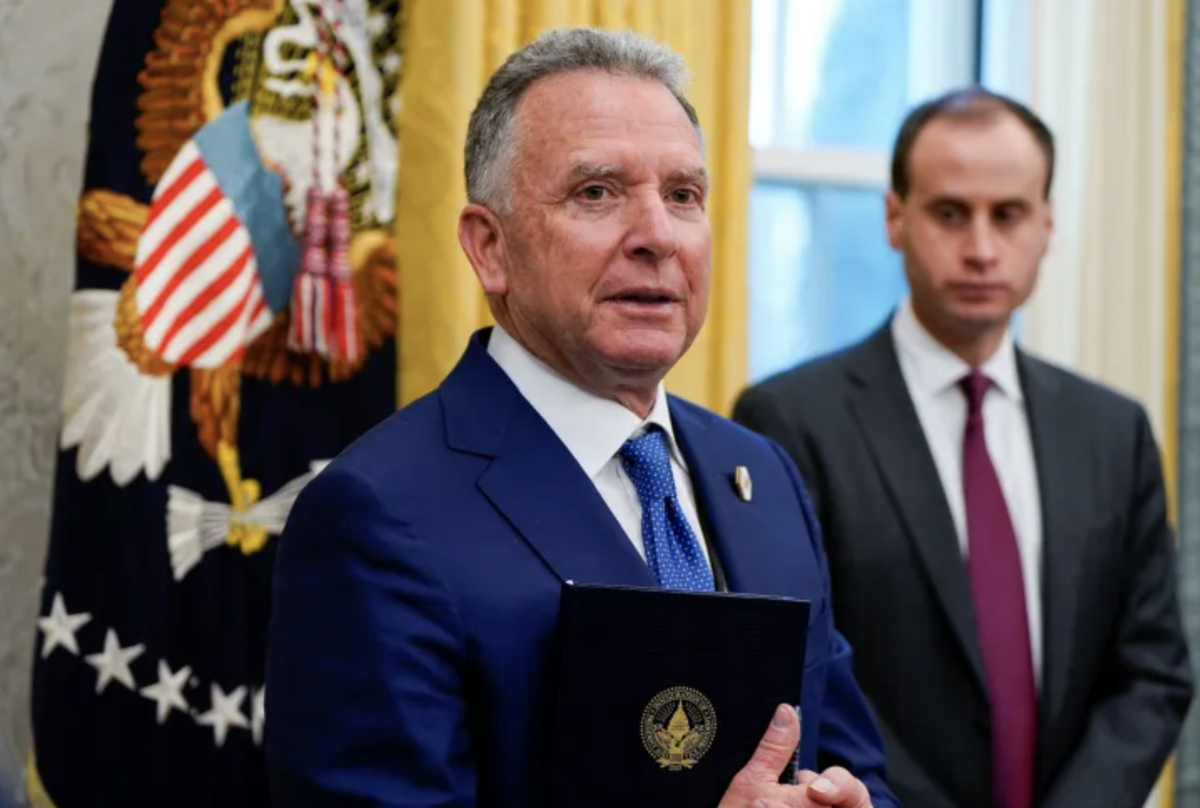
Heading the Envoy: Special Envoy Steve Witkoff will travel to the region to finalize the agreement. Witkoff will chair the negotiations.

President Trump: President Trump will personally announce the ceasefire agreement. The United States and President Trump are committed to working to ensure that negotiations continue in good faith until a final agreement is reached.

ARAB AND WORLD

Thu 29 May 2025 7:56 pm - Jerusalem Time

The Czech Republic is limiting the possibility of moving its embassy in Israel to Jerusalem soon.

Czech Prime Minister Petr Fiala said Thursday that his country will move its embassy in Israel to Jerusalem "at the appropriate moment," reducing the likelihood of the move happening sooner than previously thought, after the government had indicated it would do so following the 2023 Hamas attack on Israel.

The Czech Republic is a strong ally of Israel on the international stage, and has at times broken ranks with its European Union allies in UN voting procedures related to Middle East affairs.

After the October 2023 attack, Fiala said that moving the embassy to Jerusalem from Tel Aviv could happen within months, but today he indicated that this step may be somewhat far-fetched, according to Reuters.

"Let's make it clear... The Czech Republic will move the embassy because it's the right thing to do, and it's not about the action itself, but about the timing," Fiala explained at a hearing in the Senate of the Czech Parliament.

He said that this step should not come at a time when Israel is at war with Hamas in Gaza, and ideally when the Abraham Accords have expanded to include more partners.

He added, "We have to be a little patient, but at the same time we must be ready to take this step if the right moment comes."

The Czech Republic opened a diplomatic office in Jerusalem in 2021, a move that sparked protests from the Palestinian Authority and the Arab League.

If the Czech Republic does so, it will be the second NATO country to move its embassy to Jerusalem, after the United States, which took the step in 2018 during President Donald Trump's first term, and the first European Union country to move its embassy.

The Israeli government considers Jerusalem the eternal and undivided capital of the country, despite the lack of international recognition. The Palestinians want East Jerusalem as the capital of a future Palestinian state. Israel occupied Jerusalem in the 1967 war and later annexed it in a move not recognized internationally.
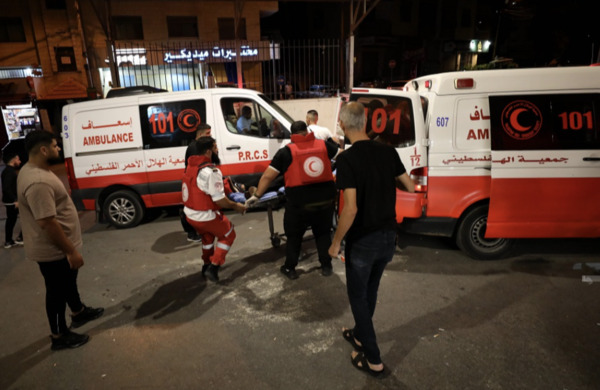
PALESTINE

Thu 29 May 2025 7:21 pm - Jerusalem Time

A young man was injured by Israeli occupation forces' bullets in Al-Mughayyir, northeast of Ramallah.

A young man was shot by Israeli occupation forces on Thursday evening during a raid on the village of Al-Mughayyir, northeast of Ramallah.

According to local sources, a young man was shot in the thigh with live ammunition after being targeted by Israeli soldiers during clashes that followed the raid on the village of Al-Mughayyir.

Sources reported that occupation forces fired sound bombs into the homes of a number of citizens and raided an event hall.

PALESTINE

Thu 29 May 2025 6:06 pm - Jerusalem Time

Red Cross: The humanitarian situation in Gaza has exceeded the scale of a catastrophe.

The International Committee of the Red Cross (ICRC) issued an urgent appeal on Thursday to respect and protect civilians in Gaza, including the wounded and sick, stressing that the destruction will not bring the region closer to peace or stability but will only increase the scale of human suffering.

A statement by the committee quoted the head of its mission in Israel and the occupied territories, Julian Leirisson, as saying: "The humanitarian situation in Gaza has exceeded the scale of a catastrophe, and the people of the Strip are struggling daily for survival." He stressed that "the humanitarian needs in Gaza are enormous, and 100 trucks of humanitarian aid per day are not enough."

He added, "Constant care must be taken to spare civilians the effects of military operations. This is not just an obligation under international humanitarian law, but a moral imperative."

He continued, "The scale of destruction we are witnessing now in Gaza will not bring us closer to peace or stability, but will rather increase the suffering."

Leirson stressed that partial solutions cannot address a crisis of the magnitude of the one unfolding in the Gaza Strip, and called for allowing the rapid and unimpeded flow of humanitarian aid, including food, medicine, and clean water, to all those in need, wherever they may be.

The statement added: "The ICRC is capable of providing effective and meaningful support and helping alleviate the suffering. The humanitarian support mechanism in place for months has proven its effectiveness when allowed to operate. It is essential that it be allowed to resume its work at full capacity."

PALESTINE

Thu 29 May 2025 6:01 pm - Jerusalem Time

Channel 12: Israel agrees to Witkoff's new proposal

Israeli Channel 12 reported that Prime Minister Benjamin Netanyahu told the families of the prisoners held by the resistance, "We will accept the Witkov plan that was conveyed to us tonight," stressing that Israel will not withdraw from Gaza "without receiving all the hostages."

For its part, the Islamic Resistance Movement (Hamas) said that it had received Witkoff's new proposal from the mediators, and that it was studying it "responsibly in a way that achieves the interests of our people and a permanent ceasefire."

PALESTINE

Thu 29 May 2025 5:08 pm - Jerusalem Time

The Israeli occupation army demands that the administration of Al-Awda Hospital in northern Gaza evacuate it.

Al-Awda Hospital in the northern Gaza Strip announced Thursday that the Israeli occupation army had demanded that its management evacuate the hospital immediately before it began detonating explosive robots in its vicinity.

The hospital administration said in a statement, "After the Israeli occupation issued a decision to evacuate the hospital, it detonated explosive robots in its vicinity."

The statement added that this came "in conjunction with intense gunfire targeting hospital buildings and facilities, in an attempt to intimidate and destabilize medical staff and wounded inside the hospital."

He pointed out that "97 people are still inside the hospital, including 13 patients and injured people, and 84 medical personnel."

For more than a week, the Israeli occupation forces have been besieging Al-Awda and Al-Indonesian hospitals in the northern Gaza Strip, targeting anyone moving inside them, in an escalation against medical personnel and hospitals as part of a war of extermination.
Last Thursday, the army targeted a medicine warehouse inside Al-Awda Hospital, sparking a fire at the site. A booby-trapped robot detonated in the vicinity, causing extensive damage, according to a brief statement posted by the hospital administration on Telegram.

Al-Awda Hospital is a private medical facility operating in the Gaza Strip. It has two branches, one in the central Gaza Strip and the other in Jabalia refugee camp. Despite its limited resources due to the Israeli blockade and genocide, it continues to provide limited care to patients and the injured.

Since launching its war of extermination on the Gaza Strip on October 7, 2023, the Israeli military has targeted Gaza's hospitals and healthcare system, putting most of them out of service, endangering the lives of patients and the wounded, according to Palestinian and UN data.

The Gaza Strip has been suffering from a catastrophic humanitarian and relief crisis since Israel closed the crossings on March 2, preventing the entry of food, medicine, aid, and fuel, while its military escalates its genocidal campaign against the Palestinian population of the territory.

With full American support, Israel has been committing genocidal crimes in Gaza since October 7, 2023, leaving more than 177,000 Palestinians dead or wounded, most of them children and women, and more than 11,000 missing, in addition to hundreds of thousands displaced.

Israel has been blockading the Gaza Strip for 18 years, leaving approximately 1.5 million Palestinians out of a population of approximately 2.4 million homeless after their homes were destroyed in the war of extermination. The Strip is suffering from a severe famine due to Israel's closure of crossings to humanitarian aid.

PALESTINE

Thu 29 May 2025 4:47 pm - Jerusalem Time

Dead and wounded in violent Israeli bombing of Gaza City

Today, Wednesday, Israeli occupation aircraft targeted a group of citizens in Gaza, near the missile intersection on Al-Jalaa Street, north of Gaza City.

According to local sources, the bombing resulted in civilian deaths and injuries. The exact nature and number of casualties are yet to be determined, as intensive airstrikes continue to circulate in the region.
According to circulated video clips, the aggression resulted in the deaths of a number of martyrs.
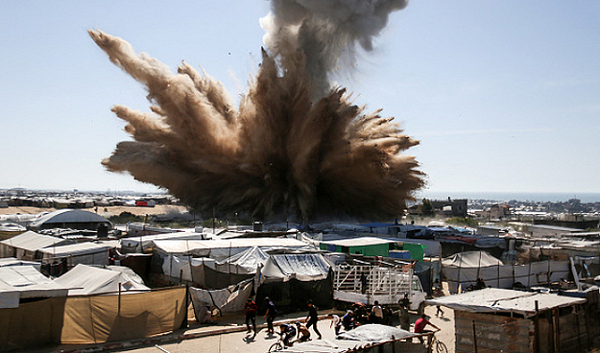
This targeting comes within the framework of the occupation's continued aggression against the Gaza Strip and its targeting of civilians.

PALESTINE

Thu 29 May 2025 2:57 pm - Jerusalem Time

Witkoff's proposal: US guarantees for serious negotiations without a commitment to ending the war

Israeli reports indicated on Thursday that the new US proposal presented by US Presidential Envoy Steve Witkoff regarding a ceasefire in Gaza includes a presidential pledge that negotiations for a permanent cessation of hostilities will be "serious," but it does not include any guarantee of a complete end to the war.

According to reports, the proposal includes a gradual Israeli withdrawal from areas occupied after the resumption of the war, as part of arrangements for the first days of the agreement.

The report also pointed to a "potential loophole" that would allow Israel to continue managing aid distribution through US companies, as the proposal only provides for UN oversight without specifying the locations and mechanisms for distribution.