PALESTINE

Thu 27 Nov 2025 8:34 am - Jerusalem Time

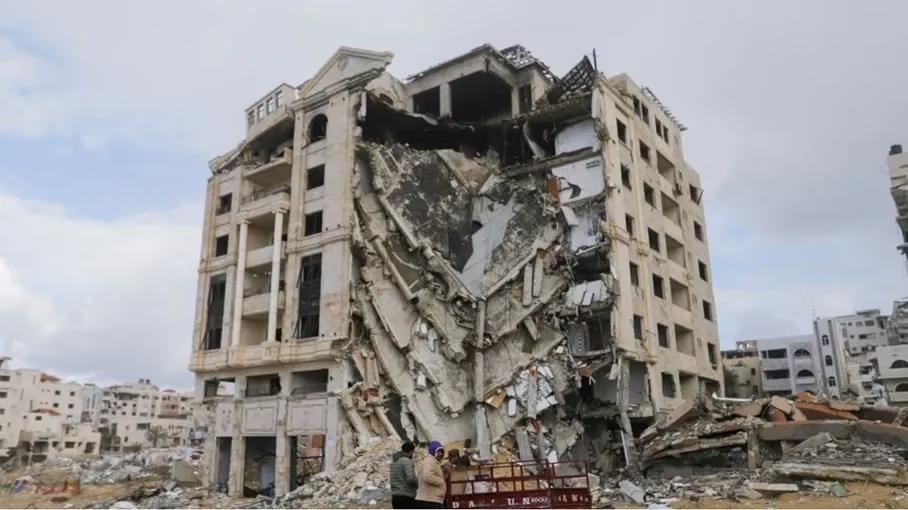
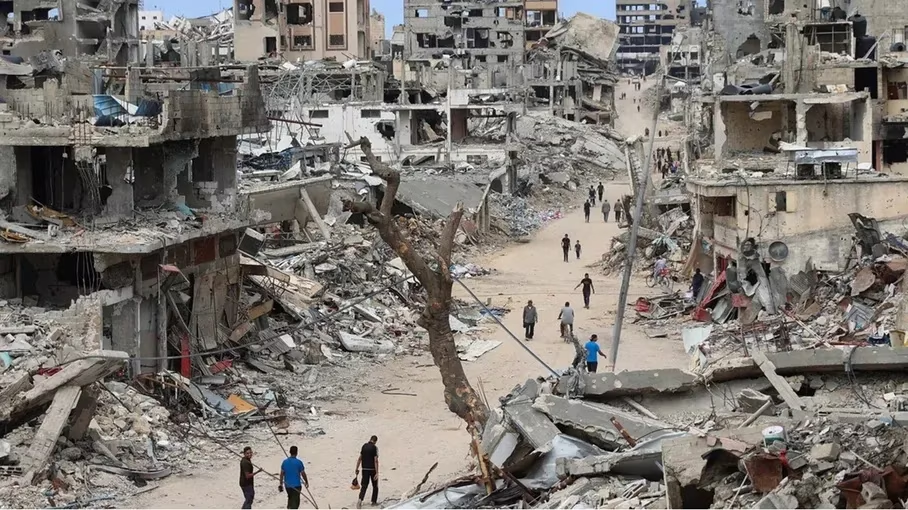
Israeli airstrikes and demolition operations in Gaza, Rafah, and Khan Youn

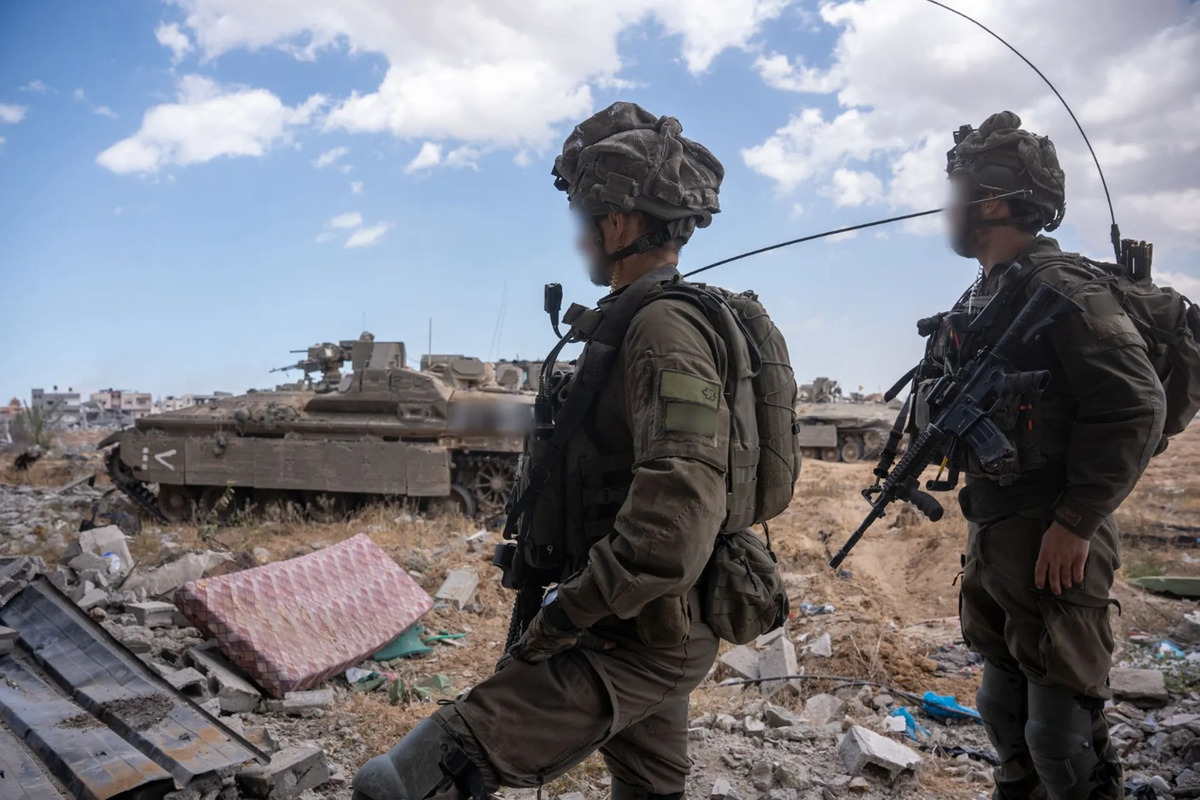
The Israeli occupation army launched airstrikes early Thursday in the areas it occupies east of Gaza City and in Khan Younis and Rafah in the southern Gaza Strip, coinciding with demolition operations of residential buildings.

Israeli warplanes carried out several strikes on the Al-Tuffah neighborhood east of Gaza City, while the army executed demolition operations on buildings in that area, the echoes of which were heard across wide parts of the city.

In Khan Younis, the occupation carried out airstrikes and demolition operations on residential buildings in the town of Bani Suheila east of the city, and in other areas east of Rafah, according to eyewitnesses.

PALESTINE

Thu 27 Nov 2025 5:59 am - Jerusalem Time

Hamas sends a message to the mediators regarding the besieged fighters in Rafah.

The Islamic Resistance Movement "Hamas" condemned the Israeli occupation's pursuit of its fighters trapped in the tunnels of Rafah for their elimination, asserting that this constitutes a blatant violation of the ceasefire.

The movement stated in a statement that it has made significant efforts to resolve their issue, but the Israeli occupation undermined them, calling on mediators to act quickly to bring them back.

Hamas added that "the brutal crime committed by the occupation through the pursuit, elimination, and arrest of the mujahideen trapped in the tunnels of Rafah city is a blatant violation of the ceasefire agreement in Gaza and a damning evidence of the ongoing attempts to undermine and destroy this agreement."

It pointed out that Hamas "has made significant efforts throughout the past month with various political leaders and mediators to resolve the fighters' issue and return them to their homes, and has presented specific ideas and mechanisms to address this problem."

The statement also clarified that Hamas presented this "in full communication with the mediators and the American administration as one of the guarantors of the ceasefire agreement, but the occupation undermined all these efforts, prioritizing the language of killing, crime, pursuit, and arrest, thwarting the efforts of the mediators who worked hard with various international parties to put an end to the suffering of these heroic fighters."

Hamas held the Israeli occupation "fully responsible for the lives of our mujahideen," calling on "the brother mediators to take urgent action to pressure the occupation to allow our sons to return to their homes, as they are a unique model of sacrifice, heroism, and patience, and a symbol of the dignity and freedom of the Palestinian people."

Earlier, the Hebrew newspaper "Haaretz" highlighted the latest developments regarding the Hamas fighters trapped in Rafah city in southern Gaza Strip, quoting statements from officers in the occupation army confirming that the fighters do not surrender.

The newspaper quoted one Israeli officer with the rank of colonel, stating that Hamas fighters do not surrender, despite the army's use of aerial and ground means to strike them, noting that some have been killed and others arrested, but locating them is extremely complicated.

The officer indicated that the militants were likely part of a force belonging to Hamas in Rafah, but the army did not confront them initially.

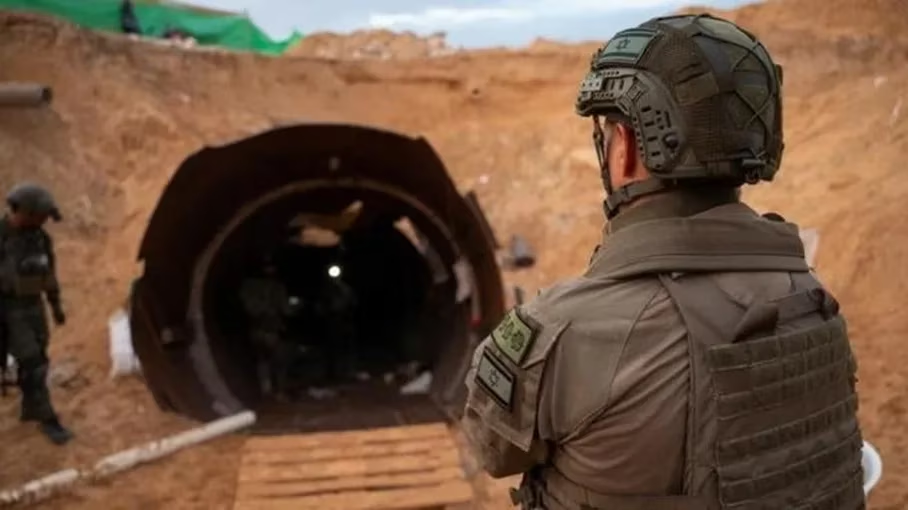
He pointed to a pile of rubble that appears to have been a former building, confirming that the fighters are not in a single tunnel, but in a vast network of tunnels, and their routes and openings must be identified.

He mentioned that "the goal the Israeli army seeks to achieve is to force the militants to gather in one underground point and attack them if they refuse to surrender," emphasizing at the same time that they do not surrender after two years of war, and the army continues to search in the tunnels, a task that cannot end.

He confirmed that "our primary mission here is to kill or capture the militants inside the tunnels in this area," claiming that "most of the fighters are underground. Some come up to breathe or to bring equipment and food, but we use many combat methods to find and strike them."

PALESTINE

Thu 27 Nov 2025 3:03 am - Jerusalem Time

An Israeli call for the establishment of a Palestinian state out of fear of dangerous alternatives to the security of the occupation.

Despite the official Israeli rejection of the establishment of a Palestinian state, and the efforts made by the government to prevent its establishment, there are other Israeli voices that consider that continuing to reject this just demand means that the matter will become a "ticking time bomb," as the absence of a Palestinian state may create a reality of extremism and international pressure.

Danit Barbibay, an expert in education, society, and public awareness, mentioned that "Israeli discussions about the Palestinian state have been ongoing for years, but in recent weeks it has taken center stage; some Israelis want to see it as a historic opportunity, while others view it as a security threat. However, the reality is much more complex, where hope meets reality. When talking about a Palestinian state, the first voice that is heard is the security voice; any sovereign land that fails to build strong governance may quickly become a space for hostile organizations' activities."

She added in an article published by Maariv, translated by "Arabi21," that "we saw what happened in the Gaza Strip when Hamas filled the governmental void, because once a sovereign entity is established, the army's freedom to operate on its territory changes, and preemptive actions become controversial on the international stage. In this case, Israel cannot operate for long in a reality where any legitimate response is met with a wave of accusations."

She pointed out that "besides that, there is the international dynamic; from the moment of declaring the state, even if it is a limited declaration, a new wave of demands, timelines, and commitments begins, long before the reality on the ground is ready for it. This is even before we address the internal Palestinian complexity, as the Palestinian society is deeply divided: weak leadership, rivalries, corruption, lack of trust, and absence of stable security apparatuses."

She clarified that "the establishment of a Palestinian state is not a magic wand that solves problems; on the contrary, it may exacerbate them and turn them into a direct threat to the occupation. We must remember that decades of political stagnation have created deep despair on the Palestinian side, and despair is not a static condition but fuel that feeds extremism. Without a horizon, hostile organizations receive favorable winds."

Barbibay added that "the international arena is also changing, and a young generation is emerging in the United States and Europe with a simplistic view. To them, the ongoing stagnation appears as a reluctance to change. If Israel does not manage the situation properly, the price will continue to rise year after year, in every election campaign and in every discussion at the United Nations. Thus, establishing a Palestinian state without strict and clear security conditions is like a ticking bomb, but even the absence of a Palestinian state may create a reality of extremism and increasing international pressures."

The writer concluded by stating that "Israel bears a grave security responsibility, and no system can be established without security, but it will not last long if there remains a void on the other side that generates frustration, which may produce hostile generations that recycle hatred and violence against Israelis. Therefore, the collapse of a Palestinian state, or the absence of any horizon, pushes the entire region towards explosion, posing a real danger to Israel, which needs to create a stable and secure reality for itself in the coming decade, while at the same time providing Palestinians with a real opportunity to begin to emerge from the cycle of terror and despair that has always returned to Israelis."

PALESTINE

Thu 27 Nov 2025 12:50 am - Jerusalem Time

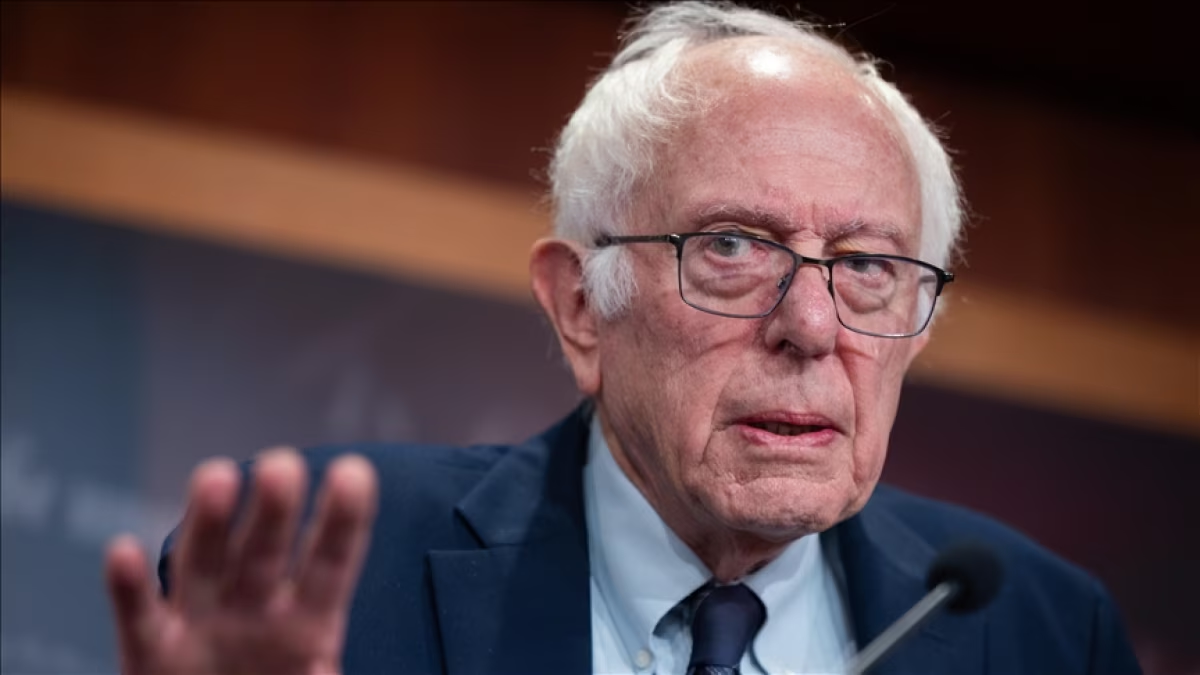
Sanders calls for urgent U.S. action to ensure aid reaches Gaza.

U.S. Senator Bernie Sanders issued an urgent call yesterday, Wednesday, demanding that President Donald Trump's administration pressure Israel to immediately allow full humanitarian aid to Gaza as winter weather conditions worsen.

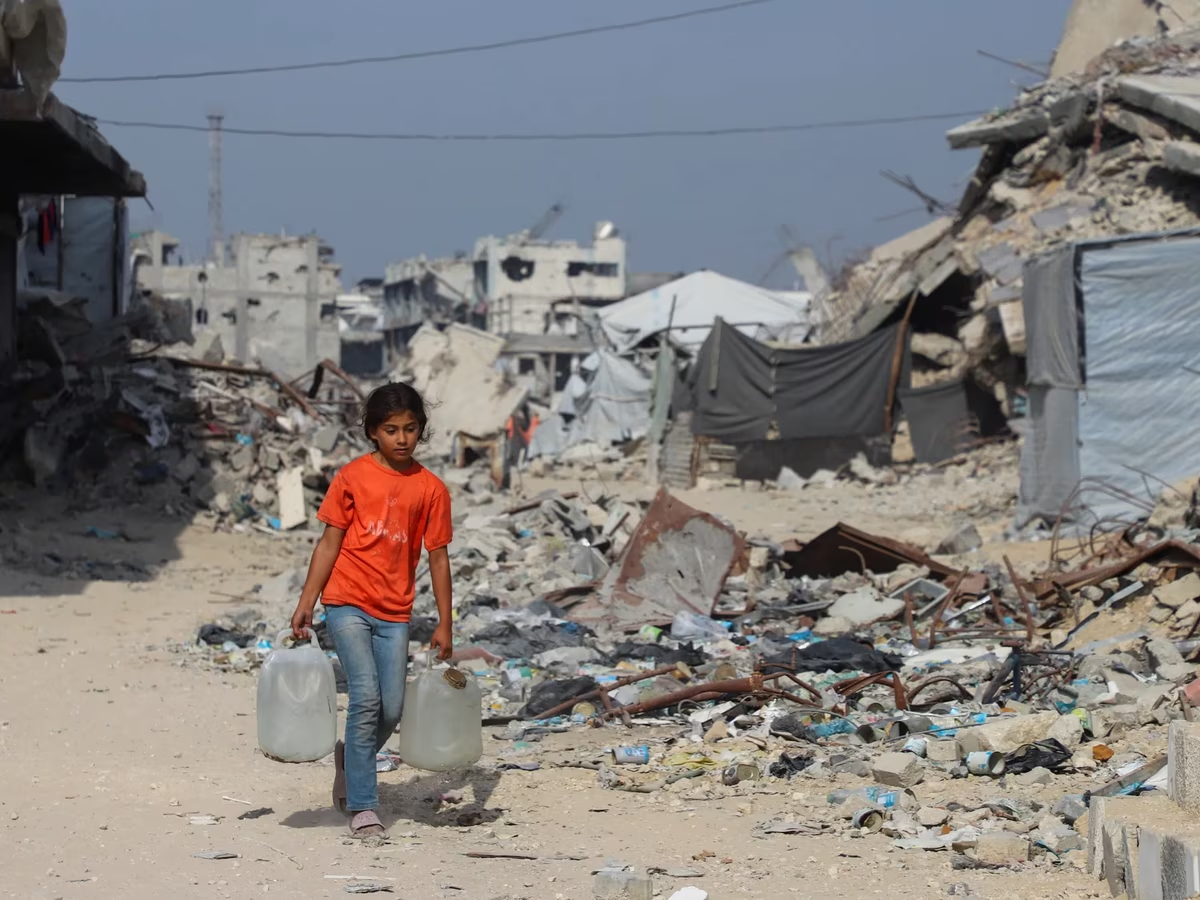
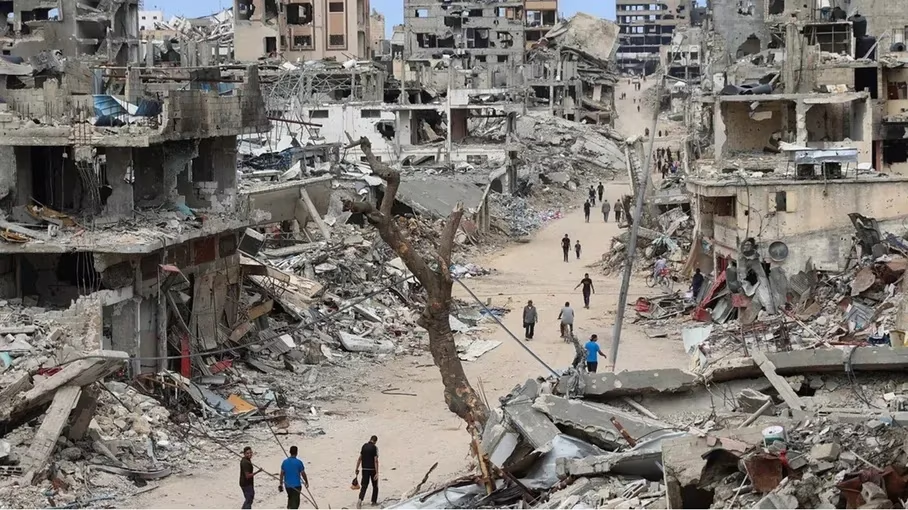
In a statement published on the platform X, Sanders noted that more than one million displaced Palestinians lack shelter and basic supplies, with 92% of housing destroyed, while Benjamin Netanyahu's government continues to restrict the entry of tents and other aid into Gaza—including food—in violation of the ceasefire.

According to the government media office in Gaza, about 1.5 million displaced Palestinians across the sector are still living in catastrophic conditions with extremely limited access to basic needs and vital services due to the ongoing Israeli blockade.

Palestinian authorities estimate that Gaza needs approximately 300,000 tents and prefabricated housing units to cover the most urgent shelter needs following the extensive destruction of infrastructure during two years of continuous bombardment.

The humanitarian crisis persists despite the ceasefire agreement signed on October 10, which clearly stipulated the reopening of crossings and allowing the entry of shelter materials, including tents and mobile homes.

Palestinian officials say that Israel has not fulfilled these commitments despite repeated appeals, and these developments exacerbate the devastating toll of the conflict that began in October 2023, which has resulted in nearly 70,000 martyrs and 171,000 injured, according to local health authorities, with most victims being women and children.

PALESTINE

Wed 26 Nov 2025 11:19 pm - Jerusalem Time

An American writer warns: The reconstruction of Gaza should not be a gateway to expanding the Israeli occupation.

An article published by National Interest magazine stated that U.S. policies allow Israel to violate the ceasefire and exacerbate the humanitarian situation in Gaza, emphasizing that the administration of U.S. President Donald Trump supports misguided reconstruction plans that reinforce occupation and support its expansion.

Writer and foreign policy analyst Alexander Langlois pointed out that Washington has not seriously addressed the humanitarian disaster in Gaza, but preferred to focus on projects that rebuild areas designated only for Israelis, leaving Palestinians trapped in devastated areas suffering from a lack of aid and basic services.

He explained that the idea of "alternative safe communities" - which the administration intends to build - is nothing more than a rebranding of detention camps for Palestinians, where residents are prevented from moving under the control of Israeli forces or potential international forces, in clear violation of international law and principles of human security.

He asserted that the real goal of this plan is not to protect civilians, but to pressure the Islamic Resistance Movement (Hamas) to disarm by using aid as a political weapon, while keeping Palestinians in narrow and deprived areas, serving the continuation of Israeli control over the occupied territories.

Langlois noted that Israeli Prime Minister Benjamin Netanyahu publicly stated that his forces would not withdraw before disarming Hamas, despite this contradicting the ceasefire agreement.

Israel has also adopted an indirect displacement plan by controlling food and shelters, and exploiting "safe" areas to encourage displacement towards besieged areas under Israeli control.

The writer believes that entrenching the current "yellow line" that separates areas under Hamas control from those under Israeli control in Gaza is a "recipe for perpetual war," which does not serve U.S. interests.

A war like this would deepen U.S. involvement in the Middle East, which could distract Washington from major concerns at home and in other parts of the world.

Any decision to deepen U.S. involvement in Gaza through blatant unilateral support for Israel - especially when it supports failed and illegal policies that kill civilians - does not reflect the behavior of an administration genuinely interested in achieving peace, according to the article.

The writer - who is the editor-in-chief of "Down" political magazine - reminded that the U.S.- and Israeli-backed "Gaza Humanitarian Foundation" has failed in its mission, exacerbating famine within the sector instead of contributing to its resolution, and collected intelligence on Palestinians.

Israel killed more than two thousand Palestinians near alleged aid sites, according to the writer, while the foundation justified the killings as unrelated to its operations, blaming Hamas for the deaths.

The article argues that this is neither integrity nor neutrality, but complicity at the expense of civilian lives.

The article criticized the continued investment and support of the United Nations for initiatives like the foundation, alongside Trump's ceasefire plan, which will not lead to sustainable peace in the region and prioritizes Israeli interests at the expense of Palestinian civilians.

The writer concluded that the unbalanced political relationship between Washington and Tel Aviv drives the United States to make decisions that serve Israeli interests at the expense of international law and Palestinian rights.

The real solution is to pressure Israel to respect the ceasefire, withdraw completely, and work towards the establishment of a Palestinian state without preconditions.

PALESTINE

Wed 26 Nov 2025 10:51 pm - Jerusalem Time

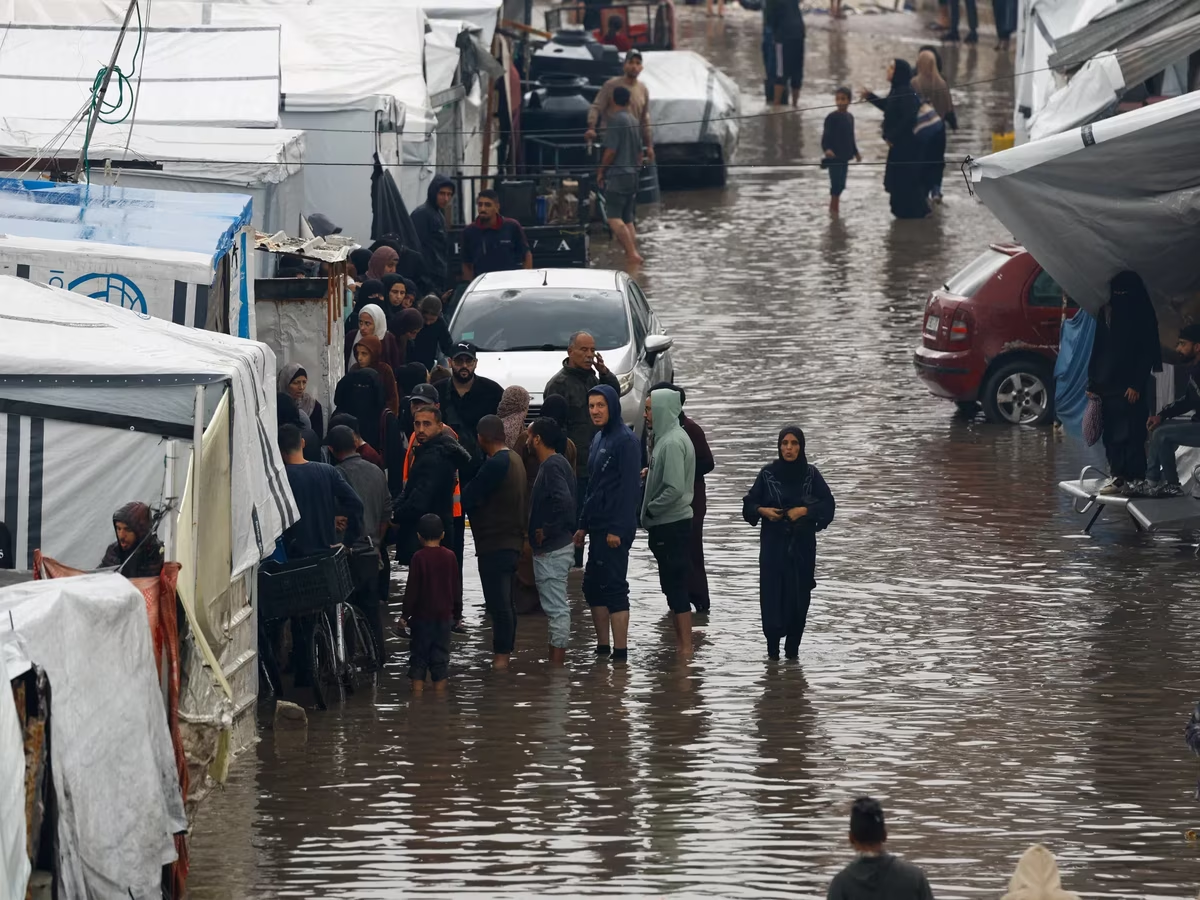
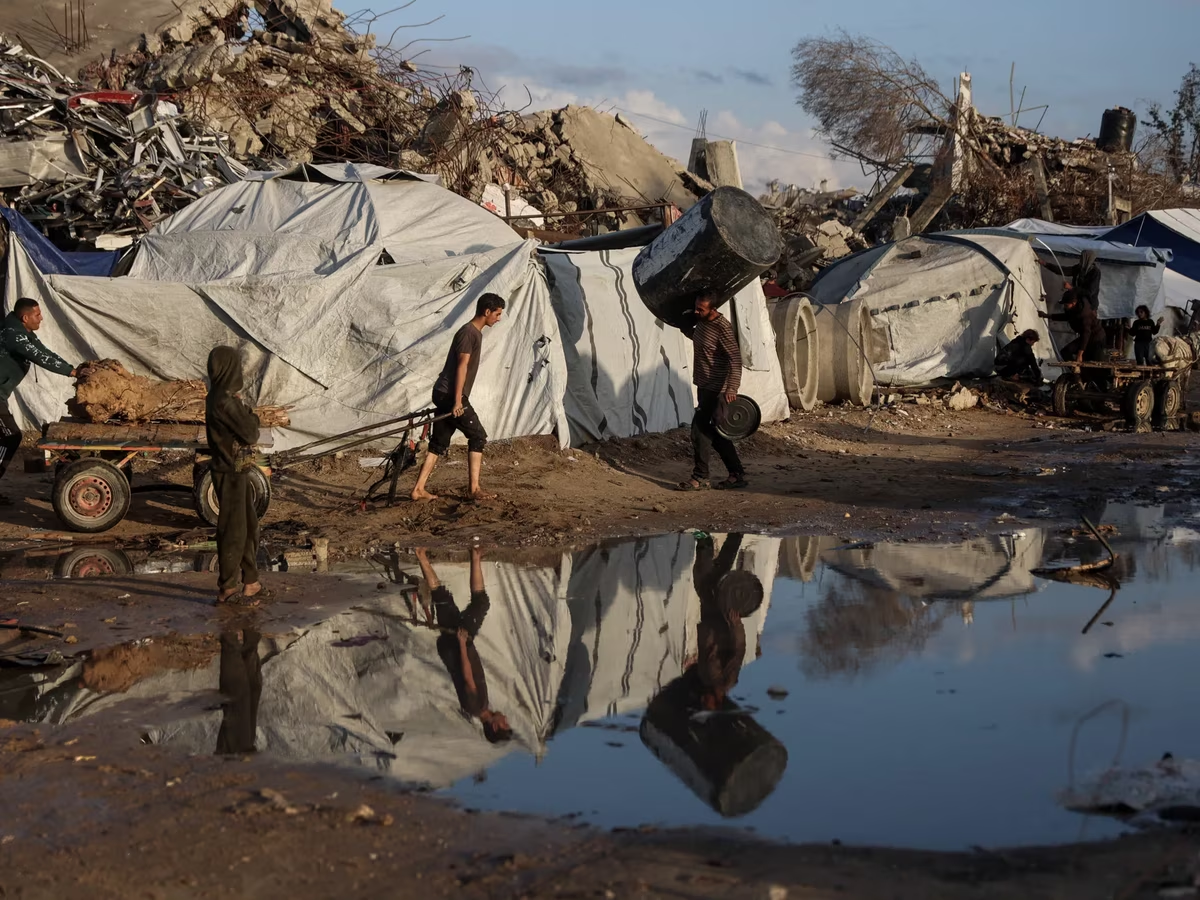
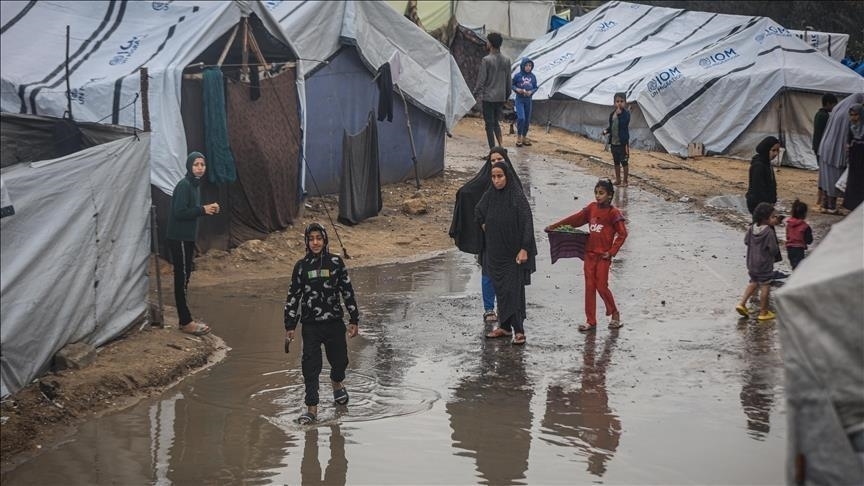
UN agencies: Rain has flooded thousands of tents in Gaza.

United Nations relief agencies stated on Wednesday that families in the Gaza Strip are facing harsh humanitarian conditions that are rapidly deteriorating with the onset of winter.

The agencies reported that the basic infrastructure in the region 'remains destroyed,' and emphasized that shelters in camps and temporary centers 'are extremely fragile and do not provide protection for Palestinians whose homes have been destroyed or who cannot return to their areas.'

The same bodies recorded that more than two million Palestinians are now crowded into less than half the area of the Gaza Strip, while most of the displaced lack adequate shelter materials to protect them from rain and wind, following a war that left widespread destruction in residential areas.

They noted that unstable weather and heavy rains in recent days have led to thousands of tents being flooded, posing a direct threat to families, especially children.

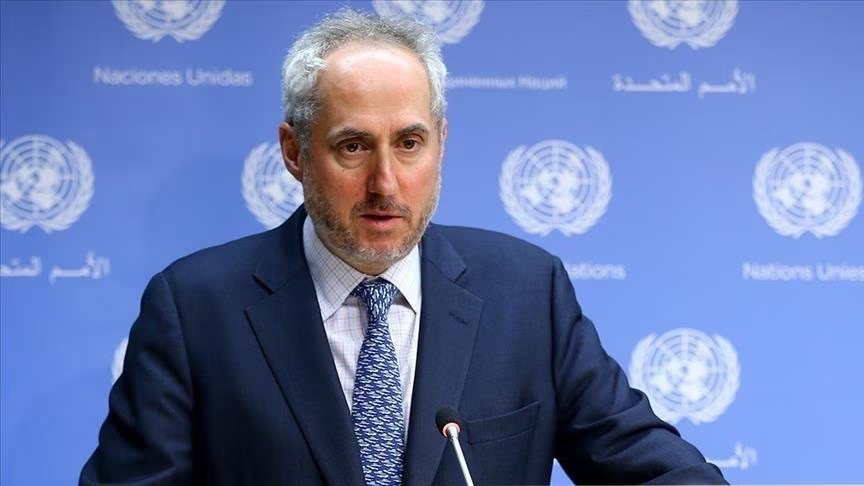
UN Secretary-General spokesperson Stéphane Dujarric said at his press conference in New York that many Palestinian families are living in 'poorly equipped shelters, exposed to flooding, which inevitably makes people vulnerable to stormy weather.'

He confirmed that the UN and its partners are doing everything they can to alleviate the problem, but the humanitarian operation 'still faces systematic obstruction of essential supplies,' as well as a ban on the work of major relief organizations, including some non-governmental organizations that are partners of the UN.

Relief organizations warned that worsening winter conditions could increase health risks for the population amid a severe shortage of basic services and ongoing obstruction of aid delivery, while displaced families struggle to adapt to an increasingly harsh humanitarian reality day by day.

PALESTINE

Wed 26 Nov 2025 9:32 pm - Jerusalem Time

Hebrew media: The occupation army is preparing for a rubble removal operation and the formation of a "New Gaza" under American pressure.

The Hebrew broadcasting authority reported extensive military and administrative preparations by the occupying army in the Gaza Strip. These preparations revolve around the introduction of heavy equipment to Rafah to begin the process of debris removal, alongside plans to establish new administrative areas, all of which comes as a result of American pressure.

The authority quoted informed sources stating that the occupying army is preparing to launch a large-scale operation in the city of Rafah, where heavy equipment will be introduced to clear the rubble and debris. The authority noted that this step represents a result of American pressure on the occupation to prepare for the next phase of Trump's plan.

These developments are part of a scheme to establish new areas that will be managed outside Hamas's rule, amid increasing American pressure to begin implementing the second phase of Trump's plan. The broadcasting authority added that the preparations include the establishment of a new humanitarian area for thousands of Palestinians, which will be called 'New Gaza.'

PALESTINE

Wed 26 Nov 2025 9:02 pm - Jerusalem Time

The genocide war has erased 69 years of development in Gaza.. and UN warnings of an economic collapse.

The United Nations Human Rights Rapporteur on Palestine, Francesca Albanese, stated that a new UN report concluded that the Israeli war on Gaza has erased 69 years of human development, destroying healthcare systems, education, infrastructure, and even banks.

Albanese wrote in a post on X that this represents the worst economic collapse ever recorded, adding that the destruction witnessed in Palestine since October 2023 has unleashed successive crises—economic, humanitarian, environmental, and social—pushing the occupied Palestinian territories from a lack of development to complete devastation.

The United Nations warned of an unprecedented collapse of the Palestinian economy in the Gaza Strip and the occupied West Bank, confirming that the two-year war has erased the impact of decades of development, pushing Gaza into a state of total destruction.

PALESTINE

Wed 26 Nov 2025 8:52 pm - Jerusalem Time

Under the title "Five Stones": The occupation launches a wide operation and besieges 70,000 Palestinians in Tubas.

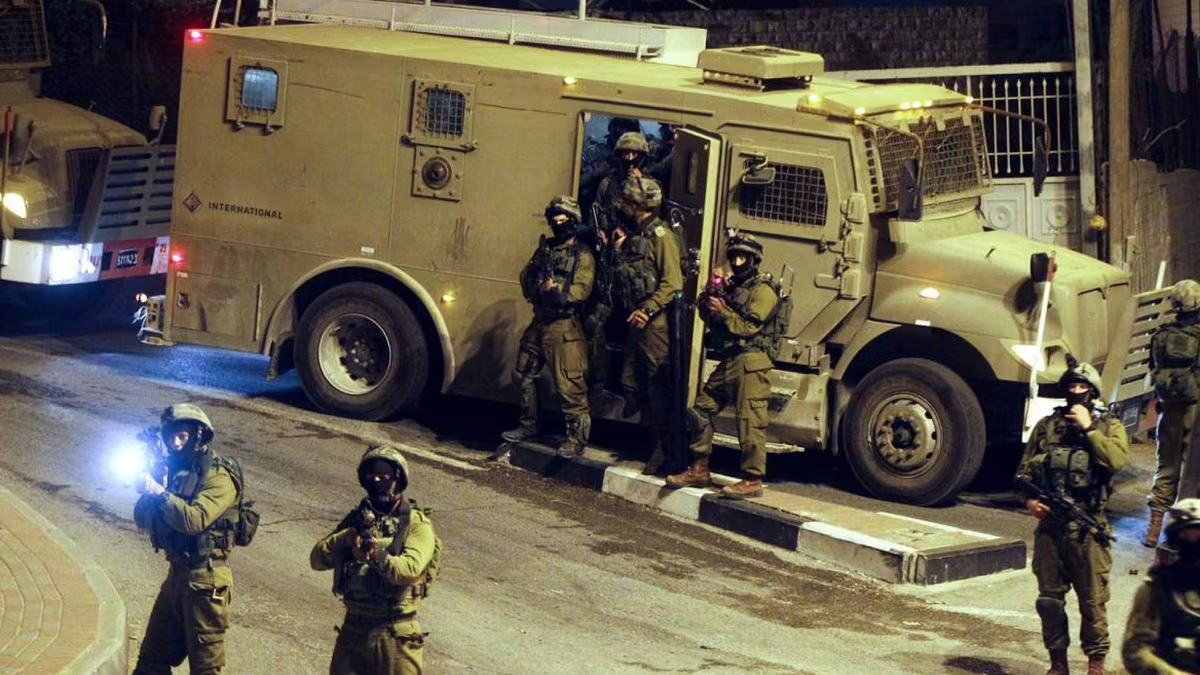
The wide-ranging aggression on the province of Tubas and its surroundings continues, as the Israeli occupation army announced the start of a large military operation dubbed "Five Stones" in the northern West Bank.

The occupation clarified that forces from the commando units and the Shomron and Menashe brigades, supported by the air force, began the operation after intelligence monitoring of attempts to establish armed infrastructure.

The province of Tubas has been witnessing extensive aggression since the night of Tuesday to Wednesday, during which the occupation sent large military reinforcements to the city and its villages, leading to a near-total movement ban.

The governor of Tubas, Ahmad Al-As'ad, stated that the occupation "has begun an operation that will last for days," and "paralyzed the movement of the province" by erecting earthen barriers, indicating that about 70,000 Palestinians are "trapped inside their homes."

The aggression included the villages of Aqaba, Tammun, and Tayaseer, and the education directorate announced the suspension of schools and kindergartens.

The forces began aerial bombardment "to isolate and encircle the area," then proceeded to comb through dozens of buildings and conduct field investigations, claiming to have found a "monitoring room" and confiscated money.

Field testimonies reported that the occupation forces stormed dozens of homes and expelled their residents before turning some into "military barracks."

The occupation army claimed that it "eliminated 3 militants" who had previously participated in attacks on its forces, asserting that the operation was an extension of the activities of the "Duvdevan" and "Yamam" units.

The Red Crescent teams in Tubas confirmed that they dealt with an injury to an 85-year-old man who was severely beaten.

In a serious incident, the occupation forces arrested a wounded Palestinian from inside a Red Crescent ambulance at the entrance of the town of Tammun.

The forces also prevent crews from reaching a child injured by burns in the town of Tayaseer.

The occupation emphasized that it "will continue proactive work to prevent the entrenchment of terrorism in the region."

This operation confirms the continuation of the policy of extensive incursions and targeting the infrastructure of resistance while imposing a tight siege on the residents of the province.

OPINIONS

Wed 26 Nov 2025 12:09 pm - Jerusalem Time

The Conditions for Winning the Next Elections in Israel

Elections are won by politicians who inspire hope. Voters want to elect people who provide them with a sense of positive emotions from the moment that they cast their ballot. We don’t want to enter the polling place with a dilemma regarding who is less likely to disappoint me. We have to believe that the people we elect will make our lives better, safer, and more peaceful. In the United States it might be about the economy. In Israel it is about who has a vision and a plan to keep us safe from the strategic dangers that we face – this primarily focuses on the relations of Israel with the Palestinians and also the demise of our liberal democracy that has been brought to us by Netanyahu and his governments. At least that is what concerns those of us who want to remove Netanyahu and his coalition from power.


There is an axiom that we have to face and accept – even more so after the war in Gaza, even with October 7 in our daily consciousness – Israel will never have security if the Palestinians do not have freedom, and the Palestinians will never have freedom if Israel does not have security.  That is the equation that we must come to terms with. Another axion aligned with this is that peace will never be built based on walls and fences that separate the two peoples that share this land from the river to the sea.


Peace has become an almost non-existent word on our political vocabularies because it is so difficult to imagine a reality of peace - after the failure of Olso, after the violence of the second intifada, after the failures of disengagement from Gaza, after October 7. All of those failures are at the hands of political leaders who rejected the objective of leading us to genuine peace. They feared peace because they refused to relinquish control over parts of the land. They refused to implement obligations within agreements that were signed even by their own governments. The leaders on both sides failed to lead to peace as they enhanced conflict narratives and realities and rode the waves of fear, suspicion, racism which stroked the flames of violence on both sides of the conflict. This was also all inspired by distorted versions of theology which sanctified martyrdom and myths of land ownership granted by the God they speak to.


The forces working against us

We face very powerful forces in our elections in Israel. We have to challenge a cult leadership that manipulates political alignments in ways that political leaders who actually hate each other end up running together. We have to confront a large population of ultra-orthodox who receive religious dictums instructing them on who to vote for, with almost zero self-thought and personal assessment. This is combined with a demographic reality that lowers our chances of winning from the outset. These very powerful forces and trends need to be confronted with political wisdom and savvy that forces us to step over lines that were thought to be red-lines until now.


Unite

Lapid, Eizencott, and Golan must unite into one election block that runs together.  The most important thing that could save Israel is to run as one list and to come out as the largest list in these elections. Uniting these parties into one list is a huge challenge in which egos and sometimes ideologies block the way. There is no room for not uniting because of nuance differences between these parties. They all agree on saving Israel’s liberal democracy, protecting the judicial system, ensuring that the media is free. They all agree that Israeli society and political life must be based on the values delineated in Israel’s Declaration of Independence. They all agree that all Israel citizens must serve the country either in the military, the police, or a national or civil service. They all agree that Israel must be a society based on the equality of all of its citizens. They all believe that Israel must seek peace with all of its neighbors. They all should agree to the axion of security and freedom written above. They can find enough of a shared ideological base to run together and then after they win, they can function as separate factions within the Knesset – but first they must win.


Unite

We cannot remove Netanyahu from power if the Arab parties do not unite into one list as the center and center left in Israel must do as well. In order to beat Netanyahu and his coalition the Arab participation in voting must rise to at least 70%. If the Arab united party gets 15+ seats, Netanyahu will lose the elections. There aredifferences between the various Arab parties, but they all share the most important imperative that Netanyahu must never serve as Prime Minister again. After the elections, they can negotiate separately with the party selected by the President to form a new coalition. As we know, there are Arab leaders who want to be part of the coalition and government and there are those who wish to serve from the opposition. But first they must run together and then recommend to the President that whoever heads the list that will win from the current opposition forces will be supported to form a new government. They must continue to vote confidence in the new government, even when there are differences of opinion because the danger of another right-wing Netanyahu led government is too great to all of us – Jews and Arabs alike.


Unite

The Jewish parties that must unite from the center-left and the left must declare that the 21% of Israel’s citizens, the Arab community of Israel, are legitimate and their votes count. The next government must include Arab parties because we are a society that believes in equality of all of the citizens. We will have a government that will advance the Trump plan that includes a clear path towards a Palestinian state. The international community will continue to support and to pressure Israel and the Palestinians to accept the two-states solution. The next government of Israel must treat all of its citizens with equality and measures must be taken to put an end the threat of organized crime that murders so many Arab citizens without most of the murderers being brought to justice.  The next government must double the investment in education, especially in those parts of our educational systems that have been left behind and pushed back because of coalition priorities that shifted public money because of pure electoral concerns.


Inspire hope

War creates fear and is a tool of political control.  Peace seems elusive and far away, almost impossible. But we must change the discussion and understand that a vision of peace which is not detached from reality can inspire. We must begin to understand that the two-states solution saves Israel – it does not threaten Israel’s existence. The non-existence of a Palestinian state living in peace with Israel threatens Israel’s existence. There will be no two-states solutions without deep and genuine cooperation between the State of Israel and the future State of Palestine. Our Israeli-Palestinian negotiated agreement will be based on wide regional cooperation on security and economic development that will provide guarantees for security for both Israelis and Palestinians. Israel’s regional integration will strengthen Israel in every way conceivable and that is fully dependent on Israel’s agreement to allow Palestinians to achieve their self-determination in a state next to Israel between the river and the sea.  Israel cannot be the democratic nation-state of the Jewish people, and all of its citizens, if the Israeli control over the Palestinian people continues. The values of a liberal democracy do not coincide with the denial of the Palestinian people’s right and desire for freedom. If our leaders want to inspire hope it is not enough to only speak about separation from the Palestinian people. They must speak about a two-states solution living in peace as good neighbors.


Israel and the World

As a nation we will continue to face an angry world that sees Israel as a state that committed war crimes in Gaza. Boycotts against Israel will spread further as Gaza begins to open up to the world. Israelis will feel less welcome almost everywhere they go. Antisemitism will continue to rise around the world. The only way to change Israel’s place in the world is by accepting a peace directive as a guiding principle for the next government. The next government of Israel that will be elected by uniting political forces and understanding that we cannot win without Jewish-Arab cooperation and coalition building will have to place an emphasis on the primary goal of ensuring security through peace. This includes keeping Israel and the IDF strong. But it also includes the recognition that Israel’s strength is only fully achieved through the strong regional and international alliances that we will have as a nation working towards peace with our Palestinian neighbors.  The political strategists guiding the campaign will poll and find convincing arguments to the leaders that talking about peace and talking about the Palestinians and their rights will lose votes. This is what they always say and they are always wrong. People will not vote for a political party that echoes the false militaristic slogans of Netanyahu, Leiberman, and Bennett. Israel will not have security by following in the footsteps of the failed leaders that we have had for too long.  The war in Gaza must be the last war and that must be the message of those who seek to replace Netanyahu.


Winning the elections

Two campaign issues that will probably top the agenda are the establishment of a national commission of inquiry on October 7, what led to October 7 and the dysfunctional Israeli government after October 7. The second issue is the drafting of Ultra-Orthodox into the army and national service. These two issues do not distinguish our values from those of Lieberman and Bennett.  Lieberman and Bennett are annexationists who will continue to sustain the Israeli-Palestinian conflict and probably create an escalation in violence. They are not leaders who provide hope of a better Israel. They might govern better than Netanyahu and probably be less corrupt than Netanyahu, but they will not make Israel a safer place for us and our children. Bennett and Lieberman represent a slightly better version of what has become the Likud of Netanyahu.   They are not our solution; they will remain part of our problem.


Yes, we whole heartedly support the establishment of the National Commission of Inquiry and yes, we want a law that will guarantee that all citizens of Israel will serve the country in some form of national-civil service, whether through the military or in a non-military service. What sets us apart from Lieberman and Bennett is our belief and determination to ensure that Israel is a country in which all of its citizens are equal, that Israel is a country that preserve the values of a liberal democracy with a strong judiciary that guarantees our civil and human rights for all – including the minorities, and that Israel is a country that is truly seeking peace with all of our neighbors.  Adopting this agenda is who we can win the next elections.

PALESTINE

Wed 26 Nov 2025 6:30 am - Jerusalem Time

Occupation army: We launched a large-scale military operation in the northern West Bank.

The Israeli occupation army announced in a joint statement with the General Security Service "Shabak" and the Border Police that they have begun a large-scale military operation in the northern West Bank area on Wednesday.

The statement confirmed that the army and the General Security Service will not allow militants to establish a foothold in the area, and that they are working proactively to thwart and prevent it.

The occupation army, Shabak, and Border Guard forces began a wide operation last night to thwart resistance activities in the northern West Bank area.

ARAB AND WORLD

Wed 26 Nov 2025 6:06 am - Jerusalem Time

Initiation of the selection process for the new Secretary-General of the United Nations

The process of selecting the tenth Secretary-General of the United Nations officially began yesterday, Tuesday, with the new appointee set to replace Antonio Guterres starting January 1, 2027.

In a joint message, the Security Council, composed of 15 countries, and the President of the General Assembly of the United Nations, made up of 193 countries, called on all member states to submit the names of candidates for the position.

The message stated, "While we express our regret that a woman has never held the position of Secretary-General, and believing in the necessity of ensuring equal opportunities for women and men in accessing senior decision-making positions, we encourage member states to strongly consider nominating women, and we emphasize the importance of regional diversity in the selection of the Secretary-General."

According to Agence France-Presse, some names have begun to circulate informally, including former Chilean President Michelle Bachelet, Director General of the International Atomic Energy Agency Rafael Grossi, and Costa Rican Rebecca Greenspan, who currently heads the United Nations Conference on Trade and Development (UNCTAD).

The members of the Security Council will begin the selection process by the end of July 2026, and the five permanent members of the council - the United States, Russia, the United Kingdom, China, and France - must agree on a candidate.

The Security Council will submit its official recommendation to the General Assembly to elect the Secretary-General for a term of 5 years starting January 1, 2027, which is renewable once.

PALESTINE

Wed 26 Nov 2025 2:25 am - Jerusalem Time

The occupation army talks about developments against the Rafah tunnel fighters.

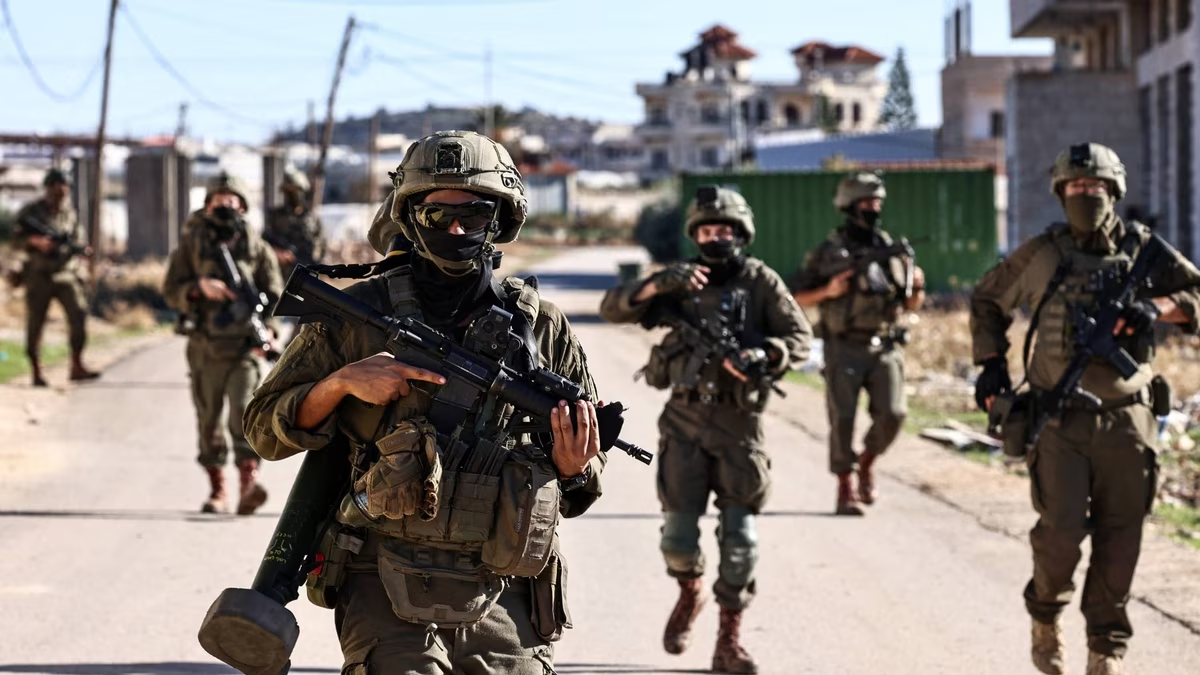
The Israeli occupation army claimed on Tuesday evening that it killed five Palestinian resistance fighters who 'most likely' emerged from a tunnel in Rafah, southern Gaza Strip.

The Israeli army stated, 'During search operations conducted by soldiers in the Rafah area, five armed terrorists were spotted and eliminated; they were likely terrorists who emerged from an underground tunnel belonging to a terrorist organization in eastern Rafah.'

According to several media outlets, dozens of Hamas fighters are trapped in the tunnels of Rafah.

Last Saturday, the spokesperson for the occupation army claimed the assassination and arrest of all fighters belonging to the Al-Qassam Brigades east of Rafah city, in the south of the strip, following hours after announcing the arrest of six of them.

The spokesperson said that 'the army' had assassinated 11 Palestinians and arrested six others from one of the tunnels in eastern Rafah in the last 24 hours.

He announced the conclusion of this file, which had been the subject of discussion between the occupation and the American administration and mediators for weeks.

A delegation from Hamas, headed by the movement's chief negotiator Khalil al-Hayya, discussed on Sunday during talks in Cairo with the head of the Egyptian General Intelligence, Hassan Rashad, who is engaged in mediation efforts to resolve the conflict, the fate of the 'Rafah fighters' with whom communication had been cut off.

The Israeli army also announced on Tuesday evening that it killed a man who crossed the 'yellow line' that is supposed to mark the boundaries of the area from which Israeli forces withdrew in the Gaza Strip.

The issue of the trapped 'Hamas' fighters in Rafah erupted due to two security incidents following the reaching of an agreement, the first on October 19 and the second on the 28th of the same month, in which Israel claimed clashes occurred with Palestinian militants and accused 'Hamas' of violating the agreement.

However, the 'Al-Qassam Brigades', the armed wing of the 'Hamas' movement, stated in its first response to the clashes that 'communication has been cut off with the remaining members of its groups in Rafah since the return of the war in March of last year.'

A report published by the 'Cairo News' channel previously stated that Israel is trying to exploit this crisis to undermine the ceasefire agreement.

Since mid this month, sources close to Israeli Prime Minister Benjamin Netanyahu have denied that he made commitments to Washington regarding the trapped 'Hamas' fighters in Rafah.

Israeli officials are calling for the surrender of these fighters and their transfer to Israel for interrogation, or their killing if they refuse to surrender.

Meanwhile, the 'Al-Qassam Brigades' confirmed earlier that 'there is no principle of surrender or handing oneself over to the enemy in our dictionary,' holding Israel responsible for any clashes that occur with its members trapped in Rafah.

For two years since October 8, 2023, the occupation army, with American support, has committed genocide against the Gaza Strip, where about 2.4 million Palestinians live, resulting in more than 69,000 Palestinian martyrs and over 170,000 injured, most of whom are children and women, with reconstruction costs estimated by the United Nations at about 70 billion dollars.

PALESTINE

Wed 26 Nov 2025 1:43 am - Jerusalem Time

The genocide war has erased 69 years of development in Gaza... and UN warnings about the consequences for the economy.

The United Nations Human Rights Rapporteur on Palestine, Francesca Albanese, stated that a new UN report concluded that the Israeli war on Gaza has erased 69 years of human development, destroying healthcare systems, education, infrastructure, and even banks.

Albanese wrote in a post on X that this represents the worst economic collapse ever recorded, adding that the destruction witnessed in Palestine since October 2023 has unleashed successive crises—economic, humanitarian, environmental, and social—pushing the occupied Palestinian territories from a lack of development to complete devastation.

The United Nations warned of an unprecedented collapse of the Palestinian economy in the Gaza Strip and the occupied West Bank, confirming that the two-year war has erased the impact of decades of development, pushing Gaza into a state of total destruction.

The report indicated that the widespread destruction caused by the war to infrastructure, productive assets, and vital services has nullified decades of social and economic progress in the Gaza Strip.

The UN report clarified that the per capita GDP of Palestine has declined to the level of 2003, equivalent to a loss of 22 years of development.

The report noted that the resulting economic crisis is among the worst 10 global economic crises since 1960.

It also warned that the extent of the destruction in Gaza means that the region will remain entirely dependent on intensive international support, and that the recovery process may take decades.

It pointed out that the Israeli war has widely destroyed every pillar of survival, including food, shelter, and healthcare, pushing Gaza towards the brink of total collapse.

It confirmed that the reconstruction of Gaza will require more than $70 billion and may extend for decades, amid ongoing destruction and the absence of infrastructure capable of rapid recovery.

The report added that the continuous and systematic destruction casts heavy shadows on Gaza's ability to rebuild itself as a livable area in the future, amidst worsening multidimensional poverty and the humanitarian crisis reaching a stage where the UN has declared famine in some areas.

The report also indicated that Gaza's economy contracted by 87 percent during the years 2023/2024, reducing the per capita GDP to only $161, one of the lowest recorded rates globally.

PALESTINE

Wed 26 Nov 2025 12:17 am - Jerusalem Time

United Nations: Displaced Palestinian families in Gaza at risk of flooding

The spokesperson for the UN Secretary-General, Stéphane Dujarric, stated on Tuesday that many displaced Palestinian families in the Gaza Strip are at risk of flooding due to their stay in poorly equipped shelters.

Dujarric explained in a press conference that people in Gaza are 'significantly at risk' in the face of adverse weather conditions, and reported that the UN and its partners are doing everything they can 'to alleviate suffering.'

He added that obstacles to the entry of humanitarian aid into Gaza continue, noting that Israel systematically prevents the entry of some vital supplies and prohibits the activities of important relief groups, including UN partners.

Earlier on Tuesday, the tents of displaced Palestinians were flooded again after heavy rains fell on the Gaza Strip, exacerbating the humanitarian crisis resulting from the ongoing Israeli attacks for two years.

A low-pressure system accompanied by heavy rains on Tuesday caused dozens of tents for the displaced to be submerged in the Mawasi area of Khan Younis in southern Gaza, amid warnings of a humanitarian disaster.

It is worth noting that the Gaza Strip needs about 300,000 tents and prefabricated housing units to meet the basic shelter needs of its residents, after Israel destroyed the infrastructure during two years of genocide.

The UN estimates the cost of rebuilding Gaza at around $70 billion, due to the repercussions of two years of Israeli genocidal war supported by the US, which led to the killing of more than 69,000 Palestinians and the injury of over 170,000.

LATEST NEWS

Tue 25 Nov 2025 11:44 pm - Jerusalem Time

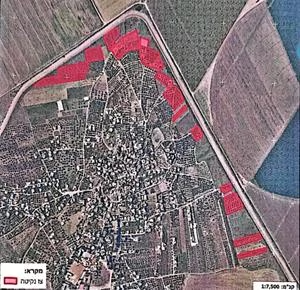
The occupation issues a military order to remove trees over an area of 59 dunams in Jenin Governorate.

The Israeli occupation authorities issued a military order to remove forested areas covering 59 dunams of land in the town of Zbuba in Jenin Governorate.

The Wall and Settlement Resistance Commission stated that the military order numbered N.K/55/25 targets a large forested area for removal and destruction under the pretext of military necessity, in a blatant assault on Palestinian agricultural land.

The Commission pointed out that the occupying state has intensified the issuance of this type of orders in all Palestinian territories in recent months, justifying it with security claims and the protection of roads used by settlers.

It added that the occupying state's persistence in issuing orders to attack Palestinian trees and crops proves its ongoing involvement in apartheid and racial segregation measures by tightening restrictions on Palestinians, under the pretext of protecting settlers, while depriving Palestinian citizens, the rightful landowners, of their most basic rights, as the occupying state allocates all resources in favor of the colonial settlers.

PALESTINE

Tue 25 Nov 2025 10:56 pm - Jerusalem Time

The Kats-Zamir crisis escalates as Netanyahu seeks to resolve the dispute between them.

The spokesperson for Israeli Prime Minister Benjamin Netanyahu said today, Tuesday, that reports about the dismissal of Defense Minister Israel Katz and the appointment of Gideon Sa'ar in his place are "false."

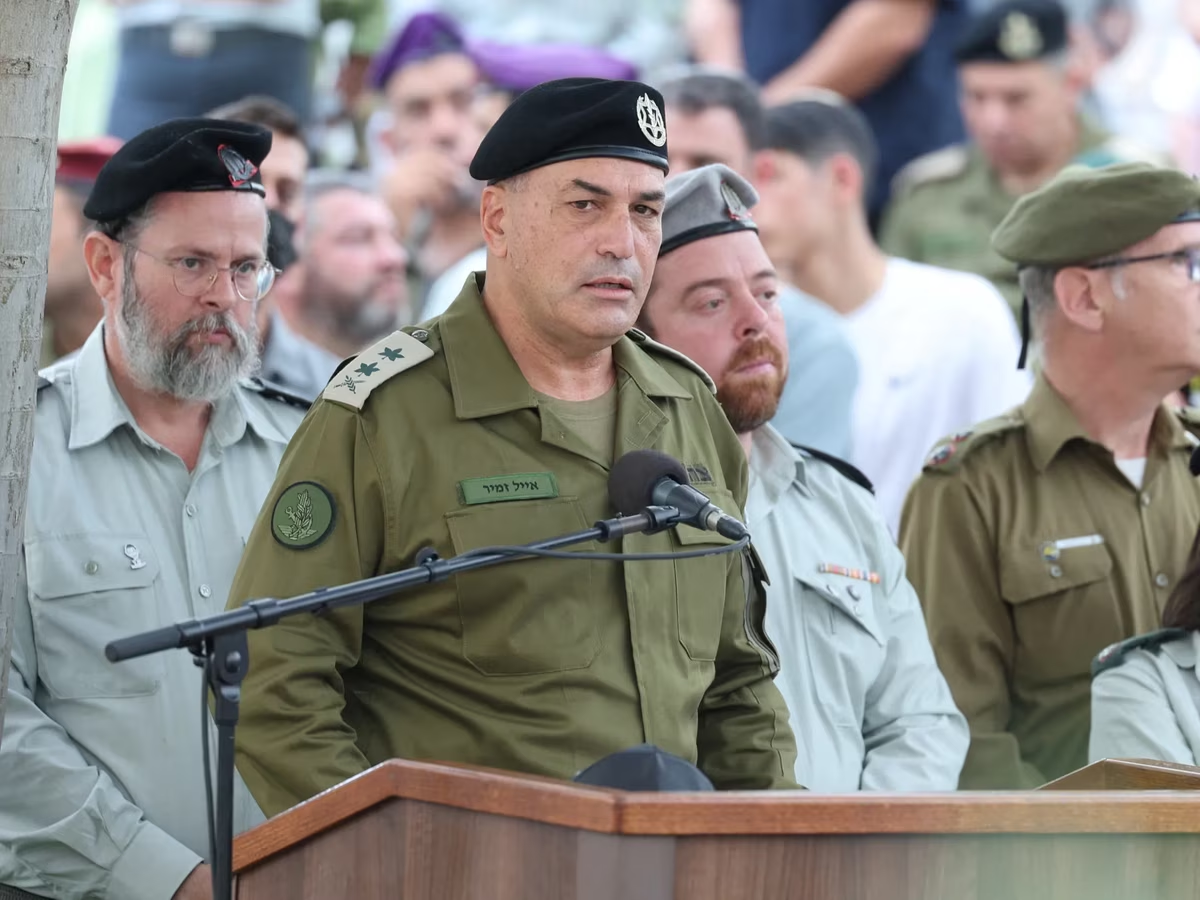
The newspaper "Israel Hayom" reported from sources that Netanyahu is considering dismissing Israel Katz from the Ministry of Defense and appointing Gideon Sa'ar instead, noting that the anticipated cabinet reshuffle comes against the backdrop of the escalating crisis between Katz and Netanyahu following the public confrontations between the Defense Minister and Chief of Staff Eyal Zamir.

On Monday, Katz froze appointments to senior military positions, a day after senior officers were dismissed without consulting him, following the failure to prevent the attack on October 7, 2023, marking a new dispute between them.

Following the freeze, Chief of Staff Eyal Zamir issued a strongly worded statement accusing Katz of jeopardizing security due to his decision regarding military appointments.

Prime Minister Benjamin Netanyahu asked Katz and Zamir to ease tensions between them after their disagreements reached a peak following the failures of October 7, 2023, according to Hebrew media.

Netanyahu's request to Katz and Zamir came during separate meetings with them on Tuesday evening, after the former refused to hold a trilateral meeting, according to the same source.

"Israel Hayom" reported that Netanyahu held two meetings at the Ministry of Defense headquarters in Tel Aviv with both Zamir and Katz, clarifying that contrary to what Netanyahu had planned yesterday, the personal meetings were held separately and took a long time.

According to the newspaper, Netanyahu asked the Defense Minister and the Chief of Staff to calm things down to keep the issue of public confrontation out of the headlines.

For its part, Channel 12 considered that Katz's refusal to meet Zamir indicates that the dispute between the two men has reached its peak, adding that after a full day of accusations, public statements, and unprecedented tension at the top of the security establishment, Netanyahu abandoned the idea of holding a joint meeting between the two and summoned each of them for a separate clarification conversation.

Katz directed on Monday to conduct a new and extensive review of the results of a military committee led by retired Major General Sami Turjeman, which was tasked with investigating the failure to prevent the October 7 attack, and he also froze senior military appointments for 30 days.

Katz added in a statement, "I appreciate the Chief of Staff, who knows very well that he is subject to the Prime Minister, the Minister of Defense, and the Government of Israel."

Meanwhile, Zamir stated in a strongly worded statement that the decision to question a report written over seven months by 12 generals and colonels, which was approved by the army commander and presented to the minister personally, is surprising.

According to Zamir, the report was initially designated for the Chief of Staff to evaluate the quality of the investigations and draw lessons comprehensively within the army, not for political use.

The Hebrew broadcasting authority reported on Monday evening, citing sources close to Zamir, that he is aware that the public statement he issued against Katz could have far-reaching consequences, including his dismissal.

Zamir announced on Sunday the dismissal of several senior military leaders and reprimanded others over the failures of October 7, including the former head of military intelligence Aman, Aharon Haliva, the former commander of the Southern Command, Yaron Finkelman, and the former head of operations, Oudi Basiuq.

These officers had previously been dismissed from their leadership positions, but the new measures are punitive and include the termination of their reserve service in the army entirely.

The newspaper "Yedioth Ahronoth" reported on Monday that Katz learned of Zamir's decisions from the media.

The broadcasting authority stated that these developments come about two weeks after Zamir received the comprehensive report prepared by Turjeman.

Turjeman is a former head of the Southern Command in the army responsible for Gaza, and he was tasked with leading a team from the army to conduct investigations into the October 7 attack.

On October 7, 2023, Hamas attacked military bases and settlements along Gaza, killing and capturing Israelis in response to the daily crimes of the occupation against the Palestinian people and their sanctities, especially the Al-Aqsa Mosque, according to the movement.

Israeli officials consider that what happened on October 7 represents the largest intelligence and military failure in Israel, causing significant damage to the image of Tel Aviv and its army in the world.

PALESTINE

Tue 25 Nov 2025 10:46 pm - Jerusalem Time

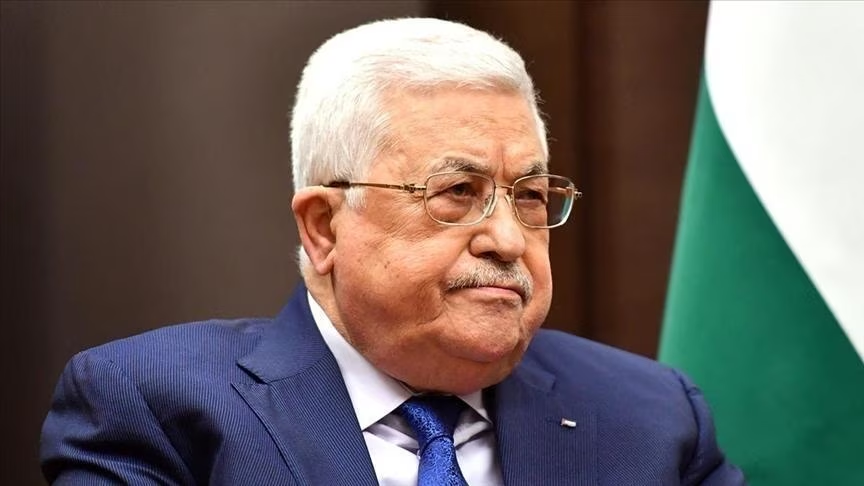
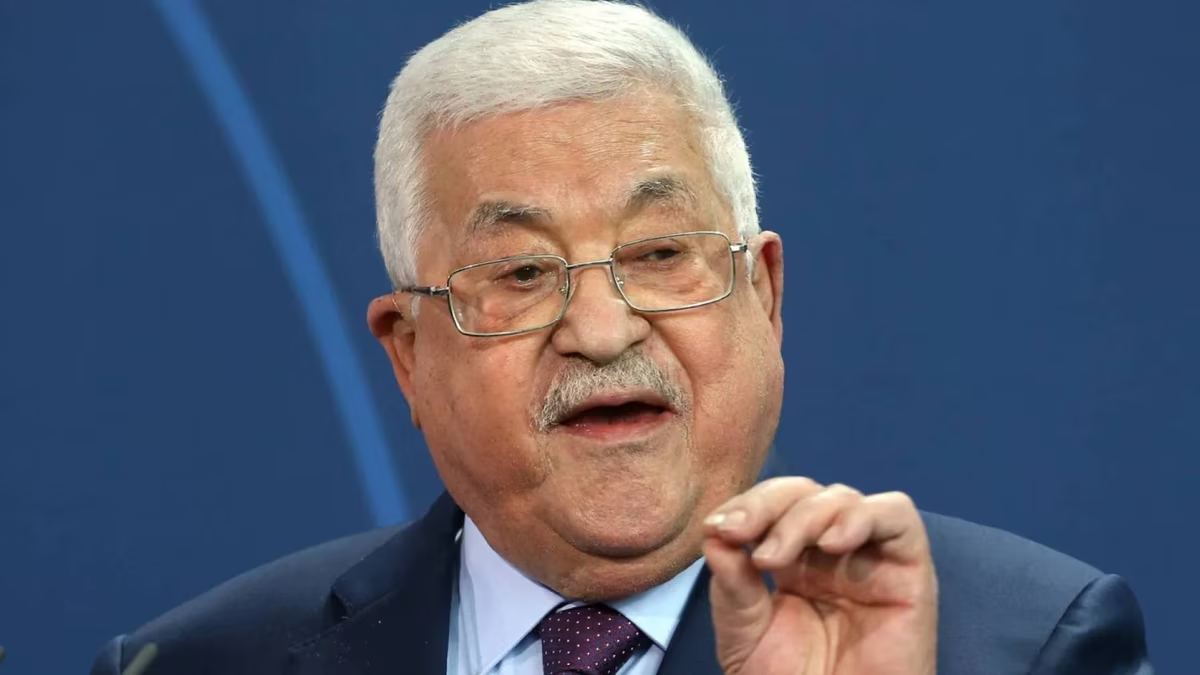
Abbas: Gaza is part of Palestine and a just peace is a regional and international necessity.

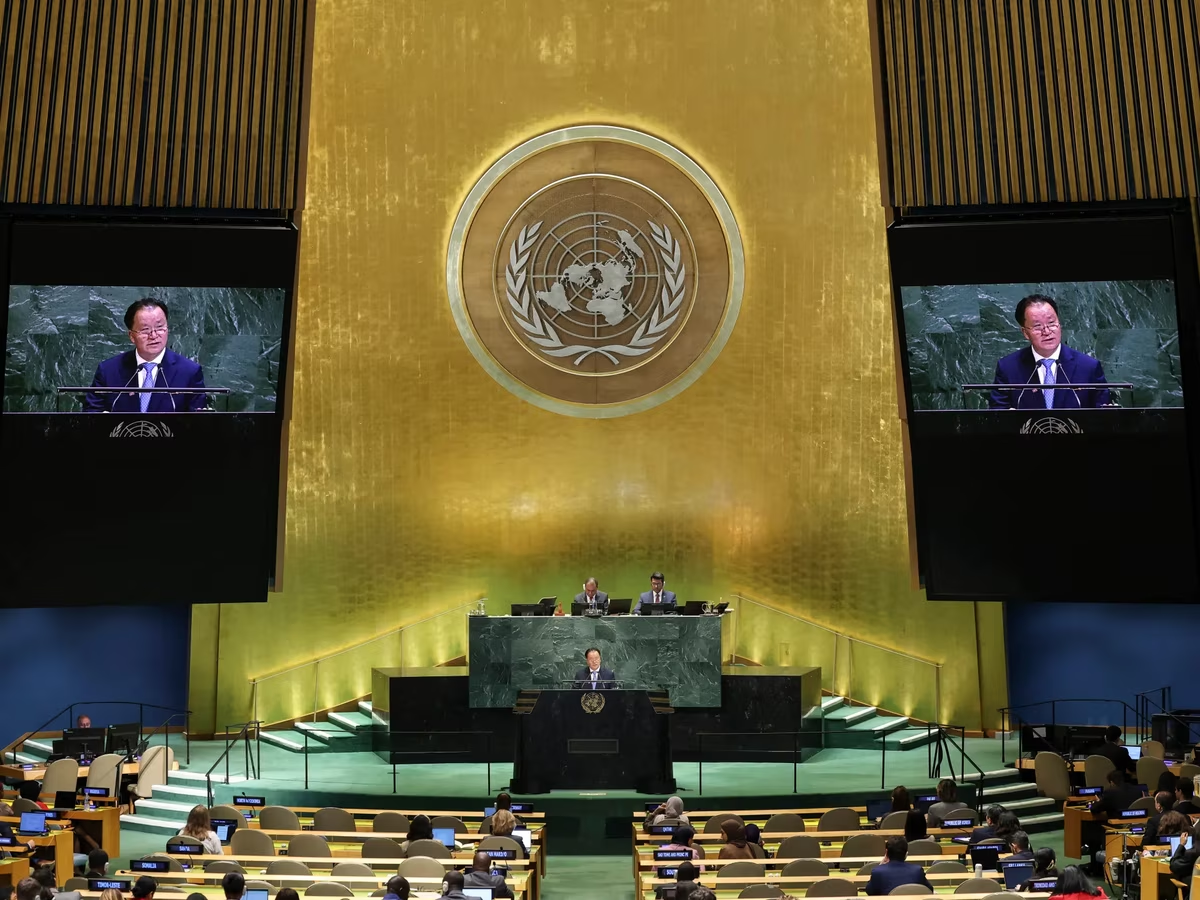
Palestinian President Mahmoud Abbas emphasized on Tuesday that the Gaza Strip is part of the State of Palestine, noting that a just peace is a regional and international necessity. This was stated in a speech on the occasion of the International Day of Solidarity with the Palestinian People, which falls on November 29 each year, delivered on his behalf by the Permanent Representative of the State of Palestine to the United Nations, Riyad Mansour.

Abbas said: "We affirm here that the Gaza Strip is an integral part of the State of Palestine, and that its unity with the West Bank and East Jerusalem is a fixed and non-negotiable right, and that all arrangements during the transitional period must be consistent with the right of the Palestinian people to self-determination and with the unity and integrity of its territories."

Since October 10, an agreement has been reached for a ceasefire between Hamas and Israel, as part of a 20-point plan by U.S. President Donald Trump, which in its initial stages calls for a ceasefire, the introduction of aid, and a prisoner exchange with Hamas. However, Israel continues to obstruct the transition to its second phase by repeatedly violating the terms.

The second phase of the plan includes provisions for managing Gaza through a temporary transitional government composed of a non-political Palestinian technocratic committee, and an economic plan from President Trump for the reconstruction of Gaza. Trump's plan also stipulates that Palestinians should not be forced to leave the Gaza Strip and that Israel should not occupy or annex the territory.

It also states that the United States will work with Arab and international partners to develop a temporary international stabilization force to be deployed immediately in Gaza, and that when the stabilization force is imposed, Israeli forces will withdraw from the territory.

Abbas continued that Palestine will work with the United States and partners in the region and the world "to establish a permanent ceasefire and to launch a political process that ends the occupation and leads to a just and comprehensive peace that ensures security, stability, and prosperity for all countries in the region."

He reiterated "the necessity of a complete Israeli withdrawal from the Gaza Strip, moving towards reconstruction, and for the State of Palestine to assume its full administrative and security responsibilities in the Gaza Strip."

He added: "And to ensure the connection of all institutions and bodies in the Gaza Strip with the Palestinian Authority and state institutions, including the crossings, and to implement the vision of one state, one government, one law, and one weapon."

Abbas addressed in his speech the effects of the genocide in the Gaza Strip and the ongoing violations in the West Bank, including East Jerusalem.

In this regard, he said: "At a time when we are facing these crimes, we are witnessing a growing international momentum in favor of recognizing the State of Palestine, and increasing support for ending the illegal occupation in accordance with the International Court of Justice's ruling and achieving a just and comprehensive peace."

He expressed the State of Palestine's rejection "of the statements and positions issued by senior officials in the extremist Israeli government, which call for racism, persecution, and hatred, and reject the independence of the State of Palestine."

He stated that settlement practices, settler violence, home demolitions, land confiscation, repeated incursions into Palestinian cities, and undermining the institutions of the State of Palestine "are all illegal unilateral steps that undermine the chances for peace."

He called on the United Nations to assume its responsibilities in stopping these practices, ensuring compliance with international law, and providing protection for the Palestinian people.

He said that "a just peace based on international legitimacy has become a regional and international necessity, and the only way to achieve it is to end the occupation completely and to realize the independence of the State of Palestine on the 1967 borders with East Jerusalem as its capital."

In light of the genocide in Gaza, many countries have recognized the State of Palestine, raising the number of countries recognizing it to 160 out of 193 United Nations member states, according to Palestinian foreign ministry data.

The Israeli genocide in Gaza since October 8, 2023, has resulted in more than 69,000 Palestinian deaths and over 170,000 injuries.

Simultaneously, Israeli assaults in the occupied West Bank have escalated, resulting in at least 1,082 Palestinian deaths and around 11,000 injuries, along with the arrest of more than 20,500 individuals, according to official Palestinian sources.

PALESTINE

Tue 25 Nov 2025 10:00 pm - Jerusalem Time

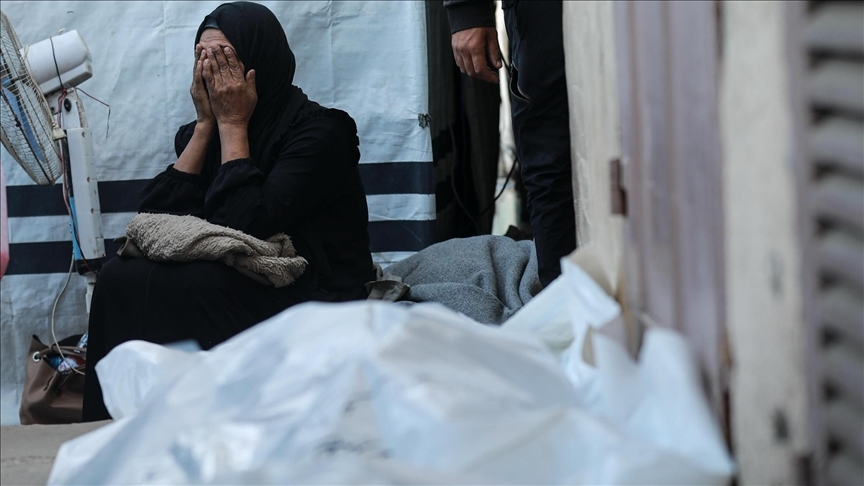
Several Dead by the fires of occupation in Gaza, while the displaced struggle against the cold and floods.

The occupation forces stated today, Tuesday, that they killed 5 militants who emerged from the tunnels in Rafah, and another who they said crossed the yellow line north of the Gaza Strip, while medical sources reported the martyrdom of a Palestinian due to the occupation's fire east of Khan Younis.

A medical source at Nasser Hospital said that a Palestinian was martyred in the town of Bani Suheila east of Khan Younis, while a reporter reported that various areas were subjected to successive attacks, including gunfire from an Israeli drone that resulted in another martyr.

In the central Gaza Strip, the civil defense announced the retrieval of the remains of 14 martyrs from under the rubble of a house in the Al-Maghazi camp, raising the death toll in the past twenty-four hours to 17 martyrs, including those retrieved from under the debris, in addition to 16 injured, according to the Ministry of Health in Gaza.

The ministry raised the death toll since October 7, 2023, to 69,775 and more than 170,000 injured, in a war described as one of the most severe waves of extermination and destruction in the history of the Strip.

Humanitarianly, hundreds of thousands of displaced people are facing extremely harsh conditions with the arrival of a new weather front that flooded the tents housing families in Gaza, Rafah, Deir al-Balah, and Al-Zeitoun.

A reporter observed tents completely submerged along with their contents of mattresses and blankets, where residents appealed to international organizations for urgent intervention to provide shelter supplies, especially with the continued blockade preventing the entry of tents and essential humanitarian materials.

The Gaza municipality stated that its crews are working with limited capabilities to mitigate the effects of the floods, while the government media office confirmed that more than 90% of the existing tents have become torn and unfit for use, warning of an imminent humanitarian disaster.

Meanwhile, international organizations accused Israel of continuing to violate the ceasefire, with the American organization "Jewish Voice" stating that the occupation violated the ceasefire 500 times over 44 days, affirming that "the extermination has not stopped."

Governmental and human rights entities in Gaza documented dozens of violations, including shelling, gunfire, and the demolition of buildings within areas controlled by the Israeli army.

Despite the ceasefire agreement coming into effect on October 10, the airstrikes and military operations continue at an unrelenting pace, amid warnings that the continuation of attacks and the deterioration of humanitarian conditions could push the Strip into a more dangerous phase.

PALESTINE

Tue 25 Nov 2025 8:37 pm - Jerusalem Time

Palestinian President: We will not negotiate about the unity of the Gaza Strip with the West Bank and Jerusalem

The President of the State of Palestine, Mahmoud Abbas, emphasized in his speech on the occasion of the International Day of Solidarity with the Palestinian People that the Gaza Strip is an integral part of the State of Palestine, and that its unity with the West Bank and East Jerusalem is a "fixed and non-negotiable right."

President Abbas affirmed that all arrangements during the transitional period must align with the right of the Palestinian people to self-determination.

This speech, delivered on his behalf by the Permanent Representative of the State of Palestine to the United Nations, Riyad Mansour, comes as "our people continue to face the consequences of the genocide in the Gaza Strip and the ongoing violations in the West Bank."

He pointed to the continuation of the occupation and its policies based on settlement, expansion, annexation, and settler terrorism.

In contrast, Abbas confirmed that this day comes at a time when "we are witnessing a growing international momentum in favor of recognizing the State of Palestine."

He noted that the Arab-Islamic efforts led by Saudi Arabia and the European Union have established "an international coalition to implement the two-state solution."

The State of Palestine renewed its welcome of the peace plan proposed by U.S. President Donald Trump, which was adopted by the Security Council in resolution 2803.

Abbas stressed the necessity of the complete withdrawal of the occupation from the Gaza Strip and for the State of Palestine to assume its full administrative and security responsibilities.

In the context of the principle of unity, the president emphasized the need to "apply the vision of one state, one government, one law, and one weapon."

He also stressed the necessity for all institutions and bodies in the Gaza Strip to be linked to the Palestinian Authority and state institutions, including the crossings, reiterating that Gaza is an integral part of the state.

President Abbas highly appreciated the recognition of the State of Palestine by several European and Caribbean countries, bringing the total number of recognizing countries to one hundred and sixty, and called on other countries to take this courageous step.

The State of Palestine confirmed its "full commitment to implementing all reforms" to strengthen the free, independent, and democratic state, emphasizing that the path to freedom is closer than ever.

PALESTINE

Tue 25 Nov 2025 7:51 pm - Jerusalem Time

Turkish Qatari Egyptian discussions on the latest developments in Gaza

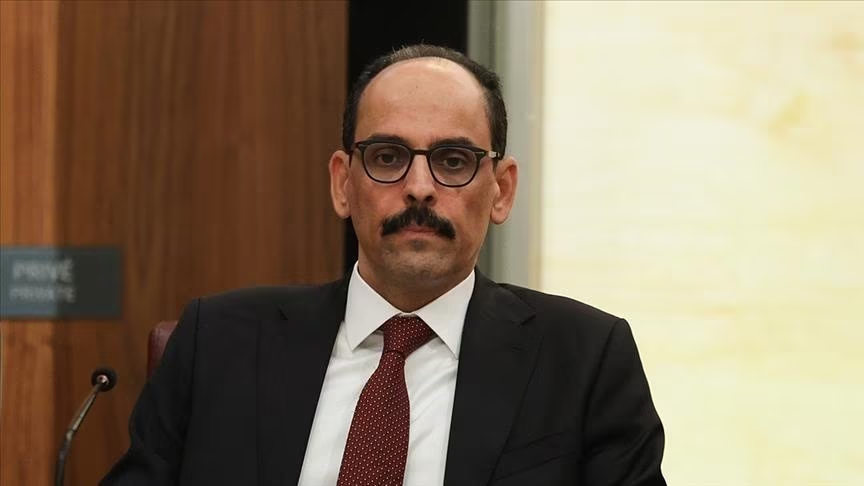
The head of the Turkish intelligence agency, Ibrahim Kalın, discussed the latest developments in the Gaza Strip with the Prime Minister and Minister of Foreign Affairs of Qatar, Mohammed bin Abdulrahman Al Thani, and the Director of the Egyptian General Intelligence, Hassan Mahmoud Rashad.

Security sources reported that Kalın, Al Thani, and Rashad met in Cairo as their countries are guarantor and mediating parties in the ceasefire agreement that began in the Gaza Strip between Israel and Hamas on October 10.

During the meeting, they consulted on moving to the second phase of the ceasefire agreement amid increasing Israeli violations in Gaza, and ways to intensify joint efforts in cooperation with the United States.

It was agreed to continue enhancing coordination and cooperation with the Civil-Military Coordination Center to remove all obstacles and prevent violations to ensure the continuity of the ceasefire.

Kalın affirmed that Turkey will continue to stand by the Palestinian people with all its capabilities, as it has always done in the past.

The ceasefire agreement halted an Israeli genocide against Gaza that began on October 8, 2023, resulting in more than 69,000 Palestinian deaths and over 170,000 injuries, most of whom are children and women, with reconstruction costs estimated by the United Nations at around $70 billion.

PALESTINE

Tue 25 Nov 2025 6:54 pm - Jerusalem Time

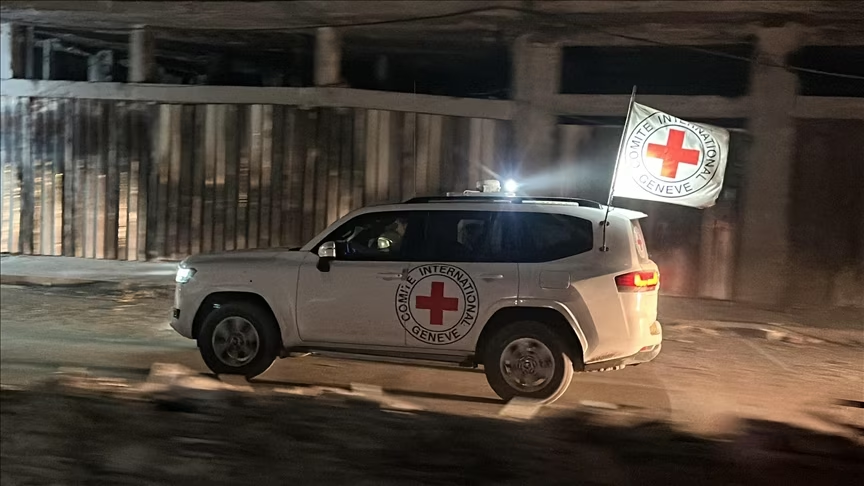
Israel receives the remains of one of its prisoners from the Red Cross in Gaza.

Israel announced on Tuesday evening that it had received the remains of one of its captives from the Red Cross inside the Gaza Strip, and the remains will be transferred to the forensic center to verify the identity of the owner.

A statement from Prime Minister Benjamin Netanyahu's office said: "Israel received, via the Red Cross, a coffin containing the remains of one of the abductees after it was handed over to the Israeli army and the Shin Bet (internal security service) inside Gaza."

It added that the remains will be received in Israel with military honors alongside a rabbi, before being transferred to the National Forensic Medicine Institute of the Ministry of Health to verify the identity of the captive, according to the same source.

The statement continued: "After the verification process of the identity of the remains is completed, his family will be officially notified."

Netanyahu's office concluded by stating: "Efforts to bring back our abductees are ongoing and will not stop until the last abductee returns," as he expressed.

Earlier on Tuesday evening, the Israeli army stated that the Red Cross had received the remains of an Israeli captive.

This came shortly after the announcement by "Al-Qassam Brigades" and "Al-Quds Brigades" of their intention to hand over the remains of an Israeli captive on Tuesday evening, after finding him in the middle of Gaza.

Thus, the Palestinian factions have handed over since the start of the first phase of the ceasefire agreement on October 10, 20 living Israeli captives and the remains of 28 others, which is the total number of bodies they possess, according to their announcements.

However, Israel claimed that one of the bodies it received does not belong to any of its captives, and that another set of remains was not new but rather the remains of a captive whose body had previously been retrieved.

Israel conditions the start of negotiations to launch the second phase of the agreement on receiving the remaining bodies of the captives, while "Hamas" asserts that it takes time to extract them due to the massive destruction in Gaza.

In contrast, there are 9,500 missing Palestinians killed by the Israeli army, and their bodies remain under the rubble of the Israeli genocide, according to the government media office in Gaza.

Additionally, more than 10,000 Palestinian captives are held in Israeli prisons, including children and women, suffering from torture, starvation, and medical neglect, with many of them having died, according to Palestinian and Israeli human rights and media reports.

The ceasefire agreement halted the Israeli genocide against Gaza that began on October 8, 2023, resulting in more than 69,000 Palestinian deaths and over 170,000 injuries, most of whom are children and women, with reconstruction costs estimated by the United Nations at around $70 billion.

PALESTINE

Tue 25 Nov 2025 5:36 pm - Jerusalem Time

Palestine: Israel killed 33,000 women and children in two years.

The Palestinian Ministry of Foreign Affairs stated on Tuesday that 33,000 women and girls have been killed in the Palestinian territories over the past two years due to Israeli violence, in practices considered among the 'most severe forms of discrimination and persecution' against women in the contemporary world.

This was stated in a statement published by the ministry on the occasion of the International Day for the Elimination of Violence Against Women, which falls on November 25 each year. Over the past two years, Israel has initiated a genocide in Gaza that ended with a ceasefire in October 2025, while simultaneously escalating its aggression against the occupied West Bank, resulting in the deaths of tens of thousands of Palestinians.

According to data from the government media office in Gaza, Israel killed more than 12,500 women and over 20,000 children without distinguishing between males and females during the two years of genocide in the sector, contributing to a total death toll exceeding 69,000.

Meanwhile, official Palestinian institutions reported the deaths of 1,080 Palestinians due to Israeli assaults in the West Bank during the same period, without providing statistics on the number of women and children among these victims.

The Palestinian Ministry of Foreign Affairs added that the occupation system practices against Palestinian women 'systematic crimes including genocide, field executions, enforced disappearances, arbitrary detention including administrative detention, torture, sexual violence, house demolitions, land confiscation, settler terrorism, starvation, and intimidation.'

It pointed out that Israeli assaults have also targeted health infrastructure, including hospitals and clinics designated for women, particularly reproductive and mental health services and shelters, depriving thousands of women of access to essential services.

It confirmed that the occupation uses surveillance tools and advanced technology, including artificial intelligence and electronic spying, to 'target and intimidate the Palestinian people, especially women.'

It noted that these practices come at a time when the world raises the slogan 'United to End Digital Violence Against Women and Girls' on this international occasion.

At the national level, the ministry stated that the State of Palestine continues to work on 'entrenching human rights and promoting the rights of women and girls,' through the implementation of human rights agreements and the adoption of policies and plans aimed at combating violence against women, empowering women, and involving them in decision-making positions.

It emphasized the 'necessity of maintaining international momentum to end Israeli colonial occupation, implement the two-state solution, and achieve the legitimate rights of the Palestinian people, including the right to self-determination and return.'

It also called for 'enhancing international legal efforts to hold the occupation accountable for its crimes, and adhering to the legal advisory opinion of the International Court of Justice and relevant UN resolutions, to ensure the protection of the Palestinian people, including men, women, and children.'

In July 2024, the International Court of Justice issued its advisory opinion regarding the illegality of the Israeli occupation and the demand for its immediate termination, as it poses an obstacle to the Palestinian people's ability to exercise their right to self-determination and the independence of their state.

Human rights organizations, including Amnesty International, believe that the failure of the international community to implement international resolutions and the recommendations of the Court's advisory opinion has contributed to Israel's continued disregard for international law and has reinforced its impunity.

LATEST NEWS

Tue 25 Nov 2025 11:57 am - Jerusalem Time

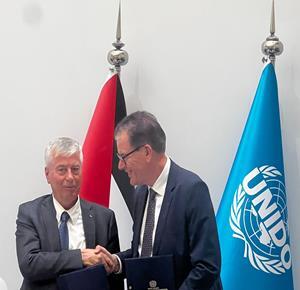
Palestine signs the National Participatory Program Agreement for Industry with the United Nations Industrial Development Organization.

The Minister of Industry, Arafat Asfour, signed the National Participatory Program Agreement for Industry in Palestine during a special event held on the sidelines of the World Industrial Summit – UNIDO General Conference 21 in the Saudi capital, Riyadh.

The agreement was signed on behalf of the United Nations Industrial Development Organization (UNIDO) by its Director-General, Gerd Müller.

The Ministry of Industry stated in a press release issued today, Tuesday, that this agreement comes as a culmination of nearly a year of joint work between the Ministry of Industry and its partners in the public and private sectors, in direct cooperation with UNIDO.

It pointed out that the agreement aims to establish the general framework for cooperation over the next five years and to identify common areas of work that contribute to the implementation of the Palestinian industrial strategy derived from the national industrial policy.

It noted that under this agreement, UNIDO will support the ministry in mobilizing the necessary funding to implement priority national projects, providing technical support, and building the capacities of the ministry and its partners, thereby enhancing the path of sustainable industrial development in Palestine.

Asfour praised UNIDO's efforts and its ongoing support for Palestine, emphasizing the importance of unifying international and Arab efforts to support the Palestinian industrial sector.

The minister called on international partners and Arab brothers to provide support that would enable Palestine to implement the agreement and achieve its goals.

The signing ceremony was attended by several Arab ministers of industry and representatives of industry ministries from brotherly and friendly countries, who affirmed their support for the path of industrial development in Palestine.

PALESTINE

Tue 25 Nov 2025 11:52 am - Jerusalem Time

Rain floods dozens of tents in Khan Younis, with a warning of a humanitarian disaster.

A low-pressure system accompanied by heavy rains caused the flooding of dozens of tents belonging to Palestinian refugees in the Mawasi area of Khan Younis in southern Gaza on Tuesday, amid warnings of a humanitarian disaster.

Eyewitnesses reported that dozens of tents in the Mawasi area of Khan Younis were flooded due to the heavy rainfall brought on by the low-pressure system.

The witnesses added that the rainwater swept away some tents and destroyed them, while others were blown away by the strong winds in those areas, exacerbating the situation for the displaced.

For his part, Khan Younis municipality spokesman Saeb Luqan stated that "the situation in the city is extremely catastrophic due to the destruction caused by the Israeli occupation of most of the road, water, and sewage networks, which has significantly affected the rainwater drainage system."

Luqan explained that 900,000 displaced persons and residents currently living in Khan Younis are facing the low-pressure system, amidst the flooding of tents.

He noted that the Israeli army "has destroyed 220,000 linear meters of road networks, exceeding 90 percent during the years of genocide, amid resource scarcity, limited capabilities, and the inability of municipal crews to deal with this massive destruction."

He pointed out that "the emergency committee crews in the Khan Younis municipality are working with primitive resources and using outdated equipment to save Palestinians, especially those living in tents."

The municipality spokesman described the scene in Khan Younis at the peak of the low-pressure system as "tragic and bleak."

PALESTINE

Tue 25 Nov 2025 11:52 am - Jerusalem Time

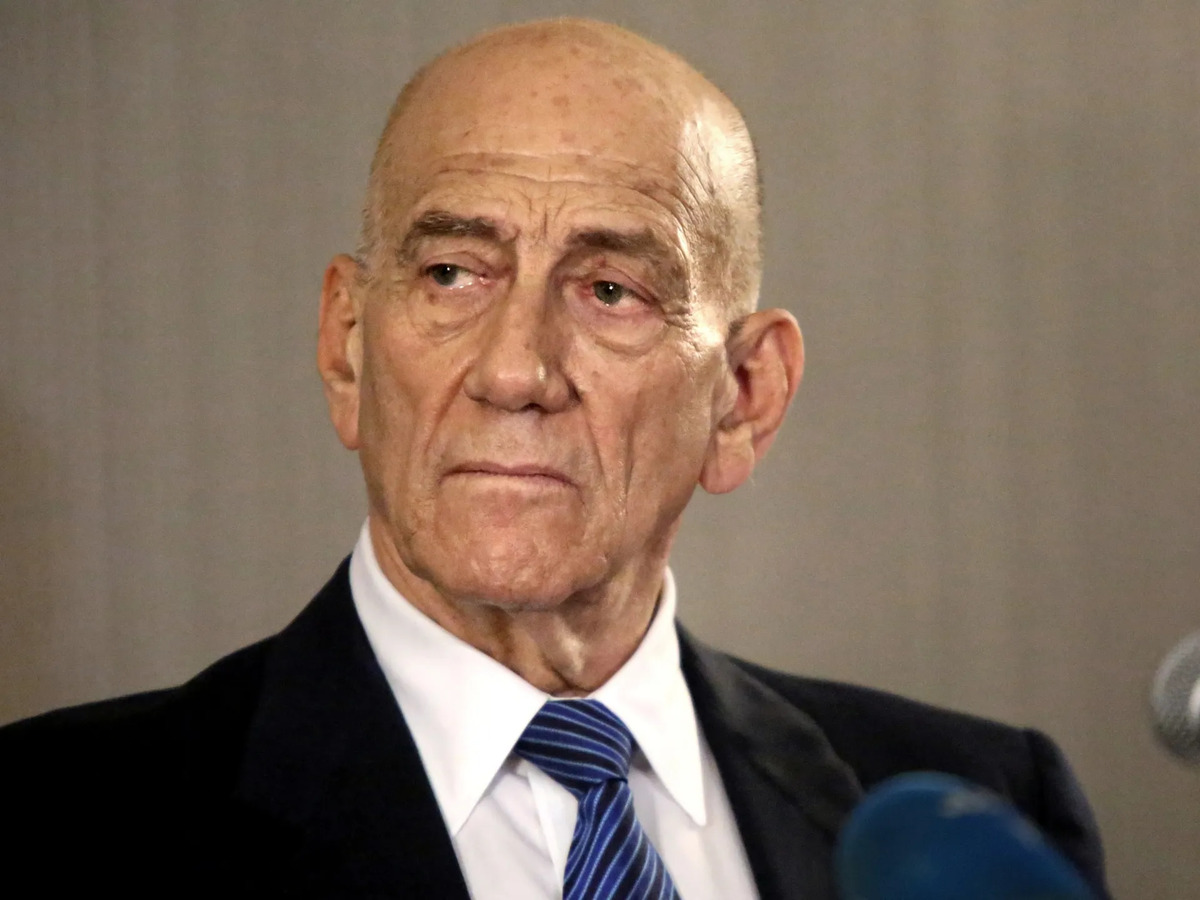
Olmert: With or without Netanyahu, Trump will lead us to a two-state solution.

In an interview with the British Times newspaper, former Israeli Prime Minister Ehud Olmert presented a sharp vision for the future of the conflict in Gaza and Palestine, asserting that the historical shift towards a two-state solution will not come from his successor Benjamin Netanyahu but from U.S. President Donald Trump.

Olmert believes that Trump has a unique influence unmatched by any other world leader, and that his peace plan for Gaza, which was adopted by the United Nations Security Council, has placed the United States in an unprecedented position to impose a comprehensive settlement.

According to Olmert, Netanyahu (wanted by the International Criminal Court) does not dare to challenge Trump for fear of political repercussions, even though he has built his career over the years on rejecting the establishment of a Palestinian state.

The former prime minister points out that if former U.S. President Joe Biden had proposed what Trump is proposing today, Netanyahu would have fiercely attacked him and the Republican Party would have criticized him as well.

Olmert, who is 80 years old, believes that Netanyahu is incapable of leading Israel towards a two-state solution and that his political downfall is only a matter of time, given his trial on corruption charges and the increasing rebellion of the far-right partners within his government.

He describes the current moment in Gaza as fragile, with a tense ceasefire punctuated by repeated Israeli strikes and delays in deploying the international stabilization force.

He considers that maintaining the Gaza agreement is a prerequisite before moving on to address the "Palestinian issue," which he sees as the key to any regional progress, including expanding the Abraham Accords to include additional Arab countries.

Olmert recalls his extensive negotiating experience with the Palestinians, where he offered to establish a state on more than 94% of the West Bank, linking it to Gaza, but he admits that momentum can easily be lost; as happened in 2008 when his last meeting with Palestinian Authority President Mahmoud Abbas failed due to a dispute over the division map.

He remembers that his initiative also collapsed under the weight of corruption scandals that ended his political life.

He states that a similar fate may await Netanyahu, who faces personal and political challenges, including a corruption trial and a battle to maintain the cohesion of the messianic Jewish and far-right nationalist elements in his ruling coalition.

Olmert strongly attacks Netanyahu's far-right partners, describing them as "enemies of the state," and asserting that they will not accept a political direction leading to a Palestinian state.

He adds—in the interview conducted by the newspaper's correspondent in Tel Aviv, Gabrielle Weinger—that Netanyahu lacks principles and that his positions change solely according to his self-interest.

In discussing the war on Gaza, Olmert does not hesitate to direct sharp criticisms at the army and the government, considering that the killing of civilians was "random, brutal, and unchecked."

This has led to hostile protests in Europe, with attempts to pursue legal action on charges of war crimes.

Olmert concludes by emphasizing that the only path to a "less hostile and violent" future is a two-state solution, although he acknowledges that it is not an easy solution.

PALESTINE

Tue 25 Nov 2025 11:42 am - Jerusalem Time

Jerusalem Post: A battle underground in Rafah is nearly undermining the truce in Gaza.

An unexpected battle is taking place underground east of Rafah, where about 200 fighters from Hamas found themselves trapped inside the Israeli-controlled part of the Gaza Strip.

The clash resulted in the deaths of 11 fighters and the arrest of 6 others, prompting Hamas to threaten to withdraw from the ceasefire agreement.

The two American envoys tried to persuade Netanyahu to allow the fighters to exit, but the proposal sparked a division within the Israeli government.

ARAB AND WORLD

Tue 25 Nov 2025 10:48 am - Jerusalem Time

Trump accepts Xi's invitation to visit China and praises the strong relations with it.

U.S. President Donald Trump praised the strength of relations with China, describing them as "very strong," following a phone call with his Chinese counterpart Xi Jinping that addressed the Taiwan issue, according to the Chinese Foreign Ministry.

Trump stated in a post on Truth Social, "Our relationship with China is very strong; this call was a follow-up to our very successful meeting in South Korea three weeks ago," noting that he accepted Xi's invitation to visit Beijing next April, while the Chinese president is expected to visit the United States later in 2026.

For its part, the Chinese Foreign Ministry said the call focused on the future of bilateral relations and trade issues between the two countries, in addition to the Ukrainian file, but the largest focus was on Taiwan.

The ministry added that the Chinese president emphasized during his call with Trump that "Taiwan's return to China" is a fundamental part of Beijing's vision for the international system after World War II, asserting that China and the United States "have worked together in the past to protect the international system, and they must continue to do so today."

Trump did not mention the Taiwan issue in his post on Truth Social.

White House spokesperson Caroline Levitt announced that the call, which lasted about an hour, addressed issues of trade, Ukraine, fentanyl, and U.S. agricultural products, stating that Washington is "satisfied with the pace of progress," and that Beijing "shares the same sentiment."

The call comes weeks after the two leaders met in Busan, South Korea, where they agreed on a framework for a trade agreement that includes Washington suspending 100% tariffs on Chinese imports in exchange for Beijing delaying the implementation of a licensing system for exporting rare earth metals.

The agreement also stipulates a reduction in U.S. tariffs and China purchasing at least 12 million tons of U.S. soybeans this year, and 25 million tons in 2026.

Military response threat Beijing considers the democratic island part of its territory and has not ruled out the use of force to subdue it, while Taiwan rejects Beijing's claims, stating that the people of Taiwan are the only ones who can determine their future.

Although it does not support Taiwan's independence, Washington is the largest supplier of weapons and military equipment to the island.

Japanese Prime Minister Sanae Takaichi hinted at the possibility of a military response if Taiwan is attacked by China, while Beijing warned—in a message delivered to the UN Secretary-General—of a firm response if Japan intervenes militarily in the Taiwan Strait.

Chinese Foreign Ministry spokesperson Lin Jian stated that the Japanese Prime Minister's remarks are provocative and blatant, warning that Beijing would deliver a "direct and severe blow" if Japan dared to intervene militarily.

The escalation between the two sides peaked after the Chinese Consul General in Osaka, Xiu Jian, posted threats that reached the point of hinting at killing Takaichi, before later deleting them from his account on the X platform.

Chinese Defense Ministry spokesperson Jiang Bin described the Japanese Prime Minister's words regarding any Chinese attack on Taiwan as irresponsible and extremely dangerous.

Jiang added in a statement, "If the Japanese side does not learn lessons from history and dares to take risks, or even use force to intervene in the Taiwan issue, it will only face a crushing defeat at the hands of the steel-willed People's Liberation Army and pay a heavy price."

OPINIONS

Tue 25 Nov 2025 9:19 am - Jerusalem Time

In the scene of policies and humanitarian positions: Christian churches alongside Gaza

Consultant Dr. Ahmed Youssef

Consultant Dr. Ahmed Youssef

Opinion Writer

The genocide war on the Gaza Strip has revealed a profound shift in the positions of Christian churches, both East and West, towards the Israeli aggression and its brutal policies. It seems that the global Christian conscience can no longer remain silent in the face of the killing, starvation, and systematic destruction faced by Palestinian civilians. Amid speeches defending justice and human rights, and others that appeared captive to political pressures and lobbies, the overall Christian scene emerged more consistent with the values of mercy and truth.

In the East, the Orthodox and Catholic churches issued firm positions condemning the bombing of churches and monasteries and targeting civilians, considering what is happening to be a “systematic assault on religious and humanitarian centers.” In a very clear statement, Patriarch Pierbattista Pizzaballa, head of the Catholic Church in Jerusalem, said:

 “What is happening in Gaza transcends the limits of human pain, and this violence cannot be justified under any pretext.”

In Egypt and Jordan, the Coptic Orthodox Church and church councils emphasized that the continued targeting of civilians and the closure of humanitarian corridors represent a blatant violation of spiritual and religious values, calling for urgent international action to stop the bloodshed.

As for Palestinian Christians, they were at the heart of the event and the first line of moral defense. Amid the bombing and siege, monasteries and churches opened their doors to shelter hundreds of Muslim and Christian families, providing what they could in terms of food and shelter. Since the early weeks of the war, Archbishop Atallah Hanna stated:

 “We do not see a war in Gaza; rather, we see an attempt to exterminate an entire people, and the silence of the world is an additional crime.”

The stance was not limited to church leaders; influential Palestinian voices also emerged, the most prominent of which was Father Manuel Musallam, who said in an emotional message addressed to the world:

 “Children in Gaza are being slaughtered in front of the world, and the church that stands with the oppressed human is the church that truly resembles Christ.”

This discourse reflects an authentic Christian spirit that transcends political debates, based on a value system that sees the human being as a dignified creature that must be protected regardless of their identity or religion.

In the West, the positions were more complex, but they were not devoid of courageous and strong voices. In the United States, a gathering of progressive bishops issued a notable statement in which Bishop Thomas Gomez said:

 “The church cannot remain neutral while the homes of the innocent are being bombed. Our faith does not allow us to justify injustice, no matter who perpetrates it.”

Progressive Protestant churches also adopted supportive positions for Palestinian rights, calling for an end to military support for Israel, and some even voted in favor of divesting from companies involved in settlements and violations, in a move considered a significant shift in the Western Christian stance.

In Europe, clear statements were issued by churches in Britain, Germany, and the Scandinavian countries, holding Israel responsible for targeting civilians, and clergy participated in popular demonstrations supporting Gaza, affirming that the church's silence is a “betrayal of Christian principles.”

Despite this general trend, some evangelical denominations in the United States – including figures within successive administrations – formed a notable exception with their unconditional pro-Israel positions, relying on theological narratives that contradict shared human and faith values. Nevertheless, these voices remain outside the general context of the Christian stance, which is becoming clearer and more aligned with Palestinian human rights.

In contrast, influential Christian figures emerged globally, such as British nun Helida Dixon and theologian Cornel West, who described what is happening in Gaza as a “moral collapse of the West.” Latin American countries, especially Brazil and Chile, witnessed widespread church positions calling for an end to the war, influenced by the historical presence of the Palestinian Christian community there.

These positions – despite their diversity – reveal that churches are not a homogeneous block, but they converge around a fundamental ethical axis: rejecting injustice, acknowledging human suffering, and calling for the protection of innocents. Between East and West, a growing trend towards solidarity with the Palestinian people is emerging, not as a political conflict, but as a test of the world's conscience and the principles upon which Christianity itself is based.

The tragedy of Gaza has put the Christian conscience to a real test, and it has become clear that wide sectors of Christians see what is happening as a moral tragedy that cannot be ignored. As the voices against genocide grow, it seems that churches today have become part of a global movement for justice and human dignity, reaffirming that mercy is not just a slogan, but a moral commitment that governs positions and policies.


PALESTINE

Tue 25 Nov 2025 9:02 am - Jerusalem Time

A survey reveals the expansion of thoughts about migration within the Israeli occupation.. Secularists at the forefront.

Israeli journalist Sami Berts revealed in an article published in the Israeli newspaper "Haaretz/The Marker" new data indicating an increase in the number of Israelis considering leaving the country, contrasted by a significant decline in this trend within the Haredi community, despite the intense pressures this community has faced since the beginning of the war, particularly regarding the conscription of its youth into the army.

Despite the media uproar and threats issued by Haredi leaders, led by former Chief Rabbi Isaac Yosef regarding the possibility of leaving the country, the reality is quite different, as the figures show that a very small percentage of Haredim are actually contemplating departure.

According to the results of a recent survey conducted by the "Viterbi" Center for Public Opinion and Policy Research at the Israeli Democracy Institute, only 3 percent of Haredim are considering emigration, the lowest percentage among various social groups.

The percentage of secular individuals considering leaving stands at 39 percent, the highest ever, while 24 percent of non-religious traditionalists express a similar desire, compared to 19 percent of religious traditionalists, and 14 percent of the religious.

On a national level, it appears that 30 percent of Arabs are thinking about leaving, compared to 26 percent of Jews, while the percentage of those seriously considering departure shrinks to 9 percent among Arabs and 6 percent among Jews.

Berts points out that the discourse on emigration, which has intensified since the judicial coup attempt in January 2023, is no longer just a general sentiment but has transformed into a tangible trend supported by official figures.

Data from the Central Bureau of Statistics showed that 143,000 Israelis left the country between 2023 and 2024, while about 200,000 people have left since the current government was formed, of whom nearly 69,000 have returned.

However, the bureau did not provide clear data regarding the identities or demographic characteristics of those leaving, nor about the intentions of those considering emigration without having executed it yet.

The survey results, which included 720 Jews and 187 Arabs, reveal that thoughts of emigration are more prevalent among younger groups, secular individuals, high-income earners, and those with academic education, along with professionals working in mobile sectors such as technology, medicine, and finance.

The data shows that 29 percent of Jews with academic education are considering leaving, while the percentage rises to 38 percent among Arabs, compared to 22 percent among those without higher education in both communities.

Although high-income earners and those with higher education are clearly prominent in the list of those wishing to leave, the cost of living remains the most influential factor in the Jewish community, followed by concerns about the future of children, security during the war, then the political situation and the nature of the government, in addition to feelings of inequality in bearing the military burden.

Cultural alienation ranks low on the list of motivations, while concerns about the future of children top the list of reasons for wanting to leave among Arabs, followed by the high cost of living.

Conversely, the survey results show that those who do not consider leaving the country rely on completely different motivations, primarily the desire to stay close to their families, to raise their children as Israelis, and the feeling of mutual security within the Israeli occupation, while it seems that the difficulty of adapting in other countries is the least of their concerns.

The survey also reveals a surprise regarding the preferred destinations of those planning to leave, as both Jews and Arabs prefer to move to European countries by a much greater margin than towards the United States or Canada.
Berts suggests that many Israelis holding European nationalities may be an important factor in this inclination.

The survey was conducted under the supervision of Dr. Lior Yohanan, Professor Tamar Herman, and Ina Orly Sabujnikov, while statistical analysis was carried out by Yaron Kaplan and Maxim Kaplan.