PALESTINE

Mon 15 Dec 2025 3:41 pm - Jerusalem Time

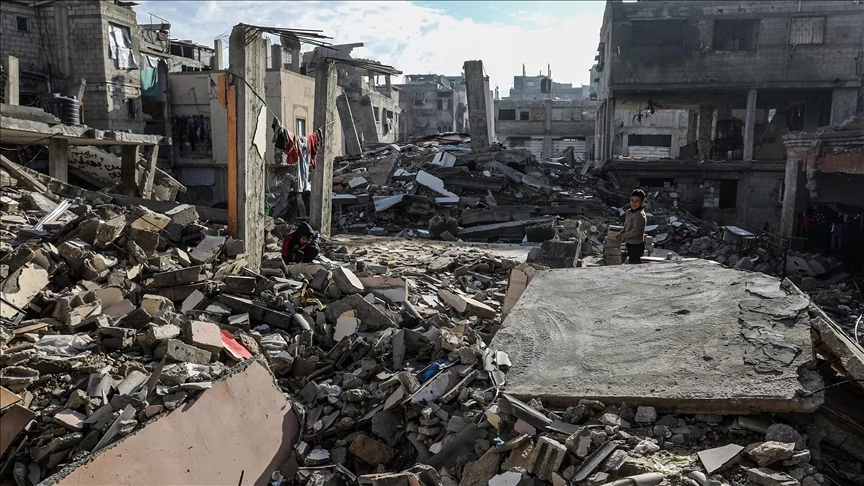
Rise in the toll of victims of the Israeli genocide in Gaza to 70,665 killed and 171,145 injured

The Ministry of Health in the Gaza Strip announced on Monday that the toll of victims of the Israeli genocide has risen to 70,665 killed and 171,145 injured since October 2023.

This came in the ministry's daily report on the statistics of the genocide committed by Israel in Gaza over two years starting from October 8, 2023.

The ministry stated: "Two new martyrs arrived at Gaza Strip hospitals, and 6 injuries during the past 24 hours."

The ministry did not provide additional details regarding the locations or circumstances of the killings and injuries, but Israel continues to violate the ceasefire agreement by targeting civilian areas and shooting at Palestinians.

The ministry indicated that 393 Palestinians were killed, and 1,086 were injured, in addition to the recovery of 632 bodies, since the start of the ceasefire agreement between Israel and Hamas on October 10 last year.

Regarding the statistics of the Israeli genocide, the ministry stated that the number of Palestinian deaths has risen to 70,665, while the number of injured has reached 171,145.

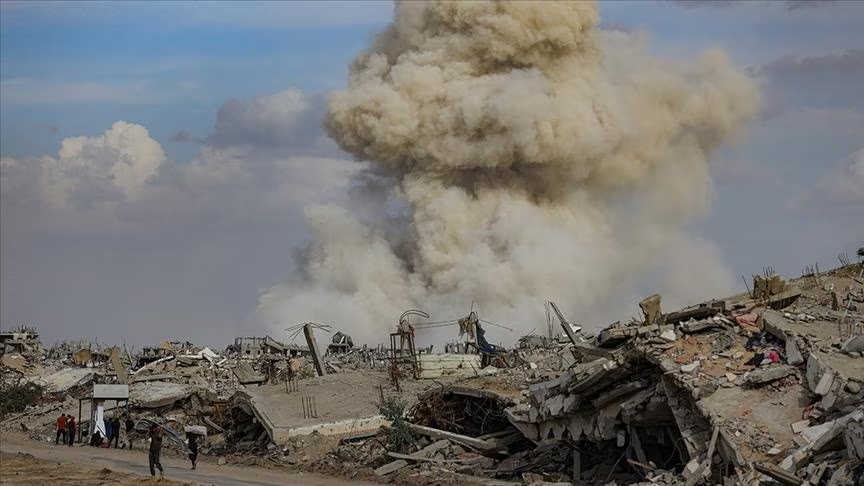
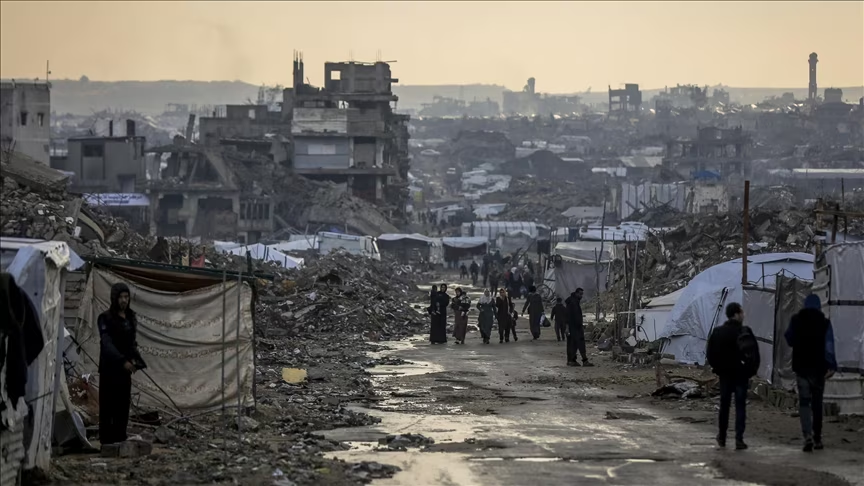
In addition to the victims, the Israeli genocide has left massive destruction affecting 90 percent of the infrastructure in the sector, with reconstruction costs estimated by the United Nations at around 70 billion dollars.

PALESTINE

Mon 15 Dec 2025 2:41 pm - Jerusalem Time

European Commissioner: Aid to Gaza must flow like a torrent, not drop by drop

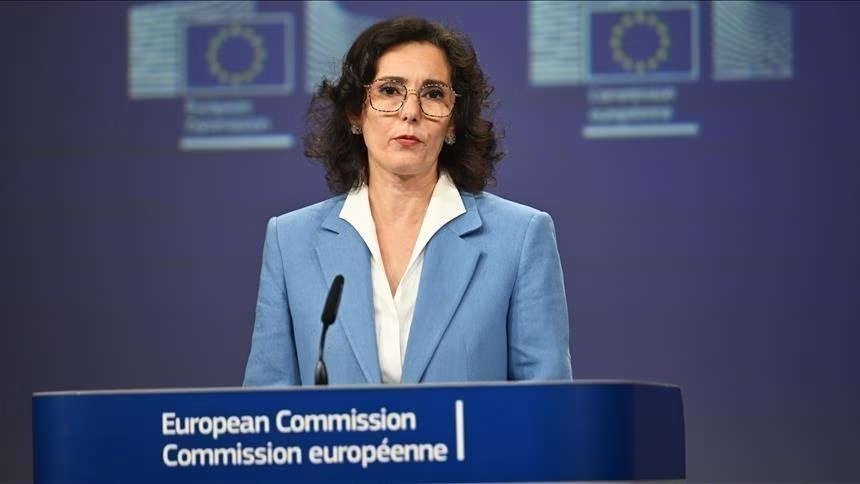
The European Union Commissioner for Equality, Preparedness, and Crisis Management, Hadja Lahbib, said that humanitarian aid to the Gaza Strip "must flow like a torrent, not drop by drop."

This came in a talk to journalists on Monday, during a meeting of European Union foreign ministers in Brussels, where she addressed the Israeli restrictions imposed on the entry of aid into Gaza.

Lahbib noted that Palestinians are still being killed daily despite the ceasefire agreement.

She pointed out that she visited Egypt two weeks ago and was not allowed (by Israel) to enter Gaza, and to the detention of hundreds of aid trucks at the Rafah border crossing.

Lahbib had previously stated that she intended to enter Gaza during her visit to Egypt, but Israel rejected her request to cross.

She emphasized that relief workers face many administrative obstacles to deliver aid to the sector.

She noted that needs in Gaza increase particularly during the winter months, and added: "Aid to Gaza must flow like a torrent, not drop by drop."

Despite the ceasefire in effect since October 10, which Israel continues to violate, the living reality for Palestinians in Gaza has not improved due to the strict restrictions Israel imposes on the entry of aid trucks, violating the humanitarian protocol of the agreement.

On the Syrian front, Lahbib said that humanitarian aid for Syria will also be discussed during the meeting.

She indicated that 16 million people in Syria still need assistance.

She mentioned that they will discuss ways to increase their contributions in Syria through humanitarian aid and development.

ARAB AND WORLD

Mon 15 Dec 2025 1:35 pm - Jerusalem Time

The American envoy arrives in the occupying state to meet Netanyahu in a sensitive visit

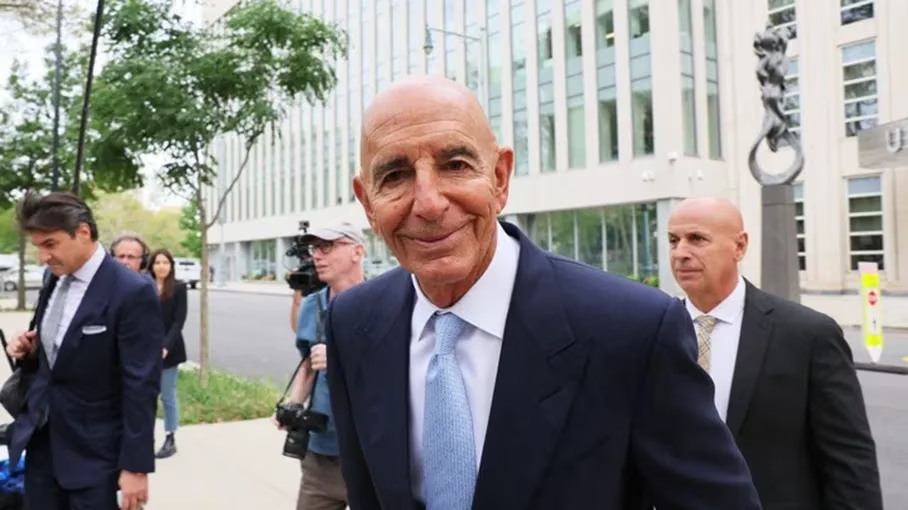
The American envoy and U.S. ambassador to Turkey, Tom Barak, arrived in the occupying state on Monday to meet Prime Minister Benjamin Netanyahu in a visit described as sensitive and multifaceted.

Barak will meet with Netanyahu and senior political and security officials amid increasing American pressure to move to the next phase of President Trump's plan in the Gaza Strip, ongoing tensions in Lebanon, and open question marks in the Syrian arena.

Operationally, this visit was described as preparatory for a meeting between Netanyahu and Trump scheduled for the end of the month in Miami, and it was said that in this sense, Barak is not coming "to listen", but to verify the extent of "Israel"'s readiness to move.

Regarding Lebanon and Hezbollah's weapons, Washington expects concrete steps from Beirut, manifested in strengthening the Lebanese army's control in the south, limiting Hezbollah's freedom of movement, and showing readiness to assume security responsibility.

This meeting focuses on Gaza and the transition to the second phase, which is supposed to allow the temporary and fragile ceasefire to pave the way for a secure and permanent security and political arrangement. The model promoted by the United States includes establishing an international stabilization force, under American leadership, that enables the gradual disarmament of Hamas and the formation of an alternative government.

It is said that the international force is under discussion between America and "Israel", especially regarding Turkey's participation, as Barak believes that Turkey should be part of the stabilization force, given its military capabilities and channels of influence in Gaza. In "Israel", this is considered a red line. Politically and security-wise, no entity with ties to Hamas can be considered a stabilization force, and its inclusion in the international framework could undermine the fundamental purpose of this step. According to the newspaper.

PALESTINE

Mon 15 Dec 2025 1:05 pm - Jerusalem Time

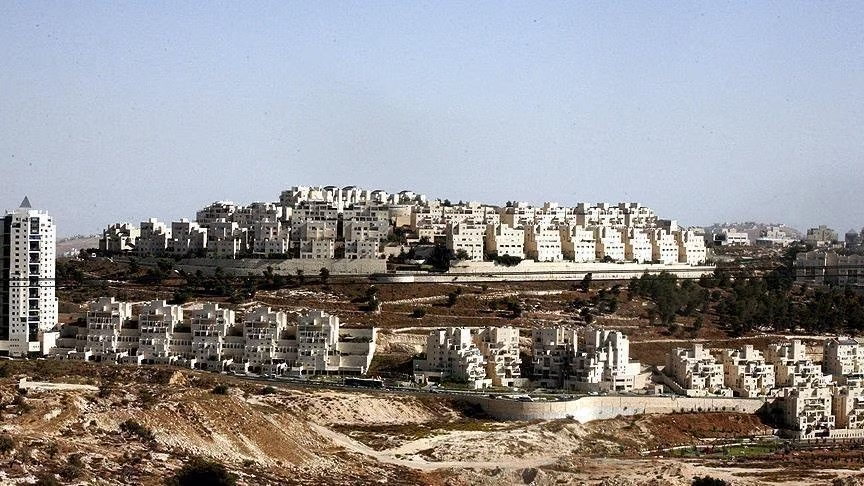
Jerusalem Governorate Warns of Israeli Plan to Establish 9,000 Settlement Units North of the City

On Monday, the Jerusalem Governorate warned of a "dangerous" Israeli plan that Tel Aviv intends to implement on the airport lands and adjacent areas north of the city, including the establishment of 9,000 settlement units.

The governorate stated in a statement: "The Israeli occupation authorities are seeking to implement a dangerous settlement plan on the lands of Jerusalem International Airport and adjacent areas."

It considered the plan a "direct threat to the geographical and demographic continuity of Palestinians between Jerusalem and the city of Ramallah (center of the occupied West Bank)."

It confirmed that the plan "aims to establish about 9,000 settlement units in densely populated Palestinian areas, including Kafr Aqab, Qalandiya, Al-Ram, Beit Hanina, and Bir Nabala, which deepens the policy of separation and isolation imposed on the city and its surroundings, and undermines any political horizon based on the two-state solution."

The governorate warned that "the so-called Israeli District Planning and Construction Committee intends to hold a session on Wednesday to discuss advancing the plan, which may include approving the basic principles of the project, including allocating commercial and public spaces."

It also noted that "the Israeli Ministry of Finance recently requested approval from the Knesset Finance Committee (Parliament) to transfer 16 million shekels (about 5 million dollars) to the Ministry of Environmental Protection, under the pretext of rehabilitating polluted lands, including Jerusalem International Airport, in a step that practically accelerates the implementation of the settlement project."

The Jerusalem Governorate warned that implementing the plan "will lead to the creation of a settlement enclave that separates northern Jerusalem from its Palestinian surroundings."

It confirmed that it "will continue to expose the plan and address the international community and human rights institutions as a blatant violation of international law and decisions of international legitimacy."

The Palestinian governmental Anti-Wall and Settlement Resistance Commission had spoken in a previous report about Israel's seizure of 2,800 dunams in the West Bank during last November, "through orders of placing hands and expropriation and amending state land boundaries."

Israel's devouring of the West Bank and then formally annexing it to it would end the possibility of implementing the principle of the two-state solution stipulated in resolutions issued by the United Nations.

This comes amid escalating attacks by the army and settlers in the West Bank and Jerusalem coinciding with the start of Israel's genocide war in Gaza on October 8, 2023, which lasted for two years and ended with a ceasefire agreement that entered into force last October.

Since the start of the Israeli genocide, the army and settlers have killed 1,094 Palestinians in the West Bank and injured about 11,000 others, in addition to arresting more than 21,000.

PALESTINE

Mon 15 Dec 2025 12:37 pm - Jerusalem Time

Settlers storm Al-Aqsa and a child injured in clashes in the West Bank

A group of settlers stormed the Al-Aqsa Mosque this morning, Monday, from the direction of Bab al-Maghariba, and carried out provocative tours in its courtyard, while a Palestinian child was injured in clashes with Israeli occupation forces in Jalazone camp in the center of the occupied West Bank.

The settlers also performed Talmudic prayers in the Al-Aqsa courtyard under the protection of the occupation police.

Jewish groups known as "Temple Mount" groups had called for intensifying the incursions during the Jewish Festival of Lights "Hanukkah".

Occupation forces arrested 22 Palestinians at dawn today, Monday, following raids and incursions they carried out in various areas of the West Bank.

A child was injured by bullets from occupation forces during the clashes in Jalazone camp north of Ramallah.

Clashes erupted in the town of Jareer and the village of Aaboud north-east and west of Ramallah city amid gunfire and sound and gas bombs.

It indicated that there is a campaign of harassment and detention of children and youth in the village of Aaboud, without reports of arrests or raids.

For its part, the Palestinian News Agency reported that the Israeli army raided the Jabal al-Taweel neighborhood in the city of Al-Bireh in the Ramallah and Al-Bireh governorate.

The agency indicated that the army fired bullets and toxic gas bombs, without reports of injuries or arrests.

It continued that the raid also targeted the town of Turmus Ayya and the village of Kafr Malik north-east of Ramallah city.

In Hebron, occupation forces arrested 3 Palestinians after searching their homes, tampering with their contents, and assaulting them with severe beatings.

Occupation forces raided the city of Hebron and the towns of Beit Awa and Halhoul, raided several homes, detained their owners, assaulted them with severe beatings, searched their homes, and wreaked havoc on their contents.

They also set up several military checkpoints at the entrances to Hebron and its towns, villages, and camps, and closed a number of main and secondary roads with iron gates, concrete blocks, and earthen barriers.

In Jenin, occupation forces left destruction and devastation after raiding a house and arresting a number of young men during the raid on the town of Jaba to the south.

Likewise, occupation forces carried out a campaign of raiding citizens' homes in the town of Awarta south of Nablus, arrested some of them, and settlers' buses accompanied by occupation vehicles raided the town of Awarta south of Nablus.

On another front, Youssef Fanadqa, deputy head of the Popular Committee in Nour Shams camp, said that about 1907 displaced families are currently living in rented apartments distributed across various areas of Tulkarm governorate, lacking the minimum necessities of life, amid heavy financial burdens due to high rental costs.

He added that no less than a thousand residential apartments were completely demolished by the occupation in Nour Shams camp, in addition to hundreds of homes that suffered partial damage, as part of a systematic destruction policy targeting the camp and its residents.

Since the start of the Gaza war on October 7, 2023, the Israeli occupation army has intensified its military operations in the West Bank, and the army and settlers' assaults in the West Bank have led to the martyrdom of no less than 1094 Palestinians and the injury of about 11,000 others, in addition to the arrest of more than 21,000, according to official Palestinian figures.

OPINIONS

Mon 15 Dec 2025 10:35 am - Jerusalem Time

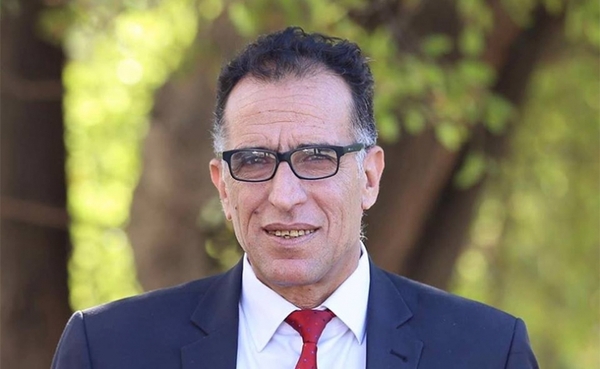
Between Hype and Reality: Is the Gap Really Widening Between Israel and the United States?

Mustafa Ibrahim

Mustafa Ibrahim

Opinion Writer

In recent days, the analytical scene has been dominated by a wide wave of articles and assessments talking about an “unprecedented crisis” between Israel and the administration of US President Donald Trump, and about an imminent confrontation with Benjamin Netanyahu over the second phase of the Gaza plan. These analyses, despite their varying tones, share one assumption: that Washington is on the verge of imposing facts on Israel, and that Netanyahu stands before a decisive moment between submission or isolation.

However, this discourse, when subjected to calm examination, seems closer to Israeli political and media hype than to a realistic description of the balance of power or the nature of the American-Israeli relationship, which has historically proven its ability to absorb differences and turn them into management tools, not into a rupture or strategic clash.

The first paradox lies in the stark contradiction within these analyses themselves. The commentators who warn of “Trump's anger” and “Washington's patience running out” are the same ones who acknowledge that the American administration has not yet formed an effective international force, has not secured clear funding for reconstruction, and has not developed a practical mechanism for disarming Hamas or ensuring the contours of “the day after” in Gaza.

If Washington is incapable of producing tangible executive tools, how can it impose decisive dictates on Israel?
And if the American plan itself is faltering, where does that “deep gap” that is said to be widening lie?

In the same context, the assassination of Riad Saed is presented as evidence of Israel's challenge to Trump's will, but this description ignores a fundamental fact: Israel has never stopped testing the limits of American patience, neither in Gaza nor in Lebanon nor in the West Bank. The assassination does not represent a coup against the relationship, but a calculated tactical message: to Washington, that Israel still retains a margin for military and security action, and to the Israeli interior, that the leadership has not relinquished its tools of power. The American reaction so far confirms this understanding, as it has not exceeded the limits of verbal reservation, reflecting the continuation of the rule of “managed disagreement” rather than open confrontation.

The talk of a “strategic rift” ignores the deep structure of the relationship between the two sides. The United States does not view Israel as a party that can be dispensed with or pressured to the point of collapse, but as a fundamental pillar in its regional influence system. In return, Israel understands that Washington is not a neutral mediator, but a biased partner that sometimes disagrees with it on the method, not on the essence.

The current disagreement revolves around managing the phase, not the final goal. Washington wants politically marketable progress internationally, while Israel wants to maintain the upper hand security-wise. This is not a zero-sum equation, but a space for ongoing negotiation, where differences are managed rather than resolved.

Some Israeli analysts portray Netanyahu's upcoming visit to Washington as if it were a historic moment of submission, while reality indicates that it is closer to a session to bridge the gaps between ambitious American rhetoric and a complex field reality. Trump does not yet have practical answers to the questions Netanyahu will raise: Who controls? Who pays? Who enforces disarmament? And who guarantees no return of chaos? In the midst of this vacuum, the ability to pressure turns into the ability to persuade, a space in which Netanyahu excels at maneuvering, especially if he relies on the faltering of the American plan itself.

As for the transition to the second phase, it is presented as a political breakthrough, but in reality, it may be a reproduction of the crisis in a different form. It is a phase based on fragile balances, incomplete understandings, and international forces whose form of participation or ability to influence has not yet been decided. From here, it does not appear that the American-Israeli disagreement has reached the level of confrontation, but rather a disagreement on the speed of steps and their sequence, whose severity is inflated media-wise – especially by Israeli opposition analysts – more than it is actually manifested on the ground.

However, the most dangerous thing in this analytical debate, and in the mutual hype about the “gap” between Washington and Tel Aviv, is that it is happening while Gaza pays the full price. While American-Israeli differences are managed as differences in method or timing, Israel is practically given wide freedom to continue military operations, delay withdrawal, and disrupt reconstruction, under the cover of joint American-Israeli plans that do not aim to stop the crime, but to organize it and prolong its duration.

The talk of American pressure becomes, in this context, political deception. The United States does not pressure to stop the killing, but negotiates on its form, ceiling, and timing. It does not differ with Israel on the essence of what is happening in Gaza, but on how to market it internationally, how to manage its political cost, and who bears the burden of “the day after” without affecting Israel's freedom of military action.

In this sense, the “managed disagreement” is not a flaw in the relationship, but part of its function. It is the mechanism that allows the continuation of genocide without breaking the alliance, and the continuation of support without bearing direct responsibility. Washington waves pressure, Israel shows reluctance, while Gaza is left to pay the price alone: with killing, starvation, destruction, and an open delay for any political or humanitarian horizon.

In conclusion, the gap between Israel and the United States does not appear to be widening as portrayed. It is more rhetorical than political, used in the media for pressure, in politics for bargaining, and in analysis to fill the void of the absence of solid data. As for the relationship itself, it is still governed by a fixed rule: Israel is a constant in American policy, disagreements are manageable, while interests are unbreakable. Between hype and simplification, the most important question is lost: not whether Washington will pressure Israel, but how this pressure will be managed without changing the essence of the existing equation, and without stopping Gaza's bleeding.

ARAB AND WORLD

Mon 15 Dec 2025 10:09 am - Jerusalem Time

Growing Cultural and Academic Isolation for 'Israel' Despite Economic Recovery and Arms Deals

Despite the cessation of the genocide in the Gaza Strip, the repercussions of the war reveal that 'Israel' continues to face growing isolation in cultural and academic fields, where boycotts persist and soft power erodes, while the economy and arms deals have returned to a near-normal path.

In an article by Israeli journalist David Rosenberg, he stated that 'there is no doubt that the announcement by four countries last week of their boycott of the Eurovision Song Contest this year in protest against Israel's war on Gaza came as a shock to many Israelis. A fifth country joined them on Wednesday, and a sixth may join later.'

Rosenberg added that 'for Israelis, the war is over, and no matter how fierce the fighting was, they are ready to move forward. There is ongoing debate about how to investigate the October 7 disaster, and the army has conducted two internal investigations, but almost no one is talking about studying how the army itself waged the war. It is history left for historians to study someday, not something occupying our present.'

He explained that 'but the Gaza war remains strongly present in many places outside Israel. As mentioned by the Irish Broadcasting and Television Authority in its statement announcing its withdrawal from the Eurovision Song Contest: 'Ireland's participation remains unacceptable given the devastating loss of life in Gaza and the humanitarian crisis there, which continues to endanger the lives of many civilians. The Irish Broadcasting and Television Authority also remains deeply concerned about the targeted killings of journalists in Gaza during the conflict.'

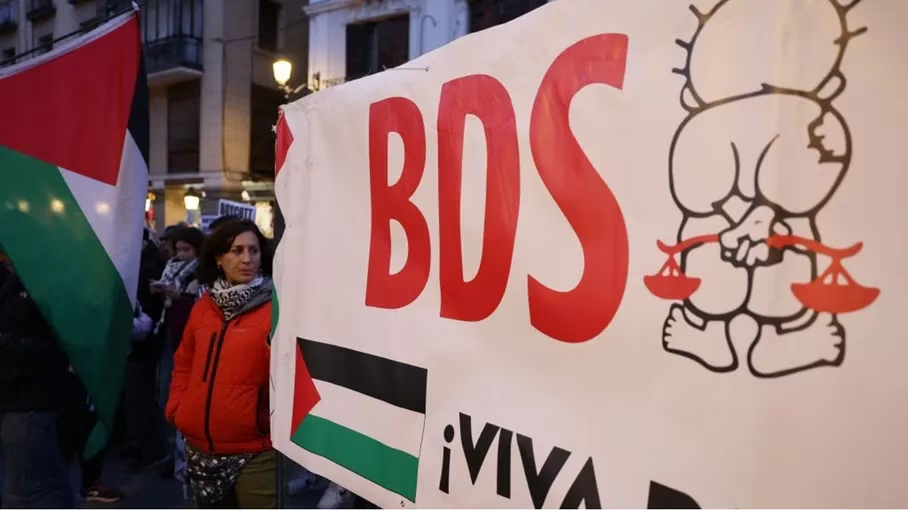
He noted that 'this is not the only event for the Boycott, Divestment, Sanctions (BDS) movement after the war. At the end of October, more than a week after the ceasefire, over a thousand literary figures, including writers Sally Rooney, Arundhati Roy, and Rachel Kushner, signed a pledge to boycott Israeli cultural institutions. An international initiative to ban Israeli music, called 'No Music for Genocide,' launched in September, continues to attract artists and production companies. Similarly, stars like Emma Stone signed a pledge to boycott Israel in the 'Filmmakers for Palestine' campaign.'

He confirmed that 'the boycott of European higher education institutions against Israel has not receded either, according to a report issued last month by the Association of Israeli University Presidents. Even as the wave of declared boycotts subsides, Israeli academics in many cases still face hidden boycotts manifested in scientific journals rejecting their research and not inviting them to academic conferences.'

He pointed out that 'it is easy to assume that many of the Boycott, Divestment, Sanctions (BDS) campaigns that launched amid the war will gradually fade if the ceasefire holds. No organizer will issue a statement announcing that a celebrity has retracted their signature on a pledge, but many of these promises to isolate Israel will be gradually forgotten. Nevertheless, Israel cannot count on a complete break from the stigma of the war.'

He said that 'as shown by the ongoing initiatives of the Boycott, Divestment, Sanctions (BDS) movement, Israel remains unwelcome in cultural and academic circles, as opposition to the brutal war over the past two years has often turned into opposition to Israel's existence as a Jewish state.'

He considered that 'hostility towards Israel has become an integral part of the progressive agenda adopted by many artists and academics. The war's impact was so profound that mere ceasefire will not change this reality.'

Rosenberg added that 'but this is not the full story of the boycott movement. Corporations and most governments were, at best, reluctant supporters of efforts to isolate Israel during the war, and since the ceasefire took effect in October, they have been eager to abandon the issue entirely. Notice how Hollywood studios, the commercial arm of Hollywood, publicly rejected the 'Filmmakers for Palestine' boycott shortly after the ceasefire took effect.'

He affirmed that 'the strange thing is that the most prominent example of boycott failure is arms sales. True, Israel lost some major arms deals during the war, but since the ceasefire, Elbit Systems signed a $2.3 billion contract with an unnamed buyer; Rafael Advanced Defense Systems reached a similar deal with Germany; and Israel Aerospace Industries is close to signing an agreement with Greece valued at an estimated 3 billion euros ($3.5 billion). The company is also establishing a joint factory for drone production in Morocco.'

He pointed out that 'one might think that buying Israeli weapons after the war would be the last thing governments would risk. But no matter the ethical doubts surrounding Israeli weapons due to its wartime conduct, they easily fade in the face of the two threats facing Europe: on one hand, the growing threat from Russia; on the other, America's hostility under Trump towards democracies on the continent, leaving it to face its military fate alone.'

He clarified that 'it is not limited to the arms sector where business seems to have returned to normal. The alleged commercial boycott of Israel during the war was not serious enough to show up in foreign investment and trade statistics. In fact, the largest cross-border mergers and acquisitions took place during the height of the fighting, specifically Palo Alto Networks' acquisition of CyberArk for $25 billion, and Alphabet's acquisition of Wiz for $32 billion.'

He noted that 'many have talked about lost contracts and delays in signing them, but it seems this problem has ended too. Since the ceasefire, a series of small deals have been concluded, such as the sale of Israeli-American startup Carbyn to American safety technology company Axon for $625 million. There are no recent statistics on foreign investment in Israel, but statistics related to foreign investment in technology companies showed no decline during the first nine months of this year.'

It confirmed that 'Israel's goods exports declined this year, but strangely, this decline is almost entirely due to a drop in exports to Ireland. Ireland is known for its hostility towards Israel, but it is unlikely to be the reason for this decline: most of Israel's exports to Ireland are advanced technological products and services sold to major multinational technology companies with branches there. Far from being supporters of the Boycott, Divestment, Sanctions (BDS) movement, Ireland strongly opposed efforts to impose trade sanctions on Israel.'

Rosenberg said that 'if Israelis had to choose between a business boycott or a boycott of arts and academia, they would likely choose the latter. Economic isolation means losing exports, jobs, and investments, leading to economic slowdown. Israel's economy is open to the world and economically advanced, while the country's market is too small, making it impossible for it to be anything less than fully engaged in the world... But no one should ignore the cost of Israel's declining soft power, that is, its ability to influence other countries through its culture, political values, and foreign policies.'

He said that 'supporters of the boycott movement had a point when they called last month to cancel the Israel Philharmonic Orchestra concert in Paris, claiming it was 'an orchestra in service of Zionist propaganda.' But this claim is exaggerated. The Philharmonic is not an arm of the Israeli government, but its outstanding performance reminds people that Israel is not just a state of war and oppression of Palestinians. Certainly, musical performances improve Israel's image far more than the failed government propaganda.'

He added that 'in any case, culture has a direct impact on the economy. Even if not on the same scale as advanced technology or natural gas, it is an export sector that creates jobs. Academic boycotts also harm the economy because they make it harder for Israeli scientists to collaborate with their counterparts around the world and obtain foreign funding that enables the innovation driving Israel's advanced technology. In fact, cross-border partnerships are extremely important; without them, Israel risks brain drain.'

He concluded by saying that 'do not expect Prime Minister Benjamin Netanyahu's government to address this problem. It hates cultural institutions and universities alike for belonging to the opposition camp, and will never think of sacrificing its war against them for the national interest. The film 'The Sea,' which tells the story of a Palestinian boy trying to reach the beach despite obstacles placed by the government, is nominated for an Oscar this year, but Culture Minister Miki Zohar wants to punish the film industry for producing it.'

ARAB AND WORLD

Mon 15 Dec 2025 9:36 am - Jerusalem Time

American Companies Compete for Gaza Reconstruction in Pursuit of Profits

While Gaza remains submerged in unprecedented destruction left by Israel's ongoing genocide war that has lasted two years, a parallel, less visible path is crystallizing in Washington, led by American contracting companies and businessmen closely linked to the administration of US President Donald Trump, in an early race to control the file of reconstruction and humanitarian aid. According to United Nations estimates, the cost of rebuilding the sector reaches about 70 billion dollars, which transforms Gaza, in the view of these parties, into an economic opportunity as much as it is a human tragedy.

Sources and documents reviewed by The Guardian reveal that the destruction or damage to nearly 75 percent of the sector's buildings has whetted the appetite of companies specialized in construction, demolition, and logistics services, seeing in the "post-war" phase a rare market for long-term contracts, despite the absence of any stable political or administrative framework to manage Gaza.

Despite the lack of an official mechanism so far to sign reconstruction contracts, this has not stopped unofficial movements. The "Peace Council" that the United Nations agreed to establish to manage Gaza, chaired by Trump, has not actually started its work, and the powers of the Civil-Military Coordination Center remain limited. This vacuum has opened the door to parallel initiatives outside traditional channels.

In this context, the White House has formed a special task force on Gaza that includes Jared Kushner, Steve Witkoff, and Aryeh Lightstone, working on formulating visions for managing aid and reconstruction. According to informed sources, technical discussions are led by two former officials from "Dog" company, who were previously linked to Elon Musk's efforts to reduce the size of the US government. Presentations have been circulated that include detailed operational plans covering pricing, profit estimates, and potential storage sites.

In this framework, Gotham LLC emerged as a major competitor to take on the logistics file. The company owns a wide network of political relations and had previously obtained a contract worth 33 million dollars to manage a controversial migrant detention center in southern Florida, known as "Alligator Alcatraz." Documents and three sources indicate that the company was the top candidate to win a contract that would be the largest in its history.

However, this path suffered an unexpected setback after the company's founder, Matt Michelson, announced his withdrawal from the competition, justifying his decision with security concerns and the possibility of negative media repercussions. Michelson told The Guardian in an interview that the plans "changed radically and expanded in an unexpected way," noting that the newspaper's inquiries contributed to reassessing the situation.

In contrast, the spokesperson for the White House task force on Gaza limited himself to confirming that planning is still in its early stages, and that "several ideas are under discussion without final decisions," refusing to delve into details related to selection mechanisms or nominated parties.

Sources indicate that American contractors recently visited the area to meet influential officials and potential partners, amid growing interest in the post-war phase. One seasoned contractor describes the scene by saying: "Everyone is rushing to reserve their position early... Gaza is being treated as if it were a new version of Iraq or Afghanistan."

The United Nations had endorsed Trump's plan for Gaza last November, amid two contrasting visions: the first promotes investment and real estate projects, and the second, adopted by the international community, focuses on rebuilding the sector as a livable environment for about 2.5 million Palestinians. Meanwhile, Israel continues its control over about half of Gaza's area and links any reconstruction in areas controlled by "Hamas" to its disarmament.

Within this context, the role of young advisors in the Gaza team has emerged, who prepared planning documents proposing the appointment of a "main contractor" to manage the entry of up to 600 trucks daily into the sector, in exchange for imposing high fees on humanitarian and commercial trucks. Estimates indicate that this model could generate annual revenues of up to 1.7 billion dollars from transportation fees alone.

The issue of transportation gains crucial importance, as Gaza relied before the war on the entry of about 500 trucks daily. However, Israel has imposed strict restrictions on entry movements since October 7, 2023, causing a severe shortage in food, fuel, and building materials, despite the stipulation in the ceasefire agreement on higher numbers.

The United Nations has long played a pivotal role in delivering aid to the majority of Gaza's population, but the future of this role has become a matter of question, amid increasing trends towards privatizing humanitarian work and assigning it to profitable companies.

These early movements reveal that the battle of "the day after" in Gaza is managed by market logic before being resolved politically or humanely. Instead of reconstruction starting from the needs of the population and their right to a dignified life, the sector is being treated as a high-risk and high-return investment opportunity. This approach threatens to turn relief into a profit tool, and reproduces the model of war economy, where destruction itself becomes an investable asset, not a tragedy that requires accountability and justice.

ARAB AND WORLD

Mon 15 Dec 2025 9:34 am - Jerusalem Time

Washington Punishes 'International Criminal Court' Judges Due to Their Investigations into Israeli War Crimes

In an unprecedented development that threatens the structure of international criminal justice, judges and prosecutors at the International Criminal Court are facing a choking campaign of American sanctions, due to their role in investigating war crimes and crimes against humanity allegedly committed by Israeli officials during the devastating war on the Gaza Strip. These sanctions, imposed by the administration of US President Donald Trump, have not been limited to diplomatic restrictions, but have extended to the daily lives of court officials, in a precedent that reflects the extent of politicization that has come to affect international justice.

The Associated Press agency revealed that nine officials at the court in The Hague, including six judges and the prosecutor general, were subjected to cutting off basic banking services, canceling their credit cards, and depriving them of digital services provided by giant companies like Amazon, as a result of their inclusion on American sanctions lists. Pursuant to an executive order issued by Trump earlier this year, these individuals were banned from entering the United States, and were dealt with under a sanctions system usually used against leaders accused of serious crimes. 

The White House justified this step as a response to what it described as "illegal and invalid actions" taken by the court against the United States and its "close ally" Israel. However, the timing of the sanctions came after the court issued arrest warrants against Israeli Prime Minister Benjamin Netanyahu and his former Defense Minister Yoav Gallant, on charges related to committing war crimes and crimes against humanity during military operations in Gaza.

Canadian Judge Kimberly Prost, one of the figures targeted by the sanctions, summarized the psychological and practical impact of these measures by saying: "Your whole world becomes restricted." She explained that she lost the ability to use credit cards, the e-books she bought disappeared, and even Amazon's "Alexa" assistant stopped responding. She added: "They are small annoyances, but they accumulate and create a constant feeling of uncertainty."

Prost was not targeted only because of the Israeli file, but also because of her previous vote in favor of allowing the investigation into possible war crimes committed by American soldiers and intelligence agents in Afghanistan. She said sadly: "I spent my life serving criminal justice, and now I am listed on the same list as those involved in terrorism and organized crime."

The sanctions did not stop at the judges themselves, but extended to their families. Peruvian Judge Luz del Carmen Ibáñez Carranza confirmed that the American travel restrictions extended to members of her family, preventing her daughters from participating in scientific conferences inside the United States. These sanctions impose on companies and individuals to refrain from providing any "financial, material, or technological support" to the targeted individuals, under penalty of huge fines or even imprisonment, which prompted banks and technology companies to withdraw their services immediately.

Deputy Prosecutor General Fatou Bensouda described the situation as a permanent state of suspicion: "When your card doesn't work in a store, you don't know if it's a technical glitch or a direct result of the sanctions." This climate of ambiguity reflects, according to observers, a deliberate attempt to intimidate the judges and push them to retreat.

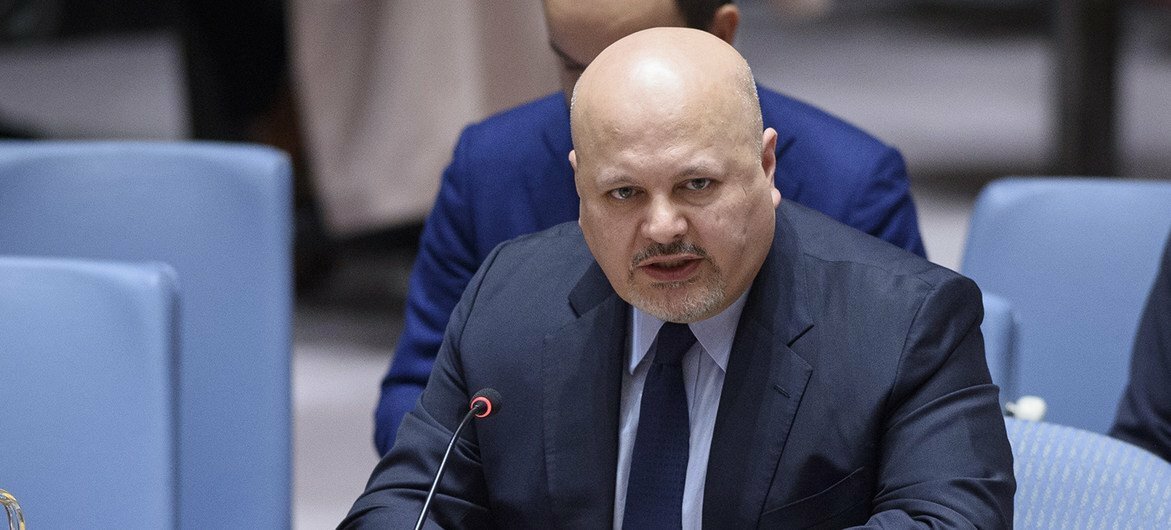
Cross-cutting reports indicate that the sanctions are only part of a broader campaign to pressure the court, where the Middle East Eye website reported last July that Prosecutor General Karim Khan received an explicit threat to "destroy" the court if the arrest warrants against Netanyahu and Gallant were not withdrawn. It was mentioned that the threat came through a lawyer linked to circles close to the Israeli Prime Minister.

The site also reported that former British Foreign Secretary David Cameron secretly warned Khan that London might stop funding the court and withdraw from it if it proceeded with issuing arrest warrants. In the same context, US Republican Senator Lindsey Graham threatened to impose sanctions on Khan if he proceeded with arrest requests.

Last May, Khan's office announced that he had taken a temporary leave amid a UN investigation into allegations of sexual misconduct, allegations that his lawyers strongly deny, confirming that the resignation came only due to media pressure, not an admission of any violation.

The American sanctions on the International Criminal Court judges reveal a dangerous shift in the relationship of major powers with international law, where justice is acceptable only when it does not touch allies. Instead of legally challenging the court's jurisdiction, recourse was made to the weapon of economic and technological sanctions, which puts the independence of international justice before an existential test, and sends a message that accountability is still subject to balances of power, not principles of justice.


Experts believe that if these pressures succeed in deterring the court's judges today, they will open the door to systematic impunity tomorrow. The issue is no longer related to Israel alone, but to the fate of the entire international justice system. Retreating in the face of sanctions means establishing a precedent that allows any influential country to criminalize judges instead of the accused, and transforming international law from a tool for accountability into a hostage of politics


Washington – Saeed Arikat- 15/12/2025

In an unprecedented development that threatens the structure of international criminal justice, judges and prosecutors at the International Criminal Court are facing a choking campaign of American sanctions, due to their role in investigating war crimes and crimes against humanity allegedly committed by Israeli officials during the devastating war on the Gaza Strip. These sanctions, imposed by the administration of US President Donald Trump, have not been limited to diplomatic restrictions, but have extended to the daily lives of court officials, in a precedent that reflects the extent of politicization that has come to affect international justice.

The Associated Press agency revealed that nine officials at the court in The Hague, including six judges and the prosecutor general, were subjected to cutting off basic banking services, canceling their credit cards, and depriving them of digital services provided by giant companies like Amazon, as a result of their inclusion on American sanctions lists. Pursuant to an executive order issued by Trump earlier this year, these individuals were banned from entering the United States, and were dealt with under a sanctions system usually used against leaders accused of serious crimes. 

The White House justified this step as a response to what it described as "illegal and invalid actions" taken by the court against the United States and its "close ally" Israel. However, the timing of the sanctions came after the court issued arrest warrants against Israeli Prime Minister Benjamin Netanyahu and his former Defense Minister Yoav Gallant, on charges related to committing war crimes and crimes against humanity during military operations in Gaza.

Canadian Judge Kimberly Prost, one of the figures targeted by the sanctions, summarized the psychological and practical impact of these measures by saying: "Your whole world becomes restricted." She explained that she lost the ability to use credit cards, the e-books she bought disappeared, and even Amazon's "Alexa" assistant stopped responding. She added: "They are small annoyances, but they accumulate and create a constant feeling of uncertainty."

Prost was not targeted only because of the Israeli file, but also because of her previous vote in favor of allowing the investigation into possible war crimes committed by American soldiers and intelligence agents in Afghanistan. She said sadly: "I spent my life serving criminal justice, and now I am listed on the same list as those involved in terrorism and organized crime."

The sanctions did not stop at the judges themselves, but extended to their families. Peruvian Judge Luz del Carmen Ibáñez Carranza confirmed that the American travel restrictions extended to members of her family, preventing her daughters from participating in scientific conferences inside the United States. These sanctions impose on companies and individuals to refrain from providing any "financial, material, or technological support" to the targeted individuals, under penalty of huge fines or even imprisonment, which prompted banks and technology companies to withdraw their services immediately.

Deputy Prosecutor General Fatou Bensouda described the situation as a permanent state of suspicion: "When your card doesn't work in a store, you don't know if it's a technical glitch or a direct result of the sanctions." This climate of ambiguity reflects, according to observers, a deliberate attempt to intimidate the judges and push them to retreat.

Cross-cutting reports indicate that the sanctions are only part of a broader campaign to pressure the court, where the Middle East Eye website reported last July that Prosecutor General Karim Khan received an explicit threat to "destroy" the court if the arrest warrants against Netanyahu and Gallant were not withdrawn. It was mentioned that the threat came through a lawyer linked to circles close to the Israeli Prime Minister.

The site also reported that former British Foreign Secretary David Cameron secretly warned Khan that London might stop funding the court and withdraw from it if it proceeded with issuing arrest warrants. In the same context, US Republican Senator Lindsey Graham threatened to impose sanctions on Khan if he proceeded with arrest requests.

Last May, Khan's office announced that he had taken a temporary leave amid a UN investigation into allegations of sexual misconduct, allegations that his lawyers strongly deny, confirming that the resignation came only due to media pressure, not an admission of any violation.

The American sanctions on the International Criminal Court judges reveal a dangerous shift in the relationship of major powers with international law, where justice is acceptable only when it does not touch allies. Instead of legally challenging the court's jurisdiction, recourse was made to the weapon of economic and technological sanctions, which puts the independence of international justice before an existential test, and sends a message that accountability is still subject to balances of power, not principles of justice.

Experts believe that if these pressures succeed in deterring the court's judges today, they will open the door to systematic impunity tomorrow. The issue is no longer related to Israel alone, but to the fate of the entire international justice system. Retreating in the face of sanctions means establishing a precedent that allows any influential country to criminalize judges instead of the accused, and transforming international law from a tool for accountability into a hostage of politics

ARAB AND WORLD

Mon 15 Dec 2025 9:25 am - Jerusalem Time

Egypt and Saudi Arabia Discuss Developments in Gaza and Sudan

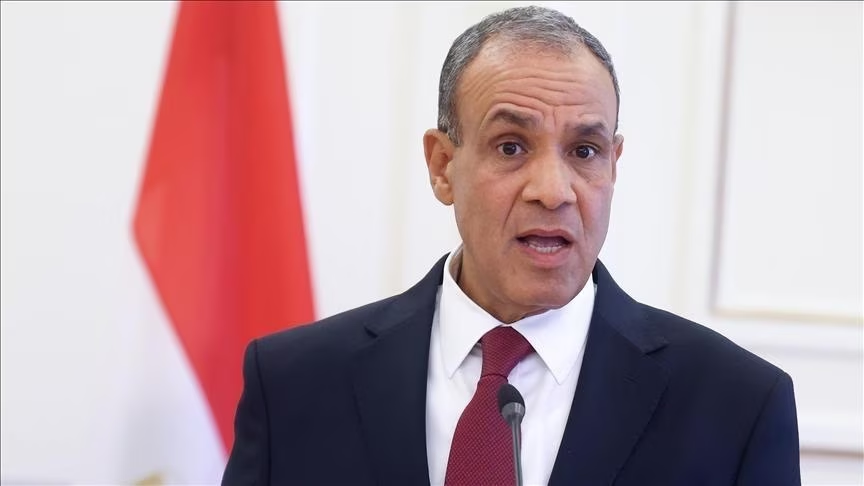
Egyptian Foreign Minister Badr Abdel Ati discussed with his Saudi counterpart Faisal bin Farhan, on Monday, developments in the situation in the Gaza Strip and Sudan.

This came during a phone call between them, "within the framework of the ongoing coordination and consultation between the two countries," according to a statement from the Egyptian Foreign Ministry.

The Egyptian Foreign Ministry stated that the two sides addressed the completion of the ongoing arrangements to hold the first meeting of the Supreme Coordination Council between Egypt and Saudi Arabia, scheduled to be held in the coming period under the chairmanship of Egyptian President Abdel Fattah El-Sisi and Saudi Crown Prince Mohammed bin Salman.

It added that the two ministers exchanged views on developments in the situation in the Gaza Strip.

Abdel Ati emphasized, according to the statement, the importance of ensuring the sustainability of the ceasefire, and implementing the obligations of the second phase of US President Donald Trump's plan to stop the war in Gaza.

He also stressed the necessity of implementing UN Security Council Resolution 2803, and the importance of deploying a temporary international stabilization force to monitor the ceasefire, protect civilians, and enable Palestinian forces to take over law enforcement duties in Gaza.

In November last year, the UN Security Council adopted Resolution 2803, related to ending the fighting and managing Gaza after the war.

Abdel Ati also emphasized the importance of ensuring unobstructed access for humanitarian aid, and preparing conditions for the start of early recovery and reconstruction.

The ceasefire agreement entered into force in October last year, ending a genocide war launched by Israel on October 8, 2023, lasting two years with American support, leaving more than 70,000 Palestinian dead and over 170,000 injured, and massive destruction affecting 90% of the civilian infrastructure, with initial losses estimated at $70 billion.

The call also addressed developments in the situation in Sudan, where the two ministers affirmed the importance of continuing coordination within the Quadripartite Mechanism (comprising Egypt, Saudi Arabia, the UAE, and the United States), with the aim of reaching a comprehensive ceasefire, according to the statement.

Abdel Ati emphasized the importance of providing "safe havens and safe humanitarian corridors to ensure unobstructed access for humanitarian aid."

He reiterated Egypt's firm stance supporting Sudan's unity, sovereignty, and stability, and preserving its national institutions.

The humanitarian suffering in Sudan is worsening due to the ongoing war caused by a dispute between the army and the "Rapid Support Forces" since April 2023 regarding the unification of the military institution, resulting in the deaths of tens of thousands of Sudanese and the displacement of 13 million people.

At the end of the call, both sides affirmed the importance of continuing close coordination and consultation in the coming period, "which contributes to supporting regional stability and enhancing joint Arab action in facing current challenges," according to the same statement.

ARAB AND WORLD

Mon 15 Dec 2025 9:05 am - Jerusalem Time

Haaretz: The repercussions of the genocide in Gaza have not ended for the occupation in the cultural and academic arenas

An Israeli newspaper stated that the repercussions of the genocide in Gaza have not ended for the occupation in the cultural and academic arenas, despite the cessation of fighting and the largely resumed economic and commercial activity, noting that boycotts in the arts and universities remain in place and pose a direct threat to what is known as Israel's soft power.

The newspaper, in a report by writer David Rosenberg, clarified that the announcement by several countries to boycott the Eurovision Song Contest in protest of the genocide in Gaza was a shock within the occupation's circles, especially amid a prevailing conviction among settlers that the war has become a thing of the past, and that it is time to move on without delving into how it was militarily managed.

It pointed out that the war remains strongly present abroad, particularly in cultural and media circles, noting that the Irish Broadcasting and Television Authority justified its withdrawal from "Eurovision" by the huge human losses in Gaza and the ongoing humanitarian crisis, in addition to concerns about targeting journalists during the genocide.

The newspaper indicated that the cultural and academic boycott was not limited to "Eurovision", as more than a thousand global writers and literary figures signed a pledge to boycott Israeli cultural institutions, while international initiatives were launched to ban Israeli music, and prominent actors and filmmakers joined campaigns to boycott the occupation in the cinematic field.

It added that universities and academic institutions of the occupation still face European boycotts, whether openly or through what it described as "hidden boycotts", such as refusing to publish scientific research or not extending invitations to participate in international conferences.

The newspaper noted that although some boycott campaigns have receded with the implementation of the ceasefire, Israel cannot rely on the disappearance of the war's effects, confirming that its image in progressive cultural and academic circles remains negative, and that opposition to the war has in many cases turned into opposition to the very existence of the occupation.

The newspaper affirmed that the real danger lies in the decline of the occupation's soft power, explaining that culture, arts, and universities play a pivotal role in improving "Israel's" global image, and that academic boycotts threaten innovation and scientific cooperation and may lead to brain drain.

PALESTINE

Mon 15 Dec 2025 8:57 am - Jerusalem Time

The Israeli Army Launches Raids and Artillery Bombardment on Gaza

The Israeli army launched a series of air raids and artillery bombardment on various areas of the Gaza Strip early Monday, within the areas it controls under the ceasefire agreement.

This comes as new violations of the agreement that entered into force on October 10 last year.

Eyewitnesses reported that the Israeli army carried out a series of air raids on the city of Rafah in the south of the Strip, which is entirely under its control under the agreement.

They said that army vehicles fired their random fire north of Rafah.

In another incident, army artillery vehicles bombarded various areas east of the city of Khan Yunis in the south of the Strip, in areas under army control, while its helicopters fired in the area, according to eyewitnesses.

The witnesses indicated that Israeli helicopters fired east of Jabalia town in the north of the Strip, while army vehicles fired their machine guns east of Gaza City.

Israel continues its violations of the ceasefire it signed with "Hamas", which has resulted since last October in the killing of 391 Palestinians and the injury of 1,063 others.

The agreement ended a genocide that Israel began on October 8, 2023, and lasted for two years, leaving more than 70,000 dead and over 171,000 injured, along with massive destruction with reconstruction costs estimated by the United Nations at around 70 billion dollars.

PALESTINE

Mon 15 Dec 2025 8:06 am - Jerusalem Time

Israeli Settler Injured by Occupation Army Fire in the West Bank by Mistake

Israeli media reported today, Monday, that soldiers fired at a person at a gas station in Kedumim between Qalqilya and Nablus in the West Bank, after suspecting that he was a Palestinian attempting to carry out a stabbing operation.

It later turned out that the injured person in the shooting was an Israeli settler, where Israeli radio confirmed that there was no stabbing operation near Kedumim and the soldiers fired by mistake at a settler and injured him with serious wounds.

Israeli Channel 14 reported that the injured person is a Jewish boy with mental disturbances, and that he waved a knife towards soldiers of a military force present at the scene, which prompted the soldiers to fire at him.

Israeli ambulance reported that the boy was transferred to one of the Israeli hospitals and is suffering from very serious injuries.

Since October 7, 2023, the Israeli occupation army has intensified its security and military operations in the West Bank, and the assaults by the army and settlers in the West Bank have led to the martyrdom of at least 1094 Palestinians, the injury of about 11,000 others, in addition to the arrest of more than 21,000, according to official Palestinian figures.

PALESTINE

Mon 15 Dec 2025 5:27 am - Jerusalem Time

Israel Continues to Resist Moving to the Second Phase of the Gaza Agreement Despite American Pressures

Sources in Israeli media reported the continued resistance of Benjamin Netanyahu's government to move to the second phase of the ceasefire agreement in Gaza despite American pressures, while the Islamic Resistance Movement (Hamas) affirmed its commitment to the agreement.

An Israeli security source told the official broadcasting authority that implementing the second phase "remains out of reach." It indicated that no country has agreed so far to join the international stabilization force that is supposed to be deployed in Gaza according to the agreement.

The same source added that Israel continues to monitor developments related to the search for the body of the prisoner Ran Guili, who is the last body that Israel demands to recover from Gaza.

In the context, the Walla website reported that Israel continues to resist American pressures to quickly advance to the second phase of the ceasefire agreement, until the recovery of Guili's body.

For his part, Israeli Prime Minister Benjamin Netanyahu, in statements made on Sunday, said that the end of the first phase of the agreement is approaching, but he added "We are the ones who decide the measures, and we are the ones who decide the responses."

He added that Israel is working to recover the body of Ran Guili, and is making great efforts in this regard, according to him.

The occupation army continued its violations of the ceasefire on Sunday, as a correspondent reported that Israeli bombing targeted a residential building in the center of Khan Yunis in southern Gaza Strip.

The occupation army announced that it killed a Palestinian who crossed the yellow line in the north of the Strip and "posed an imminent threat" to its forces, according to it.

For its part, Hamas condemned the Israeli violations of the war ceasefire agreement, and called on the mediators and guarantor countries to intervene to stop Israel's attempts to undermine and fail the agreement.

Khalil al-Hayya, head of Hamas in Gaza, affirmed in a videotaped speech on the 38th anniversary of the movement's launch, Hamas's commitment to the ceasefire agreement.

He said that starting the second phase of the agreement is a priority for the movement, in order to achieve a complete withdrawal of the occupation, and that the task of the international forces in Gaza should be limited to maintaining the ceasefire and separating the two sides on the borders of the Strip.

Al-Hayya emphasized that the resistance and its weapons are a legitimate right guaranteed by international laws and linked to the establishment of the Palestinian state.

On the other hand, the Qassam Brigades, the military wing of Hamas, mourned the commander of the military manufacturing corps, Raed Saad, who was martyred following an assassination operation carried out by the Israeli occupation in Gaza Strip on Saturday, and announced the appointment of a new commander to replace him.

The Qassam added that the assassination of Saad is a blatant violation of the ceasefire agreement, and that the Israeli occupation has crossed all red lines by assassinating Qassam leaders and the sons of the people and its continuous aggression.

It indicated that Israel is disregarding the plan of the American President Donald Trump, who and the mediators bear the responsibility, according to the Qassam.

The Qassam affirmed its right to respond to the occupation's aggression and defend itself by all means. It also announced the appointment of a new commander to carry out the tasks that Saad was handling.

The implementation of the first phase of the ceasefire agreement in Gaza began on October 10 last year, after two years of the Israeli genocide war that left more than 70,000 martyrs and destroyed most of the civilian infrastructure in the Palestinian sector.

However, Israel continues to violate the agreement with its repeated raids on the sector and by changing the agreed points for the withdrawal line known as the yellow line, and continues to restrict the access of vital humanitarian aid to Gaza residents.

ANALYSIS

Mon 15 Dec 2025 5:01 am - Jerusalem Time

Israeli Army Budget: Strategy or Trap?

The greatest geopolitical challenge facing the occupying state currently lies in restoring the army's budget to a framework that allows for economic growth, and anything else is a risky gamble on its future, raising a serious question about what the new military spending represents: a strategy or a trap.

Eli Rami Rokach Domba, the military correspondent for Israel Defense magazine, mentioned that "warnings from the Governor of the Israeli Central Bank, Professor Amir Yaron, constituted a strategic alarm regarding the essence of Israel's national security, which has boasted for decades of its financial resilience that is supposed to be a lever for operational resilience. But now, the equation has changed, because military spending, which has inflated to unprecedented levels after the long war in Gaza and Lebanon, is no longer just a response to an external threat, but has become a destructive internal force."

Domba added in the article that "the army, which was considered sacred in the eyes of the public and politicians, has become in effect an uncontrollable variable in the financial system, and a critical view from a geopolitical perspective reveals a disturbing process: the current expansion in the budget does not necessarily reflect a complex and innovative assessment of threats, but rather a surrender to an outdated concept of power through money, with a glaring disregard for the economic foundation that is a prerequisite for the existence of this power."

The military correspondent explained that "what is happening recently reveals a strategic failure in funding the army, in light of the dangerous disparity between the security threat and the economic cost, with a focus on the informal taxes imposed on the reserve army, and the excessive and continuous use of the reserves is a structural failure whose cost far exceeds the monthly compensation, because from a strategic perspective, this unusual movement of individuals indicates poor planning of regular forces and the absence of an advanced warfare strategy."

Domba affirmed that "the economic crisis is paying the price for the budget shortfall in terms of declining productivity and severe damage to commercial activity, and this is an expensive, fragile, and ineffective way to fund the army, which places the burden of defense on the internal economic front, because the greatest danger lies in the multi-year path of the army's budget, and the ongoing discussions about maintaining a high level of spending for coming years, even after the fighting subsides, mean in reality a breach of the financial framework."

He pointed out that "when the central bank governor warns that the debt-to-GDP ratio is expected to rise continuously and approach 80% of GDP in the coming decade, he is in fact describing how Israel, driven by its desire to maintain its immediate defensive capabilities, is pushing itself into a financial corner that countries only enter after a sharp geo-political rupture, and this is not just a matter of 'money', but a matter of 'authority'."

Domba clarified that "despite marketing this measure as an enhancement of internal security, it in fact converts huge budgets into security mechanisms instead of strengthening the social components that systematically reduce crime: education, employment, and local governance, which clearly shows a preference for 'short-term internal security' at the expense of building 'long-term' internal capacity, but the bitter truth is that there is no security without a stable and growing economy, and any other talk is an expensive illusion that cannot be funded in the long term."

Domba added that "the problem is not in the army or the security need, but in the absence of planning, because we are facing a security budget without an economic strategy. True, the external threat is real, but the internal one exists as well, and the disproportionate expansion of the military budget with Israel's economic capacity may destroy the industry it relies on, and here it must stop and ask: how many weapons systems, how many reserve days, and how many budgets can be funded before the market stops seeing it as a flexible and healthy economy, and before investors' confidence fades, which is a strategic asset."

This critical vision of the future of Israel's military budget indicates that it represents the greatest geopolitical challenge facing it currently, because what is paid for military spending actually abandons long-term investments in education, infrastructure, and productivity, meaning that current security policies today bring disaster to Israeli security tomorrow, because priority is given to the military budget at the expense of social strategy, which is another indicator of the misconception of security.

ARAB AND WORLD

Mon 15 Dec 2025 12:59 am - Jerusalem Time

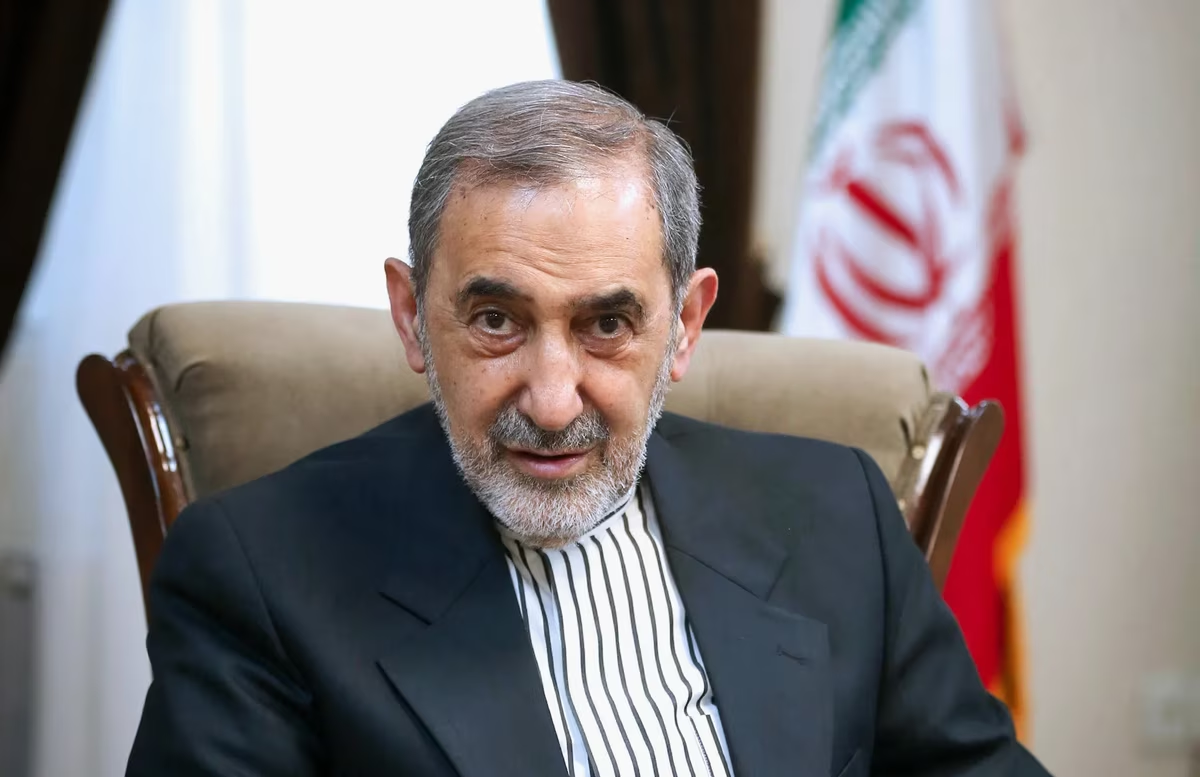
Khamenei's Advisor: Iran Will Support Hezbollah 'Firmly' in Confrontation with Israel

Ali Akbar Velayati, advisor to the Iranian Supreme Leader Ali Khamenei, said on Sunday that his country will support Hezbollah "firmly" in confronting Israel.

Velayati's statements came while Lebanon faces American and Israeli pressures to disarm Hezbollah, which has been engaged in a military confrontation with Israel for over a year following the outbreak of the war in the Gaza Strip.

Velayati said that "Hezbollah, as one of the most important pillars of the resistance axis, plays a fundamental role in confronting Zionism," according to what was reported by the Islamic Republic News Agency "IRNA."

He added, "The Islamic Republic of Iran, under the leadership and guidance of the Leader of the Islamic Revolution, will firmly continue its support for Hezbollah, which stands on the front lines of the resistance."

A ceasefire between Hezbollah and Israel has been in effect since November 27, 2024, but the Israeli army launches near-daily raids on Lebanon and continues to carry out incursions, bulldozing, and demolition operations in the south of the country.

The Lebanese government adopted an American paper in August to consolidate the ceasefire, which includes a timeline for disarming Hezbollah and deploying the Lebanese army in the south of the country. However, Hezbollah warned that moves related to disarmament could ignite a civil war.

Political Crisis

In November, a statement by Velayati sparked criticism after he considered that "the existence of Hezbollah is more important for Lebanon than bread."

Lebanese Foreign Minister Youssef Rjey responded in a post on the X platform, stating that "what is more important to us than water and bread is our sovereignty, freedom, and independence of our internal decision-making."

After the exchange, Iranian Foreign Minister Abbas Araghchi extended an official invitation to his Lebanese counterpart to visit Tehran "to consult on the development of bilateral relations and discuss regional and international developments," according to the Iranian Foreign Ministry.

However, Rjey apologized for not accepting the invitation and recently described Iran's regional role as "extremely negative" and "one of the sources of instability," especially in Lebanon.

In a post on X, Rjey considered that Hezbollah cannot "hand over its weapons without an Iranian decision, and its concern today is to buy time to maintain its internal existence in order to rebuild its capabilities," according to him.

PALESTINE

Mon 15 Dec 2025 12:16 am - Jerusalem Time

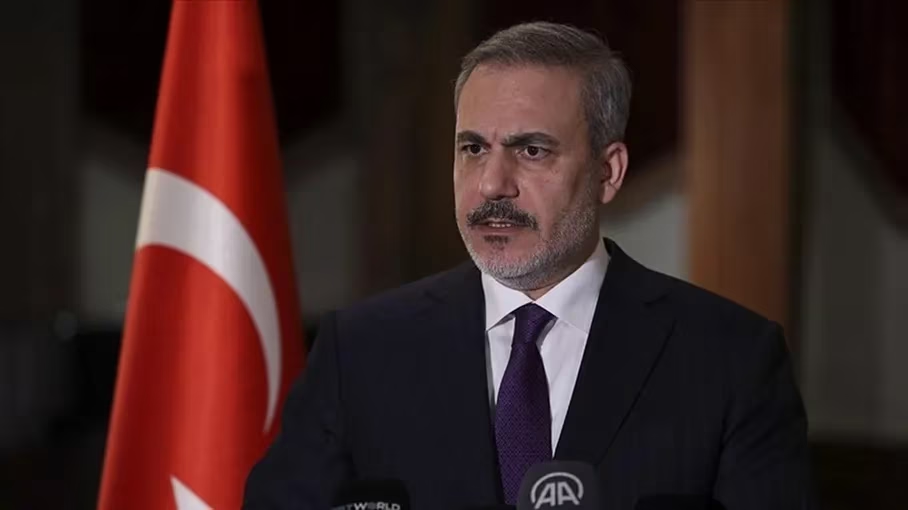
Turkish Foreign Minister Warns of Israeli Plan to Depopulate Gaza

Turkish Foreign Minister Hakan Fidan warned of an Israeli plan aimed at depopulating the Gaza Strip of its Palestinian inhabitants, emphasizing that the only way to prevent this is by deploying an international force in the sector that ensures the security of both sides and establishes a state of calm.

Fidan stated in a televised interview broadcast by a local channel that Turkey is making continuous efforts to stop the genocide in Gaza and work towards establishing a permanent ceasefire that leads to a comprehensive peace agreement.

He pointed out that all Turkish state institutions, led by President Recep Tayyip Erdogan, have intensified their diplomatic and political efforts regarding the situation in Gaza, saying: "Praise be to God, a ceasefire has been reached, but as we see today, this ceasefire is subject to repeated violations, making its environment fragile".

Fidan confirmed that President Erdogan has shown full political will in supporting the Palestinian cause, and that Ankara has actively participated in various international and bilateral efforts related to the Gaza Strip.

The Turkish minister explained that the details of forming the international stabilization force planned to be deployed in Gaza, including the number of participating countries, the size of the forces, their deployment locations, and their basic tasks, are still under discussion, within the framework of a resolution issued by the United Nations Security Council.

He noted that the Security Council adopted on November 18 last year, by a majority vote, an American draft resolution on ending Israel's genocide war on Gaza, which calls for the establishment of a temporary international force that continues until the end of 2027.

Fidan also emphasized that the main task of the international stabilization force is to establish a separation line between the occupying state and the Palestinians to prevent mutual attacks, considering that failure to achieve this will make it difficult for the force to perform its basic role.

He added that the occupation government, as a party to the conflict, has the right to choose the forces that will participate in this force, just as is the case for the Palestinians, noting that Tel Aviv exercises this right through the United States.

He continued, saying that Israel expresses reservations about Turkey's participation, given that Ankara has been the most critical and pressuring state on Tel Aviv throughout the war period.

Fidan added: "Whether we participate in this force or not, our demand is clear, which is that a force arrives that puts an end to the Israeli occupation and the injustice inflicted on Gaza, ensures the entry of humanitarian aid, and protects the survival and safety of Palestinians in the sector, as soon as possible".

He affirmed that the importance of this force stems from the fact that the current Israeli plan, according to his description, is based on depopulating Gaza of its Palestinian inhabitants, explaining that the presence of an international force on the ground is what can prevent the implementation of this plan by ensuring security and creating an atmosphere of calm.

The genocide launched by the occupying state in the Gaza Strip since October 8, 2023, and lasted for two years, resulted in more than 70,000 Palestinian martyrs, in addition to more than 171,000 injured, before ending with a ceasefire agreement that came into effect last October, but the occupying state violated it hundreds of times, leading to the fall of hundreds of martyrs and wounded among the Palestinians.

ARAB AND WORLD

Sun 14 Dec 2025 5:08 pm - Jerusalem Time

Armed attack on Bondi Beach in Sydney

A video clip showed a passerby hindering one of the attackers and disarming him during the attack in which 12 people were killed and more than 10 others were injured, today Sunday, on the famous Bondi Beach in Sydney, Australia, and the attack targeted a crowd during a celebration of the Jewish holiday "Hanukkah" (Festival of Lights).

The person who disarmed one of the attackers on the beach is a Muslim named Ahmed Al-Ahmed, and he was hit by two bullets and is currently undergoing treatment.

Footage circulating on social media sites shows a man wearing a white shirt in a parking lot running towards a man wearing a dark shirt holding a rifle, then pouncing on the armed man from behind, disarming the rifle from him and pointing it at him.

Then the man with the dark shirt appeared in the video clip losing his balance, retreating towards a bridge where another armed man was, and the man who attacked him then placed the weapon on the ground.

The video was verified through reliable footage showing the same people. It was also verified that the armed men in that clip are the two who were seen surrounded by police in confirmed photos, based on their clothes.

One of the suspected attackers was killed and the other was injured and is in critical condition.

The clip of the attack on the armed man spread quickly on social media, where people praised the man's bravery, saying that his action may have saved many lives.

One user on the X platform said "This Australian saved countless lives by disarming one of the terrorists on Bondi Beach. He is a hero".

PALESTINE

Sun 14 Dec 2025 4:34 pm - Jerusalem Time

Rabbi Eli Schlinger killed in armed attack in Sydney

Rabbi Eli Schlinger, who was killed on Sunday in an armed attack in Sydney, visited Israel and met with soldiers to encourage them to continue the genocide war in the Gaza Strip.

Over more than two years, the Israeli genocide in Gaza has left more than 70,000 dead and 171,000 injured Palestinians, mostly children and women, sparking global popular outrage and plunging Israel into international isolation.

12 people were killed and 29 others injured in an armed attack today, Sunday, during celebrations of the Jewish holiday "Hanukkah" (Festival of Lights) on Bondi Beach in the Australian city of Sydney.

Among the dead was Schlinger, who was an emissary of the Jewish movement "Chabad" (the extremist) in Australia.

"Chabad" refuses to recognize the rights of the Palestinian people under occupation and opposes any settlement that grants them any part of their occupied lands that Israel has occupied for decades.

The Israeli activist and journalist Hanuch Daum said via his "Instagram" account: "Among the victims of the attack is Rabbi Eli Schlinger, emissary of the Chabad movement."

Daum added that after October 7, 2023, "Schlinger visited Israel to provide support and encouragement," referring to the Israeli genocide war against Palestinians in Gaza.

A photo of Schlinger sitting among soldiers of the Israeli army on a military vehicle, and it is not clear if it was in Gaza or elsewhere.

Schlinger boasts of his support for the Israeli army, which has committed genocide crimes in Gaza, according to the United Nations and international human rights organizations.

According to his accounts on social media platforms, it appears that Schlinger used his photo on the military vehicle as his profile picture on "Facebook" and "Instagram".

Information about the identities and motives of the attackers was not immediately available, with the Australian authorities describing the attack as a "terrorist act".

The Australian government has repeatedly criticized Israel due to the genocide it committed in the besieged Gaza Strip, where about 2.4 million Palestinians live in tragic conditions.

Amid this genocide, Australia, along with several Western countries, recognized the State of Palestine during the meetings of the United Nations General Assembly in September last year.

Israel was established in 1948 on occupied Palestinian lands, then occupied the rest of the Palestinian territories, and refuses to withdraw and establish an independent Palestinian state with East Jerusalem as its capital.

PALESTINE

Sun 14 Dec 2025 3:27 pm - Jerusalem Time

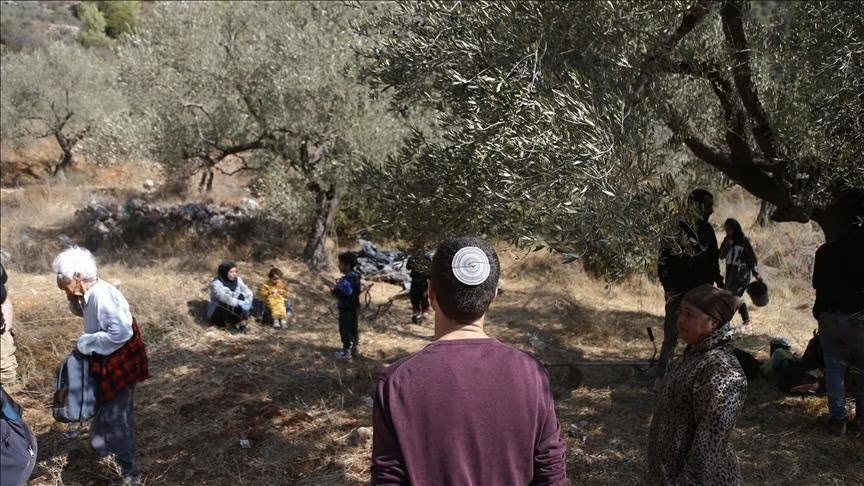
Israeli settlers damage forty olive trees in the town of Mukhmas

Israeli settlers damaged, on Sunday, about forty olive trees in the town of Mukhmas, northeast of occupied Jerusalem.

The Jerusalem Governorate stated in a statement that Israeli settlers attacked the Al-Hay area in the town of Mukhmas and cut down about 40 olive trees owned by the Palestinian Asaad Kanaan.

The governorate described the step as "a new assault added to the series of ongoing (Israeli) violations against citizens and their lands".

It noted that the assault comes days after the Israeli army demolished a park and a playground in the town, "as part of escalating attempts to control the area that is subjected to continuous Israeli attacks".

The governorate pointed out that Israeli settlers established an outpost near the town days ago, "as a gathering and planning point for repeated assaults against farmers and their lands".

According to data from the Palestinian Anti-Wall and Settlement Resistance Commission (governmental), settlers carried out 621 assaults against Palestinians and their property in the West Bank during the past November, ranging between physical assaults and practices against Palestinians and their property and livelihoods.

Since the start of the genocide war in Gaza on October 8, 2023, which continued for two years, the Israeli army and settlers in the West Bank have killed more than 1,093 Palestinians, injured about 11,000, in addition to arresting more than 21,000.

Meanwhile, the genocide in Gaza has left more than 70,000 dead and more than 171,000 injured Palestinians, mostly children and women, along with massive destruction, with reconstruction costs estimated by the United Nations at about 70 billion dollars.

ANALYSIS

Sun 14 Dec 2025 2:57 pm - Jerusalem Time

Population Decline in Europe: A Major Demographic Challenge

A report on the population decline in Europe indicates that it has become a major demographic challenge facing the continent, raising concerns about its impact on the workforce and economic stability.

The report mentioned that the United Nations expects the population in European Union countries to peak next year, and then begin its first sustained decline since the "Black Death" in the 14th century.

It stated that various governments in Europe are working to address this issue with a mix of financial incentives and social policies.

It explained that Scandinavian countries have started forming committees to propose new strategies for addressing declining fertility rates.

In France, President Emmanuel Macron addressed the need for "demographic rearmament" after fertility rates dropped by 18% over the past decade. In some countries with nationalist leadership, governments offer generous financial incentives to boost reproduction, while promoting traditional families.

In Italy, bonuses are given to working mothers with two or more children. In Poland, monthly payments for families have been raised to $220 per child, and the president signed significant tax cuts for families with two or more children. These measures aim to encourage families to have more children and enhance population growth.

European experiences indicate that government programs, even the largest ones, may produce only partial effects. Despite some programs succeeding in slowing the pace of population decline, they have not been able to fully reverse the trend.

It stated that the Hungarian experience clearly shows these limits, where the country invested 5% of its GDP in family policies, but did not achieve the desired goal.

It pointed out that decisions related to reproduction are personal and complex, and often exceed the scope of government policies. These decisions include structural issues such as housing costs, inflation, and the availability of good healthcare and education. In addition, declining fertility rates reflect societal measures such as the availability of contraception, reducing teenage pregnancies, and enhancing women's education and career opportunities.

Data indicates that the fertility rate in the European Union has dropped to an unprecedented low of 1.38 births per woman. This has led more people to delay having children, with many starting in their late twenties or early thirties.

Hungary has been implementing reproductive incentives for about 15 years, where the fertility rate rose from 1.25 to 1.45 by 2015, then to 1.61 in 2021. However, the rate returned to decline, reaching 1.39 in 2024, reflecting ongoing challenges in achieving sustainable improvement. Some experts say that incentives may have simply encouraged people who were already planning to have children to do so sooner.

It noted that interviews with youth in Budapest showed that current policies do not address some of the biggest concerns about raising children, such as the deteriorating public education system and high living costs. It attributed to Hanna Keresztes, a 24-year-old university student: "I think they should improve other things. It's not enough to just provide help to parents."

It reported that there is a shared feeling among youth that focusing on stimulating reproduction solves only part of the problem, but does not adequately address the challenges they face after the birth of children.

It quoted Adam Petreszlai, father of 5-year-old twins and another child: "The costs of parenthood far exceed the incentives. It's hard in any country to have three children."

It sees migration as one of the solutions proposed for countries facing population decline, but in the coming decades, this issue becomes more complicated with declining fertility rates worldwide except in Sub-Saharan Africa.

It attributed to Stephen Shaw, the documentary director who covered population decline: "Migration will be just a temporary solution."

It concluded its report by stating that addressing the population decline problem in Europe requires a multifaceted approach that takes into account economic, social, and cultural factors, and considers that financial incentives may achieve some success, but sustainable solutions require comprehensive improvements to public infrastructure, education, and health, to foster an environment that enables families to grow permanently.

PALESTINE

Sun 14 Dec 2025 12:35 pm - Jerusalem Time

The death of the Prisoner Sakhr Ahmad Khalil Za'oul Inside the Occupation's Prisons

Palestinian prisoner institutions announced today, Sunday, the martyrdom of the administrative detainee Sakhr Ahmad Khalil Za'oul (26 years old), from the town of Husan west of Bethlehem city, inside the Israeli occupation's prisons.

The Prisoners' Affairs Commission and the Palestinian Prisoners' Club confirmed his martyrdom, noting that this incident comes at a time when Israeli violations against Palestinian prisoners in prisons are increasing.

The prisoner Za'oul had been administratively detained since June 11, 2025, in Ofer Prison in the center of the occupied West Bank, and he is the second prisoner from Bethlehem Governorate to be martyred inside Israeli prisons during the past week after the martyrdom of the administrative detainee Abdul Rahman Al-Sabatin.

Since the outbreak of the Israeli genocide war on the Gaza Strip in October 2023, the number of martyrs inside the occupation's prisons whose identities have been identified has risen to 86 martyrs, including 50 prisoners from the Gaza Strip.

The Prisoners' Media Office affiliated with the Islamic Resistance Movement (Hamas) held the Israeli occupation authorities fully responsible for Za'oul's martyrdom, calling for an independent international investigation into the crimes committed by the Israeli prison administration, especially the slow-motion execution policy practiced by the occupation against the prisoners.

The office demanded the disclosure of the fate of the missing prisoners, the handover of the martyrs' bodies, the accountability of the occupation's leaders, and the imposition of deterrent international sanctions to stop the crimes of the prisons.

Reports indicated that the number of Palestinian prisoners in the occupation's prisons exceeds 9,300 prisoners, including more than 50 female prisoners and 350 children. Israeli media also reported the martyrdom of 110 Palestinian prisoners inside prisons since the extremist National Security Minister Itamar Ben-Gvir took office.

Za'oul's martyrdom reflects the extent of the suffering faced by Palestinian prisoners in the absence of international oversight over the ongoing Israeli violations inside prisons, and increases the pressure on human rights institutions and the international community to hold Israel accountable for its crimes.

PALESTINE

Sun 14 Dec 2025 5:54 am - Jerusalem Time

Israelis protest against Netanyahu's government, demanding an inquiry into October 7 failures

Israelis demonstrated in several cities against Benjamin Netanyahu's government, demanding the formation of an official inquiry committee into what they described as the "October 7 failures," referring to the "Al-Aqsa Flood" attack launched by Palestinian resistance on October 7, 2023.

In Jerusalem, protesters gathered in front of President Isaac Herzog's residence and demanded not to grant amnesty to Netanyahu.

In Tel Aviv, Haifa, and Beersheba, families of killed and previously captive Israelis demanded accountability for officials and not closing the failures file.

A few days ago, former head of Israel's General Security Service (Shin Bet) Ronen Bar attacked Prime Minister Netanyahu and called for the formation of an official inquiry committee into the October 7 failures.

Bar said, "Without investigating the entire system, we will have condemned the entire Israeli people to await the next October 7th."

#Watch| Launch of a demonstration in "Tel Aviv"; against Netanyahu's government pic.twitter.com/C0OE4XJKnl

Netanyahu refuses

Netanyahu rejected the opposition's calls to form an official inquiry committee and decided on November 16 to form an independent and unofficial committee.

In the Al-Aqsa Flood attack, the Islamic Resistance Movement (Hamas) attacked military bases and settlements adjacent to the Gaza Strip, killing and capturing Israelis, "in response to the occupation's daily crimes for decades against the Palestinian people and its sanctities, especially the Al-Aqsa Mosque," according to the movement.

Netanyahu is on trial for corruption charges related to bribery, fraud, and breach of trust, but he has always denied committing any violations, saying the charges are politically motivated, and insists that the trial proceedings will end with proving his innocence.

The Jerusalem Post newspaper - according to a recent poll - showed that the majority of Israelis oppose granting Netanyahu presidential amnesty, considering his government mired in corruption.

The poll revealed that about 50% of participants reject any amnesty that President Isaac Herzog could issue, compared to 41% who saw it as necessary for Netanyahu to continue in office.

Netanyahu submitted - at the beginning of this month - a formal request to the Israeli president's office to obtain presidential amnesty that ends his ongoing trial for more than 5 years.

PALESTINE

Sun 14 Dec 2025 4:41 am - Jerusalem Time

Palestinian Ministry of Awqaf Condemns Closure of Ibrahimi Mosque to Worshippers

The Palestinian Ministry of Awqaf and Islamic Affairs condemned the repeated closure of the gates of the Holy Ibrahimi Mosque by occupation forces in front of worshippers, at a time when its doors are open to settlers.

The ministry also denounced the targeting of the staff working in the mosque, the restrictions imposed on them, and the obstruction of their daily work. It affirmed that these practices represent an assault on the Awqaf's authorities and a violation of international laws.

It emphasized that "these measures come as part of a systematic policy to restrict worshippers and limit their access to the mosque, and to impose a new reality on the mosque."

In a related context, dozens of settlers, accompanied by Israeli forces, stormed the Old City in Hebron and imposed restrictions on the movement of residents and merchants.

They explained that settlers storm the city every Saturday, where they listen to explanations from guides accompanying them, while the lives of Palestinians are disrupted as shoppers avoid going to the city, leading to economic stagnation and paralysis.

At the end of last month, occupation authorities handed over to the mosque administration a decision to confiscate the inner courtyard and posted the decision on the walls of the mosque from inside and outside.

The director of the Ibrahimi Mosque, Moataz Abu Senina, said that the Palestinian Ministry of Awqaf -in cooperation with official institutions- submitted a legal objection and followed up the file in Israeli courts, in addition to submitting an official objection to the United Nations Educational, Scientific and Cultural Organization (UNESCO), considering that the mosque is listed on the World Heritage List.

The Islamic Resistance Movement (Hamas) considered the occupation authorities' decision a blatant aggression within the Judaization of holy sites.

The movement said -in a statement- that the Israeli decision falls "within a systematic policy to impose full control over the Ibrahimi Mosque, after years of military siege and restrictions on worshippers, and turning its surroundings into a settlement outpost serving ethnic cleansing projects in the heart of Hebron city."

The Ibrahimi Mosque is located in the Old City, which is under full Israeli occupation control. In 1994, Israel divided the Ibrahimi Mosque by 63% for Jews and 37% for Muslims, following a massacre committed by a Jewish settler that resulted in the martyrdom of 29 Palestinian worshippers. In the part allocated to Jews lies the prayer room.

ANALYSIS

Sun 14 Dec 2025 2:36 am - Jerusalem Time

Turkey strengthens its position as a new regional power amid declining Iranian influence

The Israeli propaganda machine continues its campaigns against Turkey, claiming that it seeks to establish itself as an alternative trade bridge to the occupation.

Kafir Chouva, a researcher on Middle Eastern affairs, pointed out that the regional situation has changed after two years of conflicts, where Iran has declined and Turkey's strength has increased with support from Qatar.

Before the attack launched by Hamas on October 7, Israel was preparing for a strategic leap through a trade corridor extending from India to the Mediterranean, but recent events have disrupted this plan.

Saudi Arabia has tightened its grip on the situation, while the Houthis have closed the Red Sea, leading to the freezing of the trade project, while events accelerated covertly with the collapse of the Assad regime in Syria.

Turkey has become the most influential player in northern Syria, allowing it to offer a new trade corridor bypassing Israel, enhancing its position as a major regional destination.

ANALYSIS

Sun 14 Dec 2025 1:23 am - Jerusalem Time

Europe Surrenders to Trump's Demands: Implications for Defense and Democracy

A magazine published an analysis explaining how Europe chose to surrender to the second Trump administration, preferring appeasement over confrontation in areas of defense, trade, and democracy.

The report indicates that Trump's return to power in January 2025 placed Europe before a difficult choice, where Trump imposed demands for increased defense spending and threatened European exports with tariffs.

European leaders chose surrender instead of facing these pressures, leading to a retreat from the idea of equal partnership and strategic autonomy.

The analysis highlights that the choice of appeasement resulted from internal pressures from populism seeking to weaken the European Union, making this strategy a trap that weakens from within.

The only proposed way out is for Europe to regain its sovereignty and build greater independence instead of waiting until the end of Trump's term.

ARAB AND WORLD

Sun 14 Dec 2025 12:56 am - Jerusalem Time

Military Analysis of the Attack in Tadmor: How Did an Armed Man Kill Three Americans, Including Two Soldiers?

In a painful incident, the Tadmor region witnessed an armed attack that led to the killing of three Americans, including two soldiers. This attack highlights the increasing security threats in the region.

The details of the attack show that the armed individuals managed to carry out a complex operation, indicating a high level of planning and organization. This raises questions about how they were able to execute the attack without being detected.

Tadmor is considered a strategic area, and it has witnessed many military operations in recent years. The recent attack reflects the continuation of tensions in the region and heightens concerns about regional security.

Reactions to the attack were swift, with many military and political leaders condemning this act, emphasizing the need to take strict measures against armed groups.

In conclusion, this attack highlights the urgent need to strengthen security in tense areas, and American and international forces must reassess their strategies to face these challenges.

PALESTINE

Sun 14 Dec 2025 12:29 am - Jerusalem Time

Increasing Academic Isolation of Israel After October 7: Growing Institutional Boycott

Since the end of the Al-Aqsa Intifada, Israel has witnessed notable cultural and academic boycotts due to the crimes it committed, but after October 7, this boycott has increased institutionally, reflecting a state of growing isolation.

Forms of academic boycott are heading towards new patterns, expanding from boycotting individuals to boycotting entire academic institutions, indicating a strategic shift in the isolation imposed on the Zionist entity.

On November 26, 2025, the Jewish writer Peter Beinart apologized for delivering a lecture at Tel Aviv University after strong reactions from activists, which sparked outrage in Israeli circles and calls to impose sanctions on him.

Many Israeli academics have received threats from an anonymous website, reflecting escalating pressures on academics who support Israeli military activities.
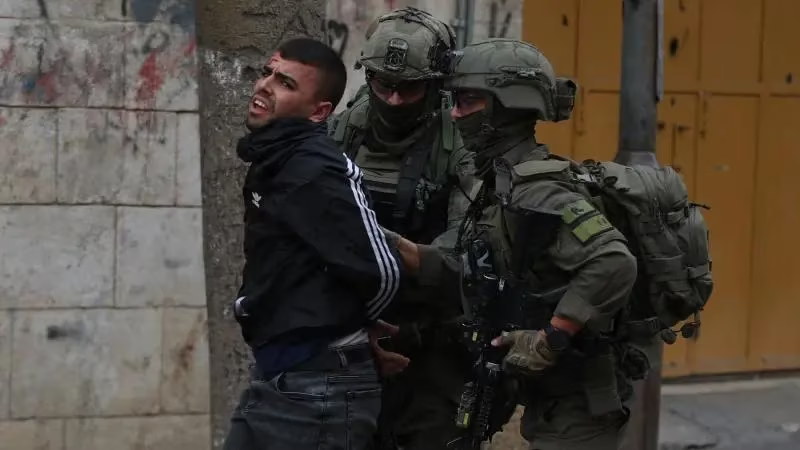
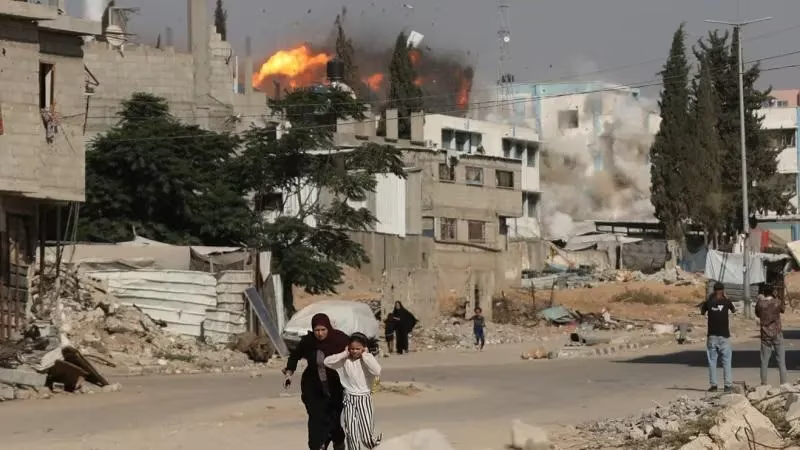
The Council of University Heads in Israel issued a report stating that academic boycotts in Europe have risen to 1000 cases, indicating that this phenomenon has not subsided despite the ceasefire.

PALESTINE

Sun 14 Dec 2025 12:24 am - Jerusalem Time

Death of a Palestinian child in Jenin and occupation assaults on Palestinians in the West Bank

A child was martyred in the city of Jenin as a result of the ongoing occupation assaults, which provoked anger in the Palestinian community.

Israeli violations continue in the West Bank, where several areas witnessed assaults on civilians.

Fears are increasing of escalating violence in the region with the continuation of Israeli military operations.

The occupation ignores the rights of Palestinians and continues its violations daily, which increases the suffering of the Palestinian people.

These conditions require urgent international action to end the assaults and protect Palestinian civilians.

PALESTINE

Sun 14 Dec 2025 12:08 am - Jerusalem Time

Aerial and artillery raids target Gaza and injure a girl in Rafah

Israeli occupation forces launched aerial and artillery raids on scattered areas in the Gaza Strip, resulting in the injury of a girl in the city of Rafah.

These aggressions come amid escalating tensions in the region, where civilians are increasingly suffering from the effects of these attacks.

The injured girl was transferred to the hospital for treatment, amid fears of deterioration in her health condition.

Occupation forces continue to target residential areas, which increases the suffering of the residents and endangers their lives.

International calls are increasing to stop these attacks and protect civilians in Gaza, but the situation remains tense.