PALESTINE

Thu 18 Dec 2025 2:06 am - Jerusalem Time

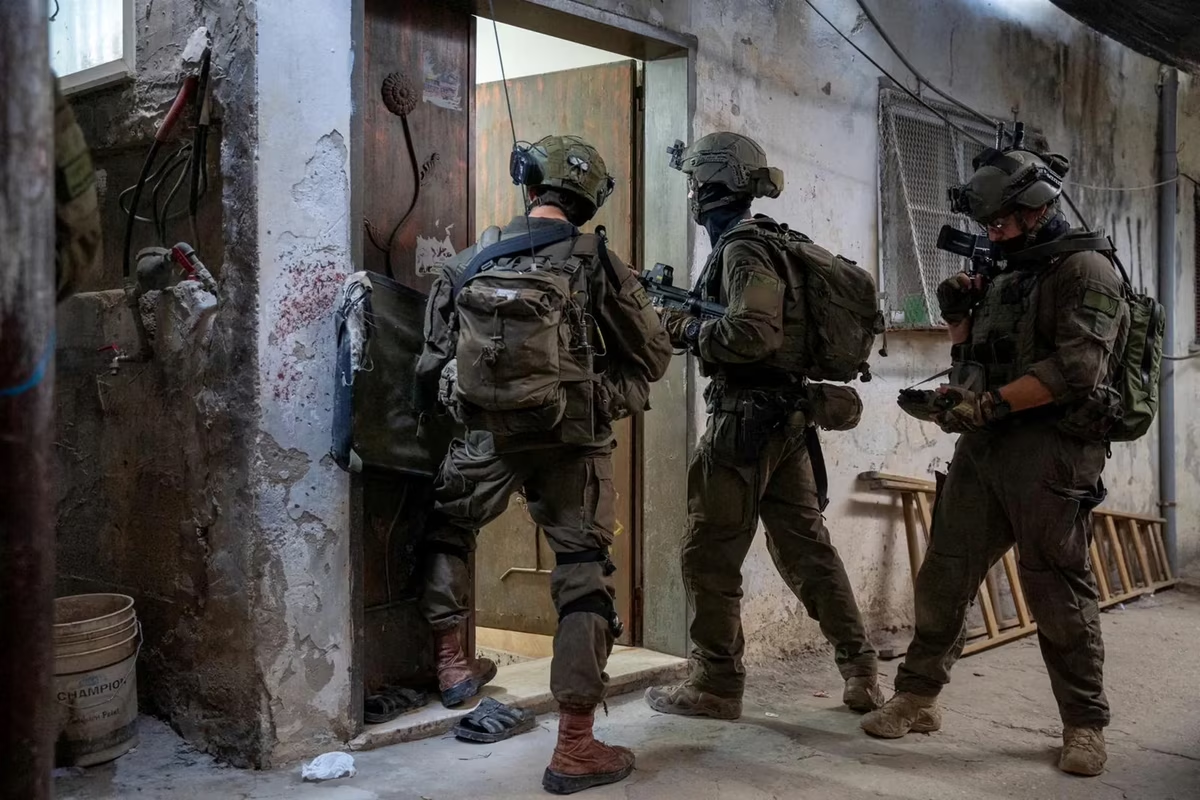
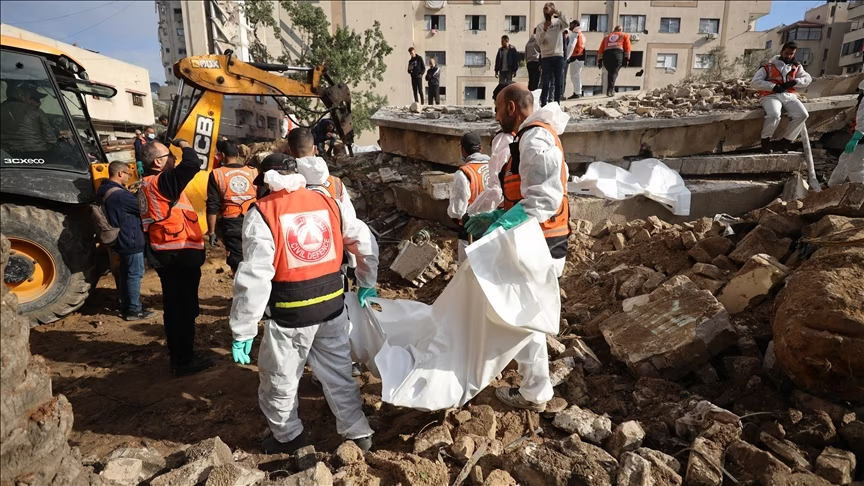
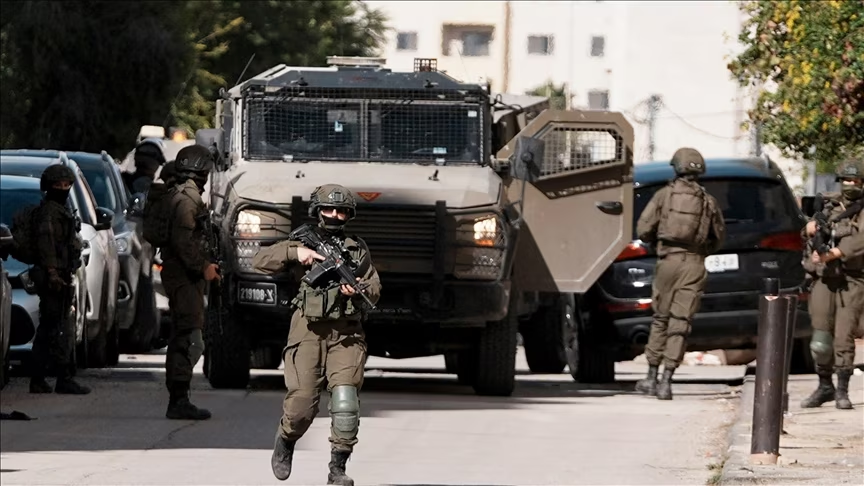
Israeli occupation army arrests two youths, assaults others, and carries out raids in the West Bank

The Israeli occupation army arrested, late Wednesday evening, two Palestinian youths, and assaulted two others, while carrying out raids at dawn today in scattered areas of the occupied West Bank.

The Israeli occupation army arrested, late Wednesday evening, two Palestinian youths during raids on the towns of Anabta and Kafr al-Labad, east of Tulkarm city.

It added that occupation soldiers forced a number of shop owners in the town of Kafr al-Labad to close their shops under threat of weapons, stopped vehicles and citizens, and subjected them to field interrogations.

In the south of the West Bank, it stated that an Israeli force raided Khirbet Deir Razih south of Hebron city, spread out around citizens' homes, and assaulted two youths from the area with beatings and tortured them.

It added that another force raided the southern area of Hebron city, and deliberately rammed its vehicles into a Palestinian vehicle, causing material damage to it without reporting any injuries.

It also reported that armed settlers attacked a vehicle in the north of Hebron city with stones, resulting in shattering its glass and causing material damage to it.

Since January 21st, the Israeli army has continued its aggression in the north of the West Bank, starting with Jenin camp, then moving to Tulkarm and Nour Shams camps, resulting in the destruction of thousands of homes and the displacement of more than 50,000 people, according to official Palestinian figures.

Since the genocide war in Gaza on October 7, 2023, the Israeli army and settlers have intensified their crimes in the West Bank, including Jerusalem, resulting in the martyrdom of about 1,100 Palestinians, injury to about 11,000, in addition to arresting more than 21,000.

PALESTINE

Thu 18 Dec 2025 12:19 am - Jerusalem Time

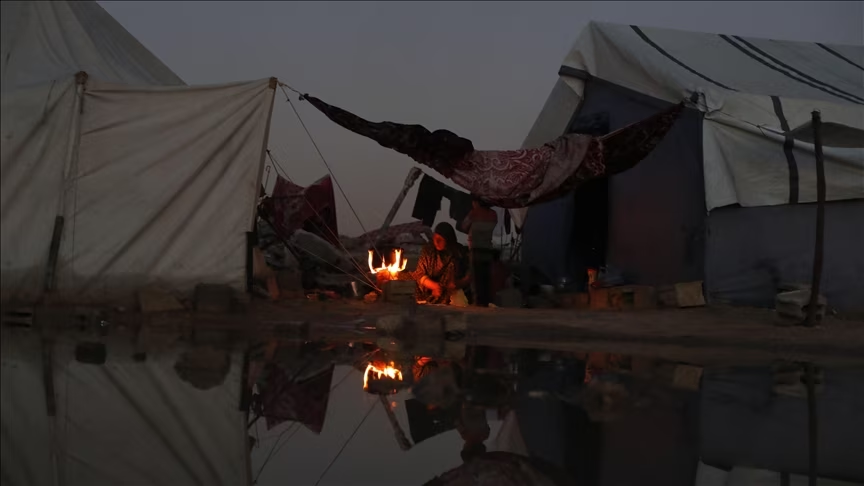
United Nations: 55,000 Palestinian families affected by rains and storms in Gaza

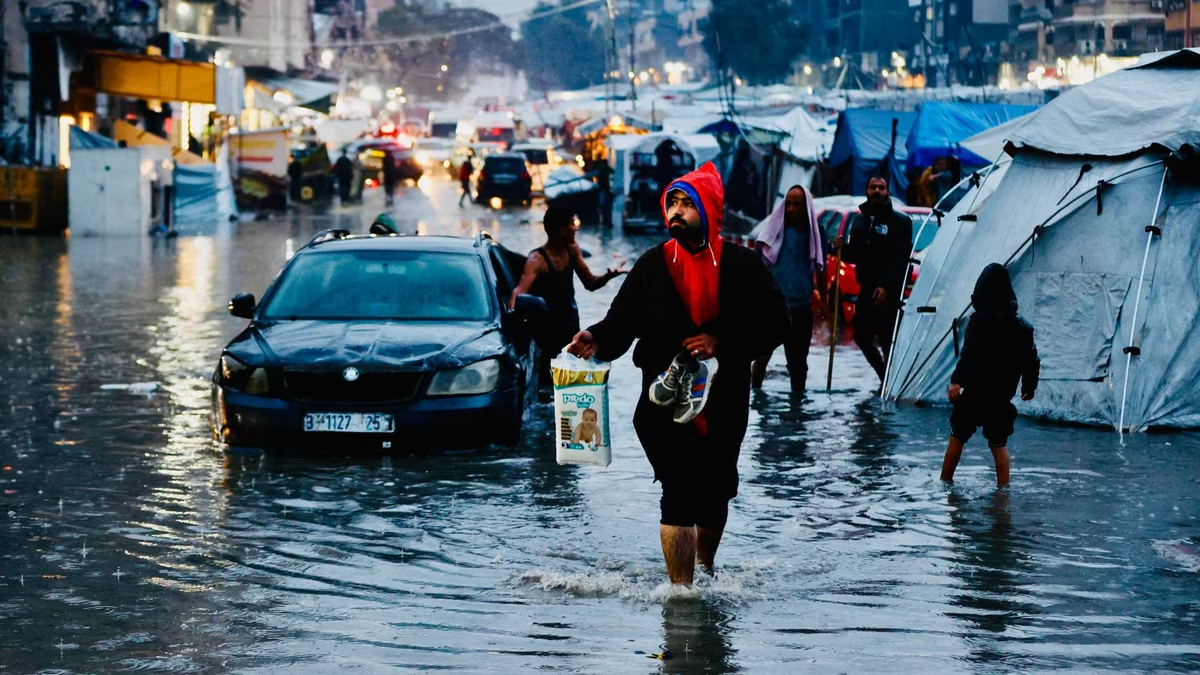
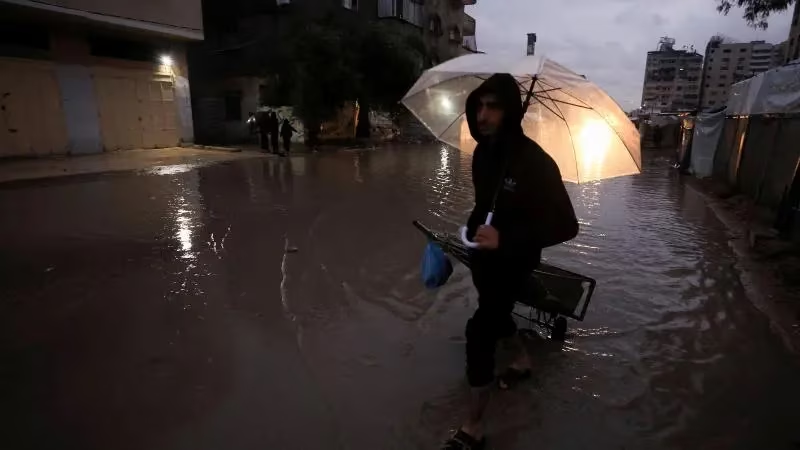
The United Nations announced that approximately 55,000 Palestinian families were affected by the recent rains and storms in the Gaza Strip, and their properties and shelters were damaged.

This was stated by Farhan Haq, Deputy Spokesperson for the United Nations Secretary-General, during a press conference held at the United Nations headquarters in New York on Wednesday.

Haq added: "The United Nations Office for the Coordination of Humanitarian Affairs estimates that approximately 55,000 families across Gaza have been affected so far by the recent rains, and their properties and shelters have been damaged or destroyed due to the storm."

He noted that the storms and rains also caused damage to dozens of child-friendly spaces in Gaza, leading to disruptions in child protection activities, which affected approximately 30,000 children throughout the sector.

Haq also warned that ongoing Israeli obstacles continue to hinder the efforts of humanitarian relief organizations to expand their intervention in the sector more quickly.

The heavy rains that Gaza experienced in recent days have exacerbated the harsh living conditions in an area devastated by intense Israeli bombing, leading to the flooding of tents made of rudimentary materials.

The heavy rains in some areas of Gaza have made problems with urban infrastructure, which was damaged during Israeli attacks, more evident, as many sewage networks and water pumping stations have stopped functioning.

PALESTINE

Wed 17 Dec 2025 10:48 pm - Jerusalem Time

Israeli Economic Expert: How the War on Gaza Supported Israel's 'Zombie' Economy

The Israeli economic expert Shir Hever, who studies the economic aspects of Israel's occupation of Palestinian territories, explains how the mobilization for the war on Gaza supported a 'zombie' economy that appears to be functioning but lacks any future prospects.

The writer at the Israeli website '972+' Amos Brison conducted an extensive interview with Hever, who holds the position of director of the 'Alliance for Justice between Israelis and Palestinians,' covering various aspects of the Israeli economy.

And below is a summary of the most important things Hever said about the deterioration of the economic situation in Israel:

The war on Gaza caused economic shocks and related crises; tens of thousands of families were displaced from border areas with Gaza and Lebanon, and direct rocket and shell strikes damaged those areas, affecting productivity.

About 300,000 reservists were drafted for long periods, leading to a significant shortage in the workforce, and many training days that were invested in these workers were lost.

The educated middle class in Israel has begun to consider emigration, and many families and educated talents have already emigrated due to the impossibility of raising their children there.

Among the manifestations and indicators of the economic crisis in Israel is that many citizens have transferred their savings abroad, fearing inflation and currency devaluation, and the decline in Israel's credit rating and increased investment risks.

Revenues have been diverted to fund the war, which led to the deterioration of public services and higher education quality, and Israel approached falling into the debt trap.

Israel's reputation internationally has become toxic, and it faces an unprecedented level of boycott, divestment, and sanctions.

The Zombie Economy: Hever described the Israeli economy as a zombie economy, saying he described it that way because it is an economy that moves but is unaware of its crisis state or imminent end.

The Israeli economy heavily relies on massive military spending and foreign credit without a sustainable plan for the future.

The government passed a budget that does not reflect the actual reality of expenditures, leading to debts spiraling out of control.

Large deals in the technology sector give a false impression of economic strength, but what is happening is that technology sector workers own shares and sell them to foreign companies and transfer the money abroad. Technological innovations and investments in this sector are declining significantly.

How did Hever respond to the booming stock market and the stability of the shekel?

And in his explanation for the booming stock market and the stability of the shekel's price, Hever said that the increase in reservists' salaries had a significant impact on the stock market and the shekel's stability. These soldiers invest their money in stocks because they cannot spend it in Gaza. They try to protect their savings by investing in the rising stock market, contributing to the economic bubble.

The Israeli Central Bank was managing the crisis by selling large amounts of dollars to give the impression that everything is under control, but it is nothing more than market manipulation.

Deterioration of living conditions and increasing poverty rate. The cost of the war greatly affected most families, contributing to the increase in their debts, and the 'Latet' report - which is an Israeli non-governmental organization that issues an annual report covering various economic and social indicators related to poverty, food insecurity, social inequality, and other issues facing vulnerable groups in Israel - indicated that the percentage of people suffering from food insecurity has risen significantly, and many Israeli families are living in hardship with debts increasing on them during the war.

When the Ministry of Finance announces the real costs of the war compared to its commitment in the 2025 budget, it is expected to lead investors and international institutions to lose confidence.

ARAB AND WORLD

Wed 17 Dec 2025 10:18 pm - Jerusalem Time

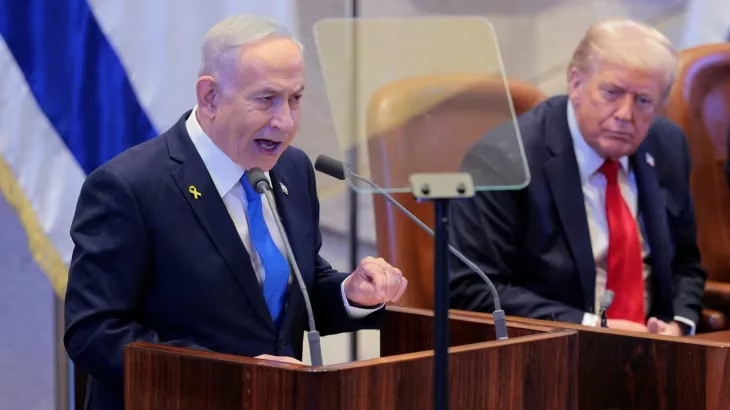
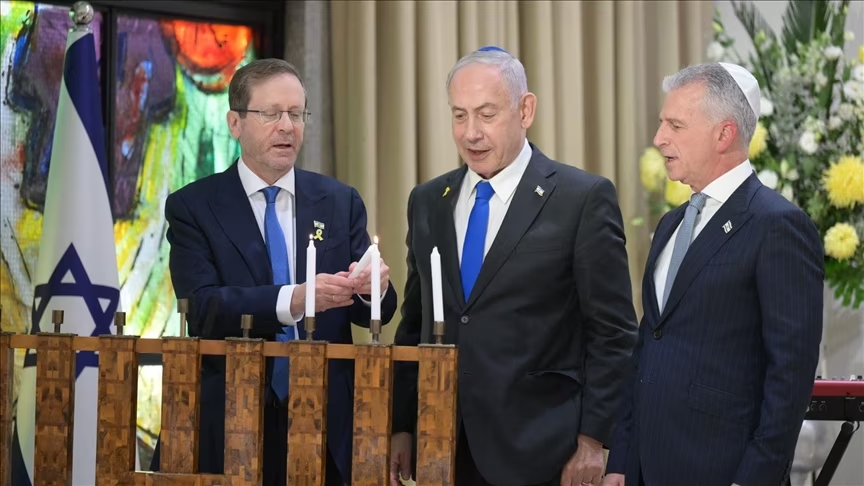
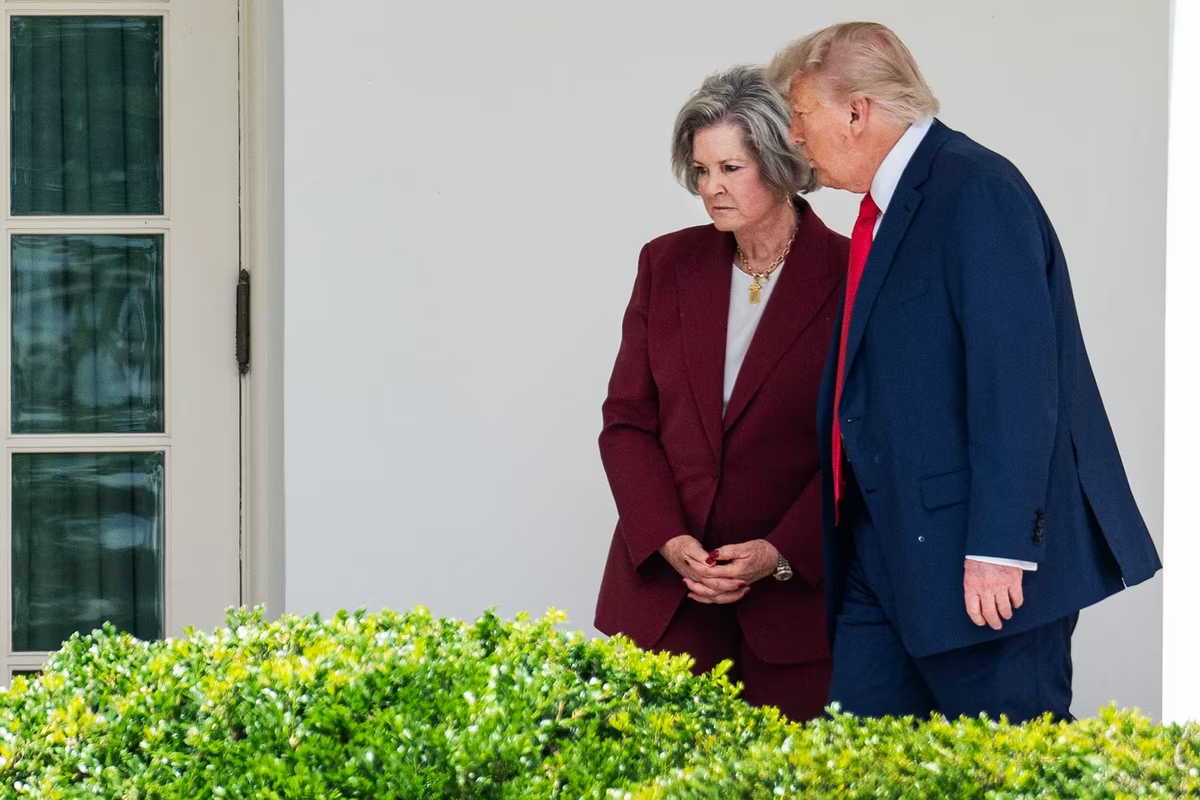
Netanyahu and Trump Discuss the Syrian File and the Occupation's Fears of Turkey Entering Gaza

At a time when the Prime Minister of the occupation, Benjamin Netanyahu, is preparing to hold his summit with President Donald Trump, the Syrian file appears as one of the files they will discuss, in light of the fact that the reality on the ground in Syria primarily serves Turkey and its president Recep Tayyip Erdogan, in addition to the occupation's fears of Turkish entry into the Gaza file.

General Yisrael Ziv, the former head of the Operations Branch in the occupation army, claimed that "the Americans do not understand the depth of the knot happening under their noses in Syria, especially after the recent incident in which two of their soldiers were killed, because the Syrian army being rebuilt consists of remnants of the previous army, but mainly of reinforcements from opposition militants, who will form part of the new Syrian forces, which have not yet been able to control more than half the territories."

And he added in an article that "the Israeli assessment of the Syrian situation is that Ankara has a clear agenda and wants a return on investment in exchange for its support for the revolution, and sees Syria as part of Greater Turkey, and has obtained Trump's blessing for that, especially since Erdogan is taking charge of it step by step, as he brings in military forces and intends to build a large base near Damascus, and encourages and creates economic participation everywhere in Syria, at the forefront of which are economic assets from oil, minerals, and ports."

And he explained that "the Israeli reading of Erdogan is that he has a regional strategic vision for Turkish influence, as he wants to be the main player in the Arab-Israeli conflict, and wants to influence the occupation in the Golan and Gaza, and invests heavily in enhancing his defensive and offensive military capabilities compared to the occupation, and does not hide his desire to confront it, and feels strong and supported when NATO is behind him and Trump's embrace on his right, and his strategy will be tested very soon in the matter of the presence of his security forces in Gaza."

And he affirmed that "if Trump decides in favor of Turkish soldiers entering Gaza, it will not only be a great victory for him over Israel, but a clear sign of his growing strength against the Americans at our expense, and it will greatly contribute to strengthening his regional leadership, and for us it will be a major political and security failure, and therefore there is not only fear of losing freedom of military action in Gaza and Syria, but Turkey will become a leading regional leader, and as an entity opposed to us, it will be more dangerous to it than Iran, because of its political power capable of driving a wedge and distancing the United States and Europe from Israel."

And he affirmed that "another difficult problem that Netanyahu will face in his meeting with Trump is that he does not fulfill the conditions of the ceasefire he committed to, and made it unilateral in practice, this is the case in Lebanon, where he attacks small and large targets there every day, and similarly in Gaza, where the dose is less, but the attack on Raed Saad constitutes a clear violation of the ceasefire, and the reason he provided did not really convince anyone."

And he explained that "it should be said that in the case of eliminating Saad and al-Tabtabai specifically, Israel had a very valid reason to eliminate them given their importance, even at the risk of reprimand from the United States, but even if some attacks were justified, it is unjustified on the other hand that the occupation does nothing to strengthen the political side of the agreement, which is a fundamental party for the agreement to become stable."

And he pointed out that "Netanyahu is working against the stability of the agreements to benefit politically from Erdogan's renewed narrative, the new master who learned from October 7, and attacks everything that moves, and above all does not want to show withdrawals to the international borders, because withdrawal looks bad."

And he concluded by saying that "it is clear that this approach contradicts sound security policy, because it deceives the public that from now on it can attack every day until the end of time, a kind of endless war, and this unrealistic illusion will bring reverse results on normalization, and will harm tourism, the economy, and reserves, and will be impossible in the budget, and will harm Israel's political position and more."

PALESTINE

Wed 17 Dec 2025 9:36 pm - Jerusalem Time

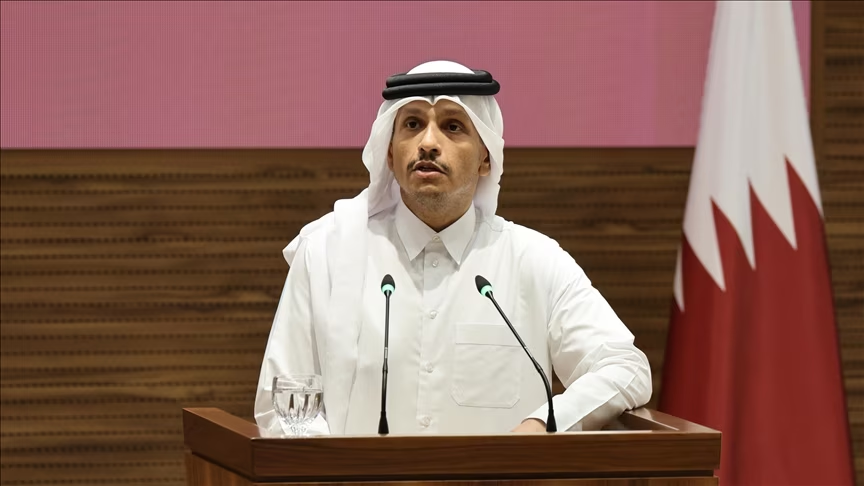
Qatari Prime Minister: Mediators will hold a meeting on Friday to outline the transition to the second phase of the Gaza agreement

Qatari Prime Minister and Foreign Minister Mohammed bin Abdulrahman Al Thani announced on Wednesday that mediators will hold a meeting next Friday to outline the transition to the second phase of the ceasefire agreement on the Gaza Strip.

This came according to televised statements made by the Qatari Prime Minister during his indefinite visit to Washington, which began on Tuesday.

And the Prime Minister said that he discussed in Washington the importance of doubling efforts to transition to the second phase of the ceasefire agreement on Gaza.

He added that preparations are underway with the American side and all mediators for a meeting of all mediators on Friday to outline how to transition to the second phase, without further details.

PALESTINE

Wed 17 Dec 2025 8:45 pm - Jerusalem Time

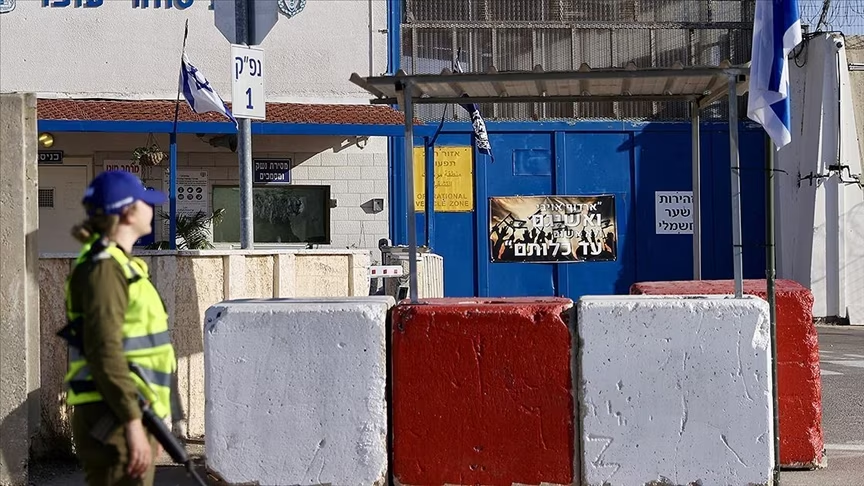
Israeli Court Closes Investigation File into the Death of Child Prisoner Walid Ahmed in Megiddo Prison

The Prisoners' Affairs Commission and the Palestinian Prisoners' Club said on Wednesday that the Israeli judiciary closed the investigation file into the death of the child prisoner Walid Ahmed (17 years old) inside Megiddo prison north of Israel, accusing the judicial system of "collusion" in crimes committed against prisoners.

The two institutions explained that following legal follow-up on the file of the death of the child prisoner Walid Ahmed (17 years old) from the town of Silwad, north of Ramallah city (central West Bank), the Israeli court in Haifa north of Israel decided to close the investigation file, claiming that all avenues had been exhausted.

They added that the child died in March 2025 inside Megiddo prison north of Israel, while the court claimed "the absence of direct crime based on autopsy results issued by the Institute of Forensic Medicine in Abu Kabir" (Tel Aviv).

According to the final autopsy report, the death was attributed to acute pulmonary embolism caused by a blood clot, claiming long-term health deterioration, which the court adopted in its decision, without addressing the effects of deliberate starvation and deprivation of treatment as central causes of death, according to the institutions.

The institutions continued that the Israeli decision "with its disregard for the clear indicators on the martyr's body that prove torture through starvation and deprivation of treatment, is nothing but a blatant attempt to conceal the actual causes that led the child Walid to this catastrophic health condition."

They pointed out that "the course of judicial follow-up since the moment of the child's martyrdom revealed the extent of deliberate procrastination and delay by the Um al-Fahm police (north) and the occupation prosecution, and the refusal of both parties to provide serious updates to the court."

They clarified that this "reflects the lack of genuine will to investigate, and the ongoing effort to dispel suspicions and remove responsibility from the real perpetrators whose practices led to this result, especially since the child Walid Ahmed did not suffer from any health problems before his arrest."

The institutions also spoke of systematic disregard for documented data and confessions issued by Israeli agencies regarding punitive and starvation policies imposed on prisoners since the start of the Israeli genocide war on Gaza, considering that this confirms "the involvement of the judicial system in protecting these policies."

They considered the case of Walid Ahmed "a glaring example of what they described as policies of slow killing of prisoners inside prisons."

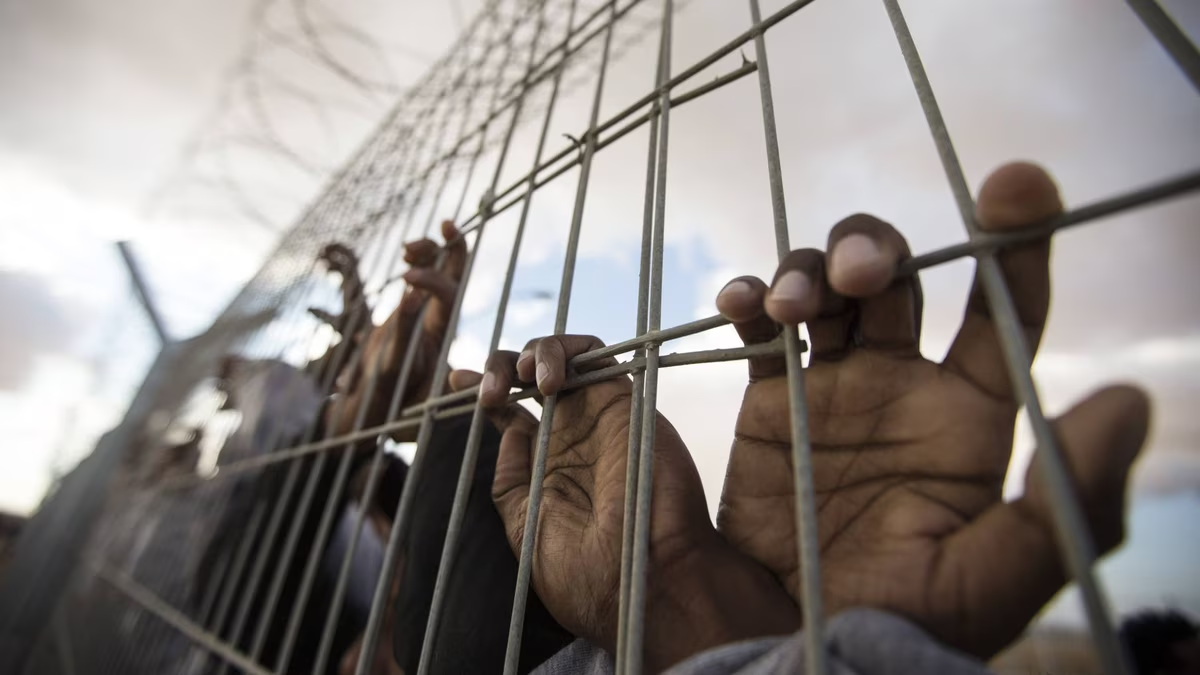
Israel detains in its prisons about 9,300 Palestinians, most of them detainees and administrative detainees, including 51 female prisoners and 350 children and about 350 administrative detainees, according to data from prisoners' institutions until the beginning of December.

Administrative detention is a decision to imprison by an Israeli military order claiming a security threat, without issuing an indictment, and it extends to 6 months renewable, and the intelligence provides the court with what is called a secret file that the lawyer and/or the detainee are prevented from accessing.

According to the institutions, the identities of 86 prisoners and detainees who died inside prisons since the start of the genocide war in Gaza have been identified "while dozens of martyrs from Gaza detainees remain under forced disappearance until now."

With American support, Israel launched a genocide war on Gaza since October 8, 2023, which lasted two years and left more than 70,000 dead and about 171,000 injured Palestinians, most of them children and women.

Simultaneously, its army and settlers escalated incursions into the West Bank, including East Jerusalem, resulting in the killing of about 1,100 Palestinians, injuring about 11,000, in addition to arresting more than 21,000.

PALESTINE

Wed 17 Dec 2025 7:47 pm - Jerusalem Time

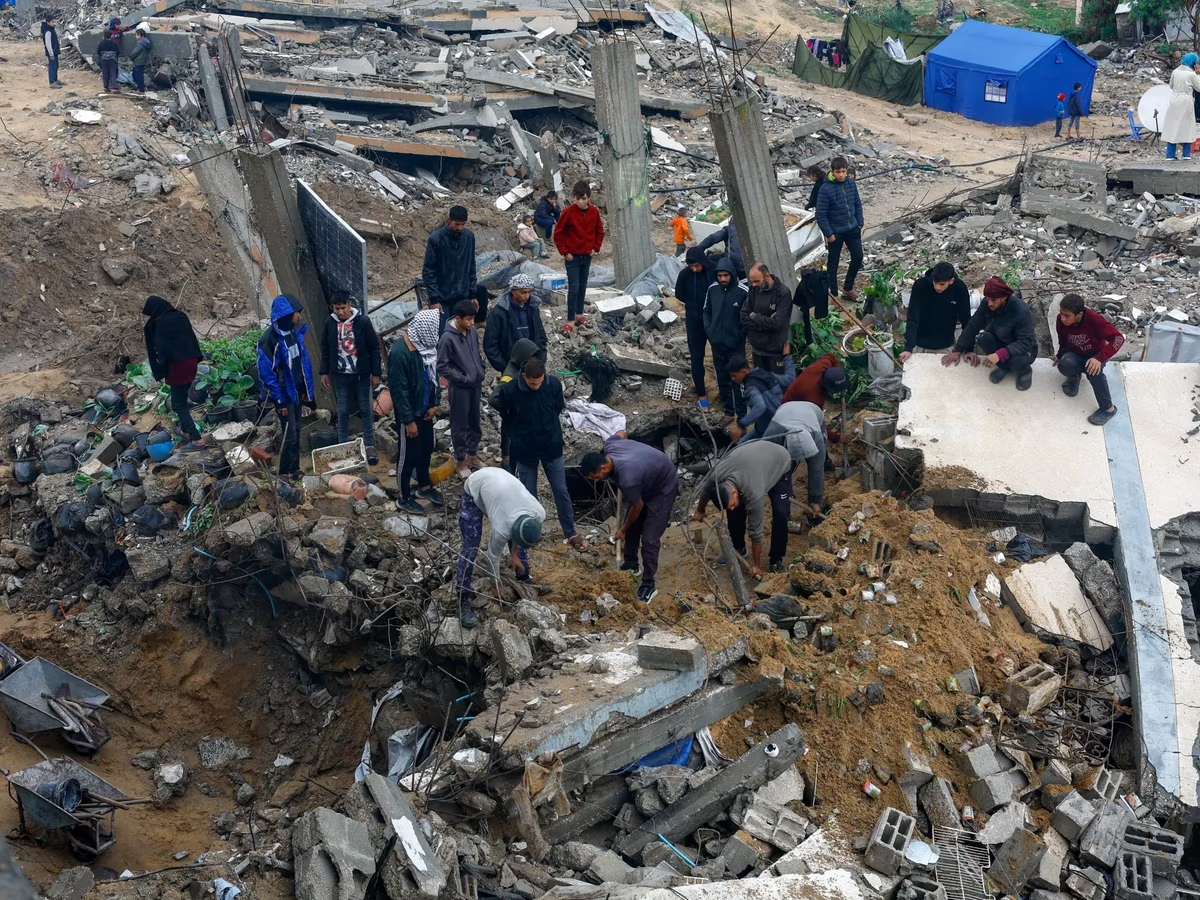
Collapse of 15 Homes in Gaza During the Recent Weather Low

At least 15 homes collapsed over the heads of their residents in Gaza during the weather low last week, as residents of the sector endure a tragic winter amid a worsening humanitarian crisis with the occupation preventing the entry of necessary aid to protect against heavy rains and strong winds.

In the context of monitoring the dimensions of the escalating humanitarian crisis in the Gaza Strip, the "Sind" verification agency documented the complete or partial collapse of at least 15 homes, resulting in casualties including children.

Satellite images also showed severe damage to displaced persons' tents due to heavy rains and strong winds, especially in Gaza City and the northern part of the sector, areas that have been subjected to intensive and systematic bombing over two years of Israel's genocidal war.

The map prepared by the "Sind" agency shows the collapses concentrated in Gaza Governorate with 11 homes, in addition to 4 other homes in the northern sector.

The data analysis relied on reports from Gaza Civil Defense, journalists' reports and photos, and satellite images. All this information was concentrated in the period from December 12 to 16, the days when the sector faced a harsh weather low.

According to the analysis results, December 12 recorded the harsh peak of the weather low on the northern areas, with more than 68% of the total observed complete and partial collapse incidents occurring on that day alone during that period.

By comparing satellite images taken before the low with those documented on December 13, the day after the low's peak, the extent of the severe damage to the tents due to rains, floods, and strong winds that uprooted and swept away several of them and flooded entire camps becomes clear, which coincides with Civil Defense statements and field footage broadcast by activists and journalists.

The Ministry of Interior in the Gaza Strip confirmed on Friday the death of 14 Palestinians due to the low, some of whom died from the effects of the weather low and due to partial and complete collapses of homes and buildings on the heads of their residents because of the rains, and 3 children died from cold.

For its part, the Government Media Office in Gaza stated that the weather low, named "Birun", revealed the depth of the entrenched humanitarian catastrophe in the sector, estimating initial losses at about 4 million dollars.

The office also recorded damage and flooding of more than 50,000 displaced persons' tents, in addition to widespread destruction in infrastructure, road networks, water lines, and damage to huge quantities of food supplies, as well as flooding of vast agricultural areas and damage to field medical points.

The office issued an urgent distress call, emphasizing the need to urgently introduce shelter materials, tents, mobile homes (caravans), and emergency supplies, in compliance with humanitarian protocols and the provisions of the ceasefire agreement that came into effect on October 10, which stipulate securing civilians' needs in such circumstances.

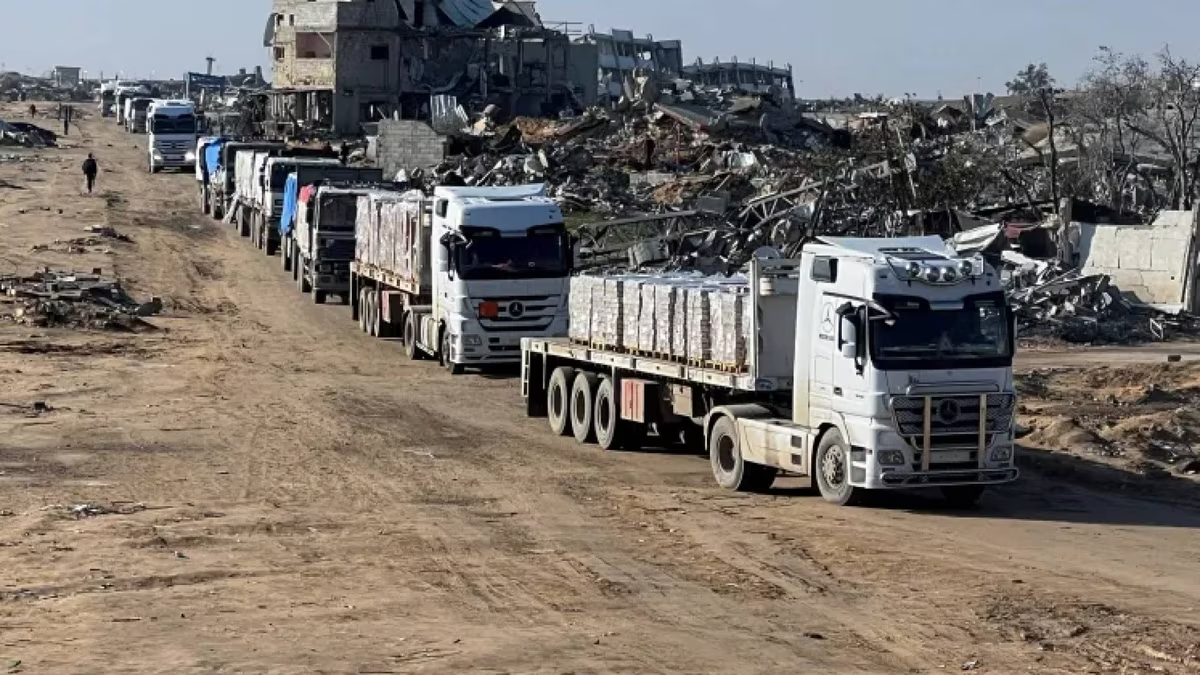
The occupation did not commit to entering 600 aid trucks daily as stipulated in the agreement, according to the Government Media Office in Gaza, which confirmed that the average number of trucks allowed by Israel to enter the sector since the agreement came into effect did not exceed 234 trucks daily.

Israel prevents the entry of materials needed by Gaza Strip residents to protect against winter rains or repair their homes that were bombed, amid uncertainty about the timing and mechanism for starting reconstruction.

PALESTINE

Wed 17 Dec 2025 7:37 pm - Jerusalem Time

Qatar and America Agree to Double Efforts to Move to the Second Phase of the Gaza Agreement

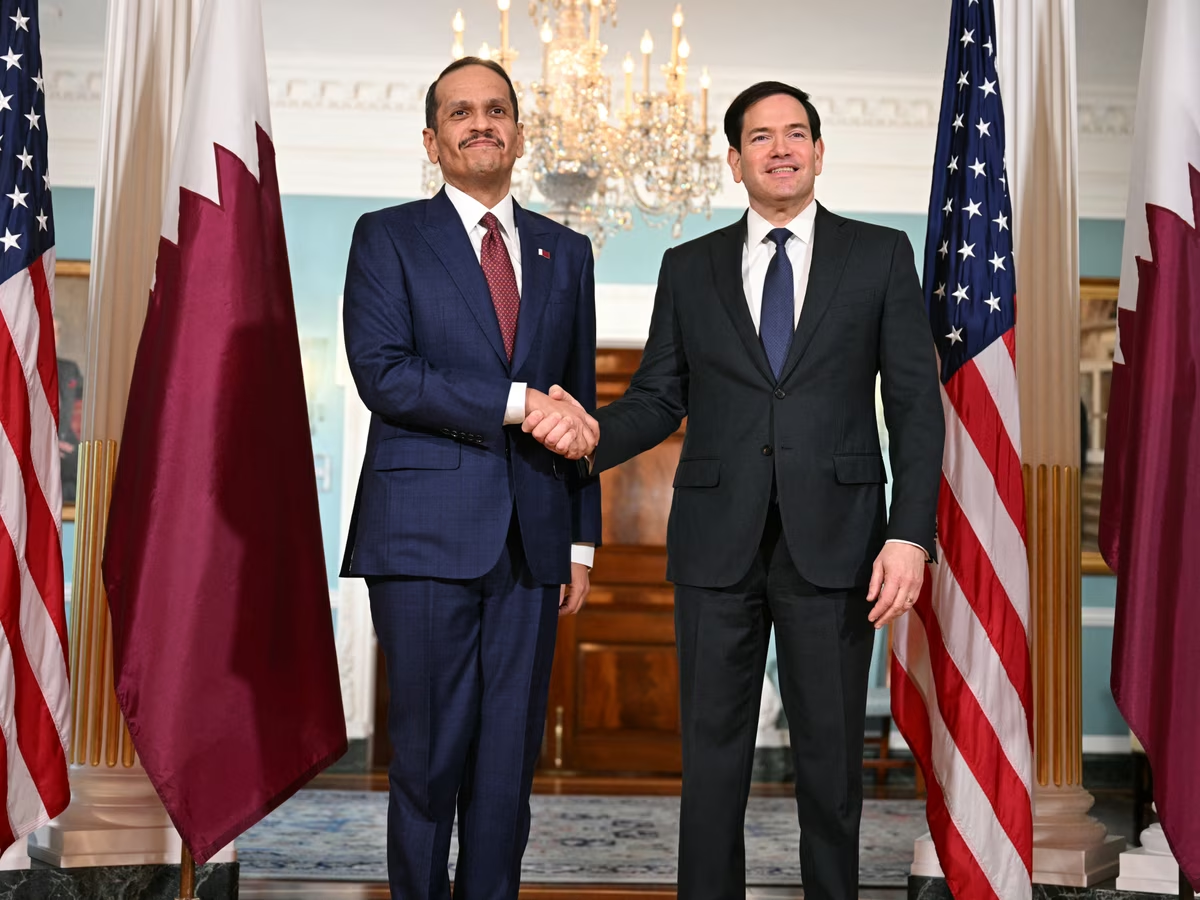
Qatar's Prime Minister and Foreign Minister Sheikh Mohammed bin Abdulrahman Al Thani announced today, Wednesday, an agreement with US Secretary of State Marco Rubio to double efforts to reach the second phase of the Gaza agreement, confirming that a meeting will soon be held between the mediators on this matter.

During a visit by Qatar's Prime Minister and Foreign Minister to Washington, he stated that preparations are underway with the American side to hold a meeting between the mediators next Friday to outline how to transition to the second phase of the ceasefire agreement in the Gaza Strip, which came into effect on October 10 last year.

He said there is an urgent need to move to the second phase of the agreement in Gaza, as well as "to form the Palestinian civil administration in Gaza as soon as possible".

He emphasized that his country does not want the stabilization force in Gaza, as stipulated in the UN Security Council resolution last November, to protect one party over another, as he put it.

He clarified that the stabilization force in Gaza should protect the agreement to end the war, noting that "there are many elements in the agreement to end the war in Gaza that must be completed".

He affirmed Qatar's commitment to working with the United States to protect the agreement to end the war in Gaza, noting that his talks in Washington raised the issue of violations of the ceasefire in Gaza.

Commenting on the ongoing Israeli violations of the ceasefire, Qatar's Prime Minister and Foreign Minister said that violations of the ceasefire in Gaza put the mediators in an embarrassing position, as he described.

He also confirmed that the humanitarian situation in Gaza occupied a large part of the discussions he held in Congress, where he emphasized the need to deliver aid to the sector unconditionally.

Qatar's Prime Minister and Foreign Minister warned that the current situation in Gaza exposes the agreement to danger every day.

ARAB AND WORLD

Wed 17 Dec 2025 12:11 pm - Jerusalem Time

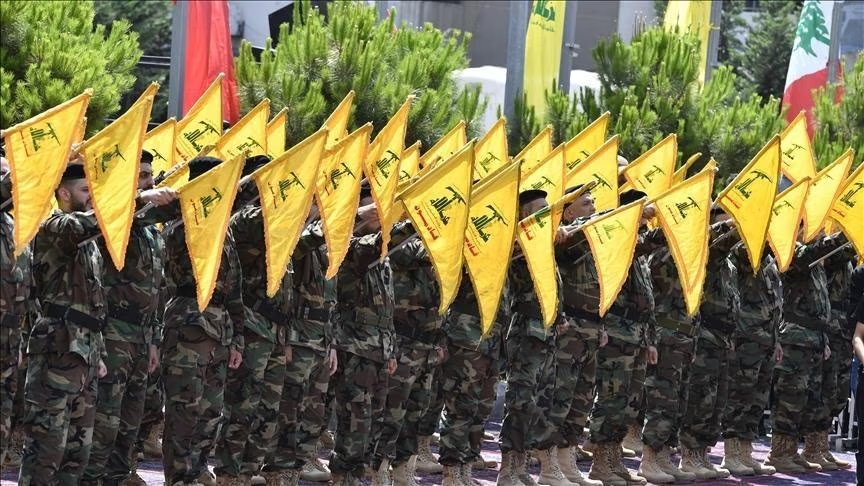
Israeli Estimates: End of December Date for New Confrontation Decision with Hezbollah

The Hebrew newspaper "Yedioth Ahronoth" estimated that the end of December/January this year could be the date for an Israeli decision to enter a new military confrontation with "Hezbollah" in Lebanon, if the American administration approves it.

The newspaper indicated in its Wednesday report that Israel is preparing for a new confrontation with Hezbollah, "which has become weaker but still well-armed".

The newspaper added: "However, defense officials believe that no operation will be carried out without the approval of US President Donald Trump, making it unlikely to take any action before Prime Minister Benjamin Netanyahu's scheduled visit to the White House later this month".

Netanyahu is scheduled to meet with Trump in Florida in the United States on December 29 this year.

The official Hebrew Broadcasting Corporation said last week that the Israeli army "completed preparations for a plan in recent weeks to launch a broad attack against Hezbollah-affiliated sites, if the Lebanese government and army fail to implement their commitment to dismantle the party's weapons before the end of 2025".

Under American-Israeli pressure, the Lebanese government approved on August 5 last year the monopolization of arms by the state, including those held by "Hezbollah", before announcing in September last year its welcome for the plan prepared by the army to implement the decision, consisting of 5 stages, but it did not specify a time frame for its application as expected, a step considered by observers as an attempt to appease the party and its base.

However, the first stage of the plan includes withdrawing "Hezbollah"'s weapons from south of the Litani until the end of this year.

But Hezbollah's Secretary-General Na'im Qassem said on more than one occasion that the party rejects this and demands the withdrawal of the Israeli army from all Lebanese territories.

"Yedioth Ahronoth" revealed that the army's intelligence branch is monitoring "hidden assets and political transformations and Iranian funding, in anticipation of a possible escalation that may be influenced by US approval and the Lebanese parliamentary elections (scheduled for May 2026)".

It said: "Hezbollah's underground network in the southern suburb of Beirut is not as deep or extensive as that in Gaza, and this is largely due to the nature of the soil that poses engineering challenges for the Iran-backed group".

But it added: "Nevertheless, Israeli military intelligence believes that the party will try to hide most of its strategic assets in tunnels and hideouts under residential buildings in Beirut's southern suburb".

It continued: "Intelligence officials were recently surprised to learn that Lebanese civilians in the capital repeatedly refused Hezbollah's requests to rent apartments outside the suburb, fearing that these properties would be targeted by Israeli air raids".

** Signs of a possible operation in Lebanon

According to the newspaper, "signs of a possible Israeli operation in Lebanon have emerged, with the Israeli army urging the political leadership to approve it, including the assassination of Hezbollah's prominent military commander, Haitham Ali al-Tabtabai".

It continued: "However, Hezbollah chose to continue exercising restraint, refraining even from launching a single mortar shell in response to the assassination of its military commander, a containment policy that was more common in previous years by Israel".

In November last year, Israel assassinated Hezbollah's Chief of Staff Haitham Ali al-Tabtabai in a raid on Beirut's southern suburb, the biggest breach of the ceasefire agreement that came into effect on November 27, 2024.

"Yedioth Ahronoth" noted that "this restraint is unlikely to continue in the event of a comprehensive escalation. The Israeli army expects Hezbollah to respond with a coordinated barrage of hundreds of rockets, shells, and drones over several days".

It added: "Officials in military intelligence believe that Hezbollah currently prefers to endure Israel's near-daily air raids instead of escalating, preferring to focus on internal power struggles that it sees as more controllable".

The newspaper quoted unnamed officials from the Israeli military intelligence branch as saying that "from a military perspective, Hezbollah is still stronger than the Lebanese army, and when this situation changes, we will know that things have turned around".

The officials added: "Until then, Hezbollah will continue to rebuild its ranks, relying mainly on local manufacturing and converting existing missiles into precision-guided ones".

The newspaper also quoted an unnamed Israeli army official as saying that "the army will have to continue confronting Hezbollah no matter the cost".

He added: "With the increasing seriousness of talk about disarming Hezbollah, and any disarmament effort tending toward the use of force, it is likely that the party will become more aggressive".

He continued: "Hezbollah will not volunteer to disarm, and the Lebanese army, for its part, maintains a neutral position".

The newspaper considered that "there is another pressure factor influencing Hezbollah's decisions, which is a political factor".

It said in this regard: "Parliamentary elections are scheduled to be held in Lebanon in May (next year), and the Israeli army believes that the current Secretary-General, Na'im Qassem, aged 72, is more concerned with restoring internal unity and political legitimacy than entering a new war with Israel".

It quoted an unnamed Israeli military official: "Qassem lacks the charisma that Hassan Nasrallah had, and as a result, there is little hope among Lebanese Shiites. More of them are now turning to the Amal Movement".

Despite the ceasefire between Israel and Lebanon coming into effect at the end of last year, Israel continues its daily attacks in Lebanon.

Since October last year, the Israeli army has intensified its attacks on Lebanon as breaches of the agreement, with media leaks about plans to launch a new attack on the Arab country.

The ceasefire agreement, signed about a year ago, was supposed to end Israel's aggression on Lebanon in October 2023, which turned into a full-scale war in September 2024, leaving more than 4,000 dead and over 17,000 injured.

PALESTINE

Wed 17 Dec 2025 12:05 pm - Jerusalem Time

Displaced people in Gaza face the risk of collapse of damaged buildings as weather depressions intensify

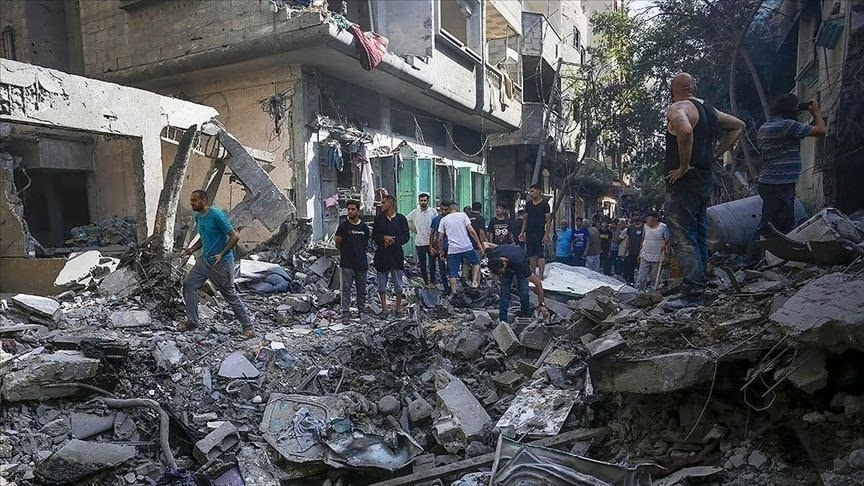
With the ceasefire in the Gaza Strip on October 10 last year, Palestinian displaced people resorted to living inside their buildings damaged by Israeli bombing during months of genocide, after tents failed to provide them with the minimum protection and safety.

The destroyed buildings, whose remaining walls suffer from large cracks, increase the risk of collapse with every weather depression that strikes the sector and is accompanied by strong winds and rains.

Under those roofs from which iron bars and large cement blocks hang, thousands of Palestinians, including children, were forced to live in the absence of safe alternatives, with Israel preventing the entry of mobile homes (caravans) to shelter them.

These risks became a tragic reality on Tuesday, following a partial collapse in a building west of Gaza City, resulting in the death of a Palestinian and the injury of four others, in addition to the flooding and scattering of thousands of tents due to the stormy depression that struck the sector on Monday evening.

This depression is the second to hit the sector in less than a week, where the first polar one "Birun" caused the death of 14 Palestinians, including 11 due to the collapse of more than 13 damaged buildings, and 3 due to the cold, in addition to the complete or partial damage and flooding of 53,000 tents, according to official data.

Civil Defense spokesman Mahmoud Basil warned in a statement of the danger of collapse of thousands of buildings damaged by the genocide as a result of "the intensification of winds and rains".

During the two years of genocide, Israel completely destroyed 268,000 housing units, severely damaged 148,000 making them uninhabitable, and partially damaged 153,000, according to the latest data from the Gaza Government Media Office.

The destruction of these housing units is part of the comprehensive genocide that the sector was subjected to, affecting 90 percent of its civilian infrastructure.

Israel continues, in the areas under its control pursuant to the agreement, to blow up and demolish what remains of residential buildings and homes, thus dissipating the Palestinians' hopes of returning to their homes after the complete withdrawal of the army from the sector.

The genocide war that Israel started on October 8, 2023, and left more than 70,000 dead and over 171,000 injured, ended with an agreement concluded between Hamas and Tel Aviv through mediators on October 10 last year, which the army violated hundreds of times with bombing, demolition, and killing.

Basil called for urgent international intervention to save Palestinians from any possible death due to repeated collapses, and to bring in safe shelters for them.

** Compulsory choice

Hiyam Abu Nada, one of those who resorted to the destroyed buildings, inside the "Hamd City" residential complex in the south of the sector, which witnessed intensive Israeli bombing.

In a statement, Abu Nada, who was displaced from Shujaiya east of Gaza, says that there is no alternative place to take refuge after Israel destroyed most of the homes in her neighborhood, and still occupies large parts of it.

She noted that despite the dangers threatening her family members, the lack of alternatives forced them to live inside the cracked buildings.

She adds that she hears sounds of small collapses in the walls due to rainwater seeping into them, continuing: "The sand collapses and falls into our eyes."

She points out that what remains of the walls in the destroyed buildings does not prevent frost from seeping into their bodies.

As for Mustafa Abu Nada, he says that the buildings damaged by the genocide "do not constitute a safe shelter (..) at any moment they could collapse on us".

He indicates that they live in the collapsing buildings "compelled despite the fear in the absence of other shelter places".

He explained that the cold conditions caused his children to contract illnesses, and that he spends the night trying to reduce water leakage inside the house by collecting it in plastic containers.

This is confirmed by Aouni Al-Haj, one of the residents of "Hamd City", saying: "We are forced to live here. Because we are unable to live inside the tents."

He reports that most buildings in the area are threatened with collapse, and they are constantly in contact with the civil defense to remove cement blocks hanging from the roofs.

As for Fatheya Obeid, who lost her husband during the war and her son was arrested, she says that the dangerous place forms a last refuge for families, noting the presence of an infant inside it amid fears of its impact by the depression.

** Harsh moments

In western Gaza City, at the Rashad Al-Shawa Cultural Center, which was heavily targeted by Israel during the genocide, the displaced Halima Aslim lives with her children amid collapse risks.

Aslim, who set up a tent under the center's roof, says she goes through harsh moments during nighttime hours with every weather depression that strikes the sector, where she spends those times awake fearing a sudden collapse.

She adds: "Our life here is full of fear, at any moment the building could collapse", describing the place she thought would be a safe shelter for her children as "a source of terror".

Aslim points to questions that haunt her whenever news of collapsing buildings reaches her, saying: "What will happen to us?".

As for Mahmoud Hamouda, displaced to the same center, he expresses his fears of the building's roof collapsing on the tent that shelters his children, amid visible cracks and fissures.

He calls for the necessity of providing mobile homes to shelter Palestinians who are pursued by death from the risk of building collapses and rains.

** Attempt to survive

Using clay, the Shaer family in Khan Yunis is trying to rebuild some walls on what remains of their destroyed home, which is about a kilometer away from the Israeli army's position.

Mohammed Al-Shaer explains that this attempt came after tents proved unable to provide real shelter for Palestinians.

He continues: "We gathered some stones resulting from the rubble of destroyed buildings, and we build a room from them using clay."

Al-Shaer resorts to using clay to build the room, due to the absence of cement needed for construction, because of Israel's closure of crossings and preventing its entry.

The Shaer family lives between two dangers, the first being the arrival of bullets fired randomly by the Israeli army, and the second the possibility of the room collapsing with any weather depression, noting that clay loses its cohesion with rains.

He indicates that living in this place comes compulsorily, after life inside fabric tents was difficult whether in summer or during winter.

In front of the place sits "Um Imad", who lost 3 of her sons while the army arrested the fourth during his way to receive aid four months ago, cooking food for her family using firewood, as an alternative to cooking gas.

She explains that the war took them back "a century" after they were forced to build using clay, amid her fears of collapses due to rains or floods.

Despite the ceasefire, Israel reneges on fulfilling its commitments, including opening crossings and bringing in the sector's basic needs, headed by 300,000 tents and mobile homes, as confirmed by Palestinian government reports.

PALESTINE

Wed 17 Dec 2025 11:53 am - Jerusalem Time

"Air catastrophe" in Gaza.. death of 17 Palestinians and flooding of 90% of accommodation centers

4 children lost their lives due to the severe cold besieging the displaced.

The Civil Defense in Gaza Strip announced on Wednesday a tragic toll for the low pressure system hitting the sector, confirming the death of 17 Palestinians due to the collapse of residential buildings.

In details of the tragedy, the directorate revealed that among the victims, 4 children lost their lives due to the severe cold besieging the displaced.

Field reports indicated the complete collapse of more than 17 residential buildings since the start of the impact of the low pressure systems on the besieged sector.

On the humanitarian situation inside the displacement camps, the Civil Defense confirmed that nearly 90% of accommodation centers in Gaza Strip were flooded due to the torrential floods and accumulation of rainwater.

It clarified that its teams received about 5,000 distress calls since the start of the low pressure systems, noting the existence of thousands of families that became homeless after their tents were completely flooded.

PALESTINE

Wed 17 Dec 2025 11:07 am - Jerusalem Time

Gaza's Clown.. Faces the Pain of Loss by Drawing Smiles on Children's Faces

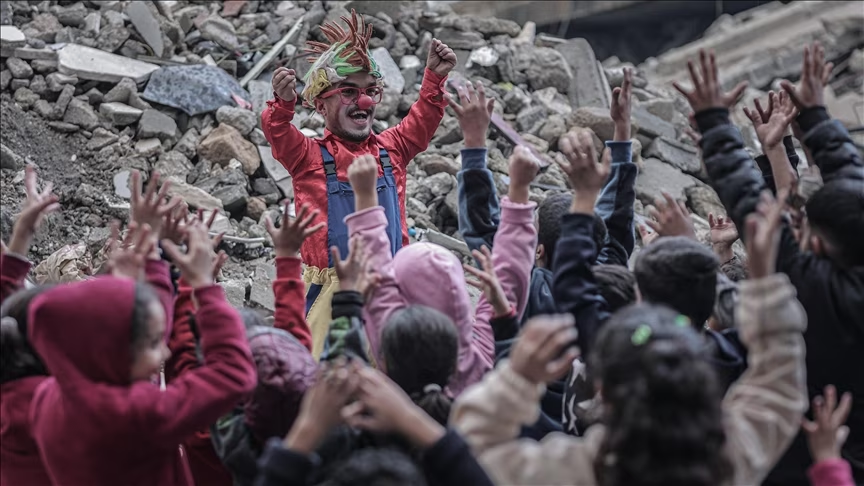
From atop the rubble of destroyed homes in neighborhoods turned into silent concrete blocks in the Gaza Strip, Ahmed Abu Sukar wears the clown costume, standing amidst children circling around him with tired eyes and worn-out clothes, laughing for moments before fear and shock return to their faces.

The clown Abu Sukar (28 years old) continues to bring joy to the hearts of children in the Gaza Strip, defying the pain of losing his family, in an attempt to alleviate the effects of the Israeli genocide war on its youngest victims.

Abu Sukar lost his father, sister, sister's children, and his home due to the Israeli genocide, and despite all this pain, he still wants to draw smiles on the faces of everyone around him, especially the children.

Before the Israeli genocide war on the Gaza Strip, Abu Sukar - short in stature - chose to work in entertaining children and bringing joy to their hearts, which he continued to do despite the harsh reality imposed by the genocide war.

This time, Abu Sukar moves between the narrow alleys of the Bureij camp, where the effects of bombing are still visible on the walls and streets, trying to create a small space for joy, in a place where the sense of security is scarce, and any form of life is absent.

Gaza's children live in extremely harsh humanitarian and psychological conditions, due to the loss of shelter, lack of stability, repeated displacement, deprivation of education and healthcare, in addition to scenes of destruction and death.

Many of these children have lost one or both parents, while others suffer from severe psychological trauma due to the Israeli genocide war.

Although his heart is filled with sorrows, Abu Sukar has not abandoned his mission, and continues to draw smiles on children's faces and make others happy, at a time when they need thousands like him to alleviate the woes and tragedies of that war that lasted for two years.

Abu Sukar lives alone in his severely damaged home, where he finds solace in the children's laughter, and revives memories of his sister's children whom he lost.

He says: "When I make the children happy, I also escape the state I'm living in, I rejoice with them, while I make them happy with these simple costumes."

He adds: "It's difficult for me, but I always make sure to be the first to draw a smile despite the pain, because my life before the war was more beautiful with my family."

Abu Sukar points out that when he enters his crumbling home, images of his lost family members come back to his memory, noting that memories of his family are still alive in his mind.

"Family is everything in this life, when I enter the house and find no one, I wait for dawn to come out because I can't bear to stay alone," thus he describes the feeling of loss.

He explains that he extracted the clown costumes from under the rubble of his destroyed home, noting that these simple things make the children happy.

He says: "These are very ordinary costumes, but they make the children happy, they need to laugh, and I need to laugh more than them."

With a tone full of sorrow and grief, Abu Sukar expresses the difficulty of bearing the absence of his sister's children from his life, noting that despite the pain, he carries a beautiful spirit inside him, and will continue to do his best to make Gaza's children happy.

He adds: "We try to hold onto hope and continue living, despite the pain and sorrow."

In light of the collapse of the health system in Gaza, children do not receive any psychological support, which makes individual attempts like Abu Sukar's initiatives a temporary outlet that alleviates the intensity of the shock, even if for hours.

According to data from the Gaza Health Ministry, the Israeli war killed more than 20,000 children, while tens of thousands were injured with varying wounds.

More than 56,000 children lost one or both parents, adding to a new generation of orphans living a double tragedy between loss and fear, under a suffocating siege that prevents the entry of aid, medicine, and infant milk.

The data indicates that hundreds of children were killed before completing their first year, while others were born during the war, facing life from their first moments under bombardment and deprivation.

On October 8, 2023, Israel launched a genocide war on the Gaza Strip that lasted two years, resulting in the killing of more than 70,000 Palestinians, and injuring more than 171,000, most of them children and women, alongside widespread destruction affecting 90% of the infrastructure, including homes, schools, and health centers.

The war, which ended with a ceasefire that entered its first phase on October 10 last year, caused one of the worst humanitarian disasters in the world, with the spread of famine, collapse of basic services, and turning millions of Palestinians into displaced people living in tents and shelters lacking the minimum necessities of life.

OPINIONS

Wed 17 Dec 2025 11:01 am - Jerusalem Time

Islamic-Christian Relations in Jerusalem: Between Brotherhood and Shared Pain

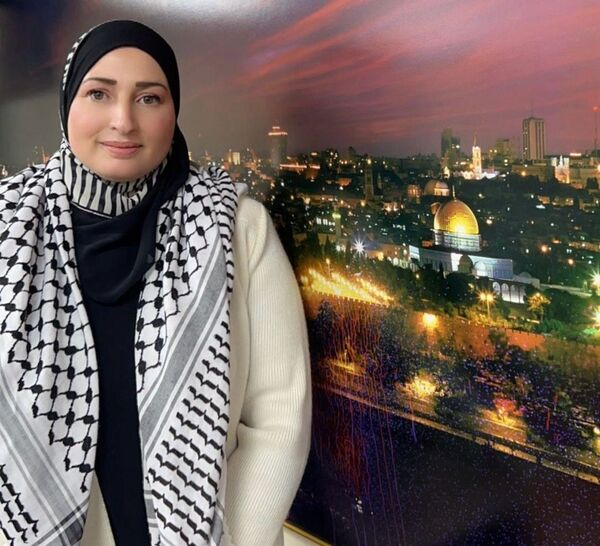
Dr. Tihani Al-Louzi

Dr. Tihani Al-Louzi

Opinion Writer

«In Jerusalem, the Islamic-Christian relationship is not measured solely by tolerance, but by partnership in defending the land and the holy sites, and by unity of stance against policies of uprooting and Judaization, where Muslims and Christians together form a single front to protect the city's identity and dignity».
Jerusalem is more than just a spiritual capital or a sacred site for the heavenly religions; it is an open political and social arena that daily tests the meaning of national partnership between Muslims and Christians. A relationship not built on courtesies or superficial coexistence, but on a long history of brotherhood and joint steadfastness in the face of Israeli occupation policies aimed at Judaizing the city and erasing its Arab Islamic-Christian identity by targeting its historical landmarks and holy sites.
Demographic estimates indicate that the population of the Old City within Jerusalem's walls is estimated at approximately 35,000 people, with Muslims forming the overwhelming majority, ranging between 25,000 and 27,500 people, or about 70%–77% of the total population. In contrast, Christians are estimated at around 4,000–4,300 people (about 11%–12%), in addition to Armenian Christians numbering between 2,000 and 2,200 (about 6%), while the number of Jews residing in the Old City is estimated at around 3,000–3,500 (approximately 8%–10%). These figures reflect a solid demographic reality affirming that the Arab Islamic-Christian character of Jerusalem remains intact, despite continuous Judaization and Israelization attempts around the clock.
The Old City and its surroundings host about 50 churches and monasteries belonging to various Christian denominations, including the Church of the Holy Sepulchre, the Church of St. Anne, the Church of the Redeemer, the Church of the Flagellation, the Armenian Church of St. James, the Syriac Orthodox Church of St. Mark, and other historical churches that constitute a living witness to the depth of Christian presence in Jerusalem. In contrast, the Old City contains about 37 mosques, in addition to 7 mosques within the courtyards of Al-Aqsa Mosque, one of the most important Islamic holy sites in the world, alongside dozens of historical mosques and zawiyas.
This spatial and spiritual intertwining between churches and mosques has never been a source of conflict among the city's inhabitants, but rather formed the basis for unity of stance and national awareness, where Jerusalemites realize that targeting any religious holy site, whether Islamic or Christian, is a direct attack on Jerusalem's identity as a whole. Accordingly, defending the churches was not merely a Christian affair, just as defending Al-Aqsa Mosque was not solely an Islamic matter, but became a comprehensive national responsibility for all residents of the Old City.
This partnership stands out clearly during religious seasons, such as Christmas, Easter, the blessed month of Ramadan, and the Eid al-Fitr and Eid al-Adha holidays, where the relationship manifests through mutual participation in religious and social occasions, without distinction among the city's inhabitants. Positions also unite in the face of Israeli restrictions imposed on freedom of worship and movement, especially within the Old City. The exchange of congratulations, participation in events, and mutual support during crises and even in moments of loss are all daily practices reflecting the depth of Islamic-Christian relations, not merely as a religious relationship, but as a single body facing shared targeting.
The Israeli occupation, through policies of closure, imposing exorbitant taxes, confiscating properties, and seizing Islamic and Christian waqf properties, works to empty the Old City of its original inhabitants, without distinction between Muslim and Christian. However, this unified targeting has contributed to strengthening internal cohesion and transformed Islamic-Christian relations into a real political and social force in defending Jerusalem.
Today, Jerusalem's image is embodied in the scene of the crescent and the cross, and the call to prayer adjacent to the ringing of bells, not merely as a religious symbol, but as a clear political expression of unity of destiny. The Muslim defends the church as he defends Al-Aqsa, and the Christian stands by the mosque as he stands by his church, believing that Jerusalem is their compass, and whoever has Jerusalem as their compass, dignity is their path.
In light of current challenges, Islamic-Christian relations in Jerusalem remain the first line of defense for the city and its identity, and a living national model proving that unity based on partnership and justice is capable of confronting Judaization and settlement policies, and preserving Jerusalem as an Arab city embracing all its children.

OPINIONS

Wed 17 Dec 2025 10:58 am - Jerusalem Time

Israel's 'Security Theory' and Its Escalating Violation of International Law and International Legitimacy

Dr. Abdul Rahim Jammous

Dr. Abdul Rahim Jammous

Opinion Writer

Since its inception, the Israeli colony has been based on a settler-colonial project, relying on what it calls the 'Security Theory,' which has transformed occupation, settlement, displacement, and repression into legitimate tools in its political and military discourse. Over time, this theory has ceased to be an expression of security concerns and has evolved into a comprehensive aggressive doctrine that transcends borders and sovereignties, recognizing neither international law nor the constraints of international legitimacy.
Over the past three years, this doctrine has reached its most dangerous peak, especially with the genocide war launched by Israel on the Gaza Strip since October 2023. The Israeli behavior has shifted from managing repressive occupation to a policy of comprehensive destruction, systematic starvation, forced displacement, and direct targeting of civilians and health, educational, and humanitarian infrastructure, in blatant violation of the Geneva Conventions, the rules of international humanitarian law, and the Rome Statute of the International Criminal Court.
The concept of 'Israeli security' has been expanded to practically permit mass killing and the erasure of Palestinian existence itself, under the pretext of 'eliminating threats.' Israel has not only violated Palestinian land but has also expanded the scope of its security doctrine to include infringing on the sovereignty of neighboring Arab countries through repeated aggressions and direct bombings in Syria and Lebanon, without international accountability or deterrence, reflecting its transformation into a state practicing open aggression outside any regulated legal framework.
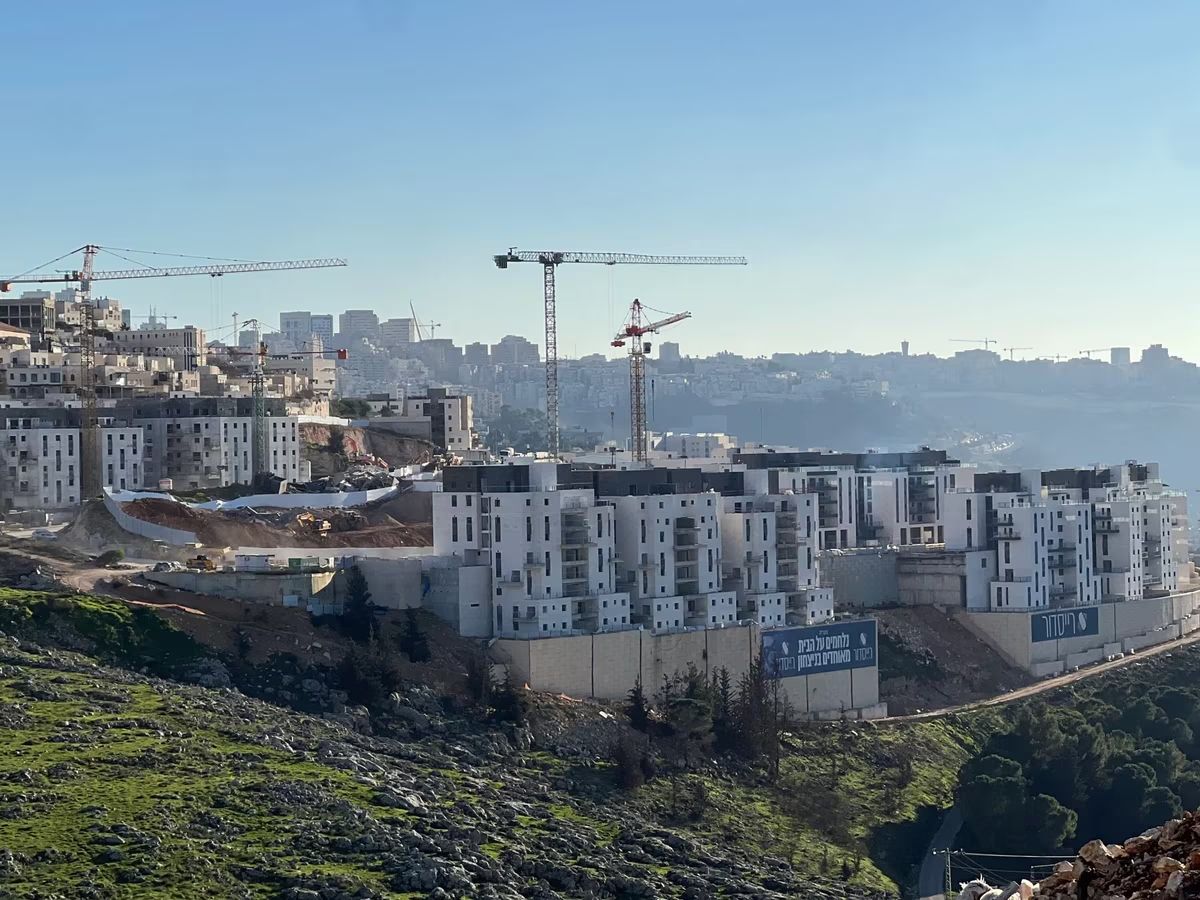
One of the most dangerous manifestations of this doctrine is the unprecedented escalation of the settlement policy, particularly in occupied Jerusalem and the West Bank. Successive Israeli governments, especially the most extreme right-wing government in Israel's history, have approved dozens of new settlement plans, including expanding existing settlements, establishing additional settlement outposts, and connecting them with road networks and infrastructure aimed at fragmenting Palestinian land, isolating Jerusalem from its Palestinian surroundings, and imposing demographic and geographical facts that prevent any future political settlement.
Settlement has evolved from a gradual occupation tool into a central pillar of Israel's security doctrine, presented as a 'preventive' measure, despite being a complete war crime under international law and a direct violation of Security Council resolutions, foremost among them Resolution 2334. Nevertheless, these policies have not faced any binding punitive measures, but have received explicit American support or complicit political silence, evident in statements by the American ambassador to Israel, who confirmed that his country does not object to the new settlement plans and considers them an internal Israeli matter, in a blatant disregard for the status of Palestinian territories as occupied lands and for international law itself.
This American position is not limited to abstaining from condemnation but constitutes direct political cover for accelerating the creeping annexation project, encouraging Israel to proceed in undermining any realistic possibility of a two-state solution, and transforming temporary occupation into a permanent settler-colonial system based on apartheid, land theft, and excluding the Palestinian people from their right to self-determination.
This Israeli impunity would not have reached this level without the structural flaw in the international system, primarily the repeated use by the United States of the veto power in the Security Council to abort any binding resolution condemning aggression or imposing sanctions, turning the international legitimacy system into a selective one, applied to the weak and disabled before the allies of power.
Despite dozens of resolutions issued by the United Nations General Assembly and despite the provisional measures issued by the International Court of Justice regarding the crime of genocide in Gaza, Israel continues its open defiance of international law, in a dangerous precedent that undermines the foundations of the international system, empties the concept of international justice of its content, and threatens international peace and security.
Mere verbal condemnation of settlement or aggression is no longer sufficient. International law, if not coupled with real enforcement mechanisms and binding punitive measures, turns into ineffective texts. In the face of this international failure, the Palestinian people's right to resist occupation remains an inherent and guaranteed right, and all forms of resistance to occupation recognized by international law remain legitimate in the face of a racist settler-colonial project.
Likewise, Arab countries whose sovereignty, airspace, and national security are violated have the right to defend themselves and confront Israeli aggressions, based on the principle of legitimate self-defense stipulated in the United Nations Charter, in a way that preserves their security and sovereignty.
In conclusion, continuing to treat Israel as a state above the law does not threaten Palestine alone but threatens the entire international law system and establishes the model of the rogue state that violates rights and sovereignties under the cover of 'security.' Confronting Israel's security theory requires breaking the logic of impunity, activating international accountability tools, and building an independent Arab and international position that restores respect for justice and the rights of peoples, and puts an end to the dominance of power over law.

PALESTINE

Wed 17 Dec 2025 10:53 am - Jerusalem Time

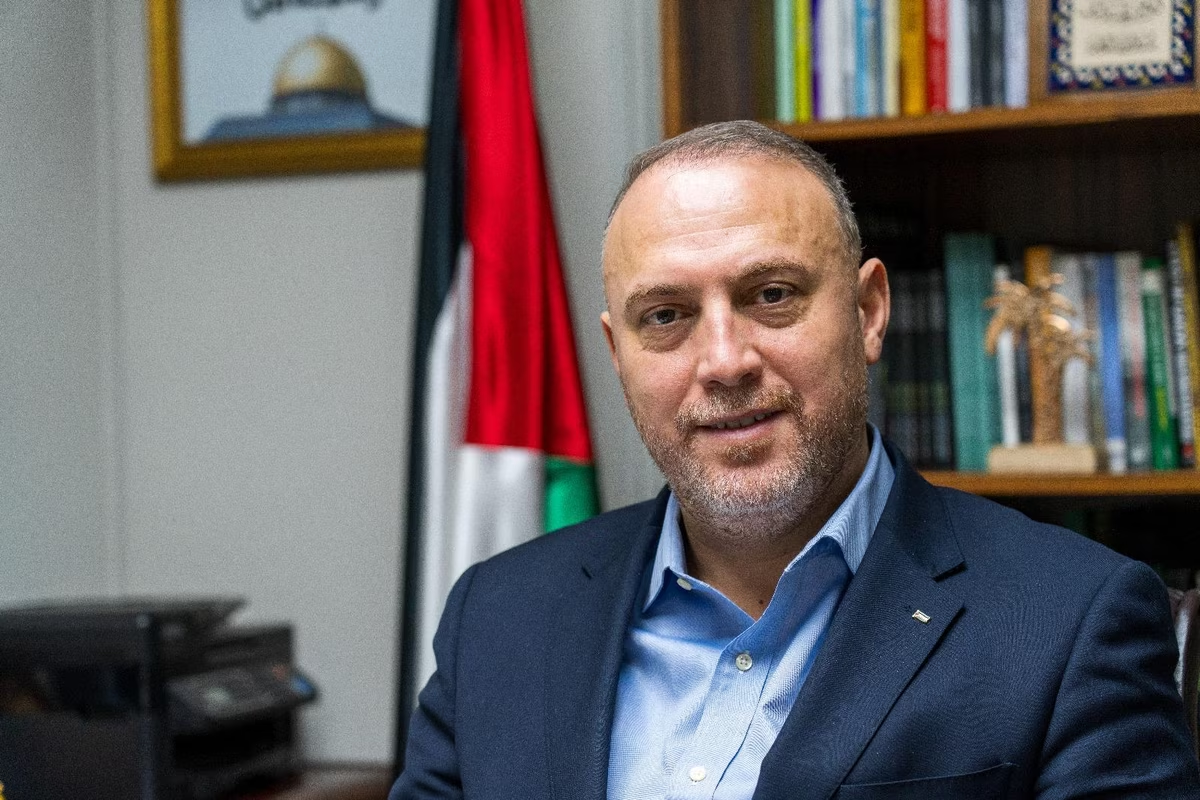
Hussam Zomlot, Palestinian Ambassador to London, in a Special Interview with 'Al-Quds': The Era of Israel's Monopoly on the Narrative Has Ended

* British Recognition as the Beginning of Correcting a 'Historical Sin'.. and a Major Change in European and American Youth Circles
* The Genocide War Left Catastrophic Effects on the Ground but Caused a Tremendous Change in International Public Opinion
* The Global Movement Supporting Palestine Needs Sustainability and Translating the Popular Tide into Practical Steps that Contribute to Ending the Occupation
* Trump May Be the Last American President to Support Israel, and the Next Presidential Candidate May Support Establishing a Palestinian State
* The Normalization Project and Regional Engineering Led by Israel Has Been Frozen.. and Regional Countries Have Realized the Danger
* The Clear Saudi Position 'No Normalization Without a Palestinian State' Restored Balance and Dispelled Israeli Illusions


Palestinian Ambassador to London, Hussam Zomlot, revealed a 'irreversible' historical shift in British and international public opinion towards the Palestinian issue, saying that 'the era of Israel's monopoly on the narrative has ended', and that the recent British recognition of the State of Palestine represents 'the beginning of correcting a historical sin' committed by Britain against the Palestinian people since the Balfour Declaration.
This came in a special and extensive interview with 'Al-Quds', in which Ambassador Zomlot addressed the dimensions of this shift, the practical steps resulting from the recognition, its comparison to the anti-apartheid struggle in South Africa, the impact of changes in American and regional positions, and the remaining challenges, especially in Israeli public opinion.

Solidarity Movement: From Tide to Flood

At the beginning of the interview, Ambassador Zomlot pointed to an exceptional phenomenon, saying: 'The solidarity movement in Britain did not fade after weeks of the start of the aggression on Gaza as some might expect, but continued and escalated. Recently, London witnessed a central demonstration attended by more than 100,000 protesters and supporters, despite the announcement of a ceasefire. This popular campaign has endured throughout two years of war'.
He attributed this continuity to 'an irreversible change in British awareness. The monopoly of the Israeli narrative has been broken. The truth has become clear to the British people and the world: Israel is an occupying and aggressor state that commits war crimes, ethnic cleansing, and genocide'. This 'horizontal and vertical' societal transformation, as he described it, is what pushed the British government under popular pressure to take practical steps, most notably the historic recognition of the Palestinian state.

On the Shift in British Public Opinion and Popular Support

Zomlot said: 'The British people and the peoples of the world have clearly received the truth: Israel is an aggressor and occupying state that practices ethnic cleansing, apartheid system, and war crimes. This has caused a real horizontal and vertical change in British society, leading to tangible steps from the government due to popular pressure, thanks to the role of Palestinian diplomacy in communication and leading the movement, and the role of supporters around the world'.
He added: 'Then came the awareness of the peoples. Our people managed during the war to achieve legendary resilience and export scenes of the ugliest genocide operation in modern history, and for the first time, a genocide operation is documented with live and direct broadcast amid the negligence of international media. The Palestinian child, woman, and man expanded the circle of documenting the crime before it occurred. And social media played a decisive role in breaking through the barrier of controlled and directed media'. He pointed out that what happened is 'a flood in public opinion in Britain and the world, promising real change. The British recognition, as issued by the state that issued the Balfour Declaration, carries great historical and moral significance'.

The Power of the Palestinian Narrative: Documenting Genocide Live

On the reasons for this radical transformation, Zomlot said: 'The fundamental reason is the bravery and resilience of our people, who inspired the world, surpassing the negligence and blackout of international media'. He added, explaining: 'The Palestinian child, woman, and man have become documenting the moment they are targeted before the missile falls. They turned the small cameras in every phone in Gaza into a global window on the crime. And the power of social media shattered the occupation's narrative that killed 70,000 civilians, including 20,000 children and the same number of women and the elderly'.
This 'flood' in global public opinion, in addition to the clarity of the official and diplomatic Palestinian message, is what paved the way for 'real change', manifested in the British recognition that carries 'unique moral and historical weight', because its source is the same state that gave birth to the occupation state through the 'Balfour Declaration' and nurtured it politically, militarily, and financially, then France took care of it by supplying it with the 'Dimona' nuclear reactor, and since 1967, the United States has nurtured and supported it with financial aid and political and diplomatic cover in the Security Council and the United Nations, covered its crimes, supported it with weapons and equipment in its genocide war, and continues to do so.

Recognition: Beginning of Correcting Balfour and Historical Injustice

The Palestinian ambassador explained the deep dimensions of this recognition: 'It is a correction of a historical crime. The Balfour Declaration not only denied our existence as a people, but turned us into 'non-Jewish communities' with only civil and religious rights, we were denied national rights and the right to self-determination. It was an injustice to history and contrary to law'.
He added: 'Therefore, when the British Prime Minister declares, after 108 years, recognition of our people's right to self-determination and sovereignty, this is the beginning of correcting that sin. It is an acknowledgment that we are a people on our land, and we have a homeland from the sea to the river'. He clarified the distinction between the 'homeland' that is indivisible, and the 'state' as a political entity that Palestinians have accepted on the 1967 borders with East Jerusalem as its capital. Confirming that 'recognition is a historic step, and the first practical step was transforming the Palestinian mission in London into an embassy for the State of Palestine with full powers and diplomatic status according to the Vienna Conventions'.

From Embassy to Banning Settlements: A Long Practical Path

On the next steps, Zomlot confirmed that the legal transformation of the mission into a 'Palestinian State Embassy' has been completed. But the essence lies in 'practical building' on this recognition, through three paths:
1. Applying British and International Law: 'This is not only to punish the occupation state, but also to apply British law and international laws. How do you recognize a state and then import goods from settlements built by the occupation on its lands? Products from settlements must be banned, British companies operating in occupied territories must be prevented, and dual nationals participating in the genocide war in Gaza who reside and work in settlements or manage companies in occupied territories must be held accountable. There are dozens of legal prohibitions that must be activated'.
2. Rebuilding Bilateral Relations on Equality: 'We want a real partnership between two equal states, not between a state like Britain and a Palestinian state under occupation'.
3. Multilateral Level: 'This position must be reflected in Britain's voting in the United Nations and Security Council, in international and regional councils and institutions, and in the work of international organizations'.

Comparison with South Africa: Israel is Not an Exception

The ambassador pointed to the lessons learned from the boycott movement that ended the apartheid system, saying: 'It is natural for international boycott movements to arise against a state that commits war crimes and genocide. Israel is not an exception, but must be boycotted and punished'.
He saw that 'solidarity with Palestine has turned into a 'shared struggle' in the South African style, and indeed its momentum today is greater than that prevailing in the era of apartheid rule in South Africa'.
He added: 'The most important lesson is that the genocide project in Gaza failed despite the severe Palestinian losses in lives and property. Israel used the most lethal killing and destruction machines and did not achieve any of its goals, and its failure exposed its criminality and racism. 7.5 million Palestinians remain rooted in historic Palestine. And this failure, with the ugliness of its crimes, is what brought down its false narrative - claims of beheading 40 children on October 7 and rape - all of that collapsed loudly and irreversibly changed the international situation in our favor'.
He added: We must restore life in the Gaza Strip as soon as possible because Gaza is the womb of Palestinian nationalism, and pay attention to the main battle which is in Jerusalem and the West Bank where the occupation's ambitions and ongoing annexation policy are. The top priority now is to strengthen our people's resilience on their land.

The American and Regional Shift: End of Unconditional Support

Zomlot said: 'External support is the backbone of Israel. If this support is withdrawn, it will not continue its crimes. In America, the change is significant among youth and even within gatherings and the 'Jewish lobby' in the two major parties, Republican and Democratic; 30% of them voted for New York Mayor Mandani, and this is clear evidence of the extent of the shift that seems to extend to the rest of the sectors, the change is enormous. President Trump may be the last American president to support Israel in this unconditional way. The Palestinian issue has become an 'electoral prize' in America as well'.
On the regional level, he saw that 'the normalization project and regional engineering led by Israel has stopped. Regional countries have realized the danger. The clear Saudi position 'no normalization without a Palestinian state' restores balance'.

The Biggest Challenge: Israeli Public Opinion and Future Action

Amid optimism, the ambassador pointed to 'the toughest challenge', which is that the vast majority of Israelis still support the genocide war; an unreasonable and unacceptable matter'. He commented: 'This requires a different strategy, where international sanctions and boycotts are one of the tools to change the calculations of this society led by right-wing racist and fascist groups. The Israeli society must be pushed towards choosing a new leadership other than this extreme right-wing leadership, and it must realize that racism and genocide have a price that it will pay unless these racist groups change their path'.

Media, UNRWA, and Palestinian Representation

On British media, he said it 'has changed for the better under public pressure, but has not yet reached the required neutrality'.
He added: 'Palestinian voices, official and popular, have succeeded in breaking through the wall of traditional international media that adopted the Israeli narrative and distorted the Palestinian struggle. We have created a hole in this wall and these holes have expanded and the official Israeli narrative has collapsed'. He continued: 'We no longer accept the Western media game of always accusing us. The question I faced daily 20 times is no longer asked 'Do you condemn?'. That game has ended. We have exposed the contradiction: Israel is the one targeting Palestinian civilians since the Nakba in 1948 as a policy and military strategy, and we reject targeting civilians from a national, strategic, and political perspective. We reject the distortion and racism in posing the question and marketing the false narrative that has been proven by all evidence and proofs that Israel is the one targeting civilians to achieve political and military expansionist gains'.
He affirmed that the State of Palestine considers 'UNRWA a red line. Targeting it is targeting the refugees' issue and an attempt to erase their just cause protected by international law. The world has renewed its mandate, and this is a strong message'.
On aid, Zomlot said: 'The responsibility for opening crossings and lifting the siege falls on Israel as the occupying power. We should not be satisfied with the entering trucks (150 or 200 trucks daily). We need to open all crossings at full capacity for more than 12,000 trucks waiting for months, and introduce all needs without obstacles, especially baby milk, medicines, and tents in this cold weather. The systematic starvation policy is rejected, and starvation engineering must be stopped and Israel punished for it'.
In response to a question about the number of injured transferred from Gaza to Britain, Zomlot said: 'Dozens through the World Health Organization; dozens of those needing urgent treatment and prosthetic limbs for children have been transferred. There is cooperation with Britain to treat critical medical cases from Gaza in its hospitals, and we appreciate that'.
In response to a question about the impact of Palestinian division, he answered decisively: 'We are the embassy of the State of Palestine, and the PLO is the sole legitimate representative of our people in all its spectra. We represent all of Palestine. Our fundamental contradiction is with the occupation'.

The Bet on Peoples Was Correct

In response to a question about the embassy's focus on which sectors in British society, Zomlot clarified: 'We initially invested in building a broad popular base, and this bet on the peoples was correct and bore fruit. Today, we deal with all parties: the street, parliament, government, parties, civil society, labor unions, and all segments of society including youth and universities. Personally, I divide my time among all these components with a focus on the base'.
He added: 'Every British politician now realizes that the Palestinian issue is a mass issue, and one word against it may cost him his popularity. This is a strength for the Palestinian people. Our fundamental strength stems from our people's amazing resilience during two years of genocide. The return of students to study in tents and on sand under bombardment, and people's clinging to their land despite hunger and destruction, this is what earned us respect and appreciation from the world's peoples. This image is what changed minds and hearts everywhere. The return of university students to universities in Gaza despite genocide and destruction reflects the bright image of the Palestinian people who love life and struggle for a better future for their children.


PALESTINE

Wed 17 Dec 2025 10:41 am - Jerusalem Time

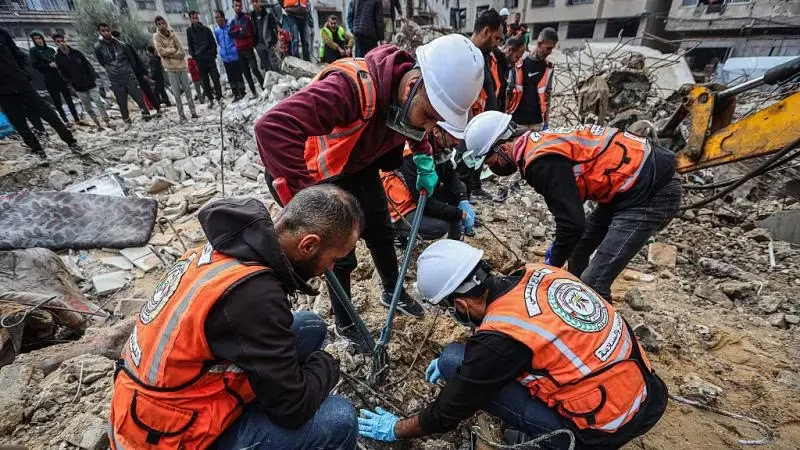
Rescuing 6 Palestinians, including two children, from under the rubble of a collapsed house in Gaza

Civil defense crews rescued, on Wednesday, 6 Palestinians including two children, after the roof of a house collapsed on them in the Shati camp west of Gaza City, due to the heavy rains accompanying the low-pressure system affecting the sector.

The civil defense stated in a statement that its crews managed to rescue 6 Palestinians from under the rubble of the collapsed house, and noted that their health condition is good.

The statement mentioned that the house consists of three floors, and that the collapse affected only the upper roof, amid the continuation of rainy weather and the sector being affected by another night of the low-pressure system.

Gaza has been hit by a low-pressure system since Monday evening, the second in less than a week, amid a significant deterioration in humanitarian conditions with thousands of homes and tents damaged.

On Tuesday, a number of Palestinians were injured and others went missing due to the collapse of a building damaged from the Israeli genocide war, due to the stormy weather accompanying the low-pressure system, according to the civil defense.

Gaza City also witnessed a partial collapse in a house belonging to the Skeik family east of the city, where its upper floors collapsed without recording injuries, while the Ministry of Health announced the death of an infant due to severe cold.

The first low-pressure system, named "Birun", caused the death of 14 Palestinians, and the complete or partial damage and flooding of 53,000 tents, according to official data, which exacerbated the suffering of Palestinians.

During the low-pressure system, data from the Government Media Office indicated the collapse of at least 13 buildings from the buildings damaged due to the Israeli genocide, and that on the heads of their residents who took refuge in them to shelter from the rain and cold.

Meanwhile, the General Directorate of Civil Defense in Gaza stated that it recorded hundreds of homes classified as dangerous and unfit for habitation, after being targeted and bombed by Israel during the genocide war.

It mentioned that a decision was made for the immediate demolition of three homes today, Wednesday, in the Tunnel and Zaytoun areas east of Gaza City, after evacuating their residents in the presence of specialized engineers.

This suffering comes amid Israel's evasion of fulfilling its commitments stipulated in the ceasefire agreement in effect since October 10 last year, and its humanitarian protocol, including the entry of shelter materials and 300,000 tents and mobile homes, as repeatedly confirmed by the Government Media Office in Gaza.

The Israeli genocide war in Gaza, which began on October 8, 2023, with American support and lasted two years, left more than 70,000 dead and over 171,000 injured, mostly children and women, and destruction that affected 90 percent of the civilian infrastructure.

ARAB AND WORLD

Wed 17 Dec 2025 10:21 am - Jerusalem Time

World newspapers: New American strategy links support for Israel to Washington's interests

World newspapers discussed developments in the relationship between the United States and Israel, noting that it is influenced by the new American national security strategy, and also spoke about Washington's efforts to obtain Venezuelan oil, not to combat drug trafficking as claimed by US President Donald Trump.

In the "Jerusalem Post" newspaper, an opinion piece stated that the national security strategy recently approved by Trump "ties Israel's support to the interests of the United States", and that it "is not a blank check as Benjamin Netanyahu assumes".

The article sees that this strategy "reflects the importance of expanding the Abraham Accords under the Trump administration", saying that everyone "realizes that this goal is directly linked to resolving the Palestinian issue, which Israel ignores".

This strategy also views -according to the article- the stabilization and reconstruction of Syria as a cornerstone of the regional system, while Tel Aviv's military policies and its refusal to reach a security agreement with Damascus undermine this vision.

The article concludes that Israel has no choice but to align with American interests or become a regional burden in the eyes of the United States.

As for the "Haaretz" newspaper, it spoke in its editorial about the Netanyahu government's -wanted by the International Criminal Court- efforts to form a government committee to investigate the October 7, 2023 attack, saying that this step "aims to cast doubt on the facts".

The newspaper noted the opposition's refusal to participate in this project "because it gives the government the right to form the committee, making the revelation of the truth impossible", adding "it is expected that the facts will be twisted so that others are held responsible while Netanyahu escapes accountability".

PALESTINE

Wed 17 Dec 2025 9:51 am - Jerusalem Time

Israeli forces and settlers escalate their attacks in northern and central West Bank

Ramallah/ Qais Abu Samra / Anadolu

Israeli forces and settlers escalated their attacks early Wednesday in the northern and central occupied West Bank, by storming the eastern neighborhood of the city of Jenin, and burning two Palestinian vehicles in the town of Ein Yabrud northeast of Ramallah governorate.

In Jenin, local sources reported that Israeli special forces stormed the eastern neighborhood of the city early today, followed by military reinforcements from the Jalame checkpoint.

The sources added that the forces raided a house in the neighborhood and turned it into a military outpost, while besieging another house, and began conducting a widespread arrest campaign among the citizens, subjecting them to field interrogations.

Following the raid, the Directorate of Education in Jenin announced the suspension of school attendance on Wednesday in public and private schools and kindergartens, to ensure the safety of students.

In a related context, settlers burned two Palestinian vehicles and wrote racist slogans on the walls of houses in the town of Ein Yabrud northeast of Ramallah in the central West Bank, according to local sources.

Witnesses stated that the fire consumed the two vehicles, while slogans were written in Hebrew on the Palestinians' homes.

Since the start of the genocide war on Gaza, the Israeli army and settlers have escalated their attacks against Palestinians and their property, killing 1,097 Palestinians in the West Bank and injuring nearly 11,000 others, in addition to arresting more than 21,000.

On October 10, a ceasefire between Israel and the Hamas movement came into effect, which was supposed to end the collective genocide committed by Tel Aviv with American support over two years starting from October 8, 2023, resulting in the killing of more than 70,000 Palestinians and injuring more than 171,000.

ARAB AND WORLD

Wed 17 Dec 2025 9:21 am - Jerusalem Time

China.. From 'Weak Cards' to an Unbeatable Power

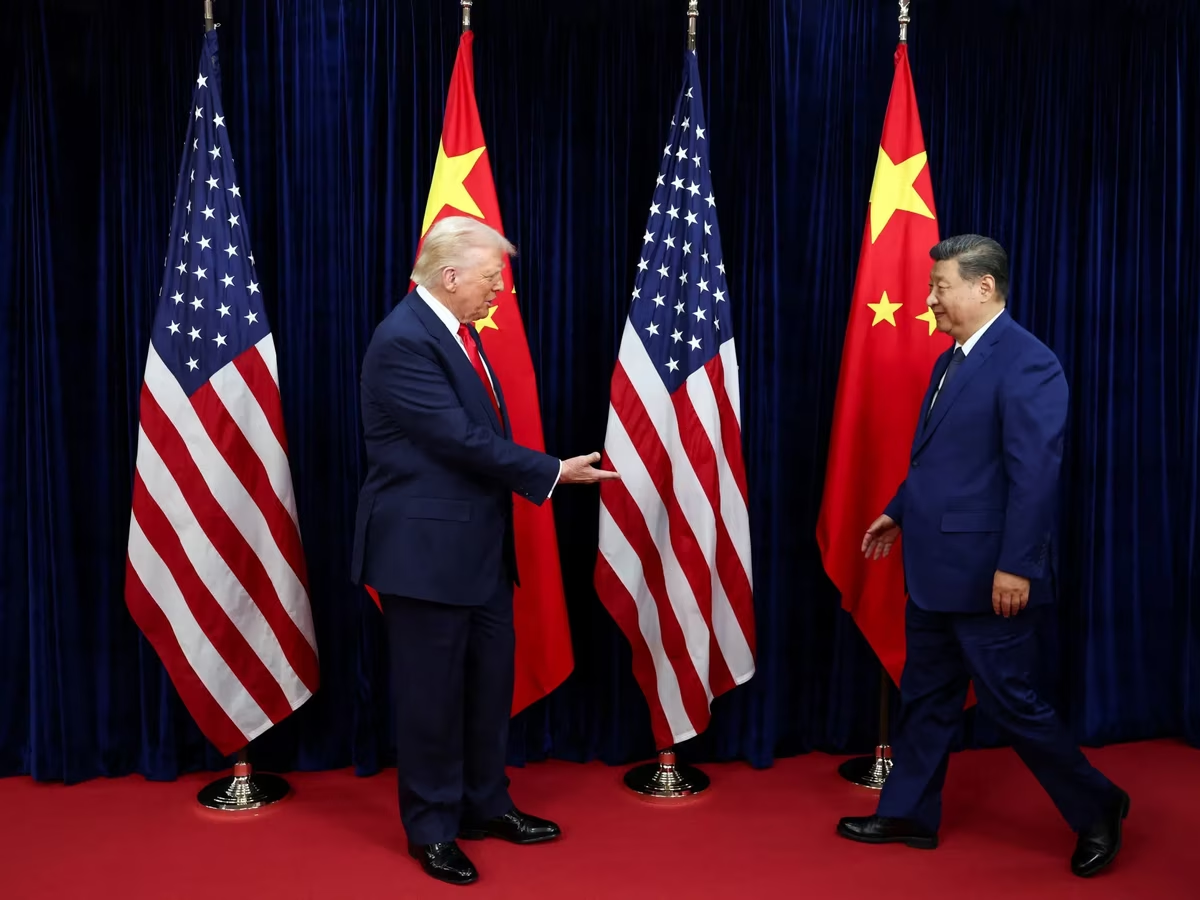
At the height of the trade escalation between Washington and Beijing in April last year, amid the exchange of tariffs and sanctions, the scene seemed as if China was holding 'weak cards,' as described by US Treasury Secretary Scott Bessent when he said that China 'is playing two cards of the two denomination.' However, the following months showed that the bet was reversed.

After successive waves of US tariffs—starting at 10%, then 20%, then jumping to 145% before returning to 10% again—the administration of President Donald Trump announced at the end of October the conclusion of an agreement described as a 'huge victory.'

However, Bloomberg's report sees that the agreement essentially restored the situation to what it was before, and even included an important US concession represented in the retreat from expanding the list of Chinese companies subject to export controls, a tool that was previously considered non-negotiable.

According to Bloomberg, China not only absorbed the pressures but emerged from the confrontation with its strengths becoming more evident. And Lizzy Seeley Lee, a researcher at the Asia Society Policy Institute, says that 'China is no longer just a fast follower, but has become a different model of development that may be more sustainable, and perhaps more realistic.'

Rare earth metals represent Beijing's most important pressure card against US industries (Reuters)

And it has long been believed that China's growth miracle carries structural fragility within it, which was fueled by repeated predictions of an imminent collapse, but Bloomberg points out that this view has become 'exhausting' in the face of the reality that China is achieving strong performance in a large number of fronts at the same time.

The most prominent of these fronts is China's near-total control over rare earth metals supply chains, which are essential materials in the production of strong magnets, phone screens, digital signals, and hundreds of industrial and military applications.

And Bloomberg explains that the restrictions imposed by Beijing on the export of these metals threaten vital US sectors, from electric cars and satellites to aviation and consumer electronics.

And Daniel Rosen, co-founder of the Rhodium Group, says that US attempts to build local capabilities in this field 'will take years to address the current excessive dependence on China.'

The United States also depends on China for components of about 700 drugs, a sensitivity that was not even raised at the table of the recent trade negotiations. And in October, China halted exports of computer chips produced by the company 'Nexperia' owned by it, causing a slowdown in production for major Japanese car companies, as an additional indication of Beijing's ability to cause widespread disruption when it wants.

In contrast, the US has limited pressure points, the most prominent of which is its dominance over advanced chips used in training artificial intelligence models, and Trump banned Nvidia from selling its latest chips—known as 'Blackwell'—to China.

However, Hongbin Li, a participant in managing the Stanford Center for China's Economy, sees that Beijing is still in a better position, saying: 'Can we live without medicines or rare metals? No. Can the Chinese live without Nvidia chips? Yes, they can.'

And Bloomberg notes that several Chinese companies have found ways to circumvent export restrictions, whether through smuggling networks or front companies, while major companies like 'Huawei' are working on developing local chips that are less advanced but sufficient to produce competitive products.

As for clean energy, data indicates that China is building solar energy equivalent to twice what the US and Europe are building together, produces 70% of the world's electric cars, and leads in battery technologies. At this year's Shanghai Auto Show, BYD displayed a battery that 'charges almost completely in 5 minutes.'

And in 2024, China installed a number of industrial robots exceeding what the rest of the world installed collectively, while DJI dominates 70% of the commercial drone market, with a clear superiority in military applications compared to the United States.

Artificial intelligence patents reflect China's expansion in future industries (Shutterstock)

Despite this progress, Bloomberg does not overlook the deep challenges facing China, from a real estate crisis that wasted trillions of dollars, to deflationary pressures, and an aging population that will lose the country a quarter of its workforce in 25 years.

It also warns of the risk of falling into the 'middle-income trap,' which the new five-year plan of the Chinese Communist Party seeks to overcome by focusing on 'future industries,' such as space and quantum computing.

But the conclusion—that Bloomberg's report reaches—is that betting on weakening China or waiting for its collapse is no longer realistic. China, as the report says, 'is a strong and determined adversary to expand its advantages,' while the US desire to 'defeat it' seems less aligned with the changing global reality.

And the report concludes by saying that reassessing China's position in the international system has become a necessity, 'not out of admiration for its model, but because betting on its fall simply will not succeed.'

PALESTINE

Wed 17 Dec 2025 9:07 am - Jerusalem Time

Israeli bombardment on Gaza and martyrdom of a Palestinian.. and weather depressions exacerbate human suffering

The Israeli occupation army bombed areas in Gaza City, and a Palestinian was martyred by the fire of Israeli occupation vehicles northwest of Rafah City in southern Gaza Strip, according to reports from Deir al-Balah.

Civil defense crews in the sector recovered the bodies of 30 martyrs out of 60 from the Salem family west of Gaza City, where the ceasefire agreement has been ongoing since October 10th.

Civil defense teams continue searching for the residents of the house after they were lost under the rubble following the targeting of a house belonging to the Abu Ramadan family in the Sands neighborhood in Gaza City.

The civil defense stated that its crews continue searching with limited tools, hoping to complete the recovery of the remaining martyrs.

Weather depressions exacerbate human suffering

Weather depressions exacerbate the humanitarian situation for Palestinians in the Gaza Strip, especially those living in homes on the verge of collapse.

Risks threatening the lives of families living in homes on the verge of collapse in Khan Yunis have been monitored, amid the weather depression.

A large number of displaced people also lost their tents during this depression, and most of them are now exposed, and have not found new tents to rebuild their camps flooded by water, especially in Gaza City and the northern sector.

Gaza's needs exceed the capacity of organizations

In this context, the United Nations Office for the Coordination of Humanitarian Affairs (OCHA) warned yesterday, Tuesday, of delays in the arrival of humanitarian aid to Gaza and not prioritizing it.

The spokesperson for the OCHA office in Gaza, Olga Cherifko, stated that needs are increasing at a faster pace than the capacity of humanitarian organizations to provide aid, despite the ongoing efforts by the United Nations and its partners.

She confirmed that the humanitarian community continues to provide assistance, but needs exceed the speed of response, pointing to the limited volume of supplies entering the sector and the growing list of materials that Israeli occupation authorities still prevent from entering the sector, including heavy machinery, equipment, and spare parts needed to repair the damaged infrastructure.

Priority given to commercial shipments over humanitarian ones

Cherifko explained that there are still significant restrictions on humanitarian operations, as the number of available routes for transporting aid remains limited, as well as the crossings through which supplies are allowed to enter.

The spokesperson said that "there are many cases where priority is given to commercial shipments over humanitarian shipments," noting that this causes delays that directly affect the speed of delivering aid.

Other challenges include the irregularity of crossing opening times and loading shipments, restrictions on essential materials, and registration requirements that prevent non-governmental organizations from bringing supplies into Gaza.

The spokesperson emphasized the necessity of lifting all these obstacles, at a time when people's needs are increasing at a faster pace than the ability to meet them.

PALESTINE

Wed 17 Dec 2025 8:59 am - Jerusalem Time

Netanyahu: Without the Maccabees, there would be no United States

Israeli Prime Minister Benjamin Netanyahu claimed that if the "Jewish Maccabees" had failed in their revolt against the Seleucid Empire, there would be no United States of America.

This came during Netanyahu's incursion into the Al-Buraq Square in occupied East Jerusalem to light a candle for the Jewish holiday "Hanukkah" (Festival of Lights) on Monday, according to a statement from his office on Tuesday evening.

Netanyahu was accompanied in the incursion by his wife Sarah, US Ambassador Mike Huckabee, and a number of Israeli soldiers.

From in front of the Western Wall, Netanyahu said in a filmed speech: "If the Maccabees had failed, there would be no Huckabee family, there would be no Judeo-Christian civilization, there would be no United States," according to his expression.

Jews celebrate the "Hanukkah" holiday in commemoration of the "victory of the Maccabees" over the Seleucid Empire in Palestinian lands in 165 BC, and this year's celebration runs from December 14 to 22.

The Maccabees are a Jewish family known for their long war to achieve political and cultural independence for Judaism during the Seleucid control over Palestinian lands in the third century BC.

They were rebels who took control of areas that were part of the Seleucid Empire, and among them emerged their leader Judah Maccabee, who called for a revolt to purify the Jews from the paganism that prevailed at the time.

Netanyahu often recalls these rebels on many occasions, one of which was on December 6, 2023, when he said in a press conference: "Our fighters are the generation that continues the path of the Maccabees."

He added: "As they wage this battle bravely these days," in reference to the genocide war that Israel launched in the Gaza Strip on October 8, 2023.

Rejecting UN resolutions that recognized the Western Wall as Palestinian land, Netanyahu said before his Likud party (right-wing) on December 19, 2017: "We had it (the Western Wall) and it will remain, the Palestinians had no existence during the Maccabees period," according to his claim.

As of 06:10 "GMT" on Wednesday, no American comment has been issued on Netanyahu's statements, and the United States is Israel's closest ally.

Washington has provided Tel Aviv with military, intelligence, and financial support since the genocide war in Gaza began, which has left more than 70,000 Palestinian dead and 171,000 injured, mostly children and women.

The United States also provides protection for Tel Aviv in the UN Security Council by repeatedly using its veto power against any resolution that Israel rejects, which the UN classifies as the occupying power in Palestinian territories.

On Tuesday, the "Hamas" movement considered Netanyahu's incursion into the Al-Buraq Square and settlers' incursions into the Al-Aqsa Mosque courtyards as a "provocative and rejected step," aimed at imposing Judaization on the mosque and the occupied city of Jerusalem.

Palestinians insist on East Jerusalem as the capital of their state, based on international legitimacy decisions, which do not recognize Israel's occupation of the city in 1967 or its annexation to it in 1980.

Israeli officials, led by Netanyahu, have repeatedly declared their rejection of establishing a Palestinian state, in defiance of international decisions issued by the UN that stipulate the implementation of the two-state solution (Palestinian and Israeli).

Israel was established in 1948 on Palestinian lands occupied by Zionist gangs that committed massacres and displaced hundreds of thousands of Palestinians, then Tel Aviv occupied the rest of Palestinian lands, in addition to other lands in neighboring Syria and Lebanon.

Source of the image inside the news: Israeli Prime Minister's account on the X platform

PALESTINE

Wed 17 Dec 2025 8:57 am - Jerusalem Time

"UNRWA": The occupation is holding 6000 trucks for the Gaza sector and a "sharp" decline in Arab support threatens our operations

The media advisor for the United Nations Relief and Works Agency for Palestine Refugees in the Near East "UNRWA", Adnan Abu Hasna, revealed precise and dangerous details related to the humanitarian reality and the agency's operations amid the ongoing war and Israeli siege, pointing to unprecedented challenges facing the agency's work in the Gaza Strip, the West Bank, and occupied Jerusalem.

Abu Hasna's statements came during his phone interview on the program "Seven O'Clock News", where he presented numbers and facts about the current situation.

Abu Hasna confirmed that despite the enormous difficulties, UNRWA remains the only cohesive entity continuing to provide its services in the Gaza Strip, relying on a current workforce of 12,000 employees.

In the education sector, he explained that the agency succeeded in returning 300,000 children to the educational process, considering it the foundation amid the current circumstances. As for the health sector, new clinics were opened in Gaza City and the northern sector, bringing the number to 8 main clinics, supported by 32 fixed medical points and 108 mobile medical teams, receiving about 16,000 patients daily.

The services did not stop there, but included the environmental services sector, where UNRWA continued to collect and transport thousands of tons of solid waste weekly, in addition to distributing thousands of cups of potable and daily-use water, reaching hundreds of thousands of displaced and non-displaced people, alongside extensive psychological support operations.

Regarding the aid file, Abu Hasna revealed a surprise about the volume of detained materials, confirming that Israel is preventing the entry of food and relief materials purchased by UNRWA for hundreds of millions of dollars.

He pointed to the existence of about 6000 agency trucks currently stacked in warehouses in Jordan and Egypt, containing food materials sufficient for the Gaza sector for a full 3 months, in addition to tents and plastic sheds sufficient for 1.3 million Palestinians.

Abu Hasna warned that preventing the entry of these materials exacerbates the catastrophe in the shelter camps that are witnessing the flying and collapse of tents, and the invasion of rainwater and sewage into the displaced people's living places, confirming that the entry of these trucks is capable of making a fundamental difference in the residents' lives.

ARAB AND WORLD

Wed 17 Dec 2025 2:35 am - Jerusalem Time

Former White House Chief of Staff Reveals Tensions Within Trump's Administration

Former White House Chief of Staff Susie Wiles revealed internal tensions in President Donald Trump's administration regarding issues from enforcing immigration laws to reducing government size.

In statements published by Vanity Fair magazine on Tuesday, Wiles, the first woman to hold the position of White House Chief of Staff, described the alcohol-abstaining president as having the personality of drinkers, with a tendency to retaliate against those he believes are enemies.

She also mentioned that Vice President JD Vance 'has been a conspiracy theorist for a decade' and described his shift from criticizing Trump to supporting him as 'somewhat political' and driven by his Senate campaign rather than principles.

She criticized the way billionaire Elon Musk dismantled the U.S. Agency for International Development and the way Attorney General Pam Bondi initially responded to the planned release of files related to Jeffrey Epstein, convicted in sexual offenses.

During the interviews, Wiles also said she warned Trump against pardoning the most violent participants in the January 6, 2021, attack on the Capitol building, the seat of Congress, and pressured him to delay his decision on comprehensive tariffs, but she could not change his mind in either case.

Trump told The Post newspaper about the Vanity Fair report 'I haven't read it, but she (Wiles) did a great job,' in response to Wiles' description of him as having the personality of 'alcohol drinkers.'

PALESTINE

Wed 17 Dec 2025 1:38 am - Jerusalem Time

International and European calls to stop settler violence and deliver aid to Gaza

Ramez Alakbarov, Deputy Special Coordinator for the Middle East Peace Process, called for the delivery of aid to the Gaza Strip and the provision of urgent needs for the sector's residents, while European countries condemned the unprecedented escalation in settler violence against Palestinians in the occupied West Bank.

Alakbarov said in a briefing to the UN Security Council -via video- from the occupied city of Jerusalem, that "The risk of death from cold in Gaza is increasing, amid a lack of aid".

This suffering comes amid Israel's refusal to fulfill its obligations stipulated in the ceasefire agreement in effect since October 10 last year, and its humanitarian protocol, including the entry of shelter materials and 300,000 tents and mobile homes, as repeatedly confirmed by the Gaza Government Media Office.

The Israeli genocide war in Gaza, which began on October 8, 2023, with American support and lasted two years, left more than 70,000 martyrs and over 171,000 injured, most of them children and women, and destruction that affected 90% of the civilian infrastructure.

Alakbarov also warned that "The ongoing Israeli settlement expansion in the West Bank, including East Jerusalem, fuels tensions, hinders Palestinians' access to their lands, and threatens the possibility of establishing a geographically contiguous and sovereign Palestinian state".

The UN official noted that Israel's attacks in the West Bank "Have caused large numbers of deaths and injuries among Palestinians, mass displacement, and widespread destruction, especially in refugee camps".

He also condemned settler attacks, which he said have become more "Frequent and violent", and often occur in the presence or with the support of Israeli security forces, especially during the olive harvest season.

During the same Security Council session dedicated to discussing the situation in the Middle East and the Palestinian issue, Algeria's representative Ammar Benjamaa said that the Israeli genocide war continues against the Palestinian people in Gaza.

Benjamaa called on the guarantors of the Gaza ceasefire agreement to assume their responsibilities regarding Israeli violations.

He pointed out that Israeli forces "Continue to move and bomb as if the ceasefire arrangements bind everyone except the Israeli occupation".

Addressing the members of the UN Security Council, Benjamaa added "It has become clear and painful that the Israeli occupation enjoys impunity in this Council".

For his part, Palestine's permanent representative to the United Nations, Riyad Mansour, accused Israel of continuing its policy of displacing and replacing the Palestinian people.

Mansour said "Settler militias work side by side with the occupation army, systematically targeting our people, with the aim of annexing the West Bank to Israel".

Since the start of the genocide war on Gaza, the Israeli army and settlers have escalated their attacks against Palestinians and their properties, killing 1,097 Palestinians in the West Bank, injuring about 11,000, in addition to arresting more than 21,000.

European Condemnation

For his part, France's representative to the UN Security Council, Jerome Bonnafont, said that "The Israeli government's approval to establish 19 new settlement outposts and the E1 settler project between Jerusalem and the Ma'ale Adumim settlement in the east, represents a blatant violation of international law and a strong blow to the two-state solution.

Bonnafont confirmed during a monthly UN Security Council session on the Palestinian issue his country's condemnation of settlement expansion and its opposition to any form of annexation of the West Bank.

Prior to the session, European countries in the Security Council condemned the unprecedented escalation in settler violence against Palestinians in the West Bank.

The European statement said "We renew our commitment to the two-state solution and emphasize the importance of unifying the Gaza Strip with the West Bank, and we call for enabling UNRWA to continue its vital work and welcome the renewal of its mandate".

In contrast, Jennifer Lusita, Deputy US Representative to the Security Council, confirmed that Washington will not allow the annexation of the West Bank and that President Donald Trump expects an end to the violence there.

Lusita added that aid must be delivered to Gaza and the body of the last Israeli returned, and the Security Council must ensure Hamas' commitment to its pledges under President Trump's plan.

ARAB AND WORLD

Tue 16 Dec 2025 10:48 pm - Jerusalem Time

Mossad Chief: Israel Must Ensure Iran Does Not Restart Its Nuclear Program After Bombing Its Facilities

The head of the Israeli intelligence agency (Mossad) David Barnea said today, Tuesday, that Israel must ensure that Iran does not restart its nuclear program, six months after bombing Tehran's atomic facilities during a 12-day war.

Barnea said during a ceremony honoring Mossad elements in Jerusalem that "the idea of continuing to develop a nuclear bomb still beats in their hearts. It is our responsibility to ensure that the nuclear project, which was severely damaged, is not reactivated again, and that through close cooperation with the Americans".

In June/June last year, over 12 days, Israel targeted nuclear facilities, military and civilian sites, assassinated senior military leaders, including the commander of the Revolutionary Guard and the chief of staff, and prominent nuclear scientists, and Iran responded with a series of missile attacks that caused unprecedented destruction in several Israeli cities.

In parallel with the Israeli attack, the United States bombed 3 Iranian nuclear facilities, and US President Donald Trump spoke about completely destroying the Iranian nuclear program, but intelligence assessments issued from Washington cast doubts on that.

PALESTINE

Tue 16 Dec 2025 10:22 pm - Jerusalem Time

Netanyahu to Hold Meeting on Thursday to Discuss Second Phase in Gaza

Israeli Prime Minister Benjamin Netanyahu will hold a meeting next Thursday to discuss the second phase in Gaza, according to Israeli Channel 12.

This comes amid American pressure on Israel to enter the second phase of the ceasefire agreement soon.

On December 4, US President Donald Trump said that the second phase of the ceasefire agreement between Israel and the "Hamas" movement will begin very soon, without specifying a date.

Despite international pressures to start this phase, Tel Aviv conditions it on the handover of the remains of its last prisoners in the Gaza Strip, where Palestinian factions continue searching operations amid the massive destruction left by the Israeli genocide war that lasted for two years.

Israel has also reneged on its commitments stipulated in the first phase, including opening crossings, allowing the entry of agreed quantities of food, medicine, shelter and construction materials, and heavy machinery, in addition to committing field violations in the sector.

In the meantime, the UN Special Coordinator for the Middle East Peace Process, Ramiz Alakbarov, briefed the Security Council on the Secretary-General's quarterly report on the implementation of Security Council Resolution 2334 (2016), which affirms, among other things, that Israel's establishment of settlements in the occupied Palestinian territories constitutes a flagrant violation of international law and a major obstacle to achieving a two-state solution.

Alakbarov said that the ceasefire in Gaza remains fragile, as evidenced by the continuation of attacks and strikes (Israeli) in the sector, noting that the United Nations is playing its role in supporting the ceasefire and meeting the enormous needs of the population, calling for advancing negotiations on the next phase and implementing the comprehensive plan for Gaza, in line with Security Council Resolution 2803.

He added: "The United Nations is currently conducting efforts to prepare for winter, including distributing tents, blankets, and other essential supplies, and reaching people wherever they are. However, conditions remain extremely dire, and the risk of hypothermia increases with the onset of winter weather.

Tragically, the first death related to hypothermia has been confirmed, for a two-week-old infant from Khan Yunis in southern Gaza, earlier today.

He continued: "Maintaining and expanding the operational space for the United Nations and its humanitarian partners, including through renewing the registration of non-governmental organizations, is of utmost importance."

He welcomed the partial reopening of the King Hussein Bridge (Al-Karama crossing) for transporting aid to Gaza, but supplies through this route remain limited, noting that large quantities of aid are stored in warehouses in Jordan, awaiting full resumption.

He urged the Israeli occupation authorities to enable the rapid and extensive movement of life-saving aid through the indispensable Jordanian corridor, in accordance with Security Council Resolution 2720.

For his part, the Permanent Representative of Palestine to the United Nations, Riyad Mansour, said that Israel is doubling its violations of UN resolutions instead of complying with them and fulfilling its duties as an occupying power, confirming that it has not stopped the war on Gaza.

Mansour explained during the same session that "the International Court of Justice clearly affirmed Israel's obligations as the occupying power, including its duty to facilitate humanitarian relief by the United Nations and its agencies, including the United Nations Relief and Works Agency for Palestine Refugees (UNRWA), but it is obstructing its work."

He added that "Israel continues to deprive the Palestinian people of access to life-saving assistance, and Israel's response to the court represents doubling its violations of United Nations resolutions and international law."

On the humanitarian front, the United Nations Office for the Coordination of Humanitarian Affairs (OCHA) warned today, Tuesday, of delays in the arrival of humanitarian aid to Gaza, as winter storms continue to exacerbate the already deteriorating living conditions for displaced families.

The spokesperson for the "OCHA" office in Gaza, Olga Cheriefko, said that needs are increasing at a faster rate than the humanitarian organizations' ability to provide aid, despite the ongoing efforts by the United Nations and its partners.

She confirmed that the humanitarian community continues to provide assistance, but needs exceed the response speed, pointing to the limited volume of supplies entering the sector and the growing list of materials that the Israeli occupation authorities still prevent from entering the sector, including heavy machinery, equipment, and spare parts needed to repair damaged infrastructure.

Cheriefko explained that there are still major restrictions on humanitarian operations, as the number of available routes for transporting aid remains limited, as well as the crossings through which supplies are allowed to enter, emphasizing the need to lift all these obstacles, at a time when people's needs are increasing at a faster rate than the ability to meet them.

PALESTINE

Tue 16 Dec 2025 8:02 pm - Jerusalem Time

UN Official Describes Gaza Ceasefire Agreement as 'Fragile' and Warns of Increasing Risk of Death Due to Cold

Ramiz Alakbarov, Deputy Special Coordinator for the Middle East Peace Process, described the ceasefire agreement in Gaza as 'fragile,' warning of an increasing risk of death due to cold with a shortage of humanitarian aid.

Alakbarov, in his speech before the UN Security Council during a meeting held at the UN headquarters in New York City today, Tuesday, to discuss the situation in the Middle East, pointed out that humanitarian access is limited and faces Israeli security obstacles, hindering the regular entry of aid, condemning the Israeli bombing that targets civilians and destroys infrastructure in Gaza.

The UN official also welcomed the release by the Islamic Resistance Movement (Hamas) of Israeli prisoners and the return of bodies, and the efforts of mediators to prevent escalation, calling for support of the ceasefire with immediate measures for reconstruction.

The residents of Gaza are facing a continuing humanitarian catastrophe, with massive destruction of infrastructure and a severe shortage of aid, despite the fragile ceasefire agreement. Meanwhile, the blockade and restrictions have exacerbated the humanitarian situation, with UN warnings of a complete economic collapse and the risk of famine and diseases.

Regarding the West Bank, Alakbarov expressed strong condemnation of the escalating violence by Israeli settlers in the West Bank, especially during the olive harvest season, emphasizing that settlements are illegal and violate international law, and demanding an immediate halt to settlement expansion.

The UN official also confirmed that Israeli military operations in the northern West Bank have led to casualties, forced displacement, and widespread destruction, amid escalating attacks documented by international reports as reaching their highest levels in years.

The West Bank is witnessing an unprecedented escalation in settler attacks, under the protection of the Israeli army, resulting in the martyrdom of Palestinians, injuries, and property destruction, especially in areas like Nablus, Ramallah, and Bethlehem.

UN and Palestinian reports have documented hundreds of attacks in recent months, including burning olive trees and assaults on farmers, while the current olive season is considered the most violent in years.

PALESTINE

Tue 16 Dec 2025 7:54 pm - Jerusalem Time

Occupation bulldozers demolish a home in Qalandiya north of Jerusalem and storm Al-Aqsa

After a raid that lasted for hours on the village of Qalandiya north of Jerusalem, occupation bulldozers began demolishing the home of citizen Samer Hamida (49 years old), claiming it was built without a permit in an area classified under the Oslo Accords as Area "C" (under full Israeli control, in terms of security and civil administration, including planning, construction, and exploitation of lands and natural resources).

Despite the lawyer for Hamida submitting a petition to the court to freeze the demolition and review the necessary licensing procedures to protect the home, the army ignored the petition and the bulldozers began demolishing it.

Samer's brother, Murad Hamida, said that his brother's home was built 10 years ago and has been inhabited since then; it consists of two floors, each with an area of 220 square meters, and 35 people live in it, including 15 children.

Murad explained that the occupation army surprised the family by raiding the home at exactly 9 o'clock in the morning and ordered its evacuation with the intention of demolishing it, adding, "We told the officer that we are in the process of obtaining a building permit, so he said to us, contact your lawyers."

"We have a decision from Smotrich"

Despite the lawyer submitting an urgent petition to the court and sending a copy to the family and communicating personally with the officer, the officer told Murad, "Consider it military land.. military confiscation and we have a decision from Smotrich for demolition."

The occupation army did not suffice with executing the memories and future of Samer and his family, but deliberately punished those citizens who were present to collectively show solidarity, by targeting them with sound bombs, gas, beating with batons, and spraying pepper gas, according to Hamida.

This citizen confirmed that contact has been cut off with his brother, the homeowner, since morning hours, because he refuses to leave the vicinity of his home which is undergoing demolition, and the army refuses to allow his relatives to reach him.

He summarized the description of his brother's psychological state with the phrase, "Samer is very frustrated.. God help him."

Murad concluded his talk by saying that his brother Muhammad's home is also threatened with demolition as it is located in the classified Area "C", and he received a demolition notice 15 years ago, and the family is still unable to obtain the necessary permits to protect it from demolition.

As for the citizen Sharif Awadallah, who is considered one of the oldest residents of Qalandiya village and one of the landowners threatened with eviction from their lands for the sake of settlement projects, he said that Samer's home is located in the middle of the village and not far from the facility that will be built for burning and recycling waste.

This elderly man added that dozens of families will be forcibly displaced for this project after moving the separation wall and annexing more lands to the borders of Jerusalem municipality.

Seizing more lands

Awadallah pointed to the danger of the large settlement project targeting Qalandiya lands, represented by the expansion of the "Atarot" settlement and the construction of 9,000 new settlement units on the lands of Jerusalem International Airport and the surrounding lands.

This elderly man concluded his talk by addressing the area of Qalandiya village lands amounting to 4,000 dunams (a dunam equals 1,000 square meters), its residents live on only 8,000 of them after the lands were confiscated and isolated outside the wall, and this elderly man confirms that the living space will become even narrower for the 2,000 citizens descending from Qalandiya after seizing more lands and confining them to an area not exceeding 300 dunams.

It is worth noting that at the beginning of last November, employees of the "Israel Lands Authority" raided Qalandiya village and delivered to its people two eviction orders for buildings and agricultural lands within 20 days, in preparation for starting the settlement projects targeting the village.

This step came after Israeli Finance Minister Bezalel Smotrich signed in last April a decision to activate old confiscation orders that targeted Qalandiya in 1970 and 1982.

A discussion session is supposed to be held in the Planning and Construction Committee tomorrow, Wednesday, to promote the new Atarot settlement neighborhood, which will include 9,000 housing units, on the site of Jerusalem International Airport.

The plan, according to the website of the "Peace Now" organization, carries features reminiscent of the E1 plan in terms of its implications for the future of the region and the building of the Palestinian state, as the new neighborhood will be located in the heart of a densely populated Palestinian urban area, extending between Ramallah and Kafr Aqab to the north, passing through Qalandiya refugee camp, Al-Ram, Beit Hanina, and Bir Nabala.

In a related context, occupation bulldozers demolished a horse stable this morning in the town of Jabal Mukaber south of the Old City, and demolished a wedding hall under construction, and notified the demolition of other homes in Rafat village northwest of Jerusalem.

On the level of violations in Al-Aqsa Mosque, 370 settlers stormed its courtyards in the two morning and evening incursion periods, celebrating the second day of the Jewish Festival of Lights (Hanukkah).

ARAB AND WORLD

Tue 16 Dec 2025 7:48 pm - Jerusalem Time

Turkey's Rising Influence in Syria Raises Concerns in Israeli Circles

Israeli security and strategic circles do not stop monitoring Turkey's rising influence in the region, especially after the collapse of Bashar al-Assad's regime in Syria, which provided Turkey with an opportunity to establish a new regional system in the Middle East, and in this case, it must maneuver between influential powers and maintain its internal and international interests.

Einat Hober-Gruen, an expert in political geography and international crises, mentioned that "after a year of the fall of the Assad regime in Syria, Turkey is consolidating its position as a dominant regional power: militarily, politically, and in the energy field, reshaping the balance of power in the Middle East, and in close coordination with the new Syrian leadership led by Ahmed al-Shar'a, armored forces and about 200 Turkish soldiers entered northern Syria, and in the coming weeks, advanced support systems will enter, including armored vehicles, advanced air defense systems, drones, and precision missiles, expected to be deployed in Syria."

She added in an article that "Ankara, which pursues a firm foreign policy and continuously strengthens its military industries, views Syria as an important geopolitical axis: a strategic sphere of influence, and a central arena for establishing its position as a regional energy power, especially in the face of Israel, in addition to developing a ballistic missile program inspired by the Iron Dome air defense system."

She explained that "Turkey renewed its plan to purchase F-35 fighter jets from the United States, following the expected lifting of sanctions, and the return of the S-400 systems to Russia, which is part of a comprehensive policy to deepen logistical, political, and military support for the Syrian regime, and part of Ankara's government efforts to consolidate its position and regional influence, and the collapse of the Assad regime provided Erdogan with crucial opportunities to reshape his strategy, as he sees Syria as a valuable strategic asset, as a center for energy, and a security arena."

She confirmed that "this allowed Ankara to position itself as a regional energy corridor through a direct land route connecting energy fields in the Arabian Gulf with targeted markets in Europe, providing an effective and economic alternative, bypassing controlled routes, and avoiding routes controlled by rival countries, and examples are evident in the $7 billion agreement between Turkish, American, and Qatari companies to build natural gas and solar energy plants in Syria; and the renewal of the Qatari gas pipeline project through Syria, announced in 2009, and being implemented after geopolitical and economic delays."

She added that "Turkey seeks to integrate these projects into a broad network of regional projects for transporting gas, fuel, and electricity, as part of its efforts to become an international trade center and a pivotal energy center connecting the Middle East to Europe, and in addition to enhancing energy security, integrating the Turkish-Syrian electricity grid at a vital junction in the regional electricity network may contribute to enhancing energy security in the Middle East in the future, and in the gradual transition to clean energy."

She pointed out that "this step aims to deepen Ankara's relations with Washington, reduce Russia's and Iran's influence, and diversify its energy sources, such as the agreement to import gas from Turkmenistan, bridging the gap between Central Asian republics and European countries, where strategic cooperation in the field of civilian nuclear energy, including agreements to transfer small modular reactors and nuclear technology, serves as a counterweight to Moscow's moves and the activities of Russia's Rosatom company, which is currently building Turkey's first nuclear power plant at a cost of $20 billion."

She explained that "this cooperation is a crucial step towards achieving long-term energy security for Turkey, one of the largest economies in the region, with a GDP of $1.4 trillion, and Turkey currently relies on gas imports from 21 countries, where imported gas constitutes 99% of its consumption, especially from Russia 42.3%, Azerbaijan 20.3%, and Iran 10.7%."

She added that "this recently signed agreement between Turkey's Botas company and America's Mercuria company to purchase liquefied natural gas worth $43 billion for 20 years has contributed to increasing the American market share, and giving Ankara significant geopolitical leverage against Moscow and Tehran."

She added that "the expected decline in Russian gas imports with the end of the agreement between the two countries in 2026 will lead to weakening Russia's position as a major gas source, and in contrast, it may enhance Turkey's position as a regional energy power, especially in the face of Tel Aviv, within the framework of the Eastern Mediterranean project, and the gas agreement with Egypt, and the emerging cooperation between Turkish and American energy companies may expand to include Iraq, Syria, and Libya, for example, through connection to the existing Arab gas pipeline network that connects Syria, Jordan, and Egypt, in addition to the South Caucasus."

She predicted that "the peace agreement between Armenia and Azerbaijan, and the opening of the 'Zangezur Corridor' will contribute to strengthening the connection between Central Asia and Europe, enhancing Turkey's position as a vital link in the regional supply and energy chain, as it imported 5.2 million tons of natural gas, an increase of 30% compared to 2024, a figure that shows the rapid growth of the Turkish energy market, and Ankara's determination to achieve energy independence in the coming years."

She pointed out that "in the context of containing the Kurdish entity, Turkey's strengthening of its relations with the Trump administration allows it to exploit its military power, as a country possessing one of the strongest armies in the Middle East, and the second largest in NATO, and its strategic location, to assume a pivotal position between energy, security, and geopolitics, and the increasing military presence in northern Syria serves as a tool to influence regional power balances, enhances its role as a major player in the post-war reconstruction process, and its participation in other international initiatives to rebuild conflict zones in Gaza, Lebanon, and Libya."

She cautioned by saying that "despite its huge investments in energy infrastructure and reconstruction of civilian areas in Syria, which may burden its economy, suffering from 30% inflation and increasing debt pressures, Ankara views this as a long-term investment to enhance its position, polish its regional image, and achieve its global vision, but this expansion exacerbates diplomatic tensions and security risks with its rivals: Russia and Iran, due to the damage to their influence in the energy field; Israel, Egypt, and the UAE, due to competition over energy routes and regional influence; and also with Greece and Cyprus, in light of gas projects in the Eastern Mediterranean, and maritime border disputes."

She noted that "Turkey's control over northern Syria provides it with a security buffer zone against Kurdish forces, and prevents the formation of an independent entity along its borders, and at the same time, Syria grants it a unique economic and strategic advantage, represented in the ability to reduce its long-term dependence on traditional gas exporters, and limit Moscow and Tehran's influence on its energy market, even in the face of risks of disruptions in global supply chains."

She added that "strengthening the partnership with Washington, alongside the gradual reduction of dependence on Moscow, makes Ankara the preferred strategic partner for the former in energy markets, and these steps enhance its economic and energy stability, support its regional position, and expand the scope of Turkish liquefied natural gas distribution to Europe and North Africa, and Washington, the world's main supplier of liquefied natural gas, provides Turkey with a reliable, diverse, and competitive alternative, forming a fundamental pillar in consolidating its energy independence, and deepening its influence in the new geo-economic system emerging on the international scene."

In a related context, Israeli General Amit Yagur criticized in an article the policies of the American envoy Tom Barrack in Syria, considering that he is naturally influenced by Turkey where he resides, and this produces a very dangerous situation for Israel.

Yagur attacked Syrian President Ahmed al-Shar'a, warning that Syria is rapidly approaching the Iranian model, and nevertheless, the United States aims through the security agreement to set limits and restrictions on the use of Israeli force, without affecting al-Shar'a's authority.

He believed that the security agreement between Syria and Israel would be tantamount to official endorsement of al-Shar'a's regime, stressing that such an agreement cannot be reached at the present time, due to new Syrian demands, resulting directly from American policy.

He affirmed that Israel is trying to stop Syria from being an agent for Turkey, and that Turkey has no presence in Syria, in addition to preventing Syrian forces from reaching the border area, preventing attacks on the Druze, and stopping the transformation of Syria into an Islamic state.


PALESTINE

Tue 16 Dec 2025 7:20 pm - Jerusalem Time

9300 Palestinian Prisoners and Detainees in Occupation Prisons

Palestinian prisoner institutions reported in a joint statement issued on Tuesday that the number of Palestinian prisoners and detainees in occupation prisons has reached approximately 9300 prisoners and detainees.

The institutions indicated that the majority of this number are detainees and administrative detainees.

The statement clarified that these figures are based on what was reported by prisoner institutions and what was announced by the occupation prisons administration until the beginning of the current month of December.

The institutions emphasized that this number does not include detainees held in camps affiliated with the Israeli occupation army.

The number of convicted prisoners reached 1254 prisoners.

The number of female prisoners to date is 51 prisoners, including two children.

The number of child prisoners to date is 350 children, detained in "Ofer" and "Megiddo" prisons.

The number of administrative detainees reached 3350 detainees.

The number of classified detainees reached 1220 detainees, noting that this number does not include all Gaza detainees held in camps and classified under this category.