ARAB AND WORLD

Tue 30 Dec 2025 8:35 am - Jerusalem Time

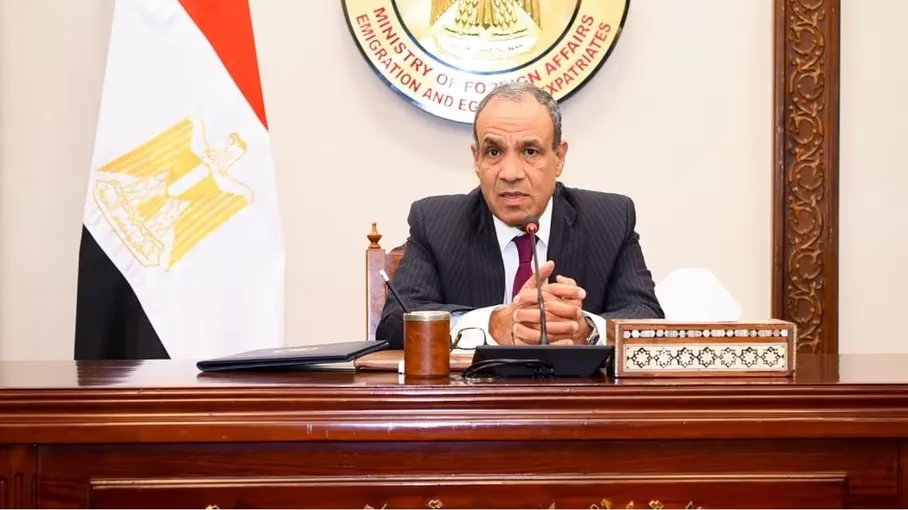
Egyptian Foreign Minister: We faced pressures and large financial offers to deport the Palestinians

The Egyptian Foreign Minister, Badr Abdel Ati, revealed that Cairo was subjected to pressures and large financial offers in recent times, in the context of attempts to pass a plan to deport Palestinians from the Gaza Strip, confirming that the Egyptian state dealt with these pressures with the logic of international law and rejected any bargain that affects Palestinian rights or national security.

Abdel Ati explained that some of these offers included waiving huge financial debts on Egypt, in addition to other economic incentives, in exchange for accepting arrangements related to the deportation of Palestinians, but Cairo categorically rejected those proposals, considering that accepting them represents a violation of the rules of international legitimacy.

The minister affirmed that Egypt's position is known and clear to all parties, including the Israeli side, noting that long years of diplomatic relations have established a mutual understanding of the nature of the red lines that cannot be crossed.

Regarding the humanitarian situation in the Gaza Strip, Abdel Ati emphasized that Israel, as an occupying power, bears full legal responsibility for opening the crossings and ensuring the flow of aid, accusing Tel Aviv of ignoring its international obligations, and added that abandoning the international law system will lead the world to the logic of chaos and "the law of the jungle."

The Foreign Minister addressed the Rafah crossing file, confirming that Egypt rejects its unilateral operation, and that any talk of dividing the Gaza Strip or imposing new paths and borders is completely rejected. He also indicated that there is a conviction in Washington of the need to quickly move to the second phase of the ceasefire agreement, with continued Egyptian efforts to push towards a fair settlement.

On the energy front, Abdel Ati denied any political dimensions to gas import agreements from the Israeli occupation, saying they are purely commercial deals between international companies, and confirmed that Egypt's ownership of two liquefaction plants in Idku and Damietta gives it a pivotal position as a regional center for gas collection and re-export, whether from Israel or Cyprus, alongside new discoveries that support local production.

On the Syrian file, the minister affirmed Cairo's support for the unity of Syrian territories and its stability, pointing to continuous communication with the new Syrian administration, and advised it not to provide pretexts for foreign interventions. He also emphasized the importance of combating terrorism and preventing Syria from becoming a platform threatening neighboring countries.

Abdel Ati also addressed the refugee file, confirming that Egypt bears heavy burdens without sufficient international support, warning that the continuation of this situation requires the international community to bear its responsibilities, especially in light of the escalating regional crises.

In conclusion of his speech, the Foreign Minister reiterated that the Grand Ethiopian Renaissance Dam file represents a national security issue that does not tolerate negligence, stressing that Egypt will defend its water rights by the means guaranteed by international law, while maintaining balanced relations with the Nile Basin countries except for the ongoing dispute with Ethiopia over unilateral policies.

ARAB AND WORLD

Tue 30 Dec 2025 7:37 am - Jerusalem Time

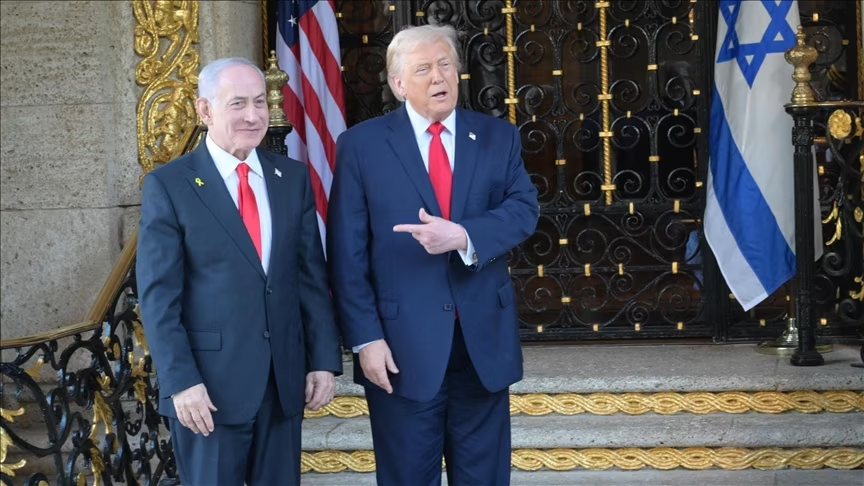
Trump: We have not reached full agreement with Netanyahu regarding the West Bank

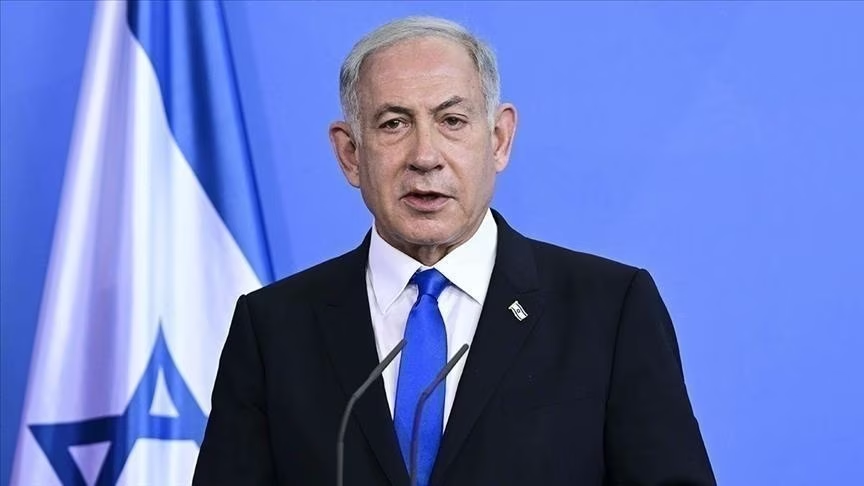
US President Donald Trump said on Monday that he had not reached "full agreement" with Prime Minister Benjamin Netanyahu regarding the occupied West Bank.

This came during a joint press conference held by Trump with Netanyahu at the White House following a meeting between them.

In his speech at the press conference, Trump said: "I discussed the West Bank issue with Netanyahu, but we did not agree 100 percent."

In response to a question whether the Palestinian Authority would be part of Gaza in the "day after," Netanyahu replied: "We will see if they carry out reforms. It depends on them."

He continued: "I believe that President Trump has clarified the required reforms from the Palestinian Authority to participate in Gaza reconstruction plans."

Contrary to these statements, Netanyahu had previously emphasized in more than one occasion his rejection of the Palestinian Authority taking any role in Gaza after the war.

Netanyahu praised the US President, saying: "We have never had a close friend like you."

He added: "I think he is exceptional in his friendship and support for Israel. The President has broken many norms, and therefore we decided to award him the Israel Prize (Israel's highest award)."

Regarding Syria, the Israeli Prime Minister said that interest requires having "peace borders" with Syria, and did not rule out the Palestinian Authority being a partner in the "day after" in Gaza, contradicting his previous statements.

Netanyahu continued: "The interest is to have peace borders with Syria."

He added: "We want to ensure these borders are safe, without terrorists, and protect our Druze friends and minorities in Syria."

President Trump responded: "This will work between Israel and Syria."

Israel has occupied the Golan since 1967, then expanded after the fall of Bashar al-Assad's regime into the buffer zone and Mount Hermon south of Syria, and announced the collapse of the ceasefire agreement signed between the two sides since 1967.

In recent months, Syrian-Israeli talks have been held to reach a security agreement that stops Tel Aviv's attacks on Damascus, but the agreement has not materialized due to Israel's insistence on not withdrawing from the areas it occupied after Assad's fall on December 8, 2024.

Despite US President Donald Trump's call for Israel to calm down with Syria, Tel Aviv continued its violations of Damascus's sovereignty through bombings and incursions that have become almost daily in recent times.

Earlier in the evening of Monday, Trump received the Israeli Prime Minister at Mar-a-Lago resort in Florida, shortly after Netanyahu's meeting with US Secretary of State Marco Rubio along with Trump's advisors Jared Kushner and Steve Witkoff.

Netanyahu also met shortly before his meeting with Trump with US Defense Secretary Pete Hegseth.

On Sunday evening, Netanyahu arrived in Florida on a visit announced by his office to last 5 days.

In recent days, Hebrew media reported that Netanyahu and Trump's discussions are expected to focus on the second phase of the ceasefire in Gaza, in addition to issues related to Iran, Syria, and Lebanon.

The Israeli Army Radio reported earlier in the evening of Monday that Trump may not make the return of the body of the Israeli policeman held in Gaza, Ran Guili, a condition for moving to the second phase.

Israel conditions the start of negotiations to launch the second phase of the agreement on receiving the body of the last prisoner in Gaza, Ran Gvili, while Hamas confirms that it may take time to extract it due to the massive destruction in Gaza.

On Wednesday, the Hebrew Channel 12 reported that Washington informed Israel and the mediators that the second phase of Trump's plan for a ceasefire in Gaza will begin early January 2025.

It is recalled that on September 29, Trump announced a peace plan and ceasefire in Gaza consisting of 20 points, including: the release of Israeli prisoners, ceasefire, disarmament of Hamas, Israel's withdrawal from the sector, formation of a technocratic government, and deployment of an international stabilization force.

On October 10, the first phase of the ceasefire agreement came into effect, while Israel violated some of its provisions and delayed moving to the second phase, citing the remaining soldier in captivity in Gaza, despite Palestinian factions continuing their search for him amid the massive destruction caused by the Israeli genocide.

The agreement was supposed to end a genocide committed by Tel Aviv over two years starting from October 8, 2023, which resulted in about 71,000 Palestinian deaths and more than 171,000 injuries, mostly children and women, but Israel continues its violations and suffocating siege on the sector to this day.

ARAB AND WORLD

Tue 30 Dec 2025 2:41 am - Jerusalem Time

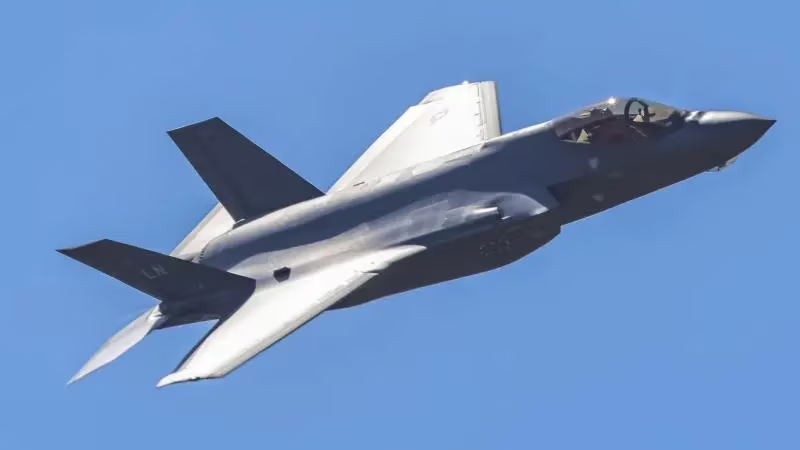
Trump is considering a deal to sell F-35 fighters to Turkey despite Netanyahu's opposition

US President Donald Trump said on Monday that he is considering a deal to sell F-35 fighter jets to Turkey, during a visit by Israeli Prime Minister Benjamin Netanyahu, who strongly opposes it.

Turkey was excluded from the F-35 fighter development program during Trump's first presidential term due to its purchase of the Russian S-400 air defense system.

Washington also prevented Turkey from buying F-35 aircraft, claiming that the presence of the S-400 system allows Russia to gather information about the capabilities of these aircraft. Nevertheless, Trump has good relations with Turkish President Recep Tayyip Erdogan.

Trump responded to a question about the deal to sell F-35 aircraft to Turkey during his meeting with Netanyahu in Florida by saying, "We are seriously considering it."

In response to a question about the possibility of conflict between Israel and Turkey, Trump described Erdogan as a "very good friend," and added, "There will be no problem. Nothing will happen."

Trump also approved in his first term the sale of F-35 aircraft to the UAE after it recognized Israel.

He finally gave approval for the sale of F-35 aircraft to Saudi Arabia.

In January of last year, the US State Department officially notified the Department of Defense of its approval for a deal to sell 40 F-16 fighters to Turkey worth $23 billion, in addition to upgrading its current fleet, thus ending months of negotiations between Ankara and Washington over the deal, which coincided with Turkey's decision to approve Sweden's accession to the North Atlantic Treaty Organization (NATO).

The US Agency for Security Cooperation and Defense reported that the State Department sent the official notification to Congress approving the sale of 40 F-16 Block 70 fighters to Turkey and 79 upgrade kits for F-16 aircraft.

ARAB AND WORLD

Tue 30 Dec 2025 1:32 am - Jerusalem Time

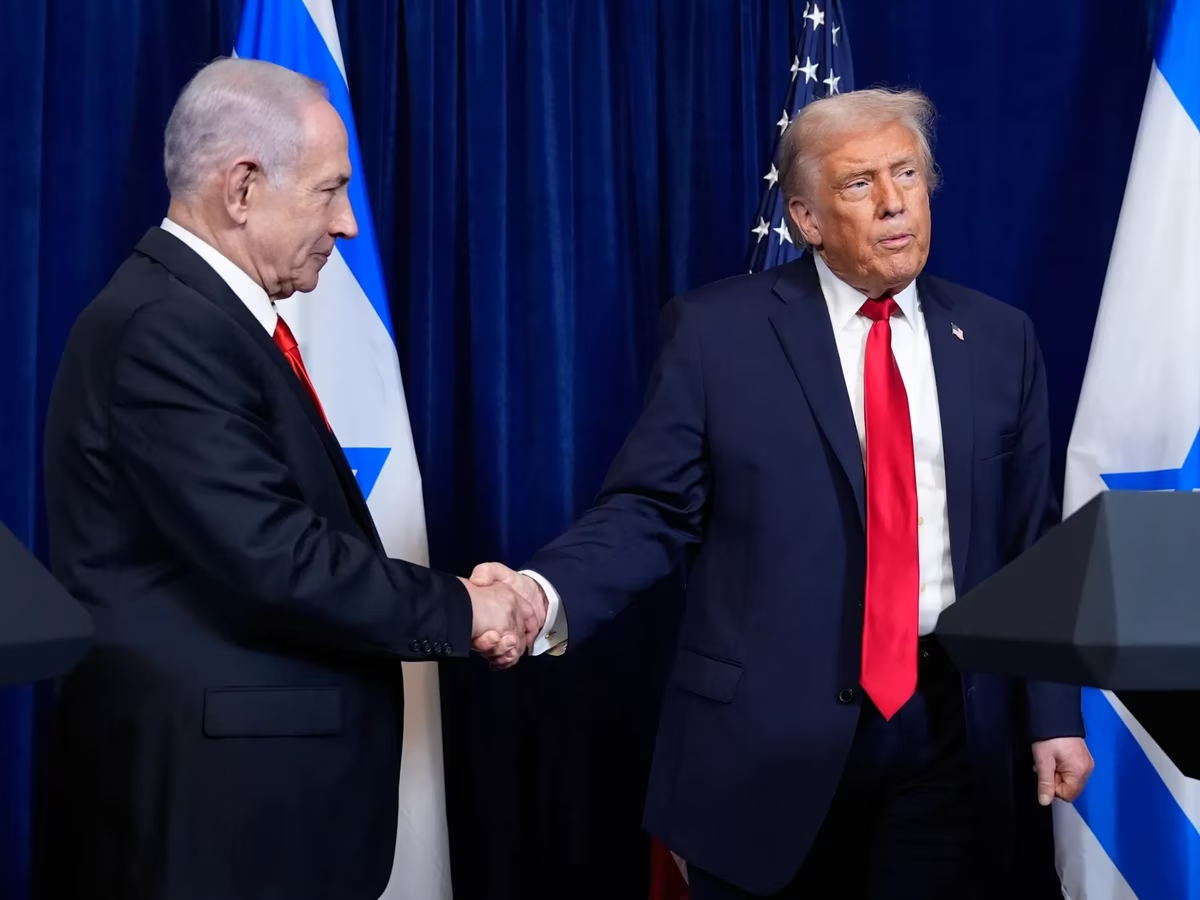
Trump threatens Hamas with a heavy price if it does not give up its weapons and calls for rapprochement between Netanyahu and Al-Sharaa

The American President Donald Trump said he would work to achieve consensus between the Syrian President Ahmed Al-Sharaa and the Israeli Prime Minister Benjamin Netanyahu, while threatening both Hamas with a heavy price if it does not give up its weapons, and Iran if it tries to rebuild its nuclear power.

Trump clarified, in a press conference following Trump's meeting with Netanyahu at Mar-a-Lago resort in Florida, that there is an understanding between the United States and Israel regarding Syria.

He renewed his expression of admiration for the Syrian President, saying "I respect President Al-Sharaa and he is a strong person that Syria needs at the present time, and our relationship with him is good".

Trump mentioned that he reached several conclusions during the meeting with Netanyahu, noting that he has done a lot of work with him, and that this matter will continue.

He addressed Netanyahu - who is wanted by the International Criminal Court on charges of committing war crimes in Gaza - saying "We will always be with you and stand by your side", while affirming at the same time his keenness to establish peace in the Middle East.

Regarding the Palestinian issue, Trump threatened the Islamic Resistance Movement (Hamas) with a heavy price if it does not give up its weapons, adding that the movement has a short time to do so.

He explained that some countries that signed the Gaza agreement because of the movement's commitment to disarm are the ones who will destroy Hamas's weapons if it does not give them up.

While pointing to Israel's fulfillment of its commitments regarding the Gaza agreement, and to the agreement with Netanyahu on "most matters", Trump clarified that the consensus between them is not 100% regarding the issue of settler violence in the occupied West Bank.

The White House man touched on the Lebanese Hezbollah party, noting that it is dealing "badly" and that he will follow what the efforts of Lebanon to disarm the party will result in.

He affirmed that Iran's strength has declined greatly and that it will not be allowed to regain it, threatening to attack it again if it attempts to rebuild its nuclear program, while expressing at the same time his openness to conducting talks with Tehran.

Trump touched on the relationship between the Turkish President Recep Tayyip Erdogan and Netanyahu by saying that there will be no problem between them, and that he supports them.

He added that Erdogan deserves great praise for "helping Israel get rid of a regime that was working against it in Syria", in reference to the ousted Bashar al-Assad regime.

Trump noted that his administration is studying the sale of F-35 fighters to Turkey.

Hamas and Israel signed a ceasefire agreement on October 10 last year, and since the agreement came into effect, the Israeli occupation army has committed hundreds of violations, resulting in the martyrdom of 418 Palestinians and the injury of 1,141 others, according to data from the Gaza Government Media Office.

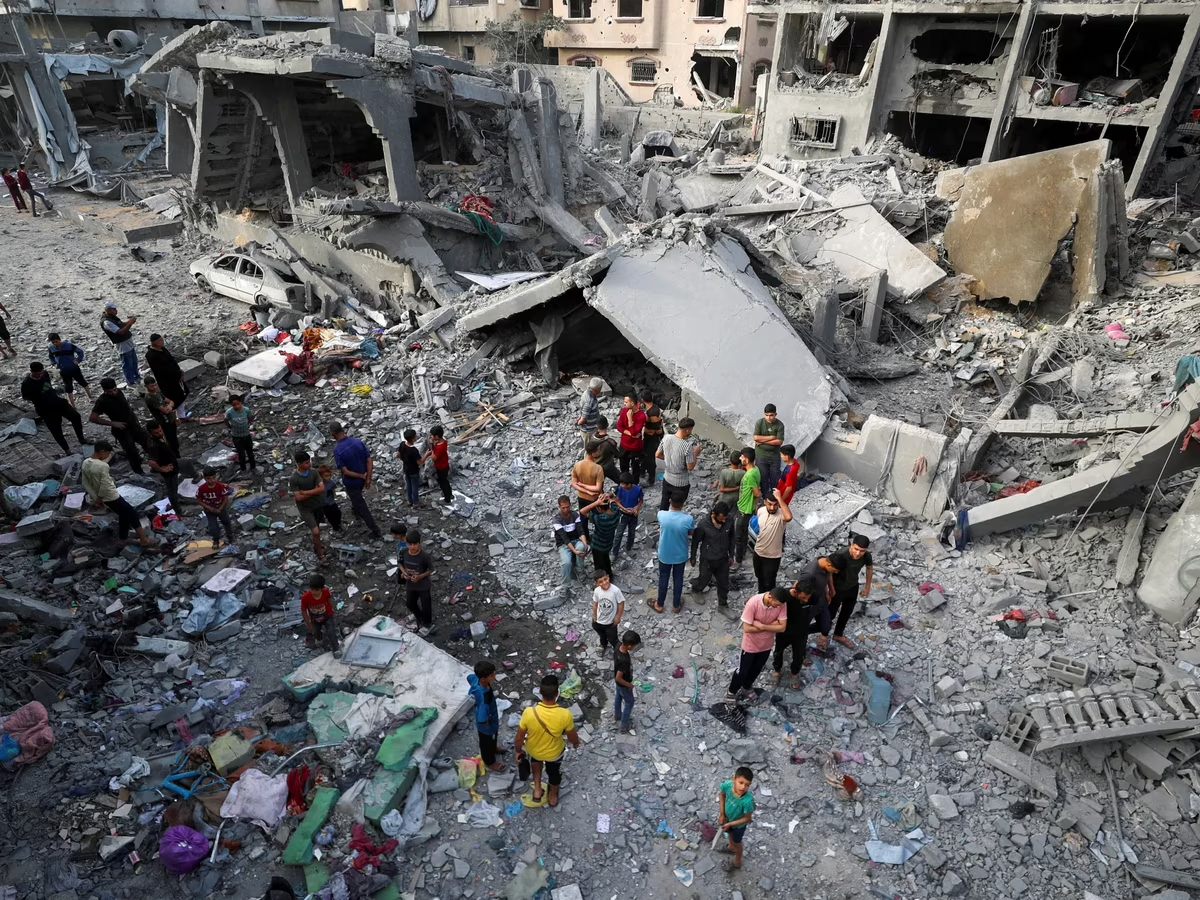
The agreement ended a genocide war launched by Israel on October 8, 2023, which lasted two years, leaving more than 71,000 Palestinian martyrs, more than 171,000 injured, and massive destruction that affected 90% of the civilian infrastructure at a reconstruction cost estimated by the United Nations at around 70 billion dollars.

PALESTINE

Mon 29 Dec 2025 11:43 pm - Jerusalem Time

The Israeli Army Raids Nablus and Forces Residents to Evacuate in Preparation for Settlers' Raid

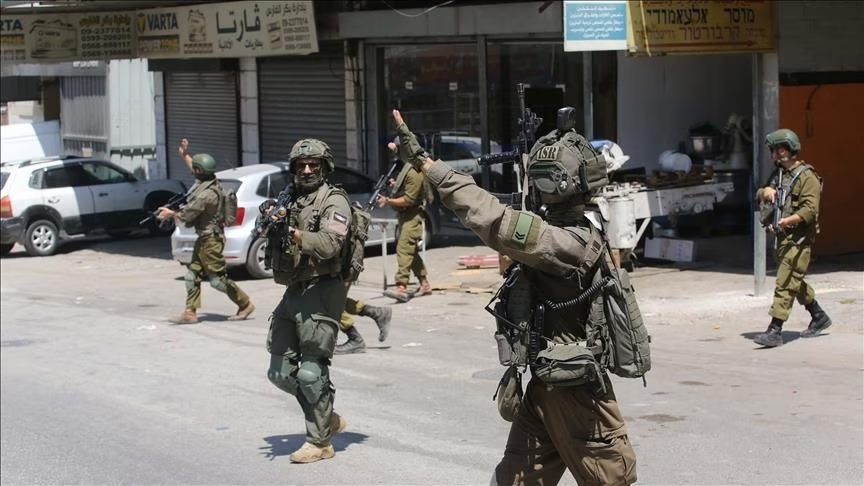
The Israeli army raided the city of Nablus in the northern West Bank occupied territory late Monday evening, forcing residents of residential buildings to evacuate.

Large forces from the occupation army, accompanied by a military bulldozer, raided the eastern area of the city, coming from the Orta, Hawara, and Beit Furik checkpoints.

It added that the army's raid comes "in preparation for settlers raiding the Tomb of Joseph and performing Talmudic prayers there".

The "Tomb of Joseph" is located in the eastern part of Nablus, which is under Palestinian control, and Jews consider it a holy site since Israel's occupation of the West Bank in 1967.

Settlers promote that the remains of the Prophet Joseph son of Jacob were brought from Egypt and buried in this place, but archaeologists have denied the validity of this narrative, saying that the age of the site does not exceed a few centuries, and it is a shrine for a Muslim sheikh named "Yusuf Dweikat".

For its part, the Palestinian Red Crescent Society announced in a statement that the army forced residents of two buildings in the Dahiya area and Amman Street in the city of Nablus to evacuate them, turning them into two observation points.

Meanwhile, Palestine TV confirmed that the Israeli army deployed snipers on Amman Street, Al-Ghawi roundabout, and the Dahiya area, and "forced residents to evacuate their homes in the eastern area of Nablus to secure the settlers' raid on the Tomb of Joseph".

It added that "occupation forces prevent media crews from covering the raid on the eastern area of the city of Nablus".

Since the start of the genocide war in the Gaza Strip, the Israeli army and settlers in the West Bank, including East Jerusalem, have killed more than 1,103 Palestinians, injured about 11,000, in addition to arresting more than 21,000.

Israel began on October 8, 2023, a genocide war with American support, lasting two years, resulting in more than 71,000 Palestinian deaths, over 171,000 injured, and massive destruction affecting 90% of civilian infrastructure, with reconstruction costs estimated by the United Nations at about $70 billion.

PALESTINE

Mon 29 Dec 2025 10:32 pm - Jerusalem Time

Revealing the Fate of Prominent Leaders in Al-Qassam Brigades

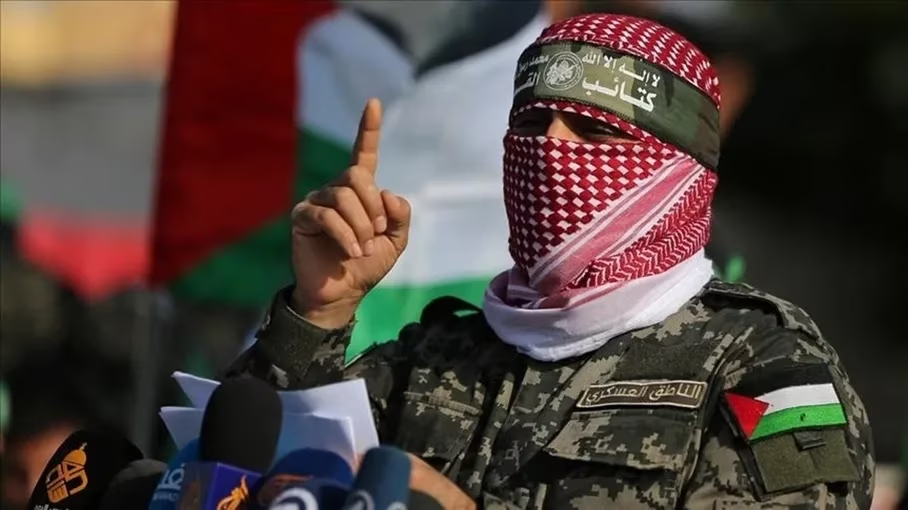
After months of silence and ambiguity, the Al-Qassam Brigades, the military wing of the Hamas movement, revealed on Monday evening the fate of a number of its military leaders, in a file that has been the subject of conflicting narratives between Israel and the Palestinians.

And Al-Qassam announced the death of its Chief of Staff Muhammad al-Sinwar, its spokesperson Hudhaifa al-Kahlout "Abu Ubaida", Rafah Brigade commander in southern Gaza Strip Muhammad Shabana, Hukm Issa commander of the Weapons and Combat Services Branch, in addition to Ra'id Saad commander of the Manufacturing Branch, during the Israeli genocide war.

Sources in Hamas provided information about the lives and careers of the Qassam leaders, confirming their prominent roles in the military and organizational structure of the brigades.

** Muhammad al-Sinwar (Qassam Chief of Staff)

- One of the first leaders of the brigades in Khan Yunis in southern Gaza Strip, and succeeded Muhammad al-Deif in the leadership of Qassam Staff, and the movement described him as having a "brilliant mind" in leading military operations during a difficult period.

- Brother of Yahya al-Sinwar, the former head of the Hamas Political Bureau, who was assassinated by Israel on October 16, 2024.

- He assumed command of the Khan Yunis Brigade, then managed the Human Resources Branch, before overseeing the Operations Branch that planned and executed the "Al-Aqsa Flood" operation on October 7, 2023.

- He carried out a number of military operations against Israeli sites and settlements during the Al-Aqsa Intifada (2000 - 2005) before Israel's unilateral withdrawal from Gaza Strip in 2005.

- He is directly responsible for planning and executing the operation to capture the Israeli soldier Gilad Shalit in 2006 from the Sofa military site east of Rafah in southern Gaza Strip.

- Israel announced his assassination in an airstrike targeting him in Khan Yunis in May 2025.

** Muhammad Shabana, Rafah Brigade Commander in Qassam:

- One of the prominent leaders in Al-Qassam Brigades in southern Gaza Strip.

- Participated in planning and executing a number of military operations during the Al-Aqsa Intifada, including the operation to capture the soldier Gilad Shalit in 2006.

- He assumed command of a battalion in Rafah Brigade, and later was appointed responsible for the brigade succeeding Ra'id al-Attar, who was assassinated by Israel in mid-2014.

- He held membership in the General Military Council of Al-Qassam Brigades, until Israel announced his assassination alongside Muhammad al-Sinwar in May 2025.

** Hukm al-Issa, Commander of the Weapons Branch

- Founder and director of the military training system in Qassam.

- His military nickname is "Abu Omar al-Suri" and he arrived in Gaza Strip from Syria after Israel's withdrawal from Gaza in 2005.

- Participated in transferring military expertise from abroad to inside Gaza Strip.

- He founded the military academy affiliated with Al-Qassam Brigades, which was established in 2010, and directly supervised the military curricula.

- He oversaw the development of defensive plans for Al-Qassam Brigades, and contributed to building the technical and structural infrastructure of the brigades.

- Israel killed him in an airstrike on Gaza City in June 2025 along with his wife and a number of his children.

** Ra'id Saad, Commander of the Manufacturing Branch

- Born on August 15, 1972 in Gaza City, and he is from the first generation of Qassam leaders since the Second Palestinian Intifada in 2000.

- He held membership in the Military Council of Al-Qassam Brigades during that period since 2003, and was known for his closeness to the General Commander Muhammad al-Deif in previous periods.

- He was subjected to several assassination attempts in recent years, most notably in 2006, when the Israeli Air Force targeted a meeting of the Military Council of Al-Qassam Brigades, but he survived the raid.

- He has been one of Israel's most wanted for years.

- During his career, he held multiple leadership positions, most notably commander of Gaza City Brigade, before later assuming command of military manufacturing in Al-Qassam Brigades, according to local media.

- He held the position of Commander of the Operations Branch in the General Military Council, before these tasks were later assigned to Muhammad al-Sinwar, while Saad remained one of the most important military leaders within the military and organizational structure of the movement.

- After the cessation of the Israeli war, Saad held membership in the new Military Council as part of Qassam's efforts to reorganize its ranks, where he manages military operations, and is seen as the second man in the leadership after Izz al-Din al-Haddad.

- He is considered the oldest, most experienced, and senior among the current military leaders, and one of the most knowledgeable about the history and details of the military work of Al-Qassam Brigades.

- Israel assassinated him on December 13 of this year by bombing his car in Gaza City.

** Hudhaifa al-Kahlout (Abu Ubaida)

- His name and image remained hidden for two decades, but he became the voice of resistance and the media face of Qassam.

- He led the media system, and conveyed the developments of the "Al-Aqsa Flood" operation to the world, and he is a prominent media symbol during all military confrontations with Israel.

- Born in 1984 in Jabalia camp in northern Gaza Strip, and joined Hamas and its brigades since the Second Intifada in 2000, and obtained a master's degree in Quranic interpretation.

- His name is linked to prominent military announcements, including the capture of the Israeli soldiers Gilad Shalit in 2006, and Shaul Aaron in 2014.

- Abu Ubaida emerged media-wise for the first time in October 2004, during the "Days of Wrath" battle that lasted 17 days, where he held the first press conference for Al-Qassam Brigades, announcing the progress of confrontations against the Israeli invasion in northern Sector.

- He appeared in the recent rounds of fighting displaying samples of locally manufactured weapons and remains of destroyed Israeli vehicles.

- His last appearance was on July 18, 2025, where he said that Palestinian factions are ready to wage a "long attrition battle" against Israel.

- Israel assassinated him on August 30, 2025.

ARAB AND WORLD

Mon 29 Dec 2025 10:17 pm - Jerusalem Time

Netanyahu directs the army to suspend military operations fearing 'undesirable involvement' during his meeting with Trump

Hebrew media said on Monday that Israeli Prime Minister Benjamin Netanyahu directed the army to suspend military operations until his return from the United States, fearing "undesirable involvement" during his meeting with US President Donald Trump.

On Sunday evening, Netanyahu arrived in the American state of Florida for a visit that the official Israeli Broadcasting Corporation said lasts 5 days.

The political leadership directed the Israeli army to suspend some military operations until Netanyahu's return from his visit to the United States.

And it explained: "This decision stems from fears of undesirable involvement during Netanyahu's meeting with President Trump in Florida".

And the corporation continued: "On Wednesday, a reserve officer was injured due to the explosion of an explosive device in Rafah, and regardless of Netanyahu's comment in English, Israel did not respond to the incident".

At the time, Netanyahu accused the Hamas movement of being behind the explosion in a post in English on the American company "X" platform.

And he said then: "Hamas' open and continuous refusal to disarm is a blatant and ongoing violation, and its violent intentions and violations were confirmed today by its detonation of an explosive device that resulted in the injury of an officer in the Israeli army, and Israel will respond accordingly".

And earlier on Monday, the US President received Netanyahu at the Mar-a-Lago resort in Florida.

And on September 29 last year, Trump announced a peace plan and ceasefire in Gaza consisting of 20 points, including: the release of Israeli prisoners, ceasefire, disarmament of Hamas, Israel's withdrawal from the sector, formation of a technocratic government, and deployment of an international stabilization force.

And on October 10 last year, the first phase of the ceasefire agreement came into effect, while Israel violates its terms and delays moving to the second phase.

And the agreement was supposed to end the genocide committed by Tel Aviv over two years starting from October 8, 2023, which resulted in about 71,000 Palestinian deaths and more than 171,000 injured, most of them children and women, but Israel continues its violations and suffocating siege on the sector to this day.

PALESTINE

Mon 29 Dec 2025 10:07 pm - Jerusalem Time

1.6 Million Palestinians in Gaza Suffering from Malnutrition and Occupation Blocking Aid Entry

The media advisor for the United Nations Relief and Works Agency for Palestine Refugees in the Near East (UNRWA), Adnan Abu Hasna, stated that 1.6 million Palestinians in the Gaza Strip are currently suffering from dangerous or multiple levels of malnutrition or food insecurity amid the ongoing obstruction by the Israeli occupation of the entry of essential humanitarian materials for the winter season.

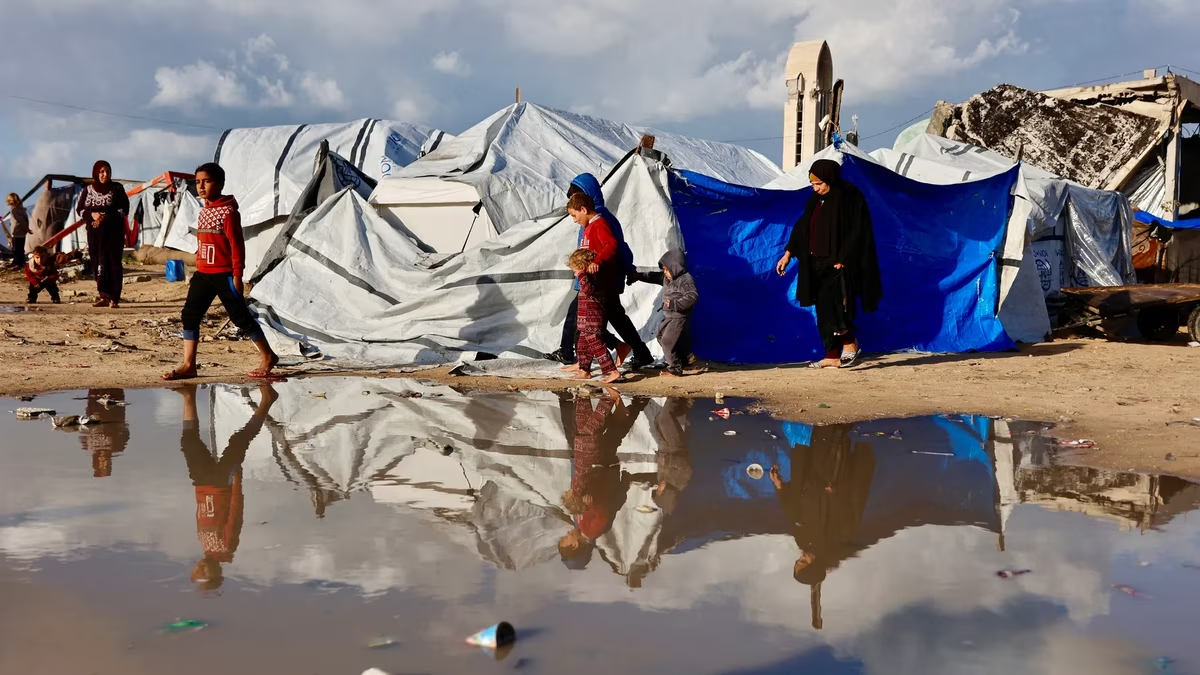
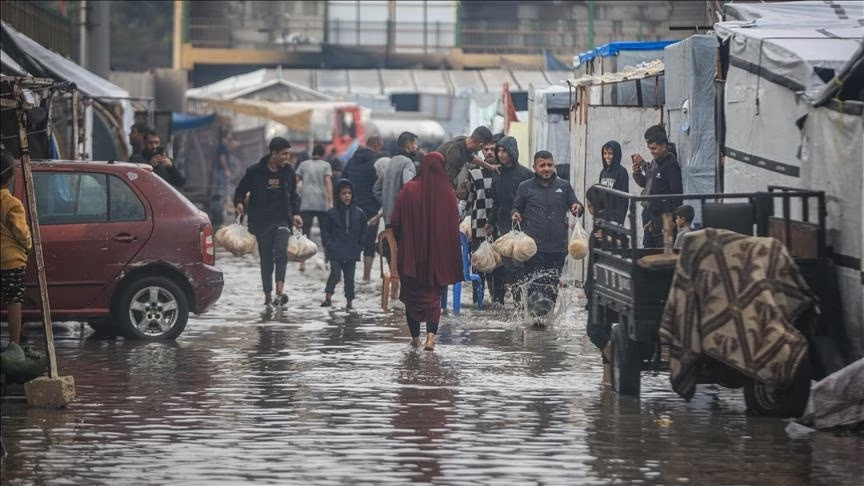
This dangerous warning comes coinciding with a severe weather depression striking the sector, uprooting thousands of dilapidated tents, while Israel is holding six thousand trucks loaded with hundreds of thousands of tents, blankets, and food supplies at the gates of Gaza.

Abu Hasna added that the current weather depression leaves catastrophic direct effects on the lives of the displaced.

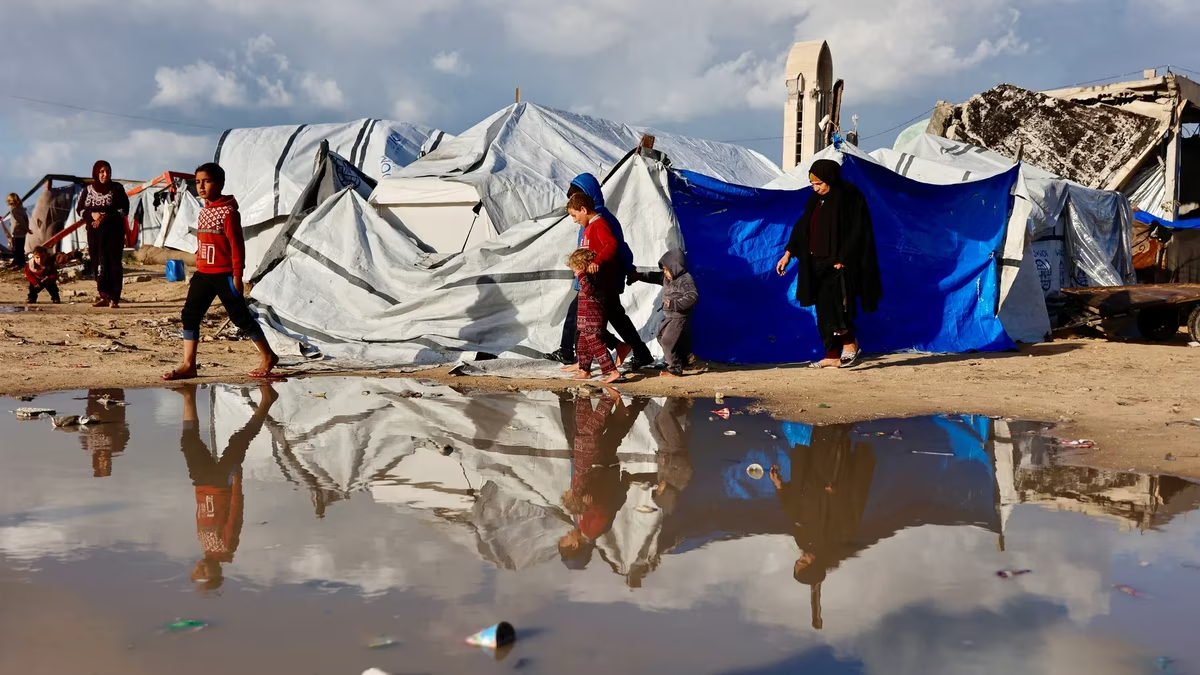
He explained that the weather depression caused the uprooting of thousands of tents and the flooding of residential areas with rainwater and sewage water, confirming that most of what are called tents were built haphazardly from plastic sheets and some fabric, and they are practically not real tents capable of protecting their inhabitants.

Abu Hasna pointed out that even the real tents have become worn out and worthless after repeated displacements dozens of times, and cannot withstand the storms or heavy rains currently hitting the sector.

The UN official confirmed that what people in Gaza feel is that the war continues, but in other ways and forms.

He explained that the continued deterioration of humanitarian conditions, the increase in the number of patients, and the non-entry of hundreds of types of food and non-food items, spare parts for sewage and water stations, medical devices, and medicines, all represent different forms of the continuation of the war on civilians.

Regarding the detained aid, Abu Hasna explained that Israel is preventing UNRWA from entering six thousand trucks loaded with hundreds of thousands of tents that the agency purchased for hundreds of millions of dollars and which people are now severely lacking.

He added that these shipments also contain hundreds of thousands of blankets and winter clothing, in addition to food supplies sufficient for the Gaza Strip for three months, all detained at the sector's gates.

On the deadly repercussions of the weather depression, three deaths have been recorded since the start of the current weather depression, the latest being an infant who died from the severe cold.

ARAB AND WORLD

Mon 29 Dec 2025 10:05 pm - Jerusalem Time

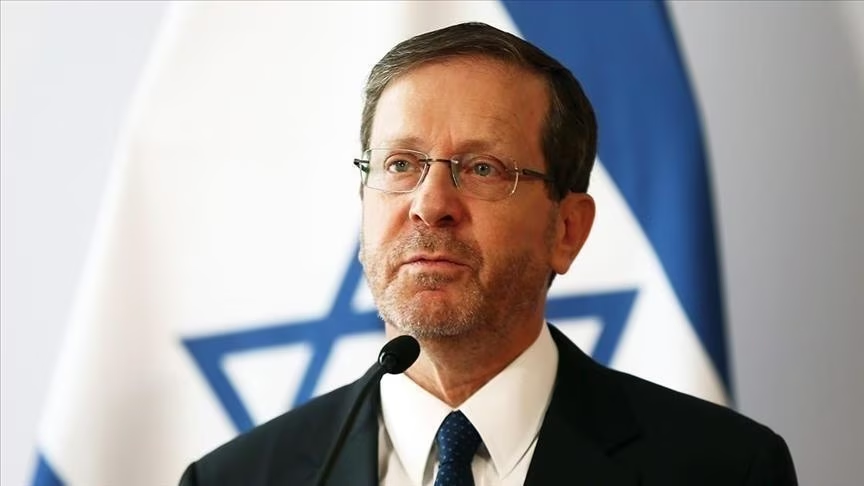
Herzog Denies Trump's Statements on Pardon for Netanyahu: We Have Not Conducted Talks

Israeli President Isaac Herzog said on Monday that he has not conducted talks with his American counterpart Donald Trump since Prime Minister Benjamin Netanyahu submitted a pardon request from corruption trials, denying Trump's statements that "the pardon is on the way".

On November 12, 2023, Trump formally requested Herzog to grant a pardon to Netanyahu, and the latter subsequently submitted a request for a pardon, while the Israeli president said he is studying the request.

Trump's request sparked widespread criticism within Israel, with accusations of interference in Israel's internal affairs and harming equality before the law.

During his reception of Netanyahu at Mar-a-Lago resort in Florida earlier Monday evening, Trump said: "How can they not grant a pardon to Netanyahu? He is a prime minister during war."

He added: "I spoke with the President (Herzog) and he says it's on the way."

However, Herzog's office said in a statement: "No contact has been made between President Herzog and President Trump since the submission of the pardon request."

Netanyahu faces charges of corruption, bribery, and breach of trust in 3 corruption files that require his imprisonment if convicted.

"File 1000" involves him and his family members receiving valuable gifts from businessmen in exchange for providing facilities and assistance to them in various fields.

While in "File 2000", he is accused of negotiating with the publisher of the Hebrew newspaper "Yedioth Ahronoth" (private) Arnon Mozes to obtain positive media coverage.

As for "File 4000", it concerns providing facilities to the former owner of the news site "Walla" Shaul Elovitch, who was also an official at the "Bezeq" communications company, in exchange for positive media coverage.

In addition to his local trial, the International Criminal Court issued an arrest warrant for Netanyahu in 2024 for committing war crimes and crimes against humanity against Palestinians in the Gaza Strip.

PALESTINE

Mon 29 Dec 2025 9:25 pm - Jerusalem Time

Palestinian trade unionist warns of liquidation and assassination operations against Palestinian workers in Israel

A Palestinian trade unionist warned of liquidation and assassination operations against Palestinian workers in Israel, calling on institutions and trade unions around the world to take serious action to prosecute the crimes committed against the workers.

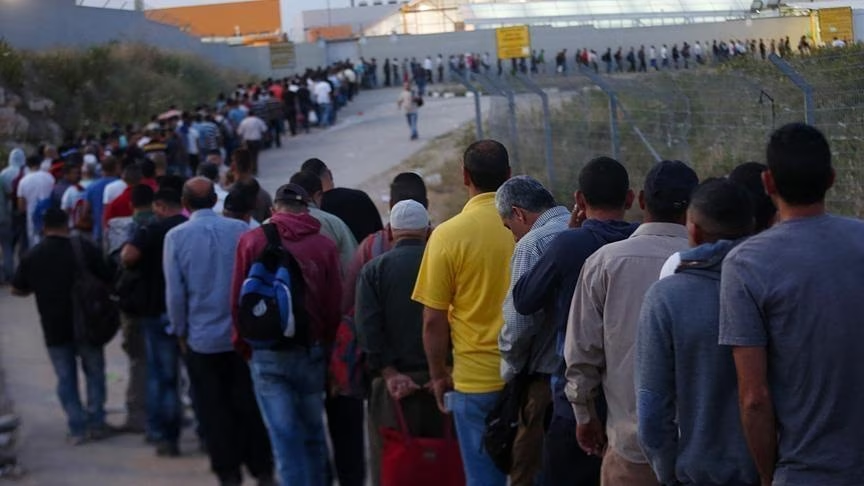
This came in a statement by Shahar Saad, Secretary General of the Palestinian Workers' Trade Unions Federation, on Monday, in response to statements by National Security Minister Itamar Ben-Gvir, who said that the treatment of Palestinian workers trying to "infiltrate" into Israel would be by opening fire.

Saad condemned the "blatant threats issued by Ben-Gvir through the Hebrew Channel 14 and other Israeli platforms, which included explicit calls to kill Palestinian workers by shooting at them while they try to reach their workplaces by various means".

He added that the incitement of settlers "through the dissemination of video clips showing Palestinian workers entering by climbing the separation walls between the West Bank and the occupied interior reveals a prepared ground for carrying out a series of liquidation and assassination operations against the workers, under the pretext of what is called illegal infiltration".

Saad warned "of the danger of this approach adopted by official Israeli parties, and implemented in many cases in undeclared ways, amid the continuous rise in the number of martyrs for a living wage during the current year".

He called on institutions, trade unions, and labor unions around the world to "take serious action to prosecute the crimes committed against Palestinian workers, expose them at international levels, and work to establish mechanisms and international courts to hold all those involved accountable".

He pointed out that Israeli policies for more than two years "have led to more than 500,000 Palestinian workers losing their livelihoods, and unemployment rates rising to unprecedented levels".

Almost daily, injuries to Palestinians near the separation wall around Jerusalem and along the borders between the West Bank and Israel recur, during attempts by Palestinian workers to cross it in search of work inside Israel, which occupies their lands.

Data from the General Federation of Palestinian Workers indicates that 44 Palestinian workers were killed by Israeli army gunfire, and more than 32,000 others were arrested, inside workplaces or during their attempts to seek work since the start of the genocide war until October 28 last.

Since the start of the genocide war on Gaza in October 2023, Israel has prevented Palestinian workers from returning to their workplaces, so some resort to climbing the separation wall despite the risks involved in the adventure.

PALESTINE

Mon 29 Dec 2025 9:18 pm - Jerusalem Time

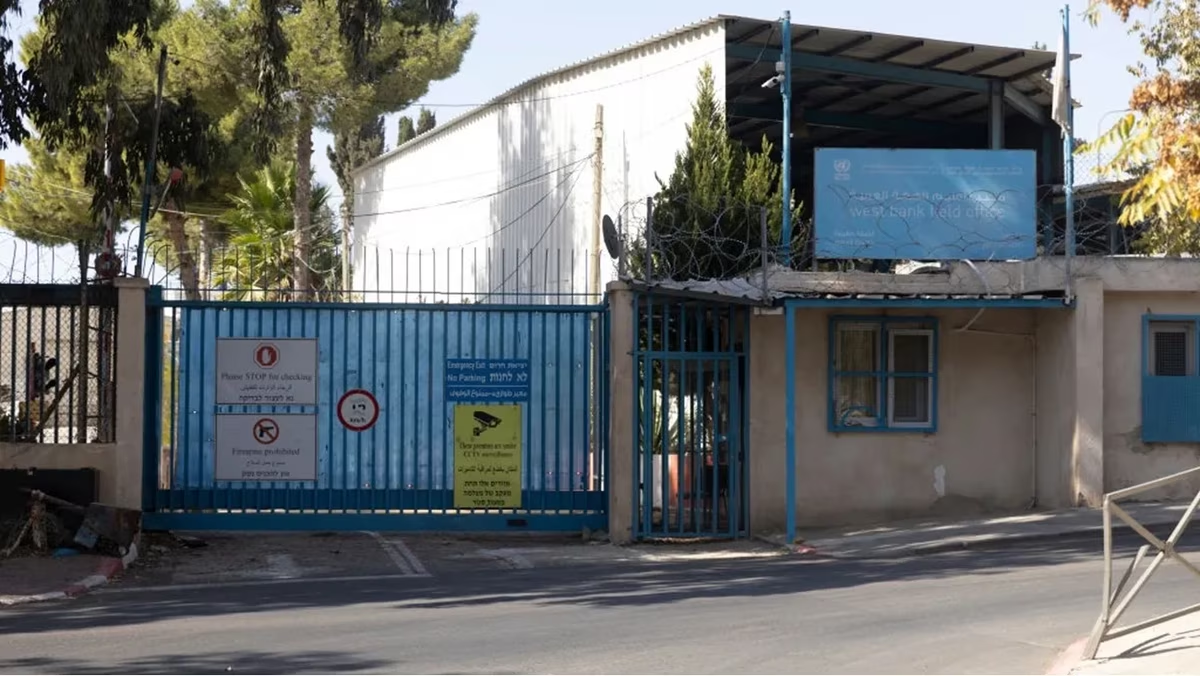
Occupation forces remove the United Nations flag and raise their own above the UNRWA headquarters in Jerusalem

Israeli occupation forces proceeded to remove the United Nations flag and raise the Israeli flag above one of the international organization's headquarters in occupied East Jerusalem, during the raid on the headquarters of the United Nations Relief and Works Agency for Palestine Refugees (UNRWA) in the Sheikh Jarrah neighborhood, on December 8, 2025. The Israeli police, accompanied by employees from the occupation municipality, forcibly entered the compound, confiscated equipment and property belonging to the agency, before removing the UN flag and raising the Israeli flag in its place. The raid was carried out at dawn using motorcycles and lifting trucks, after cutting off communications inside the headquarters, in preparation for starting the confiscation operations.

With this unprecedented scene, fundamental questions arise: What remains of the United Nations' prestige when its flag is forcibly removed? And how can an organization presumed to be a guardian of international peace claim its ability to protect civilians if it is incapable of protecting its symbols and facilities? Then, can this act be understood in isolation from a broader context that witnessed the targeting of UN schools in Gaza, the destruction of refugee camps in the West Bank, and the criminalization of UNRWA's work in Jerusalem? And does the removal of the UN flag represent a merely symbolic step, or a practical declaration that Israel no longer recognizes any authority or jurisdiction of international law on the ground?

The legal framework for the immunity of international headquarters

Theoretically, the presence of the United Nations and its agencies enjoys special legal protection under international law. Since the establishment of the UN organization, the Convention on the Privileges and Immunities of the United Nations of 1946 has been adopted, which stipulates the inviolability of UN headquarters and properties in any country. This means that it is not permissible for the host country's authorities to raid, search, or confiscate them. International agreements also exempt UN headquarters from local taxes and fees, recognizing the non-profit nature of the international organization and its humanitarian function. This legal protection is not merely formal procedures, but its essence is to preserve the neutrality of the United Nations and the safety of its operations, as the United Nations flag raised above its headquarters is considered a symbol of international immunity and protection.

The international judiciary has repeatedly affirmed the obligation to respect this immunity; for example, in October 2023, the International Court of Justice issued an advisory opinion explicitly reminding Israel of its legal duty to facilitate UN relief efforts in Gaza and cooperate with the organization's agencies in the occupied territories. These obligations fall on Israel as a UN member state and signatory to the relevant agreements, making any violation of them a direct breach of international law.

The symbolism of the United Nations and international protection

The presence of the United Nations in conflict zones symbolizes international protection and the neutrality of the international community. For decades, the blue UN flag has been adopted as a sign for internationally protected sites, starting from UN headquarters and refugee camps, even to ambulances and humanitarian convoys affiliated with it. Historically, this symbolism has gained deterrent power; it provides a safe haven for civilians under the UN banner and warns conflict parties against targeting it. But in the Palestinian case, Israel has increasingly targeted this symbolism. Forcibly removing the UN flag from above a UN-affiliated building does not represent a mere protocol incident; rather, it is a message rejecting any guardianship or international protection for Palestinians. It is tantamount to a declaration that the only reference on the ground is the power of the occupation.

UNRWA and the headquarters agreement:

The United Nations Relief and Works Agency for Palestine Refugees (UNRWA) is the most prominent example of UN presence in historic Palestine, and it is the axis of the recent event. The UN established UNRWA in 1949 to provide basic relief to Palestinian refugees after the 1948 Nakba. Since then, the agency has operated in refugee areas including the Gaza Strip and the West Bank (including East Jerusalem) alongside neighboring countries. UNRWA's presence in the occupied territories was regulated by agreements and arrangements with the relevant authorities; after Israel's occupation of the West Bank and Gaza in 1967, the Israeli government requested UNRWA to continue its operations in the areas under its control and pledged to facilitate its mission. This came in an official exchange of letters between the then UNRWA Commissioner-General Laurence Michelmore and the Israeli official Michael Comay (known as the "Comay-Michelmore Agreement"), where the Israeli side confirmed that these temporary arrangements would remain in effect until replaced or canceled by another agreement. Under this understanding, Israel committed to facilitating UNRWA's work as much as possible while considering the security considerations that Israel has always raised.

Over the following decades, despite tensions, UNRWA maintained its presence as a lifeline for millions of Palestinian refugees. It manages schools and clinics, distributes food aid, and provides social services in refugee camps, thus bearing a highly important humanitarian and stabilizing role. Therefore, international agreements, including the aforementioned Convention on the Privileges and Immunities of the United Nations, include UNRWA and its staff and headquarters within the scope of protection. Staff enjoy relative diplomatic immunities, UNRWA facilities are protected from local interventions and taxes and fees, and local authorities (including the occupation authority) are supposed to respect the agency's status and the inviolability of its facilities.

On the ground, Israel has often complained about UNRWA and accused it of taking biased positions or turning a blind eye to "terrorist" activities, accusations that the agency has repeatedly denied. Israeli governments, with the support of some allies, have sought to reduce UNRWA's role or even end it, but they failed to achieve that. The decision to continue the agency remains with the UN General Assembly, which renews UNRWA's mandate periodically with an overwhelming majority, the latest being the extension until 2028.

Israeli behavior from Gaza and the West Bank to Jerusalem:

The recent years have witnessed an escalation in Israel's hostile behavior towards the UN presence in the Palestinian territories, culminating in the flag incident in Jerusalem. This behavior has taken various forms across regions:

In the Gaza Strip: During the recent war on Gaza (starting from October 2023), UN facilities, especially UNRWA schools that were turned into shelter centers, were subjected to repeated bombing. Hundreds of civilians fell during the bombing of UNRWA sites, even dozens of UNRWA staff themselves fell while performing their humanitarian duties. The UN has repeatedly declared that "there is no safe place in Gaza" including its buildings, and considered the ongoing targeting of facilities bearing the UN emblem as a blatant disregard for UN immunity and humanitarian law. Nevertheless, Israeli operations continued fiercely, justifying them by the presence of resistance elements or weapon caches near some facilities, excuses that do not exempt it from legal responsibility for protecting civilians and relief headquarters.

In the West Bank: The situation was no less dire, albeit in a different context; UN agencies, primarily UNRWA and OCHA, faced chronic Israeli restrictions including bureaucratic obstacles, restrictions on the movement of staff and aid, in addition to arrests and injuries affecting international workers, which limited their ability to perform their tasks. Simultaneously, refugee camps in Jenin, Tulkarm, and Nour Shams were subjected to an unprecedented wave of destruction and displacement, including orders to demolish dozens of residential buildings, destroy hundreds of units, and displace thousands of families, until some camps turned into areas almost devoid of civilian life. UN reports have described these developments as the largest displacement wave in the West Bank since 1967, reflecting the transition of Israeli policy from disrupting humanitarian work to demographic engineering targeting the dismantling of camps and depriving their residents of stability and return.

In occupied East Jerusalem: The series of targeting culminated in the most dangerous measure in the occupied city of Jerusalem. Since 2024, Israel has taken escalating steps in Jerusalem, enacting a law banning UNRWA within what it considers its territories, forcing the agency to close its offices at the beginning of 2025. Then came the climax of this campaign in December 2025 with the public raid on the UNRWA headquarters in Sheikh Jarrah, under flimsy pretexts such as municipal tax debts despite the UN being exempt from taxes by law. Indeed, the raid was carried out, the office's contents were confiscated, the UN flag was removed, and the Israeli flag was raised in its place.

This development in Jerusalem carries dangerous implications, as it is the first direct and explicit challenge to the symbolism of the United Nations in this way within the occupied territories and under Israel's full control. The UN has strongly condemned this raid and described the step as a "blatant violation of the inviolability of its headquarters under international law."

The UNRWA Commissioner-General, Philippe Lazzarini, confirmed that the agency's headquarters in Jerusalem remains a UN facility subject to international immunity regardless of any measures or local legislation imposed on it, emphasizing that any Israeli attempt to strip it of its UN status lacks any legal value, because the status of UN headquarters is governed by international agreements that supersede the domestic law of states. His statements came in an official statement published on the morning of December 8, 2025 via the X platform, in response to the occupation forces' raid on the UNRWA headquarters in Sheikh Jarrah, removing the UN flag and raising the Israeli flag in its place, confiscating the agency's property, and cutting off communications inside the compound. Lazzarini warned that resorting to local legislation to criminalize UNRWA's work or confiscate its facilities represents an attempt to abolish international immunity, which is legally impossible, and entails a dangerous precedent that undermines the foundations of the international legal system.

Do states align with these calls and measures?

In the face of these developments, a question arises about the position of the rest of the states: Does any state support Israel's endeavor to "criminalize" international protection and remove the UN from the Palestinian scene? The reality is that the vast majority of the international community has explicitly rejected that. When Israel proposed a bill to ban UNRWA at the end of 2024, several Western allied countries issued statements of concern and warning. For example, the European Union issued a warning of "catastrophic consequences" if UNRWA's work was banned; similarly, other Western countries called on Israel to respect UNRWA's immunity and not obstruct it.

Some countries temporarily suspended their funding for UNRWA following Israeli accusations after October 2023, but they quickly resumed it after UN investigations proved most of those allegations false. Even the United States, which froze part of its funding at the time, did not go so far as to support banning the agency, but focused on ensuring its neutrality.

It is clear that Israel's approach to criminalizing the UN presence and international protection of Palestinian civilians faces broad rejection. The main donor countries - European, Arab, and others - have continued to provide financial support (albeit at declining rates) and political support for UNRWA and the UN in general in the Palestinian territories, considering it a fundamental stability factor. While Israel continues its campaign against UNRWA, it finds itself isolated in this endeavor.

Removing the UN flag and targeting the symbolism of the international organization in Jerusalem does not only express an assault on a UN body, but is also considered a direct targeting of the Palestinian refugees' right itself, as UNRWA is linked in existence and non-existence to UN Resolution 194 stipulating the right of return, making any tampering with it tampering with the legal structure that historically preserves this right. Despite the fact that international reactions showed a politically supportive stance rejecting the undermining of the international legal system, this response remained more symbolic than practical; if any other country had taken a similar step, the reactions would have been stronger and more procedural.

The background of this behavior becomes clear in that Israel seeks to empty the UN organization of its practical and legal content in the occupied territories as a first stage, paving the way for extending this emptying later to include the neighboring countries that host the largest bloc of Palestinian refugees, primarily Jordan, Syria, and Lebanon. From here, this approach cannot be considered an isolated event, but comes within an integrated and continuous policy aimed at redefining the international legal framework for the Palestinian issue, specifically the refugee issue, by neutralizing UNRWA and drying up its ability to perform its historical role.

Today, the question has become far beyond the incident of removing the UN flag; the real dilemma lies in the fact that the international organization has witnessed, in full view of its institutions and bodies, practices more dangerous than merely targeting its symbolism, starting from policies of widespread killing, passing through annexation operations, reaching the inhuman treatment of prisoners and imposing facts on the ground in Jerusalem. And if these fundamental violations were not met with deterrent measures, has there remained any practical status for the UN's purposes and prestige to rely on? The question is no longer related to an incident of raising or lowering a flag, but to the extent of the organization's own ability to uphold the principles it was founded on, and prevent their undermining when violated in this blatant and repeated manner.


ARAB AND WORLD

Mon 29 Dec 2025 8:50 pm - Jerusalem Time

Hebrew Media: Iran Targets the Marginalized Class in Israel to Recruit Spies

Hebrew media has highlighted Iran's increasing recruitment of Israeli spies for its benefit, enabling it to gather information and capture images, considering that the main reason for this increase is that it targets the marginalized class in "Israel".

The Israeli advisor Meir Suissa said that "news of uncovering more espionage cases for Iran has become commonplace, which means we are facing a truly dangerous phenomenon, although there is a direct link between all recent recruitment cases: they are not high-ranking officers, nor people in government administration, nor generals in the General Staff, but ordinary Israelis from the marginalized, and they will not receive special media coverage, because they are allegedly not of real intelligence value, and not a program with four cameras".

He added in an article he published that we "are facing a phenomenon much more dangerous than recruiting a high-level security official, because it does not tell the story of one person who fell, but the story of the entire Israeli society, as Iran is not only seeking security knowledge, but a vulnerability, and this vulnerability is despair, and therefore we do not really know the number of Israeli collaborators with it, and few overt Zionists are willing to sell information to a photographer for a thousand or two thousand shekels, then publish it, and cooperate, desperate youth, adults living on the edge, and exposed to Iran".

He explained that "Israel was supposed to take care of these young people targeted by Iranian intelligence, through social welfare programs, economy, and reducing the cost of living, but when society abandons them, the enemy recruits them, and this betrayal is not ideological, but existential. It is not hatred for the people, but a feeling of detachment from the state, from those who feel rejected, as if they are unimportant, and non-existent, they are suicidal spies, living in relative comfort, but in their depths they have surrendered to the enemy, and are ready to betray the state even before they betray it, because they have no way to secure a livelihood".

He pointed out that "if Mordechai Vanunu had acted with a Kodak camera out of rejection and revenge, and leaked photos from inside the Dimona reactor, then many today feel the same, but without ideology or drama, with a camera in their pockets through easy access, knowing that in the darkest days of austerity that Israelis went through in previous decades, Arab countries could not buy the loyalty of any of them, but Tel Aviv today, as a regional power, has many weak people armed with a blue ID card, and buried anger towards a state that does not see them".

He clarified that "the ministers who should stand at the forefront of combating this phenomenon are not only ministers of war, but also ministers of welfare, finance, and economy, because the high cost of living is an enemy more dangerous than Iran, and perhaps one of them should whisper a simple idea to the National Insurance Institute and government ministries about the necessity of conducting a preventive campaign, not against espionage, but against despair, by taking care of the desperate Israelis exposed to falling into the Iranian intelligence trap".

PALESTINE

Mon 29 Dec 2025 7:46 pm - Jerusalem Time

With support from the UAE Agency for International Development .. The UAE Floating Hospital welcomes a new Indonesian team to support medical efforts provided to the people of Gaza

The UAE Floating Hospital in the city of Arish has begun receiving the fifth batch of the Indonesian medical team, which includes a number of doctors and nurses in various specialties, to work alongside the UAE medical staff within the healthcare system provided to Palestinian patients and wounded coming from the Gaza Strip as part of Operation "Al-Fursan Al-Shamoukh 3".

To provide medical services according to the highest standards, the Indonesian team collaborates with the UAE medical cadres to ensure enhancing the hospital's readiness to handle critical and complex cases, and expanding the scope of specialties available to patients and the injured.

The members of the new batch of the Indonesian medical team specialize in orthopedics, surgery, anesthesia, internal medicine, and radiology, which supports the hospital's capabilities in receiving various cases and providing the necessary care for them.

The participation of the Indonesian medical cadres confirms the depth of UAE–Indonesian relations, and extends the joint cooperation in humanitarian and relief fields, reflecting the commitment of both countries to support medical efforts aimed at alleviating the suffering of the Palestinian brothers.

Since the opening of the UAE Floating Hospital in Arish on February 23, 2024, the hospital continues to perform its humanitarian role within Operation "Al-Fursan Al-Shamoukh 3", by treating Palestinian patients and wounded and accommodating their companions, where it includes 100 beds for patients and 100 beds for companions, in addition to equipped operating rooms, intensive care units, radiology departments, and laboratories.

Since launching its medical services, the hospital has provided more than 12,000 medical services, performed more than 5,200 surgical operations, provided more than 6,500 physical therapy sessions, in addition to installing 26 prosthetic limbs for patients from the Gaza Strip.


PALESTINE

Mon 29 Dec 2025 7:20 pm - Jerusalem Time

Decline in Immigration to Israel in 2025 Despite Rise in Arrivals from the West

Washington – Saeed Erakat 

Immigration to Israel in 2025 recorded a noticeable decline compared to the previous year, in an indicator that reflects complex demographic and political transformations that go beyond mere numbers. The Israeli Ministry of Immigration and Absorption announced that the number of new immigrants reached approximately 21,900 immigrants, with a decline approaching a third compared to 2024, a decline directly linked to the sharp drop in the number of immigrants coming from Russia, who have formed the backbone of immigration to Israel for decades since the 1990s, according to Israeli media outlets.

Despite this overall decline, official data reveals a notable shift in the immigration map, manifested in the clear rise in the number of immigrants coming from the United States, France, the United Kingdom, and other Western countries. This shift comes in the context of the rising phenomenon of global anti-Semitism, accompanied by bloody attacks targeting Jewish communities and institutions, including the Yom Kippur attack on a synagogue in Manchester, and the massacre that occurred during Hanukkah celebrations in Sydney, Australia.

According to data from the Ministry of Immigration and Absorption, the number of non-Russian immigrants reached approximately 13,600 immigrants in 2025, recording an increase of 23.6% compared to 2024, and a sharp jump of 81% compared to 2023. In contrast, the number of arrivals from Russia declined to approximately 8,300 immigrants only, with a decrease of 57% from the previous year, and a significant difference from 2022, which saw the arrival of approximately 74,000 Russian immigrants following the outbreak of the war in Ukraine. Demographic experts confirm that these jumps and sharp declines reflect the circumstantial nature of Russian immigration, linked more to geopolitical developments than being a long-term trend.

At the level of Western countries, the figures showed the continuation of the upward trend. Israel received approximately 3,500 immigrants from the United States, with a slight increase over 2024, and a 30% rise compared to 2023. Immigration from France also increased by 45% to reach 3,300 immigrants, while the United Kingdom recorded 840 immigrants, with a 19% increase. The number of immigrants coming from Canada reached 420, from South Africa 220, and from Australia 180 immigrants.

The ministry's data indicates that approximately one-third of the new immigrants are aged between 18 and 35, reflecting a relatively youthful character of the current immigration, and bolstering Israeli hopes of benefiting from this segment in the labor market and vital sectors. In this context, the organization “Nefesh B'Nefesh,” specialized in facilitating immigration from North America, announced that the number of immigrants from that region increased by 12% to reach 4,150 immigrants in 2025, which is among the highest figures in the organization's history spanning more than 23 years.

However, these positive indicators do not obscure a worrying demographic reality (for Israel), manifested in the continued deficit in net immigration. In 2024, approximately 82,700 Israelis left the country, which is about 50,000 more people than the number of new immigrants, and experts expect this trend to continue in 2025. Analysts attribute this human hemorrhage to the repercussions of the war that erupted following Hamas's attack on October 7, 2023, in addition to the growing internal frustration with the government's performance, particularly the controversial judicial reform project, which its opponents see as threatening the democratic foundations of the state.

In the face of these challenges, the Ministry of Immigration and Absorption intensified its efforts to enhance Israel's attractiveness to new immigrants. It organized trainings to simulate a large emergency immigration wave, and held global immigration fairs attended by more than 20,000 people, most of them in France. The Jewish Agency also announced that approximately 30,000 Jews worldwide opened files to begin immigration procedures during 2025, although this process may take up to 18 months.

Simultaneously, the Israeli government launched a package of economic and employment incentives, including cooperation with Israeli companies to secure immediate jobs for immigrants, and the approval of tax exemptions reaching zero percent for arrivals in 2026, in addition to a program worth 170 million shekels to improve integration and accelerate recognition of professional qualifications, according to the Times of Israel website.

In conclusion, the immigration figures to Israel in 2025 reflect a clear paradox: a rise in immigration motives from abroad, offset by erosion in internal stability pushing increasing numbers of Israelis to leave. While the government promotes immigration as evidence of the resilience of Israel's “pulling power” even in times of war, the data indicate that the real challenge is not limited to attracting immigrants, but extends beyond that to the ability to retain citizens and build a lasting sense of security and political and economic stability.

PALESTINE

Mon 29 Dec 2025 4:35 pm - Jerusalem Time

Euro-Mediterranean Observatory: Investigation reveals mass murder crime committed by Israeli army with US-made bombs in Gaza

The Euro-Mediterranean Observatory for Human Rights announced on Monday that it conducted a new field investigation that revealed the facts of a mass murder crime committed by the Israeli army in the Gaza Strip, in which 15 civilians were martyred, using two heavy US-made bombs, without prior warning.

The human rights observatory clarified in a statement that the investigation revealed that the Israeli army committed a crime on February 17, 2024, by targeting a family rest house in the "Khirbet al-Adas" area northeast of Rafah city, using "two US-made bombs", which led to the destruction of the place over the heads of its inhabitants.

This field investigation comes as part of the efforts of human rights institutions to document the genocide war crimes committed by Israel in the Gaza Strip during the two years of genocide, and to refute Israel's claims about the existence of "military necessity" in the targets it bombed, which resulted in the martyrdom of civilians.

The statement clarified that this targeting resulted in the martyrdom of 15 civilians from the "Abu Nahal" family, including 13 children and a woman, "without any warning or prior notice, or military necessity that justifies the precise and deliberate targeting of the family that had displaced from its original residence".

The observatory emphasized in its statement that the investigation results "which were based on efforts that lasted for months and included a field inspection of the crime scene, cross-referencing the testimonies of survivors and eyewitnesses, and a technical analysis of digital materials, indicated that the targeted site was purely civilian".

It pointed out that the targeted site "was completely devoid of any military manifestations or activities of armed factions", which refutes "possible Israeli claims about military necessity".

In refuting those claims, the observatory said that Israel's goal in targeting the family was "to kill the largest possible number of safe civilians", as the rest house contained 16 people from the family and they were celebrating a "wedding" occasion.

The statement quoted the sole survivor of this crime, Osama Ibrahim Abu Nahal (16 years old), saying: "We were sitting in a happy family atmosphere on the occasion of my brother's wedding (...) and around six o'clock, without any prior warning, we saw missiles falling on us. All I remember is that I was thrown into the air and lost consciousness".

He continued: "I woke up in the hospital with my body full of wounds and burns, and platinum rods were installed in my hands and feet (...) I asked my brother (who was outside the rest house): Where are my mother and father? I want to see them, but I later learned that everyone who was with me had been martyred".

The observatory pointed to an analysis conducted by the investigation of the destruction traces, especially the two deep craters left by the bombing, that "an Israeli warplane dropped two heavy bombs, likely of the GBU-31 type (MK-84 bombs equipped with JDAM guidance kit), each weighing about 900 kilograms".

The observatory said that these bombs have "enormous destructive power designed to penetrate military fortifications", while their use against a simple unprotected residential building led to the soil and bodies absorbing the explosion force, resulting in complete destruction and tearing the victims' bodies into small pieces, according to the statement.

The observatory noted that the army had not issued, as of Monday, any "statement to clarify the circumstances of the attack on the Abu Nahal family", saying that this comes in "a recurring pattern that reflects complete disregard for civilian lives, and total disregard for its duties to comply with international humanitarian law".

The Euro-Mediterranean Observatory called on the international community to immediately fulfill its obligations to prevent and stop the crime of genocide, through "practical and binding measures that go beyond verbal positions, including imposing an immediate and permanent ceasefire and stopping attacks on civilians and shelter centers and displacement areas".

It urged countries that have a basis for judicial jurisdiction to "open independent and effective criminal investigations into the Israeli crimes committed in the Gaza Strip, including the crime of genocide".

The Israeli army committed, during the two years of genocide, dozens of large massacres by bombing places sheltering Palestinian displaced persons, some of which resulted in the martyrdom of 100 Palestinians at the moment of the bombing.

PALESTINE

Mon 29 Dec 2025 1:31 pm - Jerusalem Time

Death of a baby and a young Palestinian due to cold and building collapse in Gaza

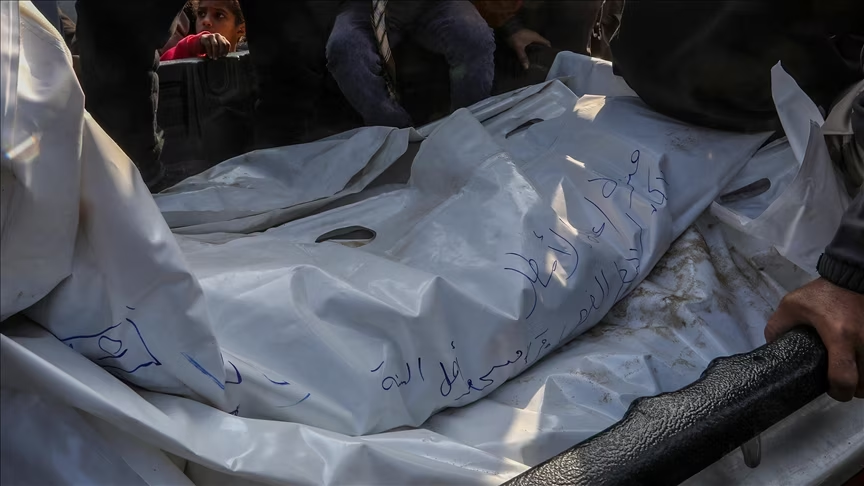
A baby died on Monday due to severe cold, and a young Palestinian due to a building collapse, as a result of the weather depression that struck the Gaza Strip and exacerbated the suffering of the displaced.

The Ministry of Health in the Gaza Strip announced the death of the child Arkan Faras Musleh, who was two months old, due to severe cold, bringing the number of deaths due to cold and the weather depression to 3 cases.

The ministry also announced the death of a Palestinian due to a building collapse, raising the number of victims admitted to hospitals due to building collapses caused by the weather depression to 17 cases.

Meanwhile, the suffering of the displaced is worsening amid the weather depression striking the sector, while meteorological services expect a drop in temperatures, with heavy rainfall.

Palestinians are forced to reside in dilapidated buildings prone to collapse due to lack of options amid Israel's destruction of most buildings in the sector, and its prevention of the entry of mobile homes, construction materials, and reconstruction, shirking its commitments stipulated in the ceasefire agreement.

Suddenly, the Israeli occupation army opened the Gaza Valley stream from its side, which was closed by dams, causing the flooding and drifting of the tents of the Palestinian displaced in the nearby areas.

For his part, Mahmoud Basil, spokesperson for the Palestinian Civil Defense in the Gaza Strip, said that since the impact of the weather depressions on the Gaza Strip began, 18 residential buildings have collapsed completely, resulting in significant human and material losses.

He added that more than 110 residential buildings have suffered partial collapses that are dangerous, posing a direct threat to the lives of thousands of citizens living in them or around them, and more than 90% of the displaced tents have been blown away and flooded due to the strength of the winds and the abundance of rain in a scene that reflects the magnitude of the ongoing humanitarian catastrophe.

He explained that the Civil Defense teams have received more than 700 appeals and distress calls since the start of this weather depression, varying between rescuing those trapped in water and dealing with collapses and severe damages.

Basil continued that the repercussions of these weather depressions have resulted in the death of 25 citizens, including 6 children who died due to the bitter cold, while others died due to building collapses and falling into wells and rainwater collection pools.

He called on the world and the international community to take immediate and serious action to aid the citizens and provide urgent humanitarian needs before the catastrophe worsens further, stressing that tents have proven completely ineffective in the Gaza Strip as they did not provide protection from the cold or rain and are no longer suitable as a humanitarian solution in these harsh conditions.

Meanwhile, the United Nations Relief and Works Agency for Palestine Refugees (UNRWA) said that about 235,000 people in the Gaza Strip were affected by the weather depression Byron, which led to building collapses and damage to tents during the period between December 10 and 17.

The agency added that 17 buildings collapsed, and more than 42,000 tents or temporary shelters suffered complete or partial damage, affecting at least 235,000 people, according to what it conveyed from the Shelter Group in Gaza, which includes United Nations organizations and non-governmental organizations.

Since Saturday, the Gaza Strip has been affected by a polar weather depression, which is the third of its kind since the beginning of the winter season, accompanied by heavy rains and strong winds, at a time when residents face a severe shortage of shelter materials and basic aid.

Despite the end of the genocide war with the entry of the ceasefire agreement into force on October 10, 2025, the living conditions have not seen significant improvement, due to Israel's shirking of fulfilling its commitments stipulated in the agreement, including the entry of the agreed quantities of food, relief, medical materials, and mobile homes.

PALESTINE

Mon 29 Dec 2025 1:25 pm - Jerusalem Time

Rise in Deaths from Low Pressure in Gaza to 25, Including 6 Children

The Civil Defense in the Gaza Strip announced on Monday that the number of Palestinians who died due to low-pressure systems since the beginning of December has risen to 25 people, including 6 children who died from the severe cold.

This came in a statement issued by Civil Defense spokesperson Mahmoud Basil, highlighting the deterioration of humanitarian conditions in the sector due to the low-pressure systems.

Basil said in the statement: "The repercussions of the low-pressure systems have resulted in the death of 25 citizens, including 6 children who died as a result of the severe cold, while the others died due to building collapses and falls into wells and rainwater collection pools."

The Gaza Strip had not witnessed low-pressure systems accompanied by heavy rain, strong winds, and severe cold before this December.
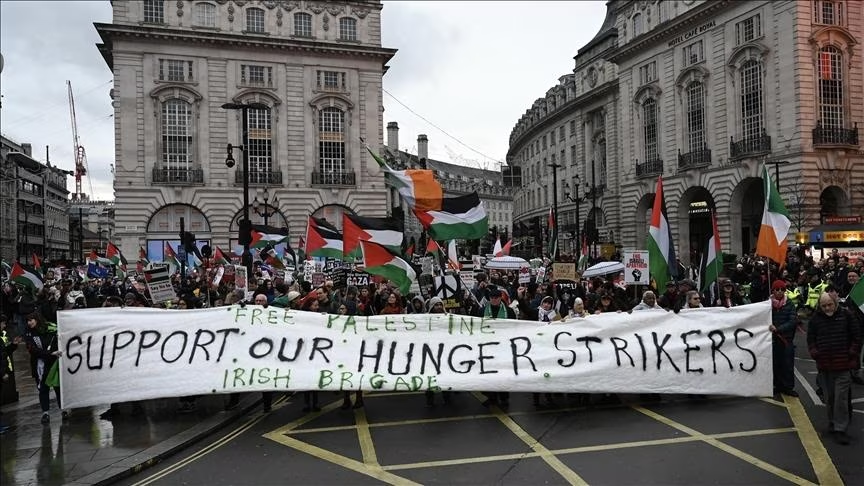
Earlier on Monday, the Ministry of Health stated that the number of children who died from the severe cold since this December has risen to 3, as the ministry counts the bodies that arrived at its hospitals, while the Civil Defense counts what reached the hospitals and what did not.

Basil reported the complete collapse of 18 residential buildings damaged by previous Israeli bombing due to the effects of the low-pressure systems and rains in the same period.

More than 110 residential buildings suffered "dangerous" partial collapses, posing a direct threat to the lives of thousands of Palestinians living in them or around them, according to Basil.

Palestinians are forced to live in cracked and dilapidated buildings due to the lack of options amid Israel's destruction of most buildings in the sector, and its prevention of the entry of mobile homes, construction materials, and reconstruction, shirking its obligations stipulated in the ceasefire agreement.

In a related context, Basil said that 90 percent of the displaced people's tents flew away and sank due to the heavy rains and strong winds, in various areas of the sector.
He pointed out that thousands of Palestinian families lost their temporary shelter and their meager belongings, such as "clothes, blankets, and bedding," which exacerbated their humanitarian suffering.

Basil renewed the urgent call to the international community for "immediate and serious action to aid the Palestinians and provide urgent humanitarian needs, before the catastrophe worsens further."

He demanded the "immediate" start of the reconstruction process and the provision of safe housing that preserves the dignity of the Palestinian human being and protects their life.

For the third day, the Gaza Strip is affected by a low-pressure system accompanied by heavy rain and strong winds, resulting in the flooding and scattering of thousands of displaced people's tents, according to Basil.

Basil warned of more casualties due to the continuation of the low-pressure system, amid harsh humanitarian conditions faced by the displaced inside fragile tents and destroyed homes.

Despite the end of the genocide with the entry into force of the ceasefire agreement on October 10, 2025, the living conditions have not seen significant improvement due to Israel's evasion of fulfilling its obligations stipulated in the agreement, including the entry of the agreed quantities of food, relief, and medical materials, and mobile homes.

On October 8, 2023, Israel began a genocide in Gaza that lasted two years, leaving more than 71,000 Palestinian dead and over 171,000 injured, and massive destruction that affected 90 percent of the civilian infrastructure, with reconstruction costs estimated by the United Nations at about 70 billion dollars.

ARAB AND WORLD

Mon 29 Dec 2025 1:23 pm - Jerusalem Time

Massive demonstrations in "Somaliland" rejecting normalization with Israel

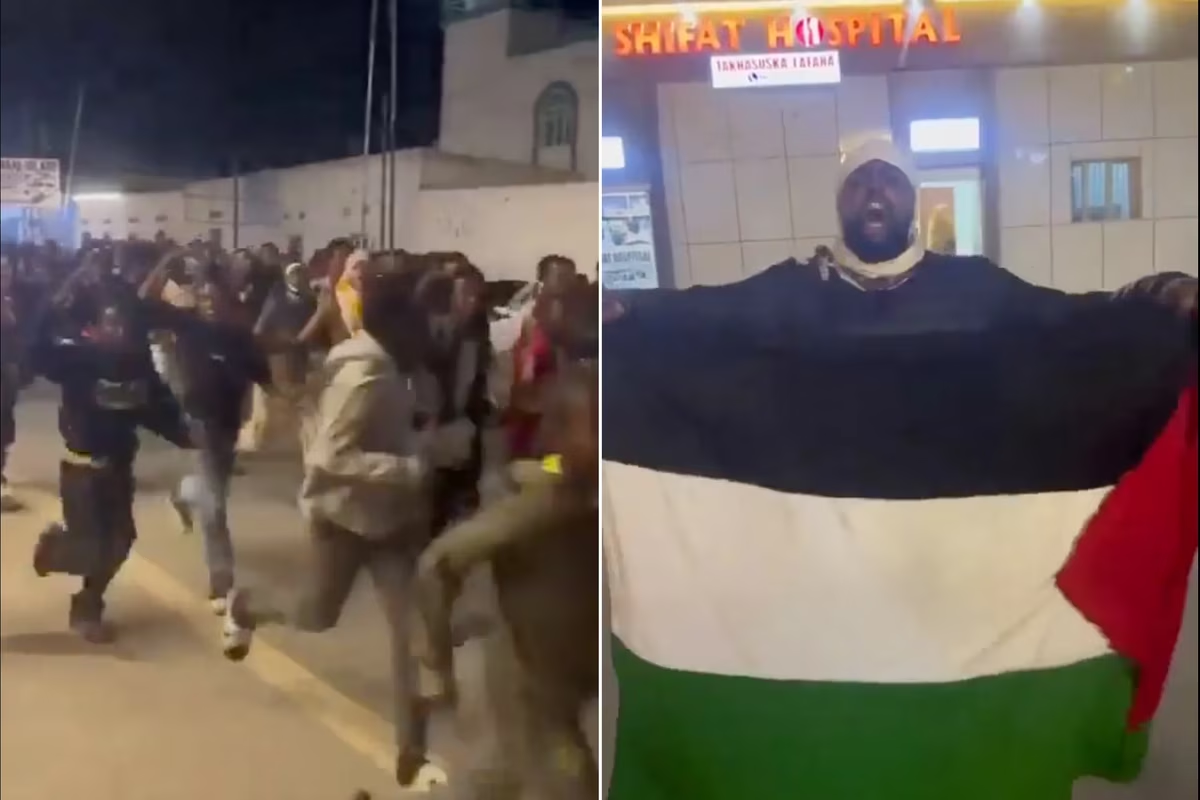
In a scene reflecting popular rejection of any normalization steps with Israel, massive demonstrations erupted in the secessionist region of "Somaliland," rejecting any talk of recognition or rapprochement with Tel Aviv, where protesters raised Palestinian flags and chanted slogans supporting the Palestinian cause, in a striking political message that transcends the region's borders.

Several cities in the region witnessed popular protests in which participants expressed rejection of any Israeli presence or establishment of relations with Tel Aviv, while the most prominent of these protests were concentrated in the city of Borama in Awdal state, near the Bab el-Mandeb Strait, with participation from members of the Samaroon clan, which administratively resides under the authority of "Somaliland."

These protests come after Israeli Prime Minister Benjamin Netanyahu announced on last Friday the recognition of what is called "Somaliland" as an independent and sovereign state, a step that provoked widespread Arab and international condemnation.

The protests followed the circulation of reports about political efforts to establish relations or rapprochement between the secessionist authorities of "Somaliland" and Israel, which sparked widespread popular anger, prompting activists to call for demonstrations rejecting what they described as "bias against the will of the peoples and their historical positions."

Bloggers and activists saw what happened as an unexpected development, confirming that Netanyahu's government did not expect the emergence of protests rejecting Israel from within a region seeking international recognition, considering these demonstrations a politically embarrassing message to Israel.

They pointed out that raising Palestinian flags reflected adherence to the Palestinian cause as a moral and humanitarian issue, and that any bets on passing normalization in isolation from popular will may collide with widespread rejection even in areas experiencing internal political complexities.

According to activists, popular anger was more evident in Awdal state, where residents rejected any celebration of Israel or promotion of what they described as "alliance with Zionism," confirming that the movements came as a direct reaction to talk of political rapprochement with Tel Aviv.

Protesters affirmed that the strategic coast of Awdal extending from Lughaya to Zeila is not for sale or barter, emphasizing that the region is an integral part of Somalia, and its people support the country's unity as much as they openly support the Palestinian cause.

Bloggers explained that the participation of the Samaroon clan carries special political connotations, as it is not historically known for supporting the secession project, considering this movement a reflection of growing popular rejection of Israeli intervention, and it may constitute an early indicator of the expansion of tension in the region.

They added that this public rejection sends a clear message that the local street in Borama and Awdal state does not align with any orientations towards normalization, warning that ignoring popular sentiment may exacerbate resentment and lead to broader movements in the coming phase.

Activists concluded: "What is happening in Borama may be an early warning of the escalation of popular protests, amid growing rejection of any Israeli presence or influence, amid fears that foreign interventions may deepen internal divisions and threaten social stability in Somalia."

PALESTINE

Mon 29 Dec 2025 12:51 pm - Jerusalem Time

Civil Defense in Gaza: We received more than 400 distress calls and have nothing to offer

The official spokesperson for the Civil Defense Department in the Gaza Strip, Major Mahmoud Basil, stated that the department received more than 400 distress calls from citizens, from noon on Saturday until morning on Sunday, due to tents flying away and the displaced needing urgent services, but the department has nothing to offer amid the lack of fuel and necessary capabilities.

This dangerous development coincides with the fourth polar low-pressure system hitting the Gaza Strip since the beginning of winter, characterized by unprecedented wind strength that led to the tents of thousands of displaced people flying away.

The Civil Defense recorded two deaths during this low-pressure system: the first for a young child who drowned in accumulated rainwater, and the second for a woman who was killed instantly after a wall collapsed on her.

Basil added that what distinguishes this low-pressure system is the strength of the winds that uprooted citizens' tents significantly, especially in the port area west of Gaza City on Saturday night.

People were forced to stand by the tent poles to secure them for fear of them flying away, confirming that the Civil Defense itself could not withstand these strong winds.

In a related context to the scientific description of the weather phenomenon, residents of the Gaza Strip are facing a polar low-pressure system where wind speeds reached more than 50 kilometers per hour, with gusts ranging between 70-80 kilometers per hour.

Wind strength is measured according to the Beaufort scale, which determines its danger based on speed within 12 degrees, where wind gusts in this low-pressure system ranged between the seventh degree, which is strong winds, and the ninth degree, which is very stormy winds.

Tent poles bend sharply at the seventh degree of wind, and pegs may be uprooted from the ground, while at the eighth and ninth degrees, structural damage occurs that tears tent fabrics and breaks poles, and may lead to uprooting and complete flying away.

The winds also cause the collapse of some walls and buildings prone to collapse, especially in parts of the sector destroyed by Israeli bombing.

Danger of buildings prone to collapse

The United Nations Relief and Works Agency estimated that storms and rains in Gaza led to the collapse of 17 buildings and damage to more than 42,000 tents completely or partially since December 20 of this month.

Regarding living conditions, Basil emphasized that most residents of the sector are currently living in tents that do not protect their occupants, and children are shivering from the cold, noting that the temperature reached less than two degrees Celsius, which poses a great danger to children, adults, and the sick.

On the other hand, the spokesperson warned of the danger of buildings prone to collapse that could collapse at any moment on the residents, which would result in a large number of casualties, and called on residents to evacuate these buildings immediately for fear of their collapse, but admitted that citizens face a real dilemma because there are no safe or healthy alternatives, making all appeals directed to them practically ineffective.

In the context of operational challenges, Basil confirmed that the existing efforts within the sector from the service system are certainly not sufficient to deal with this reality, and pointed out that in the context of weather lows and a world that knows what is happening in Gaza, the sector should be provided with capabilities, resources, and fuel, but the reality indicates a severe shortage in all these basic resources.

On the preventive level and proposed solutions, Basil called on citizens to work on securing tents more, but admitted that the fabrics and tents available in the sector are insufficient.

He pointed out that the previous low-pressure system destroyed many tents that were supposed to be replaced, but no alternative tents entered the sector at all, and today many other tents flew away and tore, and the citizen is looking for a non-existent alternative.

Basil directed a clear message to the world that "the tent is ineffective," confirming that this is a fact that the international community must recognize, and called for the reconstruction process to begin immediately alongside the introduction of caravans and mobile homes, so that citizens do not suffer from these recurring weather lows that will continue throughout the long winter season.

OPINIONS

Mon 29 Dec 2025 12:45 pm - Jerusalem Time

The Internal Reality of the 'Hamas' Movement and the Will for Change

Mustafa Ibrahim

Mustafa Ibrahim

Opinion Writer

On the one hand, 'Hamas' is trying to reimpose its security and administrative presence by reopening police stations, deploying security elements, and organizing public life, but on the other hand, it is incapable of providing any tangible improvement in people's lives. This contradiction produces a growing gap between the organization and the street, where the movement's measures are read as an effort to consolidate control, not to protect society.


Hamas is living through one of its most sensitive and complex phases since its founding, a phase where military defeat intersects with organizational exhaustion, political confusion with existential anxiety about its future and role. The war has not only weakened the military structure but has also struck the command system and decision-making, pushing it to confront questions that can no longer be postponed: What after the war? Who governs Gaza? And at what cost?
Hamas lost most of its political bureau members during the war, along with the administrative committee leaders who managed the sector for years, creating a deep leadership vacuum that was not easy to contain, and only a limited number of central figures remain to lead Gaza, most notably Khalil al-Hayya, Ghazi Hamad, and Nizar Awadallah, all of whom are outside the sector, which has deepened the decision-making gap between those managing the organization and those living the daily consequences of governance inside.
This vacuum has exploded latent differences between the external leadership and Gaza's leadership, surfacing with the escalation of media discourse and mutual accusations about the 'political line' and the limits of pragmatism. However, these differences are not understood merely as a struggle for leadership, but as a struggle over defining the next phase: a phase of governance? Or a phase of organizational survival? Or merely managing a long-term crisis?
In an attempt to prevent organizational collapse, Hamas formed what is called the 'Leadership Council' after the assassinations of Ismail Haniyeh and Yahya Sinwar, as a transitional framework until 2026, but this council, by its temporary nature, has not produced effective leadership so much as it has managed internal balances and prevented division, and it has become clear that at this stage, it is not seeking leadership for change, but leadership for endurance.
In this context, the trend towards electing a new president for the general political bureau emerges, not as a traditional organizational entitlement, but as a tool to manage a multi-level crisis. Here, the elections are not just an attempt to fill a leadership vacuum, but a means to reorganize the internal house and prevent the movement's disintegration at a critical historical moment. However, what the movement's internal discourse overlooks is that these elections are taking place amid a profound shift in the popular mood inside Gaza. The Gaza street, which used to measure the legitimacy of authority by its ability to 'endure,' now measures it by its ability to secure life, and the question 'Who leads the movement?' is no longer as important as the question 'Who protects people from hunger, cold, illness, and total collapse?'
The sector is witnessing a radical transformation in the relationship between society and authority. After months of genocide, starvation, repeated displacement, and infrastructure collapse, the Gaza society is no longer in the position of a 'political incubator' for any party, but in the position of a victim seeking the minimum of security and stability.

The vast majority of people today live on irregular humanitarian aid, amid the collapse of water, electricity, health, and education services. Thousands of families have lost their homes and been forced to displace more than once, while winter and famine have become daily threats. In this context, discussions about elections and organizational legitimacy seem distant from people's priorities, and sometimes provocative.
On the one hand, 'Hamas' is trying to reimpose its security and administrative presence by reopening police stations, deploying security elements, and organizing public life, but on the other hand, it is incapable of providing any tangible improvement in people's lives. This contradiction produces a growing gap between the organization and the street, where the movement's measures are read as an effort to consolidate control, not to protect society.
And in the absence of real political alternatives, this popular discontent does not turn into organized protest, but into heavy silence, dwindling patience, and slow erosion of legitimacy, which is more dangerous to any authority than open anger.
Alongside the occupation, Hamas faces an escalating internal threat represented by armed gangs supported by Israel, which are draining its security structure and creating chaos, and in facing this threat, it resorts to tightening its security grip, deterrence, and liquidation, not only out of a motive to consolidate rule, but out of fear of losing control.
However, this security approach, in the absence of a political or social horizon, deepens the rift with society and turns security from a protection tool into a symbol of authority, increasing the fragility of the relationship between the movement and the people.
On the other hand, Hamas exploited the truce to reorganize its administrative apparatuses, impose oversight on international associations and organizations, and continue tax collection, even during the war, but these measures, in the view of a wide segment of Gazans, are not read as crisis management, but as insistence on ruling without the ability to save, as it governs a sector without resources, without crossings, and without the capacity to launch real reconstruction, turning authority into an additional burden on a society living on the edge of total collapse.
In this context, Khaled Meshaal emerges as an option that meets Hamas's need to present a marketable political facade regionally and internationally, and less attached to the Iranian axis. However, this option, no matter how pragmatic it is, does not provide an answer to the Gaza street's questions and does not reduce the daily cost of governance, but focuses more on managing relations with the outside than addressing the inside.
The cohesion of Hamas's organization cannot be separated from the high human cost paid by Gaza society. The movement, which shows remarkable ability to manage its internal differences through elections, consensus, and pragmatism, fails in turn to translate this ability into policies that protect people or alleviate their burdens of war and collapse, thus succeeding in saving the organization but failing to save society.
And the elections, no matter how they appear as evidence of internal vitality, are not politically innocent. They are used today as a tool to reproduce legitimacy, postpone confronting difficult questions, and consolidate the rule of fait accompli, not as an entry point for reviewing the experience or assuming responsibility for its outcomes, and while discussions within the movement's frameworks revolve around leadership and representation, the Gaza street faces hunger, cold, and homelessness, without horizon, and without a political partner who feels the weight of its suffering.
The most dangerous thing is that Hamas, while defending its stay in power, has begun to burden society with the cost of this survival, treating popular endurance as a political asset that can be depleted endlessly. Instead of acknowledging the failure of the model combining 'resistance' and 'governance,' and responding to the shift in popular mood, it persists in consolidating security control, as if legitimacy is seized by force, not built by responsibility.
What Gaza faces today is not only occupation and destruction, but the continuation of disaster management with a narrow organizational mentality that prioritizes the movement's survival over people's right to life, and in this context, it is required—ethically and politically—to clearly choose: either to assume the responsibility of governance with all its human and political implications, or to make way for a new national path that is not managed at the expense of people's blood and patience.

PALESTINE

Mon 29 Dec 2025 12:42 pm - Jerusalem Time

Hamas: Anticipated speech by Al-Qassam on Monday at 4 PM Jerusalem time

The official website of the Islamic Resistance Movement "Hamas" announced that the Al-Qassam Brigades, the military wing of the movement, will broadcast an anticipated speech on Monday at 4 PM Jerusalem time, without revealing the content of the speech or the files it will address.

This announcement comes amid the continuation of the Israeli aggression on the Gaza Strip, and amid ongoing debate regarding the fate of Abu Obeida, the military spokesperson for the Al-Qassam Brigades, following Israeli claims of his assassination during an air raid targeting Gaza City at the end of August last year, claims that the movement has neither confirmed nor officially denied to date.

Israeli Defense Minister Yisrael Katz had previously stated that the army had succeeded in "eliminating" Abu Obeida, before the occupation army and the Israeli internal security agency (Shin Bet) issued a joint statement saying that the operation targeted Hudhaifa al-Kahlout, known as "Abu Obeida", based on "prior intelligence information about his location".

In contrast, the Al-Qassam Brigades have not issued any statement confirming or denying these claims, which has kept the fate of the military spokesperson in a circle of ambiguity, and added notable political, media, and military dimensions to the announcement of the anticipated speech.

Palestinian and regional circles are eagerly awaiting this speech, amid growing questions about the identity of the speaker, and whether the expected appearance will carry a surprise related to the fate of Abu Obeida, who has been absent from the media scene for a considerable period.

This development comes in the context of the ongoing war on the Gaza Strip, which erupted following the "Al-Aqsa Flood" operation on October 7, 2023, when Palestinian factions carried out a broad attack on military sites and settlements adjacent to the Strip, resulting in the killing and capture of hundreds of Israeli soldiers, according to the factions' statements, which said the operation came as "a response to the suffocating siege imposed on Gaza for 18 years, and the escalation of violations against Palestinian holy sites and Al-Aqsa Mosque".

In a related context, the Al-Qassam Brigades had confirmed in previous statements that "the Nazi enemy, by assassinating our leaders and our people, and its daily and ongoing aggression against our people in various areas of Gaza, has crossed all red lines", considering that Israel "is disregarding the Trump plan", in reference to the understandings and political efforts proposed to contain the escalation.

The Al-Qassam Brigades called on US President Donald Trump and international mediators to "bear responsibility for these serious transgressions and this repeated recklessness against our people, our resistors, and our leaders", emphasizing that "our right to respond to the occupation's aggression is guaranteed, and we have the right to defend ourselves by all means".

Regarding violations of agreements, the Gaza Health Ministry reported that the occupation has killed about 391 Palestinians since last October, and injured 1,063 others, as part of the ongoing bombing and targeting operations.

Since October 8, 2023, the Israeli occupation has been waging a war of genocide on the Gaza Strip, lasting two years, resulting in more than 70,000 Palestinian martyrs, and over 171,000 injured, in addition to massive destruction affecting about 90% of the civilian infrastructure in the Strip, according to official and UN estimates.

ARAB AND WORLD

Mon 29 Dec 2025 12:25 pm - Jerusalem Time

China condemns Israel's recognition of 'Somaliland' and calls for stopping separatist activities

China condemned today, Monday, Israel's recognition of the so-called 'Somaliland region', rejecting any attempt to divide Somalia or undermine its unity and territorial integrity.

Lin Jian, spokesperson for the Chinese Ministry of Foreign Affairs, told journalists, 'We urge the authorities in Somaliland to immediately stop their separatist activities and conspiring with foreign powers.'

He emphasized that Beijing 'opposes any attempt to divide Somali territories'.

The announcement of Israel's recognition of the separatist 'Somaliland region' as an independent state last Friday provoked widespread Arab, Islamic, and regional condemnation and denunciation.

Official positions condemning it were issued by several Arab and Islamic countries, and Islamic, Arab, and African organizations issued statements condemning the Israeli step and warning of its repercussions on the region.

In response to the step, 21 Arab and Islamic countries announced their categorical rejection of Israel's declaration recognizing Somaliland.

In a statement, they said that the Israeli action carries serious implications for security in the Horn of Africa and the Red Sea, affirming full support for Somalia and rejection of any measures that undermine its unity.

The 21 countries added that they categorically reject linking the Israeli action to any plans for the displacement of the Palestinian people.

The 'Somaliland region', which has not enjoyed official recognition since declaring secession from Somalia in 1991, acts as an independent entity administratively, politically, and security-wise, with the central government unable to extend its control over the region, or its leadership to achieve independence.

The Somali government refuses to recognize the region as an independent state, considering it an integral part of the territories of the Republic of Somalia, and views any deal or direct dealings with it as an aggression on the country's sovereignty and unity.

Israel became, on Friday, the first country in the world to officially recognize the region. The office of Israeli Prime Minister Benjamin Netanyahu said the decision comes 'in the spirit of the Abraham Accords', announcing 'the establishment of full diplomatic relations' and agreements for cooperation in agriculture and technology with the region.

PALESTINE

Mon 29 Dec 2025 11:31 am - Jerusalem Time

235,000 Affected in Gaza Due to Low Pressure System That Led to Building Collapses and Damaged Tents

The United Nations Relief and Works Agency for Palestine Refugees in the Near East (UNRWA) said on Monday that about 235,000 people in the Gaza Strip were affected by the low-pressure system "Byron," which led to the collapse of buildings and damage to tents between December 10 and 17.

The agency explained in a post on its account on the American company "X" platform that "months of war and displacement have forced people in Gaza to live amidst rubble prone to collapse, in temporary shelters or dilapidated tents."

It added that the storm "Byron" that hit the Gaza Strip on December 10 was "a natural disaster, but its repercussions were man-made," referring to the exacerbation of damages due to widespread destruction and lack of safe shelters following the Israeli genocide war.

It continued: "It is estimated that 17 buildings collapsed, and more than 42,000 tents or temporary shelters suffered complete or partial damage during the period from December 10 to 17, affecting at least 235,000 people," according to what it quoted from the Shelter Cluster in Gaza, which includes United Nations-affiliated organizations and non-governmental ones.

Since the impact of the low-pressure systems on Gaza began in December, 18 Palestinians, including 4 children, have died, while about 90 percent of the displacement centers for those whose homes were destroyed by Israel were flooded, according to a previous statement from the Civil Defense in the sector.

The low-pressure systems also led to damage affecting more than a quarter of a million displaced people, out of about 1.5 million living in tents and primitive shelters that do not provide the minimum protection, according to previous data from the Government Media Office in Gaza.

Several residential buildings damaged by previous Israeli bombing during the months of genocide also collapsed due to rain and wind.

Palestinians are forced to live in cracked buildings prone to collapse due to lack of options amidst Israel's destruction of most buildings in the sector, and its prevention of the entry of mobile homes, construction materials, and reconstruction, shirking its obligations stipulated in the ceasefire agreement.

Despite the end of the genocide with the entry into force of the ceasefire agreement on October 10, 2025, living conditions have not seen significant improvement due to Israel's shirking of fulfilling its obligations stipulated in the agreement, including the entry of the agreed quantities of food, relief, and medical materials, and mobile homes.

On October 8, 2023, Israel began a genocide in Gaza that lasted two years, leaving about 71,000 Palestinian deaths and more than 171,000 injured, and massive destruction that affected 90 percent of the civilian infrastructure, with reconstruction costs estimated by the United Nations at about 70 billion dollars.

PALESTINE

Mon 29 Dec 2025 10:23 am - Jerusalem Time

Bank of Palestine Expands Globally after Receiving an In-Principle Approval for a Full Banking License from ADGM Abu Dhabi, UAE

Bank of Palestine has received an In-Principle Approval (IPA) from the Financial Services Regulatory Authority (FSRA) of ADGM, the international financial centre of the Capital of the United Arab Emirates (UAE) to obtain a Category 1 (CAT1) License. This authorization will allow Bank of Palestine to conduct the following regulated activities in or from ADGM: Accepting Deposits and Arranging Deals in Investments, targeting the Global Palestinian community at large.


Once fully operational in H2 of 2026, this license will allow the bank to operate globally from ADGM further strengthening its proposition and diversifying its operations leveraging seamless digital banking services.


“This is a historic milestone for Bank of Palestine, ushering in a new era of global reach, digital excellence, and future-proof banking and wealth management,” said Hashim Shawa, Chairman of Bank of Palestine Group. “As we mark 65 years since our founding in 1960, operating from Abu Dhabi, one of the world’s most dynamic international financial hubs, reflects our ambition to serve our people and partners across the globe, building on a legacy of resilience and innovation.”


Linda Tarazi, who brings over two decades of international banking experience, has been appointed CEO of ADGM entity, Bank of Palestine – Global Ltd., where she will lead the bank’s global expansion.


Abu Dhabi provides the ideal environment for this expansion, offering the trust, innovation, and robust regulatory oversight required to scale globally.
Arvind Ramamurthy, Chief Market Development Officer at ADGM, said: “We are pleased to welcome Bank of Palestine to ADGM. Their decision to choose Abu Dhabi as a global launchpad reinforces ADGM’s position as a trusted and well-regulated leading international financial centre in the MENA region. ADGM’s dynamic ecosystem brings together a diverse community of global banks, asset managers, fintech innovators, and professional service providers, all operating within a robust regulatory framework aligned with international standards. BOP’s long-standing history and expertise will further enrich this ecosystem of global financial entities.”


Bank of Palestine Group is the foremost financial institution in Palestine across all operating indicators, with deep expertise in SME financing, financial innovation, and banking under challenging conditions.
The bank has maintained a presence in the UAE since 2015 through its DIFC Representative Office in Dubai and recently expanded its regional footprint by opening a Representative Office in Cairo to serve its growing client base in Egypt.


BOP also enjoys strategic partnerships with leading Development Finance Institutions (DFIs), leveraging diverse financial tools to strengthen the real economy in Palestine. It has earned global recognition for financial, digital, and gender inclusion, and proudly maintains 50% gender balance at the Board level and 45% across its workforce, underscoring its commitment to ESG principles and the UN Sustainable Development Goals.


PALESTINE

Mon 29 Dec 2025 10:11 am - Jerusalem Time

3 Palestinians Injured in Israeli Bombing Targeting Northern Gaza Strip

Three Palestinians were injured today, Monday, as a result of the Israeli occupation army targeting the Jabalia camp in northern Gaza Strip, in an area from which it withdrew pursuant to the ceasefire agreement, in a new violation of the ceasefire agreement that came into effect on October 10 last year.

A medical source reported that three Palestinians were injured due to an Israeli targeting west of the destroyed Jabalia camp, without revealing the severity of their injuries.

Eyewitnesses said that the Palestinians were injured in an airstrike in an area from which the Israeli army withdrew pursuant to the first phase of the ceasefire agreement.

The witnesses added that an Israeli aircraft carried out an airstrike on the eastern areas of the Bureij camp in the center of the sector, coinciding with artillery shelling targeting areas east of Rafah city, within the areas that the army continues to occupy, in addition to targeting areas east of Gaza city.

The nature of the targets hit by the airstrikes or artillery shelling has not yet been clarified.

This ongoing shelling comes amid worsening suffering for the displaced amid the weather depression hitting the sector, where meteorological services expect a drop in temperatures, heavy rains, amid the continued suffering of the sector's residents due to the repercussions of the war and Israeli restrictions on the entry of aid.

The Israeli army still controls the southern and eastern strips of the sector, in addition to large parts of northern Gaza, continuing to occupy nearly 60% of the sector's area.

Since the ceasefire agreement came into effect, the Israeli army has committed hundreds of violations, resulting in the martyrdom of 418 Palestinians and the injury of 1,141 others, according to data from the Gaza government media office.

The agreement ended a war of genocide launched by Israel on October 8, 2023, lasting two years, leaving more than 71,000 Palestinian martyrs, over 171,000 injured, and massive destruction affecting 90% of the civilian infrastructure, with reconstruction costs estimated by the United Nations at around 70 billion dollars.

PALESTINE

Mon 29 Dec 2025 10:01 am - Jerusalem Time

Netanyahu in Florida: Diplomacy of Silence and a Maneuver to Buy Time to Escape Gaza Obligations

In a carefully orchestrated scene, Israeli Prime Minister Benjamin Netanyahu departed Ben Gurion Airport heading to Florida on Sunday, where he meets US President Donald Trump at Mar-a-Lago resort, in a visit that appears on the surface to be routine diplomacy, but in essence carries a lot of political maneuvers and attempts to buy time. Netanyahu's choice to travel without journalistic accompaniment, and his refusal to make any statements before departure, cannot be separated from his awareness of the sensitivity of the moment, nor from his desire to manage messages away from the spotlight, especially amid increasing American pressures to push him towards the second phase of the ceasefire in Gaza.

This summit, the fifth between the two men since Trump's return to the White House in his second term (January 20, 2025), comes at a time when Washington is trying to establish a new political and security path for Gaza, based on forming a technocratic Palestinian government, and deploying an international stabilization force, in exchange for a gradual Israeli withdrawal from the sector. However, Netanyahu, known for his mastery of procrastination policy, treats these proposals as more of an internal political burden than a strategic opportunity, which makes him inclined to keep them in the open discussion circle without clear commitment to them.

So far, Israel and Hamas have not officially signed the second phase of the agreement, amid mutual accusations of violating the first phase. It is true that Hamas has not yet returned the body of one of the hostages, but in return, Israel refuses to open the Rafah crossing in both directions, content with allowing only exit movement. This disrupted balance in implementing commitments reflects Netanyahu's attempt to maintain field pressure cards, and using humanitarian details as negotiation tools, not as legal or ethical obligations.

In this context, Netanyahu seems keen to redirect the compass of discussions with Trump towards broader regional files, headed by Iran and Hezbollah. Israel promotes fears that Tehran is rebuilding and expanding its ballistic missile program after the Twelve Days War last June, and also threatens to resume war with Hezbollah if the Lebanese government does not commit to disarming it according to the American timeline. However, this escalatory language serves, practically, one goal: justifying the disruption of any serious American pressure on the Gaza file under the pretext of broader security priorities.

Notably, Netanyahu's agenda in Florida seems limited to the point of raising questions. In addition to his meeting with Trump and Secretary of State Marco Rubio, the Israeli Prime Minister does not have intensive political appointments, but allocates time to meet evangelical leaders and activities with Jewish and community figures. This choice is not a mere protocol detail, but reflects his constant pursuit to strengthen his supportive base inside the United States, and circumvent any official pressures through investment in religious and political influence networks.

In conclusion, Netanyahu's visit seems closer to a calculated political maneuver than a genuine attempt to advance the settlement path. He seeks to present himself as a partner to Washington, without offering the required concessions, and uses escalation with Iran and Hezbollah as a pretext to keep Gaza in a state of "non-decision," where there is neither comprehensive war nor real peace. This gray area is the ideal environment for Netanyahu, as it allows him to escape internal and external obligations at once.

What Netanyahu is doing is not just crisis management, but a deliberate reproduction of instability. He realizes that transitioning to the second phase of the ceasefire means opening a political discussion about Gaza's future, a discussion that threatens the cohesion of his right-wing coalition. Therefore, he prefers to keep the agreement suspended, using mutual violations as a pretext, while placing full responsibility on the other side before the international community.

In contrast, Trump seems ready to turn a blind eye to these maneuvers as long as they do not directly clash with his broader agenda. The personal relationship with Netanyahu, and internal electoral considerations, make American pressure limited in scope. And the result is that Gaza remains hostage to a tug-of-war game, where humanitarian and security files are used as bargaining chips, not as an issue requiring an urgent and fair solution.

PALESTINE

Mon 29 Dec 2025 8:45 am - Jerusalem Time

Progress in consultations to form an international stabilization force in the Gaza Strip

Reports have revealed progress in consultations related to forming an international stabilization force intended to be deployed in the Gaza Strip, as part of what is known as the second phase of the political and security arrangements discussed by the Israeli occupation and the United States in the context of the post-war period.

Members of the Political and Security Cabinet (the Cabinet) were informed during a meeting that three countries have agreed to an American request to participate in the international stabilization force in Gaza, without disclosing their names, except for noting Indonesia as a country that has expressed readiness to send troops.

Names of other countries that were previously circulated as potential "contributors" to this force include Italy, Pakistan, and Bangladesh, as part of American efforts to form a multinational force that will undertake security tasks in the sector.

The report quoted a senior Israeli official as saying, following the Cabinet meeting, that "the basic plan that the American President Donald Trump and Israeli Prime Minister Benjamin Netanyahu worked on was based on expanding the Abraham Accords after the end of the war and the return of the prisoners," but this path "currently faces major challenges."

The official explained that the focus has now shifted to the second phase of the understandings, primarily the issue of forming a multinational force, emphasizing that "Turkey will not be part of this force," adding: "We will not be forced to include any country we do not want to participate, and we do not want Turkey."

The official acknowledged the existence of serious doubts within the Israeli occupation regarding the ability of the anticipated international force to disarm Hamas, but considered that "it should be given a chance," according to his expression.

According to the briefings presented to the Cabinet, the transition to the second phase, even if officially announced by the United States, will require additional logistical preparations, noting that "at least several additional weeks" will be necessary to finalize the plan's format, assemble the international force, and ensure its readiness before deploying it in the Gaza Strip.

The Israeli official indicated that the transition to this phase "would have taken time even under the best circumstances," explaining that the United States is seeking to complete all arrangements before introducing any forces into the sector.

In a related context, the official addressed the possibility of Russia's participation in the international stabilization force, amid its increasing involvement in the Syrian file, considering that "Russian participation is not necessarily a negative thing," and could form "a balancing factor for Turkey."

He also noted that Syrian President Ahmed al-Sharaa faces major internal challenges, pointing out that Israel believed that signing an initial security framework with Syria could happen faster, "but Syria is unstable," in his words.

The Israeli official also addressed the escalating tensions with Lebanon, following the recent strikes carried out by the Israeli army, saying that "the Lebanese government strongly desires to dismantle Hezbollah, but it faces major difficulties."

He added that less than a week remains until the end of the "internal Lebanese deadline" for the first phase of disarming the party, confirming that the orientation within the occupation is to "continue holding the lands and executing operations," while being prepared to move "if and when all options are exhausted."

According to the security briefings, Hamas is still active, continues to rearm and restore part of its capabilities, although it has not returned to its previous level. Officials also pointed to the accelerating pace of Iran's production of ballistic missiles, a development described by Israeli security circles as concerning.

This comes at a time when discussions are intensifying within the Israeli occupation and Washington about the future of Gaza, amid regional political and security complexities, indicating that the next phase may be more sensitive and complex than previous ones.

PALESTINE

Mon 29 Dec 2025 8:37 am - Jerusalem Time

Injury to a Palestinian in the northern West Bank.. and a video documents soldiers mistreating an elderly man with an amputated foot

A Palestinian was injured late Sunday evening after his car was hit by an Israeli military vehicle in the northern occupied West Bank, while official media published a video clip of soldiers mistreating an elderly Palestinian man with an amputated foot.

A citizen was injured with "wounds due to a military vehicle of the occupation colliding with his vehicle in the city of Tulkarm".

It clarified that "a vehicle of the occupation collided with the citizen Fadi Marouh's vehicle while he was passing through Al-Quds Open University Street in the city".

The collision resulted in "him being injured with wounds, upon which he was transported by an ambulance affiliated with the Palestinian Red Crescent Society to Thabet Thabet Martyrs Hospital, while the vehicle suffered significant damage".

Meanwhile, Palestine Voice Radio (governmental) published a video clip showing Israeli soldiers assaulting the elderly Palestinian Saeed Al-Amour (61 years old) from Al-Rakeez village in Masafer Yatta south of Hebron city in the southern West Bank.

The video shows Al-Amour, who is amputated of a foot and uses two crutches, being knocked to the ground and kicked while one of the soldiers pointed his weapon at him.

Al-Amour has been injured multiple times in assaults by Israeli settlers, most notably when he was subjected to gunfire that led to the amputation of one of his feet in April/Nisan last year.

In mid-December/January of this year, he was injured after being subjected to an assault by beating by settlers near his home, and was taken to Yatta Hospital where he received treatment.

Since the genocide war on Gaza began on October 8, 2023, the Israeli army and settlers in the West Bank, including East Jerusalem, have killed at least 1103 Palestinians and injured about 11,000, in addition to arresting more than 21,000.

Meanwhile, the Israeli genocide war in Gaza has left more than 71,000 Palestinian dead and 171,000 injured, mostly children and women, along with massive destruction with reconstruction costs estimated by the United Nations at about 70 billion dollars.

Israel was established in 1948 on occupied Palestinian lands, then occupied the rest of the Palestinian territories, and refuses to withdraw and establish an independent Palestinian state with East Jerusalem as its capital.

ARAB AND WORLD

Sun 28 Dec 2025 3:51 pm - Jerusalem Time

UN Rapporteurs Call on Britain to Protect the Lives of Palestine-Supporting Activists on Hunger Strike

UN rapporteurs called on Britain to protect the lives and rights of detained Palestine-supporting activists engaged in a hunger strike.

The UN rapporteurs noted in a written statement on Sunday that 8 Palestine-supporting activists in Britain continue an open-ended hunger strike since November 2.

The statement expressed the rapporteurs' deep concern for the lives of the detainees and their basic rights.

The statement added: "We call on Britain to protect the lives and rights of the detained Palestine-supporting hunger strikers."

It confirmed that hunger strikes are often the last resort for those who believe their right to protest and effective remedies have been exhausted.

The statement indicated that the health condition of the striking detainees, as they enter their second month, has deteriorated significantly, and they face serious health risks including organ failure, irreversible neurological damage, heart system disorders, and possibly death.

The statement called on British authorities to ensure timely access to emergency and hospital medical care for the strikers when necessary, avoid any measures that could be seen as pressure or retaliation, and respect medical ethics.

The rapporteurs emphasized the need to understand these strikes in a broader context of restrictions imposed on Palestine-supporting activities in Britain, noting that the detainees are held due to protest activities.

It affirmed that "the state is fully responsible for the lives and well-being of those it detains, and urgent action is needed now."

The rapporteurs expressed their readiness for effective cooperation with the British government and to closely monitor the situation.

The UN special rapporteurs are part of what is known as the special procedures mechanisms under the Human Rights Council.

These independent mechanisms are the main means of information gathering and monitoring relied upon by the Council to address human rights situations in specific countries or to tackle thematic issues anywhere in the world.

The experts within these mechanisms work independently and without pay, as volunteers outside the UN structure.

PALESTINE

Sun 28 Dec 2025 3:45 pm - Jerusalem Time

Far-right party pushes new bill to ban the adhan in Green Line mosques

A far-right Israeli party announced on Sunday that it is pushing a new bill in the Knesset (parliament) to ban the adhan via loudspeakers in mosques within the Green Line (Palestinian territories occupied in 1948).

After about eight years since the last attempt to restrict the sound of the adhan through legislation, the Otzma Yehudit party (led by the extremist Minister of National Security Itamar Ben-Gvir) announced this morning (Sunday) that it is pushing a new initiative to ban loudspeakers in mosques.

The bill stipulates that "no sound amplification system shall be installed or operated in a mosque without a permit, and the party's proposal is accompanied by a commitment to tighten supervision and impose hefty fines".

The proposal "will be based on a ban on operating loudspeakers, while considering granting the permit according to criteria including the intensity of the noise, the means available to reduce it, the location of the mosque, its proximity to residential areas, and the impact of the sound on residents".

"In case of violation of the rules, the police officer has the right to stop the operation immediately", and if the violation continues, it is possible to "confiscate the loudspeakers and impose a fine of up to tens of thousands of shekels".

Ben-Gvir and Knesset member from his party, Tzvika Fogel, confirmed that "the current bill defines a regulated licensing and supervision mechanism, places clear personal responsibility on the operating party, and greatly enhances enforcement powers and penalties".

Ben-Gvir said: "In many places, the sound of the muezzin is considered unreasonable noise that harms the quality of life and the health of residents (Jews), and it is a phenomenon that cannot be accepted. The Israeli police will act firmly to enforce the law, and the bill provides them with the tools they lacked".

The explanatory note for the bill states: "Noise is considered a health hazard, and despite previous enforcement operations, there is currently no law that provides sufficient tools to deal with this phenomenon".

It added: "Therefore, it is proposed to establish a clear system that includes an automatic ban, an explicit permit, appointing a person responsible for the operation, and imposing large fines. The bill aims to restore calm and improve the quality of life for residents, while ensuring effective and clear enforcement".

The bill includes deterrent fines: Installing or operating loudspeakers without a license exposes one to a fine of 50,000 Israeli shekels (15.7 thousand dollars).

It indicated that operating loudspeakers "in violation of the license conditions exposes one to a fine of 10,000 shekels (3.14 thousand dollars). These fines are transferred to a dedicated confiscation fund, used, according to the bill, for general purposes".

Amid widespread protests in Arab cities and towns in Israel, the Israeli Knesset approved in March 2017 a preliminary reading of a bill submitted by the far-right to ban the adhan during nighttime hours in mosques in occupied Jerusalem and Palestinian towns within the Green Line, but it was not ultimately passed.

The current Israeli government led by Benjamin Netanyahu is the most extreme in Israel's history, according to Hebrew media, and statements by foreign leaders and politicians including former US President Joe Biden.