OPINIONS

Fri 16 Jan 2026 5:26 pm - Jerusalem Time

The Palestinian Economy: A Security File, Not a Development Path

The Palestinian economy is no longer merely a field of numbers and indicators, nor a technical file measured by growth rates or aid volumes. Instead, it has transformed into one of the most dangerous arenas of undeclared conflict. It is an economy meticulously managed between the two extremes of prohibited collapse and forbidden advancement, used more as a tool for security control than a natural developmental path. In this narrow space, Palestinians are allowed to live, but without possessing the conditions for a dignified life or the tools of economic power that could become a lever for liberation and independent decision-making.

Israel, as the dominant power, has never treated the Palestinian economy as a natural right of a people under occupation, but rather as a security variable whose rhythm must be controlled. Extreme poverty is a danger because it generates uncontrollable explosions, and real growth is also a danger because it creates a productive society less susceptible to blackmail and more capable of organized resilience. Between these two limits, the standard of living has been adjusted, natural resources, crossings, and the labor market have been controlled, and the Palestinian economy has been linked to a complex system of dependency that ensures its continuation in a state of “functional survival” without transitioning to a state of historical action.

Despite this, the very persistence of the Palestinian economy, in the absence of sovereignty over land, water, energy, and borders, is a striking paradox. An economy operating without sovereign tools, without freedom of movement for individuals and goods, and under suffocating commercial and financial restrictions, should have collapsed. But it did not. Not because it is structurally strong, but because Palestinian society has, over decades, developed an exceptional ability to adapt and endure, enabling it to maintain a minimum level of social stability within a narrow space where it was allowed to move. However, this resilience has largely remained an individual daily effort, not the fruit of a conscious national economic policy, making it an exhausting resilience without cumulative prospects.

In this context, the Palestinian economy has gradually transformed into a fragile consumer economy, based on salaries, clearing, and foreign aid, while productive sectors have declined, dependency on the Israeli economy has deepened, the middle class has eroded, and unemployment rates have risen, especially among youth. Thus, the economy has been stripped of its developmental dimension, turning it into a tool for permanent crisis management, not a national building project. Even reform attempts witnessed in some stages, as in the experience of Dr. Salam Fayyad, confirmed that the problem lies not only in external constraints but in the absence of a vision capable of intelligently engaging with them instead of merely passively adapting to them.

That experience, despite its limitations and political ceiling, revealed that sound economic management is capable, even partially, of disrupting the logic of control, expanding the margin of movement, and transforming resilience from a defensive state into a cumulative path. The paradox is that the subsequent decline of this approach returned the economy to the square of dependency and crisis management, which confirms that the absence of vision is no less impactful than the harshness of the occupation itself.

This reality is most severely manifested in the Gaza Strip, where the economy has turned into a relief economy, where life is managed on the brink of disaster, without allowing for complete collapse or real advancement. As for the West Bank, a model of “fragile stability” prevails, which ensures security calm but does not open up serious developmental prospects. In both cases, the economy is not a free arena, but a security-managed space, where poverty and growth levels are precisely determined.

From here, the real question is not how to maintain a “viable” economy under occupation, but how to transform it into a resistant economy, built to be a tool for long-term peaceful engagement. Engagement here does not mean the illusion of complete economic liberation, nor jumping over reality, but conscious work within it to reduce dependency, enhance local production, and build self-capacity that accumulates power slowly but steadily.

In this framework, neither the authority alone nor the market alone can be relied upon to build this resistant economy. The modern economic battle is a battle of an entire society, starting from consumption choices, investment patterns, the role of municipalities and unions, all the way to universities and the private sector. Supporting local products, building short production chains, and encouraging cooperative initiatives are not technical details, but forms of daily engagement that quietly accumulate their impact. A resistant economy is not born from a sudden political decision, but gradually takes shape from a network of small decisions, when need turns into awareness, and survival into a project.

Transforming the economy from a security file to a resistant developmental path is not an intellectual luxury, nor a political slogan, but one of the forms of the modern liberation battle. Between an economy managed to stay alive without prospects, and an economy built to be a tool for peaceful engagement that disrupts control and expands the margin of decision, the future and meaning of Palestinian resilience are determined. The question is no longer whether Palestinians can survive, as they have proven that, but whether they can transform this survival into an organized force that deprives the occupation of one of its most dangerous tools of control: controlling livelihoods and the horizon of life.
ARAB AND WORLD

Fri 16 Jan 2026 4:38 pm - Jerusalem Time

Washington re-mobilizes its military force in the Middle East in preparation for a war on Iran

Washington – Saeed Erikat

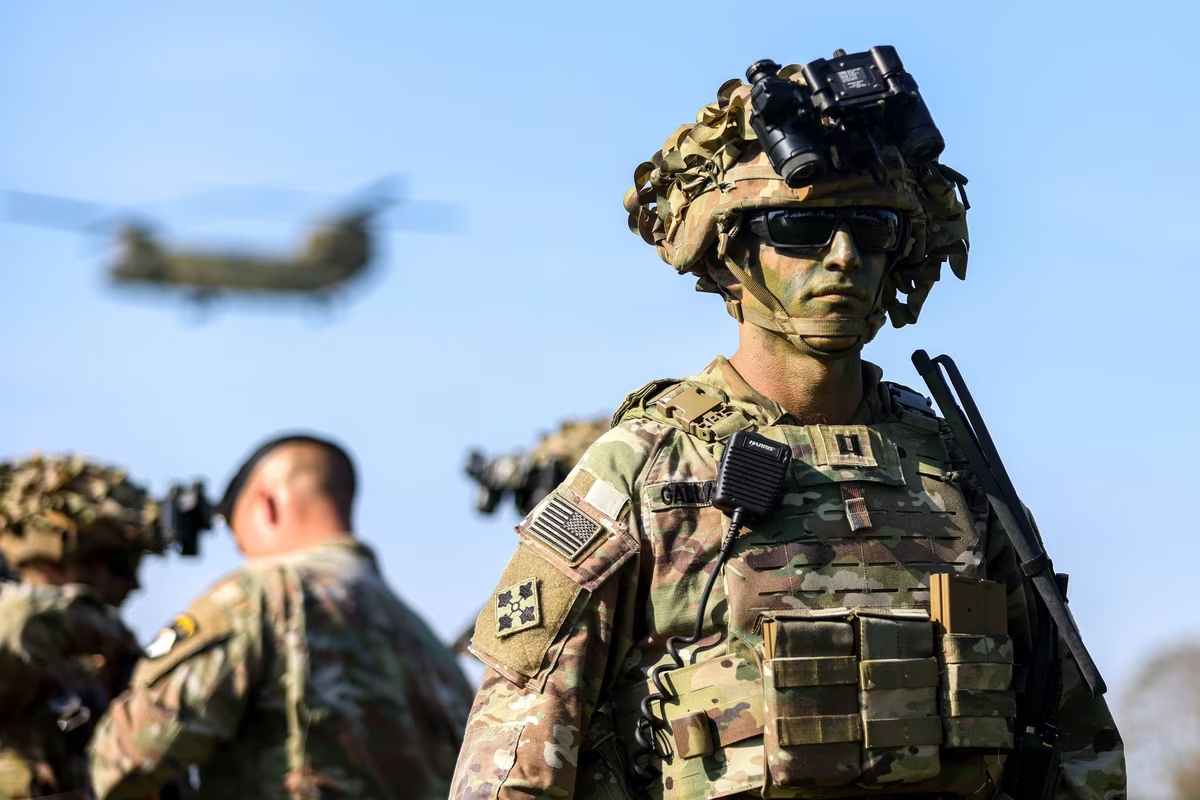
Recent American military movements in the Middle East reveal a gradual escalatory climate, reflecting serious preparation for a potential military confrontation with Iran, despite US President Donald Trump's decision to postpone a direct strike. According to a report published by the New York Times, the US Department of Defense has begun to strengthen its military presence in the region, in a clear effort to fill deterrence gaps revealed by the military assessments themselves.

According to American officials, the aircraft carrier "USS Abraham Lincoln" and a number of warships belonging to its strike group (13 naval units) are making their way from the South China Sea towards the Middle East, on a journey that will last about a week. The reinforcements also include sending squadrons of fighter jets, aerial refueling aircraft, in addition to additional air defense systems, in an unmistakable sign of raising the level of combat readiness.

Cross-referenced reports indicate that the American military establishment explicitly informed Trump that the current American deployment is insufficient to contain any potential Iranian response, especially if it targets American bases spread across more than one country in the region. The Pentagon also warned that any limited strikes would not lead to regime change in Tehran, but might draw the United States into a long-term war of attrition, with exorbitant political and military costs.

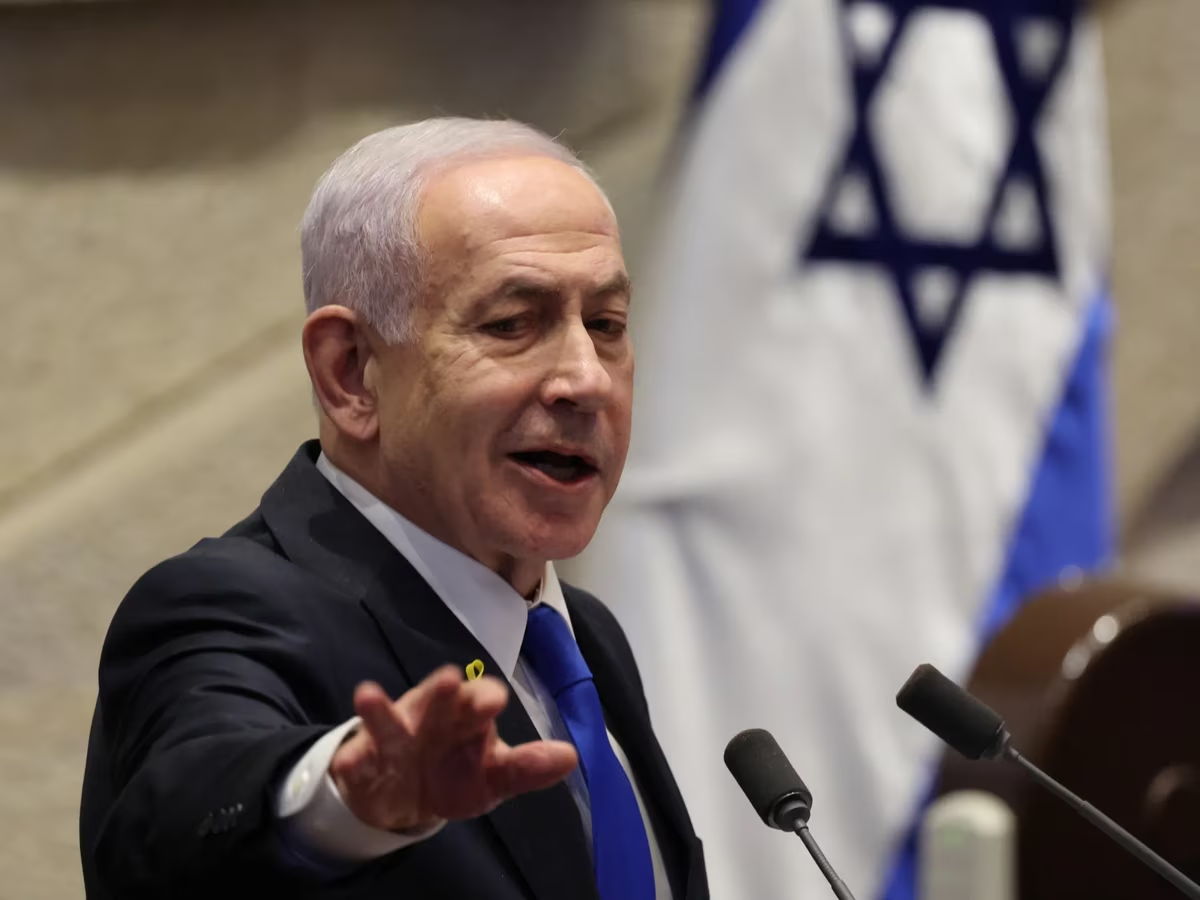
In the same context, the New York Times report (later confirmed by the Axios platform) stated that Israeli Prime Minister Benjamin Netanyahu asked Trump to postpone any attack on Iran, wishing to gain more time to prepare for a potential Iranian response. This request seems consistent with Israel's increasing reliance on the American military umbrella, especially after the failure of interception systems to prevent a number of Iranian missiles from reaching Israeli territory during the June 2025 war, which accelerated the acceptance of a ceasefire after 12 days.

On the other hand, it cannot be ruled out that these leaks and postponements are part of a strategic deception campaign aimed at keeping Tehran on edge, while actual war preparations are conducted away from the spotlight, as happened before the outbreak of the "Twelve Days" war.

The White House continues to market a moral narrative for the escalation, claiming that Trump's threats prompted Iran to postpone scheduled executions, warning of "consequences" if repression continues. However, internal unrest in Iran appears, in this context, to be merely an additional pretext added to a long record of justifications used to normalize the option of war.

It is worth noting that after the Iranian nuclear program was the central pretext for the June war, Trump expanded the circle of threats to include the conventional missile program, announcing, during his meeting with Netanyahu in Mar-a-Lago at the end of last December, his support for any Israeli attack if Tehran "continued" to develop its missiles. However, ignoring the fact that ballistic missiles represent Iran's only remaining deterrence tool reveals the narrowness of this logic, and its danger at the same time.

Recent American moves reflect a structural contradiction in strategy: a desire for deterrence without bearing the consequences of war. Strengthening military assets does not necessarily mean an immediate intention to attack, but it reveals the fragility of previous assessments that assumed the possibility of "striking Iran" without a widespread response. This logic reproduces the illusions of quick wars, ignoring the nature of the asymmetric conflict and Tehran's ability to expand the scope of confrontation regionally.

Experts believe that the most dangerous aspect of the scene is the transformation of every Iranian file—nuclear, missile, or internal—into a ready justification for war, which eliminates any real diplomatic horizon. The American-Israeli approach does not seek to change Iran's behavior as much as it seeks to strategically subjugate it, a goal that has historically proven to be achievable only through immense human and political costs, often far exceeding the calculations of decision-makers.

PALESTINE

Fri 16 Jan 2026 3:39 pm - Jerusalem Time

Head of Gaza Management Committee: 200,000 urgent housing units to be supplied to Gaza as part of an integrated development plan

In his first official appearance after his appointment, Dr. Ali Shaath, head of the "Palestinian National Committee for the Management of the Gaza Strip," announced the actual launch of the committee's work from the Egyptian capital, Cairo.

Shaath revealed that the top priority is the urgent supply of 200,000 prefabricated housing units, to replace tents, within integrated residential communities that include health, educational, and security facilities.

Shaath explained that the formation of the committee, consisting of 15 moderate professional figures, came as a result of the consensus of Palestinian factions in the recent Cairo meetings, and with direct support from the United States (based on Security Council Resolution 2803 and Trump's peace plan). This committee is considered the "civil bridge" that will take over the immediate administration of the Strip after the undermining of Hamas's field rule.

The launch of the committee coincided with the announcement by US envoy Steve Witkoff of the start of the second phase of the agreement. Shaath praised the pivotal role of President Abdel Fattah El-Sisi and the support of President Trump's administration, stressing that the committee will work on:

Reconstruction and transparent distribution of humanitarian aid.

Providing care for women and children and addressing war traumas.

Paving the way for the unity of the Palestinian political system and an independent state.

The final statement of the factions in Cairo had affirmed full support for this "transitional committee," while calling on mediators to pressure for the complete withdrawal of the occupation and to ensure the return of normal life, thereby ensuring the confrontation of annexation plans in the West Bank and the Judaization of Jerusalem.

PALESTINE

Fri 16 Jan 2026 3:38 pm - Jerusalem Time

Hamas: Dangerous escalation confirms the occupation's continued policy of sabotaging the Gaza ceasefire agreement

Deliberate commission of horrific massacres in recent hours, especially in Nuseirat and Deir al-Balah.

Hamas movement issued a strongly worded statement on Friday, accusing the Israeli occupation of deliberately committing horrific massacres in recent hours, especially in Nuseirat and Deir al-Balah.

The movement considered this escalation to be a "blatant and repeated violation" of ceasefire understandings, and bloody messages aimed at undermining any opportunity to establish stability in the Strip.

The movement linked the intense airstrikes with recent political announcements, noting that this escalation disturbingly coincides with:

President Trump's announcement of the formation of a "Peace Council."

And the beginning of practical steps to form a "technocrat government."

And the agreement entering "Phase Two."

Hamas affirmed that the occupation seeks, through these raids, to impose a new reality on the ground and obstruct international efforts aimed at ending the war completely.

The movement concluded its statement by holding the mediators (Egypt and Qatar) and the guarantor countries legally and morally responsible for pressuring the occupation government.

It stressed that the international community's silence on these violations, which led to the deaths of field commanders and civilians, will lead to the collapse of all understandings, affirming that the resistance will not stand idly by in the face of Israeli "evasion policy."

PALESTINE

Fri 16 Jan 2026 2:14 pm - Jerusalem Time

12 dead in Gaza Strip Due to Occupation Violations Within 24 Hours

Palestinian media sources reported that 12 citizens were killed in various areas of the Gaza Strip due to Israeli occupation violations and airstrikes, from Thursday morning until now.

Bombing of homes in "Deir al-Balah" and "Nuseirat"

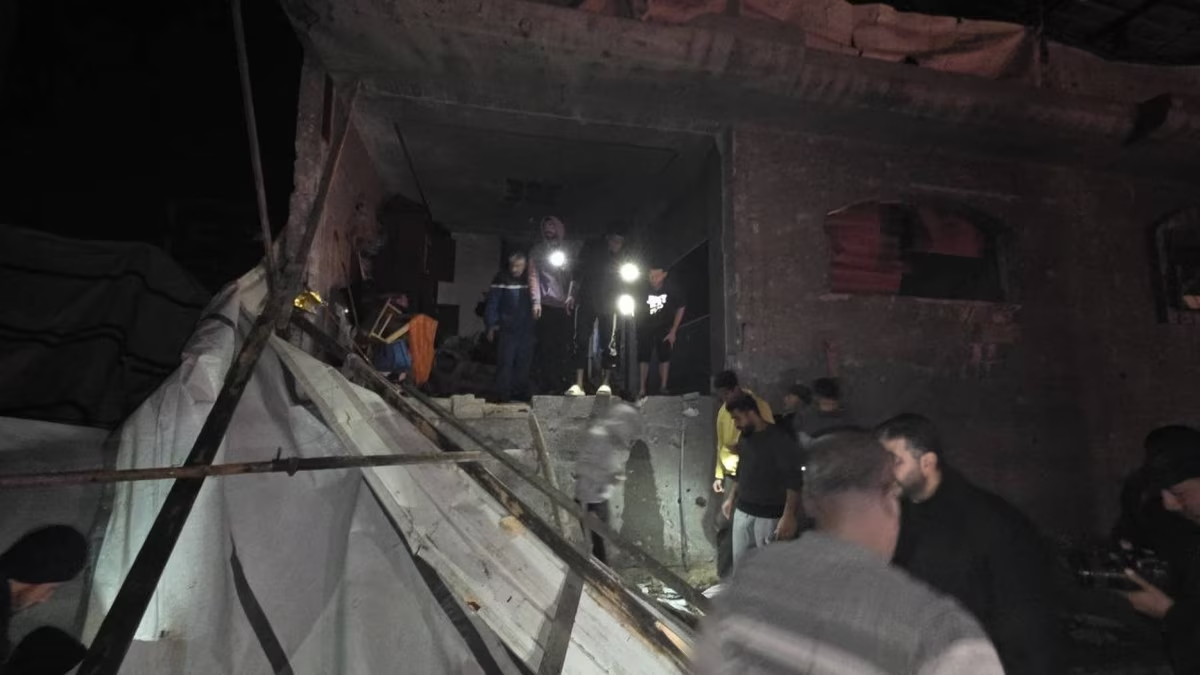
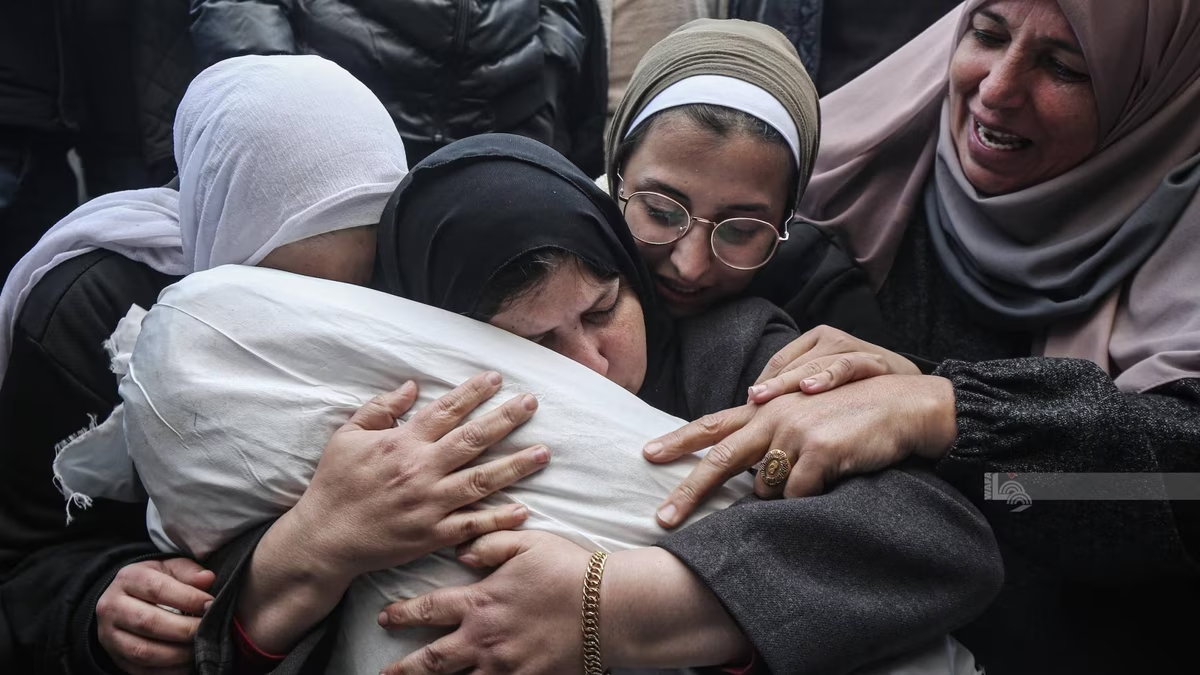
Sources added that two martyrs died in an Israeli bombing that targeted the courtyard of the Al-Jarou family's home west of Deir al-Balah city in the central Strip, while the bombing of the Al-Hawli family's home west of Deir al-Balah led to the martyrdom of 4 people and the injury of others.

In the Nuseirat refugee camp in the central Strip, 3 citizens were martyred as a result of targeting a home belonging to the Al-Khatib family.

Targeting in "Rafah" and "Gaza"

In a related context, sources said that one martyr was killed by occupation army fire near the Al-Alam roundabout west of Rafah city in the southern Strip.

It also reported that one martyr and a number of injuries occurred in the targeting of a police point near the Al-Nabulsi intersection southwest of Gaza City.

Crime in "Khan Yunis"

In the southern Strip, the elderly woman Sabah Ahmed Ali Abu Jamea (62 years old) was martyred as a result of gunfire west of Khan Yunis.

PALESTINE

Fri 16 Jan 2026 1:24 pm - Jerusalem Time

Trump announces support for Palestinian technocratic government

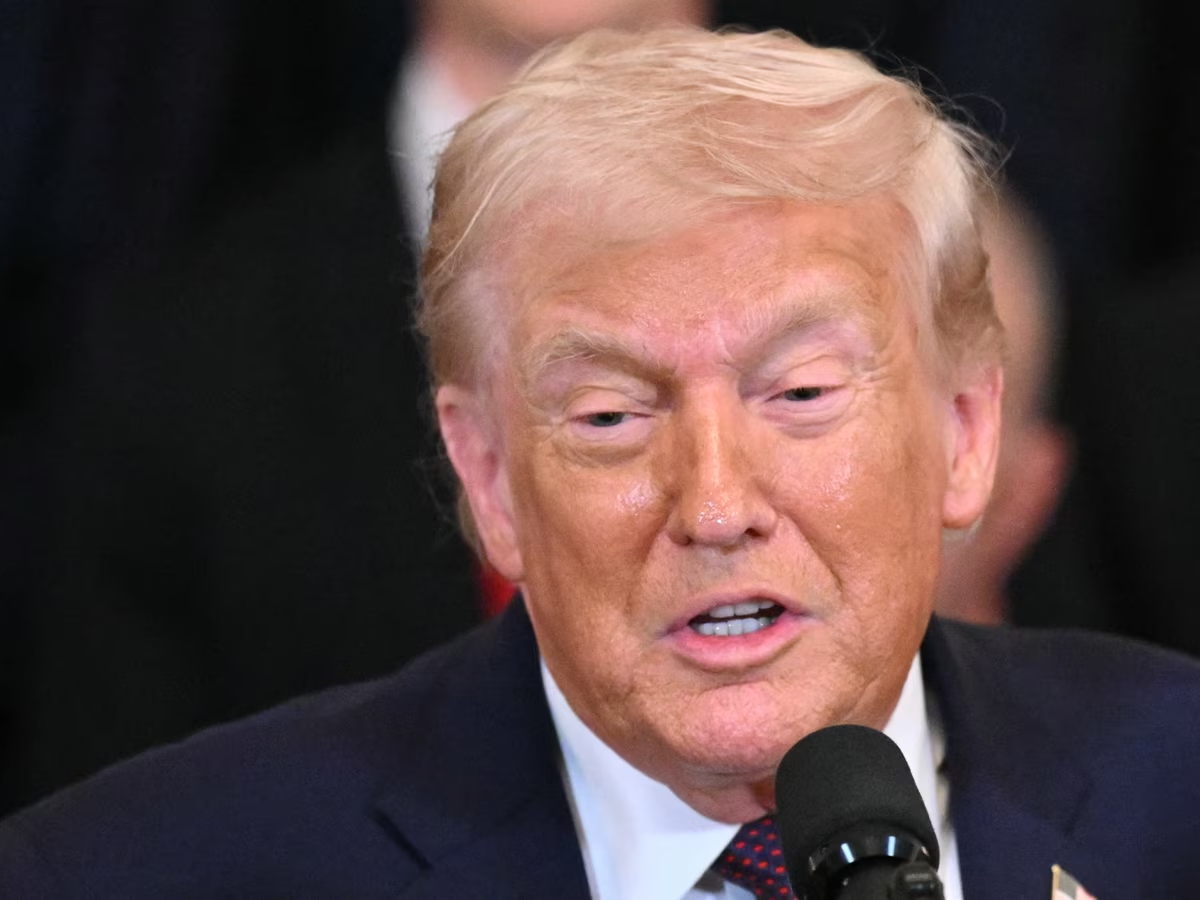
In a remarkable political development concerning the future administration of the Gaza Strip, US President Donald Trump announced on Thursday his support for what he described as the "newly formed Palestinian technocratic government," in a move reflecting an American attempt to rearrange the administrative and political landscape in the Strip during a complex transitional phase. Trump affirmed, via the Truth Social platform, that he supports the National Committee for the Administration of Gaza, as a technocratic body operating under the supervision of an international peace council personally chaired by him, aiming to "manage the affairs of the Strip away from factional polarization."

This announcement comes at a time when the National Committee for the Administration of the Gaza Strip held its first meeting in Cairo, with the participation of its fifteen members of Palestinian technocrats. The committee is headed by Ali Shaath, a former deputy minister in the Palestinian Authority, while Nikolay Mladenov, who oversees its work on behalf of the Peace Council, has joined it. This formation is seen as an attempt to combine Palestinian expertise with international oversight, thereby giving the new administration a degree of political legitimacy and external support.

The committee consists of Dr. Ali Shaath, who serves as the head of the committee and handles the energy and transport portfolios, while Dr. Bashir Al-Rayes handles the financial portfolio, Dr. Jabr Al-Daour the education portfolio, and Dr. Ayed Yaghi the health portfolio. Rami Helles is responsible for religious affairs, Dr. Ali Barhoum for water and municipalities, Adnan Abu Wardeh for justice and judiciary, Hana Tarazi for social affairs, Osama Al-Sidawi for land and housing, and Abdul Karim Ashour for agriculture, in addition to Dr. Ali Shaath temporarily overseeing the energy and transport portfolios, Omar Shamali for communications, and Ayed Abu Ramadan for economy, trade, and industry, while Husni Al-Mughni handles tribal affairs, and Major General Sami Nesman handles internal affairs.

Concurrently, Trump officially announced the formation of the Peace Council, noting that the names of the participating world leaders would be announced soon. The Council is supposed to oversee the transitional phase in Gaza and coordinate international efforts aimed at alleviating the humanitarian crisis and rebuilding administrative structures. According to diplomatic data, Mladenov is working with regional and international parties to prepare a package of urgent humanitarian measures, intended to support the committee from its inception and enhance its ability to operate in a highly complex environment.

However, this path faces significant obstacles, most notably the opposing Israeli stance. According to diplomatic estimates, Israel objects to allowing the technocratic committee to use civilian employees from either Hamas or the Palestinian Authority, which creates a real administrative vacuum. This objection also extends to the police force, as Israel rejects any role for elements linked to the Palestinian Authority, placing the committee before an operational dilemma that could undermine its ability to effectively manage the Strip.

This intransigence comes amid a highly tense relationship between Benjamin Netanyahu's government and the Palestinian Authority, where Tel Aviv treats the Authority as a hostile entity not fundamentally different from Hamas, and withholds billions of dollars of its funds under the pretext of incitement. This reality makes any role for the Authority, even if limited or technical, subject to widespread Israeli rejection.

In contrast, American officials acknowledge Israeli opposition even to low-level Palestinian Authority participation in Gaza's administration, but they believe this issue can be addressed in the coming weeks. They emphasize that the Cairo meeting was primarily preparatory, aiming to lay the general foundations for future work, rather than resolving all contentious details.

Washington believes that the available margin of optimism is linked to the possibility of achieving tangible progress in disarming Hamas, as it believes that any such progress could prompt Israel to show greater flexibility regarding the Palestinian Authority's involvement in Gaza's administration. However, American officials simultaneously acknowledge that communications related to this issue are still in their early stages, and they face complex political and security challenges that make their path long and uncertain in outcomes.

The initiative to form a technocratic government in Gaza also reflects an American attempt to produce an administrative solution that transcends the traditional Palestinian division, but it clashes with a highly complex political and security reality. Technocrats, no matter how competent, need a stable operational environment and supportive political will. In light of Israeli rejection and the absence of a comprehensive Palestinian consensus, this government appears threatened with becoming a mere formality unless international promises are translated into clear practical commitments.

On a broader international level, data indicates that the National Committee for the Administration of Gaza may have a wider margin for action after the official announcement of the Peace Council. The United States seeks to reveal its composition next week on the sidelines of the World Economic Forum in Davos. Names of major and regional countries are being put forward to join the Council, with an American tendency to fill some seats with leading figures from international financial institutions, in an attempt to give the Council political and economic weight.

Despite talk of a positive response from a number of invited countries, American efforts to expand the Council's membership have not yet achieved the desired success. Nevertheless, American officials confirm that Trump personally participated in selecting the members, and that the invitation process received an encouraging response, reflecting an American determination to move forward on this path.

The success of any new administration in Gaza remains contingent on its ability to gain the trust of the population before achieving international recognition. Gaza suffers from a long legacy of crises, and changing administrative structures is not enough without addressing the root causes of economic and security problems. If the technocratic committee is not given real powers and sufficient resources, it may turn into another fleeting experiment, added to a series of initiatives that have not touched the essence of the Strip's suffering.

PALESTINE

Fri 16 Jan 2026 1:05 pm - Jerusalem Time

Britain calls for increased international support to maintain Gaza ceasefire

British Foreign Secretary Yvette Cooper called for increased international momentum to maintain the ceasefire in the Gaza Strip and to address the deteriorating humanitarian situation suffered by the population.

Cooper stressed the necessity of implementing transitional measures led by Palestinians, while respecting the sovereignty and the right of the Palestinian people to self-determination.

In the same context, the US envoy to the Middle East, Steve Witkoff, announced on Wednesday the launch of the second phase of the US President's 20-point plan to end the aggression on Gaza, which includes the transition from ceasefire to disarmament, the formation of a transitional Palestinian administration, and reconstruction.

Witkoff explained that the new phase is based on establishing a national committee to manage Gaza that will run the affairs of the Strip, with the implementation of a full disarmament process, and the launch of comprehensive reconstruction projects.

For his part, Egyptian Foreign Minister Badr Abdel Aty announced an agreement on the names of 15 members of the "technocrat committee" that will manage Gaza, pointing to the support of Palestinian factions for this step, and providing the appropriate atmosphere for the committee to assume its duties immediately.

The occupation and the "Hamas" movement had agreed last October to Trump's 20-point plan, which stipulates the administration of Gaza for a transitional period under the supervision of an international "peace council".

It is worth noting that the events since October 7, 2023, have resulted in the killing and injury of about 243,000 Palestinians, most of them women and children, in addition to missing persons, displaced persons, and widespread destruction in the Strip.

ARAB AND WORLD

Fri 16 Jan 2026 11:58 am - Jerusalem Time

The Implications of Israel's Recognition of Somaliland on the Horn of Africa

If there is one positive aspect to Israel's decision to recognize the breakaway region of Somaliland as an independent state, it is the clear exposure of its plans in the region as never before. Perhaps the tweet by Israeli journalist Eddie Cohen on the "X" platform summarized the essence of the Israeli project at this moment in history, as he says: "Whoever thinks that a few firecrackers that fell in Mukalla port before New Year's Eve will end the project of restoring the state of the South, is a fool. The state of the South, the state of Al-Fasher, and the state of Al-Jufra and Sirte will rise, even if noses are rubbed in the dirt. Be sure of this fact." A correct understanding of Israel's decision regarding Somaliland stems from comprehending the nature of its expansionist Zionist project in the region, which believes that Israel's borders are between the Nile and the Euphrates. It also confirms that the Hebrew state is proceeding with the implementation of one of its most dangerous documents, the Kivunim document, which records its vision for dividing and fragmenting the countries of the region. Therefore, the step of recognizing Somaliland must be read within this broad framework that targets Arab countries collectively and individually. It must also be read from the perspective of the seriousness of its repercussions on the security of the Horn of Africa and the Red Sea, and on the countries located in this vital area of the world. This recognition will establish a dangerous precedent in this region, which is plagued by ethnic conflicts and states fragile in their social structure and national cohesion. It will open the door for rebel groups, especially in Sudan, Libya, Yemen, and even Ethiopia and Kenya, to declare their independence, and then find those who recognize them without regard for international laws and respect for the institutions regulating members of the international family.

Somaliland occupies a strategic location in the Red Sea on the Gulf of Aden, with a coastline of 460 miles. It is also located at the entrance to the Bab al-Mandab Strait, which controls 12% of international trade, amounting to $790 billion, and 40% of trade between Asia and Europe, including Gulf oil. The port of Berbera, located in its capital Hargeisa, represents an important economic lung in the region, as it is the largest port on the Gulf of Aden. This strategic importance is what led Britain to occupy this region from 1887 to 1960, when the Republic of Somaliland gained independence, later uniting with Somalia, which was under Italian occupation. However, mismanagement and the authoritarianism of President Siad Barre's regime at the time created a kind of despair towards voluntary unity, which ended with the region unilaterally declaring its independence when the central state collapsed in 1991. Since then, the separatist region of Somaliland has been seeking international recognition to make it an independent state from federal Somalia.

On the other hand, Somaliland has active communities abroad, especially in the United States, which have worked diligently to gain recognition. It was noteworthy that the recognition of the so-called (Republic of Somaliland) was included in the 2025 project prepared by an elite group of conservative Republicans close to President Trump during his election campaign, under the supervision of the Heritage Foundation. Although he disavowed that project at the time, experience currently proves that much of what was included in it is part of President Trump's movements and interests. Academic Karen K. called for the importance of recognizing Somaliland's independence, "because combating (malign) Chinese activity on the continent should include developing strong public diplomatic efforts. And recognizing separatist Somaliland is a hedge against the deterioration of the United States' position in Djibouti." This vision later developed into a draft resolution submitted to Congress by Representative Scott Perry, calling for the recognition of Somaliland, according to the following justifications: the region's stability for three decades, its strategic and security importance, and its commitment to democracy. These justifications presented by the American Congressman are the same ones presented by the Israeli elite as reasons for Israel's recognition of this region. Israeli journalist Nadan Feldman wrote an article in "Haaretz" comparing Israel and Somaliland, stating: "Both are small, weak democracies located in regions teeming with authoritarian regimes and deadly wars. Both also suffer from sovereignty problems in the face of the international community, and both have enemies seeking to destroy them." In January of last year, the former president of Somaliland participated in an academic event at the Heritage Foundation in Washington, after which Republican Representative Jim Risch introduced a project to recognize the region's independence from Somalia, which this time was passed by the Foreign Relations Committee with bipartisan support. So far, it cannot be definitively stated whether the Trump administration will recognize the region or not, given the complexity surrounding the issue, as its recognition will directly affect strong allies of the United States, foremost among them Saudi Arabia and the Arab Republic of Egypt, while Israel works through its influential mechanisms to push the administration to make that decision.

Israel's intentions and motives for taking this decision can be understood from the painful realities that the October 7 war experience revealed for Israel. Houthi missiles posed a significant security concern for the Hebrew state. Although communication between Israel and Somaliland is not a new event, Israel sees the current moment as a great opportunity to take a step forward in its grand project in the region. On the one hand, it is confident that the division within the Arab body has reached a stage that enables it to make the most difficult decisions without fearing reactions. On the other hand, it enjoys unprecedented support from the current American administration. In light of Netanyahu's government's diligent efforts to change the equation in the region by changing the regime in Iran, encircling the Saudi borders with security risks, and sending a message to rebels in Sudan and Libya, it has taken this step driven by security concerns and expansionist dreams. It is clear that Israel will seek to develop an intelligence infrastructure that enables it to monitor and even control the waterways in the region, especially if the military base that Ma'ariv newspaper previously spoke about is completed, which it said would be built with the support of "regional parties." This step certainly posed a direct threat to many countries, foremost among them Saudi Arabia, Turkey, Somalia, Eritrea, Egypt, and China, in addition to Sudan. Only Ethiopia – in this region – can engage in the new arrangements that Israel wants and in which regional parties cooperate. But what Ethiopia overlooks, driven by its urgent desire to access sea outlets, is that, like Sudan, Kenya, and other countries, it suffers from internal divisions, and this step could encourage internal parties within it to demand secession or self-determination. There is the Ogaden region, which historically belongs to the Somali nationality, and its relationship with the Ethiopian state has been in constant turmoil, in addition to the Tigray region, which is simmering after the central government suppressed its uprising by armed force. For Saudi Arabia and the Arab Republic of Egypt, the strategic threat remains related to the security of international corridors and securing their strategic surroundings. The entry of Ethiopia as an influential player will increase the existing tension between it and Egypt regarding the Nile water issue. There are Iran and its Houthi ally, who know with certainty that this step is directly aimed against them. As for China and Turkey, they view the step as a direct threat to their long-term investment in this vital region, as both countries maintain military bases and strong relations in Somalia.

Israel has taken a big step by making this decision, and no matter how confident it is in the reactions, it has, unexpectedly, created a favorable atmosphere for strong alliances that could crystallize in the near future to confront this threat. Even before this step, regional understandings emerged, involving Turkey, Saudi Arabia, and Egypt, on important issues such as Gaza, Sudan, and Yemen. If this alliance is formed and expanded, the equation is expected to change in more than one country, such as Sudan, Yemen, and Libya, especially since more than twenty Arab and Islamic countries have issued a statement rejecting the Israeli step. Therefore, strengthening this alliance will weaken the outcomes of Israel's recognition of Somaliland and empty it of its content, and at the same time could delay any American consideration of taking a similar step. In the face of this crisis, influential Arab countries are called upon to make a great effort to build bridges with the mother country Somalia and assist it. Turkey has a successful experience when it managed to defuse the crisis between Somalia and Ethiopia following Ethiopia's signing of an agreement with Somaliland to use sea ports, a step that has been long overdue from Arab countries, which have been too preoccupied with other matters to focus on Somalia and its people.

ANALYSIS

Fri 16 Jan 2026 11:58 am - Jerusalem Time

Trump's Poisoned Offer to Iranians

On Saturday, January 10, less than two weeks after the outbreak of the protests now sweeping Iran, US President Donald Trump resorted to his favorite social media platform to post a message of support, saying: "Iran is looking for freedom, perhaps as never before. The United States is ready to help!!! President Donald J. Trump." As usual, Trump's use of capital letters and excessive exclamation marks seems more like the style of a teenager than the leader of a global superpower. However, the promise of American "help" raises much deeper and more serious problems.

First and foremost, "help" is not a US specialty, especially under the leadership of a man who bombed Iran last summer, shortly after returning to power on a pledge to keep the United States out of foreign wars. Additionally, Trump is responsible for maintaining a suffocating sanctions regime imposed on the Islamic Republic, which contributed to the high inflation rates that ignited the current protests in the first place. As always in such forms of economic warfare, it is the non-elite segments of Iran that have paid the highest price.

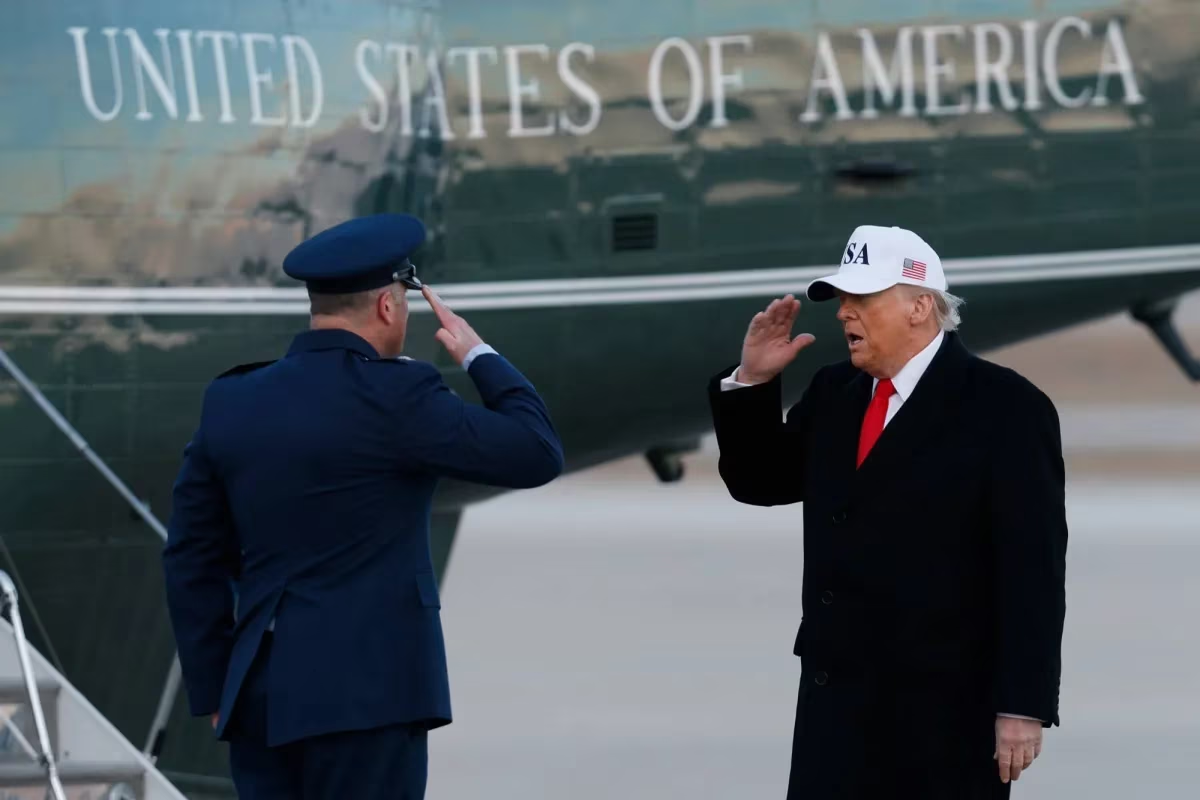
Beyond Trump's latest offer of "help" to Iranians being a departure from the entire "America First" premise, it also represents a shift in presidential rhetoric towards this country that has long been demonized. Previously, Trump's rhetoric primarily focused on Iran's alleged pursuit of nuclear weapons and ballistic missiles equipped with chemical and biological warheads, all of which was marketed as a serious threat not only to the United States but also to America's closest friends and most prominent regional partners in the ongoing genocide, namely the state of Israel. But Trump now appears in a "rescue" posture, having warned this month: "If Iran shoots (as it was reported) and violently kills peaceful protesters, as is its custom, the United States of America will come to their rescue." On Tuesday, Trump assured Iranian protesters that "help is on the way," without clarifying the nature of this help.

Right-wing American media quickly echoed the rhetoric with encouraging headlines such as: "Trump has a historic opportunity to help overthrow the anti-American Iranian regime." For his part, Israeli Prime Minister Benjamin Netanyahu joined this discourse, asserting that Israel supports "the struggle of Iranian protesters for freedom, and strongly condemns the mass killings of innocent civilians" - a striking statement from a person who has overseen the extermination of Palestinians for more than two years.

With Trump's recent promises of "help," it's hard not to wonder if he's borrowing a page from the old policy playbook of former US President George W. Bush, the architect of the "War on Terror," and the face of an administration dedicated to spreading the neoliberal (neoconservative) ideology that Trump has long claimed to vehemently oppose. At its core, neoconservatism aims to create military chaos around the world, using the promotion of democracy and seemingly humanitarian ideas as a pretext for bloody imperial expansion. Although Trump succeeded in winning over many American voters by his alleged pledge to abandon such foreign adventures, and instead focus on self-isolation and "making America great again," the neoconservative tendency, it seems, is hard to shake off.

Certainly, Trump's presidency evokes George W. Bush's presidency in more ways than one. Both men are characterized by comical behavior, not to mention a striking relationship with English grammar and spelling, which would have been entirely amusing were it not for the widespread bloodshed each oversaw during their tenure. Similarly, both showed excessive enthusiasm for relying on God in their destructive endeavors. Despite Trump's declared opposition to regime change policy, and to the Bush-era interventions in Iraq and Afghanistan - as part of what was known as the "War on Terror" which ended with the deaths of millions of people - in his first year after returning to power, he managed to bomb a group of countries, in addition to arresting Venezuelan President Nicolas Maduro.

As for Florida Congressman Randy Fine, who recently introduced a bill allowing Trump to annex Greenland, he resorted to the "X" platform to suggest: "Perhaps we should Maduro Khamenei." In this context, "Khamenei" refers to Iranian Supreme Leader Ali Khamenei, while the word "Maduro" is used here as a new verb meaning to kidnap the leader of a sovereign state.

But while Trump today promises that the United States is "ready to help!!!" Iran, it is worth pausing at previous instances of American "help!!!" in this country - such as what happened in 1953, when the US Central Intelligence Agency (CIA) orchestrated a coup that overthrew democratically elected Prime Minister Mohammad Mosaddegh, a coup that paved the way for decades of rule by the Shah of Iran, known for his widespread torture practices, before he was overthrown by the Iranian Revolution in 1979. Ironically, the son of the late Shah is active today, from his position in luxurious exile outside Washington D.C., calling for American intervention in Iran.

At the same time, Trump may have realized the benefits of "helping" the peoples of other countries as a means of diverting attention from undemocratic realities within the United States itself, including its transformation into a full-fledged police state, where immigration enforcement agents feel free to kill American citizens with impunity. And with Trump continuing to almost directly evoke Bush, the last thing Iranians need today, most likely, is for "the United States to come to their rescue."

ISRAELI AFFAIRS

Fri 16 Jan 2026 11:31 am - Jerusalem Time

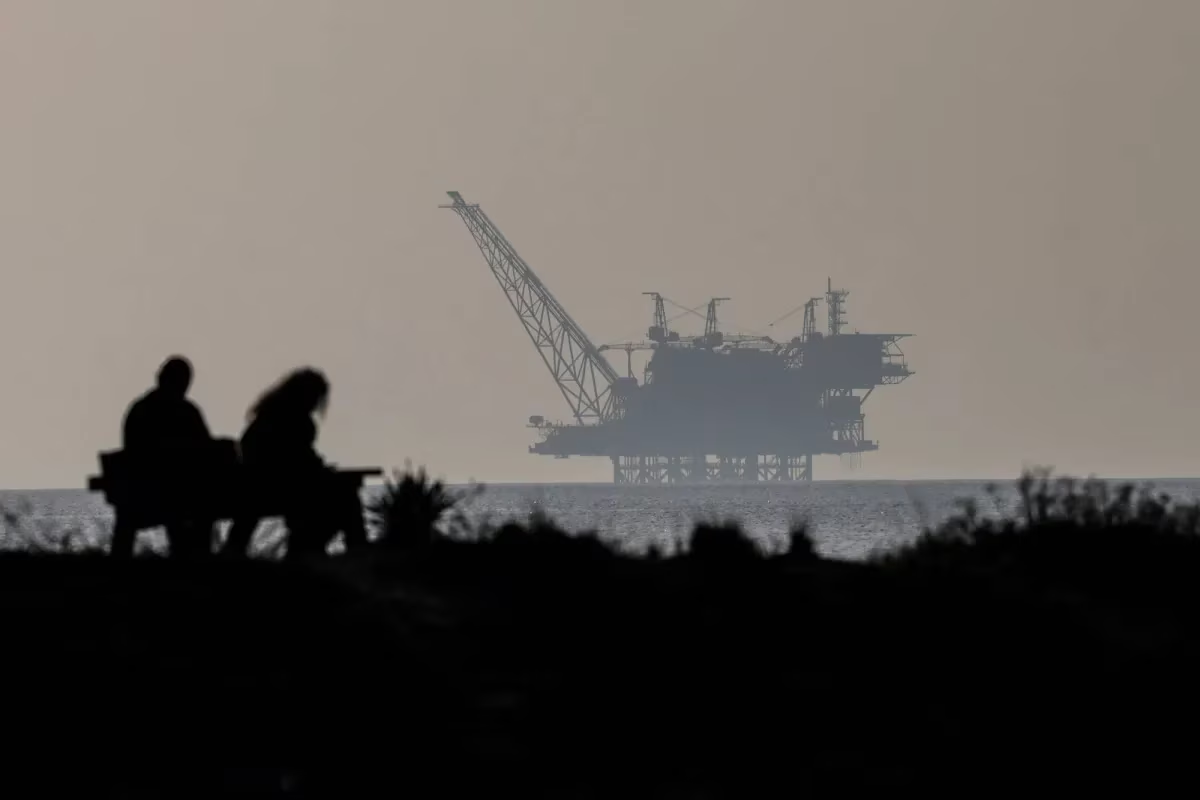
Chevron gives green light to expansion of giant Israeli Leviathan field

Chevron, through its arm "Chevron Mediterranean Limited", has made the final investment decision to develop and expand the production capacity of the giant Leviathan natural gas field off the coast of Israel. The Leviathan field's reserves are approximately 600 billion cubic meters. The expansion, costing approximately $2.4 billion, will allow for production and supply within Israel and its neighboring countries until 2064.

Clay Neff, President of Chevron's Exploration and Production sector, said in a statement: "Chevron is a key player in the Eastern Mediterranean energy sector, with our focus on natural gas production and export. Our operations are vital to meeting the growing energy needs in local and regional markets."

Neff added: "Our decision to invest in expanding the production capacity of the Leviathan field reflects our confidence in the future of energy in the region. Pragmatic energy policies in the United States and the region contribute to enhancing energy security in the Eastern Mediterranean, and create a stimulating environment for investment in the Middle East and the world."

The Leviathan expansion project is expected to begin operations by the end of the current decade. The project includes drilling three additional offshore wells, adding new subsea infrastructure, and developing processing facilities on the Leviathan production platform. These steps aim to increase the total amount of gas supplied to Israel and the region to approximately 21 billion cubic meters annually.

For his part, Jack Baker, General Manager for the Eastern Mediterranean region at Chevron, affirmed that "this step embodies our continuous commitment to partnering with the State of Israel to develop natural gas resources, and provide essential energy to millions of people in Israel, Egypt, and Jordan."

The Leviathan platform is located approximately 10 kilometers off the coast of the "Dor" region. The work shares in the field are distributed as follows: "Chevron Mediterranean Limited" (operator) 39.66 percent, "NewMed Energy" 45.34 percent, and "Ratio Energy" 15 percent. In addition to Leviathan, Chevron's assets in the Eastern Mediterranean include the producing Tamar gas field, and the Aphrodite field under development off the coast of Cyprus. The company also operates two exploration blocks in Egypt, in addition to its contribution to a non-operated joint venture in another exploration block in the Egyptian Mediterranean.

ARAB AND WORLD

Fri 16 Jan 2026 11:31 am - Jerusalem Time

Harvard and its peers are declining globally against Chinese universities

Harvard University in the United States has fallen to third place in a global list measuring the volume of academic output, and other American universities have also seen a significant decline in that ranking compared to Chinese universities, which have made remarkable progress in the field of research output.

Until recently, Harvard was the most productive research university in the world, according to a global ranking based on academic publications, but it has declined, similar to other American universities, while Chinese universities have risen in rankings that focus on the volume and quality of research they produce.

Commenting on this, the New York Times said it is the latest evidence of the decline that American academic institutions have been experiencing for several years, and it appears that the administration of President Donald Trump may accelerate it due to its decision to cut research funding provided to American universities that rely heavily on the federal government to fund their scientific projects.

In the early 2000s, 7 American universities were among the top 10 universities, led by Harvard University, in the global university ranking based on scientific output, such as articles published in scientific journals.

At that time, there was only one Chinese university (Zhejiang University) among the top 25 universities, but that university is now at the top of the ranking issued by the Centre for Science and Technology Studies at Leiden University in the Netherlands, and the current list also includes 7 other Chinese universities among the top 10 universities.

The New York Times report clarified that Harvard University currently produces significantly more research than it did 20 years ago, yet it has fallen to third place, but it still holds the first place in Leiden's rankings for the most cited scientific publications.

According to the aforementioned report, the problem of leading American universities is not a decline in research output, but rather a much greater increase in the research output of Chinese universities. Leiden University statistics indicate that 6 prominent American universities, including the Universities of Michigan, California, Johns Hopkins, and Stanford, now produce more research than they did two decades ago, but it remains less than what their Chinese counterparts produce.

Although global university rankings do not receive much attention in the United States, some prominent American academics note the increasing growth in Chinese research output reflected in these rankings, and warn that the United States is falling behind.

The former president of the Massachusetts Institute of Technology, Rafael Reif, admitted in a press statement last year that "the number and quality of research papers from China are truly remarkable and far superior to what we do in the United States."

Academic circles in other countries monitor global rankings and consider them a measure of academic efficiency and the ability to compete with the United States. Zhejiang University prominently displays its rankings on its website, and Chinese state media have celebrated the rise of the country's universities in global rankings.

Leiden Centre began preparing an alternative ranking based on a different academic database called "OpenAlex." Harvard University ranks first in this ranking, but China's progress continues, as among the 13 universities in the alternative list, 12 are Chinese universities.

On the other hand, Harvard University tops the global university ranking in terms of academic performance, which is prepared by the Informatics Institute of the Middle East Technical University in the Turkish capital, Ankara.

In another ranking, the Nature Index, Harvard University ranks first, followed by 10 Chinese universities.

Harvard University and other leading American universities are currently facing a new set of challenges against the backdrop of the Trump administration's decision to cut scientific research grants, as well as travel bans and an anti-immigration campaign that has affected international students and researchers.

As a result, the number of international students arriving in America in August 2025 decreased by 19% compared to the previous year, which negatively affects the status and rankings of American universities, as outstanding students are forced to study and work elsewhere.

In contrast, China is investing billions of dollars in universities and striving to make them attractive to foreign researchers. A few months ago, China began offering a special visa for graduates of prestigious universities in science and technology fields to travel to China for study or business.

Chinese President Xi Jinping defended his country's decision to increase spending on universities by emphasizing that the strength of any country on the global stage depends on its scientific superiority.

In contrast, the Trump administration took the opposite approach, seeking to cut billions of dollars from scientific research grants allocated to American universities. University leaders in the United States warned throughout 2025 that cuts in federal research grants could have devastating effects, and the American Association of University Professors and several legal entities filed a lawsuit to challenge some of these cuts.

A federal judge issued an order for the federal government to resume funding Harvard University, after the Trump administration cut billions of dollars in research funds in the spring, but the administration appears insistent that it will reduce future grants allocated to the university.

ARAB AND WORLD

Fri 16 Jan 2026 11:30 am - Jerusalem Time

Trump opens door to diplomacy with Tehran… and keeps military option open

The United States brought the international debates over the bloody popular protests in Iran to the Security Council chamber, opening the door - even if temporarily - to the intensive diplomatic efforts currently being made by many countries, but while continuing the American military buildup, which provides multiple options for President Donald Trump after he hinted in recent days at striking and imposing additional sanctions against the Iranian regime.

Based on an urgent American request submitted on Wednesday night, the Security Council decided to hold an emergency meeting on Iran on Thursday afternoon. This came after President Trump made a series of vague statements regarding the nature of the measures the United States could take against Iran after he promised the protesters there that “help is on the way” to them, and that his administration “will act” to respond to the bloody crackdown launched by the Iranian authorities, which has led to the death of at least 2615 people in the past few weeks, according to initial estimates by human rights organizations.

Referring to reports of preparations for the execution of a citizen named Irfan Sultani (26 years old), Trump confirmed that one of the Iranian protesters was no longer sentenced to death, saying: “That’s good news. We hope the situation continues this way!” In response to a question about the source of his information, Trump said: “Very important sources on the other side.” While he did not rule out the possibility of military action by the United States, he added: “We will monitor developments,” before indicating that his administration had received a “very good report” from Iran.

A newspaper reported that “Trump’s statements can be interpreted as a retreat from any imminent plans for an attack.” However, it mentioned that prior to the American raids on Iranian nuclear sites last June, Trump issued a statement saying that he would make a decision “within the next two weeks,” knowing that he had actually made up his mind to carry out the attack.

A senior American official quoted that Trump did not rule out the military options presented by his leaders in recent days, adding that whether or not to issue any military orders depends on what the Iranian security services will do later. The highest alert for long-range bombers was announced in the United States in preparation for launching strikes when needed, but “this measure seems to have been temporarily halted as of Wednesday afternoon,” according to another American official.

However, influential Republican Senator Lindsey Graham criticized some headlines in major newspapers that spoke of President Trump backing down from his hardline stance on Iran, describing them as “inaccurate.” He said: “Quite the opposite… Just wait.” He wrote in a post on “X”: “All headlines of this type are examples of absolutely inaccurate news reports. The circumstances surrounding the necessary and decisive actions that must be taken against the evil Iranian regime have nothing to do with President Trump’s will or determination. Nothing could be further from the truth.” Referring to the headline: “Trump backs down on Iran,” Graham wrote: “All headlines written in this style are examples of highly inaccurate reports.”

The US Navy currently has three missile-equipped destroyers in the Middle East, including the aircraft carrier “USS Theodore Roosevelt,” which entered the Red Sea in recent days. The Navy also has at least one missile-equipped submarine in the region, according to officials at the US Department of Defense, which has provided President Trump with a wide range of options, including potential targets within the Iranian nuclear program and ballistic missile sites.

US officials attributed the small number of US warships in the Middle East to the recent widespread deployment in the Caribbean. It was reported that “other options, such as a cyber attack or a strike targeting the Iranian internal security apparatus, which uses lethal force against protesters, seem more likely.” The newspaper published another analytical article that the United States’ allies in the region “do not support any American military action there” for fear that “the repercussions of escalating US-Iranian tensions, or the possibility of state collapse in Iran, would harm their security.” It added that “the reason is also that some Gulf governments have come to view Israel (…) as a hostile state seeking to dominate the Middle East. It is believed that Israel may pose a greater threat to regional stability than Iran.”

Meanwhile, the Group of Seven (G7) major industrialized nations condemned the “brutal repression” practiced by the Iranian authorities against their citizens, affirming their readiness to impose additional sanctions on Iran. Indeed, the United States on Thursday imposed new sanctions that included five Iranian officials accused of being behind the suppression of protests, warning that it was tracking financial transfers by Iranian leaders to banks around the world.

The US Treasury Department said in a statement that it had imposed sanctions on Ali Larijani, Secretary of the Supreme National Security Council, as well as leaders in the “Revolutionary Guard” and law enforcement forces, accusing them of orchestrating the crackdown. Treasury Secretary Scott Pisent said Washington’s message to Iranian leaders was clear: “The US Treasury Department knows that you, like rats on a sinking ship, are frantically transferring stolen money from Iranian families to banks and financial institutions around the world. Rest assured that we will track it and we will track you.” He affirmed that the United States “stands firmly with the Iranian people in their demand for freedom and justice.”

PALESTINE

Fri 16 Jan 2026 11:30 am - Jerusalem Time

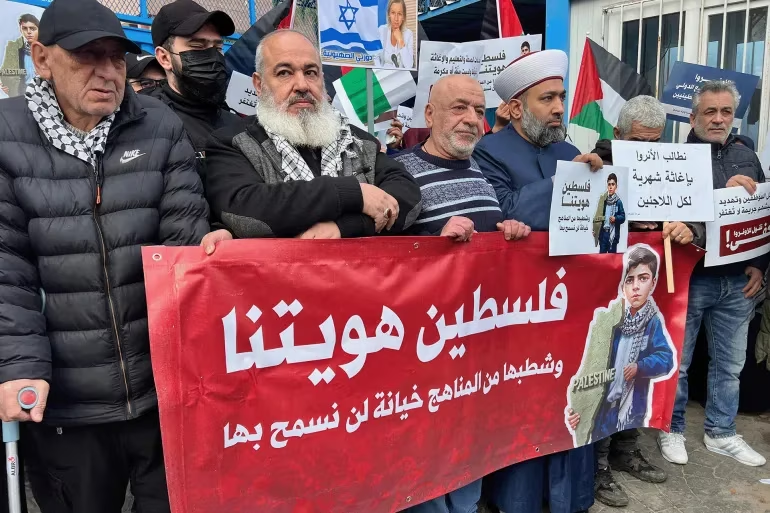
Reasons for UNRWA in Lebanon to remove the name Palestine from its curricula

A modification in the geography textbook used in schools of the United Nations Relief and Works Agency for Palestine Refugees (UNRWA) sparked a wide wave of anger in Palestinian camps in Lebanon after the historical name Palestine was changed to "West Bank" and "Gaza Strip" on a map included in an "enrichment material" book designated for sixth-grade students for the academic year 2025-2026. The map quickly became the spark for popular protests yesterday, Wednesday, encompassing most Palestinian camps, where UNRWA schools witnessed a state of unrest, and students refrained from attending their classes, while angry parents and students tore up and burned the book, considering what happened an attempt to erase the Palestinian cause and a direct infringement on the right of return. Students and parents from 61 schools managed by UNRWA in various Lebanese regions participated in these movements, from Tripoli in the north, where the Nahr al-Bared and Beddawi camps are located, to Sidon in the south, where the Ain al-Hilweh camp is located. These schools include about 35,000 Palestinian students and constitute the primary pillar of official education for refugee children in the country.

The new version of the geography textbook also caused confusion within the agency's schools themselves, which are managed by Palestinian educational and administrative "cadres" who found themselves in direct confrontation with parents and students. Teachers confirmed that the book, classified as "enrichment," includes a clear change in the map, where the name Palestine was replaced by two arrows pointing to the West Bank and the Gaza Strip overlooking the Mediterranean Sea. In response to inquiries from sources, UNRWA in Beirut stated that it adopts the curricula of host countries and uses the official textbooks approved therein, and clarified that in Lebanon, it teaches the Lebanese national curriculum, including the geography textbook for the sixth grade, "Lights on the Geography of Lebanon and the Arab World," affirming that it had not made any modifications to the official textbooks. It mentioned that the "enrichment" geography textbook is an additional educational tool it produced to support the basic textbook, aiming to enhance critical thinking skills, map reading, and analysis among students, and indicated that some information was left open to encourage discussion and exploration within the classroom, affirming its deep respect for the national and historical identity of Palestinian refugees and its commitment to protecting their dignity and rights.

However, protesters view what happened as exceeding the educational framework and express accumulated concern about changes affecting the Palestinian national identity within educational curricula. Opponents directed direct accusations at UNRWA management of "conforming to Israeli and American policies," considering that deleting the name Palestine from the map is not a technical detail but a fundamental infringement on the national narrative and rights. For his part, the director of the "Thabet for the Right of Return" organization, Sami Hammoud, said that these protests are part of a series of movements carried out by Palestinians in the camps, through popular movements, activists, and institutions, to send a clear message to the Director-General of UNRWA that its policies "destroy what remains of our people's steadfastness, and undermine the essence of the agency's role." He added to sources that "previous administrations, despite all the cutbacks, did not take similar steps, while the current administration persists in policies that strike the last pillars of steadfastness, the latest of which was the attempt to erase the name Palestine from educational curricula, which practically means obliterating Palestinian consciousness and erasing national memory among generations." For his part, Muhammad Dib, a member of the Committee for the Defense of Refugee Rights, believed that UNRWA had gone beyond the issue of service cutbacks, and the targeting now affects the core of its role and the essence of the national cause and Palestinian identity, affirming to sources that the refugees' protests and sit-ins are an expression of their adherence to their identity and their cause for which they have struggled for long decades, and that the name Palestine cannot be erased or reduced in any educational curriculum.

In turn, sources – a spokesperson for the parents – stated that the movements are not limited to rejecting the policy of cutbacks in education, health, and social affairs, but go beyond that to what she describes as a direct infringement on the Palestinian national identity, and sees in her conversation with sources that targeting national symbols and attempting to erase the name Palestine from curricula constitutes a transgression of all red lines and a direct threat to the consciousness of Palestinian generations. From the Burj al-Shamali camp in southern Lebanon, Rosaline Mansour tells sources that the protests aim to pressure UNRWA management to retract the deletion of the name Palestine from the geography textbook, adding that this step goes beyond the educational framework to affect national identity and the right of return. She clarified that the demands are not limited to curricula but also include improving students' conditions and addressing the legal and educational problems faced by refugees. In turn, Amna Ibrahim questioned the basis that allows the deletion of the name of an entire homeland from students' memory, affirming that the name Palestine must remain present in curricula without deletion or dilution. She stressed to sources that infringing upon it is not a symbolic matter but a matter of existence and dignity, adding that the protesters' demands also include settling the residency status of Palestinian refugees coming from Syria – especially students – and reinstating the aid they were deprived of this year. Participants in the movements affirmed that Palestine will remain present in memory and conscience, no matter how many attempts there are to obliterate or redefine it.

PALESTINE

Fri 16 Jan 2026 11:29 am - Jerusalem Time

Trump: Gaza Peace Council 'Formed'

US President Donald Trump announced on Thursday the formation of a "Peace Council" for Gaza, as declared in the American plan to end the war in the Palestinian Strip, indicating that with the support of Egypt, Turkey, and Qatar, a comprehensive disarmament agreement with Hamas will be reached.

Trump added: "As chairman of the Peace Council, I support the newly appointed Palestinian technocratic government and the National Committee for Gaza Administration, with the support of the Council's High Representative, to manage Gaza during a transitional phase."

Trump said on his "Truth Social" platform, "It is a great honor for me to announce that the Peace Council has been formed," noting that he would reveal the list of council members "soon."

He added: "I can confirm that it is the greatest and most prestigious council ever formed, anywhere, at any time."

The formation of the council comes shortly after the announcement of a 15-member Palestinian technocratic committee to manage the Gaza Strip after the war.

The committee will operate under the supervision of the Peace Council, which Trump is expected to chair. The plan also stipulates the deployment of an international stabilization force in the Strip and the training of Palestinian police units.

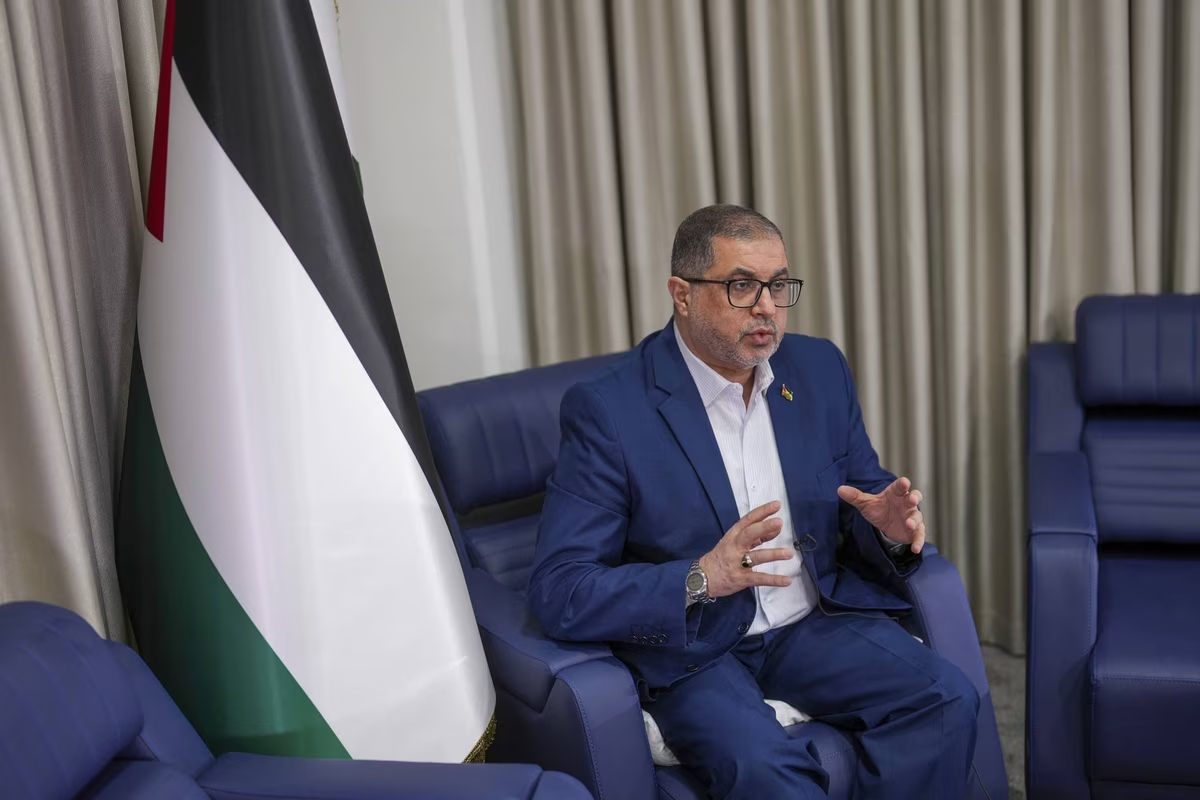
Hamas leader Basem Naim said in a statement on Thursday that "the ball is now in the court of the mediators, the American guarantor, and the international community to empower the committee."

The US-backed Gaza peace plan came into effect on October 10, allowing for the return of all hostages held by Hamas during its attack on Israel on October 7, 2023, and ending the war in the besieged Strip.

Ali Shaath, a Palestinian civil engineer, was chosen to lead the technocratic committee, and he will have the arduous task of guiding the first phase of the reconstruction of the devastated Palestinian Strip.

Bulgarian diplomat Nikolay Mladenov, the UN envoy for the Middle East peace process from early 2015 until the end of 2020, is expected to lead the field operations of the Peace Council.

According to sources, among the countries expected to join the council are the United Kingdom, Germany, France, Italy, Saudi Arabia, Qatar, Egypt, and Turkey.

According to US Middle East envoy Steve Witkoff, the second phase of the plan, which came into effect on Wednesday, stipulates the "reconstruction" of the Gaza Strip.

On the other hand, Trump affirmed that tariffs are the reason behind the "great financial numbers" achieved by the American economy, noting that US national security is at its strongest today.

Trump said: "We collected hundreds of billions of dollars due to tariffs without actual inflation, and the financial data released today is great, and our country has never achieved better than this."

PALESTINE

Fri 16 Jan 2026 11:29 am - Jerusalem Time

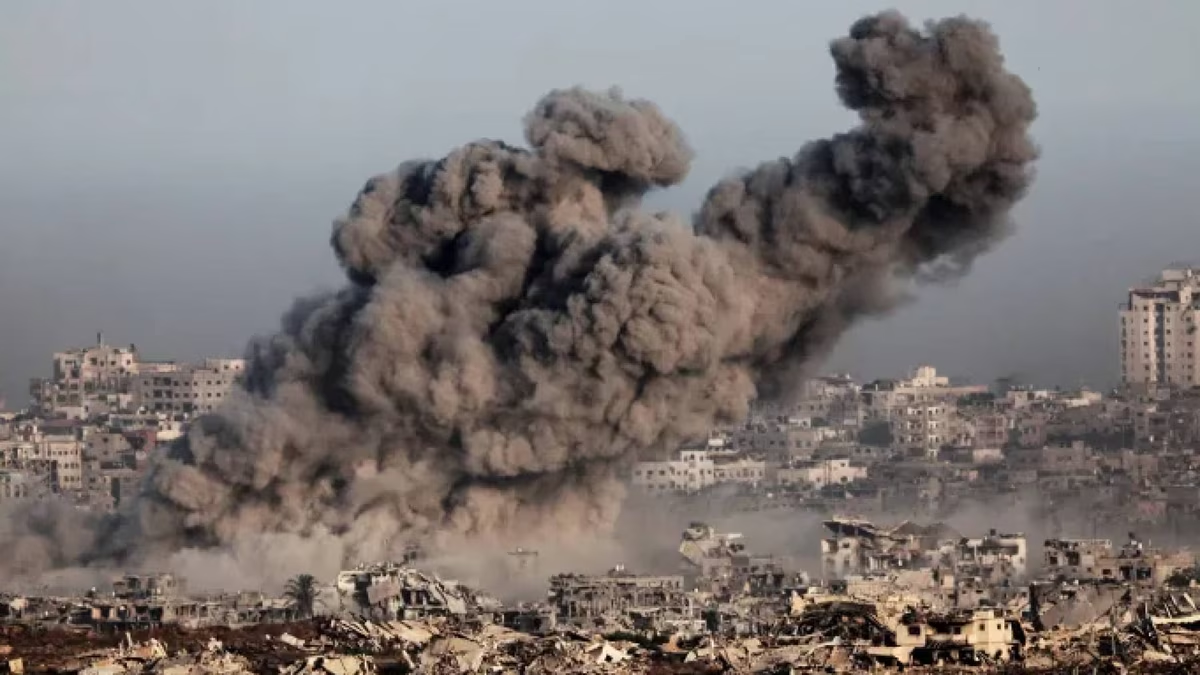
The occupation escalates its aggression.. Airstrikes hit central and western Gaza, and the death toll rises to 10 people

A massacre in Nuseirat camp (central sector), after targeting the home of the "Al-Khatib" family with heavy missiles.

The assassination of Al-Quds Brigades leader Ashraf Al-Khatib in an occupation bombing of a house in Nuseirat camp.

In a new crime within the series of evening raids, occupation fighter jets committed a massacre in Nuseirat camp (central sector), after targeting the home of the "Al-Khatib" family with heavy missiles, resulting in the martyrdom of Al-Quds Brigades leader Ashraf Al-Khatib.

Medical sources reported the martyrdom of (3) people as an initial toll and the injury of dozens, with the victims transferred to "Al-Awda" and "Al-Aqsa Martyrs" hospitals, amid great difficulty in rescue operations due to the massive destruction.

On Al-Rashid Street (the sea), an airstrike targeted a police security point at "Al-Nabulsi Junction" southwest of Gaza City, resulting in martyrs and injuries among security personnel and beachgoers.

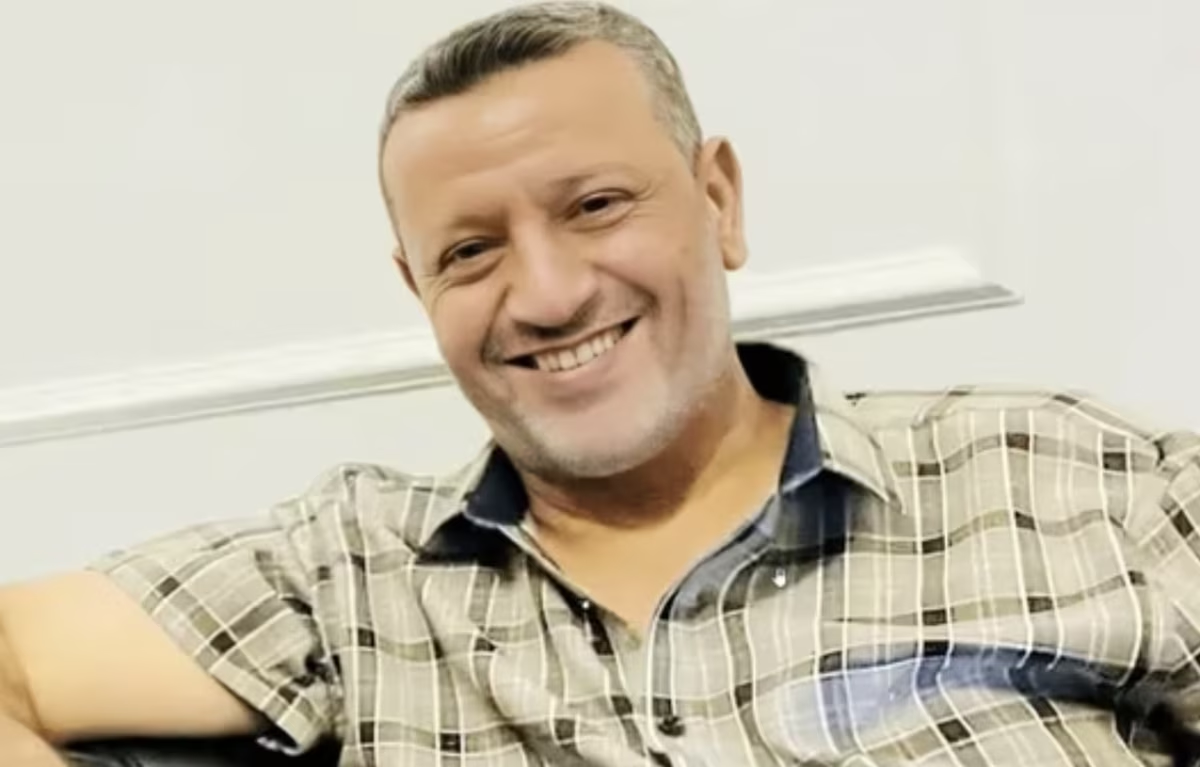
In a significant field development, medical and journalistic sources confirmed the assassination of Al-Qassam Brigades leader, Muhammad Al-Hawli, along with his wife and daughter, after their home was bombed in Deir al-Balah, raising the number of martyrs in the city since morning to (10) martyrs.

These massacres come on the first day of the mediators' announcement of the start of the "second phase" of the ceasefire agreement, reflecting an Israeli field disavowal of de-escalation commitments.

Data from the government media office in Gaza indicates that the occupation has committed more than 1244 violations of the agreement since its start last October, warning that direct targeting of civilians and field figures aims to blow up the agreement from within and return to the square of all-out war.

PALESTINE

Thu 15 Jan 2026 11:28 pm - Jerusalem Time

Media: Assassination of Al-Qassam leader "Mohammed Al-Hawli" after targeting his location in Deir al-Balah

The leader of the Izz al-Din al-Qassam Brigades, Mohammed al-Hawli, has been martyred.

Sources reported on Thursday evening the martyrdom of Mohammed al-Hawli, a leader in the Izz al-Din al-Qassam Brigades (the military wing of the Hamas movement), following an Israeli occupation airstrike that targeted him in the city of Deir al-Balah, central Gaza Strip.

This operation comes amid an intense military escalation by the occupation in the central and southern areas of the Strip since the morning hours.

Al-Hawli is considered one of the prominent field cadres, and his assassination comes at a sensitive time, coinciding with the announcement of the start of the "second phase" of the ceasefire agreement.

Observers believe that this operation could reignite the confrontation front and push the resistance to respond to these violations, putting the fate of recent security understandings at stake.

With Al-Hawli's martyrdom, the death toll from the Israeli occupation's shelling of Deir al-Balah and Rafah since the morning rises to eight martyrs.

Civil defense and ambulance crews continue to retrieve the injured from the bombing sites, amid intense overflights by reconnaissance aircraft (drones) that have not left the skies of the central region after the targeting operation.

PALESTINE

Thu 15 Jan 2026 9:26 pm - Jerusalem Time

Escalation continues on the ground.. 7 martyrs in Gaza and incursions into Ramallah

(7) martyrs have fallen since Thursday morning, as a result of direct targeting by the Israeli occupation army.

Medical sources from inside Gaza Strip hospitals reported the death of (7) martyrs since Thursday morning, as a result of direct targeting by the Israeli occupation army of the cities of Deir al-Balah (central Gaza) and Rafah (far south).

This coincided with warplanes launching an airstrike targeting areas where occupation forces were deployed east of Khan Yunis city, amid continued artillery shelling of populated residential neighborhoods, which raised the death toll and increased the suffering of displaced people in those areas.

West Bank: Incursion into Kafr Malik On another note, Israeli occupation forces stormed the village of "Kafr Malik" in the Ramallah district, central West Bank, on Thursday evening.

Eyewitnesses reported that military vehicles raided neighborhoods of the village, where occupation soldiers carried out search and raid operations on a number of homes, leading to clashes with local youth.

These incursions come within the framework of the continuous escalation policy pursued by the occupation authorities in various cities and villages of the West Bank to tighten the noose on Palestinian citizens.

These bloody field developments come at a time when the Palestinian street is awaiting the results of recent diplomatic announcements regarding the "second phase" of the ceasefire agreement.

Observers believe that the continuation of raids and incursions undermines chances of calm and presents mediators with a new challenge to compel the occupation government to stop its military actions, especially in areas classified as "safe" for displaced people.

PALESTINE

Thu 15 Jan 2026 7:26 pm - Jerusalem Time

Washington will not force Israel to abide by the truce despite the launch of the second phase in Gaza

Washington – Said Arikat

Informed sources reported on Thursday that the United States will not exert the necessary pressure on Israel to force it to maintain the truce in the Gaza Strip, despite the announcement by the US President's envoy, Steve Witkoff, on Wednesday (1/26/14) of the launch of the second phase of military operations in the Strip, according to statements by US military official Witkoff. This step comes at a very sensitive time when the Strip is witnessing escalating security tensions, amid growing fears of an exacerbation of the humanitarian crisis and a rise in civilian casualties as a result of the ongoing conflict.

The second phase, according to officials' statements, may include new military and strategic movements whose full details have not yet been revealed, but local sources indicate the possibility of escalating operations and targeting specific sites, which may increase the suffering of civilians and deepen the humanitarian crisis. Security experts believe that the continuation of operations without strict international pressure weakens the chances of de-escalation and threatens the stability of the Strip in the short and medium term.

It is worth noting that in this context, the issue of the recently announced Palestinian technocratic committee is shrouded in ambiguity, as it is not yet clear who is directly responsible for it and to whom it reports. However, informed sources confirmed that US President Donald Trump, who will assume the presidency of the so-called "Gaza Peace Council," will be the direct authority responsible for the committee's work. The sources stated that members of the Gaza Strip management committee have begun arriving in Cairo in preparation for participating in the upcoming meetings regarding the arrangements for the civil administration of the Strip during the next phase.

President Trump is expected to clarify these matters at the Davos Forum next week, where he will participate in the forum on Wednesday, January 21, which marks one year since he took office at the White House.

Regarding the structure of the Palestinian National Committee, sources indicated that Dr. Ali Shaath will serve as the head of the committee and will be responsible for the energy and transport portfolios, while Dr. Bashir Al-Rayes will handle the financial portfolio, Dr. Jabr Al-Daour the education portfolio, and Dr. Ayed Yaghi the health portfolio. Rami Helles will be responsible for religious affairs, Dr. Ali Barhoum for water and municipalities, Adnan Abu Wardeh for justice and judiciary, Hana Tarazi for social affairs, Osama Al-Sidawi for land and housing, and Abdul Karim Ashour for agriculture, in addition to Dr. Ali Shaath temporarily overseeing the energy and transport portfolios, Omar Shamali for telecommunications, and Ayed Abu Ramadan for economic, trade, and industry portfolios, while Husni Al-Mughni will handle tribal affairs, and Major General Sami Nesman will handle internal affairs. The sources confirmed that the upcoming meeting will discuss the committee's work mechanisms, determine the priorities of the first phase, and discuss ways to coordinate efforts with regional and international parties, ensuring the continuity of basic services and the reorganization of civil administration in the Strip, under broader international and regional arrangements to establish a technocratic civil administration, based on professional competence and meeting the living and service needs of the population in light of the complex humanitarian and economic conditions.

The US State Department affirmed the United States' support for Israel in what it considers "legitimate security necessities," without direct intervention in ensuring adherence to the truce. This policy reflects the complex balance between the close strategic partnership with Tel Aviv and international obligations towards protecting civilians. International experts believe that this position reinforces Israel's feeling of freedom to make military decisions without accountability, which may affect the future dynamics of the conflict and further complicate the tasks of any new Palestinian committee attempting to manage the situation in Gaza.

According to experts, the American position clearly illustrates the contradiction between strategic support and diplomatic reservation, and that not pressuring Israel may be understood as implicit approval of breaking the truce, which puts Washington in the face of growing international criticism. This fragile balance between the security alliance with Israel and humanitarian accountability reflects the major challenges of US policy in the Middle East, and highlights the difficulties Washington faces in reconciling its strategic interests with its moral obligations towards civilians affected by the conflict, including the technocratic committee.

On another note, Palestinians in Gaza are living in tragic conditions as a result of the long siege and lack of basic services. Any additional military escalation could lead to mass displacement and an exacerbation of the humanitarian crisis, increasing pressure on international and local organizations to provide support, and putting the international community to a real test of its ability to protect civilians and alleviate their suffering amid escalating military operations, while the fate of any Palestinian body under American supervision remains ambiguous and controversial.

Moreover, the United States' disregard for potential threats to break the truce could have far-reaching consequences for the course of the conflict. It gives Israel a wider margin for military action without accountability, and reduces the effectiveness of the international community as a balancer. This situation could complicate opportunities for de-escalation, and push Palestinians to rely more on regional and international support to mitigate the effects of military operations, which further complicates future political solutions and makes achieving lasting peace more difficult, deepening the cycle of ongoing conflict in the region, and increasing the ambiguity surrounding the new technocratic committee.

Observers believe that the second phase could be a real test for US policy in the region, especially with increasing international pressure on Washington to play a more effective role in protecting civilians. Any additional escalation will undoubtedly lead to widespread diplomatic repercussions, including condemnations from the United Nations and European Union countries, and perhaps strained relations with some Arab countries, which further complicates the political and security landscape in the region, and places the technocratic committee under strict and unclear scrutiny.

In conclusion, the current crisis in Gaza stands out as a stark demonstration of the fragility of the balance between strategic considerations and humanitarian dimensions. The focus on supporting Israeli security without regard for the repercussions of operations on civilians reflects significant challenges for the international community, and makes any efforts to achieve a sustainable de-escalation or a lasting political solution more complex. The continuation of the second phase without effective intervention could lead to an exacerbation of the humanitarian crisis, and increase the suffering of the population in the Strip, with long-term effects on regional stability, and further obscures the role of any Palestinian committee under American supervision.

ARAB AND WORLD

Thu 15 Jan 2026 2:07 pm - Jerusalem Time

United States redeploys forces in the Middle East amid anticipation of a potential strike against Iran

In a new indication of escalating regional tension, the United States on Wednesday began withdrawing some of its forces stationed at several military bases in the Middle East, a move coinciding with European intelligence assessments suggesting the possibility of a US attack on Iran within the next twenty-four hours. European officials told "Reuters" (Wednesday evening) that the ongoing military movements reflect field preparations for the potential slide into a direct confrontation.
These developments recall the scene before the twelve-day US-Israeli war against Iran in June 2025, when Washington then partially evacuated its forces from sensitive bases in the region in anticipation of an Iranian response. It appears that President Donald Trump's administration is adopting the same scenario today, albeit in a more complex context, given the shift in deterrence balances and the expansion of potential targeting areas.
Among the most prominent bases where the US military presence is being reduced is Al Udeid Air Base in Qatar, which is considered one of the most important pillars of the US military deployment in the Gulf. This base was subjected to a direct Iranian missile attack last June, in response to a US bombing targeting nuclear facilities inside Iran. Tehran had preceded that attack by informing Washington through indirect channels, which allowed US forces sufficient time for partial evacuation and preparation to intercept missiles.
However, current Iranian warnings suggest that any upcoming confrontation will be different in terms of rules of engagement. Iranian officials assert that the response to any new US strike will include targeting US military bases and ships deployed in the region, without prior warning this time, which raises the probability of casualties and complicates deterrence calculations.
In this context, Ali Shamkhani, assistant to Iran's Supreme Leader Ayatollah Ali Khamenei, wrote on "X" on Wednesday, criticizing the repeated American rhetoric about "preemptive strikes." He said: "The American president, who constantly repeats the futile narrative of attacking Iranian nuclear facilities, would do better to also recall the bombing of the #AlUdeid American base with Iranian missiles." Shamkhani, who survived an Israeli assassination attempt during the twelve-day war, added that "recalling that incident is sufficient to create a realistic understanding of Iran's will and ability to respond to any aggression."
In contrast, US President Donald Trump appeared to disregard these warnings, saying on Tuesday: "Iran said the same thing the last time I bombed them." On the same day, Trump held a closed meeting at the White House with his top national security and defense advisors, dedicated to discussing potential scenarios for dealing with Iran.
The "New York Times" quoted US officials as saying that intelligence assessments indicate that any US strike will likely be met with an Iranian missile response targeting Al Udeid Base, and possibly other US bases in Iraq and Syria. The newspaper confirmed that this assessment was the focus of extensive discussion within the White House on Tuesday evening.As for the "Washington Post," it quoted a US official as saying that the Trump administration "simply does not possess sufficient military assets in the region to carry out a comprehensive strike without risking retaliation," especially after withdrawing some military capabilities for use in other operations, including US movements against Venezuela. Nevertheless, the United States still maintains at least three naval destroyers equipped with guided missiles in the region's waters, in addition to the capability of B-2 strategic bombers, which previously launched from bases within US territory to carry out long-range strikes.
Recent US movements reflect a logic of "risk management" more than a readiness for an all-out war. Evacuating bases does not necessarily mean an intention to attack, but rather may be a dual deterrent message: reducing potential losses, and keeping the option of a strike open without getting involved in uncontrollable escalation. However, this approach simultaneously reveals the limits of American power in an increasingly hostile regional environment, where military dominance alone is no longer sufficient to impose equations.
In contrast, Iran appears confident in its ability to raise the cost of any US attack, based on the June 2025 experience which, albeit partially, broke the image of absolute American superiority. The threat of no prior warning this time indicates a strategic shift in Iranian doctrine, from calculated response to shocking response. Between this and that, the region stands on the brink of an escalation that no one may want, but which could erupt due to a single miscalculation.


PALESTINE

Thu 15 Jan 2026 12:18 pm - Jerusalem Time

Tel Aviv adheres to the Yellow Line.. and America launches "Phase Two" to disarm Gaza and form a "technocratic administration"

Hebrew and American reports on Thursday morning outlined the features of the next phase of the situation in the Gaza Strip, as Tel Aviv affirmed its refusal to withdraw from current positions without "disarmament," coinciding with Washington's announcement of the start of implementing the new peace plan.

Sources reported that Tel Aviv does not intend to withdraw from what is known as the "Yellow Line" east of the Gaza Strip at the current stage, linking any step back to achieving tangible and real progress in the disarmament of the Hamas movement.

This position comes with the announcement by the US envoy to the Middle East, Steve Witkoff, on Wednesday evening, of the launch of "Phase Two" of President Donald Trump's 20-point plan.

The plan aims to: establish a transitional Palestinian administration with a technocratic character. Immediately begin the disarmament process. Commence the full reconstruction of the Strip.

In this context, a Hebrew newspaper revealed that the US envoy did not address the issue of opening the Rafah crossing, amid the absence of any new instructions for the occupation.

The newspaper attributed this to Netanyahu's insistence on not opening the crossing before "recovering a last body" still held by Hamas, according to the newspaper's description.

Reports stated that the Israeli occupation army is preparing to launch new operations in full coordination with the United States, if Hamas refuses to disarm.

Hebrew estimates indicate that the movement: held at least 10,000 fighters. Succeeded in recruiting thousands more recently. Possesses strategic weapons.

The Hebrew newspaper highlighted the financial strength of the movement, as security agency estimates claim that Hamas possesses huge cash funds stored in tunnels (especially in Gaza City and Al-Shati refugee camp), estimated at no less than 400 million shekels, and could reach one billion shekels.

The movement used these funds as part of an "economic emergency plan" to pay the salaries of tens of thousands of its members throughout the war.

Hebrew estimates indicated that the entry of about 4,200 aid trucks weekly enabled Hamas to collect daily tax revenues in the millions, which contributed to: increasing the salaries of its members to about 1,500 shekels per month.

Regarding the day after, a Hebrew newspaper confirmed that Hamas demands the retention of its government teams (since 2007), which is rejected by the international community.

Alternatively, a "technocratic committee," including names "familiar and acceptable" to Tel Aviv and having good relations with the Palestinian Authority, will manage public services in coordination with "Ramallah" and the United Nations.

The Hebrew newspaper concluded that the testing of these arrangements will begin from an "experimental neighborhood" in Rafah, with an emphasis that there will be no immediate withdrawal from the "Yellow Line."

PALESTINE

Thu 15 Jan 2026 12:04 pm - Jerusalem Time

Ali Shaath Reveals Features of Gaza Reconstruction: 7 Years for Recovery

Dr. Ali Shaath, head of the Technocrat Committee for the administration of the Gaza Strip, affirmed that the committee's essential mission is to provide decent living conditions that preserve the dignity of the Palestinian citizen. Shaath, based on his professional experience, estimated that the Strip needs seven years of hard work to return to a better state than it was before.

Shaath explained that the reconstruction plan, prepared in cooperation with the World Bank and relevant ministries, is based on three main stages: emergency relief, which extends for six months; recovery, which takes two and a half years and includes the restoration of infrastructure and basic facilities; and then reconstruction and development.

Regarding the rubble, Shaath estimated that its removal would not take more than three years. Part of it will be recycled to create additional areas in the sea, and the rest will be used in construction materials to protect the environment.

The committee prioritizes water, electricity, and education files:

Water and Sanitation: Desalination plants will be maintained and new ones established, with an emphasis on adhering to the internationally stipulated "Mekorot" water lines. Treatment plants, about 25-30% of which were destroyed, will also be repaired.

Electricity: The sector currently operates with only about 60-70 megawatts out of the 150 megawatts it needs. Work is underway to restart the damaged power plant and improve the efficiency of the line coming from Egypt.

Education: Shaath stressed the need to compensate students for the loss of two and a half years of education, with the possibility of recruiting teachers from the West Bank.

Dr. Shaath affirmed that the Technocrat Committee works in full integration with the Palestinian Authority and Arab countries, relying on the Palestinian Basic Law as the sole reference. He clarified that the committee does not possess political or military powers, as these files fall within the jurisdiction of the "Peace Council" and the "International Stabilization Force." The committee's scope of work (currently covering 50% of the Strip) will gradually expand as the occupation army withdraws eastward under the Gaza agreement.

The commission's operations will be funded through a dedicated fund at the World Bank, relying on Arab and international donations. Egypt, Qatar, and Turkey announced in a joint statement on Wednesday evening the completion of the committee's formation, headed by Ali Shaath, considering it a pivotal step to improve humanitarian conditions. This move comes amidst a tragic reality left by the war of annihilation, where more than 242,000 Palestinians have been recorded as martyrs or injured, and widespread destruction has affected most cities in the Strip.

OPINIONS

Thu 15 Jan 2026 10:25 am - Jerusalem Time

The Decisive Moment: Between Administrative Responsibility and the Danger of a Vacuum

 Azzam Abdulkarim Rashdi Shawwa

Azzam Abdulkarim Rashdi Shawwa

Opinion Writer

Gaza today is no longer merely a news headline or a battlefield of military confrontation. It has become a harsh mirror exposing the magnitude of political paralysis, the absence of unified decision-making, and the confusion surrounding crisis management at the most dangerous moment in the modern history of our people. The devastation, starvation, and collapse of essential services endured by its population have exceeded all limits of tolerance and can no longer be addressed with a mindset of waiting or political ambiguity.

Within this exceptional reality, the formation of the Administrative Committee for Gaza emerged as an emergency response imposed by the conditions of war and aggression, and by the near-total breakdown of the ability of official institutions to operate on the ground. Ignoring this reality, or bypassing it through rhetorical political discourse, serves neither Gaza nor its people. Instead, it opens the door to a dangerous administrative vacuum one for which ordinary citizens alone bear the cost.

The most serious threat facing Gaza today is not only the machinery of war, but the vacuum itself: a vacuum of decision-making, a vacuum of administration, and a vacuum of political courage. In times of catastrophe, a vacuum is not a neutral position; it is a national danger that threatens social cohesion, deepens collapse, and turns people’s suffering into an arena for political rivalry and internal conflict.

From this standpoint, any organized framework that seeks to manage the minimum requirements of daily life during this critical phase deserves responsible support—not pre-emptive suspicion or political demonization. In moments of emergency, politics is not measured by the purity of slogans, but by its capacity to protect people and prevent comprehensive collapse.

Accordingly, I hereby affirm my clear and explicit personal support along with that of the Shawwa family, and many Palestinian families and clans for the Administrative Committee for Gaza and its members, as a temporary national framework imposed by necessity. Its purpose is to protect society, provide essential services, and preserve civil peace. It is neither a permanent political project nor a substitute for national legitimacy.

This support does not constitute an open-ended mandate, nor does it grant cover for any deviation from the committee’s service-oriented mission. Rather, it is conditional upon full transparency, strict adherence to a non-factional character, accountability to the public, and a clear declaration that the committee’s mandate is limited to the emergency phase and ends immediately once conditions allow for the full resumption of national institutions.

Conversely, abstract opposition that is not accompanied by practical and implementable alternatives cannot be considered a responsible national position. Leaving Gaza without effective administration under any political pretext amounts to indirect participation in deepening the suffering of the population and prolonging chaos.

The primary responsibility also lies with all Palestinian factions, whose duty first and foremost is to manage the crisis. What is required today is a courageous and unified political decision that provides temporary national cover for administering people’s affairs, establishes a serious path toward ending division, restores institutional unity, and places Gaza at the center of Palestinian national priorities.

Gaza does not need additional statements; it needs responsible administration and clear decisions. It does not need competition over authority, but rather a genuine national partnership worthy of the scale of sacrifice. Every delay in this regard imposes an additional burden on a people exhausted by war and subjected to costs beyond endurance.

In conclusion, we state this with absolute clarity; those who choose hesitation or obstruction at this decisive moment bear national and moral responsibility before their people and before history. Managing Gaza today is not a political option open to debate; it is an urgent national duty. A vacuum is not a position it is a crime against the people. Gaza, which has endured and resisted under aggression, deserves decisions commensurate with its sacrifices no less.

At this critical juncture, it is also our duty to extend sincere appreciation to all Arab, Islamic, and international states that have contributed to reaching this decisive moment in Palestinian history.

PALESTINE

Thu 15 Jan 2026 10:21 am - Jerusalem Time

Who is affected by the electricity and water cut-off to UNRWA institutions in Jerusalem?

The cut-off of electricity and water to the buildings of the United Nations Relief and Works Agency for Palestine Refugees (UNRWA) in Jerusalem not only threatens the administrative workflow but also affects the rights of thousands of refugees whose daily lives depend on the agency's services. As part of practical steps to implement Knesset (Israeli Parliament) laws that banned the agency's work in "Israel," the latest of which was the final approval last Monday of a bill to cut off electricity and water to its offices, UNRWA was effectively notified of the cut-off of both services to its buildings in East Jerusalem.

This measure contradicts Israel's obligations as an occupying power under international humanitarian law, which guarantees the protection of humanitarian institutions and prevents obstruction of their work or the use of essential services as a tool of collective pressure. The notice delivered by the Israeli water and sewage company "Gihon" to the international agency stated that water service would be cut off within 15 days because the registered consumer name for the properties is UNRWA, while the Jerusalem District Electricity Company (Palestinian) notified the agency that it would refrain from providing electricity service to 10 of its facilities in Jerusalem, and that its name would be removed as a beneficiary or subscriber to this service.

On Monday, occupation forces stormed UNRWA's health clinic in the Old City, known among Jerusalemites as "Al-Zawiya," and demanded the removal of UN signs. "This raid was followed by a temporary closure order against the health center for 30 days, and it may never reopen," according to Roland Frederick, UNRWA's Director of West Bank Affairs, in a tweet on the "X" platform.

Abeer Ismail, the agency's media office director, told sources that the measure of cutting off electricity and water services includes all UNRWA facilities and buildings in East Jerusalem, including the administrative headquarters in Shuafat refugee camp, in addition to 3 schools, the health clinic, and the waste compactor.

According to the spokesperson, outside the camp, it also includes the health clinic in the Old City of Jerusalem, and two schools belonging to the agency in Silwan and Sur Baher, in addition to the presidency headquarters in Sheikh Jarrah and the Qalandia Training Center.

In addition to all staff in these facilities being affected, especially health staff, as the agency is currently working to transfer them and their patients to the nearest health point belonging to it in Jerusalem governorate, 16,419 refugees registered with UNRWA in Shuafat camp, out of 80,000 living there, will be affected by the new measure, according to the media office director, as well as 120 to 150 patients who visit UNRWA clinics daily in both the Old City and Shuafat camp.

"We are also talking about 4,741 children registered in UNRWA records in Shuafat camp, about 1,000 of whom received their vaccinations at the camp clinic, and 600 received their education in its three schools. All of these were deprived of learning inside the camp this academic year after the schools were closed, and 800 elderly people will also be deprived of treatment at the camp clinic," added the agency's media office director.

The international agency serves 192,000 refugees in Jerusalem governorate, and Abeer Ismail confirms that none of its facilities can operate without electricity and water services, adding that staff are subjected to harassment, and many of them have been detained and interrogated during raids by Israeli security forces on the headquarters.

She concluded by saying, "We are trying to deliver services to refugees as much as possible, but it is very difficult."

Roland Frederick, UNRWA's Director of West Bank Affairs, described the raid as "disgraceful" in a post on the X platform, referring to a center that has received support from member states for decades and has been visited by many of them, adding that all of this portends a rapid shrinking of the UN's presence in occupied East Jerusalem.

He stressed that these disgraceful tactics are part of an ongoing campaign by the Israeli authorities to prevent UNRWA from fulfilling its mandate granted by the UN General Assembly in occupied East Jerusalem, which is not under Israeli sovereignty, noting that the application of Israeli law to it is illegal.

He mentioned that the International Court of Justice ruled in October 2025 that Israel is obligated to facilitate UNRWA's relief operations, yet the current measures are precisely the opposite, and if these amendments are implemented, they indicate the approaching end of UNRWA's operational presence in East Jerusalem, which has spanned decades.

These developments come yesterday following amendments introduced in December 2025 to anti-UNRWA Knesset laws.

The Knesset General Assembly voted in the second and third readings on October 28, 2024, on the first law, which stipulates preventing UNRWA from carrying out any activities within "areas under Israeli sovereignty," withdrawing privileges and facilities from it, and preventing any official Israeli contact with it.

The law obliges the international agency not to operate any representation, and not to provide any services or any activities directly or indirectly from within "Israel's sovereign areas."

The second law stipulates that privileges obtained by the agency under exchanged letters between it and Israel in 1967, which address the facilities approved by the Israeli government regarding UNRWA's functions, do not apply, and also stipulates that no Israeli authority shall make any contact with UNRWA or any party on its behalf.

ARAB AND WORLD

Thu 15 Jan 2026 9:47 am - Jerusalem Time

Trump in the Corner: From Encouraging Protests to the Prospect of an Imminent American Strike Against Iran

News Analysis


US President Donald Trump put himself in a tight political and strategic corner when he sent a direct public message to Iranians, calling on them to continue protesting, asserting that "help is on the way." Experts believe that this statement, which went beyond the bounds of traditional diplomatic rhetoric, was not merely an expression of moral support, but carried with it a political commitment that would be difficult to retract. Since the White House linked its public stance to internal movements within Iran, the credibility of the American administration has been on the line, both domestically in the US and in the Iranian street and the international community.
This discourse came at a highly sensitive time, coinciding with the expansion of protests within Iran and the tightening of security measures against demonstrators, amidst reports of a large number of casualties and detainees. With each passing day without a practical translation of the phrase "help is coming," pressure on the Trump administration to take concrete action increases. Here the dilemma becomes clear: retreat is interpreted as weakness, while escalation, especially military, opens the door to a widespread regional confrontation whose rhythm cannot be easily controlled.
In this context, the role of the neoconservative current within Washington, supported by the influence of the Israeli lobby, clearly stands out in pushing for a broad military option against Iran that is not limited to deterrence or limited strikes, but aims to create a strategic shock leading to regime change. This current believes that the current moment represents a rare opportunity, where internal protests intersect with economic pressures and political isolation, and argues that any partial strike will give Tehran room to reorder its cards. From this perspective, they push for a harsh strike that targets the joints of military and security power, an argument that resonates strongly within Israeli circles who believe that the real danger lies not only in the Iranian nuclear program, but in the continuation of the regime itself.
In contrast, political and security assessments in Washington indicate that the option of an airstrike is being considered more seriously than ever before, especially after Trump canceled communication channels with Iranian officials and linked any diplomatic opening to an end to the repression of protesters. This shift reflects a transition from a policy of gradual pressure to a policy of brinkmanship, where deliberate ambiguity is used as a deterrent, but at the same time increases the likelihood of miscalculation and a rapid slide towards confrontation.
On the Iranian side, Trump's statements were met with direct accusations against Washington of interfering in internal affairs, and warnings that any attack would be met with a broad response, either directly or through Tehran's allies in the region. Iran has raised its military readiness, in a message aimed at deterring the United States and showing that the cost of a strike will not be limited or one-sided. This mutual interaction reinforces the climate of escalation, and makes any incident or miscalculation a potential spark for the outbreak of conflict.
Notably, American discourse has begun to link confrontation with Iran (allegedly) to a moral and humanitarian dimension, not limited to traditional issues such as nuclear activity or regional influence. This linkage gives Washington a broader political justification, but at the same time raises the bar of commitments. When confrontation is presented as a defense of a people subjected to oppression, it becomes difficult to be content with sanctions or statements, and military force becomes a potential tool to maintain the credibility of the discourse.
Ultimately, the Trump administration appears to be caught between the pressure of a current pushing for a strong strike that could change the balance of power in Iran, and the concerns of a security establishment that realizes that regime change is not a quick military task, but a path fraught with risks. Between these two options, impressions are reinforced that an American strike, if not inevitable, is at least imminent, as a result of the accumulation of political rhetoric more than it is the product of an isolated military decision.
The danger of Trump's position lies not only in the probabilities of war, but in the way his political decision has been constrained by public discourse directed at the people of an adversary state. This type of discourse transforms military action from a strategic option into a tool to save credibility, which explains the acceleration of talk about an imminent strike. In such cases, language itself becomes a driving factor for war, not merely a reflection of it.
The push by neoconservatives and the Israeli lobby to overthrow the Iranian regime brings to mind past experiences that showed the gap between overthrowing a state and managing its aftermath. A strong strike may disrupt the regime, but it does not guarantee a stable alternative, and may open the door to wider regional chaos. This contradiction between political ambition and on-the-ground reality will remain the decisive factor in Washington's final decision.

OPINIONS

Thu 15 Jan 2026 9:46 am - Jerusalem Time

The road to the second stage is more important than reaching it!

Ibrahim Melhem

Ibrahim Melhem

Opinion Writer

Perhaps the cost of lingering among the hills of rubble, the wind lashing at tents, and the spread of epidemics and diseases, is much higher than the cost of the ambiguity surrounding the roles and tasks that will be undertaken by the committee tasked with managing Gaza, which is holding its first meetings today in Cairo to announce the commencement of its work.
There is no disagreement on the names, whatever their orientations, as all of them are national figures who have previously undertaken tasks and roles in successive governments. However, there are anxious questions that need answers, which appeared in the welcoming statement of the Authority, regarding references, scenarios, and caution against the dangers of fragmentation, duality, disintegration, dispersion, and separation between agencies and institutions in one homeland, and the fear of “permanent temporary.”

There are many entitlements that should pave the way for the path of suffering that the technocrat committee is taking by dismantling the mines of pretexts created by the “Likud wolf” to evade the entitlements of withdrawal from the yellow line to the red, removing rubble, starting reconstruction, and opening the Rafah crossing in both directions. Today, we will hear from Netanyahu a flood of caveats that will pose obstacles to the start of the new phase, foremost among them the body of the last soldier, “Ran Gooli,” and the weapon of “Hamas.”

Between the hammer of the harsh living conditions of the displaced and the anvil of oppressive Israeli conditions, the committee's task seems almost impossible in the absence of clear references and firm international guarantees. The lesson is not in forming the committee but in its ability to be a link, not a break, and to build a bridge for crossing towards unity, sovereignty, and the establishment of a state. The first obstacles were at the Karama crossing yesterday, by obstructing the travel of the head of the committee and the official in charge of its security file to Cairo, before they were allowed to leave after a delay of several hours.

PALESTINE

Thu 15 Jan 2026 4:19 am - Jerusalem Time

Palestinian official: Qalandia Airport plan in Jerusalem aims to control 12% of West Bank lands

Salah Khawaja, an official in the Wall and Settlement Resistance Commission, warned of strategic dangers from a massive Israeli settlement project being established on the lands of the historic Qalandia Airport north of occupied Jerusalem.

Khawaja stated in remarks that the plan aims to change the features of the area and impose new realities on the ground as part of what is called the "Greater Jerusalem" project.

He explained that Qalandia Airport, which was a symbol of Palestinian sovereignty before the 1967 occupation, gradually transformed from a civilian airport into an Israeli military base, before becoming today a target for a settlement plan that includes the construction of about 9,000 housing units.

He clarified that the project aims to isolate Jerusalem from its Palestinian surroundings and displace dozens of Bedouin communities from the area.

The official in the Wall and Settlement Resistance Commission pointed out that this step will cut off geographical communication between the northern and southern West Bank, turning Palestinian villages into "closed cantons."

He added that the Israeli plan enjoys political consensus within both the occupation government and the opposition, and comes within the strategy of expanding settlements and linking them to the "Ma'ale Adumim" settlement, thereby strengthening Israeli control over approximately 12% of the West Bank lands.

Khawaja warned that the implementation of the project would lead to the "erasure of Qalandia's historical features," which included the fourth largest land area in the vicinity of Jerusalem and Ramallah, stressing that demolition operations in the area are accelerating rapidly, as part of a systematic displacement plan.

Yesterday, Monday, the Israeli District Planning and Building Committee in Jerusalem postponed to a later session the approval of a settlement project targeting the lands of the former Jerusalem International Airport, which provides for the construction of approximately 9,000 settlement units north of Jerusalem on an area estimated at about 1243 dunams (a dunam equals one thousand square meters), constituting a huge colonial barrier that cuts off geographical communication between Jerusalem and Ramallah, and deals a devastating blow to the possibility of an independent Palestinian state with geographical contiguity.

ISRAELI AFFAIRS

Wed 14 Jan 2026 11:03 pm - Jerusalem Time

Hebrew media: Tel Aviv government races against time and opens shelters in anticipation of an Iranian strike

This readiness comes as a result of assessments that any American attack will be met with an Iranian attempt to bomb the "beating heart" of the occupation to achieve a balance of deterrence. According to sources, the municipalities of Ofakim in the south and Ra'anana north of Tel Aviv have decided to open public shelters.

Sources: The municipality of Kiryat Gat in the south opens its public shelters as the "zero hour" approaches for the anticipated American attack on Iran. The strategic areas in the occupied entity have witnessed unprecedented mobilization.

According to sources, municipalities in major cities, led by Tel Aviv, Beersheba, and Dimona, have begun opening and equipping public shelters, a clear indication of serious fears of a direct Iranian missile response that could target economic centers, military bases, and sensitive installations.

In Tel Aviv, the economic center of the occupation, the municipality announced the opening of shelters in all neighborhoods, along with the distribution of strict instructions to residents regarding the "response time" to air raid sirens.

This readiness comes as a result of assessments that any American attack will be met with an Iranian attempt to bomb the "beating heart" of the occupation to achieve a balance of deterrence.

As for Beersheba, which is considered the gateway to the south and includes vital command centers and air bases such as "Hatzerim," the readiness of fortified shelters has been raised to the highest level.

Sources indicate that the army expects the south to be targeted with intense missile barrages, either from inside Iran or via long-range missiles, which has made Beersheba a pivotal area in the internal defense plan.

Preparations in Dimona are of utmost importance and sensitivity, given the presence of the nuclear reactor there. Shelters have been opened for residents simultaneously with the reinforcement of air defense systems (such as Patriot and Arrow) around the city.

Security agencies fear that Tehran may launch a "symbolic or retaliatory strike" towards Dimona in response to any American targeting of its nuclear facilities.

Tel Aviv: Opening public shelters and securing metro stations as refuge areas.

Beersheba: Mobilization in surrounding air bases and equipping shelters in residential areas.

Dimona: Tightening air defense surveillance and opening shelters for residents to confront any qualitative missile threat.

The transition of Tel Aviv, Beersheba, and Dimona to a "shelter opening" status means that the occupation is not just awaiting an American attack, but is preparing for a heavy price it may pay deep within its cities. With continued coordination with "CENTCOM," these settlements remain in a state of bated breath, awaiting what the coming hours may bring, which could turn these shelters into havens for millions of residents fearing fire coming from the East.

According to sources, the settlements of Ofakim in the south and Ra'anana north of Tel Aviv have decided to open public shelters, and the settlement of Kiryat Gat in the south is opening its public shelters.

Sources reported that the opening of shelters in some settlements was by decision of the heads of the settlements and not by the Home Front Command, and the majority of municipalities that opened shelters are in the southern and central regions.

OPINIONS

Wed 14 Jan 2026 10:57 pm - Jerusalem Time

Palestinians and Greenland: From Humor to Political Discourse

Dr. Ibrahim Nairat

Opinion Writer

Sometimes, comedy carries more than just fleeting laughter. A short scene in the 1987 series The Golden Girls, where the idea of “relocating Palestinians to Greenland” is proposed, seems at first glance to be merely a sarcastic joke. But upon reconsideration, this joke reveals a broader political logic: viewing land as a commodity, people as elements that can be redistributed, and ideas that are presented today as impossible can tomorrow become negotiable in political discourse. This article explores how a comedic joke transforms into a mirror of grand politics, and how a comedic idea can expose the most dangerous ethical slips in dealing with the issues and rights of peoples.

The reference to relocating Palestinians to Greenland, as it appeared in an American comedy show, The Golden Girls, was not just a fleeting joke or a sarcastic fantasy detached from political reality. The scene that included the phrase “Giving the Palestinians Greenland?” appeared in the final episode of the second season titled “Empty Nests,” where a new character made a sarcastic proposal on air in a radio show to solve the “Middle East crisis” by relocating Palestinians to the island of Greenland. The purpose of the scene was political satire, but today it acquires a broader meaning in the context of re-reading political discourse.

To be honest, I saw this scene years ago, and it was surprising to me. It came back to my memory since Donald Trump's announcements about his intention to buy Greenland, and I couldn't help but see a connection between the two ideas, between the joke and political reality, between sarcasm and the underlying seriousness in official discourse. Comedy, in moments of great transformation, does not function as an antithesis to politics, but as its first experimental space. Ideas are expressed there before they are formulated, and reactions are tested before positions are codified. Therefore, treating this proposal as laughter without consequences misses understanding what is deeper and more dangerous.

In the same context, Donald Trump's request to buy Greenland acquires its significance beyond being a shocking statement or a diplomatic misjudgment. What was revealed at that moment was not just geographical ignorance, but a political vision that sees land as a commodity, sovereignty as a matter of negotiation, and deals with the existence of peoples as a secondary element that can be bypassed. The question was not raised about the will of the people of Greenland, nor about their history or their right to self-determination, but about the island's feasibility and strategic value. This logic, when applied to Palestine, does not seem strange or unlikely, but rather entirely consistent with itself.

It is true that many analyses have rightly sought to deny the existence of any real conspiracy or practical plan aimed at specifically deporting Palestinians to Greenland, and to emphasize the impossibility of this scenario politically, legally, and logistically. However, denying the conspiracy does not mean denying the idea, nor does it deny that the patterns of thinking that produce such “fantasies” actually exist within some decision-making circles. Recent history teaches us that ideas once described as insane or unbelievable were not always dismissed, but were recycled in different forms when circumstances changed.

To look at the matter from a deeper perspective, it can be said that this proposal is not far from the logic of colonial projects and forced population distribution. The idea of settling Jews in Palestine, which formed the historical basis of the Palestinian-Israeli conflict and created a long and intractable path to solutions, produced a political world accustomed to thinking of land as a solution, and people as elements capable of redistribution. Today, it seems that this logic, after exhausting itself, has returned in a reversed and distorted form, where there is a hint of a “solution” based on resettling Palestinians in distant and harsh places like Greenland. However, what is more dangerous than this sarcastic or absurd proposal is what it implicitly reveals: that reaching a “final solution” to the conflict, in the minds of some who imagine it, is still governed by the same logic that originally created it, i.e., the search for an alternative place for a people instead of recognizing their rights where they are. If the settlement of Jews in Palestine was historically presented as a solution to the Jewish question in Europe, then the thinking today about deporting Palestinians, or even hinting at finding another homeland for them, reflects a deep ethical and political deadlock, where the same madness is reproduced instead of being dismantled. This is a kind of madness and revealing, because it reproduces the same mentality that sees human rights as merely a secondary variable in the face of geographical and political planning, but at the same time it highlights the dangers of cold thinking detached from ethics and popular sovereignty.

Here, Greenland is no longer an actual proposed place, but transforms into an intense symbol of a broader logic that believes the world can be rearranged if its problems become intractable, and that peoples outside the center of power are transferable or displaceable whenever their existence is considered an obstacle. In this context, sarcasm becomes an indirect means of normalization, as it does not raise the question of the moral legitimacy of displacement, but merely turns it into material for laughter, as if the problem lies in the strangeness of the idea, not in its enormity.

The danger does not lie in the existence of a ready plan, but in the fact that the idea of displacement itself has become negotiable, imaginable, and capable of appearing in popular culture without being met with outright fundamental rejection. Ideas do not give birth to policies all at once, but go through stages: from a joke in The Golden Girls, to a marginal discussion, to an “imperfect alternative,” and then to an option that is proposed when prospects are blocked.

This logic is the same that governed the “Deal of the Century,” where the Palestinian issue was dealt with not as a matter of occupation, rights, and history, but as an administrative obstacle that could be overcome through demographic or economic solutions. In this conception, the Palestinian is not seen as a landowner, but as a planning problem, and Palestine is not seen as a matter of justice, but as a file capable of redistribution.

What makes the connection between Greenland and Palestine necessary today is that both reveal an ethical shift in international political discourse, where dehumanization is no longer a scandal, but a possible outcome, sometimes stated frankly, sometimes sarcastically, and sometimes in the name of political realism.

The most dangerous aspect of this proposal is that it does not target Palestinians alone, but presents a model for dealing with indigenous peoples and anyone outside the equations of power. A world where the destinies of people are discussed as maps of influence are discussed, and solutions are proposed through displacement instead of justice.

Therefore, merely describing the idea of “Palestinians to Greenland” as a bad joke is not enough. The joke here is not an invention out of thin air, but a reflection of an existing logic, which may not be today's plan, but may turn into tomorrow's thinking when the limits of the possible are tested, and when what is “non-negotiable” is redefined.

In a world where major policies often begin as unreasonable ideas, the most dangerous thing to do is to be complacent that madness, simply because it is madness, will remain outside politics.


PALESTINE

Wed 14 Jan 2026 8:01 pm - Jerusalem Time

Netanyahu: There will be no withdrawal or reconstruction in Gaza before Hamas is disarmed and the body is recovered

In a firm response to the American announcement of the start of the second phase, Israeli Prime Minister Benjamin Netanyahu, on Wednesday evening, reiterated that Israel will not proceed with any withdrawal or development steps without achieving its field conditions.

Netanyahu clarified, during a phone call with the family of soldier "Ran Guily" (the owner of the last body held in Gaza), that any announcement of the formation of a "technocrat" committee to manage the sector would not deter his government from its main demand to return "Ran" for burial in Israel.

Netanyahu was categorical in his stance on the reconstruction process, making its commencement conditional on "the complete disarmament of Hamas and the Gaza Strip." He indicated that the Israeli army would maintain its current positions to ensure this demand, and also revealed the continued closure of the Rafah crossing despite all international pressure, linking its reopening or any political concessions to the recovery of the body and the fulfillment of specific intelligence demands conveyed through mediators.

These statements reflect a chasm between Netanyahu's demands and the plan announced by US envoy "Witkoff," as Washington focuses on starting a transitional and reconstruction phase, while Netanyahu insists on "security first." Observers believe that the Prime Minister's insistence on recovering "Ran's" body as a prerequisite may practically hinder the launch of the second phase on the ground, posing a new challenge for the American administration and mediators (Egypt, Qatar, and Turkey) to reconcile positions between "humanitarian reconstruction" and stringent "Israeli security demands."

PALESTINE

Wed 14 Jan 2026 7:18 pm - Jerusalem Time

Washington Announces Launch of Second Phase in Gaza, Welcomes Palestinian Technocratic Administration

Washington – Said Arikat


The administration of US President Donald Trump announced the start of the second phase of its political plan to end the war in the Gaza Strip, a move described as a transition from temporary de-escalation to a path of re-engineering the security and administrative landscape in the afflicted Strip. The announcement coincided with Washington's welcome of the Palestinian-regional consensus on forming a fifteen-member Palestinian technocratic committee to manage Gaza during a transitional phase.

Steve Witkoff, the US President's Special Envoy, stated in a statement published on the "X" platform that the United States, on behalf of President Trump, is launching the second phase of the twenty-point American plan, which aims to transition from a ceasefire to disarmament, establish a technocratic government, and initiate comprehensive reconstruction of the Gaza Strip.

Witkoff clarified that the new phase stipulates the establishment of a transitional Palestinian administration with a technocratic character, named the "National Committee for Gaza Administration," which will be responsible for managing daily life affairs, overseeing reconstruction, and leading the process of complete disarmament, especially the withdrawal of weapons from all individuals and entities not officially authorized.

The US envoy affirmed that Washington expects full compliance from Hamas with its commitments, foremost among them the immediate release of the body of the last deceased hostage, warning that any breach of obligations would lead to "dire consequences." In contrast, Witkoff stressed that the first phase of the American plan contributed to providing unprecedented humanitarian aid, maintaining the ceasefire, returning all living hostages, in addition to recovering the remains of twenty-seven out of twenty-eight deceased hostages.

The US official praised the role of regional mediators, especially Egypt, Turkey, and Qatar, considering their diplomatic efforts crucial in achieving the progress made so far and paving the way for the more complex second phase.

For his part, Egyptian Foreign Minister Badr Abdel Ati announced on Wednesday that a consensus had been reached on the names of the members of the Palestinian technocratic committee, affirming that the committee enjoys the support of all Palestinian factions. He expressed hope for the official announcement of its formation soon, in preparation for its dispatch to the Gaza Strip to take over the management of essential services and organize daily life affairs.

Abdel Ati stressed that the formation of the committee does not in any way mean the political separation of the Gaza Strip from the West Bank, affirming that Egypt rejects any path that leads to entrenching division and adheres to the two-state solution as the only sustainable framework. He also expressed his anticipation for the launch of the second phase of the American plan immediately after the official announcement of the committee.

Circulating information indicates that some members of the committee reside within the Gaza Strip, while others are outside it, and the committee will temporarily be based in Cairo at the beginning of its work, which may necessitate the reopening of the Rafah crossing in coordination with Israel. However, the timing of the committee's start of work is still undecided, given the difficulties Washington faces in mobilizing the necessary international funding for the reconstruction program.

The anticipated committee is headed by Ali Shaath, former Deputy Minister of Transport in the Palestinian Authority, in an attempt to give a professional, non-factional character to the administration of the transitional phase.

The American plan, in essence, reflects a security-administrative approach more than a comprehensive political vision, as it focuses on disarmament and service management without addressing the roots of the conflict related to the occupation and Palestinian national rights. The establishment of a technocratic government stripped of political powers may provide fragile stability, but it does not constitute an alternative to a comprehensive political project, raising questions about the sustainability of this formula without a clear sovereign horizon.

It is worth noting that relying on a neutral technocratic committee seems theoretically attractive, but in practice it is fraught with challenges, given a divided Palestinian reality and a highly complex regional context. The success of the committee will not only depend on the competence of its members, but also on its ability to operate without Israeli security pressures or external dictates, a condition that is difficult to achieve in the absence of clear political and legal guarantees.

As for the disarmament process, it remains the most controversial item of the plan, as it is presented as a prerequisite for reconstruction, not as a result of an integrated political process. This approach reflects an imbalance in the balance of priorities and reproduces the equation of power instead of the equation of rights, which may turn reconstruction into a tool of political pressure, not a real gateway to achieving peace and stability.