





Dr. Khalil Tafakji: Targeting Khan al-Ahmar is part of the "Greater Jerusalem 2050" project and aims to create a geographical reality where the area becomes a contiguous Israeli space without a Palestinian presence. Abdullah Abu Rahma: The targeting of Khan al-Ahmar comes within the framework of the "E1" plan, which aims to connect "Ma'ale Adumim" with surrounding settlements, extending to Jerusalem. Dr. Hassan Breijieh: Talk of reclaiming Areas (A) and (B) reflects a growing Israeli trend to undermine Palestinian authorities and re-impose direct control. Mohammed Abu Allan Dragmeh: Smotrich's vision is to control about 82% of the West Bank and leave Palestinians with about 18% of it in the form of "cantons." Dr. Suhail Diab: The movements in Khan al-Ahmar, Jerusalem, and Al-Aqsa are part of an Israeli strategic vision to resolve the conflict and impose a fait accompli in a race against time. Fayez Abbas: Netanyahu giving Smotrich the green light to evacuate Khan al-Ahmar is unlikely given the absence of American support and the potential for escalating international reactions. Ramallah - Exclusive to "Al-Quds" - The recent threats made by Israeli Finance Minister Bezalel Smotrich to evacuate the Khan al-Ahmar community east of Jerusalem, along with his statements regarding reclaiming control over areas classified as (A) and (B), and the threat of further targeting the Palestinian Authority, raise concerns about accelerated Israeli trends towards a new phase aimed at reshaping the geographical and political reality in the West Bank, in parallel with escalating pressures on the Palestinian Authority. Officials and specialists in settlement and Israeli affairs, in separate interviews with "Al-Quds," warn that targeting Khan al-Ahmar is not merely a limited field measure, but rather comes within the context of broad settlement projects that seek to create geographical contiguity between the settlements surrounding Jerusalem and connect them to the Jordan Valley area, by removing Palestinian Bedouin communities and imposing new realities that would entrench the separation between the north and south of the West Bank, and isolate Jerusalem from its Palestinian extension, thereby weakening the chances of establishing a geographically contiguous Palestinian state. At the same time, they believe that Smotrich's threat to reclaim areas (A) and (B), coupled with continuous threats against the Palestinian Authority, reflects a trend towards reducing the PA's role and weakening its political and administrative presence, whether through economic and financial pressures or through expanding field and security interventions, amid indications that the Israeli government seeks to impose a new equation based on strengthening direct control over the land and undermining the foundations of any future political settlement and striking the two-state solution. The "Greater Jerusalem 2050" Settlement Project The expert in settlement affairs, Dr. Khalil Tafakji, believes that the threats of Israeli Finance Minister Bezalel Smotrich regarding the displacement of the Khan al-Ahmar Bedouin community east of Jerusalem cannot be read in isolation from a broader strategic project that Israel seeks to implement under the title "Greater Jerusalem 2050," which aims to reshape the Palestinian geography and demography east of Jerusalem and connect the occupied city with the Jordan Valley area, through settlement expansion and the displacement of Palestinian Bedouin communities from large areas in the West Bank. Ethnic Cleansing Against Bedouin Communities Tafakji explains that Khan al-Ahmar represents one of the central links in this project, as it is the largest Bedouin community extending towards the Jordan Valley, pointing out that what is happening falls within a systematic ethnic cleansing policy targeting Bedouin communities, which began in the northern and central Jordan Valley and extends south towards Masafer Yatta, with the aim of emptying those areas of their Palestinian residents and tightening Israeli control over them. Exploiting the International Criminal Court Issue Tafakji indicates that Smotrich is trying to exploit the International Criminal Court issue to justify accelerating the implementation of these plans, by portraying them as a response to what the Israeli side describes as hostile actions or a declaration of war, but the real motives go beyond the current political moment and are linked to long-term Israeli plans that have been prepared in advance. Tafakji clarifies that the Israeli focus on Khan al-Ahmar is not limited to the E1 settlement project, as some Israeli organizations, including the "Peace Now" movement, present it, but rather is linked to a broader plan related to the "Jerusalem 2050" project, which includes establishing an integrated settlement, economic, and tourism infrastructure extending east of Jerusalem to the Nabi Musa and Al-Buqai'a area, where Israel plans to build a large airport, in addition to developing extensive infrastructure including drilling groundwater wells, laying water networks, and establishing railway lines. Settlement Tourism Space Tafakji also points out that the Israeli plan includes transforming the area into a huge tourist and hotel space, in parallel with expanding existing settlements and establishing 32 new settlements, most notably the "Nof Prat" settlement located north of Khan al-Ahmar, in addition to establishing industrial zones and infrastructure projects that serve the settlement expansion in the area. Removing Khan al-Ahmar as a Condition for Implementation According to Tafakji, the removal of Khan al-Ahmar is a fundamental condition for the completion of this project, explaining that Israel seeks to create a geographical reality where anyone coming to the area feels that they are moving within a contiguous Israeli space, "without seeing any Arab presence on either side of Road No. 1" connecting Jerusalem and the Jordan Valley. Tafakji stresses that Israel has been working for years to build an integrated infrastructure network connecting settlements with water, roads, and sewage networks, separately from Palestinian communities, thereby ensuring full readiness for any future step related to annexation. "Al-Hay Al-Shami" Plan Tafakji notes that the "Al-Hay Al-Shami" plan in the town of Al-Eizariya southeast of Jerusalem may constitute a potential location for relocating the residents of Khan al-Ahmar, similar to what happened previously with the Jahalin Arabs, considering that all current indicators point to a field preparation process awaiting the appropriate pretext for implementing the displacement. A Practical Trend to Annul Oslo On the other hand, Tafakji considers that the recent Israeli moves in areas (A) and (B) reflect a practical trend to completely end the Oslo Accords, citing what happened in Jenin with the control of lands in the Al-Jabriyat area, and the repeated Israeli talk about returning evacuated settlements such as "Ganim" and "Kadim," in addition to continuous military orders to confiscate lands, as happened in Qabatiya. Tafakji points out that Israeli interventions in the administration of the Ibrahimi Mosque in Hebron represent a direct intervention in the civil powers granted to Palestinians in areas (B), as part of a gradual process to expand Israeli influence. Burying Any Possibility of an Independent Palestinian State Abdullah Abu Rahma, Director General of the Popular Action Department in the Wall and Settlement Resistance Commission, confirms that Israeli Finance Minister Bezalel Smotrich has continued, since joining the government, to work on imposing Israeli sovereignty over the West Bank, and preparing the political and legal groundwork for a broad annexation process, leading to "burying any possibility of establishing an independent Palestinian state." Supporting and Empowering Settler Militias Abu Rahma explains that Smotrich's role was not limited to the governmental aspect, but rather he moved through multiple channels, including enacting laws within the Knesset, and exploiting his position in the Ministry of Finance to inject huge sums of money into settlements, in parallel with policies aimed at accelerating the demolition of Palestinian homes and displacing residents, in addition to his role in the Ministry of War and the Civil Administration, which allows him to issue demolition orders, stop construction, and expand field control over the land. Abu Rahma refers to the "unofficial aspect" of Smotrich's activity, which is represented by supporting and empowering settler militias, by providing funding, vehicles, infrastructure, and roads, in addition to what he announced about legitimizing more than 103 settlements and about 160 settlement outposts during the recent period, bringing the number of settlement outposts to between 360 and 380 outposts on Palestinian lands. In the Context of the Decisive Plan Abu Rahma confirms that these policies come within what is called the "Decisive Plan," which is based on three options for Palestinians: displacement, killing, or living under the conditions of occupation, considering that this vision does not distinguish between areas (A), (B), and (C), but rather targets the entire Palestinian geography. Khan al-Ahmar and the "E1" Plan Regarding the Khan al-Ahmar community, Abu Rahma believes that its targeting comes within a political and settlement context linked to the "E1" plan, which aims to connect the "Ma'ale Adumim" settlement with the surrounding settlements, extending to Jerusalem, which would lead to the separation of the northern West Bank from its south, and the isolation of Jerusalem from its Palestinian surroundings. Abu Rahma points out that Khan al-Ahmar constitutes a central community, but it is surrounded by eighteen other Bedouin communities threatened with targeting within the same plan, which are communities extending between Jabal al-Baba and Nabi Musa. Escalation Against Palestinians to Boost Electoral Position Abu Rahma notes that these moves coincide with internal political pressures faced by Smotrich, and his attempt to use the escalation against Palestinians to strengthen his electoral position, given that he has not yet exceeded the electoral threshold in the upcoming elections, which pushes him to "escalate the rhetoric of displacement and settlement." Abu Rahma confirms that Israeli plans, including the "E1" project, which was approved within a vision extending until 2050, aim to create settlement contiguity between "Ma'ale Adumim" and Jerusalem, with serious implications for the possibility of establishing a Palestinian state, and for separating the north of the West Bank from its south, and completely isolating Jerusalem. Efforts to Confront Abu Rahma confirms that the Commission is conducting a field visit to the Khan al-Ahmar area to consult with the residents and assess developments, with the aim of formulating a plan to confront any potential demolition or displacement steps, stressing that the steadfastness of the residents and popular solidarity are capable of thwarting these plans, as happened in previous stages. Towards Transcending Existing Political Agreements Dr. Hassan Breijieh, a researcher in wall and settlement affairs, believes that the threats of Israeli Finance Minister Bezalel Smotrich to displace the residents of Khan al-Ahmar and reclaim control over areas classified as (A) and (B) carry clear political implications that reflect the current Israeli government's tendency to transcend existing political agreements, foremost among them the Oslo Accords, in parallel with accelerating settlement expansion projects in the West Bank. Breijieh explains that Smotrich's statements indicate, first and foremost, his non-recognition of the Oslo Accords and the administrative and geographical divisions that resulted from them in the Palestinian territories, pointing out that talk of reclaiming areas (A) and (B) reflects a growing Israeli trend to undermine Palestinian authorities and re-impose direct control over more lands in the West Bank. Breijieh confirms that these positions also reflect a clear disregard for international conventions and laws, considering that the Israeli escalation towards Khan al-Ahmar comes in the context of a political response to the steps of the International Criminal Court, especially after the issuance of summonses against Israeli Prime Minister Benjamin Netanyahu and Smotrich, which also links the threats to political messages directed to the international community. Breijieh warns that proceeding with the displacement of Khan al-Ahmar will practically pave the way for accelerating the implementation of the E1 project, which would geographically divide the West Bank, by separating its north from its south and isolating Jerusalem, in addition to strengthening Israeli control over major roads and axes, thereby entrenching a reality similar to the apartheid system on Palestinian land. Expanding Settlements and Imposing Control Mohammed Abu Allan Dragmeh, a writer specializing in Israeli affairs, believes that the threats of Israeli Finance Minister and Minister in the Israeli Ministry of War, Bezalel Smotrich, to displace the Khan al-Ahmar community and reclaim areas classified as (A) and (B), represent an extension of a systematic Israeli policy led by Benjamin Netanyahu's government, aimed at expanding settlements and imposing control over the largest possible area of West Bank lands, in parallel with reducing the Palestinian presence geographically and politically, which effectively leads to the elimination of the two-state solution project. Dragmeh explains that Smotrich's statements cannot be separated from the general context adopted by the current Israeli government since its formation, pointing out that talk of displacing Khan al-Ahmar comes within a broader policy targeting Palestinian communities, especially pastoral ones, in different areas of the West Bank. Dragmeh notes that recent years, especially since the start of the war on the Gaza Strip, have witnessed the displacement of dozens of Palestinian Bedouin communities, as part of a continuous escalation of the settlement project and policies of restricting Palestinian residents. Dragmeh indicates that Smotrich's calls to "reclaim" areas classified as (A) and (B) are directly linked to his political slogan based on canceling the Oslo Accords, which he previously described as a "disgrace" that must be erased, considering that this proposal is consistent with an Israeli vision based on controlling the largest possible area of Palestinian lands with the fewest possible number of Palestinians, which would lead to ending any realistic possibility of establishing an independent Palestinian state. Dragmeh confirms that what is happening in the Jordan Valley and the northern West Bank provides a practical model for understanding the nature of the threats associated with Khan al-Ahmar, explaining that the policies implemented on the ground reflect a trend towards imposing new realities through settlement expansion and land confiscation, thereby gradually redrawing the geographical and political map of the West Bank. Not a Reaction to the ICC Memorandum Dragmeh refutes the Israeli narrative that attempts to present these threats as a reaction to the decisions of the International Criminal Court, describing this justification as "lacking substance." Dragmeh points out that Smotrich himself spoke during a press conference in which he announced his intention to displace Khan al-Ahmar about what he described as the current government's settlement "achievements," boasting about building 100 Israeli settlements and establishing 160 agricultural settlement outposts that controlled approximately one million dunams of West Bank lands, and considered these steps a "revolution" in the settlement file. The Palestinian Authority and the Accumulated Crisis Regarding the Palestinian Authority, Dragmeh believes that Smotrich's threats to launch a "war" against it are not new, explaining that the PA has been facing an escalating economic siege for more than three years since the formation of Netanyahu's current government, through financial deductions and Israeli legislation that targeted its resources, including deductions related to allocations for prisoners and the families of martyrs, in addition to laws compensating those Israel describes as victims of resistance operations. According to Dragmeh, the ultimate goal of these policies is to push the Palestinian Authority towards a state of institutional incapacity, which could lead to internal unrest or weakening its political structure, ultimately undermining the Palestinian entity itself. Control Over Approximately 82% of the West Bank Area Dragmeh believes that the vision proposed by Smotrich is based on Israel's control over approximately 82% of the West Bank area, while keeping Palestinians in fragmented areas that constitute about 18% of the area in the form of "cantons" that do not amount to a viable political entity. Dragmeh believes that the final outcomes of these policies, according to existing indicators, are moving towards confiscating more Palestinian lands, confining Palestinians to the narrowest possible area, and ending any horizon for a political solution based on two states, in addition to weakening the Palestinian Authority, which, from the Israeli perspective, is a political structure that could form the basis for any future Palestinian state. Resolution of the Palestinian-Israeli Conflict Suhail Diab, a professor of political science and specialist in Israeli affairs, confirms that what is happening in Khan al-Ahmar, Jerusalem, and Al-Aqsa Mosque cannot be read as separate or cumulative events, but rather falls within a comprehensive Israeli "strategic vision" aimed at resolving the Palestinian-Israeli conflict in a race against time, especially in the current phase preceding the Israeli elections. Eliminating the Palestinian Dream Diab explains that the coming months will be a pivotal stage in focusing Israeli efforts on the West Bank, through policies aimed at "eliminating the Palestinian dream" by imposing new realities on the ground, taking advantage of the international community's preoccupation with regional wars and crises, such as the war in Ukraine and tensions with Iran, which allows for the passage of settlement and political projects that have been on the table for many years. Imposing a Fait Accompli in the West Bank Diab points out that the central goal, according to this vision, is not limited to influencing the results of the Israeli elections, but extends to imposing a fait accompli in the West Bank, thereby determining the future of the Palestinian-Israeli conflict for many years to come, whether towards strengthening the Palestinian narrative internationally or breaking it in favor of the Israeli vision. Diab clarifies that the current Israeli strategy, especially after the events of October 7, 2023, is based on radically reshaping the reality in the West Bank, through a gradual cancellation of what was agreed upon in Oslo, and transforming more than 80% of the West Bank area into areas under Israeli security and administrative control, while confining about 90% of the Palestinian population to no more than 10% of the land, as part of an attempt to re-engineer Palestinian "demography and geography." Diab confirms that these policies also include the complete Judaization of Jerusalem, and isolating it from its Palestinian surroundings, in addition to intensifying settlement activity, where more than 100 settlements and 106 settlement outposts are in the process of being established during the recent period, in parallel with attempts to "dry up the Palestinian Authority" economically and weaken it until its collapse. Completely Ending the PA's Existence Diab confirms that the recent statements by Israeli Finance Minister Bezalel Smotrich reflect this trend, especially his talk about "declaring war" on the Palestinian Authority in light of its approach to the International Criminal Court, pointing out that the declared goal in extremist Israeli discourse is to completely end the PA's existence. Diab considers that the West Bank has become a "main theater" for the conflict at this stage, as the Israeli government seeks to regain "strategic initiative" after recent military and political failures in more than one regional arena, which pushes it to refocus on the Palestinian arena as the most amenable field for imposing political and field achievements. Diab confirms that what is happening today represents an Israeli attempt to reproduce a reality similar to what happened in 1948, by reducing and reshaping the Palestinian presence, stressing that the coming months will be decisive in determining the direction of the conflict, whether towards strengthening the Palestinian narrative internationally or towards entrenching Israeli control over the land. Justifying the Targeting with the ICC Issue Fayez Abbas, a writer specializing in Israeli affairs, believes that the threats of Israeli Finance Minister and Minister in the Israeli Ministry of War, Bezalel Smotrich, to evacuate the Khan al-Ahmar community, came in the context of a direct reaction to the International Criminal Court's announcement of issuing an arrest warrant against him, pointing out that Smotrich seemed to have entered a state of political escalation following the decision. Abbas explains that Smotrich quickly attacked the International Criminal Court and accused it of "anti-Semitism" and hostility to Jews, coinciding with his announcement of his intention to sign an order to evacuate Khan al-Ahmar, a file that has been a subject of Israeli hesitation for many years due to political sensitivity and anticipated international reactions. Khan al-Ahmar as an International Symbol Abbas points out that Khan al-Ahmar has become an "international symbol" in confronting Israeli settlement policies over the past years, especially since its geographical location is central in the area connecting the northern and southern West Bank, which makes any evacuation or settlement expansion there have direct implications for the possibility of implementing the two-state solution, by entrenching the geographical separation between parts of the West Bank. Abbas explains that Smotrich did not stop at the Khan al-Ahmar file, but also escalated his threats towards the Palestinian Authority, again declaring "war" on the PA through economic and security tools, including continuing to deduct clearance funds and pressuring the Palestinian economy through his powers in the Ministry of Finance and the Ministry of War. Abbas believes that Smotrich needs political support from Israeli Prime Minister Benjamin Netanyahu at this stage, but Abbas rules out that Netanyahu would give the green light to evacuate Khan al-Ahmar in the absence of American support and the potential for escalating international reactions, noting that Smotrich continues to promote what he calls a "revolution" in the "Biblical homeland" in the occupied West Bank.

PALESTINE
Thu 21 May 2026 11:30 am - Jerusalem Time
Smotrich's Threats: Harbingers of a New Phase, with the Evacuation of Khan al-Ahmar as its Gateway

OPINIONS
Thu 21 May 2026 11:29 am - Jerusalem Time
The Settlement Pincer Plan: Suffocating the Palestinian Authority Between Collapse and Displacement

The discourse emanating from Israeli settler right-wing circles, associated with Bezalel Smotrich's faction, is no longer merely an extreme ideological expression or inflammatory material directed at the internal Israeli public. Instead, it has become a comprehensive political and strategic action plan aimed at reshaping the entire Palestinian reality, by dismantling the political, economic, and legal foundations upon which the political process has been built since the Oslo Accords, leading to the weakening of the Palestinian National Authority and pushing Palestinian society towards chaos or emigration.The report published on a website affiliated with the settler right-wing reveals with unprecedented clarity the essence of the current vision of the most extreme Israeli government in Israel's history, which no longer views the Palestinian Authority as a political partner—even formally—but rather considers it an "enemy entity" that must be dismantled and stripped of any political, economic, or security capabilities.The danger in the report is not only its hostile tone but also its clarity in discussing the use of economics as a strategic weapon to de facto annul Oslo. When there is explicit talk of "cutting off the Authority's financial oxygen tube," targeting clearance funds and correspondent banks, and pushing for the collapse of public services, education, and employee salaries, we are not facing transient financial measures, but rather an organized policy of collective punishment and political and economic starvation.This approach reflects the transition of the settlement project from the stage of "conflict management" to the stage of "re-engineering Palestinian reality," by creating an economic and social environment hostile to life, thereby pushing segments of Palestinians towards silent forced migration under the pressure of poverty, despair, and a closed horizon. Therefore, the discussion in the report about the possibility of "pushing the population towards emigration" is not just an analysis, but clearly reveals the demographic dimension of the settlement project, based on reducing the Palestinian presence in the West Bank without an official declaration of expulsion.From a legal perspective, these policies represent a blatant violation of the rules of international humanitarian law, especially the provisions of the Fourth Geneva Convention, which prohibit collective punishment, targeting civilian populations, and depriving them of basic necessities of life. Furthermore, the use of economic tools to dismantle the Palestinian social structure falls within the framework of illicit pressures exerted on a people under occupation.Even more dangerous, the report reveals a qualitative shift within Israeli political thought; the settler right-wing is no longer content with rejecting the two-state solution or politically attacking Oslo, but is now actively seeking to end any possibility of a Palestinian political or administrative entity, even if limited in powers. Therefore, targeting the Palestinian Authority today is not only related to its political positions but also to its representation of a symbol of Palestinian national identity and a legal and political cornerstone for the idea of a future Palestinian state.The statements of some figures mentioned in the report also reflect a complete disregard for signed agreements and international legitimacy, by claiming that Israel alone remains committed to Oslo, while the Palestinians have "canceled it" by resorting to international institutions and the International Criminal Court. This, in essence, is nothing more than an attempt to delegitimize any Palestinian legal or diplomatic move that seeks to hold the occupation accountable for its crimes and violations.What is happening today goes beyond financial pressure or political bickering; it is an organized attempt to reshape the Palestinian issue according to an exclusionary settlement vision, by dismantling the Authority, weakening society, and imposing new demographic and geographical realities that make permanent occupation normal and acceptable.In the face of this project, what is required from the Palestinian side is no longer merely crisis management or waiting for international changes, but rather rebuilding elements of national steadfastness on the foundations of political unity, strengthening the national economy, protecting public institutions, and expanding political, legal, and diplomatic engagement with the occupation, considering that the battle is no longer only on the ground, but on the very Palestinian national existence.
ARAB AND WORLD
Thu 21 May 2026 11:29 am - Jerusalem Time
The 'Triple Coercion' Strategy: How Tehran Succeeded in Neutralizing American and Israeli Military Superiority?
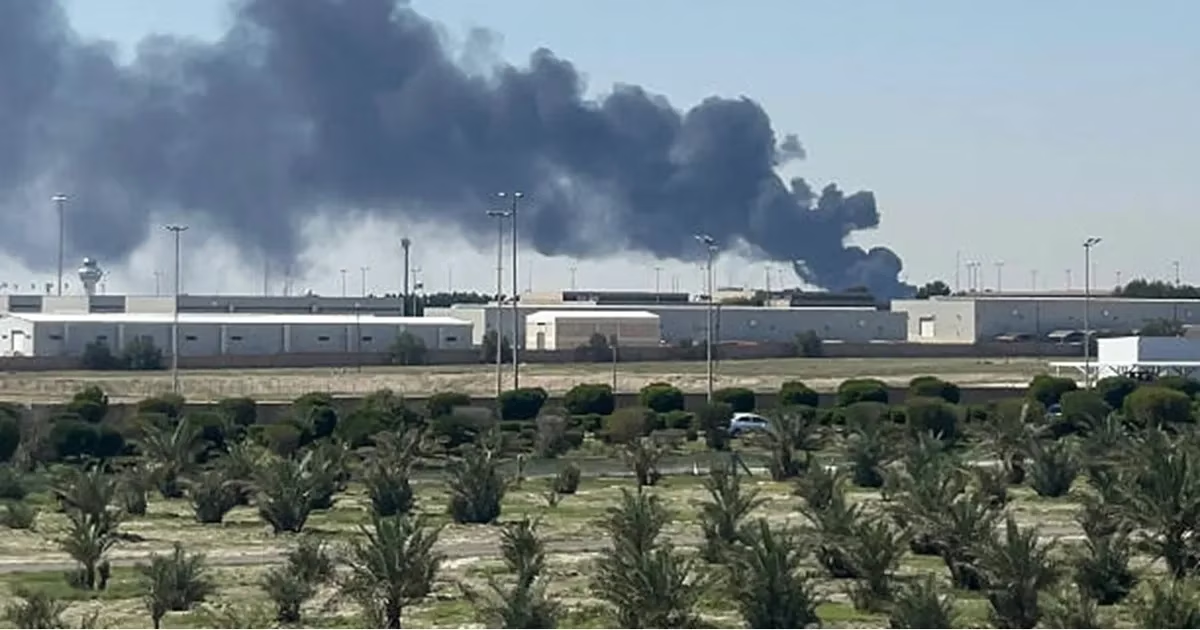
Despite vast military disparities, Tehran managed to forge a new reality on the ground that prevented the United States and the Israeli occupation from achieving a swift victory in the confrontation that erupted in early 2026. According to analytical readings, Iran adopted an innovative strategy known as 'Triple Coercion,' which focuses on shifting pressure from direct confrontation to targeting the vital interests of third parties with strategic ties to Washington.
This strategy enabled the Iranian leadership to overcome the initial shocks and the wave of assassinations that targeted its cadres, quickly moving to a phase of imposing military and political stalemate. This was clearly demonstrated by Tehran's ability to expand the conflict to include international energy corridors and neighboring countries, putting global economic interests at risk.
Since mid-March, Iranian forces have tightened their grip on the Strait of Hormuz, the most important shipping lane for oil and gas trade in the world. This move was not merely a show of force, but part of a calculated plan to limit the targeting of vital facilities deep within Iran by threatening to completely paralyze global energy movement.
At its core, the 'Triple Coercion' theory relies on attacking the weaker party in the adversary's equation to force them to retreat, which Tehran applied by targeting Gulf countries. Experts in deterrence strategies believe that Iran considered these countries the 'fragile link' through which pressure could be exerted on political decision-making in Washington, making them pay a heavy price.
The major turning point occurred on March 18, when the Israeli occupation army bombed the 'South Pars' natural gas field. The Iranian response was immediate and unconventional, with Iranian drones and missiles targeting the 'Ras Laffan' facility in Qatar, as well as vital oil facilities in Saudi Arabia and Kuwait, thereby drawing new boundaries for the conflict.
This Iranian escalation directed against Gulf energy facilities led to a historic surge in oil prices, placing President Donald Trump's administration under immense domestic and international pressure. Washington then realized that continued absolute support for Israeli operations could lead to an uncontrollable global economic collapse.
In a surprising move, the American president quickly disavowed the Israeli attack on the Iranian field, asserting via social media platforms that the strike was not coordinated with his country. This American stance represented a clear tactical retreat, as Trump pledged to stop attacks on Iranian facilities in exchange for Tehran ceasing to target allies in the Gulf.
Observers believe that this moment was an implicit declaration of the success of the Iranian deterrence equation, as serious discussions began about setting a ceiling for military escalation. Despite continued skirmishes, the basic rules of engagement changed in favor of the party that was able to efficiently threaten international energy flows.
The field results showed that the United States and the occupation, despite their relative immunity to direct strikes, remain exposed to the targeting of their regional allies. Tehran cleverly exploited this loophole to achieve political influence that forced the White House into a direct negotiating path to end the crisis.
On April 8, a ceasefire agreement was reached, but it did not include the reopening of the Strait of Hormuz, leaving the strongest leverage in Iran's hands. All subsequent American attempts, including naval blockades and economic pressures, failed to force Tehran to relinquish control of the shipping lane.
The American administration launched what it called 'Operation Freedom' to secure the ships stranded in the strait, which numbered over a thousand cargo ships and oil tankers. However, Washington was forced to withdraw from this operation a few days later, a clear indication of its inability to confront Iranian threats in a complex geographical environment.
Researcher Nicole Grajewski confirms that Iran's ability to curb American power reflects a shift in regional power balances, where traditional military power is no longer sufficient to resolve conflicts. Tehran now possesses a geopolitical 'insurance policy' that prevents its adversaries from considering launching comprehensive attacks in the future.
The strategic implications of this confrontation extend beyond the current war, as it has solidified Iran's position as an indispensable party in any future security arrangements. Chatham House believes that prolonged control over maritime navigation has granted Tehran gains that it will leverage in any upcoming international negotiations.
In conclusion, this experience revealed deep flaws in American foreign policy and its ability to protect its allies in major crises. It is likely that other regional powers will resort to emulating the Iranian model of using 'indirect coercion' to counter Western influence, ushering in a new phase of hybrid conflicts.
Iran currently holds a clear advantage, while the United States appears to be in disarray as a result of targeting the weakest links in its alliance system.
OPINIONS
Thu 21 May 2026 11:28 am - Jerusalem Time
The Return of Bipolarity: How the Beijing Summit Redrew the Map of Global Powers?
Ramallah - “Alquds ” dot com
Opinion Writer
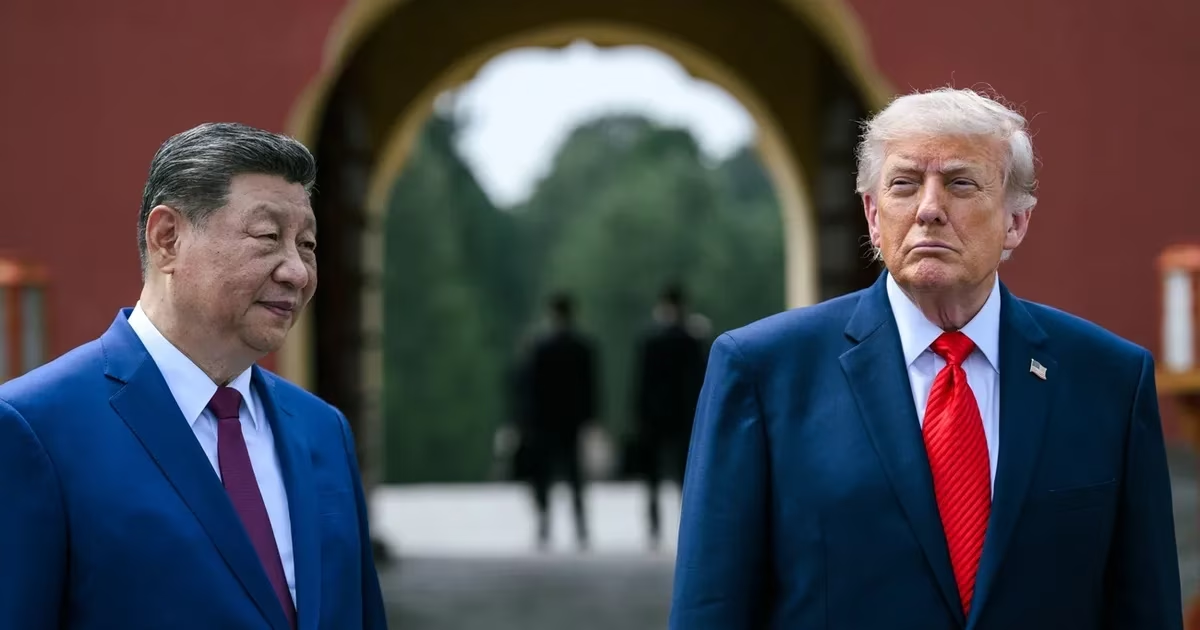
US President Donald Trump's visit to the Chinese capital, Beijing, marked a fundamental turning point in contemporary political history. It was not merely a diplomatic protocol but an implicit declaration of the end of the unipolar era. These meetings solidified the return of international balance between two great powers, bringing to mind the era of bipolarity that previously dominated the world, but this time with an overwhelming economic and commercial character.
After decades of American unipolarity following the collapse of the Soviet Union and the decline of Russian influence, China, with its characteristic calm, managed to climb the ladder of power to reach peer status. The conflict today is no longer ideological between communism and capitalism, as it was in the last century, but has become a fierce competition within the halls of global stock exchanges and the philosophy of the free market, in which everyone has become involved.
The features of this shift were evident in the nature of American demands, as the White House leader stood before his Chinese counterpart requesting trade facilitations and the opening of closed markets, in addition to seeking Beijing's support on thorny political issues such as the Iranian file. This scene summarizes a new reality in which absolute hegemony has faded in favor of a forced partnership imposed by mutual interests and the growing economic power of the East.
While the American and Chinese poles dominate the scene, other traditional powers such as Europe and Russia appear to have receded to the back rows, content to observe the major transformations with diplomatic smiles. In contrast, rising Asian powers from Singapore to India are emerging as future players who refuse to remain in the shadows, reinforcing the hypothesis that the future is now being written with Asian ink.
As for the African continent, it still lives in a state of political stagnation under the weight of regimes, some of which have lasted for half a century without real change that keeps pace with the acceleration of global time. While the world races in the arena of technological and economic development, the question remains about the ability of these regions to catch up with the new bipolarity train, which does not wait for those who are late for the modern imperial transformations.
The leader of the free world came asking for open markets and the demolition of walls from his Chinese counterpart, as if time is witnessing the return of imperial eras.
OPINIONS
Thu 21 May 2026 11:28 am - Jerusalem Time
Washington Threatens to Revoke Visas of Palestinian Mission to UN
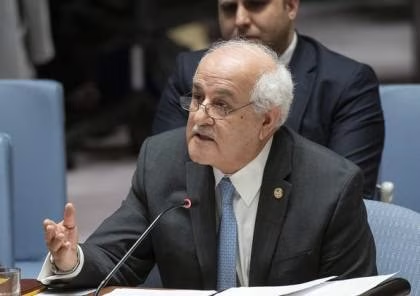
Washington – Said Arikat 21/5/2026
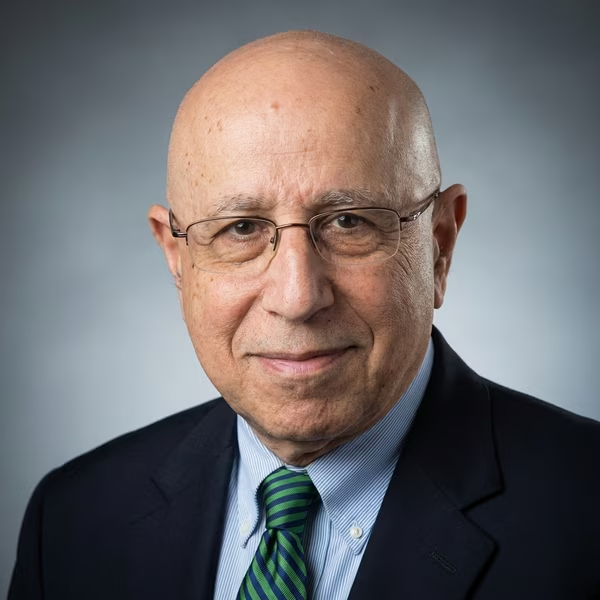
A leaked American diplomatic document revealed pressures exerted by the administration of US President Donald Trump on the Palestinian leadership to withdraw the nomination of Palestine's Permanent Representative to the United Nations, Riyad Mansour, for the position of Vice-President of the UN General Assembly, hinting at punitive measures that could include revoking the visas of members of the Palestinian mission in New York.
According to a cable issued by the US State Department on May 19, classified as "sensitive but unclassified" as reported by National Public Radio (NPR), American diplomats in Jerusalem were asked to exert direct pressure on Palestinian officials this week to persuade them to abandon the nomination, on the grounds that Mansour "has a history of accusing Israel of genocide" and that his assumption of a high-ranking position in the General Assembly "would fuel tensions and undermine Trump's peace plan for Gaza."
The cable included language considered threatening by observers, as it indicated that "Congress will take very seriously" the continuation of the Palestinian nomination, adding that "reconsidering visa waivers remains an available option."
This escalation comes at a time when the international arena is witnessing a sharp division over the Israeli war on Gaza, while the Palestinian Authority is trying to strengthen its diplomatic presence within the United Nations, benefiting from widespread international sympathy for Palestinian civilians after many months of war and destruction.
In a text message to Al-Quds newspaper correspondent, the Palestinian Permanent Ambassador to the United Nations, Riyad Mansour, denied the validity of these claims, noting that the US mission to the United Nations also denied the validity of these claims.
According to the radio, the office of Palestinian President Mahmoud Abbas refused to comment on the content of the cable, while the US State Department did not issue any official clarification regarding the leaks.
Unprecedented Diplomatic Precedent
Former diplomats say that threatening to revoke the visas of an accredited diplomatic mission to the United Nations is an unprecedented step in US-Palestinian relations. Despite successive US administrations, both Republican and Democratic, opposing Palestinian attempts to expand their international representation, resorting to the visa card against an entire UN mission raises broad legal and political questions.
Last year, the Trump administration prevented a number of senior Palestinian officials, including Palestinian Authority President Mahmoud Abbas, from obtaining visas to enter the United States ahead of General Assembly meetings, but at the time refrained from affecting the Palestinian mission to the United Nations.
In this context, former US official specializing in Palestinian affairs, Hady Amr, stated to the radio that threatening to use visa restrictions is "extremely rare" and is usually only used in extreme cases related to espionage or security interventions.
He added that "expelling diplomats or restricting their work undermines the ability of countries to resolve disputes through political and diplomatic channels."
Mansour had withdrawn his nomination for the presidency of the UN General Assembly last February, after similar American pressures, according to the leaked cable.
Israel's Ambassador to the United Nations, Danny Danon, welcomed the decision, considering the Palestinian nomination to be "an attempt to turn the General Assembly into a political circus against Israel."
Danon's statements reflect the extent of Israeli concern about the rising Palestinian political presence within the corridors of the United Nations, especially after the influential speeches delivered by Mansour during the war on Gaza, which received wide interaction within and outside the international organization.
Elections for the Vice-Presidents of the General Assembly are scheduled for June 2, with the list of candidates from the Asia-Pacific group including several countries such as Afghanistan, Iraq, Mongolia, and Palestine.
Washington fears, according to the cable, a "worst-case scenario" in which a Palestinian official is tasked with managing high-level UN sessions addressing the war in Gaza or Israeli policies.
Humanitarian Speeches that Angered Washington and Tel Aviv
Riyad Mansour's name prominently emerged in recent months due to his emotional speeches within the United Nations, especially when he broke down in tears during a session in May 2025 while speaking about Palestinian children killed in Israeli raids on Gaza.
He said then: "These are children… children," as he pounded the table with his fist, affected by the scenes of mothers embracing their dead children.
In August 2025, he also called for a ceasefire as "the only way to save Israelis and Palestinians together," emphasizing that the continuation of killing "is not an inevitable fate."
Observers believe that these speeches contributed to diplomatically embarrassing Israel, especially with the increasing international accusations regarding blatant humanitarian violations in Gaza by Israeli occupation forces, which explains the American and Israeli sensitivity to any broader UN role for Mansour.
The American pressures on the Palestinian mission reveal a clear contradiction between American rhetoric about freedom of diplomatic work and actual practice when it comes to the Palestinian issue. Washington, which constantly defends the "rules-based international order," seems willing to use immigration and visa tools to punish diplomatic representatives for political stances within the United Nations. This behavior not only weakens the image of the United States as an international mediator but also reinforces the prevailing global impression that the American administration treats international institutions as an arena for politically protecting Israel, not an independent space for balanced discussion and diplomatic representation.
The Israeli and American concern about the rise of Palestinian presence in the United Nations reflects a growing realization that the real battle is no longer just military, but also moral and informational. Riyad Mansour's influential speeches, especially those related to children and civilian victims, succeeded in conveying the Palestinian tragedy to global public opinion in direct humanitarian language that is difficult to contain with traditional propaganda. Therefore, Washington and Tel Aviv seek to reduce the space for this voice within international forums, fearing that global popular sympathy will turn into increasing political and legal pressure on Israel in international arenas.
This crisis also reflects the fragility of the relationship between the Palestinian Authority and the Trump administration, which, since its return to the White House, has re-adopted a policy of maximum political and diplomatic pressure on Palestinians. Instead of pushing for a real political process or ending the war in Gaza, the American priority seems to be focused on controlling Palestinian discourse and preventing any move that might give Palestinians symbolic momentum within the United Nations. However, this policy may backfire, as it grants Palestinian diplomacy more international sympathy and portrays Palestinians as a party being punished even within multilateral institutions that are supposed to represent the entire international community.
PALESTINE
Thu 21 May 2026 10:50 am - Jerusalem Time
Israeli Anger at the Growing Palestinian Narrative in New York: Mamdani Breaks American Consensus

Israeli concerns are mounting with the commemoration of the 78th anniversary of the Palestinian Nakba, as attention focuses on New York State and the emergence of political figures like Zohran Mamdani. Observers believe that Mamdani represents a current that rejects recognition of the legitimacy of the occupation, indicating a profound shift in the American political landscape regarding the Palestinian issue.
Conflict expert Uzi Rabi considered Mamdani's involvement in defending Palestinian rights to reflect the collapse of the traditional consensus around Israel within the United States. He explained that for the progressive left, the Palestinian issue has become a symbol of the global struggle against injustice, no longer merely a border dispute but a conflict between two opposing moral and historical narratives.
Mamdani has adopted the 1948 Palestinian narrative in all its dimensions, considering the Nakba a universal concept symbolizing the loss of homeland and ongoing systematic oppression. This approach places the Palestinian issue within a global discourse that connects the oppressed around the world, which raises suspicion among pro-occupation institutions in Washington.
Analysts point out that the new generation of progressive politicians, many of whom come from immigrant backgrounds, do not see Palestine as merely a foreign policy file. For them, the Palestinian issue is an integral part of their political identity based on anti-colonialism and the pursuit of social justice and international equality.
In this context, the so-called 'Red-Green Alliance' stands out, an intellectual coalition that combines the radical left and anti-Western Islamic political discourse. This alliance, though not a formal organization, forms a united front against what they describe as Israeli colonialism and subservience to traditional American institutions.
What directly concerns the occupation is that this current does not merely criticize specific government policies but challenges the legitimacy of the Jewish state's existence from its very foundation. Once Israel is categorized within the framework of 'colonial projects,' the goal for these activists becomes to delegitimize the entire political structure of the occupation, not just to negotiate borders.
Sources confirmed that the success of the Boycott, Divestment, Sanctions (BDS) movement was not primarily economic, but rather a remarkable success in shaping the consciousness of a new generation of students and politicians. These young people now speak a new moral language that describes Israel as an oppressive system, which represents a fundamental change in discourse that was once exclusive to academic circles.
In conclusion, the Israeli side believes that the transfer of these ideas from university halls to decision-making centers in major cities represents a long-term strategic threat. The 'Nakba' storm in New York is not a fleeting event, but an indicator that the American-Israeli relationship is entering a new phase of sharp polarization that touches the core of the Zionist narrative.
For a new generation of progressive politicians in the United States, the Nakba is not just a foreign policy stance, but part of their political identity.
PALESTINE
Thu 21 May 2026 10:50 am - Jerusalem Time
Fisherman martyred and 16 others injured in occupation attacks on Gaza Strip

Medical sources at Al-Shifa Hospital in Gaza City reported today, Wednesday, the martyrdom of Palestinian fisherman Muhammad Shamalakh after his boat was directly shot at by naval vessels belonging to the occupation. The sources explained that the fisherman was practicing his profession in the open Mediterranean Sea off the coast of Sheikh Ajlin, southwest of the city, when Israeli forces targeted him, leading to his immediate death and his arrival at the hospital as a lifeless body.
In a related context, Israeli warplanes launched a series of airstrikes targeting residential areas in the central part of the Strip, where a house belonging to the Abu Shamala family in Al-Bureij camp was bombed. The destruction operation came after the occupation army issued warnings to residents and neighboring homes about the necessity of immediate evacuation, causing a state of panic and forced displacement of families in the targeted area.
Regarding the overall toll, the Ministry of Health in Gaza announced an increase in the number of victims of the ongoing Israeli aggression since October 7, 2023, to 72,773 martyrs, in addition to 172,723 others with varying injuries. The ministry indicated in its periodic statement that the health system is still dealing with the influx of injured despite major challenges and the lack of necessary medical capabilities.
Official data issued by the ministry showed that the past twenty-four hours witnessed the registration of one martyr and 16 new injuries that arrived at hospitals. The sources also pointed out that the period following the ceasefire on October 11 saw an escalation in violations, during which 881 martyrs were killed and 2,621 Palestinians were injured in scattered attacks.
As part of search and rescue operations, medical and civil defense teams were able to recover 776 bodies from under the rubble and in border areas that witnessed previous incursions. Field teams continue their attempts to reach the missing despite the continuous intensive Israeli air activity and targeting of movements in the eastern and northern areas of the Strip.
Gaza Strip hospitals received one martyr and 16 injuries in the past twenty-four hours due to the ongoing attacks.
PALESTINE
Thu 21 May 2026 10:49 am - Jerusalem Time
Widespread International Condemnation of Israeli Humiliation of Freedom Flotilla Activists and Recall of Tel Aviv Ambassadors in Rome and Paris

Italian Prime Minister Giorgia Meloni expressed her strong condemnation of the way Israeli authorities treated the detained activists of the Global Freedom Flotilla. Meloni affirmed in an official statement that her country would not tolerate the violation of its citizens' dignity, demanding the immediate release of all detained Italians and an official apology from the Israeli government.
In an escalating diplomatic move, the Italian Ministry of Foreign Affairs summoned the Israeli ambassador in Rome to provide clear explanations regarding the circulated videos. Sources indicated that the Italian government considers the disregard of its previous demands concerning the activists' safety unacceptable, negatively impacting bilateral relations between the two sides.
For his part, Italian Foreign Minister Antonio Tajani described the leaked scenes as contradicting the most basic principles of human rights and human dignity. Tajani clarified through his official accounts that coordination with the Prime Minister's office led to immediate actions to respond to what he described as unjustified excesses against unarmed civilians.
On the French side, the position was not much different, as Foreign Minister Jean-Noël Barrot announced Paris's strong condemnation of the actions by Israeli National Security Minister Itamar Ben-Gvir. Barrot confirmed that he had issued instructions to summon the Israeli ambassador to France to express official protest and obtain immediate clarifications regarding the safety of French nationals.
The French minister stressed that the protection of French citizens abroad is a top priority for the French state, and their exposure to any kind of humiliation or ill-treatment cannot be accepted. Barrot demanded the swift release of all participants in the flotilla and ensuring their safe return to their countries without further delay.
The far-right Israeli minister, Itamar Ben-Gvir, had stirred a storm of controversy after publishing a video documenting moments of Israeli forces arresting and abusing activists. The video shows dozens of solidarity activists with their hands tied and kneeling in humiliating positions, while soldiers shout at them under the supervision of the minister himself.
In shocking footage, Ben-Gvir appeared waving the Israeli flag in front of the handcuffed activists, chanting provocative slogans inside a detention center. The video also documented the minister's demands to his prime minister, Benjamin Netanyahu, to place these activists in prisons designated for Palestinian prisoners, describing them as 'saboteurs' in open incitement against them.
The video also included a violent assault by Israeli soldiers on an activist who chanted 'Freedom for Palestine' as Ben-Gvir passed by, where the elements pulled her hair and threw her to the ground forcefully. Instead of stopping the assault, the Israeli minister appeared smiling and directing abusive words at her, demanding her silence amidst the laughter of the surrounding soldiers.
The scenes also showed the abducted individuals being taken to detention tents under harsh conditions and sarcastic comments from Ben-Gvir, who was chanting 'The people of Israel live.' These images, according to observers, reflect a state of political showmanship practiced by the far-right in Israel at the expense of international laws and norms regarding the treatment of international solidarity activists.
In turn, the Islamic Resistance Movement (Hamas) strongly condemned these practices, describing them as scenes of abuse and humiliation that reflect the sadism of the occupation leaders. The movement said in a press statement that what happened was a desperate attempt to intimidate international activists and deter them from performing their humanitarian role in trying to break the unjust siege imposed on the Gaza Strip.
The movement considered that these behaviors confirm the state of moral degradation reached by the occupation army and its political leaders, while at the same time praising the courage of the activists. It affirmed that the will to break the siege will not stop in the face of these attacks, but will increase the international community's determination to expose the ongoing crimes of the occupation against the Palestinian people.
Amnesty International joined the condemnations, describing the seizure of the flotilla ships and the abduction of those on board as a 'shameful and inhumane' act. The organization called on the international community to exert real pressure on Israel to stop its piracy in international waters and ensure the protection of human rights activists who seek to provide humanitarian aid.
The 'Global Freedom Flotilla' comes as part of a series of initiatives aimed at highlighting the escalating humanitarian suffering in the Gaza Strip since last October. The Strip suffers from a severe shortage of all basic necessities of life as a result of the tight siege and ongoing military operations that have destroyed infrastructure and the health system.
It is worth noting that this is not the first time Israeli forces have intercepted ships carrying humanitarian aid in international waters, as incidents of abduction and forced deportation of activists have been repeated. Israel continues to impose its siege on Gaza since 2007, ignoring all international resolutions and appeals to open crossings and facilitate the passage of relief convoys.
It is unacceptable that these protesters, including many Italian citizens, are subjected to such treatment that violates human dignity.
PALESTINE
Thu 21 May 2026 10:49 am - Jerusalem Time
Behind the Scenes of the Failure of 'Trump's Plan' in Gaza: Billions of Dollars in Promises and a Reality Drowning in Rubble

The American plan to reconstruct the Gaza Strip is facing a real predicament more than seven months after the ceasefire agreement brokered by US President Donald Trump in October 2025. Field data reveals a state of complete paralysis in construction operations, amidst funding difficulties plaguing the 'Peace Council' tasked with overseeing the transitional phase.
According to international press reports, the reality in Gaza is characterized by bleak ambiguity, as Palestinian technocrats assigned to administer the Strip remain stranded in Egyptian territory. Israeli occupation authorities prevent these officials from entering the Strip to carry out their duties, which has marginalized their role and rendered the administrative committee an inoperative entity.
Regarding financial support, figures have shown a huge gap between promises and reality; out of 7 billion dollars pledged by nine countries during the inaugural meeting of the Peace Council, only the UAE and Morocco have committed to payment. An informed source indicates that donor countries are now hesitant to transfer their shares due to the ongoing diplomatic stalemate and the absence of any tangible progress on the ground.
The shocking figures indicate that what has actually been collected represents only $1.75 for every $100 of the announced pledges. This financial scarcity starkly contrasts with estimates issued by the United Nations, which confirm that the cost of reconstructing what the war destroyed exceeds 70 billion dollars and could take many decades.
In a related context, a separate pledge of 10 billion dollars made by Trump remains shelved and under the control of US State Department official Jeremy Lewin. Sources reported that the Peace Council has not officially requested these funds yet, while some donors use regional tensions as a pretext to delay paying their financial commitments to the Strip.
While Gaza residents suffer from a lack of services, a salary crisis emerged for the 'National Committee for Gaza Administration' based in Egypt, where its 12 members receive salaries ranging from 16 to 17 thousand dollars monthly. Reports also revealed that the salary of Nikolay Mladenov, the High Representative for Gaza, amounts to about 400 thousand dollars annually, figures that sparked widespread criticism within the Council itself.
Despite these budgets allocated for administration, field sources confirmed that not a single bottle of water has entered Gaza under the banner of this committee since the beginning of this year. This paradox reflects the lack of field impact of the entities created by the American plan to manage Palestinian affairs in the afflicted Strip.
While US President's advisor Jared Kushner was promising donors in Davos an 'amazing success' and the transformation of Gaza into a global tourist hub with smart cities and airports, reality is drowning in an unprecedented humanitarian tragedy. Israel still controls more than half of the Strip's area and imposes strict restrictions preventing essential aid from reaching the displaced.
Hundreds of thousands of Palestinians live in temporary and makeshift tents amidst widespread hunger and a complete collapse of the health and education systems. Even American promises to establish 'fenced and semi-permanent' camps as a temporary alternative have not materialized on the ground, leaving residents in direct confrontation with harsh living conditions with no prospect of a solution.
Local and international contractors, for their part, expressed their frustration at the halt of tenders for rubble removal, as no actual contracts have been signed yet. They confirmed that machinery remains idle, and no practical step has been taken to prepare the ground for the start of construction operations promised to residents after the cessation of aggression.
In contrast, the Peace Council defends its performance, with a senior official denying the existence of a suffocating financial crisis, considering the liquidity shortage as part of a broader funding crisis for UN programs. The Council clarified in a report addressed to the international organization that the gap between pledges and disbursement is what separates a 'framework on paper' from real results.
Nikolay Mladenov acknowledged in a briefing to the Security Council that 'the door to Gaza's future remains closed,' pointing out that continuous violations of the ceasefire by both sides hinder any reconstruction effort. This admission reflects the magnitude of political complexity surrounding the Palestinian issue and the intertwining international agendas that impede relief.
Informed sources raise pessimistic questions about the Council's ability to implement even in the event of major political shifts such as the disarmament of factions. Observers believe that the worst outcome could be the Palestinian parties agreeing to international conditions, followed by the international community's inability to provide the necessary logistical and financial support to begin implementation.
The future of more than two million Palestinians in Gaza remains suspended between glittering American promises and the bitter reality left by the war of annihilation. While officials in Washington talk about 'smart cities,' displaced people struggle for survival in camps lacking the most basic necessities of life, awaiting a genuine international will to end their ongoing suffering.
Not a single bottle of water has entered Gaza under the banner of the National Committee since January 2026, and promises of smart cities remain ink on paper.
PALESTINE
Thu 21 May 2026 10:49 am - Jerusalem Time
Washington lifts sanctions on UN rapporteur Francesca Albanese by judicial decision

US authorities announced on Wednesday the lifting of financial and legal sanctions that had been imposed on the United Nations Special Rapporteur on the situation of human rights in the occupied Palestinian territories, Francesca Albanese. This step came in implementation of a judicial order issued by federal courts, after a period of diplomatic and legal tension surrounding the international official's positions on the war in the Gaza Strip.
A formal notice published on the US Treasury Department's website confirmed the removal of Albanese's name from the global blacklist, a measure that had prohibited her from using major credit cards or conducting any transactions through the international banking system. This reversal represents a shift in the punitive measures taken by the US administration against UN figures critical of Israeli policies.
Washington had imposed these sanctions in July 2025, in response to statements made by Albanese criticizing US support for military operations in the Gaza Strip. The justifications for the sanctions at the time also included her recommendation to the International Criminal Court to issue arrest warrants for Israeli Prime Minister Benjamin Netanyahu on charges related to war crimes.
For his part, Federal Judge Richard Leon issued a decision to suspend these sanctions last week, emphasizing in his ruling that the protection of freedom of expression must remain a priority that serves the public interest. The judicial decision considered that restricting the UN official's financial movement due to her political views represents a legal overreach that requires immediate correction.
In contrast, Secretary of State Marco Rubio had launched a sharp attack on Albanese when the sanctions were announced last year, describing her activities as "biased and malicious." Rubio explicitly accused her of antisemitism and supporting terrorism, accusations that Albanese categorically rejected, asserting that she was performing her professional duty in monitoring human rights violations.
Albanese, an Italian lawyer, has held her UN position since 2022 under a mandate from the Human Rights Council, and although she does not officially speak on behalf of the international organization, her reports receive widespread attention. In previous reports, she accused the Israeli occupation authorities of committing acts amounting to "genocide" in the Gaza Strip, which exposed her to intense international pressure.
The UN rapporteur confirms that she has been subjected to a series of threats and harassment since assuming her duties, due to her outspoken positions on violations in the occupied territories. The lifting of sanctions against her brings renewed attention to the legal and political conflict within the United States regarding the limits of criticizing Israel and protecting immunities associated with international human rights work.
Protecting freedom of expression always serves the public interest.
PALESTINE
Thu 21 May 2026 10:48 am - Jerusalem Time
US threats to revoke Palestinian delegation's visas to prevent 'Mansour' from running for UN post

Media sources have revealed an unprecedented American move targeting the Palestinian diplomatic mission to the United Nations, with Washington threatening to revoke the entry visas of the delegation members. This threat comes as part of the US administration's efforts to prevent Palestinian Ambassador Riyad Mansour from competing for the position of Vice President of the United Nations General Assembly in its upcoming session.
Press reports indicated that the US State Department issued direct instructions to its diplomats in occupied Jerusalem to exert intense pressure on the Palestinian leadership. These moves aim to force the Palestinian side to immediately withdraw Mansour's nomination, with warnings of dire diplomatic consequences if they insist on this step.
According to a diplomatic cable classified as 'sensitive,' the US administration views Ambassador Riyad Mansour as a political adversary due to his history of criticizing Israeli policies. The cable accuses Mansour of continuously working to accuse Tel Aviv of committing genocide, which Washington completely rejects and considers an obstacle to the peace process.
The US State Department considered that Palestine's accession to the position of Vice President of the General Assembly would undermine the 'peace plan' proposed by President Donald Trump. This plan includes a vision for the reconstruction of the Gaza Strip and the establishment of a so-called 'Peace Council,' which Washington sees as threatened if the Palestinians gain an official and influential platform within the international organization.
Sources indicated that American pressure was not limited to diplomatic aspects but also extended to sensitive economic files concerning the Palestinian Authority. US diplomats hinted that non-compliance with demands could hinder any progress in the file of recovering tax and customs funds that the Israeli government has long withheld.
Political circles in Washington fear that this position would provide Palestinians with an opportunity to chair high-level sessions related to Middle East issues. The US administration believes that the internationalization of the conflict through UN institutions and international courts does not serve the peace process but rather complicates the political landscape and bilateral relations between Washington and Ramallah.
The threat to revoke the visas of accredited diplomats to the United Nations is a qualitative escalation unprecedented in dealing with the Palestinian mission. Although the Trump administration previously refused to grant visas to senior officials last year, targeting the permanent delegation in New York represents a breach of diplomatic norms followed with the international organization.
Elections for the Vice Presidents of the General Assembly are scheduled for June 2, with the Palestinians competing within the Asia-Pacific group. Washington is seeking to resolve the issue of Mansour's withdrawal by no later than May 22, to ensure he does not reach one of the sixteen positions allocated for Vice Presidents.
It is worth noting that Ambassador Riyad Mansour faced similar pressures last February, which then led him to withdraw from running for the presidency of the General Assembly. The US administration is currently repeating the same strategy to prevent him from assuming the deputy position, considering that his presence in this position will not contribute to improving the living conditions of Palestinians on the ground.
These developments come at a time when Palestinian-American relations are witnessing escalating tension due to biased positions towards the occupation. The Palestinian mission insists, so far, on its right to international representation, despite threats that could lead to paralysis in its diplomatic activity within the United Nations in New York.
Granting Mansour a platform will not improve the lives of Palestinians, but will cause serious damage to US relations with the Palestinian Authority.
OPINIONS
Thu 21 May 2026 10:48 am - Jerusalem Time
Kentucky Elections Open File on Israeli Influence in American Politics

Washington – Said Arikat – 5/21/2026
The Republican primary elections in Kentucky transformed from an ordinary local competition into a broad political confrontation that highlighted the influence of pro-Israel lobbying groups within the United States, after Republican Representative Thomas Massie lost his seat to the candidate supported by US President Donald Trump and multiple Israeli lobby organizations.
The election battle, considered one of the most expensive and controversial races this year, saw a massive influx of money from entities and individuals supporting Israel, including billionaire Miriam Adelson, widow of casino magnate Sheldon Adelson, the Israeli-American who funded Israeli Prime Minister Netanyahu and US President Donald Trump's 2024 election campaign, with the aim of unseating Massie, who angered pro-Tel Aviv lobbies due to his stances against foreign aid, including US military aid to Israel.
Despite his significant loss, the voting results revealed a growing division within the Republican Party regarding the relationship with Israel, especially among younger generations. Electoral estimates showed that the majority of Republicans under the age of forty voted for Massie, indicating rapid shifts within the conservative movement towards foreign policy issues and political influence associated with Israel.
Observers believe that the race transcended the boundaries of traditional partisan competition, becoming a political test for any Republican representative attempting to break the historical American consensus supporting Israel. The campaign against Massie did not only focus on his political program but also sought to portray him as someone outside the mainstream of the Republican Party.
For decades, Israel has maintained strong support within both Democratic and Republican establishments, while influential lobbying groups, most notably the American Israel Public Affairs Committee (AIPAC), have played an influential role in funding election campaigns and building extensive political and media networks within Washington.
However, the Israeli war on Gaza and the accompanying images of destruction and civilian casualties have led to clear shifts in American public opinion, especially among young people who have become more skeptical of the traditional Israeli narrative and less willing to grant unconditional support to Tel Aviv.
These shifts have also begun to extend to conservative and libertarian sectors within the Republican Party, which made Massie represent a new model for a right-wing current that rejects foreign interventions and believes that aid to Israel is inconsistent with the slogan "America First."
The Massie case reflects a decline in the American political establishment's ability to control the public debate about Israel as it did in past decades. Social media has allowed Americans to follow the war in Gaza directly, away from the traditional narrative that long dominated American media. This shift has created a different political awareness among new generations, who now view the Palestinian issue from a humanitarian and human rights perspective rather than merely a security file linked only to Israel. Furthermore, internal economic pressures have led many to question the feasibility of continued massive foreign aid at a time when domestic crises in the US are escalating.
The election campaign against Massie was characterized by the intensive use of political advertisements and financial spending, as lobbying groups flooded the state with campaigns aimed at politically isolating him and warning any other Republican representative from repeating his stances.
Trump also played a direct role in the battle, having considered Massie's loss a political necessity to re-impose discipline within the Republican Party, especially amid the rise of conservative voices criticizing the party's traditional foreign policies.
In the background of the scene, other disagreements between Massie and the US administration also emerged, including his repeated demands to disclose documents related to the Jeffrey Epstein case, a case that continues to stir widespread controversy within the United States.
With the escalation of the debate, conservative voices began to demand that pro-Israel lobbying groups be subjected to the Foreign Agents Registration Act (FARA), which imposes transparency standards on entities associated with foreign interests.
Although these calls are still limited in their impact within Congress, their mere public circulation within Republican circles represents a significant change in American political discourse.
The debate within the United States is no longer solely about Israel and the Palestinians, but has also become linked to the nature of the American political system itself. The increasing role of political money in elections, especially when linked to foreign issues, has raised growing concern among broad segments of Americans who feel that political decisions are becoming more linked to major funders than to ordinary voters. With declining trust in political and media institutions, any massive spending campaign is interpreted by many as an attempt to impose a political will on American society, which explains the extent of the anger that accompanied the recent Kentucky battle.
Analysts believe that what happened also reflects a crisis within the "America First" movement, as some Trump supporters are now questioning why unlimited support for Israel continues, at a time when inflation rates, debt, and social crises are rising within the United States.
In contrast, defenders of Israel cling to it as a key strategic ally for Washington in the Middle East, and believe that any decline in its support would lead to a weakening of American influence in the region.
However, with the widening gap between the political establishment and public opinion, these arguments seem less capable of convincing increasing segments of Americans, especially young people and populist conservatives.
The Republican primary elections in Kentucky reveal that the debate about Israel has entered a new phase within the United States, where criticism of Israeli policies is no longer confined to the progressive left or student movements. The presence of conservative voices criticizing foreign aid and the political influence of pro-Israel lobbies means that the shifts are deeper and more widespread. Although Massie lost his seat, the extent of support he received among young Republicans indicates a gradual change that may reshape the American debate about the Middle East in the coming years, especially if wars and humanitarian crises in the region continue to escalate.
OPINIONS
Thu 21 May 2026 10:48 am - Jerusalem Time
War!

Decisive, dramatic, and pivotal; this is how the lengthy call between Netanyahu and Trump yesterday was described, as part of the "fox's" frantic attempt to incite the "madman" to resume the war against Iran as soon as possible.Netanyahu's arrogance, his blatant interference in American foreign policy, and his bullying of the White House residents are summed up by a famous saying from a close friend of former President Bill Clinton after a meeting between them: "It was not clear which of us was the leader of the world's superpower!"And today, Netanyahu returns to practice the same blackmail with the "inflated ego," exploiting his involvement in the "Epstein" files to turn the latter into a pliable tool that the "fox" manipulates to reignite the confrontation with Tehran, keeping the region and the world in a state of anticipation and bated breath, amidst constant confusion striking global supply chains.Six weeks of continuous strikes, in which Washington used the latest in its deadly arsenal, and the regime in Tehran did not fall. This failure raises major questions about the nature of the weapons that Washington and Tel Aviv might resort to in the anticipated strike, which Trump boasted would "end quickly."And because Trump is racing against time with the approach of two major deadlines; the World Cup matches in June, and then the midterm elections, there is a fear that Trump will – or delegate Netanyahu for the dirty mission – use tactical nuclear weapons that will turn selected targets on the Persian plateau into ashes, to create soft and burnt areas that facilitate their access to the heart of the nuclear stockpile in Isfahan.
OPINIONS
Wed 20 May 2026 7:12 pm - Jerusalem Time
Rereading the Palestinian Dilemma in the Face of Israeli Occupation
The Palestinian situation is not merely a traditional political conflict between a people under occupation and a state with immense military superiority. Rather, it appears as one of the most complex dilemmas in modern human history, because it is not only based on land, borders, and weapons, but on an intertwined network of history, fear, memory, identity, and psychological and political contradictions that have made each party, in a way, a reflection of the other, and influenced by it even in the most hostile moments.
In all peoples who have lived under occupation, or on the verge of displacement, the same question has arisen in different forms: How can one survive without surrendering? And how can one resist without collective suicide? But in the Palestinian case, this question becomes more cruel and complex, because the Palestinian faces not only military occupation, but also a state full of internal contradictions, a changing world, and at the same time, their fear of losing their cause if the wait is prolonged, and their fear that an open confrontation might exhaust society itself.
Hence, a deep division emerged within the Palestinian situation between those who prefer “long-term steadfastness and minimizing losses” and those who believe that “direct pressure” is a necessity even if the cost is high. This division was not a conflict between betrayal and patriotism, or between courage and cowardice, but between two different interpretations of the meaning of survival and the meaning of liberation under a huge imbalance of power.
Supporters of long-term steadfastness start from a cold reading of reality. They believe that occupations do not always collapse through sudden explosions, but sometimes through slow erosion. They believe that Israel, especially when governed by hardline governments, possesses an immense ability to turn any widespread military confrontation into a humanitarian catastrophe for Palestinians, and that the militarily stronger party often wants to drag its opponent into a field it already knows it excels in. Therefore, they believe that wisdom is not in fighting every battle, but in knowing which battles one can survive after.
In their view, survival itself is resistance. Building a school under siege is resistance, preventing social collapse is resistance, and keeping society alive despite all attempts to weaken it is a form of slow victory. These people fear that grand slogans will turn into fuel for wars that do not change the balance of power, but rather change people's lives for the worse for long decades. Therefore, they prefer quiet accumulation: building institutions, improving the economy, maintaining a minimum of stability, and avoiding major explosions that could set society back years.
However, this vision constantly faces the accusation that it might gradually turn into managing defeat instead of resisting it. Its opponents say that occupation does not understand the language of patience alone, and that the dominant power, when not facing real pressure, expands further and becomes less willing to make any settlement. For them, talking about “minimizing losses” might, over time, turn into an unannounced acceptance of the status quo.
From here emerges the “direct pressure” current. This current believes that a high cost is not always a choice, but an inevitable result of any confrontation with a superior power. It believes that peoples do not obtain their rights merely by waiting, but by creating a political, security, and moral price that makes the continuation of the occupation costly for the other party as well. In the mind of this current, the problem is not in escalation itself, but in the absence of the ability to impose an equation that makes Israel feel that the continuation of the current situation is not free.
This trend is also fueled by a deep sense of daily humiliation. When a Palestinian lives for long years under restrictions, fear, and political deadlock, talk of “managing the conflict” becomes, for some, akin to asking for eternal coexistence with suffocation. At that point, confrontation, even if militarily losing, turns into an attempt to restore dignity and meaning above all else.
But the dilemma of this approach is that it clashes with a harsh reality: Palestinian society always pays the biggest price. Every widespread escalation leaves behind economic, social, and psychological devastation, and re-produces the same questions: Does open confrontation really change the equation, or does it open repeated cycles of bleeding without a clear horizon?
At the heart of this dilemma, the Palestinian leadership stands in a continuous historical perplexity. The problem was not only: How do we confront the occupation? But also: How do we deal with the contradictions of the Israeli situation itself? Israel is not a single homogeneous bloc; it contains the national and religious right, the pragmatic security establishment, and currents that believe in complete resolution, and others that fear that continued control over another people will lead to long-term moral and political ruin. Therefore, Palestinians have always tried to understand: Which Israel are they facing? The fearful Israel or the superior Israel? The Israel that wants to manage the conflict or the one that wants to resolve it by force? Or the Israel that doesn't even know what kind of end it wants?
Conversely, Palestinians were also not a single bloc. Within Palestinian society itself, all possible contradictions emerged between realism and dreams, between politics and emotion, and between the necessities of daily life and the desire for complete liberation. This is why the Palestinian decision remained stuck in an almost impossible question: How can a rational long-term decision be made in a constantly changing reality, controlled by huge power imbalances, regional and international pressures, internal divisions, and unpredictable Israeli transformations?
Every Palestinian step has always clashed with a complex Israeli mirror. When the leadership chose negotiation, it was accused internally of making concessions without return, while Israeli governments continued to expand their security and settlement policies. And when Palestinian forces chose escalation, Israel used that to justify further military grip, isolation, and to strengthen its security narrative to the world. It was as if every Palestinian action found someone within Israel to employ it for their own vision.
Thus, the two parties truly became reflections of each other. Israeli fear of Palestinians generated more hardline policies, and these policies generated deeper Palestinian anger, and Palestinian anger, in turn, reinforced Israeli fears and pushed Israeli society further towards the security right. It is a closed loop that constantly reproduces itself, until it sometimes seemed that the two parties psychologically inhabited each other more than the wall separated them.
The Palestinian lives the occupation as a complete daily structure: in movement, economy, geography, political language, and even in the small details of life. And the Israeli lives the Palestinian as a constant presence in their security, historical, and political consciousness. This is why the conflict has transcended the boundaries of land to become a conflict over narrative, fear, memory, identity, and the future of the entire region.
And perhaps the deepest tragedy is that both parties, despite all this blood and hostility, have reached a truth that neither can escape: no one is capable of eliminating the other, and no one has yet succeeded in finding a just and safe formula for coexistence with the other's existence. Israel, despite its military superiority, has not succeeded in transforming power into permanent stability, and Palestinians, despite all forms of steadfastness and resistance, have not succeeded in breaking the reality imposed by the immense power imbalance.
This is why the Palestinian-Israeli situation appears to be one of the most complex human and political dilemmas in modern times. The issue is not only how a people is liberated, nor only how a state seeks security, but how two peoples, each carrying a memory of fear and a deep wound, can break out of a cycle that constantly reproduces itself.
In the end, the Palestinian remains suspended between two great fears: the fear of slow dissolution under long-term occupation management, and the fear of a major explosion that might consume what remains of society's capacity to endure. And between these two fears, the attempt to find an almost impossible equation continues: how to preserve dignity without losing life, and how to resist a harsh reality without resistance itself becoming a burden beyond people's capacity to endure.
PALESTINE
Wed 20 May 2026 7:11 pm - Jerusalem Time
Smotrich Signs Order for Immediate Evacuation of Khan al-Ahmar Gathering East of Jerusalem

Israeli Finance Minister Bezalel Smotrich issued a decision for the immediate evacuation of the Khan al-Ahmar Bedouin community located east of occupied Jerusalem. This announcement came at a sensitive political time, as the far-right minister affirmed that this measure falls within his direct legal powers, vowing that this step is only the beginning of a new phase of field policies.
Media sources revealed that Smotrich seeks, through this decision, to impose a new reality in the West Bank, indicating that he is leading a massive settlement plan. This plan includes the establishment of more than 100 new settlements and about 160 agricultural outposts, in addition to legalizing existing outposts and expanding the road network that serves settlers at the expense of Palestinian lands.
Observers link the timing of this decision to the international legal pressures Smotrich has been facing recently. Reports indicated that the minister received an official notification that the International Criminal Court in The Hague had received a request to issue an arrest warrant against him, which might push him to escalate measures on the ground to escape political and legal crises.
The Khan al-Ahmar community, inhabited by the Jahalin tribe, is a geographically crucial stronghold in the land conflict. The community is located in a strategic area separating the northern and southern West Bank, surrounded by a settlement belt that includes the settlements of 'Ma'ale Adumim' and 'Kfar Adumim,' making its control a vital objective for the occupation.
Through the demolition of the community, the occupation authorities seek to complete the 'E1' settlement project, which aims to completely isolate East Jerusalem from its Palestinian surroundings. This plan directly threatens the possibility of a geographically contiguous Palestinian state, as the evacuation of Khan al-Ahmar will tear apart the West Bank and turn it into isolated cantons.
The Khan al-Ahmar issue has witnessed widespread international tensions since 2018, when the Israeli government first attempted to carry out the demolition. However, intense international pressure, especially from the US administration and the European Union, forced successive governments to freeze the decision for fear of diplomatic and legal repercussions in international forums.
The United Nations has warned on previous occasions that any forced displacement of Khan al-Ahmar residents could amount to a 'war crime.' These warnings are based on international law, which prohibits the occupying power from forcibly transferring civilian populations from their lands, which puts the Israeli government in direct confrontation with the international community.
On the Palestinian side, there was a state of anger and warning of an explosion of field conditions as a result of this escalatory decision. National and legal activists considered targeting Khan al-Ahmar as targeting the Palestinian presence in Jerusalem as a whole, calling for intensified popular steadfastness in the community to confront the expected demolition mechanisms at any moment.
Political analysts believe that Smotrich is exploiting the internal turmoil in Israel and the debate about early elections to boost his popularity among the far-right. By pushing settlement and displacement issues, the minister is trying to establish himself as a leader of the settlement movement capable of implementing ideological promises despite international and local opposition.
Field data indicate that Bedouin communities around Jerusalem suffer from continuous tightening, including building prohibitions and the demolition of educational and health facilities. This systematic tightening aims to push residents to leave 'voluntarily' after the impossibility of livelihoods, which the occupation has failed to achieve so far in the face of the steadfastness of the people of Khan al-Ahmar.
The implementation of the immediate evacuation decision will lead to the displacement of more than 200 people, most of them children and women, who already live in harsh conditions. The area lacks basic infrastructure due to Israeli restrictions, yet residents insist on staying on their land, to which they resorted after their first displacement in 1948.
On the economic front, Smotrich claimed in his statements that he succeeded in maintaining the stability of the Israeli economy despite the multi-front war. However, his opponents believe that his extremist policies in the West Bank increase the financial and security burdens on the state and lead to further international isolation that will negatively affect investments and the economy.
In conclusion, the fate of Khan al-Ahmar remains suspended between the insistence of the far-right on demolition and the Palestinian and international ability to curb this trend. The coming days will be decisive in determining the direction of the conflict in this strategic area, amid real fears that the decision will lead to a new wave of comprehensive escalation in the occupied territories.
This is just the beginning; we are leading policies to entrench the settlement project through construction, road paving, and the organization of agricultural outposts.
ARAB AND WORLD
Wed 20 May 2026 7:11 pm - Jerusalem Time
Shuttle Diplomacy.. Pakistan's Interior Minister Returns to Tehran to De-escalate Tensions with Washington
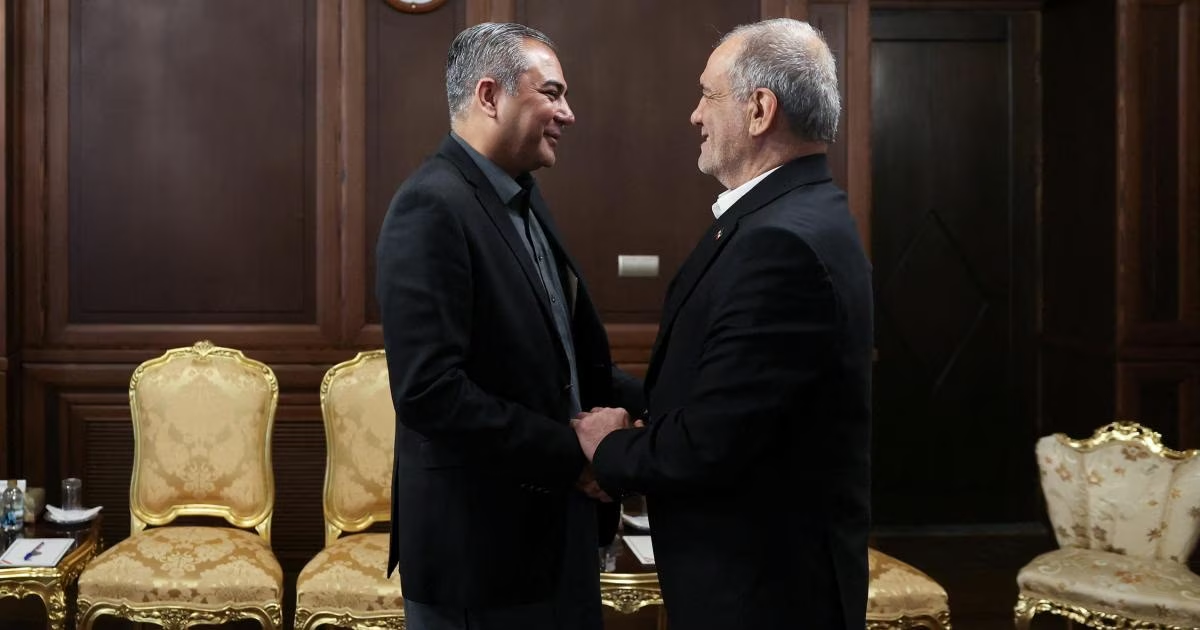
Pakistani Interior Minister Mohsin Naqvi arrived in the Iranian capital, Tehran, on a surprise official visit, less than two days after concluding his previous visit. Official sources reported that these shuttle movements reflect a state of diplomatic alert in Islamabad to deal with the rapidly evolving developments in the Iranian file.
Official circles in Tehran or Islamabad did not precisely disclose the Pakistani minister's agenda, but diplomatic sources indicated deep Pakistani concern about the possibility of resuming military operations. Through this visit, Pakistan seeks to solidify open channels of dialogue and prevent any breakdown in the current diplomatic process.
These movements come within the framework of mediation led by Pakistan and widely supported by China and regional and Gulf powers, aiming to pave the way for a comprehensive political settlement. Observers believe that Islamabad is trying to play the role of a bridge between Tehran and Washington to avoid war scenarios that could destabilize the entire region.
During his first visit, which lasted from Saturday to Monday, Naqvi held a series of high-level meetings, including with Iranian President Masoud Pezeshkian. He also held discussions with Parliament Speaker Mohammad Bagher Ghalibaf, who led his country's delegation in previous negotiation rounds with the American side in Pakistan.
These diplomatic movements coincided with Tehran's announcement of submitting its official response to the latest American proposals regarding the nuclear file and regional issues. In contrast, US President Donald Trump expressed his objection to those proposals, which increased the pace of tension and the need for mediators to intervene.
In a related context, the Iranian President sent reassuring messages to neighboring countries, emphasizing that his country's foreign policy is based on the principle of good neighborliness and regional cooperation. These messages come at a sensitive time when Iran is trying to neutralize regional fronts in the event of any direct confrontation with international powers.
In statements coinciding with the Pakistani minister's presence in Tehran, the US President revealed that he was about to make a decision to attack Iranian targets. Trump explained that he backed down from this military option at the last minute in response to mediations led by active Gulf states in the region.
Pakistani-Iranian discussions also covered sensitive security files related to securing the long shared border between the two countries, which extends for hundreds of kilometers. Tehran fears that Washington might exploit some separatist groups on the border to destabilize internal security, which Iran describes as terrorist movements.
On the economic front, Pakistan has played a vital role in alleviating the burden of the US naval blockade imposed on Iranian exports and imports. Islamabad has opened land trade corridors to facilitate the movement of goods, which has strengthened the robustness of bilateral relations in the face of continuous external pressures.
In Islamabad, the government maintains official silence regarding the details of the mission led by Naqvi, preferring to work away from the spotlight to ensure the success of the mediation. Pakistan aims through this move to provide a safe exit for both the Iranian and American sides, ensuring they save face and preventing a slide towards confrontation.
For his part, former Pakistani Ambassador to Tehran Asif Durrani affirmed that the visit holds exceptional importance in conveying mutual messages between Washington and Tehran. Durrani clarified that his country's role focuses on facilitating discussions and bridging divergent viewpoints, rather than exerting pressure on either party.
Pakistani diplomacy is making redoubled efforts to maintain the extension of the undeclared ceasefire and to try to reach a permanent political settlement. Islamabad realizes that any outbreak of war in its western neighbor would have catastrophic repercussions on its national security and its already struggling economy.
Islamabad has redoubled its efforts to find a solution to the conflict, as it believes that reigniting the war would be a disaster for everyone.
PALESTINE
Wed 20 May 2026 7:11 pm - Jerusalem Time
Warnings of 'compensatory incursions' into Al-Aqsa and settlement attempts to introduce sacrifices

Dozens of extremist settlers stormed the courtyards of the blessed Al-Aqsa Mosque this Wednesday morning, under heavy protection from the Israeli occupation police. These incursions come amidst intensive calls from alleged Temple groups to carry out large-scale incursions tomorrow, Thursday, in what is known as a 'compensatory incursion' coinciding with the upcoming Jewish holidays.
Sources in the Islamic Endowments Department in occupied Jerusalem reported that about 176 settlers violated the mosque during the morning period, carrying out provocative tours in its precincts. Among the intruders was the head of the National Security Committee in the Knesset, Zvika Fogel, a member of the far-right 'Jewish Power' party, reflecting the official political cover for these violations.
The sources documented Fogel taking souvenir photos in front of the mosque's landmarks accompanied by Rabbi Elisha Wolfsohn, head of the 'Temple Mount Religious School'. Wolfsohn is considered one of the most incitement-prone figures who regularly storm Al-Aqsa and give daily Talmudic lessons within its courtyards, with the aim of entrenching Jewish presence in the place.
For his part, Jerusalem affairs researcher Ziad Abhais warned of the danger of the coming days, especially with the advent of the so-called Jewish 'Feast of Weeks' next Friday. Abhais explained that settlers are planning a compensatory incursion tomorrow, Thursday, given that the mosque is not open for incursions on Fridays and Saturdays, which increases the pace of mobilization.
Abhais pointed to hidden intentions to try to impose 'sacrifice' rituals inside Al-Aqsa, whether plant or animal, by smuggling freshly slaughtered meat. These attempts come in the context of extremist groups' efforts to transform the mosque into a spiritual 'temple' by performing full Talmudic rituals in its courtyards.
The 'Feast of Weeks' or 'Shavuot' is known in the Jewish narrative as the holiday of the giving of the Torah and the beginning of the harvest season, historically linked to the idea of returning to the land. This holiday has gained increasing importance for the Zionist project, as it is linked to agricultural settlements and the reinforcement of the Talmudic narrative about the city of Jerusalem.
Statistics issued by the Endowments Department indicate a worrying escalation in the number of intruders during this holiday over the past four years. In 2025, the mosque recorded 985 settler incursions, the highest number compared to 668 settlers in 2024, and 354 in 2023, showing a dangerous upward trend.
Last year, settlers succeeded in smuggling parts of an animal sacrifice and scattering them near the Dome of the Chain, in an attempt to simulate 'altar' rituals. Surveillance cameras and eyewitnesses also observed settlers scattering bread dipped in wine and pouring water in the same area, as part of provocative Talmudic rituals.
Observers believe that linking the 'Feast of Weeks' with the idea of sacrifice aims to emphasize the full sovereignty of the occupation over Al-Aqsa Mosque and change its Islamic identity. Jerusalemite researchers warned that these practices are not merely religious rituals, but political tools for replacement and spatial and temporal control over the mosque.
In a related context, the International Jerusalem Foundation affirmed that Al-Aqsa Mosque is going through a critical stage that directly threatens its architectural and historical identity. The Foundation said in a statement that the occupation seeks to end the historical Jordanian role in managing the mosque, and impose an actual police administration that controls all details of entry and exit.
The Foundation explained that the absence of real deterrence encourages Temple groups to go further in gradual Judaization steps, exploiting unprecedented government support. It considered that the equation of popular 'ribat' (steadfastness) remains the only obstacle to the implementation of Israeli plans aimed at radically changing the status quo.
The Foundation sent warning messages to the Jordanian authorities, indicating that their Hashemite guardianship over the holy sites is threatened with actual removal and termination on the ground. It called for the adoption of new strategic options based on popular support in Jerusalem, Amman, and the Arab and Islamic worlds to confront this encroachment.
'Shavuot' is considered the third occasion targeted by Temple organizations during this May, after 'Second Passover' and 'Jerusalem Unification Day'. On both occasions, the mosque witnessed massive compensatory incursions accompanied by the raising of Israeli flags and public prayers in blatant defiance of Muslim sentiments.
A state of extreme tension prevails in occupied Jerusalem, where occupation forces impose strict restrictions on the entry of Palestinian worshipers to secure settler routes. Palestinian calls continue to travel to Al-Aqsa and remain steadfast there tomorrow, Thursday, to confront attempts to desecrate it and thwart plans to introduce sacrifices.
Al-Aqsa Mosque stands on the threshold of moving towards direct liquidation steps of its identity and architecture, and is on the verge of ending the historical Jordanian role in it.
PALESTINE
Wed 20 May 2026 5:46 pm - Jerusalem Time
Gaza Under Escalation: Night Raids and Forced Evacuation Orders Undermine Ceasefire Agreement

Tensions are escalating in the Gaza Strip with continued Israeli airstrikes targeting homes and residential areas, deepening the humanitarian suffering of residents facing harsh conditions. Palestinian citizens affirmed that the phrase 'genocide continues' is no longer just a slogan, but a daily reality embodied in repeated displacements and loss of safety under continuous bombardment.
Field sources and activists documented horrific moments on Tuesday evening of shelling that targeted a home in the Bureij camp in the central Strip, where thick clouds of smoke covered the sky immediately after the raid. This targeting led to widespread destruction of surrounding properties, causing panic among families who were trying to rebuild their lives after months of devastation.
In Gaza City, a massive fire broke out early Wednesday in the Al-Nasser neighborhood west of the city following an airstrike that targeted a residential building, necessitating the urgent intervention of civil defense crews. Rescue teams made strenuous efforts to control the flames and extract victims from under the rubble, amid a severe shortage of capabilities and equipment needed to deal with such disasters.
These field developments coincide with heavy gunfire heard in areas south of Khan Yunis and the Al-Tuffah neighborhood east of the Strip, indicating a widespread military escalation. Observers considered these movements clear violations of the ceasefire agreement, which was supposed to be in effect since October 10, 2025, putting the agreement on the verge of collapse.
Local sources reported that the occupation army has returned over the past forty-eight hours to the 'scorched earth' policy by evacuating entire residential blocks before destroying them. Israeli forces use high-explosive bombs that wipe out entire neighborhoods, turning populated areas into rubble within minutes, without regard for the presence of civilians.
Journalist Mohammed Haniyeh indicated that the occupation is gradually escalating its war through systematic assassinations and forced evacuation orders affecting thousands of families. He explained that the bombing of a single house now leads to the destruction of an entire neighborhood, deepening the wounds of Palestinians who have been suffering from the ravages of war for more than two and a half years without a real cessation of aggression.
For his part, preacher Jihad Helles stated that hundreds of families found themselves forced to flee in the darkness of night from the north and south of the Strip to escape shells and rockets. Helles described the reality in Gaza as beyond description, where tragedies pursue residents at every corner, and the journey to find safety turns into a continuous, unending nightmare.
In a related context, activist Adham Abu Salima affirmed that Gaza's dawn is now stained with the color of blood and destruction, as the aggression targets innocents in the middle of the night in a deliberate terrorizing manner. He added that this renewed escalation reflects a determination to continue tormenting defenseless civilians, at a time when the world is preoccupied with other issues far from the tragedy of the besieged Strip.
On social media platforms, Gazans' pages have turned into arenas for documenting daily crimes, with hashtags confirming that 'the genocide has not ended.' Bloggers express their anger at the international silence regarding the gradual escalation that is destroying people and stone, considering that the absence of deterrence encourages the occupation to persist in its violations.
Residents of the Bureij camp spoke of harsh details of evacuation operations in 'Block 7,' where they were forced to leave their homes under direct threat before the entire residential block was wiped out. These scenes were repeated in several areas, forcing families to resort to the streets or overcrowded shelters that lack the basic necessities for a dignified life.
Reports indicate that sudden targeting has now extended to markets and coastal areas that residents thought were relatively safe, creating a state of constant tension. The danger is not limited to direct shelling but also extends to famine and diseases that are ravaging children and the elderly amid a suffocating siege that prevents the entry of essential aid.
For the third consecutive day, the occupation continues to issue night evacuation orders, a tactic aimed at psychologically and physically exhausting the population and increasing the pace of internal displacement. Activists believe that this policy aims to empty strategic areas in the Strip and turn them into buffer zones, deepening the humanitarian crisis and making a return to normal life impossible.
In conclusion, the scene in the Gaza Strip remains open to further escalation in the absence of any political horizon for a real and comprehensive cessation of aggression. Gazans appeal to the international community and human rights organizations to intervene immediately to stop the bloodshed and protect civilians from the war machine that does not differentiate between a home, a hospital, or a school, affirming their steadfastness despite all attempts at extermination.
No matter how much we tell you about Gaza's unending wounds and tragedies, we will not be able to describe the bitter reality we live.
PALESTINE
Wed 20 May 2026 5:46 pm - Jerusalem Time
Human Rights Watch: Occupation continues to cut off lifelines in Gaza despite truce agreements

Human Rights Watch reported that the humanitarian system, upon which the lives of residents in the Gaza Strip depend, continues to face existential threats, more than six months after the ceasefire agreement concluded in October 2025. These warnings coincide with international preparations for a Security Council briefing on the implementation of the conflict resolution plan, amidst human rights skepticism about the effectiveness of these diplomatic moves in the face of the bitter reality on the ground.
Adam Coogle, deputy director of the Middle East and North Africa division at the organization, explained that the lived reality in Gaza completely contradicts political reports, as Palestinians continue to suffer from the burden of hunger and systematic deprivation of basic medical care. Coogle pointed out that the continued targeting of civilians proves that the war machine has not actually stopped claiming lives, making talk of stabilizing the situation mere baseless claims.
Regarding the crossings, the organization documented the Israeli authorities' closure of all access points to the Strip at the end of February 2026, coinciding with a regional military escalation, which led to a sharp collapse in the flow of supplies. The average number of trucks entering weekly decreased from 4200 trucks to only about 590 trucks, representing a huge deficit in the basic needs of the population for food, medicine, and commercial goods.
Concerning the health situation, reports issued by the World Health Organization revealed that only 19 out of 37 hospitals are partially operational, while the rest of the facilities are completely out of service. These hospitals suffer from a shortage of about 46% of essential medicines, in addition to strict restrictions imposed by the occupation on the entry of generators and spare parts necessary to operate vital medical equipment.
Medical statistics indicate that more than 43,000 Palestinians have sustained injuries resulting in permanent disabilities, with children accounting for a quarter of this huge number of victims. More than 50,000 people need long-term medical rehabilitation programs, at a time when Israeli forces deliberately disrupt rehabilitation facilities and prevent access to necessary supplies for treating the injured and those with special needs.
In the displacement camps, international sources warned of an environmental and health catastrophe due to the spread of rodents and insects and the outbreak of skin infections and infectious diseases among the displaced. Sewage pumping stations in areas such as Khan Younis have completely stopped working, leading to streets being flooded with untreated waste, while water facilities rely on dilapidated generators and recycled oil.
On the ground, Israeli military attacks continued to claim lives, with the Ministry of Health recording the deaths of at least 856 Palestinians and the injury of thousands of others since the supposed truce began. Aid workers were also not spared from targeting, with 593 workers killed since October 2023, including eight who died in recent months, prompting international organizations to suspend their services in some areas to ensure the safety of their teams.
Human Rights Watch concluded its report by emphasizing that Israel, as the occupying power, is legally obligated to ensure access to food, water, and medical services for civilians without restrictions. The organization called on the international community to pressure for the lifting of the ban on UNRWA and to ensure the safety of humanitarian workers, stressing that the use of starvation as a weapon of war amounts to genocide crimes that must be held accountable.
Palestinians in Gaza are still hungry and deprived of medical care, and civilians are still being killed, and this is the reality of life no matter what is said in the Security Council.
PALESTINE
Wed 20 May 2026 8:32 am - Jerusalem Time
Sponsored by Jeremy Corbyn.. The Palestinian Forum in Britain honors Nakba witnesses and survivors of the 1948 massacres

The Palestinian Forum in Britain organized an exceptional honoring event for a number of Nakba witnesses and survivors of the massacres committed by Zionist gangs during 1948. The ceremony was held under the patronage of MP Jeremy Corbyn, former leader of the Labour Party and current parliamentary leader of 'Your Party', with a remarkable presence of political figures and human rights activists.
The ceremony witnessed wide participation, including independent MPs Ayoub Khan and Iqbal Mohammed, in addition to representatives from the Green Party in London and Birmingham councils. Representatives from British organizations in solidarity with the Palestinian cause, and Holocaust survivor Stephen Kapos, were also present at the event, alongside the families of the honorees and members of the Palestinian community in the United Kingdom.
Adnan Hamidan, head of the Palestinian Forum in Britain, affirmed in his opening speech that honoring these witnesses is a symbolic recognition of their steadfastness and continuous sacrifices for decades. Hamidan pointed out that listening to and documenting the narratives of survivors is a fundamental pillar in preserving national identity and protecting Palestinian history from attempts of obliteration and falsification.
This ceremony coincided with the commemoration of the 78th anniversary of the Palestinian Nakba, in which Palestinians recall the forced displacement of hundreds of thousands from their homes in 1948. Historical data indicates that the occupation displaced about 957,000 Palestinians out of 1.4 million people who lived in more than 1,300 towns and villages that were subjected to destruction and displacement.
Participants in the ceremony reviewed the extent of the tragedy left by the Nakba, where Zionist forces committed more than 70 bloody massacres that led to the martyrdom of more than 15,000 people. These events ended with the establishment of Israel on an area exceeding 85% of historical Palestine, turning the majority of the Palestinian people into refugees in the diaspora.
The event included a special honoring of Ben Jamal, CEO of the Palestine Solidarity Campaign (PSC), in recognition of his long efforts in supporting Palestinian rights. Ben Jamal announced during the ceremony his stepping down from his leadership position to dedicate himself to family circumstances and caring for his sick wife, amidst widespread praise for his role in promoting the boycott and solidarity movement.
The list of honored figures included a selection of academics and activists, among them Dr. Ghada Karmi, Dr. Mahmoud Al-Haj Ali, Khalil Al-Nourisi, and Huda Al-Turk. The honoring also included Fawaz Sadeq Al-Muzaini, Walid Mousa Al-Samhan, Mahmoud Al-Agha, and Souad Al-Khatib, while Attallah Saeed and Michel Abdel Massih were honored in absentia due to their health conditions.
Artistic segments added a heritage character to the ceremony, as artists Osaid Maher and Islam Shaaban presented a bouquet of national songs that evoke nostalgia for home and return. They were accompanied by Hussein Atwi on musical instruments, while actress Sarah Al-Agha praised the documentary film produced by the forum to document live testimonies from the heart of the Nakba events.
The ceremony hall was adorned with symbols of Palestinian identity, from olive branches and thyme to the Keffiyeh and embroidered dresses representing various Palestinian cities. The seating tables bore the names of destroyed villages such as Al-Qastal, Tantura, and Lubya, in a symbolic message confirming that Palestinian memory is still alive and passed down from the generation of witnesses to the generation of youth in the diaspora.
This honoring represents the least that can be done for these figures, and it is essential to document their memories as an integral part of Palestinian memory.
PALESTINE
Wed 20 May 2026 8:26 am - Jerusalem Time
Smotrich Signs Order for Immediate Evacuation of Khan al-Ahmar Gathering East of Jerusalem

The Finance Minister in the Israeli occupation government, Bezalel Smotrich, announced today, Tuesday, that he has officially signed an order for the immediate evacuation of the Bedouin gathering of 'Khan al-Ahmar' located east of occupied Jerusalem. Sources reported that Smotrich considered this decision an integral part of his ministerial powers, issuing direct threats to those he described as 'enemies' that this step is merely a prelude to broader measures in the West Bank.
In statements reported by Hebrew media, the far-right minister boasted about his government's achievements in settlement expansion, pointing to the establishment of more than 100 new settlements and 160 agricultural outposts during the past period. Smotrich claimed that these moves aim to preserve more than a million dunams of what he described as 'state lands,' emphasizing that work is underway to pave roads and regulate construction to make the settlement project an irreversible reality.
Economically, Smotrich claimed success in maintaining the stability of the Israeli economy despite fighting a 'multi-front war' which he described as unprecedented since 1948. These statements come at a time when the settlement offensive on Palestinian lands is intensifying, as the occupation seeks to impose full control over areas classified as 'C' and empty them of their original inhabitants through demolition orders and forced evictions.
Khan al-Ahmar village is a strategic Bedouin gathering located on the highway connecting Jerusalem and Jericho. The village has been struggling since 2009 to remain in the face of repeated Israeli attempts at displacement. The occupation justifies demolition decisions by the absence of legal building permits, a pretext it systematically uses to reject any planning schemes for Palestinians in these vital areas.
For its part, the Islamic Resistance Movement (Hamas) quickly condemned this decision, describing it as a 'new crime' committed by the fascist Zionist government against the Palestinian people in Jerusalem and the West Bank. The movement affirmed in a press statement that this dangerous development falls within the occupation's plans aimed at geographically dividing the West Bank and isolating occupied Jerusalem from its Palestinian surroundings to assert full control over it.
1. The movement called on the international community and the United Nations to take urgent action and break the silence regarding these blatant violations of international laws. It stressed the importance of holding occupation leaders accountable for their disregard for UN resolutions, warning that the continuation of these policies will lead to further escalation in the region given the Palestinian people's insistence on holding onto their land and historical rights.
It is worth noting that the United Nations had previously issued strong warnings, considering that any forced evacuation of Khan al-Ahmar residents could amount to a 'war crime.' Bedouin communities in that area are subjected to daily attacks by extremist settlers with direct protection from occupation forces, with the aim of pushing residents to voluntary departure and expanding settlements surrounding Jerusalem.
This is just the beginning; we have established more than 100 new settlements and 160 agricultural outposts that make the settlement project irreversible.
PALESTINE
Wed 20 May 2026 8:24 am - Jerusalem Time
'Peace Council' report blames resistance for Trump's Gaza plan setback, Hamas responds

The US Ambassador to the United Nations, Mike Waltz, presented the first periodic report of the 'Peace Council' tasked with monitoring the implementation of UN Resolution 2803. This report tracks the progress made in the peace plan proposed by US President Donald Trump to end the conflict in the Gaza Strip.
The report, covering six months of diplomatic and field work, included direct accusations against Hamas and Palestinian resistance factions. The document considered the factions' refusal to lay down their arms as the biggest obstacle to transitioning to permanent civilian rule in the Strip.
Diplomatic sources confirmed that the report praised the resilience of the ceasefire despite daily violations described as serious. The Council commended the role of mediators in Egypt, Qatar, and Turkey, in addition to the American leadership, in maintaining the fragile calm over the past months.
The report revealed the final completion of the Israeli hostage file, with the last living hostage recovered in October of last year. It also noted the Israeli side's receipt of the last remains of detainees in January 2026, completely closing this thorny file.
In contrast, the Israeli occupation authorities fulfilled their commitments by releasing hundreds of Palestinian prisoners from their jails. The list included 250 prisoners with high sentences, in addition to about 1700 Palestinians who were arrested from Gaza after the events of October 7th.
The report presented a detailed 15-point roadmap agreed upon in previous meetings in Cairo. This roadmap aims to complete the implementation of the comprehensive peace plan under the supervision of High Representative Nikolay Mladenov and international mediators.
The plan stipulates the establishment of the 'National Chamber for the Transitional Authority' to be the sole legitimate body responsible for security and civilian governance. The proposal requires Hamas to permanently cease all military, administrative, or police activities within the borders of the Gaza Strip.
The report emphasized the principle of 'one authority, one law, and one weapon' as a fundamental rule for the next phase. It calls on all armed factions to refrain from direct or indirect interference in the administration of the Strip's public affairs to ensure the success of the transitional period.
The security commitments in the report include complete and verified disarmament and the dismantling of all military infrastructure. This step is to be followed by a phased arms disposal process agreed upon with the Israeli side and international parties.
The Peace Council proposed deploying an international stabilization force to act as a support barrier and secure humanitarian aid distribution operations. Occupation forces will gradually withdraw to the perimeter of the Strip, provided that international verification of tangible progress in the disarmament file is achieved.
On the economic front, the report announced the availability of international financial pledges totaling $17 billion allocated for reconstruction. These operations will begin under the authority of a specialized national committee in areas declared free of armed manifestations and military depots.
The report called on the UN Security Council to take firm measures to pressure Palestinian factions to accept the roadmap. It urged member states to use their influence to ensure unhindered access for the international arms monitoring body to all areas of Gaza.
For its part, Hamas quickly denied the report's contents, describing it as a suspicious attempt to confuse matters. The movement affirmed that the occupation is the real party obstructing the agreement by refusing the clauses related to its legal and humanitarian responsibilities towards the population.
The movement stressed that it does not cling to the administration of Gaza and has repeatedly expressed its readiness to hand over administrative tasks to a national committee. It considered that focusing solely on disarmament and ignoring the rights of the Palestinian people aims to impose occupation conditions under a UN cover.
The main obstacle to full implementation remains Hamas's refusal to accept documented disarmament, relinquish coercive control, and allow a genuine civilian transition in Gaza.
ARAB AND WORLD
Wed 20 May 2026 8:20 am - Jerusalem Time
Behind the Scenes of the Secret Plot: How Netanyahu and Trump Sought to Restore Ahmadinejad to Power in Iran?
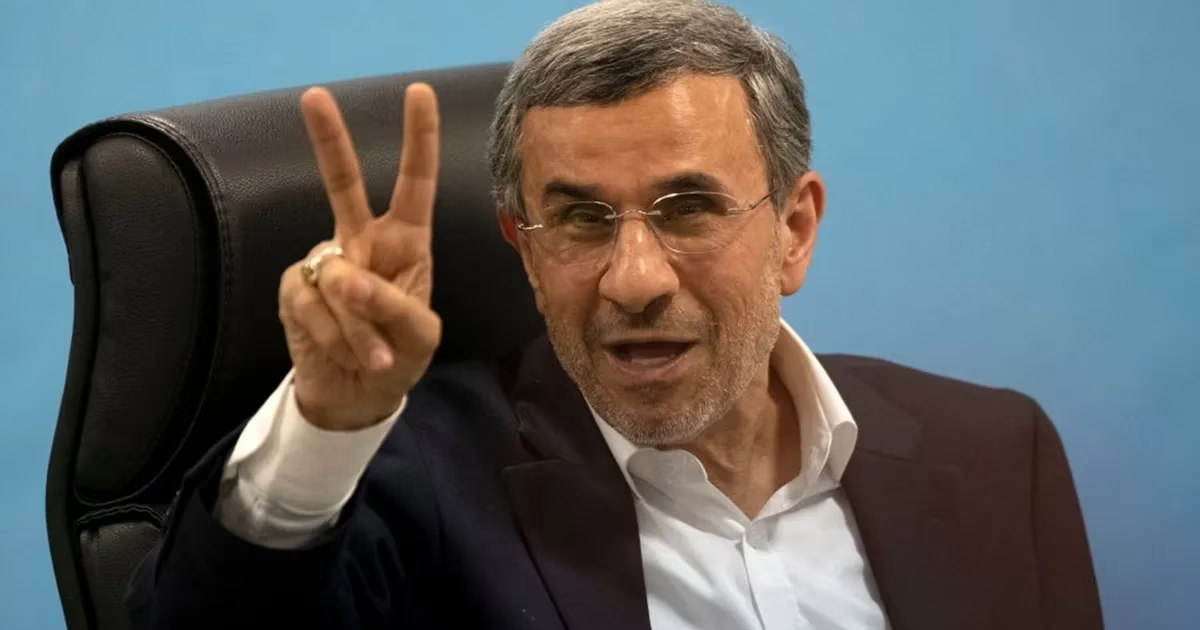
International press reports have revealed intriguing details about the objectives of the recent war, indicating that the United States and "Israel" devised a secret plan aimed at bringing former Iranian President Mahmoud Ahmadinejad back to power. This move followed intense airstrikes targeting senior officials in Tehran, with US President Donald Trump hinting at his desire to see new leadership from within the Iranian system take the reins.
According to informed sources, the plan formulated by Israeli intelligence agencies involved coordination with Ahmadinejad, who was previously known for his hardline stances, with the aim of exploiting his escalating differences with the ruling faction in Iran. However, this strategy faced a major obstacle in its early hours when Ahmadinejad's home in Tehran was subjected to an Israeli raid described as intended to "free him" from the imposed guard, which led to his injury and disappearance.
US officials reported that Ahmadinejad, who miraculously survived, became highly skeptical of the feasibility of the Israeli plot to change the regime after being injured. Since then, news of the former president has completely ceased, amidst mystery surrounding his health status and current whereabouts, which has sparked a wave of speculation and rumors across social media platforms inside and outside Iran.
Choosing Ahmadinejad for this role raises deep questions, given his long history of hostility towards the West and his previous calls to wipe "Israel" off the map, as well as his record of suppressing opposition. Sources suggest that betting on him came as a result of a shift in his stance in recent years, where he accused the regime of corruption and attempted to rebel against the restrictions imposed on him, making him a potential element for inciting internal unrest in the eyes of Tel Aviv and Washington.
For her part, White House spokeswoman Anna Kelly clarified that the military operation known as "Epic Fury" primarily focused on neutralizing Iranian missile and nuclear threats. Kelly affirmed that US forces succeeded in destroying ballistic missile production facilities, noting that diplomatic efforts are now focused on drafting a final agreement that will completely end Tehran's nuclear ambitions.
In contrast, a spokesman for the Israeli Mossad refused to comment on reports related to contact with Ahmadinejad or details of the operation targeting his home. Reports confirm that the Israeli plot consisted of several stages, starting with political assassinations and ending with the collapse of the Iranian state's administrative structure, but the resilience of Iranian institutions revealed an intelligence misjudgment of the regime's ability to absorb initial shocks.
Observers believe that these leaks reflect the magnitude of the political stakes that accompanied the military operations, as Benjamin Netanyahu and Donald Trump sought to reshape the political map in the Middle East through a radical change in Tehran. With the continued mystery surrounding Ahmadinejad's fate, the question remains about the realism of these plans in light of internal Iranian complexities and the intertwining of regional and international interests.
The plan developed by the Israelis and discussed with Ahmadinejad faltered after he was injured in a raid aimed at freeing him from house arrest.
OPINIONS
Wed 20 May 2026 8:15 am - Jerusalem Time
Apartheid by Another Name: Why Normalizing Israel Means Normalizing Oppression
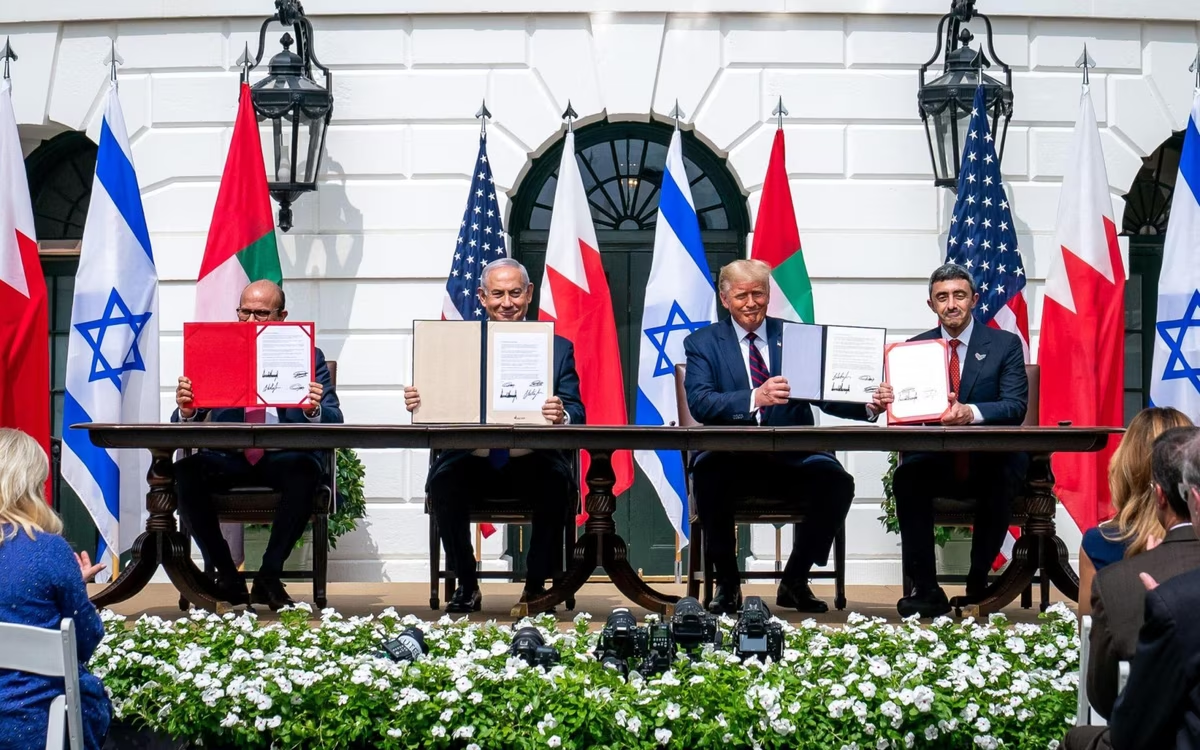
By: Said Arikat
May 20, 2026
News analysis
Washington, D.C- By any serious historical or moral measure, the claim that the United Arab Emirates merely maintains “state-to-state” relations with Israel collapses under scrutiny. Diplomacy is never morally neutral. It never has been. States are judged not only by whom they recognize, but by what systems of domination they choose to normalize, legitimize, and sustain through engagement.
Had governments in the late 1980s embraced full normalization with apartheid South Africa while insisting they were simply practicing pragmatic diplomacy, they would not be remembered as neutral actors. They would be remembered as enablers of a system defined by racial hierarchy, territorial fragmentation, and institutionalized dispossession. The anti-apartheid struggle was never about symbolism. It was about whether the international community would tolerate a political order built on permanent legal and structural inequality.
It is worth noting that during apartheid South Africa, the UAE itself had no formal relations with the regime—reflecting a once widely shared international consensus that systems of institutionalized domination were incompatible with normal diplomacy.
That consensus is now deeply eroded in the case of Israel’s rule over Palestinians.
A broad body of human rights organizations and legal scholars—including B’Tselem, Human Rights Watch, and Amnesty International—have concluded that Israel operates a system of institutionalized domination over Palestinians that meets the legal definition of apartheid. B’Tselem describes it as “a regime of Jewish supremacy from the Jordan River to the Mediterranean Sea.” While governments contest terminology, they do not contest the underlying documented record: dual legal systems, territorial fragmentation, discriminatory governance structures, and entrenched structural inequality.
This is not abstraction. It is architecture.
In the occupied West Bank, Palestinian life is shaped by checkpoints, roadblocks, restricted roads, military zones, and a separation barrier that cuts deeply into territory and fragments communities into disconnected enclaves. Movement is tightly controlled and often unpredictably restricted. Access to hospitals, schools, farmland, workplaces, and family networks is governed by a dense system of permits, closures, and military discretion.
Alongside this physical fragmentation is a legal duality that human rights organizations consistently identify as central to the system. Israeli settlers live under Israeli civil law, with full rights and political representation. Palestinians live under military law, are tried in military courts, face administrative detention without charge in many cases, and are subject to sweeping restrictions on movement, construction, protest, and civil life. Two populations in the same territory are governed by two entirely different legal regimes based on identity.
In parallel, settler violence in the West Bank has been repeatedly documented by Israeli and international human rights organizations and journalists. Reports describe intimidation, attacks on villages, destruction of homes and property, and sustained assaults on farmland and livelihoods. These incidents frequently occur in environments where accountability is limited and enforcement inconsistent, reinforcing concerns about impunity and the erosion of legal protections.
Nowhere has scrutiny intensified more sharply than in the context of detention practices.
Since the escalation of the Gaza war, the United Nations, Amnesty International, Human Rights Watch, and Israeli organizations such as B’Tselem have documented serious allegations of abuse in Israeli detention facilities. These reports describe patterns of ill-treatment, humiliation, physical violence, and credible allegations of sexual violence in detention contexts.
A 2024 United Nations report concluded that thousands of Palestinian detainees were subjected to treatment consistent with torture and called for independent investigations and accountability mechanisms. Amnesty International and Human Rights Watch have similarly raised concerns about systemic abuse and the absence of effective oversight.
Journalistic reporting has reinforced these findings. Nicholas Kristof, writing in The New York Times (May 18), cited testimonies from former detainees describing severe abuse, including allegations of sexual violence, and called for urgent independent investigation. His reporting reflects a broader pattern across international journalism: sustained allegations emerging from multiple credible sources that demand scrutiny rather than dismissal.
High-profile cases have further intensified concern. In one widely reported incident, Israeli soldiers were arrested in connection with allegations of sexual assault against a Palestinian detainee at the Sde Teiman facility. The case triggered internal military proceedings and public controversy. According to BBC reporting, Israeli military authorities later dropped charges, citing evidentiary and procedural difficulties—a decision widely criticized by human rights organizations as emblematic of persistent accountability failures in detention-related cases.
These cases are not isolated proof of doctrine, but part of a broader, well-documented pattern of allegations, investigations, and unresolved accountability that has drawn sustained international attention.
In Gaza, the scale of destruction since October 2023 has fundamentally altered global perception. Entire neighborhoods have been reduced to rubble. Hospitals, schools, universities, bakeries, water systems, and refugee shelters have been severely damaged or destroyed. Humanitarian agencies warn of catastrophic conditions: mass displacement, famine risk, and the collapse of basic infrastructure under prolonged siege and sustained military operations.
Some genocide scholars and legal experts have warned that the situation may meet the threshold of genocide under international law, while others stress that only judicial determination can establish legal classification. What is beyond dispute is the scale of civilian suffering and infrastructural collapse.
Against this backdrop, normalization acquires a more precise meaning: not transformation, but accommodation.
The UAE’s decision to establish formal relations with Israel under the Abraham Accords was presented as a breakthrough for regional stability and pragmatic diplomacy. Its proponents argued it would generate leverage and moderation. Yet despite expanded diplomatic, economic, and security ties, the underlying realities—occupation, settlement expansion, displacement, blockade, and recurring cycles of violence—have not fundamentally changed.
Normalization has not altered the structure. It has stabilized it.
This exposes the central flaw in reducing diplomacy to “state-to-state relations.” Such a framework abstracts political engagement from human consequence. It treats deeply unequal systems of power as neutral administrative arrangements rather than lived systems of coercion, fragmentation, and control over an entire population.
History offers a clear warning. During apartheid South Africa, many states justified continued engagement in the name of pragmatism and influence. In hindsight, those positions are widely regarded as having prolonged an unjust system by granting it legitimacy and delaying accountability.
The same moral question now returns under conditions of far greater visibility.
None of this negates Jewish historical suffering or the enduring reality of antisemitism, both of which remain serious and must be confronted unequivocally. But historical trauma cannot function as permanent exemption from accountability. History repeatedly shows that societies shaped by persecution can, when empowered, reproduce systems of domination over others.
The tragedy of normalization is that it was marketed as a pathway to peace, yet increasingly functions as a mechanism that stabilizes diplomatic relations while leaving intact the structures that produce inequality, fragmentation, and recurring violence.
True peace cannot be built on unequal rights, fragmented geography, permanent military control, and institutionalized racism. Nor can diplomacy detached from accountability produce genuine stability. It can only defer reckoning.
Ultimately, the question is not whether states have the sovereign right to engage with Israel. The question is whether such engagement, under present conditions, amounts to normalization of a system that a growing body of international legal experts and human rights organizations increasingly describe as apartheid, and which remains under sustained allegations of grave violations requiring independent judicial scrutiny.
History will not judge this moment on diplomatic language or strategic convenience.
It will judge whether the world saw a system of domination unfolding in real time—and chose normalization anyway.
PALESTINE
Wed 20 May 2026 8:14 am - Jerusalem Time
Freedom Flotilla Intercepted: Hundreds of Activists Detained, US Sanctions Target Organizers

Organizers of the global Freedom Flotilla announced that their boats were directly attacked by Israeli occupation forces on Tuesday, with sources confirming that fire was opened on at least two boats as they attempted to advance towards the Gaza Strip. Despite live broadcast footage documenting the shootings, the occupation authorities quickly denied using live ammunition, claiming they only used non-lethal warning measures.
Reports from the flotilla's command stated that the Israeli navy managed to intercept all 50 participating boats in international waters. This operation resulted in the detention of 428 participants from over 40 countries worldwide, in a move aimed at preventing the humanitarian aid carried by the activists from reaching the besieged residents of the Strip.
For its part, the Israeli Ministry of Foreign Affairs emphasized in an official statement that it would not tolerate any attempt to violate what it described as the 'legal naval blockade' on Gaza. Sources clarified that the measures taken against the boats came after a series of warnings directed at the participants to retreat, asserting that no injuries occurred among the protesters during the takeover operation.
In international reactions, Turkish President Recep Tayyip Erdoğan strongly condemned the violent Israeli intervention to obstruct the flotilla's path, describing its participants as 'travelers of hope.' Erdoğan called on the international community to assume its responsibilities and act immediately to confront Israeli practices that disregard international laws and prevent aid from reaching civilians.
According to data issued by the organizers, among the detainees are 78 Turkish citizens, in addition to activists and human rights defenders of European, Asian, and American nationalities. This journey is the third attempt by the flotilla, which set sail from southern Turkey last Thursday, after two previous attempts were thwarted at sea by Israeli naval forces.
In a related context, Washington entered the crisis with the US Treasury Department announcing financial sanctions against four individuals linked to the flotilla's organization. The US administration claimed that these individuals have ties to the Hamas movement, which activists considered an attempt to politicize humanitarian work and justify Israeli attacks on peaceful activists.
Palestinian cause supporters responded to these accusations by asserting that there is a deliberate confusion by Tel Aviv and Washington between defending human rights and supporting Palestinian factions. They pointed out that the flotilla's goal is to break the illegal blockade and highlight the escalating humanitarian suffering in the Gaza Strip, away from any political agendas.
These developments come at a time when international relief agencies confirm that the quantities of supplies entering Gaza are still below the minimum required for survival. Despite previous understandings to increase the flow of aid, the reality on the ground indicates the continued strict restrictions imposed by Israel on all crossings and entry points leading to the Strip.
More than two million Palestinians in Gaza live in catastrophic conditions, with most displaced from their destroyed homes to temporary tents lacking the most basic necessities of life. These tents are spread over rubble and along roadsides, amid a severe shortage of food, medicine, and potable water, making the arrival of blockade-breaking convoys an urgent necessity.
Despite increasing international pressure, Israel continues its categorical denial of a policy of starving the population or withholding aid, claiming it facilitates the passage of relief convoys. However, testimonies from UN organizations and the reality on the ground refute these claims, as aid remains hostage to Israeli political and military decisions that hinder its regular arrival.
In conclusion, the interception of the Freedom Flotilla represents a new chapter in the confrontation between international activists and the occupation authorities at sea. Human rights circles are awaiting the fate of the 428 detainees, amid calls for consular and embassy intervention to ensure their safety and secure their release after their boats were confiscated and they were prevented from completing their humanitarian mission.
We will not allow any violation of the legal naval blockade imposed on Gaza.
ARAB AND WORLD
Wed 20 May 2026 8:11 am - Jerusalem Time
Vance confirms progress in negotiations with Iran, Washington hints at military option

US Vice President J.D. Vance stated during a press conference at the White House that ongoing negotiations with Tehran are showing tangible progress. Vance clarified that the US administration continues intensive work to reach a final formula, emphasizing that the primary goal is to ensure Iran does not possess any nuclear weapons.
The Vice President affirmed that the United States considers the option of resuming military operations as a ready alternative should the diplomatic path falter. He indicated that US forces are on high alert, confirming that President Donald Trump possesses the capability and will to proceed with this path if an acceptable agreement is not reached.
These statements come just hours after President Donald Trump announced the suspension of imminent military strikes against Iranian targets. Trump revealed that he had given the Iranian leadership a deadline of two to three days to prove its seriousness in negotiations before making a final decision on military escalation.
The US President clarified via his 'Truth Social' platform that the decision to postpone the attack came in response to direct requests from leaders of Gulf countries, including Qatar, Saudi Arabia, and the UAE. He noted that these leaders expressed optimism about the possibility of reaching an agreement that satisfies all parties and spares the region a wider conflict.
Sources reported that Trump issued clear instructions to the US military to prepare for a comprehensive and large-scale attack at any moment. The President confirmed that he was only an hour away from giving the execution order before deciding to give diplomacy a final chance based on regional mediations.
In the same context, media sources quoted Trump as saying that regional leaders believe Tehran has begun to act more rationally in recent hours. However, Trump reiterated his warnings that the United States might be forced to deliver a very strong blow if these talks do not yield tangible results by the end of the week.
On the other hand, the Iranian response was firm, delivered by Army spokesman Mohammad Akrami Nia, who vowed unprecedented responses. Akrami Nia warned that any American-Israeli aggression would be met with the opening of new fronts and the use of military tools not previously employed in the confrontation.
The region has been in a state of extreme tension since the United States imposed a naval blockade on Iranian ports in mid-April. This blockade has paralyzed navigation in the Strait of Hormuz, which is the lifeline for global energy supplies, after Tehran responded by closing it to uncoordinated vessels.
International fears prevail regarding the collapse of the fragile truce that began on April 8, which temporarily halted a violent round of direct fighting. Observers believe that the next few days will be crucial in determining the fate of stability in the Middle East, either through agreement or a return to war.
It is worth noting that direct military conflict between Washington and Tel Aviv on one side, and Tehran on the other, erupted in late February. These confrontations resulted in thousands of deaths and injuries, in addition to severe material losses to infrastructure and vital facilities for the warring parties.
Reports indicate that current negotiations are taking place through multiple mediations aimed at ending the mutual blockade and opening international waterways. Washington demands strict security guarantees regarding Iran's nuclear program and regional military activity as a prerequisite for lifting sanctions and the blockade.
Amid this anticipation, US bases in the region remain on constant alert, awaiting the outcome of the 'three-day' deadline. Global capitals are closely monitoring the results of these diplomatic moves, fearing a military explosion that could lead to an unprecedented global energy crisis.
Iran must accept that it cannot possess nuclear weapons, and we are fully prepared to resume the military campaign if necessary.
PALESTINE
Wed 20 May 2026 8:10 am - Jerusalem Time
The Peace Council Under Fire: Has It Become a Cover for Netanyahu's Agenda in Gaza?

Criticism has escalated against the international 'Peace Council,' tasked with overseeing the implementation of US President Donald Trump's plan in the Gaza Strip, amid accusations that it has become a political tool serving the objectives of Israeli Prime Minister Benjamin Netanyahu. Observers noted that the Council has narrowed the current crisis to the issue of disarming the resistance, ignoring Israel's stalled commitments.
In its latest report submitted to the UN Security Council, the Peace Council considered Hamas's refusal to disarm as the primary obstacle to implementing the comprehensive plan. The report emphasized that reconstruction efforts in the devastated Strip would not begin before the disarmament process is completed and an international force is deployed to assume security tasks in the region.
Hamas, for its part, was quick to deny these allegations, describing the report as fully adopting the occupation's narrative and aiming to confuse matters. The movement affirmed that the report ignores continuous Israeli violations since the ceasefire came into effect in January 2025, including the expansion of land occupation and non-compliance with the humanitarian protocol.
Mahmoud Mardawi, a leader in the movement, clarified in press statements that the resistance had not agreed at any stage to immediate disarmament, but rather accepted Article 20, which sets a horizon for confining weapons to the independent Palestinian state in the future. He added that the priority now must be to implement the humanitarian commitments that Israel is evading.
Mardawi pointed out that the occupation still refuses to allow necessary medical equipment and the rehabilitation of hospitals and vital roads, despite these being an integral part of the first phase of the agreement. He accused the head of the Peace Council, Nikolay Mladenov, of being unable to compel Netanyahu to adhere to what was agreed upon, while the occupation army continues its killing and starvation operations.
For his part, political analyst Ahmed Al-Tannani described the report as the 'most dangerous misleading operation' for the international community regarding the reality in Gaza. Al-Tannani believed that the Council is trying to reframe the international discussion to focus solely on disarming Palestinians, while ignoring the continued siege and military aggression.
In contrast, researchers at the American Council on Foreign Policy believe that Hamas is primarily responsible for the agreement's failure. They claim that the movement reneged on supposed commitments to dismantle its military structure and leave the Strip, considering that the resistance's weapons pose a threat even to international technocrat committees.
Al-Tannani responded to these claims by emphasizing that the resistance fulfilled its essential commitments, foremost among them the handover of all Israeli prisoners within 72 hours of the agreement's start. He clarified that Israel was the one that obstructed the entry of the international technocrat committee by preventing it from accessing the Strip to carry out its administrative and humanitarian tasks.
Field reports indicate that Israel exploited the period of relative calm to expand its military control within the Strip by up to 8%. According to experts, Netanyahu's admission of controlling about 60% of Gaza's area constitutes a blatant violation of the withdrawal provisions stipulated in the first phase of the peace plan.
Dr. Mahmoud Yazbak, an expert in Israeli affairs, believes that the timing of the report's release after Mladenov's meeting with Netanyahu in Tel Aviv raises questions about the Council's independence. Yazbak pointed out that Mladenov did not bother to meet with the Palestinian side before formulating his conclusions, which appeared blatantly biased.
Yazbak criticized the international report's disregard for the weapons provided by the occupation authorities to armed militias within the Strip with the aim of inciting chaos. He considered that the international community's silence on these practices gives Netanyahu the green light to continue his 'scorched earth' strategy and keep Gaza a destroyed and uninhabitable society.
Data indicates that Israel still fully controls the crossings and regulates the movement of individuals and goods, making any talk of a 'Palestinian Authority' or 'technocrat committees' mere ink on paper. Observers believe that this situation is coordinated with the American administration, which provides political cover for these transgressions.
With Netanyahu's explicit threat to resume comprehensive military operations unless his new conditions are met, the entire Trump plan is at stake. Current Israeli demands exceed what was previously signed and aim to impose a permanent security reality that legitimizes the occupation's presence deep within the Strip.
The situation in Gaza remains suspended between the hammer of international pressure for disarmament and the anvil of Israeli intransigence on the humanitarian file. In light of this clear international bias, the Palestinian resistance finds itself facing difficult choices to preserve the constants of the cause and prevent the liquidation of national rights under the guise of peace.
The resistance will not commit to any agreement in which the occupation dictates what it wants without fulfilling its humanitarian and field obligations.
PALESTINE
Wed 20 May 2026 8:05 am - Jerusalem Time
Washington Imposes Sanctions on 'Palestinian Scholars Association', 'Samidoun' Network, and Activists in the 'Fleet of Steadfastness'

The US Treasury Department issued a decision to include a number of human rights and religious organizations and active figures on the international sanctions list. The list included the 'Palestinian Scholars Association' and the 'Samidoun' organization for the defense of prisoners, in addition to prominent activists in the 'Fleet of Steadfastness' seeking to break the siege on the Gaza Strip, allegedly due to these entities' association with activities related to the Islamic Resistance Movement (Hamas).
The US State Department clarified in an official statement that these designations come within a strategy targeting three main categories that facilitate the funding and field activities of Palestinian movements. The department claimed that the targets include organizers of naval fleets, members of international networks supporting the resistance, and coordinators who act as political and organizational fronts for the Popular Front for the Liberation of Palestine.
Among the most prominent names included in the sanctions is Mohammed Al-Khatib, the European coordinator of the 'Samidoun' network and a resident of Belgium, who previously faced attempts by Belgian authorities to withdraw his refugee status. 'Samidoun' defines itself as an international network aimed at supporting Palestinian prisoners in Israeli occupation prisons, but Washington accuses it of operating as an organizational and financial cover for politically prohibited activities in the US.
US sanctions also targeted Marwan Abu Ras, head of the Palestinian Scholars Association, in a move aimed at religious institutions and scholars associated with the Palestinian interior. The US administration believes that these institutions play a role in providing moral and logistical support for resistance programs, which Washington describes as a 'malign program' that hides behind humanitarian and social pretexts.
In a related context, activist Saif Abu Kashk, spokesman for the Fleet of Steadfastness, was added to the blacklist shortly after his detention by Israeli authorities off the coast of Greece. Abu Kashk was deported to Barcelona, Spain, after his arrest, where US and Israeli circles accuse him of direct coordination with Palestinian entities to break the naval restrictions imposed on Gaza.
For his part, US Treasury Secretary Scott Bessent stated that attempts to operate naval fleets towards the Gaza Strip represent a challenge to the diplomatic efforts led by the US administration to achieve what he described as 'lasting peace'. Bessent affirmed that his department will continue to pursue and dismantle all global financial support networks used by Hamas in various countries around the world to ensure the drying up of its funding sources.
These sanctions entail strict legal and financial measures, including the freezing of all assets and properties belonging to the individuals and organizations mentioned within the jurisdiction of the United States. This decision also prohibits all American companies and financial institutions, or those dealing in dollars, from entering into any commercial or financial transactions with those listed.
The measure taken today highlights how Hamas exploits community organizations and religious institutions to advance its agenda.
OPINIONS
Tue 19 May 2026 7:01 pm - Jerusalem Time
The “Board of Peace” and the Machinery of Dispossession
By: Said Arikat
May 19, 2026
News analysis
Washington, D.C-The grim irony could hardly be more complete. While Israel wages a devastating regional war under the banner of “security” and “self-defense,” Gaza continues to disappear map square by map square, neighborhood by neighborhood, family by family. At the very moment Washington claims to be pursuing “peace” through the Trump administration’s so-called “Board of Peace,” Israeli Prime Minister Benjamin Netanyahu openly boasts that Israel now controls 60 percent of Gaza — up from roughly 53 percent when the October 2025 ceasefire agreement supposedly came into force.
This is not the language of de-escalation. It is the language of conquest.
Netanyahu’s admission strips away months of diplomatic theater and exposes what Palestinians, humanitarian organizations, and many international observers have warned all along: the ceasefire was never genuinely intended to end the occupation or halt the destruction of Gaza. Instead, it appears to have functioned as a mechanism for consolidating territorial gains while maintaining military pressure under shifting pretexts.
The ceasefire terms were explicit. Israeli forces were not supposed to re-enter areas from which they had withdrawn, provided Hamas fulfilled its obligations. By virtually every public account, Hamas released the living Israeli hostages and returned the bodies in its possession while cooperating in efforts to recover additional remains. Yet Israel not only maintained daily military operations inside Gaza but expanded its territorial footprint dramatically.
That expansion alone constitutes a devastating political confession. Netanyahu has effectively acknowledged that Israel violated the agreement while facing almost no meaningful consequences from Washington or its Western allies. Instead of condemnation, Israel continues to receive military, diplomatic, and political cover from the United States — the very country that claims to supervise the ceasefire through its self-styled “Board of Peace.”
The name itself now reads less like diplomacy and more like Orwellian satire.
There is little “peace” about a process under which more than 870 Palestinians have reportedly been killed since the truce was meant to begin, humanitarian aid remains heavily restricted, and entire sections of Gaza are absorbed into expanding Israeli military control. Peace cannot coexist with forced displacement, siege, starvation, and permanent occupation. What is unfolding increasingly resembles a systematic campaign to render Gaza unlivable while normalizing the gradual erasure of Palestinian territorial existence.
The war with Iran has only accelerated this dynamic.
As global attention shifts toward missiles, regional escalation, and fears of wider war, Gaza recedes from the headlines — precisely the political environment Netanyahu’s government appears to have desired. The confrontation with Iran provides Israel with strategic distraction, diplomatic insulation, and renewed Western sympathy. Under the fog of regional conflict, the slow-motion annexation of Gaza proceeds with diminished scrutiny.
This is not incidental. It is strategic.
For years, Netanyahu and the Israeli far right have openly spoken about reshaping Gaza permanently, encouraging “voluntary migration,” and preventing any pathway toward Palestinian sovereignty. What is now occurring on the ground aligns disturbingly well with those ambitions. The steady territorial expansion, the destruction of civilian infrastructure, the suffocating blockade, and the refusal to articulate any viable postwar political framework all point toward a policy aimed not at coexistence but demographic and geographic transformation.
Ethnic cleansing does not always arrive in one dramatic moment. Sometimes it unfolds incrementally — through siege, displacement, deprivation, and relentless military pressure designed to make life impossible for the targeted population.
The United States bears enormous responsibility for enabling this trajectory.
President Donald Trump entered office promising stability and “peace through strength.” In February, his administration helped establish the “Board of Peace,” ostensibly to oversee implementation of the ceasefire and facilitate negotiations. Yet the board’s conduct has exposed the profound dishonesty embedded in Washington’s approach.
Rather than holding Israel accountable for territorial expansion and repeated violations, the Board has reportedly focused blame on Hamas’s refusal to disarm — despite the fact that disarmament was never a binding prerequisite in the original agreement. The issue was explicitly deferred to future negotiations tied to broader political arrangements, including discussions surrounding Palestinian statehood.
This distinction matters enormously.
By retroactively redefining the ceasefire terms to prioritize Hamas’s disarmament above all else, Washington effectively handed Israel a permanent justification for delaying implementation while continuing military operations. The result is a diplomatic shell game: Israel violates the agreement materially on the ground while the United States shifts attention toward conditions that were never formally required in the first phase.
In doing so, Washington has abandoned even the pretense of acting as an honest broker.
The broader implications are catastrophic. International law becomes meaningless when agreements are selectively interpreted according to geopolitical convenience. Ceasefires lose credibility when one side can seize additional territory during implementation without penalty. Human rights language becomes hollow when civilian suffering is subordinated to strategic alliances.
Perhaps most damaging of all is the moral collapse revealed by this process. The same Western governments that invoke international law in other global conflicts appear unwilling to apply those principles consistently when Israel is involved. Entire legal frameworks concerning occupation, collective punishment, civilian protection, and territorial acquisition through force seem suspended in Gaza.
This double standard is not lost on the rest of the world.
Across the Global South, the Gaza catastrophe has become a defining symbol of Western hypocrisy — a place where declarations about democracy and human rights collide with the reality of unconditional military and diplomatic support for a devastating occupation. The credibility of the United States as a defender of international norms is eroding rapidly, not because of hostile propaganda, but because of its own actions.
Meanwhile, Palestinians continue paying the price in blood.
Behind every statistic lies a human reality: families buried beneath rubble, children growing up amid starvation and displacement, hospitals operating without adequate supplies, entire communities erased from the map. The normalization of this suffering represents one of the great moral failures of our era.
And yet the political language surrounding Gaza remains astonishingly sanitized. Israeli territorial expansion is framed as “security control.” Forced displacement becomes “evacuation.” Starvation policies are discussed as “aid disputes.” A devastating military occupation is repackaged as conflict management.
But words cannot indefinitely conceal reality.
Netanyahu’s own admission has shattered the illusion. Gaza is not moving toward peace. It is being fragmented, occupied, and transformed under cover of war. And the United States, despite its rhetoric about diplomacy and stability, is not restraining this process — it is facilitating it.
History will remember that distinction clearly.
ECONOMY
Tue 19 May 2026 11:14 am - Jerusalem Time
Notable Improvement in Results Compared with the Corresponding Period Last year ..Arab Palestinian Investment Company (APIC) achieved USD 900,000 in net profit attributable to the company’s shareholders in the first quarter of 2026

Arab Palestinian Investment Company (APIC) announced its financial results for the first quarter of 2026. APIC Chairman and CEO Tarek Aggad announced that the company achieved total revenues of USD 324.7 million, marking an 11% increase compared to the corresponding period of last year. Earnings before interest, taxes, depreciation, and amortization (EBITDA) rose by 38.7% and reached USD 16.9 million, while profit from operations grew by 41% to reach USD 14.1 million. Net profit attributable to APIC shareholders reached USD 900,000 in the first quarter of 2026, compared to a net loss of USD 320,000 recorded during the corresponding period of 2025.
Total assets stood at USD 1,028.2 million, marking a 2.7% increase to 2025’s year-end. While total liabilities reached USD 761.3 million, up by 3.8%. Net equity attributable to APIC shareholders amounted USD 229 million, maintaining relative stability with a marginal decrease of 0.1% compared to year-end 2025.
Aggad expressed his satisfaction with the group’s notable improvement in first-quarter results of 2026 compared with the corresponding period last year, despite the continued local and regional challenges facing its subsidiaries, most notably the persistent economic recession resulting from the Israeli occupation’s withholding of Palestinian Authority funds. Consequently, the Palestinian government was unable to pay the full salaries of its employees or to fulfill its financial obligations to the private sector, which in turn adversely affected the performance of the group’s companies. He added that the Palestinian Authority’s direct and indirect delayed debts to APIC subsidiaries reached unprecedented levels and amounted to approximately USD 158 million, with an average annual financing cost of around USD 7.5 million. In addition to the ongoing external headwinds in Turkey resulting from the application of International Accounting Standard #29, where the company incurred non-cash losses of approximately USD 2.5 million in the first quarter of 2026.
APIC is a public shareholding investment company listed on the Palestine Exchange (PEX: APIC). It holds diversified investments across the manufacturing, trade, distribution and service sectors in Palestine, Jordan, Saudi Arabia, the United Arab Emirates, Iraq and Turkey through its group of subsidiaries: Siniora Food Industries Company; Unipal General Trading Company; Palestine Automobile Company; Medical Supplies and Services Company; National Aluminum and Profiles Company (NAPCO); Reema Hygienic Paper Company; Sky Advertising and Promotion Company; Arab Leasing Company and Arab Palestinian Storage and Cooling Company. The company also peruses investment and geographic diversification beyond Palestine and across regional and global markets through its investment arm APIC Capital, which manages a portfolio combining direct stakes in private and publicly listed companies alongside investments in a select group of leading private equity and venture capital funds. APIC employs over 3400 staff through its subsidiaries. For more information, visit https://apic.ps/