PALESTINE

Thu 19 Feb 2026 11:58 am - Jerusalem Time

Trump chairs the first meeting of the 'Peace Council': A new structure for Gaza administration and a challenge to the UN's role

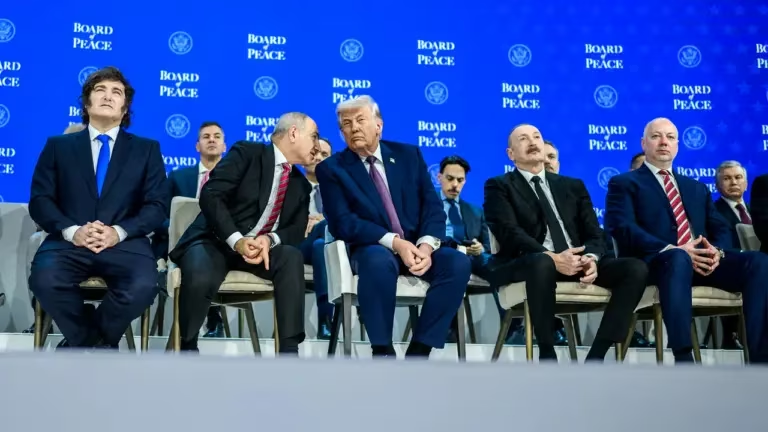
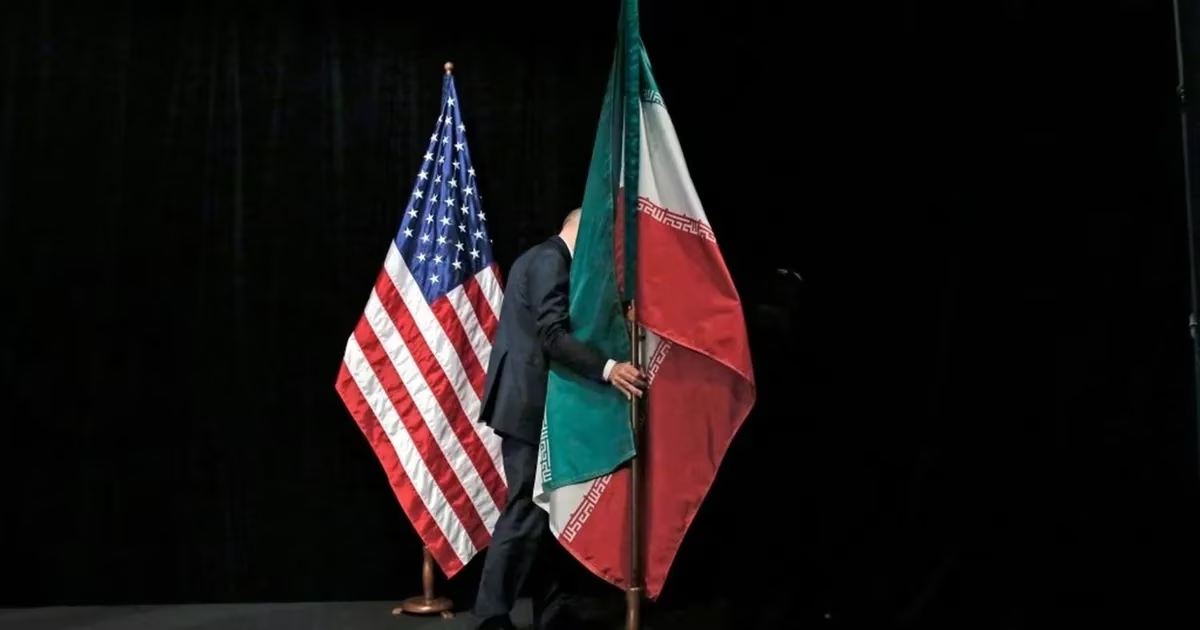
US President Donald Trump today, Thursday, chaired the first inaugural meeting of what is known as the 'Peace Council,' an initiative he officially launched as an alternative or complement to the traditional roles played by international organizations. This move has received widespread support from Trump's close allies, while raising a wave of concern among other countries that see it as an attempt to undermine the legitimacy and role of the United Nations in global conflicts.

The roots of this council date back to a proposal Trump presented last September as part of his plan to end the Israeli war on the Gaza Strip, before the initiative's ambitions expanded to include resolving other international conflicts. The council, which Trump directly chairs, aims to seize the mediation and crisis management role historically confined to the corridors of the international organization in New York.

According to the council's founding charter, the membership of participating states is set for a renewable three-year term, but there is a controversial clause that allows states to obtain permanent membership in exchange for paying one billion dollars to fund the council's activities. This financial approach reflects Trump's 'transactional' vision in managing foreign policy and making countries bear their share of the costs of international security and peace.

The executive council is composed of prominent figures in Trump's inner circle, with Secretary of State Marco Rubio, Special Envoy Steve Witkoff, and the President's son-in-law Jared Kushner appointed. Former British Prime Minister Tony Blair also emerged as a founding member, which drew widespread criticism given his history associated with the Iraq War and imperialist policies in the region.

Regarding international participation, the council's official account announced the joining of more than 20 countries as founding members, including active regional powers in the Middle East such as Saudi Arabia, Qatar, Egypt, and the UAE. The list also included countries such as Turkey, Jordan, Bahrain, and Morocco, in addition to countries from Eastern Europe, Asia, and Latin America such as Hungary, Pakistan, and Vietnam.

In contrast, the council faced outright rejection from major Western and Eastern powers, with Britain, the European Union, France, and Germany announcing their intention not to join as permanent members. 'Global South' countries such as Brazil, South Africa, and India also rejected the American offer, considering that the initiative lacks the balance required to resolve international conflicts fairly.

Notably, the Vatican distanced itself from the council, emphasizing that the management of international crises should remain exclusively within the jurisdiction of the United Nations to ensure neutrality. China and Russia, two countries with veto power in the Security Council, were also absent from the formation, which puts the new council in potential confrontation with existing international legal structures.

Trump based the legitimacy of his council on a resolution drafted by the United States and approved by the UN Security Council last November, recognizing the council as a temporary transitional administration for the Gaza Strip. According to this resolution, the council will set the general framework and coordinate the necessary funding for the reconstruction of the devastated strip, within Trump's vision that stipulates a radical reform of the Palestinian Authority.

The international mandate grants the Peace Council the authority to deploy a temporary international stabilization force within the Gaza Strip, with the tasks of this force ending by the end of 2027. The council is committed under this agreement to submit periodic reports every six months to the 15-member UN Security Council, to inform them of the progress made in security and humanitarian files.

Despite this mandate, China and Russia expressed strong reservations during the vote, abstaining from endorsement on the grounds that the resolution does not give the United Nations a clear role in shaping Gaza's future. The legal authority of the council outside the Palestinian territory remains unclear, especially regarding enforcement tools and how to coordinate with other international relief organizations.

Attention is drawn to the broad powers enjoyed by Trump as chairman of the council, as the charter grants him the right of veto over any decision taken by members, in addition to the authority to dismiss any member. This centralization of decision-making has raised experts' concerns about the council becoming a tool for implementing US foreign policy away from international consensus.

From a human rights perspective, international law experts described Trump's oversight of the administration of foreign territories as approaching modern 'colonial practices.' Human rights organizations criticized the absence of any Palestinian representation in a council that decides the fate of Gaza, considering it a marginalization of the people of the land and a repetition of historical mistakes in managing conflicts in the Middle East.

The council also faced sharp criticism for including Israel as a founding member of a body tasked with overseeing Gaza, at a time when the occupation faces accusations of committing war crimes and genocide. Observers believe that Israel's presence in the council undermines its neutrality and makes it a party to the conflict instead of a mediator for peace and reconstruction.

Today's meeting is scheduled to discuss thorny issues including mechanisms for distributing humanitarian aid in Gaza, details of deploying the international stabilization force, and ways to raise the necessary funding for reconstruction. Countries such as Japan, South Korea, and India are participating as observers, indicating an international desire to monitor the behavior of this new entity before full engagement.

The Peace Council's charter grants its chairman broad executive authority, including the right to veto decisions and dismiss members, with an international mandate to transitionally administer Gaza.

PALESTINE

Thu 19 Feb 2026 11:58 am - Jerusalem Time

Trump Launches 'Peace Council' in Washington: $5 Billion for Gaza Reconstruction and Anticipated International Force

US President Donald Trump will inaugurate today, Thursday, the first meeting of the 'Peace Council' in Washington D.C., with wide participation from representatives of over 45 countries. This meeting comes amidst international anticipation of its decisions regarding the future of the Gaza Strip and the unresolved issues left by the ongoing war.

Trump is scheduled to deliver an opening speech at the 'Donald J. Trump Institute for Peace,' the center recently renamed to bear his personal name. During his speech, the US President will announce the success of participating countries in raising $5 billion as an initial payment for the reconstruction fund of the devastated Strip.

Sources indicate that the meeting's agenda will focus on thorny issues, most notably the proposal to disarm Hamas and mechanisms for humanitarian aid flow to the population. Participants will also discuss the council's feasibility in dealing with the complex logistical and security challenges facing the region in the coming phase.

Responsible sources confirmed that the US administration intends to announce plans for several countries to contribute thousands of soldiers as part of an international force aimed at achieving stability in Gaza. This force will be tasked with maintaining security and ensuring the continuity of relief and reconstruction operations under direct international supervision.

For her part, White House spokeswoman Karoline Leavitt clarified that the pledged $5 billion budget will be under the exclusive supervision of the Peace Council. She indicated that the US administration seeks to ensure high transparency in the disbursement of these funds and their direction towards vital projects in the Strip.

The formation of the council has sparked widespread debate in diplomatic circles, especially as it includes the Israeli side while lacking any official representation from the Palestinian side. This absence has raised questions about the council's ability to reach comprehensive and sustainable solutions acceptable to all parties involved in the conflict.

International concerns also arise that this council might become an alternative to traditional UN platforms, which could weaken the United Nations' role in resolving global conflicts. Observers believe that Trump's intention to expand the council's future tasks to address issues beyond Gaza's borders reinforces these diplomatic concerns.

Regarding international participation, permanent members of the UN Security Council are absent from the meeting, with the exception of the United States, as France, Britain, Russia, and China did not participate. In contrast, representatives from the European Union and various countries from different continents, including Albania and Vietnam, are attending.

Prominent figures in the US administration are expected to speak at the event, including Secretary of State Marco Rubio and advisor Jared Kushner. Former British Prime Minister Tony Blair will also participate, and he is expected to play a pivotal role in managing the council's files and coordinating its international efforts.

In a related context, sources quoted a council member as saying that the Gaza plan faces severe field obstacles related to the deteriorating security situation. He explained that the absence of trained and ready police forces represents an impediment to the implementation of any large-scale development or relief programs at present.

The same official described the current humanitarian aid flow situation as 'catastrophic,' emphasizing the urgent need to find safe and effective distribution channels. He added that the biggest challenge is not only in providing aid but in identifying the entities that will be responsible for field distribution and ensuring its delivery to those in need.

It is worth noting that the 'Peace Council' was established by a decision from Trump in mid-January, based on a US plan to end the war previously adopted by the UN Security Council. The council aims to create a new international framework away from traditional paths that the White House deems insufficient to resolve the conflict.

Establishing security in the Strip is a fundamental condition for progress in other areas, but police forces are not adequately ready or trained.

OPINIONS

Thu 19 Feb 2026 11:58 am - Jerusalem Time

The pain of loss in Ramadan!

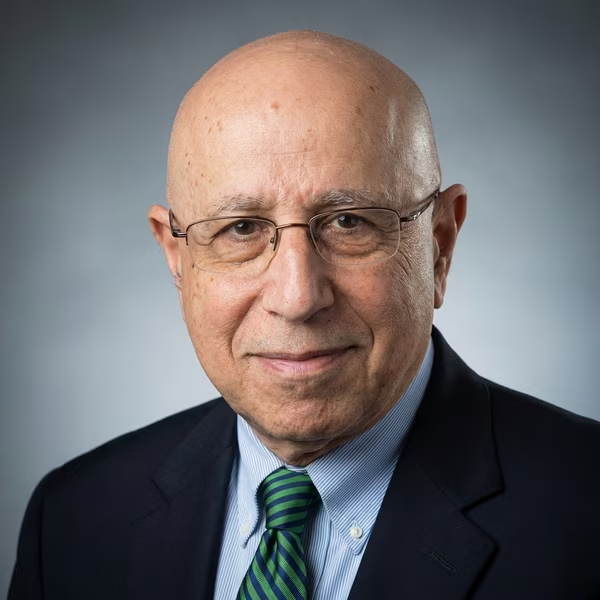
Dr. Ibrahim Melhem

Editor-in-Chief

The least that can be said is that the images of mothers heartbroken by the loss of their beloved children alone tell of the magnitude of the pain that shakes the hearts of the patient and resilient; for there is nothing more painful than losing the essence of souls and the fruits of hearts. How much more so if this loss occurs in a month when hearts gather at sunset on one ground? So, the one who used to bring joy and happiness to souls is absent from the table, and the one who was waiting for the call to prayer to quench his hunger with a sip of water or a piece of bread.The mother's wailing at the farewell of her son, "Muhannad Al-Najjar" (14 years old), who died on the first day of Ramadan while he was gathering firewood to prepare Iftar food, shakes the soul and shatters the conscience. Muhannad, who went out to look for firewood to light the pot for his hungry family, ignited a fire in his mother's heart that the sea waters cannot extinguish.The daily killing has not stopped, even if its forms have changed; death resides in every corner: the death of patients whose medicine has run out, and the wounded whose travel has been delayed at crossings restricted by "chains of slowness," or by pouring lava on the heads of those sleeping in tents, under the pretext of assassinating a wanted person who happened to pass by. It is "slow genocide"; practiced by the occupiers with cold blood, and they hunt their victims with sniper bullets as they hunt game, without any conscience or fear of law.In Gaza, Ramadan is not measured by the number of fasting hours, but by the number of raids on homes and tents and bullets, which are fired from behind brightly colored bunkers and lines, penetrating the bodies of those seeking life, so sunset there becomes synonymous with the absence of loved ones.Muhannad left, and the firewood remained mixed with tears of pain, and the table still lacked his laughter, his calm and his boisterousness, so "sunset" in Gaza transformed from a moment in the presence of tranquility to a moment in the presence of absence.

OPINIONS

Thu 19 Feb 2026 11:57 am - Jerusalem Time

Occupation, Creeping Annexation, and the Entrenchment of Colonial Control

The decision by the occupation government to initiate the registration and settlement of lands in the occupied West Bank represents a dangerous escalation that falls within the framework of the creeping annexation project, and a clear attempt to impose legal and administrative facts that entrench colonial control over Palestinian land. It reflects the gravity of the occupation government's decision, which violates international law and international resolutions. The initiation of land organization and registration in the West Bank constitutes an arbitrary measure and widespread looting of lands in the occupied West Bank, an effective annexation, and a direct assault on occupied Palestinian land and the rights of its legitimate owners, showing contempt for the international community. The Israeli decision represents an attempt to reclassify vast areas of occupied Palestinian land as "state lands," based on internal administrative procedures that neither create nor abolish rights, and starkly contradict the rules of international humanitarian law, particularly the provisions of the Fourth Geneva Convention of 1949, which prohibits the occupying power from making permanent changes in occupied territory or confiscating the property of residents under occupation. The resumption of land registration for the first time since 1967, and the establishment of specialized bodies within the Israeli Ministry of Justice and the allocation of budgets to implement these procedures, cannot be considered a neutral administrative matter. Instead, it comes within a systematic policy aimed at transforming vast areas of unregistered or disputed lands into so-called "state lands," in preparation for allocating them for settlement expansion and strengthening Israeli control, especially in Area "C." This step will lead to a profound change in the legal reality of lands in the West Bank, as Palestinian citizens will be required to undergo complex procedures to prove their ownership according to criteria imposed by the occupation, which may lead to them losing their rights in vast areas under the pretext of legal and administrative considerations. The West Bank is an integral part of the Palestinian territory occupied in 1967, and is subject to the provisions of international law and international legitimacy resolutions, foremost among them the relevant Security Council resolutions. Any measures aimed at imposing a new legal or administrative reality under the guise of "sovereignty from the bottom up" represent an unacceptable circumvention of the existing legal status and an attempt to legitimize creeping annexation. The West Bank is occupied territory according to the provisions of international law, and any measure aimed at establishing the ownership of the occupying state over lands in the occupied territory constitutes a clear violation of the rules of international humanitarian law, and is considered a form of de facto annexation even without a formal declaration. Targeting lands through unilateral registration will lead to a dangerous escalation, undermine the foundations of the political process, disregard signed agreements, deepen instability, and expose the region to further tension and explosion. The international community must assume its legal and political responsibilities, and the importance of the United Nations and the International Criminal Court taking practical steps to stop these illegal measures, ensure the protection of the rights of the Palestinian people to their land, resources, and property, and take practical steps to stop these policies that do not serve peace and aim to undermine the possibility of an independent, sovereign Palestinian state on the June 4, 1967 borders with Jerusalem as its capital. The property rights, individual and collective, of the Palestinian people to land and real estate are fixed and inalienable rights that cannot be lost by prescription. Our people will continue their legitimate struggle in defense of their land and their fixed national rights, and attempts to impose a fait accompli will not grant legitimacy to the occupation, nor will they change the undeniable truth that the land is occupied Palestinian territory, no matter how long the occupation lasts.

OPINIONS

Thu 19 Feb 2026 11:57 am - Jerusalem Time

Is Trump's End Nearing? Signs of Cracks Within the US

Few expected that US President Donald Trump would go this far in his second term, whether in his disregard for international law or in his rough handling of the network of alliances that for decades formed the cornerstone of American influence in the world. Since his return to the White House, it has been clear that he seeks to monopolize decision-making, overstepping the norms of checks and balances, and narrowing the spaces within which American institutions traditionally operated with relative independence.The transgressions did not stop at controversial executive orders but also affected relations with Congress and state governors, a scene that re-raised the question of the limits of presidential power in the American constitutional system. Domestically, his policies towards immigrants – both legal and illegal – took a sharply confrontational turn, accompanied by unprecedented inflammatory language against people of color, including Arabs and Muslims, which contributed to expanding Islamophobia and deepening societal division. Criticism of Israel in some circles began to be equated with the suspicion of "anti-Semitism," amidst measures targeting activists sympathetic to Palestinians in the wake of the war in Gaza.Externally, the scene appeared more turbulent. Threats to annex Canada and Mexico, frequent talk of controlling Greenland, along with public insults to US allies in Europe, reflected a unilateral tendency that deals with international politics through a logic of deals and pressure, not partnership. His administration's relationship with international institutions was also marked by a great deal of tension, whether with the United Nations or international courts, reinforcing the impression that Washington sometimes acts as a power above the law.This cannot be separated from the unlimited support received by the war criminal, Israeli Prime Minister Benjamin Netanyahu, during his massacres in the Gaza Strip, with its tragic scenes that shook global public opinion. This support was reflected within the US itself, where massive million-person demonstrations took place in dozens of major cities, demanding an end to the war and a review of foreign policy. The results of local elections in a number of states, with Democrats advancing over Republicans, also served as an early warning bell for the ruling party ahead of the midterm elections.In the context of external escalation, the administration adopted a harsh rhetoric towards China, Russia, and Iran, with a policy of brinkmanship, returning the world to an atmosphere of worrying polarization. Trump did not hesitate to use a theatrical rhetoric towards Venezuela, brandishing force and boasting about his country's ability to decide, in language that seemed closer to the logic of political coercion than to balanced diplomatic norms. The most prominent manifestation of this barbarism was the kidnapping of President Maduro and his wife from inside his palace, and bringing him humiliatingly to America for trial, which reinforced the image of an administration inclined to impose its will, rather than adhering to the rules of the international system.Domestically, American academics and politicians warned that polarization had reached dangerous levels, and that inflammatory rhetoric and partisan division could push the country into unprecedented social tension. With increasing criticism within the Republican Party itself, and signs of unease among some members of Congress, cracks began to appear within the camp supporting the president, reflecting a growing awareness of the danger of the current path for the future of both the party and the state.From my perspective, the continuation of this approach will not be easy or long-lasting. American institutions, despite the pressures they have faced, still possess a degree of immunity and ability to self-correct. The escalating talk of holding the president accountable or reducing his influence reflects that the issue has gone beyond partisan disagreement, becoming linked to the image of the United States and its international standing.The question today is: Is Trump's end nearing? Perhaps the answer is not yet decisive, but what is certain is that the American interior is boiling, and the coming months will determine not only the fate of a president but also the shape of America's role in a rapidly changing world that seeks greater balance and respect for international law.

PALESTINE

Thu 19 Feb 2026 11:57 am - Jerusalem Time

In cooperation with the Arab League and Egyptian media... "Xinhua" organizes media forum in Cairo in April

Xinhua News Agency will organize the high-level forum for media and think tanks of the Global South countries - the China-Arab Partnership Conference - in Cairo from April 26-28. The forum focuses on the theme of "Enhancing Wisdom, Opening New Horizons, and Working to Build a China-Arab Community of Shared Future." The forum aims to strengthen the deep friendship between China and Arab countries, promote cultural exchange and mutual learning between civilizations, in addition to unifying visions and mobilizing joint efforts of China and Arab countries, as important forces in the Global South on the international stage. The forum will host more than 150 representatives from media, think tanks, government agencies, and regional and international organizations from China and Arab countries, to conduct in-depth discussions on four main axes: "Solidarity and Joint Cooperation: Jointly Promoting the Reform of Global Governance," "Innovation as a Driving Force: Sharing a Prosperous Future for Development," "Mutual Learning Among Civilizations: Walking Together on Diverse Development Paths," and "Empowering Youth: Building Foundations for Openness and Innovation Together." Editor-in-Chief Ibrahim Melhem received an invitation to attend the conference, presented to him by the agency's director in Palestine, "Henry Huang."

ARAB AND WORLD

Thu 19 Feb 2026 11:57 am - Jerusalem Time

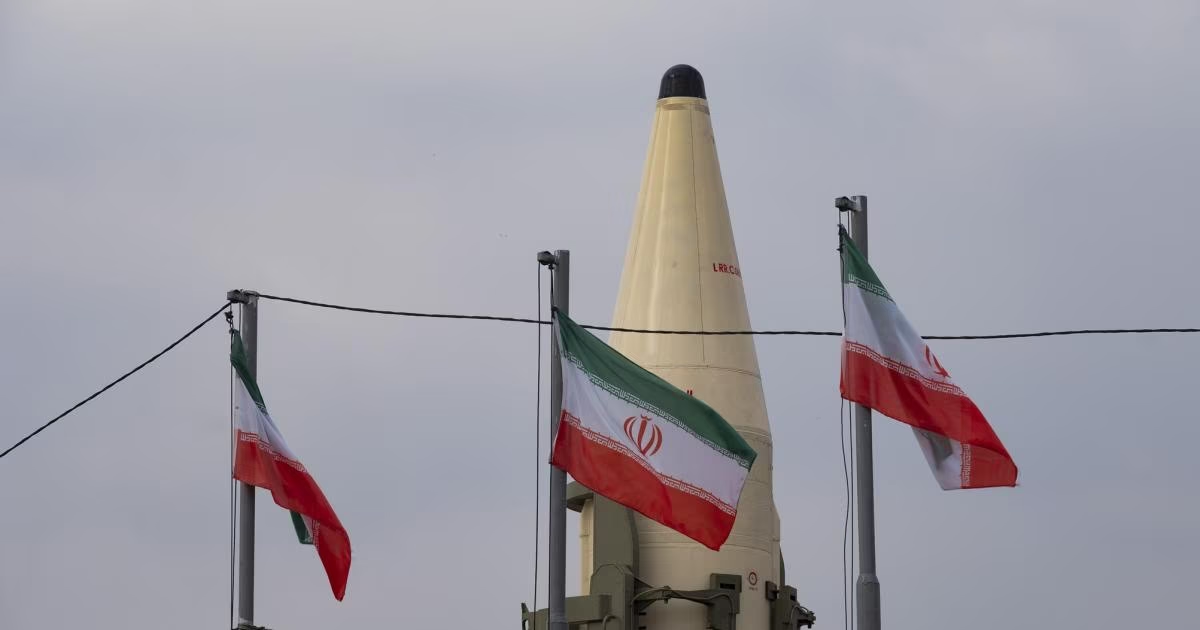
US military readiness for a potential strike against Iran, Israel awaits 'zero hour'

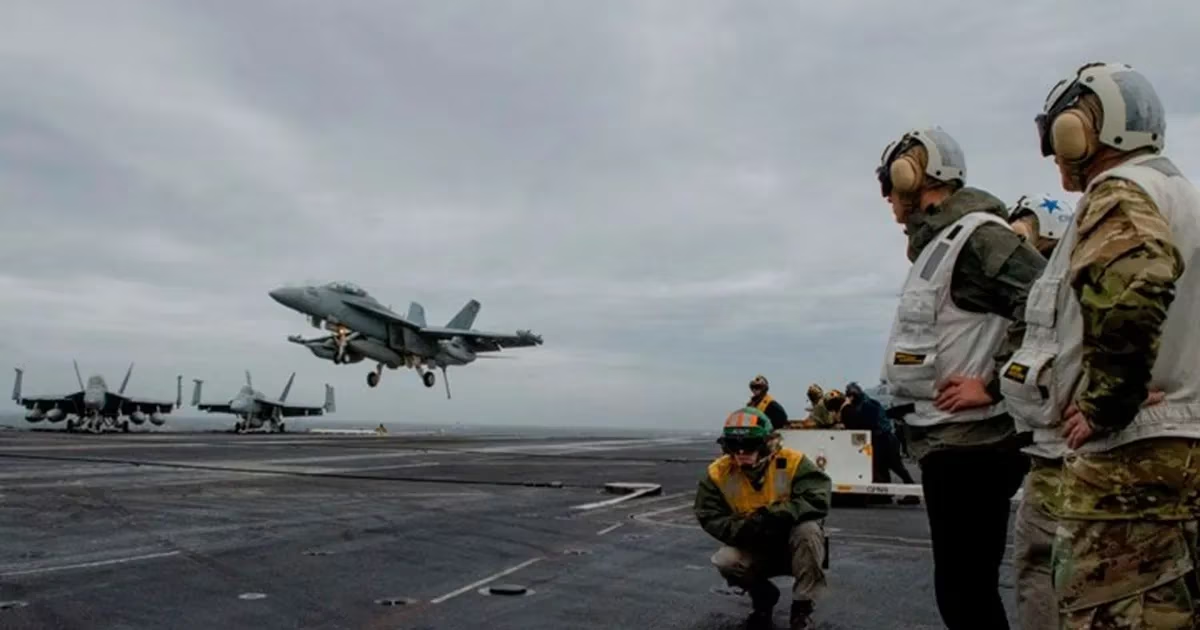
Informed sources revealed that the US administration has received notifications indicating that the armed forces may be in full readiness to carry out military operations against Iranian targets by the end of this week. This development comes after large-scale mobilization of US air and naval capabilities in the Middle East, signaling the seriousness of recent threats hinted at by the White House.

Despite these field preparations, sources indicate that US President Donald Trump is still weighing available options, having held closed discussions to review arguments for and against direct military intervention. Trump also sought the opinions of his senior advisors and international allies to determine the most effective course of action to deal with the Iranian issue at this critical stage.

In the context of intensive diplomatic and security movements, the White House Situation Room witnessed a high-level meeting of ministers and national security officials to discuss the rapid developments. This meeting coincided with the President receiving a detailed briefing from Special Envoy Steve Witkoff and his son-in-law Jared Kushner on the results of indirect talks held with the Iranian side through Omani mediation.

For its part, military circles in Tel Aviv are awaiting early warning from Washington before taking any offensive step against Tehran. According to Hebrew reports, this coordination aims to enable the Israeli home front to take necessary measures and adjust security instructions for settlers in line with the expected Iranian response.

The Israeli army has been on high alert for about a month, with readiness levels escalating day by day to confront all possible scenarios. Israeli operational plans include the possibility of strong preemptive strikes against Hezbollah in Lebanon, to prevent the opening of multiple fronts in the event of a direct confrontation with Iran.

Security sources confirmed that Israel intends to keep any US warning it receives regarding the attack date secret, to ensure the element of surprise and avoid any leaks that could hinder the operation. The security system is currently undertaking intensive secret preparations, including strengthening air defenses and intensifying surveillance on the northern and eastern borders.

As part of ongoing political coordination, US Secretary of State Marco Rubio is scheduled to arrive in Israel on the twenty-eighth of this month. The visit aims to hold important meetings with Prime Minister Benjamin Netanyahu to discuss final arrangements and joint coordination regarding hot regional issues, foremost among them the Iranian threat.

Recent days have witnessed diplomatic activity in Geneva, where Trump sent his envoys to meet with Iranian officials in a last attempt to avoid military confrontation. Despite Tehran's announcement of some progress in those negotiations, the American tone remained sharp with continued military buildup in bases near Iranian territory.

On the ground, recent satellite images showed Iran building massive concrete fortifications over sensitive military facilities. These Iranian steps aim to protect vital sites from potential air raids, especially those sites that were targets of previous attacks last year.

Images also showed the burial of tunnel entrances at strategic nuclear sites, as well as the fortification of entrances to other facilities under thick layers of soil and concrete. These Iranian moves reflect an attempt to restore defensive capabilities and repair missile bases damaged in previous rounds of escalation with the United States and Israel.

In light of this complex scene, observers believe that the region is on the verge of a major strategic shift that could redraw the balance of power. While the language of threats and warnings continues, diplomatic channels remain slightly open, amidst questions about whether Trump will issue orders for actual military action before the end of the week.

In conclusion, all eyes remain on the White House and field movements in the waters of the Gulf, as the scale of military buildups reflects an American desire to impose a new reality. In contrast, Iran continues to strengthen its internal defenses and hint at its ability to target American interests in the region if it is attacked.

The military may be ready to launch an attack on Iran by the weekend following a major buildup of air and naval assets.

ARAB AND WORLD

Thu 19 Feb 2026 11:56 am - Jerusalem Time

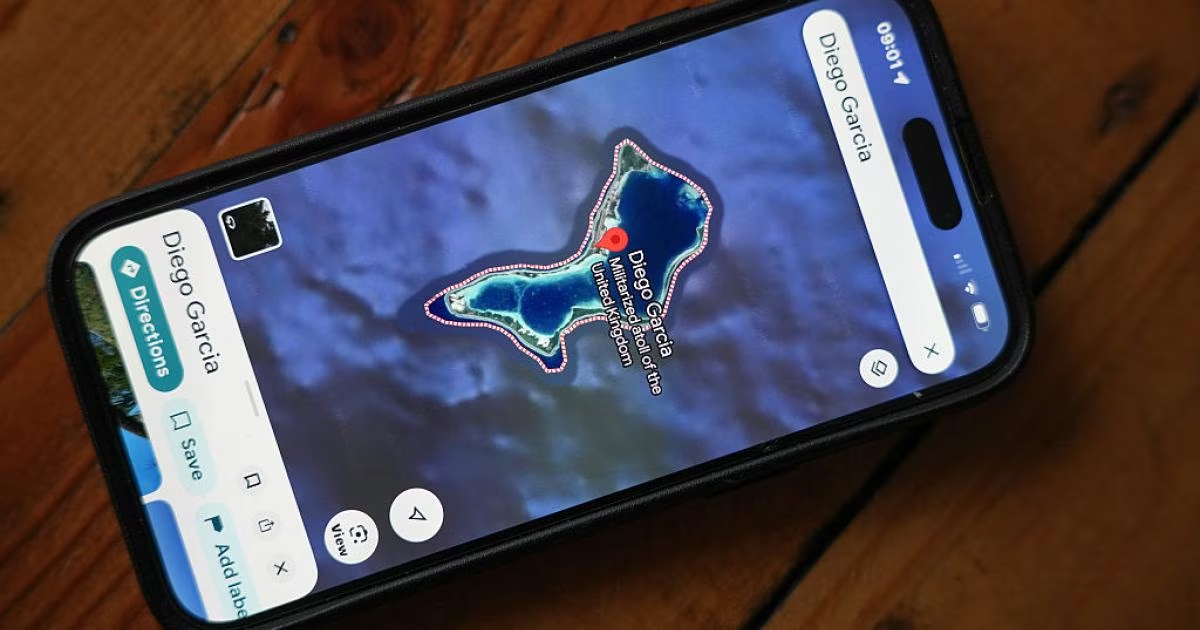
Trump threatens to use 'Diego Garcia' base to strike Iran and warns London against abandoning it

US President Donald Trump issued strong warnings to Tehran, hinting at the possibility of using military force from long-range strategic bases. Trump affirmed that the United States might be forced to resort to the 'Diego Garcia' base in the Indian Ocean and 'Fairford' Air Base in Britain to carry out military operations aimed at deterring the Iranian regime.

Trump's statements came via his 'Truth Social' platform, where he linked potential military action to the failure of diplomatic efforts to conclude a new agreement with Iran. He described the regime in Tehran as 'extremely dangerous,' emphasizing that the mentioned military bases represent a fundamental pillar of American national defense and security strategy.

In a related context, Trump sharply criticized the British government led by Keir Starmer, warning it against proceeding with an agreement to transfer sovereignty over Diego Garcia island to the Republic of Mauritius. The US President considered the signing of a hundred-year lease agreement a 'fragile' measure that could lead to the loss of control over a vital location monitored by international powers such as China and Russia.

Diego Garcia base is one of the most important US military installations outside its borders, housing an advanced military airport capable of accommodating heavy strategic bombers. The base also provides naval facilities in a deep-water port that supports warships and nuclear submarines, making it an ideal launching point for operations in the Middle East and Asia.

The island's importance extends to intelligence and surveillance, as it contains advanced technical equipment for monitoring communications and military movements in the Indian Ocean region. The base plays a pivotal logistical role as a supply and support center for US forces deployed across three continents: Asia, Africa, and the Middle East.

Historically, Britain separated the island from the Chagos Archipelago in 1965 and granted it to the United States to establish this joint base, which later became a launching pad for major operations. That period witnessed the displacement of about two thousand indigenous inhabitants of the island, which sparked legal and international disputes that lasted for decades in the halls of the United Nations.

The UN General Assembly issued a resolution in 2019 demanding London end its administration of the islands and hand them over to Mauritius, which subsequently led to the signing of an agreement in May 2025. Despite the signing of the agreement, which grants Britain the right to use the base for a full century, Trump sees this step as 'unjustified weakness' from a strategic ally.

Trump noted in his post that abandoning this land represents a 'great folly' that harms Western national security interests in general. He linked this issue to his previous ambitions related to purchasing Greenland, considering that acquiring strategic locations is the only guarantee to confront increasing global threats.

Legally, the agreement between Britain and Mauritius is still awaiting final ratification by the parliaments of both countries to officially come into effect. US military circles fear that any changes in the political sovereignty of the island could lead to future restrictions on the freedom of movement of forces or the use of sensitive facilities.

International capitals are closely monitoring these statements, which redraw the features of US foreign policy in a new Trump era, especially concerning the Iranian file. The question remains about the extent of London's response to these American pressures, especially in light of its international commitments to Mauritius and UN resolutions.

Should Iran decide not to conclude an agreement, the United States may be forced to use the Diego Garcia base to repel a potential attack from a highly dangerous regime.

ARAB AND WORLD

Thu 19 Feb 2026 11:56 am - Jerusalem Time

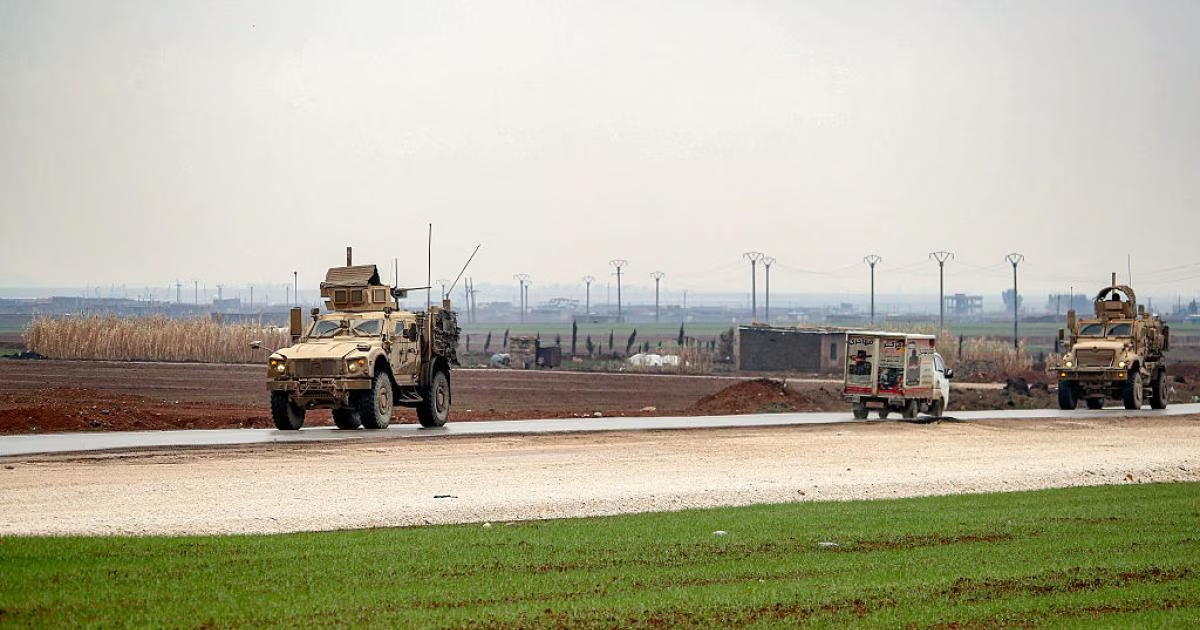
Washington decides to withdraw all its military forces from Syria within two months

Media reports and official sources have revealed that the American administration intends to withdraw all its military forces from Syrian territory within the next two months. This decision includes approximately one thousand American soldiers who were stationed in various areas, in a move that represents the end of Washington's direct military presence, which lasted for years under the guise of combating ISIS.

These field movements come after the Syrian government regained control over vast areas of the country and reached understandings with the Syrian Democratic Forces (SDF). According to sources, the agreement stipulates the integration of these forces, which were a key ally of the international coalition, into official state institutions, paving the way for ending the pretexts that necessitated the foreign presence.

The signs of this withdrawal have already begun to appear on the ground through the evacuation of some strategic sites, as the Syrian army took over the Al-Shaddadi base in the southern Hasakah countryside and the Al-Tanf border base. These bases are considered among the most important points previously used by the international coalition to manage military and logistical operations in the eastern and border regions with Iraq and Jordan.

In a related context, informed sources confirmed that Washington has transferred thousands of detained ISIS elements from Syrian prisons to secure detention centers within Iraqi territory. This preemptive step aims to ensure that no security breaches or escapes occur that might follow the military vacuum resulting from the withdrawal of American forces from the previous detention centers.

For his part, a high-ranking American official described the departure process as falling within the framework of a 'measured and conditional transition' that takes into account the current field conditions. He indicated that American forces will remain on alert to deal with any emergency threats that ISIS may pose, while providing the necessary support to partners to ensure that terrorist activities do not return to the region.

The official concluded his statements by indicating that the intensive American military presence is no longer necessary at present, especially with Damascus expressing its full readiness to assume security responsibilities and combat terrorism. This shift reflects a fundamental change in American policy towards the Syrian file, with a focus on political solutions and local security arrangements instead of permanent military deployment.

An intensive American presence is no longer necessary in Syria, given the Syrian government's readiness to assume primary responsibility for combating the terrorist threat.

ISRAELI AFFAIRS

Thu 19 Feb 2026 11:56 am - Jerusalem Time

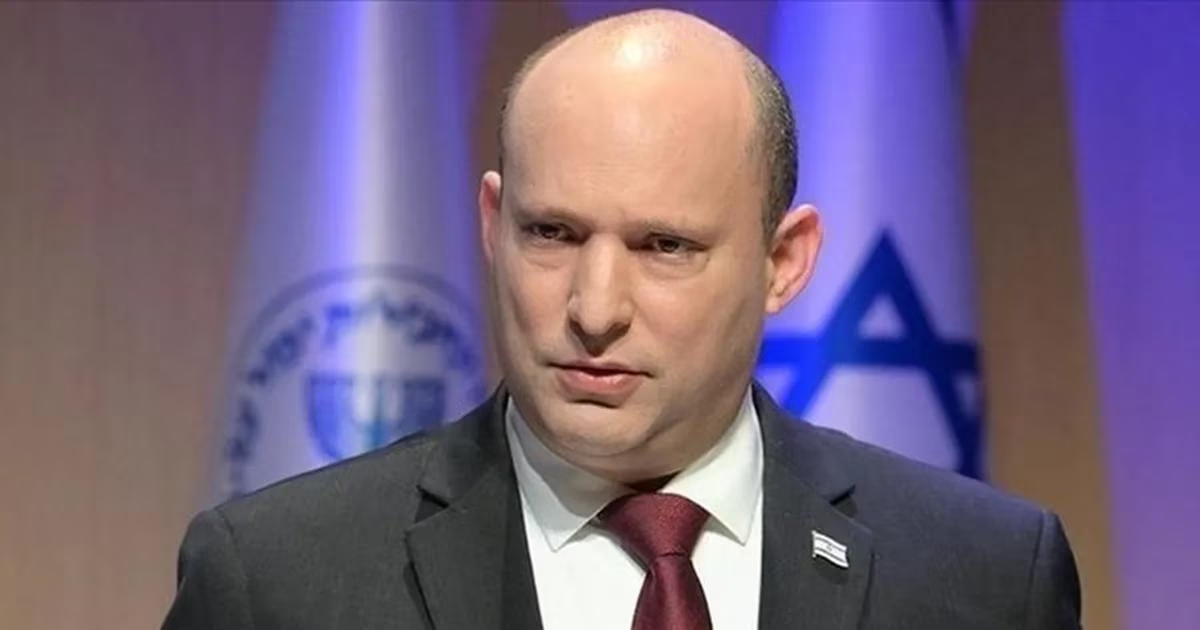
Bennett attacks Turkey, calls it 'the new Iran,' calls for strategy to confront Erdogan

Former Israeli occupation prime minister, Naftali Bennett, launched a scathing attack on the Turkish state, considering it 'the new Iran' in the region. Bennett described Turkish President Recep Tayyip Erdogan as a cunning and dangerous adversary, stressing the need for Tel Aviv to reformulate its international strategy to deal with what he described as the escalating Turkish threat.

In a post published on his official 'X' account, Bennett warned of extensive Turkish moves in the Syrian and Gaza Strip files, the Eastern Mediterranean region, and even the African continent. He claimed that these moves directly aim to encircle Israel and weaken its security position, calling on the Israeli leadership not to ignore these indicators as happened in previous files.

The former Israeli official claimed that Ankara's regional influence contributed to the formation of a hostile axis largely similar to the axis led by Tehran in the Middle East. He referred in his speech to the close ties between the Turkish administration and forces he describes as extremist in both Qatar and Syria, which he sees as strengthening a front hostile to Israeli interests.

Bennett called for urgent action to confront what he called 'the hostility coming from Ankara' in parallel with confronting Iranian threats, stressing that the nature of the confrontation may differ in tools but must be simultaneous and coordinated. Bennett believes that Israel desperately needs to develop a comprehensive action plan that takes into account Turkey's growing regional ambitions.

These sharp statements come amid a state of continuous and tangible tension in relations between Ankara and Tel Aviv, which has significantly escalated since the beginning of the Israeli aggression on the Gaza Strip. Israeli circles continue to express their concern about the growing Turkish role in regional issues, especially with the continuation of official Turkish criticism of Israeli policies towards Palestinians.

I warn you: Turkey is the new Iran. Erdogan is a cunning and dangerous adversary seeking to encircle Israel. We must not turn a blind eye again.

PALESTINE

Thu 19 Feb 2026 11:56 am - Jerusalem Time

White House: $5 Billion via 'Peace Council' for Gaza Strip Reconstruction

White House spokesperson, Caroline Leavitt, confirmed that the $5 billion budget allocated for the reconstruction of the Gaza Strip, pledged by member states of the 'Peace Council,' will be placed under the direct and exclusive administration of the Council. Leavitt clarified in a press statement that this approach aims to ensure the implementation of reconstruction plans in accordance with the vision set by the new international council.

Washington D.C. is scheduled to host an expanded meeting of the Peace Council member states on Thursday, where US President Donald Trump will open the session with a keynote address. Trump's speech will be followed by a series of interventions from representatives of participating countries to present their vision for the next phase in the war-torn Palestinian territory.

The spokesperson revealed that the meeting will see the participation of more than 20 countries, and the list of these countries and the amount of donations each entity has committed to the Gaza reconstruction fund will be disclosed to global public opinion. She emphasized that this step represents significant progress in addressing the aftermath of years of chaos and violence in the region.

Regarding the mechanism for disbursing funds, Leavitt indicated that the Peace Council is the legally authorized body to determine spending priorities and how the allocated budget will be used. She added that a team of technocrats will work alongside the Council to make the necessary technical decisions in continuous consultation with donor countries.

On the diplomatic front, Turkish Foreign Minister Hakan Fidan's participation in this high-level meeting has been confirmed, where he will represent President Recep Tayyip Erdoğan in the discussions. This participation comes amid widespread regional interest in the new arrangements led by Washington to manage the situation in the Gaza Strip after the cessation of military operations.

It is worth noting that the 'Peace Council' came into being in mid-January by a decision from President Trump, as part of a broader plan to end the war in Gaza. The establishment of this council was based on UN Security Council Resolution No. 2803 issued in November 2025, which grants it international legal cover despite the controversy surrounding its powers.

Although the Council's charter does not explicitly mention the Gaza Strip by name in its founding texts, it is known as a permanent international organization aimed at promoting 'good governance' in conflict areas. The charter grants President Trump exceptional powers, including the right of veto and the authority to appoint members for life, which observers see as an attempt to bypass traditional UN structures.

The Peace Council is considered the cornerstone among four organizational structures designed by the US administration to manage the transitional phase in Gaza. The Council's tasks are integrated with the 'National Committee for Gaza Management' and the 'Gaza Executive Council,' in addition to the 'International Stabilization Force' which will undertake security tasks on the ground according to the provisions of Trump's twenty-point plan.

Media sources reported that the Washington meeting represents the Council's first official launch and will take the form of a donor conference entirely dedicated to reconstruction. This move aims to accelerate the implementation of the second phase of the ceasefire agreement that came into effect on October 10, 2025, to end the suffering of approximately 2.4 million Palestinians in the Strip.

These international efforts face significant challenges amid the catastrophic conditions experienced by Gaza residents, where more than 1.5 million displaced people still lack basic services. Through this massive investment, the White House seeks to establish a new political and security reality that ensures no return to comprehensive military confrontation.

We are talking about a five-billion-dollar investment for the reconstruction of Gaza, which has been a scene of violence for many years.

ISRAELI AFFAIRS

Thu 19 Feb 2026 11:56 am - Jerusalem Time

Israeli readiness for American green light to strike Iranian ballistic missile system

Hebrew official sources reported on Wednesday evening that the military establishment in Israel is awaiting approval from the American administration to launch a military operation targeting Iran's ballistic missile system. These moves come amidst escalating regional tensions and reports indicating an approaching direct military confrontation between Washington and Tehran, despite declared diplomatic channels.

Flight tracking data revealed intensive American military activity over the past forty-eight hours, with large numbers of fighter jets and aerial refueling aircraft being dispatched. Reinforcements also included the arrival of early warning aircraft (AWACS) at American bases deployed in Europe and the Middle East, reinforcing the hypothesis of preparation for a large-scale military operation.

Reports clarified that the scenario of targeting Iranian missile capabilities is now strongly on the table for discussion in Tel Aviv, coinciding with the anticipation of decisions from US President Donald Trump. Observers believe that the current military buildup reflects the seriousness of American threats to end the Iranian nuclear and missile file through military force if political pressure fails.

For its part, Hebrew press sources stated that Israeli security agencies' assessments indicate a jump in the probability of an American attack following the latest round of talks between the two parties. These assessments confirmed that the gaps between Washington and Tehran remain deep, especially regarding the demand for a complete abandonment of uranium enrichment within Iranian territory, which Tehran categorically rejects.

With the negotiations in Geneva reaching a dead end, security circles in Israel expect the White House to resort to the military option sooner than previously planned. A state of alert prevails within Israeli decision-making circles to keep pace with any sudden American decision that could radically change the balance of power in the region in the coming days.

Israeli military circles do not rule out the possibility of direct and effective involvement of the Israeli army in combat operations against Iranian targets if a confrontation erupts. High-level intelligence and technical coordination is currently underway between the two sides, including the exchange of sensitive information and the development of air defense systems and military communications to ensure maximum readiness for any escalation scenario.

Tehran accuses both Washington and Tel Aviv of fabricating pretexts for military intervention and seeking to change the political regime in the country by brandishing military force and economic sanctions. In contrast, Iran insists that its missile and nuclear program is a sovereign right for defensive and peaceful purposes, affirming that it will not relinquish its rights under the weight of continuous threats.

The Iranian leadership has vowed a decisive and devastating response to any military aggression targeting its territory, even if the attack is limited in its geographical scope or objectives. Tehran insists on the necessity of lifting all Western economic sanctions as a fundamental condition for any future understandings, at a time when the United States continues to strengthen its military grip in the region with direct incitement from its ally Israel.

Israel expects President Trump to resort to the military option sooner than it had anticipated in recent days as a result of negotiations reaching a dead end.

PALESTINE

Thu 19 Feb 2026 11:56 am - Jerusalem Time

New Israeli Escalation: Raids and Artillery Shelling Target Various Areas in Gaza Strip

The Israeli occupation forces renewed their military operations in the Gaza Strip early Thursday morning, launching a series of intensive aerial raids and artillery shelling. Field sources reported that artillery shells directly targeted the eastern areas of Khan Yunis city in the southern Strip, coinciding with the movement of occupation vehicles in those vicinities.

In a parallel escalation, aerial raids struck areas where occupation forces are deployed in Rafah city, in the southernmost part of the Strip, in addition to other targets in the eastern neighborhoods of Gaza City. These field developments come at a time when the region is witnessing escalating tensions due to the continuation of military operations despite existing understandings.

On the humanitarian front, medical sources at Nasser Medical Complex confirmed the martyrdom of two Palestinian citizens as a result of gunfire by occupation forces yesterday, Wednesday. The incident occurred near the Yellow Line area in Bani Suhaila town, east of Khan Yunis, raising the pace of direct targeting of civilians in border areas.

In a related context, bulldozers and engineering units of the occupation army continue widespread destruction operations of what remains of citizens' homes, vital facilities, and infrastructure. These operations are concentrated in residential blocks controlled by Israeli forces in various parts of the Strip, exacerbating the total extent of destruction.

Official data issued by the Ministry of Health in Gaza indicates that these aggressions represent a blatant violation of the ceasefire agreement concluded on October 10, 2025. The toll of victims from these violations until the beginning of this week has reached approximately 603 martyrs and more than 1600 injured, amid international silence regarding the continued escalation.

Military operations come as part of a series of continuous violations of the ceasefire agreement that began last October, leaving hundreds of martyrs and injured.

PALESTINE

Thu 19 Feb 2026 11:55 am - Jerusalem Time

Young man killed by settlers' bullets during an attack on the village of Mukhamas in Jerusalem

Palestinian medical sources reported the martyrdom of 19-year-old Nasrallah Muhammad Jamal Abu Siam, who succumbed to critical injuries sustained during an attack carried out by groups of settlers on the village of Mukhamas, northeast of occupied Jerusalem. The martyr had been transferred to the hospital in critical condition after being shot with live ammunition, where medical teams made efforts to save him before his death was announced this evening.

Mukhamas village witnessed widespread attacks carried out by dozens of settlers under direct protection from Israeli occupation forces, resulting in varying injuries to five Palestinian citizens. Field reports indicated that three of the injured were directly shot with live ammunition, while others suffered injuries resulting from physical assaults that accompanied the raid on the village and the destruction of its property.

The settlers' attacks were not limited to shooting but also included organized looting and theft targeting the property and livelihoods of the area's residents. Settler groups seized dozens of sheep owned by Palestinian citizens, in a move aimed at economically pressuring the residents and forcing them into forced displacement from their lands threatened with confiscation.

Mukhamas village and the neighboring Bedouin community of 'Khillet al-Sidra' are subjected to a series of systematic attacks that vary between burning homes and barns and destroying private vehicles. The acts of vandalism also affected the residents' simple infrastructure, including the smashing of solar panels, which represent the sole source of electricity, in addition to destroying surveillance systems that residents install to document these ongoing violations.

Approximately 59 individuals, mostly children and women, live in the 'Khillet al-Sidra' community, where they face harsh living conditions amidst the existential threats that pursue them. These attacks come within a broader settlement policy aimed at displacing Bedouin communities in the vicinity of occupied Jerusalem, amidst human rights appeals for the necessity of providing international protection for unarmed Palestinians in the face of escalating settler violence.

The Palestinian Ministry of Health announced the martyrdom of 19-year-old Nasrallah Muhammad Jamal Abu Siam, who succumbed to his severe injuries from settlers' bullets.

OPINIONS

Thu 19 Feb 2026 11:34 am - Jerusalem Time

Trump’s “Board of Peace” Is a PR Stunt With No Mandate, No Math, and No Legitimacy

News Analysis

Washington, D.C. — When the “Board of Peace” convenes on February 19, the White House will sell it as a historic breakthrough. The press is being primed for a dramatic announcement: more than $5 billion in humanitarian pledges and talk of “thousands of personnel” for an international stabilization force. The imagery will be staged. The rhetoric will soar. The headlines will write themselves.


But beneath the branding, the initiative is empty. The Board has no clear mandate. No published legal authority. No defined operational structure. No accountability mechanism. It is being marketed as a peace framework for Gaza while refusing to answer the questions that determine whether any framework can work. It is diplomacy as performance.


The most revealing fact is what the Board does not include. Palestinians are nowhere to be seen. They are not represented. They are not consulted. They are not even described as a political community with rights. In the Board’s public framing, Palestinians appear as a humanitarian problem to be managed, not a people entitled to liberty and freedom, to live in dignity in their own homeland. A “peace” initiative that excludes the people whose future is being discussed is not peacebuilding. It is an attempt to impose outcomes without consent.


A Brand in Search of a Mandate


Trump unveiled the Board in January and promoted it at Davos as a platform for “world peace.” The February 19 gathering looks less like a working summit than a staged announcement. It is designed to project momentum through money figures. It avoids the hard questions of post-war governance.


The Board’s public description reads like a collection of slogans: reconstruction, stabilization, policing, demilitarization. These are not interchangeable. Reconstruction requires financing pipelines, procurement rules, and legal authority. Stabilization requires a defined mandate, rules of engagement, and political legitimacy. Policing requires training, oversight, and an accountable justice system. Demilitarization requires a political settlement. The Board offers none of the foundations required for any of these tasks. It substitutes language for architecture.


Trump’s insistence that he will serve as chairman makes the intent clearer. This is not a multilateral institution. It is a U.S.-directed coalition. It is built to avoid international frameworks that might impose constraints. The United Nations is one of those constraints. It insists on legal legitimacy and Palestinian representation. That is exactly what this Board appears designed to circumvent.


The Credibility Gap: Allies and Arithmetic


The membership list reflects the same problem. Roughly two dozen countries have reportedly accepted participation, including Israel, Qatar, Saudi Arabia, Turkey, and Egypt. But major European allies are conspicuously absent. Several European governments have expressed concern that the Board is intended to supersede the United Nations and sideline the Palestinian Authority.


That absence is not cosmetic. It is operational. Rebuilding Gaza requires long-term financing, technical expertise, and political legitimacy. Europe is central to all three. Without it, the Board is not a reconstruction mechanism. It is a stage for declarations.


The money being touted is equally revealing. Five billion dollars sounds impressive. It is still a fraction of what Gaza’s recovery requires. A UN, EU, and World Bank assessment estimated reconstruction could cost upward of $70 billion and stretch for years. Against that benchmark, the Board’s pledge looks like a token down payment. Worse, pledges are not cash. They are often recycled commitments, conditional promises, or sums that never materialize. Announcing a number without disbursement plans, oversight, or implementation capacity is not leadership. It is advertising.


The Board is built for a headline, not for a decade-long recovery. Its first major promise already signals its limits. Too little money. Too little structure. Too little legitimacy.


The Kushner Vision: Development Without Sovereignty


The credibility gap widens further with the “master plan” promoted by Jared Kushner, Trump’s son-in-law and a real estate developer. Kushner has described a vision of skyscrapers, new cities, and a coastal tourism zone. He claims Gaza could be rebuilt in two or three years with $25 billion in investment.


The plan is revealing not because it is ambitious, but because it is unserious. Its aesthetic resembles a Gulf mega-project. Its politics resemble a colonial fantasy: redevelopment without sovereignty. Gaza is not an empty plot awaiting investors. It is a devastated society emerging from mass displacement, demolished infrastructure, and unresolved political authority. Reconstruction involves property rights, land ownership disputes, the return of displaced families, and governance legitimacy. A tourism zone cannot be built over a political vacuum.


Kushner’s timeline is especially implausible. Two years of construction requires stability. It requires enforceable contracts. It requires functioning courts. It requires clear land title. It requires a governing authority capable of providing security and services. Gaza currently has none of these prerequisites. Pretending otherwise is not optimism. It is denial. It reduces a political catastrophe to a real-estate rendering.


Security: Stabilization or Subjugation?


The security component is where the Board becomes most dangerous. Trump claims member states will commit thousands to an international stabilization force. Yet he has not clarified whether Israel would accept such a force operating independently. He has not said who would command it. He has not said under what rules it would operate. He has not said what accountability would apply.


For Palestinians, “stabilization” carries bitter echoes. It risks becoming a euphemism for external control. It risks becoming domination repackaged as humanitarian concern. Without clear parameters and Palestinian consent, any such force would be viewed not as a guarantor of safety but as another layer of subjugation.


Trump’s demand that Hamas commit to “full and immediate demilitarization” is equally detached from reality. Demilitarization cannot be imposed by decree. It requires a political settlement. It requires a legitimate governing authority. It requires a credible security alternative. Without those, calls for disarmament sound like surrender terms. Surrender terms do not produce durable ceasefires. They produce humiliation, fragmentation, and relapse.


The Geopolitical Context


The timing is not accidental. It follows U.S.-Iran talks in Geneva. Trump has threatened to strike Iran if it does not curb its nuclear program. He also insists he prefers negotiated outcomes. The overlap underscores a pattern. There is theatrical diplomacy on one front. There is coercive leverage on another.


The Board may therefore serve as much to project American influence regionally as to rebuild Gaza locally. It provides a stage for Washington to claim initiative. It pressures allies into alignment. It presents an alternative to UN-centered legitimacy. And it does all this while Palestinians remain absent from the room where their future is being designed.


Conclusion: A Hollow Core


Ultimately, the Board of Peace is less an institution than an instrument. It gives Trump a platform to claim authorship of Gaza’s future. It helps pressure allies into alignment. It sidelines legitimacy frameworks that would require Palestinian representation and enforceable accountability.


A peace framework that excludes Palestinians is not merely flawed. It is illegitimate. It asks the world to accept that Gaza’s fate can be decided by outside powers, while the people who live there are reduced to recipients of aid, objects of security planning, and targets of economic redesign. That is not a path to stability. It is a recipe for permanent grievance.


If the Board is serious, it must begin where it currently refuses to begin: with Palestinian self-determination, with freedom and dignity in their own homeland, and with a political process rooted in rights rather than public relations. Without that, the Board’s grand name disguises its true purpose — a promise of peace without a plan, and a plan without legitimacy.

OPINIONS

Wed 18 Feb 2026 8:29 pm - Jerusalem Time

Keeping Palestinians in Place… and Out of the Equation

Dr. Ibrahim Nairat

Opinion Writer

When Ali Jarabawi distinguished between physical transfer and legal transfer, he was not looking for a new term as much as he was trying to read a profound transformation in the tools of the Palestinian-Israeli conflict. In 1948, the scene was clear and shocking: direct expulsion, mass uprooting, and a forceful reshaping of the demographic map. The goal then was to settle the conflict on the ground by reducing the Arab presence to the minimum possible.

But 1967 presented Israel with a different equation. The land expanded, but the population did not disappear. Suddenly, it found itself facing a large Palestinian human mass that could not be easily uprooted, not only for demographic reasons, but because the world had changed, and the cost of overt displacement became politically and morally higher. At this moment, the shift began: the question was no longer how to remove people from the land, but how to keep them in it without them owning it.

Thus, what can be called “legal transfer” was born. The Palestinian remains on his land, but he is separated from its keys. The borders are not in his hands, the resources are not in his hands, the airspace is not in his hands, the security decision is not in his hands. Daily life seems relatively normal—schools, markets, institutions—but sovereignty is absent. Control is no longer noisy as in scenes of mass expulsion, but has become quiet, organized, and legally framed.

In this model, there is no need for displacement trucks. A complex legal and administrative system is sufficient to rearrange the relationship between man and land, so that the body remains in place while the land is managed from outside. Control here is less confrontational with the international community, and seemingly less morally costly, but it is more entrenched in the long run.

And it seems that the current reality represents the culmination of this logic. Settlement expansion, reclassification of lands, strengthening control over strategic areas, and complicating the administrative structure in the West Bank and Jerusalem, all reflect one philosophy: consolidating control while keeping the population. The goal is no longer mass expulsion as in the mid-20th century, but creating a suffocating and oppressive environment that pushes towards “silent migration,” making the Palestinian presence fragile, limited in sovereignty, and restricted in potential.

At the heart of this transformation stands the Oslo station. When the Palestinian Authority was established, it was presented as a transitional step towards an independent state. But with the faltering political path, it gradually transformed into an entity that manages the population within a narrow ceiling of powers. The issue was no longer about liberating the land as much as it became about managing society under occupation.

Here, the most dangerous transformation occurred: the redefinition of responsibility.

Before the establishment of the Authority, as in the First Intifada, society moved on its own initiative. Popular committees managed daily life, and initiative came from the grassroots. No one waited for an official signal. After the establishment of the Authority, however, the question was repeated with every escalation: What will the Authority do? Not what will we do?

The existence of an official authority repositioned political action. Initiative shifted from society to the institution, and with it, the logic of confrontation changed. The Authority, by virtue of being an authority, prioritizes internal stability, preventing chaos, and maintaining public order. This is a logic of administration, not a logic of a liberation movement.

The paradox is that the Authority is popularly demanded to act, but it operates within arrangements that do not grant it control over land, borders, or resources. It is an authority without sovereignty. If it escalates, it risks its very structure. If it refrains, it is accused of inaction. In this gray area, the model of administration is entrenched instead of the model of liberation.

Thus, what resembles a “compromise” is formed on the ground: no independent Palestinian state, no single state with equal rights, but a continuation of Israeli control with limited Palestinian self-rule. A model that postpones resolution but does not cancel it, and manages the crisis instead of solving it.

This reality may provide short-term tactical gains for Israel, as it avoids major decisions related to withdrawal or granting full political rights. But it does not solve the structural contradiction at its core. Keeping an entire people without sovereignty, while continuing to control their land and resources, does not produce lasting stability, but rather reproduces the conflict in a new form.

The question is how can control over land be combined with depriving the population of sovereignty or equality? How long can this contradiction be managed without exploding again?

Unless a political horizon is opened that recognizes full rights—whether through two real states or one state with equal rights—the current formula will remain a temporary management of a deep historical crisis.

At the heart of this equation, Palestinian society faces a difficult test: Will it remain waiting within a tightly managed system, or will it redefine its position as an actor, not an object of control?

Perhaps here, specifically, lies the most important question for the next phase.

ARAB AND WORLD

Wed 18 Feb 2026 8:29 pm - Jerusalem Time

Economist: 'Cornerstone' Cracks - Saudi-UAE Dispute Threatens Dire Consequences for the Region

International press reports indicate that Saudi-Emirati relations are undergoing a period of escalating tension that has surpassed the usual diplomatic decorum between the two countries. Sources pointed out that the fraternal tone that once dominated official statements now starkly contradicts the reality on the ground, especially after indirect clashes occurred in thorny regional issues.

The Economist magazine stated that the main turning point began to clearly crystallize last December, when Riyadh accused Abu Dhabi of threatening its national security and bombed an Emirati arms shipment in Yemen. This covert military escalation reflected the depth of the dispute over influence in the Arabian Peninsula and the Horn of Africa, putting common interests at risk.

On the diplomatic front, it appears that direct communication channels between senior officials in the two countries have largely broken down, with effective dialogue ceasing and being replaced by sharp media rhetoric. According to sources, media platforms supported by both countries have been unleashed to launch mutual attacks, something unprecedented given the strict censorship usually imposed by Gulf capitals.

In Sudan, the dispute manifested in supporting the two sides of the armed conflict, with Saudi Arabia backing the Sudanese army, while the UAE is accused of providing financial and military support to the Rapid Support Forces. Riyadh views this intervention as a direct threat to the security of the Red Sea, which it considers a vital sphere of influence that cannot be divided between two competing parties.

As for the Yemeni file, the move by the UAE-backed Southern Transitional Council to seize territories belonging to Saudi-backed forces led to an escalation of the situation on the ground. Saudi pressure forced the Transitional Council to retreat, a step observers considered an attempt to reduce Emirati influence in the southern and eastern governorates of Yemen.

Economically, companies operating in the region have begun to feel the brunt of this dispute through newly introduced bureaucratic obstacles and delays in granting work visas to employees of companies based in the UAE. Diplomatic sources also reported the detention of commercial trucks at land borders, indicating the use of the economic card as a tool for political pressure.

Figures indicate that the volume of trade between the two countries reaches $31 billion annually, making any economic rupture a costly gamble for both sides. However, the competition to attract foreign investment and Riyadh's transformation into a regional business hub has intensified tensions with Dubai, which dominated this role for decades.

In the context of sovereign comparisons, the divergence in visions regarding political Islam and dealing with separatist forces in the region stands out, with Abu Dhabi tending towards completely eradicating Islamist movements. In contrast, Riyadh shows greater flexibility in accommodating some Islamist groups within its political balances, which irritates the Emirati side.

The dispute also extends to the stance on the Israeli occupation, where the UAE pursued full normalization in 2020, while Saudi Arabia still sets conditions related to Palestinian rights. This divergence in managing sensitive issues has led to the emergence of a 'clash of narratives' in which each party accuses the other of being beholden to external interests or falling under the influence of pressure groups.

Despite analysts ruling out a comprehensive blockade similar to what happened with Qatar in 2017, concern prevails in diplomatic circles over the continuation of a 'no peace, no war' situation. Experts believe that deep-rooted economic ties may prevent a complete collapse, but they will not prevent the continuation of fierce competition in international arenas.

In a notable development, Qatar, which was previously the target of a blockade, began to play a mediating role to bridge the views between Riyadh and Abu Dhabi. The Emir of Qatar held intensive meetings this February, including with the Saudi Minister of Defense and the President of the UAE, in an attempt to defuse the crisis before it is too late.

Other countries such as Egypt, Bahrain, and Turkey are participating in quiet diplomatic efforts to contain the situation, given the importance of Gulf stability for Arab national security. However, reports confirm that these efforts have not achieved tangible progress so far, given each party's adherence to its strategic positions in regional conflict files.

Observers believe that the UAE, which possesses an efficient army and a diversified economy, no longer wishes to play the role of 'junior partner' in Saudi foreign policy. This shift in Emirati political identity clashes with the new Saudi vision that seeks to consolidate its absolute leadership of the Arab and Gulf region.

In conclusion, the question remains about the extent to which the two countries can separate legitimate economic competition from political confrontation that could burn everything in already volatile issues. The continuation of this dispute could lead to a redraw of the map of alliances in the Middle East, serving other regional powers that are closely monitoring the scene.

The dispute between the two countries, like any rivalry in the Gulf, is a mix of the personal and the political, and has now turned into an open clash of narratives.

PALESTINE

Wed 18 Feb 2026 8:19 pm - Jerusalem Time

Annexation and Displacement Plans: Ministers in the Occupation Government Announce Intention to Cancel Oslo and Extend Sovereignty

Israeli Energy Minister Eli Cohen announced that the government is moving forward with actual measures to extend what he described as 'Israeli sovereignty' over the occupied West Bank territories. Cohen, in statements reported by media sources, considered this step a restoration of what he called 'the legacy of the fathers,' a clear reference to the occupation's intention to legitimize settlements and establish permanent control over the occupied territories.

For his part, Finance Minister Bezalel Smotrich revealed the features of the government's next phase, emphasizing that it will work intensively to cancel the Oslo Accords signed with the Palestinian side. Smotrich stressed during a party conference that the strategic goal is to definitively prevent the establishment of a Palestinian state and to impose full Israeli law on all occupied Palestinian territories without exception.

Smotrich's political vision included explicit calls for what he described as 'voluntary emigration' of Palestinians from the West Bank and Gaza Strip, considering this path the only solution to end the conflict. These statements come at a time when international warnings are escalating regarding the occupation's attempts to change the demographic and legal reality in the occupied territories through veiled forced displacement policies.

Regarding field control, the Finance Minister clarified that plans to expand settlements will not be limited to the West Bank but will also include the Negev and Galilee regions to strengthen the Jewish presence. This approach aims to integrate urban and rural settlements and develop the agricultural sector in those areas, to ensure a demographic superiority that serves long-term Israeli national goals.

Last week witnessed serious legal moves, as the Ministerial Committee for National Security decided to begin the process of registering land in the West Bank for the first time since 1967. This decision paves the way for converting vast areas of Palestinian land into 'state land,' which facilitates their sale to settlers or their allocation for military and security purposes belonging to the occupation.

Media sources confirmed that the land registration project grants the Israeli government broad powers to officially transfer land ownership to the army, security agencies, and settlers. Smotrich considered this legal step aimed at thwarting any unilateral international or Palestinian moves, while Defense Minister Yisrael Katz described it as a fundamental pillar for strengthening Israeli control.

On the Gaza Strip front, Smotrich renewed his extremist calls for the necessity of fully re-occupying the Strip and forming a military government to manage its civil and security affairs. His proposed plan includes establishing new settlement outposts within Gaza, in parallel with continued pressure to encourage residents to leave the Strip under the weight of difficult living and security conditions.

In contrast, these plans faced sharp criticism from opposition leader Yair Lapid, who described Smotrich's vision as an 'illusion' that deviates from the field and political reality. Lapid pointed to major security challenges in Gaza, warning that sliding towards direct military administration would cost Israel exorbitant prices it cannot bear in the long run.

Lapid drew attention to the fact that the current reality in Gaza indicates a role for the Palestinian Authority, especially at the Rafah crossing where officially affiliated employees are present. He clarified that the passports of arrivals and departures are stamped with Palestinian Authority stamps, which refutes the claims of the far-right about the ability to erase the official Palestinian presence from the scene.

These rapid developments come amid categorical Palestinian rejection and widespread Arab and international condemnation, as these steps are considered a blatant violation of international law and United Nations resolutions. Observers warn that the implementation of these plans will ignite the situation in the entire region and eliminate any remaining opportunities for achieving a just political settlement.

Canceling the Oslo Accords is part of a governmental vision to impose full sovereignty and reorder control over the Palestinian territories.

PALESTINE

Wed 18 Feb 2026 8:19 pm - Jerusalem Time

Occupation confirms confiscation of 14 archaeological sites in Sebastia and continues demolition operations in the West Bank

The Israeli occupation authorities issued an official decision to confirm the confiscation of 14 archaeological sites in the town of Sebastia, located north of the occupied West Bank. This measure aims to transform these historical lands into what is called 'state land,' in preparation for extending full Israeli sovereignty over them and permanently preventing Palestinian citizens from accessing them.

This step comes within the framework of a broader plan by the occupation government aimed at seizing vast areas of West Bank land under flimsy legal and historical pretexts. This policy, which relies on registering lands as 'state land,' represents a strategic shift in dealing with Palestinian archaeological areas since the 1967 occupation.

Field sources reported that the town of Sebastia is subjected to a fierce settlement attack, with dozens of buses carrying settlers and foreign visitors flowing daily to the archaeological sites under the protection of the occupation army. These systematic incursions aim to entrench the settlement presence and confiscate the historical rights of Palestinians to their land and cultural landmarks.

Residents of the town were shocked in August of last year by a decision to convert about 1775 dunams, which is equivalent to one-third of the town's area, into a 'national park.' The occupation authorities base these confiscations on biblical claims that the area was the capital of an ancient kingdom, in an attempt to legitimize control over Palestinian cultural heritage.

In parallel with the confiscation decisions, the occupation army escalated its military operations in various governorates of the West Bank, where bulldozers carried out demolition operations of citizens' homes in the city of Hebron. Demolition operations began in the early morning hours, displacing Palestinian families amid the continuation of the policy of collective punishment and the destruction of infrastructure.

In the northern West Bank, occupation forces imposed a tight siege on a number of villages and towns located south of Nablus city, including the town of Aqraba, which suffers from repeated attacks. These areas are subjected to continuous night raids and home invasions, interspersed with physical assaults and field interrogations with local residents with the aim of intimidating them.

Regarding arrests, the Palestinian Prisoners' Club revealed shocking figures reflecting the scale of Israeli escalation, with over 9,000 Palestinians documented as arrested since the beginning of 2025. The total number of detainees since October 7, 2023, has risen to over 23,000 arrests, including all segments of Palestinian society.

For his part, the spokesperson for the UN Secretary-General, Stéphane Dujarric, criticized the recent Israeli moves aimed at imposing sovereignty over West Bank lands. He affirmed in press statements that these decisions lack any legal legitimacy and constitute a blatant violation of international law and relevant UN resolutions concerning Palestinian rights.

Observers believe that these accelerating policies of land confiscation and home demolitions aim to create a new geographical and demographic reality that prevents the establishment of a contiguous Palestinian state. Through these repressive measures, the occupation seeks to empty areas classified as 'archaeological' or 'vital' of their original inhabitants and replace them with settlers permanently.

The decisions taken by the Israeli government regarding imposing its authority over lands in the West Bank are illegal and contrary to international law.

PALESTINE

Wed 18 Feb 2026 8:18 pm - Jerusalem Time

Military escalation by the occupation in Gaza as the first day of Ramadan arrives

The first signs of the blessed month of Ramadan in the Gaza Strip began amidst a new field escalation, as occupation forces continued their violations of the existing truce agreement. Field sources reported that occupation vehicles carried out a series of attacks, ranging from concentrated artillery shelling to intense gunfire, disrupting the Ramadan atmosphere in the targeted areas and increasing the state of security tension.

In detail of the field developments, the occupation artillery directly targeted the eastern areas of the Al-Bureij refugee camp in the central Strip, causing panic among the displaced and residents. Concurrently, military vehicles stationed on the borders renewed their machine-gun fire towards the eastern neighborhoods of Khan Yunis city to the south, while local sources monitored sniper operations targeting the movements of citizens in the eastern outskirts of Gaza City.

The aggression did not stop there but extended to the city of Rafah, in the far south of the Strip, where occupation vehicles opened fire near the strategic 'Morag' axis. Border areas in Khan Yunis also came under continuous barrages of fire launched from the sand berms behind which the occupation forces are stationed, reflecting a determination to disrupt any state of field stability at the beginning of the holy month.

These field attacks come as a continuation of a bloody day witnessed by the Strip yesterday, Tuesday, which resulted in the martyrdom of a child and the injury of three other citizens, including an elderly man, due to scattered targeting. These data confirm the exacerbation of the humanitarian suffering of the Strip's residents who face harsh conditions, where the pain of loss and siege is mixed with the sanctity of fasting days under the weight of continuous military threats.

Occupation forces continued their violations of the truce agreement in the Gaza Strip through a series of attacks that included gunfire and artillery shelling.

PALESTINE

Wed 18 Feb 2026 8:17 pm - Jerusalem Time

International Rejection of the "Peace Council": Mexico and Spain Reject Trump's Attempts to Hijack the Palestinian Cause

Said Erikat

Opinion Writer

Washington – Saeed Erikat – 2/18/2026

In a striking diplomatic scene, the "Peace Council" launched by US President Donald Trump's administration is facing unprecedented international embarrassment after Mexico officially refused to join it, aligning with a firm Spanish stance. This rejection stems from the deliberate exclusion of the Palestinian Authority from the negotiation table.

At her press conference on Monday morning, Mexican President Claudia Sheinbaum unequivocally announced her rejection of the American invitation, emphasizing that the fundamental flaw lies in the absence of the Palestinian side. Sheinbaum stated: "Since we recognize Palestine as a state, it is extremely important for both Israel and Palestine to participate. But the meeting was not planned on that basis." This position was not isolated, as Spanish Prime Minister Pedro Sánchez had previously expressed a similar rejection, stressing that the council operates "outside the framework of the United Nations" and excludes the Palestinian Authority, which Madrid considers the sole legitimate partner for peace.

Notably, Mexico did not merely reject the invitation but chose the role of an observer, allowing it to monitor developments without granting legitimacy to the council's decisions. It thus joins a growing list of European and established countries such as France, Germany, Greece, and New Zealand, all of whom have expressed reservations about the council's broad powers and its attempt to circumvent international legitimacy. It appears that Trump's attempt to create a parallel entity to the United Nations, concentrating power in his hands and those of his "son-in-law Jared Kushner" to reconstruct Gaza according to a purely real estate vision, has collided with the wall of defending international law and the right of Palestinians to represent themselves.

The "Peace Council," chaired by Trump, is scheduled to meet in Washington on Thursday morning, February 19, 2026.

Experts believe that what Donald Trump is doing through the so-called "Peace Council" is nothing more than a crude attempt to hijack the Palestinian cause and exploit it in a real estate deal under the guise of reconstruction. By completely excluding Palestinians, including the Palestinian Authority (which the United States supports), the American president proves that he is not seeking a just peace, but rather imposing a new guardianship that entrenches the reality of occupation and nullifies the role of the international community represented by the United Nations.

The rejection by both Mexico and Spain is not just a fleeting diplomatic stance; it is a slap to attempts to marginalize international law. Furthermore, the attempt to make peace a "privilege" that Washington distributes according to its narrow interests, rather than a "right" for the Palestinian people, is considered the real reason behind the failure of all previous initiatives. This new council will remain merely a faded facade of hegemony unless the true owners of the land are involved.

Experts also believe that while Trump thinks he can buy loyalties with billions of dollars for Gaza's reconstruction, Mexico, under Sheinbaum's leadership, proves that political principles are more valuable than any suspicious funding. The council requires huge donations of up to one billion dollars for permanent membership, as if the cause of an entire people can be subjected to public auction. Mexico's choice of an observer role is a clever message: "We are for peace, but not at the expense of Palestinian rights."

A Latin American diplomat told Al-Quds newspaper's correspondent in Washington that: "This position restores credibility to independent Latin American diplomacy and serves as a model for countries that want to maintain their international relations without becoming a tool in the game of axes." The diplomat, who requested anonymity and not to mention the country he represents, added: "While Trump bets on money, Mexico bets on reason and justice, and there is a vast difference between the two bets."

PALESTINE

Wed 18 Feb 2026 8:17 pm - Jerusalem Time

Pakistan conditions its participation in Gaza force on US guarantees and rejects disarming the resistance

Informed government sources reported that Pakistan is seeking explicit guarantees from the United States of America regarding the nature of the tasks assigned to its forces potentially to be sent to the Gaza Strip. These moves come within the framework of international arrangements to establish a stabilization force, with Islamabad emphasizing that its role should be limited to maintaining peace and security without engaging in direct confrontations.

Pakistani Prime Minister Shehbaz Sharif is scheduled to travel to Washington D.C. tomorrow, Thursday, to participate in the first official meeting of the Peace Council launched by US President Donald Trump. This meeting will be attended by high-level delegations from at least 20 countries to discuss security and political arrangements for the next phase in the Palestinian territories.

Expectations indicate that President Trump will announce during the meeting a massive plan for the reconstruction of the Gaza Strip, estimated at billions of dollars, in parallel with providing technical details about the international stabilization force. This force will operate under a United Nations mandate and aims to secure the Strip during the transitional period following the cessation of military operations.

Sources close to the Pakistani Prime Minister's office reported that Sharif wishes to clarify the strategic objectives of the stabilization force and the entity to which it will be administratively subordinate before making a final decision. The Pakistani government also attaches great importance to knowing the field chain of command to ensure that the mission does not deviate from its agreed humanitarian and security path.

Sources confirmed that the Pakistani position is firm in rejecting any role related to disarming the Islamic Resistance Movement (Hamas), considering it a red line that cannot be crossed. One official explained that the Pakistani army is ready to contribute thousands of soldiers to traditional peacekeeping missions, but it will not be a party to any internal conflict or disarmament operations.

Trump's 20-point plan relies primarily on forming a security force from major Islamic countries to oversee economic recovery and reconstruction operations. Washington sees Pakistan's joining as a qualitative addition given its army's long experience in dealing with complex conflicts and counter-insurgency operations in difficult geographical areas.

On the diplomatic front, leaked documents revealed that the European Union has already opened communication channels with the transitional governance structures recently formed in the Gaza Strip. The European bloc is considering providing financial and technical support to the National Committee for the Administration of Gaza, which began its actual work in mid-January to manage civil affairs.

A document issued by the European External Action Service showed that EU foreign ministers will hold a crucial meeting in Brussels on February 23 to discuss the situation on the ground. The meeting aims to formulate a unified European position on mechanisms for supporting stability in the Strip and determining the extent of contributions to urgent development projects.

Although most European governments preferred not to officially join the Washington-led Peace Council, they decided to send representatives as observers to ensure coordination. The European Commissioner for the Mediterranean, Dubravka Šuica, will attend the Washington meeting to follow the details of the American peace plan and ensure its compatibility with the European vision for a solution.

The European Union affirmed in its internal correspondence that full non-membership in the Peace Council does not mean abandoning the commitment to the success of comprehensive de-escalation efforts in the region. Brussels seeks to maintain its role as a key player in providing humanitarian aid and supporting Palestinian civil institutions away from sharp political tensions.

In the context of technical support, the European Union Police Support Mission intends to contribute to the qualification of Palestinian security and civilian personnel and provide them with the necessary equipment. These efforts will focus on building criminal justice institutions and training civilian police to ensure the rule of law and protect public and private property during the reconstruction period.

We are ready to send troops, but they can only be part of a peace mission; we will not participate in disarming Hamas, as this is out of the question.

PALESTINE

Wed 18 Feb 2026 8:16 pm - Jerusalem Time

American plan to recruit 'criminal gangs' and armed militias to manage security in Gaza

International press sources have revealed tendencies within the administration of US President Donald Trump to rely on organized crime gangs and drug smuggling networks to form the nucleus of new police forces in the Gaza Strip. These plans come amidst American efforts to find a security alternative to the Hamas movement, with warnings from military leaders and Western allies about the danger of this step and its repercussions on stability.

Reports indicate that Israel directly supports these proposals, having already armed and supported some factions and armed militias since the outbreak of confrontations in October 2023. These groups are formed based on family and tribal ties, but their long record of organized crime raises deep concerns among Palestinian civilians who do not trust these formations.

Field reports have documented these militias' involvement in widespread looting of humanitarian aid trucks in recent months, in addition to committing murders and kidnappings. What adds to the gravity of the scene is the presence of elements within these groups who previously declared their allegiance to the Islamic State organization or fought in its ranks in neighboring conflict zones.

Senior military leaders in the United States, along with officials from Britain and France, have expressed grave concern about the proposed peace plan faltering due to the absence of reliable security partners on the ground. They believe that relying on criminal elements will lead to the collapse of any attempt to establish stability, and will turn the Strip into an arena of permanent chaos under the supervision of illegitimate forces.

In a related context, Jared Kushner, President Trump's son-in-law, emerged as a pivotal figure in drafting the 20-point peace plan, which includes the establishment of temporary residential clusters called 'safe zones'. This plan aims to isolate Palestinian residents in areas controlled by the Israeli army and its loyal militias, away from the influence of resisting Palestinian factions.

The first of these residential clusters is currently being built on the ruins of the former city of Rafah, an area under the influence of the Israeli-backed 'Popular Forces' militia. This group faces explicit accusations of drug smuggling and control over vital resources, which puts residents before difficult choices between displacement or submission to gang authority.

Kushner is working in coordination with Aryeh Lightstone, an official at the Abraham Accords Institute, who is managing the planning for Gaza's future from a Tel Aviv hotel. Billionaire investors aspiring to invest in the sector after the war are participating in these discussions, which has led some sources to describe this group as the 'Hilton Club' that adopts an ideological vision far from the reality on the ground.

Western officials question the feasibility of this approach, asserting that attempting to impose unpopular family militias will not succeed in gaining the trust of the Palestinian street. Observers believe that residents view these groups as tools in the hands of the occupation, and that attempting to replace an existing authority with criminal gangs will lead to a renewed and more violent explosion of the situation.

Concerns are growing that the US administration will use the residents' rejection of these militias as a pretext for continued military operations, under the guise of 'cleansing' areas of those sympathetic to the resistance. This approach could give Israel a permanent green light to reignite the war at any time, under the pretext of the Palestinians' failure to seize the opportunity for 'liberation' offered by the American plan.

Despite the ambiguity surrounding the names of the militias nominated to carry out security tasks, the White House has not denied these reports. Names such as 'Dughmush family' and 'Jaysh al-Islam' emerge as parties suspected of links to extremist organizations and previous international kidnapping operations, which raises major question marks about the security standards applied in vetting.

In the search for field leaders, political circles circulated the name of Jamal Abu Hassan, the former security official in the Palestinian Authority, to lead the new police force. Figures such as Hussam Al-Astal also appeared, who explicitly announced his coordination with the Israeli side and his readiness to participate in the administration of Gaza in the post-war phase, based on his previous security background.

The US administration is currently trying to rally international support to fund these forces, with Trump announcing pledges of $5 billion for reconstruction and the formation of an international stabilization force. This international force is supposed to operate under the umbrella of the United Nations to coordinate with the Israeli army, while local militias take on repressive and security tasks within residential neighborhoods.

However, reality indicates that these plans face significant financial and legal obstacles, as well as widespread popular and political rejection. The international community fears that funding militias involved in crimes will lead to international legal prosecutions, especially with the documentation of these groups' violations against unarmed civilians during the current war.

In conclusion, it seems that Gaza's security future is teetering between the hammer of occupation and the anvil of armed gangs that Washington seeks to legitimize. With no horizon for a comprehensive national political solution that includes all Palestinian components, these proposals remain mere attempts to impose a fragile security reality based on 'the power of arms and crime' instead of legitimacy and law.

A number of senior American military leaders have expressed concern that the peace process proposed by Donald Trump will not succeed without reliable security partners.

PALESTINE

Wed 18 Feb 2026 8:16 pm - Jerusalem Time

150 International Figures Accuse French Foreign Ministry of 'Misinformation' Against UN Rapporteur Albanese

More than 150 prominent international figures, including former ministers and diplomats, have directly accused French Foreign Minister Jean-Noël Barrot of systematic 'misinformation'. This comes after the French minister called for the resignation of the UN Special Rapporteur for the Occupied Palestinian Territories, Francesca Albanese, from her position based on statements inaccurately and distortedly attributed to her.

The roots of the crisis trace back to actions by French presidential camp deputies on February 10, who demanded the withdrawal of Albanese's UN mandate, claiming she classified Israel as a 'common enemy of humanity'. The Foreign Minister adopted this stance the following day, describing her statements as 'outrageous and reprehensible' and containing justification for the events of October 7 and unacceptable analogies.

In an open letter issued today, Wednesday, the signatories, representing several countries such as the Netherlands, Greece, Denmark, and Argentina, refuted the official French claims. The international figures affirmed that Albanese never described Israel as an enemy of humanity, but rather that the attack on her aims to tarnish her reputation and obstruct her human rights work in documenting violations in the occupied territories.

The signatories emphasized that the UN Rapporteur was recalling a fundamental principle of international law, which is the necessity of accountability for grave crimes that are not subject to political whims. The letter called on the French Foreign Ministry to retract its position and correct the false information it publicly promoted against the UN official, to preserve the credibility of French diplomacy.

For her part, Francesca Albanese strongly responded to these accusations, describing them as 'completely false and distorted'. She clarified in media statements that her previous remarks were taken out of context, as she was referring to the system that allows the continuation of genocide and apartheid without accountability, considering the absence of justice as the true enemy of the international community.

Sources indicated that Albanese had previously spoken at a forum about the existence of a 'common enemy' represented by international silence and the military and financial support that fuels crimes in Gaza. She affirmed that most countries in the world have, in one way or another, contributed to facilitating these violations by providing political and logistical cover for Israel, which necessitates a comprehensive legal and ethical review.

In a clarifying interview, the UN Rapporteur reiterated that she did not target the state of Israel as an entity with the description 'common enemy', but rather condemned the international system that grants impunity to perpetrators of crimes. She considered that attempts to silence her through distortion would not deter her from performing her duty to highlight the suffering of Palestinians and demand the application of international law to all without exception.

Accountability for grave violations of international law is a legal obligation, not a political option, and the accusations against me are false and distorted.

PALESTINE

Wed 18 Feb 2026 8:16 pm - Jerusalem Time

Single indictment against an Israeli soldier for looting in Gaza despite documentation of hundreds of violations

Hebrew media sources revealed official data issued by the Israeli occupation army, indicating that only one criminal indictment has been filed against a soldier for looting Palestinian property during the ongoing genocide war in the Gaza Strip. This single legal action comes amidst widespread human rights reports and videos documenting systematic theft and vandalism carried out by occupation forces against Palestinian civilian property.

Sources clarified that the aforementioned indictment resulted from a 'plea bargain' concluded with a reserve soldier, where the military court sentenced him to only 60 days in prison, in addition to 30 days of community military service. This sentence is considered extremely lenient and disproportionate to the scale of documented crimes, which showed soldiers boasting about seizing private belongings from citizens' homes in Gaza and Lebanon.

Reports confirmed that this isolated case represents only 'the tip of the iceberg' of violations committed by ground units during military operations, as hundreds of reports and documentations have not resulted in any actual punitive measures against those involved. This judicial behavior indicates a policy of turning a blind eye adopted by the occupation army towards crimes committed against Palestinian property, which encourages soldiers to continue looting and destruction without legal deterrence.

These developments come after the prisoner exchange agreement and ceasefire came into effect on October 10th, following a bloody two-year genocide war. This war left a catastrophic toll of victims exceeding 72,000 martyrs and 171,000 injured, in addition to widespread destruction affecting most residential neighborhoods and vital facilities in the besieged strip, making life there almost impossible.

Regarding material losses, international estimates indicate that the Israeli aggression caused the destruction of approximately 90% of civilian infrastructure in the Gaza Strip, including hospitals, schools, and water and electricity networks. The United Nations estimated the total cost of rebuilding what the war machine destroyed at about $70 billion, amidst an unprecedented humanitarian and economic crisis experienced by the residents of the strip.

This case represents only the tip of the iceberg in light of videos showing soldiers vandalizing and looting Palestinian property.

PALESTINE

Wed 18 Feb 2026 8:16 pm - Jerusalem Time

Storm of anger at the Berlin Film Festival due to attempts to marginalize the Palestinian issue

The corridors of the Berlin International Film Festival witnessed a massive wave of anger and protests, following attempts by the administration to impose restrictions on political expression and marginalize discussions related to the genocidal war waged by the Israeli occupation in the Gaza Strip. International artists and directors expressed their dissatisfaction with these trends, which they considered an attempt to tame art and isolate it from the bitter human reality.

American director and artist Mark Ruffalo mocked these restrictions, confirming in a post on the 'X' platform that attempting to make politics a forbidden topic at this particular time is reprehensible. Ruffalo added that artists feel an urgent need to express their positions to remind the world of their creative identity linked to issues of justice.

Tension escalated with more than 80 current and former festival participants signing an open letter, in which they directed scathing criticism at the administration for its complete silence regarding the crimes committed in Gaza. The signatories demanded that the festival take a clear moral stance consistent with its history of supporting humanitarian causes.

Statements by the head of the jury, Wim Wenders, ignited the anger after he called on filmmakers to stay away from politics and focus only on artistic aspects. Participants considered this call a retreat from cinema's pioneering role in shedding light on human tragedies and international violations.

In a prominent protest step, the famous Indian writer Arundhati Roy announced her withdrawal from the festival's activities, expressing her rejection of the policy of silencing voices. Prominent cultural figures accused the festival administration of direct censorship of artists who tried to convey the voice of the victims in Palestine.

The signatories of the protest letter, including Palestinian artist Saleh Bakri and director Mike Leigh, affirmed that the separation between cinema and politics is an illusion that cannot be achieved in an interconnected world. They stressed that art derives its value from its ability to confront injustice and stand by the oppressed everywhere.

The letter pointed to a widespread movement within the global film industry, where more than 5,000 film professionals, including Hollywood stars, refuse to cooperate with complicit Israeli institutions. This number reflects the extent of isolation that cultural circles have begun to impose on entities supporting the occupation.

Artists criticized the blatant contradiction in the positions of the Berlin Festival, which had previously issued strong and clear solidarity statements regarding other international crises such as the war in Ukraine. They considered that ignoring the Palestinian tragedy represents a double standard in the moral principles that the festival claims to adhere to.

The open letter called on the festival administration to fulfill its moral duty by clearly stating its opposition to the genocide and crimes against humanity committed by the occupation army. It also demanded an end to all forms of protection that the festival provides to Israel from international criticism and demands for legal accountability.

Among the signatories were prominent names in the world of cinema such as Tatiana Maslany, Peter Mullan, and Tobias Menzies, in addition to directors Lukas Dhont and Nan Goldin. This diversity of names reflects an international consensus among creators on the need to break the barrier of silence regarding what is happening in the occupied Palestinian territories.

Media sources reported that the festival has turned into a kind of 'media capital' for protests, as the administration's attempts to contain the escalating anger have failed. Political discussions have imposed themselves in every seminar and film screening, challenging the official desire to neutralize art from current issues.

Observers believe that this crisis puts the Berlin Festival to a real test of its credibility as a global platform that supports freedom of expression. The demands are no longer limited to symbolic solidarity, but extend to the need to take concrete measures to end involvement in polishing the image of the occupation through cultural forums.

Artists concluded their letter by emphasizing that cinema will remain a tool for resistance and revealing facts, no matter how great the pressures of censorship. They stressed that history will record the positions of cultural institutions at this critical moment, either aligning with human values or accepting subservience to narrow political agendas.

It is somewhat strange that talking about politics suddenly becomes a forbidden topic at the Berlin Film Festival, especially at this moment when everyone wishes to remind the world that they are artists.

ISRAELI AFFAIRS

Wed 18 Feb 2026 8:16 pm - Jerusalem Time

Hebrew analyses warn of Tehran's cunning in Geneva negotiations and anticipate escalation in the West Bank

Hebrew media reports indicate that the current situation between the United States and Iran is characterized by escalating tension despite ongoing diplomatic channels, with Ma'ariv newspaper warning against excessive optimism regarding the outcomes of the Geneva talks. Sources pointed out that military history proves that wars often erupt as a result of escalating mutual threats, even in the presence of announced negotiations between conflicting parties.

Israeli interpretation of the situation suggests that Tehran is pursuing a strategy of buying time and demonstrating political cunning, exploiting negotiations to strengthen its symbolic and field cards. Hebrew circles believe that Iran's gamble primarily relies on testing the patience of the American administration and its ability to withstand the economic and political pressures resulting from the state of no peace and no war in the region.

In the context of field escalation, sources noted that the Iranian Revolutionary Guard deliberately sent strong messages during the negotiation rounds by conducting military maneuvers simulating the closure of the Strait of Hormuz. These moves aim to emphasize Tehran's ability to choke global shipping, as about a quarter of the world's oil supplies pass through this vital strait, representing a strategic vulnerability for Washington.

For his part, Iranian Supreme Leader Ali Khamenei threatened to target and sink aircraft carriers and American naval vessels recently deployed to Gulf waters, a move described by sources as an attempt to embarrass the American leadership. Tehran realizes that any military conflict in this sensitive region will lead to catastrophic economic repercussions feared by the White House, giving the Iranian negotiator more room for maneuver.

On the other hand, Israeli Prime Minister Benjamin Netanyahu, in cooperation with the Chief of Staff, announced raising the highest state of alert among defensive and offensive forces to confront any potential scenarios. This mobilization coincides with ongoing daily military operations launched by the occupation army in various areas of the West Bank and Lebanon, in an attempt to deter what it describes as imminent threats.

Occupation intelligence estimates indicate that Iran is actively seeking to incite Palestinians to open a new front of confrontation in the West Bank, exploiting the approaching holy month of Ramadan to escalate the situation. Based on these estimates, the occupation army intensified its field presence and deployed special units and the Commando Brigade in refugee camps and Palestinian cities to carry out widespread arrest campaigns.

Reports concluded that Tehran possesses multiple options to activate 'proxies' in the region, including Hezbollah in Lebanon and resistance factions in the Gaza Strip and Syria, in the event of any direct attack. Occupation security agencies are closely monitoring these movements, considering that coordination between these fronts represents the biggest challenge that may face regional stability in the coming period.

Iranians are more capable of buying time and more cunning in negotiation, and the matter is related to when American patience runs out.

PALESTINE

Wed 18 Feb 2026 8:16 pm - Jerusalem Time

Unprecedented Humanitarian Crisis: International Organizations Begin Withdrawal from Gaza Under Pressure of Occupation Restrictions

Major international relief organizations have begun procedures to withdraw their staff from the Gaza Strip, a dangerous field development that portends an exacerbation of the humanitarian catastrophe experienced by the Strip's residents. This step comes in response to severe restrictions imposed by the occupation authorities, which set a deadline at the beginning of next month for the cessation of activities of dozens of humanitarian bodies.

Informed sources reported that the occupation authorities notified about 37 international organizations, including long-standing European and British institutions, of the expiration of their legal registration to operate in the Palestinian territories. The occupation authorities stipulated that to renew this registration, detailed lists of local staff names and accurate information about funding sources must be provided.

These measures have raised widespread fears of a complete collapse of the relief system within the besieged Strip. The concerned organizations considered these demands a blatant violation of the principles of data protection and the confidentiality of humanitarian workers, which threatens the independence of their field operations.

International bodies affirmed that complying with Israeli conditions exposes the lives of their local staff to direct risks and security persecutions. They also stressed that this policy undermines bridges of trust between international donors and aid beneficiaries in affected areas.

Among the organizations threatened with cessation are institutions that form the backbone of relief work, such as 'Action Against Hunger' and 'ActionAid'. The list also includes 'Alliance for Solidarity' and 'Campaign for the Children of Palestine', which manage vital projects in the food and water sectors.

According to media sources, the decision also affected 'CARE' and 'DanChurchAid' and the 'Danish Refugee Council'. These institutions are responsible for securing basic needs for thousands of displaced people who have lost their homes and livelihoods during the ongoing war.

Israeli notifications also included the 'International Disability Alliance' and the 'Japan International Volunteer Center', in addition to multiple branches of 'Doctors of the World'. These entities play a pivotal role in providing specialized healthcare and psychological and social support to vulnerable groups.

Among the most prominent organizations that have begun to reduce their presence are 'Doctors Without Borders' with its various branches, 'Mercy Corps', and the 'Norwegian Refugee Council'. These organizations manage emergency medical and food programs that cannot be replaced given the massive destruction inflicted on local institutions.

Field reports warned that the cessation of 'Oxfam' and the 'International Rescue Committee's' work would create a humanitarian gap that cannot be filled in the short term. Hundreds of thousands of Palestinian families depend entirely on the aid provided by these entities to survive.

Several institutions have already begun closing their offices in Gaza and the West Bank, and have started evacuating their international staff before the specified deadline. This relief vacuum will immediately lead to the cessation of the distribution of ready-to-eat meals and essential health baskets to prevent epidemics.

Damage is expected to affect therapeutic feeding programs for children suffering from severe malnutrition in the northern and southern parts of the Strip. Basic healthcare services provided to pregnant women will also cease, increasing the risks of maternal and infant mortality.

Mobile clinics and first aid points, which form a vital lifeline in areas where hospitals have been destroyed, are also threatened with complete cessation. This will exacerbate the spread of infectious diseases associated with water contamination and a lack of safe food for displaced populations.

The danger is not limited to the service aspect but also extends to the absence of field monitoring and independent documentation of violations and humanitarian conditions. These organizations are considered international witnesses to what is happening on the ground, which the occupation seeks to obscure through these restrictions.

These rapid developments come at a time when the political track is witnessing a clear stumbling block in moving to the second phase of the ceasefire agreement. This overlap between political pressures and humanitarian needs increases the suffering of the Strip's residents who face harsh living conditions.

The new Israeli conditions affect the core of humanitarian work and its independence, exposing local staff to direct risks and undermining trust with donors.

ARAB AND WORLD

Wed 18 Feb 2026 8:15 pm - Jerusalem Time

Unprecedented American Military Buildup in the Region.. Portents of a Comprehensive Confrontation with Iran

Media reports, citing informed sources, revealed on Wednesday extensive American military movements indicating the approach of a direct military confrontation with Iran. The sources confirmed that the US military has completed more than 150 military cargo flights dedicated to transporting advanced weapon systems to its bases in the Middle East region, amid an unprecedented escalation of political and field tensions.

The past twenty-four hours witnessed a remarkable escalation with the arrival of 50 additional fighter jets of the latest global models, including F-35, F-22, and F-16 aircraft, to enhance offensive air capabilities in the region. Observers believe that this massive military buildup, coinciding with an escalating rhetoric from President Trump, puts the US administration on a path from which it is difficult to retreat without extracting substantial concessions from Tehran regarding its nuclear file.

Sources quoted officials in the Trump administration as saying that the current movements are not merely a show of force or an attempt at deception, but rather actual preparations for a military operation that may begin very soon. The officials explained that the nature of the current president and his advisors tends towards military decisiveness if Iranian intransigence continues, making the option of a major war closer than ever before.

Estimates indicate that the anticipated operation will not be a limited or swift strike, but is likely to turn into a comprehensive military campaign lasting several weeks and targeting the infrastructure of the Iranian regime. This campaign is expected to be broader in scope and more impactful than previous military operations witnessed in the region, aiming to bring about a radical change in regional power balances.

In a related context, sources reported that there is high-level coordination for launching a joint military campaign between the United States and Israeli occupation forces, aimed at undermining the influence of the Iranian regime and directly threatening its existence. These plans are considered more dangerous than previous confrontations, as preparations are being made for them to be a decisive blow that surpasses in intensity previous wars witnessed in the region over the past decades.

For his part, US Vice President Vance stated that diplomatic talks have reached a dead end in certain aspects, indicating that the President has set clear red lines that the Iranian side has not yet shown willingness to adhere to. Vance affirmed in press statements that the US administration will not be lenient in addressing these issues, which reinforces the hypothesis of resorting to the military option as a last resort to impose American conditions.

The Trump administration is closer to engaging in a major war in the Middle East than most Americans realize, and it may begin very soon.

PALESTINE

Wed 18 Feb 2026 8:15 pm - Jerusalem Time

Martyr in Khan Yunis on the first day of Ramadan, and the European Union considers supporting the Gaza management committee

A young Palestinian man was martyred by Israeli occupation forces in the city of Khan Yunis, south of the Gaza Strip, coinciding with the first day of the holy month of Ramadan. Medical sources at Nasser Hospital confirmed that the victim fell as a result of direct gunfire near the Bani Suhaila roundabout in the eastern part of the city, reflecting an escalation on the ground at a time when residents had hoped for relative calm.

Since the early morning hours, the eastern areas of Khan Yunis city have witnessed intense gunfire from Israeli military vehicles stationed at deployment points. These attacks extended to include the 'Moraj' axis north of Rafah city, in addition to artillery shelling targeting the eastern outskirts of Al-Bureij refugee camp in the central Strip, causing a state of panic among citizens.

In Gaza City and its north, occupation forces continued their field violations by targeting the eastern areas of Beit Lahia city with heavy machine gun fire. Artillery shelling also targeted the vicinity of Al-Sikka Street in the Al-Zaytoun neighborhood southeast of Gaza City, and despite the intensity of the fire, no human casualties have been reported in those areas so far.

These Israeli military movements come within a series of continuous violations of the ceasefire agreement that came into effect on October 10, 2025. Observers believe that the continuation of these operations threatens the collapse of fragile understandings and increases the suffering of the besieged residents who face harsh humanitarian conditions with the beginning of the holy month.

On the political front, Turkish President Recep Tayyip Erdogan expressed his aspirations that the 'Peace Council' would play a crucial role in establishing the foundations of permanent stability in the Gaza Strip. Erdogan stressed that achieving a comprehensive ceasefire is the primary demand, describing what is happening in Gaza as a real test for the global conscience and human values.

Turkish Foreign Minister Hakan Fidan is scheduled to represent his country at the upcoming meeting of the Peace Council in the US capital, Washington, tomorrow, Thursday. This meeting aims to discuss ways to enhance de-escalation and develop international mechanisms to ensure that military confrontations are not repeated, and to provide political cover for relief and reconstruction operations in the next phase.

In turn, the Islamic Resistance Movement 'Hamas' issued an urgent appeal to the Peace Council for the necessity of immediate action to stop the repeated Israeli violations of the truce agreement. The movement demanded in a statement the necessity of obliging the occupation to the declared principles for achieving peace, stressing that international silence encourages the Israeli side to continue its field violations.

In a remarkable political development, documents issued by the European External Action Service revealed the European Union's intention to provide tangible support to the National Committee for the Management of Gaza. The documents, which were seen by journalistic sources, indicated that Brussels has already begun communication channels with the transitional governance structures that have recently been formed to take over the reins in the Strip.

The European Union is exploring the possibility of providing the necessary resources to enable the National Committee to perform its administrative and service tasks, in a step aimed at enhancing institutional stability. These proposals are expected to be officially circulated during the meeting of the foreign ministers of the EU member states scheduled to be held in Brussels on February 23rd.

These European and international moves represent an attempt to create a new political reality in Gaza away from the continuous cycle of violence, despite the significant field challenges. The success of these efforts remains dependent on the extent of commitment to the ceasefire and the ability of international parties to pressure for an end to military attacks targeting civilians in the Strip.

I hope that the Gaza Peace Council will contribute to achieving permanent stability, a ceasefire, and the desired peace in the Strip, as the issue of Gaza is a test of consciences.