






News Analysis
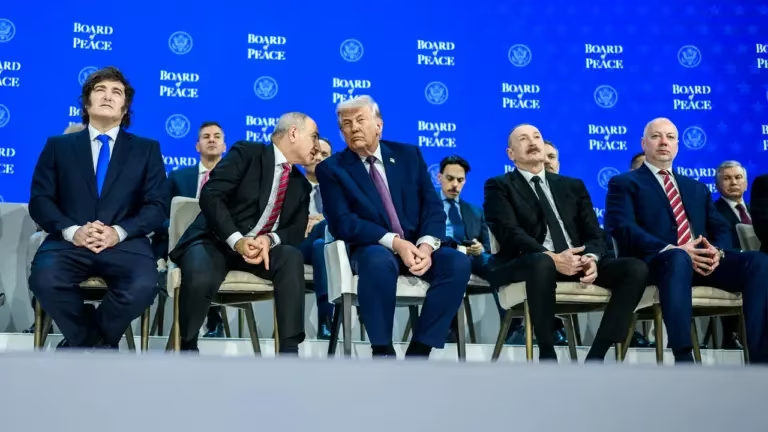
Washington, D.C. — When the “Board of Peace” convenes on February 19, the White House will sell it as a historic breakthrough. The press is being primed for a dramatic announcement: more than $5 billion in humanitarian pledges and talk of “thousands of personnel” for an international stabilization force. The imagery will be staged. The rhetoric will soar. The headlines will write themselves.
But beneath the branding, the initiative is empty. The Board has no clear mandate. No published legal authority. No defined operational structure. No accountability mechanism. It is being marketed as a peace framework for Gaza while refusing to answer the questions that determine whether any framework can work. It is diplomacy as performance.
The most revealing fact is what the Board does not include. Palestinians are nowhere to be seen. They are not represented. They are not consulted. They are not even described as a political community with rights. In the Board’s public framing, Palestinians appear as a humanitarian problem to be managed, not a people entitled to liberty and freedom, to live in dignity in their own homeland. A “peace” initiative that excludes the people whose future is being discussed is not peacebuilding. It is an attempt to impose outcomes without consent.
A Brand in Search of a Mandate
Trump unveiled the Board in January and promoted it at Davos as a platform for “world peace.” The February 19 gathering looks less like a working summit than a staged announcement. It is designed to project momentum through money figures. It avoids the hard questions of post-war governance.
The Board’s public description reads like a collection of slogans: reconstruction, stabilization, policing, demilitarization. These are not interchangeable. Reconstruction requires financing pipelines, procurement rules, and legal authority. Stabilization requires a defined mandate, rules of engagement, and political legitimacy. Policing requires training, oversight, and an accountable justice system. Demilitarization requires a political settlement. The Board offers none of the foundations required for any of these tasks. It substitutes language for architecture.
Trump’s insistence that he will serve as chairman makes the intent clearer. This is not a multilateral institution. It is a U.S.-directed coalition. It is built to avoid international frameworks that might impose constraints. The United Nations is one of those constraints. It insists on legal legitimacy and Palestinian representation. That is exactly what this Board appears designed to circumvent.
The Credibility Gap: Allies and Arithmetic
The membership list reflects the same problem. Roughly two dozen countries have reportedly accepted participation, including Israel, Qatar, Saudi Arabia, Turkey, and Egypt. But major European allies are conspicuously absent. Several European governments have expressed concern that the Board is intended to supersede the United Nations and sideline the Palestinian Authority.
That absence is not cosmetic. It is operational. Rebuilding Gaza requires long-term financing, technical expertise, and political legitimacy. Europe is central to all three. Without it, the Board is not a reconstruction mechanism. It is a stage for declarations.
The money being touted is equally revealing. Five billion dollars sounds impressive. It is still a fraction of what Gaza’s recovery requires. A UN, EU, and World Bank assessment estimated reconstruction could cost upward of $70 billion and stretch for years. Against that benchmark, the Board’s pledge looks like a token down payment. Worse, pledges are not cash. They are often recycled commitments, conditional promises, or sums that never materialize. Announcing a number without disbursement plans, oversight, or implementation capacity is not leadership. It is advertising.
The Board is built for a headline, not for a decade-long recovery. Its first major promise already signals its limits. Too little money. Too little structure. Too little legitimacy.
The Kushner Vision: Development Without Sovereignty
The credibility gap widens further with the “master plan” promoted by Jared Kushner, Trump’s son-in-law and a real estate developer. Kushner has described a vision of skyscrapers, new cities, and a coastal tourism zone. He claims Gaza could be rebuilt in two or three years with $25 billion in investment.
The plan is revealing not because it is ambitious, but because it is unserious. Its aesthetic resembles a Gulf mega-project. Its politics resemble a colonial fantasy: redevelopment without sovereignty. Gaza is not an empty plot awaiting investors. It is a devastated society emerging from mass displacement, demolished infrastructure, and unresolved political authority. Reconstruction involves property rights, land ownership disputes, the return of displaced families, and governance legitimacy. A tourism zone cannot be built over a political vacuum.
Kushner’s timeline is especially implausible. Two years of construction requires stability. It requires enforceable contracts. It requires functioning courts. It requires clear land title. It requires a governing authority capable of providing security and services. Gaza currently has none of these prerequisites. Pretending otherwise is not optimism. It is denial. It reduces a political catastrophe to a real-estate rendering.
Security: Stabilization or Subjugation?
The security component is where the Board becomes most dangerous. Trump claims member states will commit thousands to an international stabilization force. Yet he has not clarified whether Israel would accept such a force operating independently. He has not said who would command it. He has not said under what rules it would operate. He has not said what accountability would apply.
For Palestinians, “stabilization” carries bitter echoes. It risks becoming a euphemism for external control. It risks becoming domination repackaged as humanitarian concern. Without clear parameters and Palestinian consent, any such force would be viewed not as a guarantor of safety but as another layer of subjugation.
Trump’s demand that Hamas commit to “full and immediate demilitarization” is equally detached from reality. Demilitarization cannot be imposed by decree. It requires a political settlement. It requires a legitimate governing authority. It requires a credible security alternative. Without those, calls for disarmament sound like surrender terms. Surrender terms do not produce durable ceasefires. They produce humiliation, fragmentation, and relapse.
The Geopolitical Context
The timing is not accidental. It follows U.S.-Iran talks in Geneva. Trump has threatened to strike Iran if it does not curb its nuclear program. He also insists he prefers negotiated outcomes. The overlap underscores a pattern. There is theatrical diplomacy on one front. There is coercive leverage on another.
The Board may therefore serve as much to project American influence regionally as to rebuild Gaza locally. It provides a stage for Washington to claim initiative. It pressures allies into alignment. It presents an alternative to UN-centered legitimacy. And it does all this while Palestinians remain absent from the room where their future is being designed.
Conclusion: A Hollow Core
Ultimately, the Board of Peace is less an institution than an instrument. It gives Trump a platform to claim authorship of Gaza’s future. It helps pressure allies into alignment. It sidelines legitimacy frameworks that would require Palestinian representation and enforceable accountability.
A peace framework that excludes Palestinians is not merely flawed. It is illegitimate. It asks the world to accept that Gaza’s fate can be decided by outside powers, while the people who live there are reduced to recipients of aid, objects of security planning, and targets of economic redesign. That is not a path to stability. It is a recipe for permanent grievance.
If the Board is serious, it must begin where it currently refuses to begin: with Palestinian self-determination, with freedom and dignity in their own homeland, and with a political process rooted in rights rather than public relations. Without that, the Board’s grand name disguises its true purpose — a promise of peace without a plan, and a plan without legitimacy.
Share your opinion
Trump’s “Board of Peace” Is a PR Stunt With No Mandate, No Math, and No Legitimacy