OPINIONS

Fri 27 Feb 2026 10:11 am - Jerusalem Time

Decisive Days Ahead

Overall expectations indicate that yesterday's negotiations, Thursday, will be decisive and fateful, and the outcome of these negotiations will determine President Trump's stance. The options available if negotiations fail include a naval and aerial blockade, or a limited, focused strike targeting vital military and security objectives to subjugate Iran to American demands, or multiple strikes initiated by the United States and lasting several days to weaken the regime in preparation for its overthrow in the near future. Israel would enter the battle if it were subjected to bombardment by Iran.

Unofficial Israeli intelligence analyses suggest that a strike is inevitable and will be limited. However, what will determine everything after the strike is the Iranian response. If the Iranian response is as declared by Iranian military, security, and political leaders, then the region as a whole is heading towards a comprehensive regional war. But if the response is limited and far from Israel, the repercussions will not be significant, yet at the same time, this will not lead to a comprehensive change in positions, especially Iranian ones.

Meanwhile, unofficial Russian intelligence analyses suggest that what is happening is part of the pressure exerted by the United States against Iran to obtain the maximum possible concessions, and that no strike is coming in the near future.

Despite its complexities and President Trump's hesitation, the reality indicates that the true intentions, given the nature of the American military buildup, are heading to extremes, for several reasons, the most important of which are:

First - President Trump champions peace through strength, meaning subjugating countries to the Trumpian will and vision. Therefore, he is not seeking negotiations but rather Iran's submission to American conditions. All ongoing negotiations aim to justify the upcoming attack on Iran, and to claim that all diplomatic avenues have been exhausted to avoid war, in addition to gaining time for the military buildup, which was completed with the arrival of the largest American aircraft carrier, the "Gerald Ford."

Second - The Americans cannot accept any agreement that is limited in time or temporary, or resembles the Obama 2015 agreement. That is, what is required is a permanent agreement that allows President Trump to declare victory and that he has subjugated Iran. This permanent agreement would lead to the dismantling of the nuclear program in one way or another, and Iran would also agree to negotiate afterward on its ballistic missile capabilities and its relations with its allies.

Third - Any possible or probable agreement will clearly feature Israel, and this complicates reaching any agreement, as Israeli pressures are pushing the Trump administration to be tough in order to achieve a clear and unambiguous accomplishment.

Fourth - The flexible Iranian stance, willing to go to limits it has not reached before, cannot align with what President Trump wants, because what is required is Iran's surrender, or as Trump says, either you agree or we go the bad way.

Fifth - Israel, the central factor in the American-Iranian negotiations, will never accept any agreement according to the Iranian vision, meaning, as Netanyahu said, "We want a sustainable agreement, an agreement forever," and this was echoed by the American Jewish envoy and negotiator "Steve Witkoff."

Therefore, all ongoing diplomacy, called negotiations, has nothing to do with reality. What is required is not Iranian flexibility, nor concessions here and there. It is unequivocally clear that what is required is Iran's complete surrender to Zionist-American demands, and this confirms that the drums of war are drowning out everything else.

In a public opinion poll in Israel conducted by the "Israeli National Security Research Center" on February 25, approximately 51% of respondents stated that they support a unilateral strike by Israel against Iran. This alone indicates the true reality regarding the view of Iran, as does the statement by American Democratic Senator "Chuck Schumer," the minority leader in the US Congress, after a briefing from the CIA director, who said: "Look, the matter is serious... Trump must explain this to the American people," meaning we are facing an inevitable theater of war.

Previously, we said that the American-Israeli plan in the region was settled in the meeting between President Trump and Netanyahu a month ago at the "Mar-a-Lago" resort in Palm Beach outside Miami, where it was agreed to resolve the region's issues so that they would be completely subjugated to American interests, and transformed into an American lake with Israeli influence and captaincy to maintain its security, and this is not possible without subjugating Iran.

It is true that American Trump is somewhat hesitant, as the media suggests, and it is true that there is internal American division regarding resorting to the military option, but I personally do not see President Trump as hesitant. Rather, it seems to me that he is heading to war with Iran because he sees the matter from a personal perspective first, and he sees America's greatness in subjugating other countries to American will to plunder their wealth, as happened in Venezuela where he boasted in his "State of the Union" address about America obtaining 80 million barrels of oil, in addition to seeing himself as a messenger from God "Yahweh" sent to protect his chosen people, and this was clearly mentioned in the US National Security Strategy "Protecting Israel's Security," and this is not possible without subjugating Iran.

Anyone who hears President Trump's "State of the Union" address will understand that this man sees no one and understands only one language, the language of wrestling, of which he was and still is a fan. It's either victory or making a deal that leads to his victory, meaning he does not think of losing; in fact, this term does not exist in his vocabulary. That is why he carried out all this military buildup, or as he called it, the "beautiful fleet."

So the choices have become clear: honor and dignity or submission, because a man with President Trump's mentality does not understand the language of respect. The published "Epstein" files are enough to illustrate how he thinks: no morals, no honor. They only understand the language of force, the language of steadfastness, and the language of attrition.

The confrontation is imposed on Iran and its allies, and the conclusion of the battles initiated by the "Flood" will be determined by the upcoming battle. It will either be an end to the war and a move towards stability in the region by putting an end to arrogance, genocide, and ethnic cleansing, or entering into wars of attrition that will affect the entire region, and may even extend much further. As for submission to the Zionist-American agenda, that means losing everything for decades.

Decisive days are coming, carrying within them all hope for a Ramadan dawn filled with pride and dignity for every people who say, "Far be it from us to be humiliated."

PALESTINE

Fri 27 Feb 2026 10:10 am - Jerusalem Time

Smotrich's Statements... Gaza Between Settlement Strategy and Electoral Gains

Mohammad Joudeh: Smotrich's statements reveal what lies behind the deadline set for "Hamas," placing Gaza at a strategic crossroads between containment and the re-imposition of comprehensive control.

Hani Abu Al-Siba': These statements come in a political and electoral context, as Israeli parties use the Gaza issue as an influential card in the upcoming elections.

Fayez Abbas: Smotrich is trying to enhance his presence to ensure his survival in the Knesset by adopting the dream of re-establishing settlements in the Strip, despite the limited feasibility of achieving this goal.

Nihad Abu Ghosh: The displacement plan and the occupation of Gaza have become a central option for the far-right government, which explains Israel's reluctance to implement its commitments under the Trump plan.

Suleiman Basharat: Smotrich's statements aim to create fear among Palestinians, Arabs, and Muslims, given that the Zionist project is based on a policy of demographic replacement.

Yasser Manna': The idea of re-establishing settlements in the Gaza Strip is not new; it was proposed in the first weeks of the war, and the current discourse is a direct extension of this trend.

Ramallah - Exclusive to "Al-Quds"-

The statements by Israeli Finance Minister Bezalel Smotrich regarding the occupation of the Gaza Strip and the establishment of settlements there, if Hamas is not disarmed within the specified deadline, raise serious scenarios about the future of the Strip, amidst escalating discussions within Israeli political circles about a radical change in the existing reality. However, these statements may be understood within an electoral context.

In separate conversations with "Al-Quds," writers, political analysts, and specialists believe that these statements come within the context of electoral bidding, but they are interpreted as an indicator of trends within the Israeli government seeking to impose new realities on the ground, going beyond conflict management to re-establish direct control over the Strip, including settlement projects and long-term security arrangements.

He points out that linking the disarmament of the resistance with the option of occupation reflects a political vision that seeks to leverage field developments to impose a new equation in Gaza, which may open the door to a more complex phase at both political and humanitarian levels.

Intense Political Moment

Writer and political analyst Mohammad Joudeh believes that the recent statements by Israeli Finance Minister Bezalel Smotrich regarding the occupation of the Gaza Strip and the establishment of settlements there, coinciding with Israeli Prime Minister Benjamin Netanyahu's talk of a deadline for disarming Hamas, in addition to the positions of US Ambassador Mike Huckabee, reflect an intense political moment that cannot be separated from the internal Israeli balances, the nature of the relationship with the United States, and the shape of the regional order after the war.

Joudeh believes that Smotrich's statements reveal what lies behind the deadline set for Hamas, placing Gaza at a strategic crossroads between containment and the re-imposition of comprehensive control.

Clear Ideological Vision

Joudeh clarifies that Smotrich's statements do not represent merely a military threat, but rather express a clear ideological vision belonging to a current that considers the Israeli withdrawal from Gaza in 2005 a strategic mistake, linking it to the rise of Hamas and the recurrence of rounds of confrontation.

According to Joudeh, within this perception, the talk of occupying the Strip and building settlements there reflects an attempt to reshape the demographic and sovereign reality in Gaza, and not merely to achieve security deterrence.

An Entry Point for Redefining the Legal and Political Status of the Strip

Joudeh points out that the timing of proposing the idea of occupation and settlement coinciding with a deadline for disarming Hamas carries deep political implications, as the demand for disarmament is not limited to being a security condition, but rather constitutes an entry point for redefining the legal and political status of the Strip. Failure to disarm may open the door to a scenario of complete control, while disarmament according to Israeli conditions means establishing a new security equation that keeps Israel in the upper hand.

Joudeh explains that Netanyahu is operating under conflicting pressures, between the demands of the religious and national right calling for a decisive resolution in Gaza, and international pressures, especially American, to avoid a permanent re-occupation that could lead to a widespread regional escalation.

Joudeh considers Smotrich's statements also represent a tool of pressure within the ruling coalition to ensure that no settlement is accepted that does not include a complete dismantling of Hamas's military structure.

Regarding the positions of US Ambassador Mike Huckabee, Joudeh believes that they are read in the region as an indicator of a current within the United States that provides intellectual or religious cover for Israeli expansionist discourse, which strengthens the confidence of the right-wing current in Israel even if it does not translate into official American policy.

A Political Warning Paving the Way for Resumption of Military Operations

Joudeh points out that disarming Hamas in the Israeli sense means ending its military and organizational capacity as a ruling force, but historical experiences show that complete disarmament is rarely achieved without a decisive military defeat or a major political settlement, which makes the proposed deadline closer to a political warning that paves the way for the possibility of resuming military operations.

Joudeh proposes four possible scenarios, including resuming the war with the aim of military decisive action and dismantling Hamas's structure, or reaching a long-term truce that restricts its capabilities in exchange for new humanitarian and administrative arrangements, or imposing permanent military control through buffer zones and a fixed military presence within the Strip, in addition to a weaker possibility of a broader political settlement within a regional framework.

Joudeh points out that the scene reflects a struggle within Israel between a vision that seeks to radically reshape the political map in Gaza, and another pragmatic one that focuses on deterrence and restoring calm, stressing that the next phase may constitute a decisive moment in determining the future of the Strip for many years to come.

Israeli Vision for Imposing Permanent Control

Writer and political analyst specializing in Israeli affairs Hani Abu Al-Siba' believes that Israeli Finance Minister Bezalel Smotrich's statements regarding the occupation of the Gaza Strip and the establishment of settlements there came during a press interview that addressed the question "Why has no decisive action been taken in the Gaza Strip yet?" He points out that these statements reflect an Israeli vision based on imposing permanent control over the Strip and linking the future of Gaza to the complete disarmament of Hamas.

Abu Al-Siba' explains that Smotrich spoke about giving Hamas a deadline to disarm, considering that failure to do so would give Israel a justification to occupy the rest of the Gaza Strip, while emphasizing that security control would remain in the hands of the Israeli army, and that any future forces within the Strip must be disarmed and subject to Israeli decision, with the Israeli government rejecting any political or administrative role for Hamas in Gaza.

Abu Al-Siba' points out that Smotrich claimed that Israel currently controls more than 53% of the Gaza Strip's area, and considered this control permanent, announcing the government's intention to rebuild settlements and return settlers to the Strip.

Abu Al-Siba' draws attention to Smotrich's call for "soft displacement," by encouraging Gaza residents, especially youth, to emigrate amidst the destruction of homes and deteriorating living conditions. Smotrich stressed that the reconstruction of the Strip would be conditional on Hamas's disarmament, and that any rocket launch would be met with a resumption of military operations and the occupation of the rest of the Strip.

Statements in a Political and Electoral Context

Abu Al-Siba' explains that these statements come in a political and electoral context, as Israeli parties use the Gaza issue as an influential card in the upcoming elections, amidst Prime Minister Benjamin Netanyahu's and Smotrich's efforts to regain the trust of the Israeli voter by proposing projects of complete control and re-settlement.

Push Towards Voluntary Migration

Abu Al-Siba' expects the Israeli government to continue placing obstacles in the way of any international arrangements or external forces to manage the Strip, while seeking pretexts to prolong the suffering of the residents with the aim of pushing them towards what is called "voluntary migration," pointing to a link between developments in Gaza and regional escalation, especially given the Israeli bet on disarming the resistance despite the difficulty of achieving this.

Abu Al-Siba' points out that the statements of US Ambassador to Israel Mike Huckabee, in which he spoke about Israel's control over the Middle East from a biblical perspective, reflected harmony with the trends of the Israeli right, despite the US State Department's assertion that those statements were taken out of context.

Abu Al-Siba' believes that these positions show that American support for Israel has gone beyond military and political aspects to adopting its regional goals.

Abu Al-Siba' believes that the escalation of extremist statements as elections approach reflects a competition between Israeli right-wing parties to win voters' support, stressing that the next phase will be characterized by more pressure and restrictions on Palestinians, in contrast to the Palestinians' continued reliance on steadfastness in the face of these policies.

Smotrich and the Attempt to Ensure His Survival in the Knesset

Writer specializing in Israeli affairs Fayez Abbas explains that Israeli Finance Minister Bezalel Smotrich's statements regarding the occupation of the Gaza Strip and the re-establishment of settlements there are largely linked to internal electoral calculations, given his declining popularity and the possibility of his party failing to cross the electoral threshold in the upcoming Israeli elections. Abbas points out that Smotrich, through his hardline positions and statements, whether in the West Bank or the Gaza Strip, seeks to enhance his political presence and try to ensure his survival in the Knesset.

Abbas notes that Smotrich adopts a discourse based on the dream of re-establishing Jewish settlements in the Gaza Strip, but the chances of achieving this goal remain limited, considering that the administration of the Strip will remain in the hands of the United States or within international arrangements that will not allow the return of Israeli settlement construction. Abbas believes that the next phase may witness a repetition of similar statements from far-right leaders regarding settlements in Gaza, within the framework of political bidding, pointing out that there have been attempts by right-wing groups to storm the border with the Gaza Strip, but they were turned back and warned of the consequences of these steps due to the danger they pose to those participating in them and to Israeli soldiers.

Smotrich and the Settlement Show

Regarding settlements in the West Bank, Abbas believes that a number of settlement outposts established during the last three years, with Smotrich as a minister in the Ministry of Defense, are nothing more than show outposts that are unlikely to turn into permanent settlements.

Abbas explains that Smotrich boasts about expanding these outposts, but the data on the ground indicate negative migration from the settlements towards the Green Line, explaining that about 1050 settlers left the West Bank last year, without any actual increase in the number of settlers, despite the tax facilities and government aid provided by Israel to encourage settlement.

Future of the Strip and Submission to American Decision

Abbas confirms that the issue of disarming Hamas and the future of the Gaza Strip will remain largely subject to American decision rather than a purely Israeli decision, pointing out that Israel may try to obstruct any American plan by raising conditions such as disarming Hamas or excluding the Palestinian Authority from managing the Strip.

The Option of Displacement is Still Valid

Writer and political analyst specializing in Israeli affairs Nihad Abu Ghosh explains that Israeli Finance Minister Bezalel Smotrich's statements about the occupation of the Gaza Strip and the establishment of settlements there can be understood from two main angles. The first is related to political competition within Israel, where adopting extremist, racist, and more aggressive positions towards Palestinians gives their proponents more popularity amidst preparations for general elections expected before the end of 2026. Abu Ghosh points out that Smotrich's popularity and his bloc are currently hovering around the electoral threshold in most opinion polls, which pushes him to raise the bar of his political positions.

Abu Ghosh notes that the more important angle relates to the nature of the prevailing thinking among the far-right government in Israel, where the option of displacing Palestinians from the Gaza Strip, re-occupying it, and settling in it is still valid and occupies the thinking of Israeli right-wing leaders, as a means of permanently eliminating the Palestinian presence.

Abu Ghosh confirms that this trend is not limited to Gaza, but extends to the West Bank, amidst the complicity of the American administration and its silence on Israeli violations, and the close alliance between Washington and Tel Aviv in multiple regional files, starting from the war on Gaza to preparing for a potential confrontation with Iran.

Abu Ghosh explains that the displacement and re-occupation plan is no longer just extremist ideas put forward by marginal officials, but has become a central option for the far-right government, which explains Israel's reluctance to implement its commitments within US President Donald Trump's plan, especially withdrawing from the Yellow Line, opening crossings, bringing in aid, and starting the reconstruction of Gaza.

Abu Ghosh points out that Israel has reduced the first phase to recovering prisoners and bodies, and is currently seeking to limit the second phase to the item of disarming the resistance only.

Abu Ghosh explains that the positions expressed by US Ambassador Mike Huckabee reflect, in a crude and provocative manner, what the American administration is doing by adopting the Israeli security concept and remaining silent on the aggressions, recalling previous statements by US Ambassador Tom Barrack about the non-finality of the Sykes-Picot borders, and US President Donald Trump's decision to recognize Israeli sovereignty over the occupied Syrian Golan.

Abu Ghosh believes that the Israeli government believes it has a historic opportunity that may not be repeated to achieve the project of "Greater Israel" or "Complete Israel," benefiting from a comfortable right-wing majority, broad American support, Palestinian division, in addition to the state of weakness and disintegration in the Arab system.

Abu Ghosh calls for focusing on rebuilding Palestinian national action institutions and adopting a unified national program based on strengthening steadfastness and activating the tools of popular, political, diplomatic, and legal struggle, considering that unifying the Palestinian position can contribute to formulating a unified Arab position in confronting Israeli policies, especially after the war on Gaza brought the Palestinian issue back to the forefront of global attention as an issue of freedom, justice, and peace.

Statements Reflecting the Nature of the Colonial Settlement Project

Political writer and analyst Suleiman Basharat believes that Israeli Finance Minister Bezalel Smotrich's statements regarding the re-establishment of settlements in the Gaza Strip cannot be separated from the broader political and ideological context that governs current Israeli policies, pointing out that adherence to re-settlement clearly reflects the nature of the colonial settlement project that Israel seeks to entrench on Palestinian land.

Basharat explains that settlement represents one of the primary tools and methodologies for strengthening the Israeli colonial project, which explains the rapid acceleration in Israeli measures aimed at expanding settlements and providing all necessary components to strengthen them, whether in the West Bank or by proposing the idea of returning to settlement in the Gaza Strip, in addition to the Israeli tendency to remain in the territories that Israel controlled in Syria and Lebanon.

Basharat points out that the Israeli project is not limited to strengthening control within Palestinian territories only, but also includes a broader expansionist dimension at the Middle East level, within a vision based on regional hegemony and control.

Israel, the Spearhead of the Zionist Movement

Basharat explains that Israel, from the perspective of the Zionist movement, represents the spearhead of a global project through which the Zionist movement seeks to impose its influence in the region as a strategic center in the world, which reinforces a growing feeling among the Zionist current that the opportunity is currently ripe to achieve these goals.

Basharat notes that US Ambassador Mike Huckabee's statements reflect the state of "euphoria" experienced by the global Zionist movement, where supporters and theorists of the Zionist project are now boasting about the political and field gains achieved during the current phase.

Basharat emphasizes that one of the important dimensions of Smotrich's statements is the attempt to create a state of fear among Palestinians, Arabs, and Muslims, given that the Zionist project is fundamentally based on a policy of demographic replacement at the expense of the indigenous population.

Basharat believes that these statements aim to push Palestinians either to emigrate or to accept the fait accompli, by instilling a feeling that their chances of remaining on their land have become limited.

Basharat explains that the next phase may move towards two main paths. The first is the continued Israeli drive to strengthen the settlement project and impose new realities on the ground, including accelerating settlement in the West Bank and the possibility of re-establishing settlements in the Gaza Strip, a scenario that remains linked to Israel's ability to impose it without political or field obstacles.

The second path, according to Basharat, is related to the possibility of these plans colliding with regional and international variables, especially regarding the future of American influence in the Middle East, as Israel relies heavily on American power to support its project. Basharat believes that any decline in American ability to impose hegemony, or failure to achieve the goals of confrontation with Iran, could constitute a fundamental obstacle to establishing the settlement project, especially in light of indications of the disintegration of American-European alliances and the potential emergence of new international powers that could affect the level of support provided to Israel.

Disarmament as an Entry Point for Arranging the Governance System in Gaza

Writer and researcher specializing in Israeli affairs Yasser Manna' explains that Israeli Finance Minister Bezalel Smotrich's statements about the occupation of the Gaza Strip and the establishment of settlements there reflect a clear ideological orientation that seeks to transform the war's objectives from merely dismantling Hamas's military capabilities to reshaping the sovereign and geographical reality in the Strip, thereby opening the way for imposing direct Israeli control.

Manna' points out that the timing of these statements coinciding with Israeli Prime Minister Benjamin Netanyahu's talk of a deadline for disarming Hamas indicates that the disarmament issue is being put forward as an entry point for rearranging the governance system in the Gaza Strip, noting that the failure of the political path could lead to the imposition of direct Israeli control or different forms of long-term security and military administration.

Manna' believes that the statements attributed to US Ambassador Mike Huckabee provide rhetorical cover that strengthens the confidence of the right-wing current within Israel, even if these positions do not translate into official American policy, which gives the Israeli right a wider scope to propose more hardline projects related to the future of the Gaza Strip.

Re-establishing Settlements in the Gaza Strip is Not New

Manna' points out that the idea of re-establishing settlements in the Gaza Strip is not new; it was proposed in the first weeks of the war by ministers and members of parliament from the Israeli right-wing current who called for the re-establishment of settlements that were evacuated in 2005, considering that the current discourse is a direct extension of this political trend that has accompanied the developments of the war since its beginning.

Expected Scenarios for the Future of the Gaza Strip

Manna' explains that the expected scenarios for the future of the Gaza Strip revolve around three main paths. The first is the possibility of reaching partial understandings regarding disarmament in exchange for establishing a ceasefire and setting new arrangements for managing the Strip with regional or international support, a path that is less costly politically and security-wise.

The second path, according to Manna', is the failure of the proposed deadline and a return to a widespread military operation that could pave the way for direct occupation or the imposition of long-term Israeli military administration.

Manna' points out that the third path is based on the continuation of a gradual pressure policy through limited military operations and the expansion of buffer zones, while maintaining the threat of war without reaching the stage of complete control.

Manna' explains that the direction of developments will be determined in light of the results of mediation efforts, the balances of the ruling coalition in Israel, and the extent of the ability of various parties to bear the cost of any potential escalation.


PALESTINE

Fri 27 Feb 2026 10:10 am - Jerusalem Time

'Ring of Fire' Strategy: Why is the Occupation Expanding its Aggression Towards Quiet West Bank Cities?

The Israeli occupation's military operations are no longer confined to traditional confrontation centers in the northern West Bank, such as Jenin and Nablus, but have extended to cities and towns previously known for their relative tranquility. This field shift raises profound questions about the underlying objectives behind targeting areas that have not witnessed prominent military resistance formations, indicating a desire to generalize a state of instability.

Salfit recently witnessed one of the largest military incursions since the beginning of this year, with occupation forces deploying hundreds of soldiers and dozens of vehicles in an operation that lasted for about 12 continuous hours. The incursion involved imposing a comprehensive curfew, searching over 150 homes, and converting some into military barracks and field interrogation centers, amidst widespread destruction of private property.

Local sources reported that occupation forces imposed a tight military cordon around the Martyr Yasser Arafat Hospital in Salfit, completely preventing civilian movement by closing the city's main entrances. These measures were accompanied by the distribution of leaflets claiming the goal was 'combating terrorism,' pretexts that observers see as mere cover for a show of force and intimidation of civilians.

Analysts believe that the escalation in Salfit is not isolated from settlement plans, as the governorate is subjected to extensive bulldozing operations aimed at establishing a massive settlement neighborhood known as 'Ariel West.' This project, spanning over 6,000 dunams, aims to isolate the city from its geographical surroundings and transform it into a canton besieged by settlements from all sides.

Israeli policy in the West Bank relies on the principle of 'gradual seizure,' where areas classified as (C) are targeted first to tighten the noose on Palestinian presence. This methodology aims to absorb international and local reactions by implementing plans in spaced-out stages, leading to the imposition of complete demographic and geographical control.

Political specialists indicate that the occupation is trying to draw a new 'psychological map' for Palestinians, based on dividing them into categories according to the level of calm or escalation. This approach aims to create internal brakes within Palestinian society by linking living stability to submission to security measures, known as the 'carrot and stick' policy.

The scale of forces involved in incursions into 'quiet' cities and the use of helicopters in landing operations reflect a desire to impose a new field reality that goes beyond the declared security dimension. These operations carry clear political messages that there is no place in the West Bank beyond the grip of the occupation, regardless of the presence or absence of military resistance activity.

In Bethlehem, the picture was no different, as occupation authorities re-drew land boundaries in the areas of Beit Jala and Battir, in a provocative move aimed at dragging those areas into the circle of confrontation. Researchers believe that these movements aim to empty the land of its original owners in favor of relentless settlement expansion that devours green spaces.

Settlers' role emerges at this stage as a third executive arm of the occupation, working in parallel with the army to intimidate farmers and prevent them from accessing their lands. This complementarity between official and militia roles aims to accelerate the pace of actual annexation of the West Bank and transform Palestinian villages into isolated islands behind military gates.

Despite the occupation's attempts to impose a 'pretext-blocking' policy and restrict Palestinian movement, history proves that the current state of adaptation is a means of steadfastness, not surrender. Palestinians who faced siege in previous intifadas are now inventing alternative ways to manage their daily lives, affirming their attachment to the land despite all attempts at forced displacement.

The divisions imposed by the Oslo Accords (A, B, C) are now mere designations that the occupation bypasses daily through its repeated incursions into city centers nominally under Palestinian control. This تجاوز aims to undermine any national authority and portray the occupation as the sole force controlling the fate and daily movement of the population.

Observers expect that the continuation of this pattern of escalation could lead to a comprehensive explosion in the West Bank, as economic and security pressures reach their peak. The Palestinian people, undergoing a period of intense pressure, possess the historical ability to overturn equations at critical moments, making the occupation's bets on permanent calm losing bets.

The repellent environment that the occupation tries to create through home demolitions and military checkpoints is part of a long-term strategy to reduce the Palestinian population density in vital areas. This policy targets not only resistors but the Palestinian presence itself, by making daily life an unbearable burden under the weight of pursuit and intimidation.

In conclusion, Palestinian steadfastness in the targeted cities remains the rock upon which settlement expansion projects shatter. Despite the massive military arsenal, Israeli anxiety persists about the inability to break national will, which explains the occupation's constant resort to developing tools of oppression and expanding the 'ring of fire' to include every inch of Palestine.

The occupation seeks to create a psychological and geographical map that divides Palestinians to impose a new settlement reality.

ARAB AND WORLD

Fri 27 Feb 2026 10:10 am - Jerusalem Time

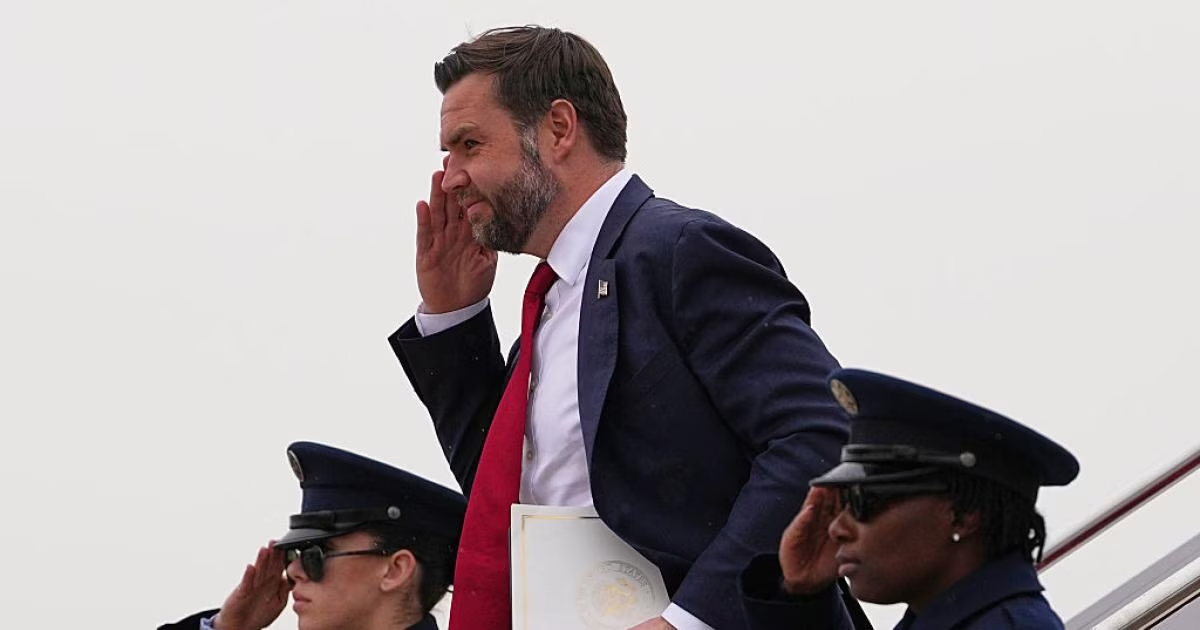
Vance rules out long war with Iran, Geneva talks make 'intensive' progress

US Vice President J.D. Vance affirmed that the current US administration is not considering entering into military conflicts in the Middle East that would extend for years. Vance clarified in press statements that any military action President Donald Trump might decide against Tehran would not necessarily lead to the United States sinking into a new military quagmire, as some suggest.

Vance, who previously served in the US Marine Corps, stressed that the diplomatic option remains Washington's preferred method for resolving differences with the Iranian side. However, the US Vice President linked the success of this path to the nature of Iranian actions and the messages Tehran sends during the current phase, which is witnessing an escalation in political rhetoric.

In a related context, the third round of indirect talks between the United States and Iran concluded in Geneva, Switzerland, which diplomatic sources described as very serious. Iranian Foreign Minister Abbas Araghchi indicated that this round was the most intensive since the launch of the new negotiation process, mediated by the Sultanate of Oman.

These diplomatic moves come under pressure from the deadline set by President Donald Trump on February 19, where he gave Tehran a period of ten to fifteen days to reach a final agreement. Trump warned that failure to reach understandings would lead to dire consequences, coinciding with the reinforcement of US military deployments in the region.

Informed sources reported that the negotiations held at the residence of the Omani Ambassador in Geneva witnessed in-depth discussions on the nuclear file and the lifting of economic sanctions. The US side was represented in these meetings by Special Envoy Steve Witkoff and Jared Kushner, President Trump's son-in-law, reflecting the importance the administration attaches to this file.

For his part, Iranian Foreign Minister Abbas Araghchi stated that the negotiating delegation presented Tehran's demands clearly and explicitly during the meetings held through the Omani mediator. Araghchi affirmed that good progress has been made in drafting the elements of a potential agreement, indicating a desire by both parties to avoid military confrontation through diplomatic channels.

Discussions are scheduled to move to a technical level in the Austrian capital, Vienna, next Monday, where discussions will take place under the direct supervision of the International Atomic Energy Agency. This technical track aims to address the precise details related to Iran's nuclear activities and ensure their peaceful nature in accordance with required international standards.

Omani Foreign Minister Sayyid Badr bin Hamad Al Busaidi, who is leading the mediation between the two countries, affirmed that significant progress has indeed been made, necessitating the return of delegations to their capitals for consultation. Al Busaidi clarified that efforts are continuing to bridge viewpoints and overcome obstacles that still stand in the way of reaching a comprehensive and sustainable agreement.

Reports indicate that the fourth round of political negotiations may be held in less than a week, in order to maintain the momentum of progress achieved in Geneva. During this period, both parties must prepare a set of technical and legal documents that will form the basic structure of any future agreement between Washington and Tehran.

IAEA Director General Rafael Grossi participated in the Geneva round as a technical observer, which Iranian sources considered a step contributing to advancing the talks with greater precision. Grossi seeks to ensure sufficient technical guarantees that dispel Western concerns about Tehran's nuclear ambitions and allow for the transition to implementation phases.

Washington adheres to its essential position of preventing Iran from possessing any nuclear weapon, a demand that constitutes the core of the historical dispute between the two parties. In contrast, Tehran continues to deny its pursuit of developing atomic weapons, affirming its legitimate right to possess a nuclear program dedicated to peaceful and medical purposes and energy generation.

In addition to the nuclear file, ballistic missile issues and Iran's regional influence emerge as additional obstacles that Washington seeks to integrate into any final agreement. Despite Iran's declared rejection of discussing these files outside the framework of the nuclear program, the intensity of recent meetings indicates the possibility of major political trade-offs.

The region is experiencing a state of cautious anticipation, as the intensive diplomatic track coincides with military preparations on various fronts. Observers believe that the next few days will be crucial in determining the course of the relationship between the Trump administration and the Islamic Republic, either towards a historic breakthrough or unprecedented escalation.
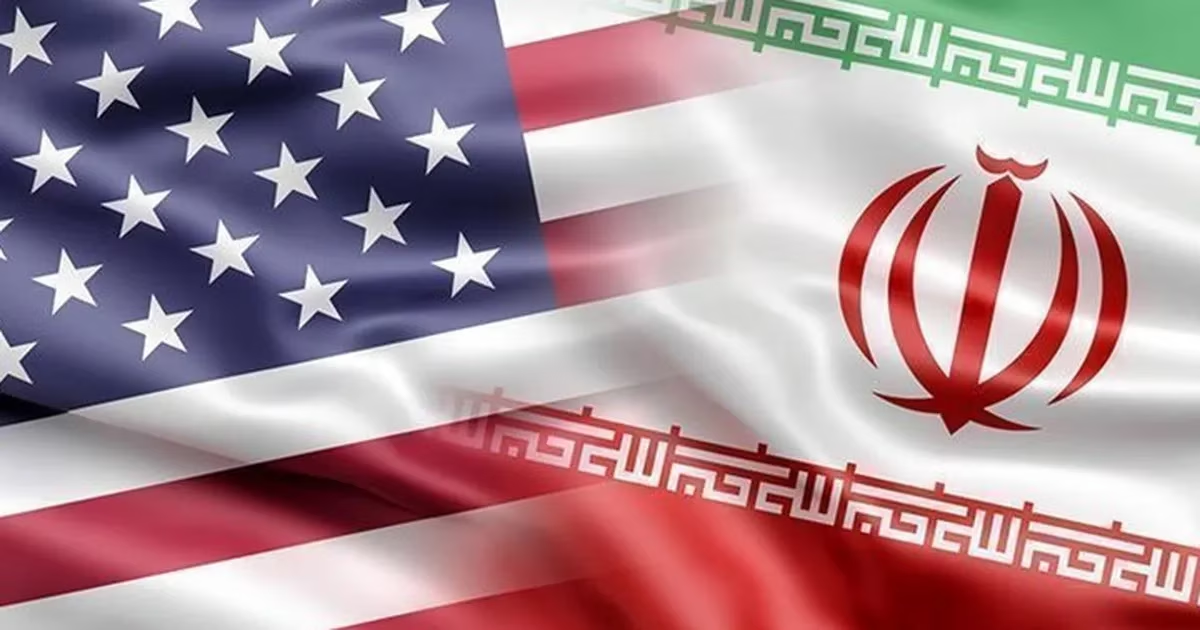
In conclusion, Vance's statement ruling out a long war sends a reassuring message to the American public, but it carries an implicit threat that any military action would be swift and focused. The bet now is on what the technical Vienna round and the anticipated fourth round in Geneva will yield to end the current tension in the Middle East.

The idea that we will be fighting a war in the Middle East for years with no end in sight is completely out of the question.

PALESTINE

Fri 27 Feb 2026 10:10 am - Jerusalem Time

Dead and wounded in continuous Israeli raids on Gaza and Khan Yunis

Israeli occupation forces escalated their aerial and artillery attacks early Friday morning, targeting various areas in the central and southern Gaza Strip. These raids resulted in casualties, including martyrs and wounded, in a continuation of the daily violations of the ceasefire agreement that came into effect on October 10th.\n\nField sources reported that three martyrs and several injured individuals fell as a result of shelling that targeted the city of Khan Yunis in the southern Strip. The bodies of the martyrs arrived at Nasser Medical Complex after occupation aircraft targeted a police point in the city, causing widespread destruction in the area.\n\nIn the central Strip, a Palestinian was martyred and others were injured in a raid that targeted a police point near the vital Salah al-Din Street. These attacks coincide with another raid that targeted the al-Tuffah neighborhood in Gaza City, which also led to the martyrdom of two and the injury of several citizens with varying degrees of wounds.\n\nFor its part, the occupation army announced in an official statement that it had killed a Palestinian in the southern region, claiming that he tried to cross what is known as the 'Yellow Line'. The statement alleged that forces from the Golani Brigade spotted a person described as armed approaching their positions, which prompted them to open fire on him and neutralize him directly.\n\n"The Yellow Line" is known as a temporary imaginary border drawn under the recent ceasefire agreement, separating the areas where the occupation army is positioned, which controls about 53% of the Strip's area to the east, and the areas where Palestinians are allowed to move in the western direction.\n\nField statistics indicate that the number of martyrs since the agreement came into effect has exceeded 618, most of whom fell by occupation bullets and shells under the pretext of approaching buffer zones. These figures reflect the fragility of the Israeli commitment to the declared calm for months.\n\nOn the humanitarian front, the United Nations Office for the Coordination of Humanitarian Affairs revealed shocking figures related to food security within the Strip. The office explained that one out of every five families still relies on only one meal a day due to the severe shortage of supplies.\n\n The UN report confirmed that the vast majority of Palestinian families in Gaza are now completely unable to bear the exorbitant costs of basic goods. This deterioration comes amid strict restrictions imposed by the occupation on the entry of aid and commercial goods through border crossings.\n\nIn a related context, Amjad Al-Shawa, head of the Network of Non-Governmental Organizations in Gaza, warned of the occupation's continuous attempts to impose its control over the mechanisms of humanitarian organizations' work. Al-Shawa called on the international community and human rights institutions to intervene urgently to ensure the independence of relief work and protect working teams in the field.\n\nIt is worth noting that the Gaza Strip has suffered massive destruction of infrastructure and residential areas since the start of the war on October 7, 2023, which has left more than 72,000 martyrs. Despite the agreement entering its second phase last January, the full Israeli withdrawal has not yet been effectively achieved.\n\nThe second phase of the agreement stipulates the withdrawal of Israeli forces from populated areas and the handover of the Strip's administration to a national Palestinian technocratic committee. However, occupation forces continue their limited military operations and air raids, threatening the collapse of fragile political understandings sponsored by international parties.\n\nThe occupation is trying to control the work of humanitarian organizations in the Strip, and the international community must pressure to protect the independence of relief work.

ARAB AND WORLD

Fri 27 Feb 2026 10:10 am - Jerusalem Time

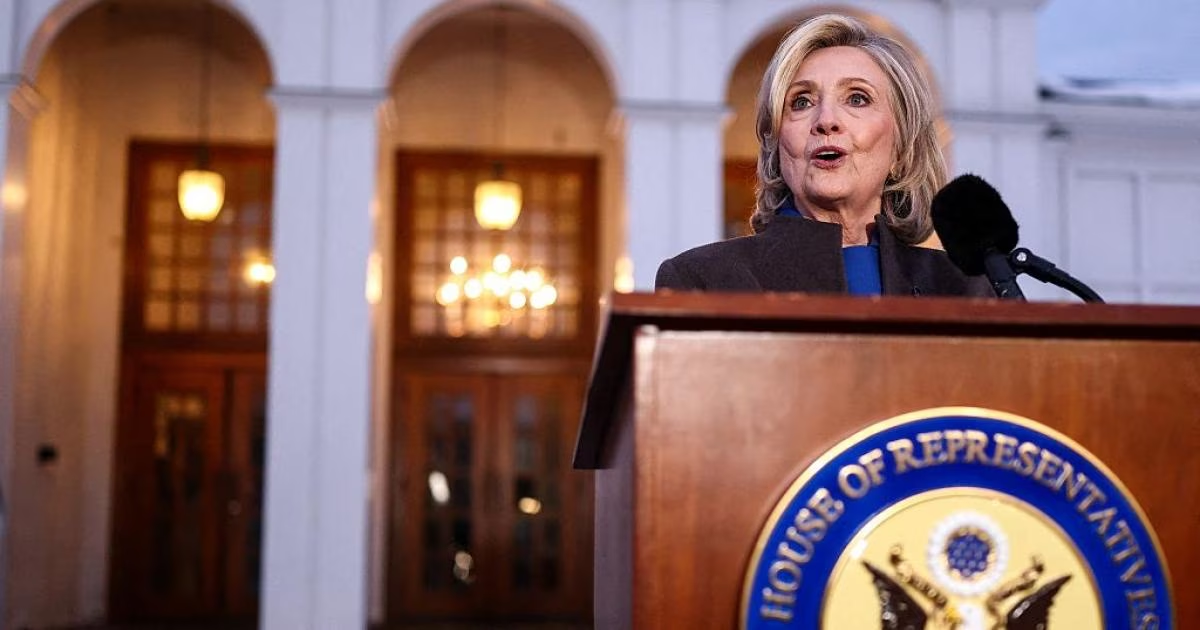
Hillary Clinton Clears Her Husband of Epstein's Crimes and Demands Trump Be Subpoenaed to Testify

Former US Secretary of State, Hillary Clinton, affirmed that her husband, former President Bill Clinton, was unaware of the criminal activities Jeffrey Epstein was involved in. This came during a hearing held by a US Congressional investigative committee, where Clinton emphasized her husband's innocence of any connection to the late financier's abuses.

In response to journalists' questions after the session, Clinton expressed her complete, one hundred percent confidence that Bill Clinton knew nothing about the sexual crimes attributed to Epstein. She clarified that attempts to drag her family's name into this case lack concrete evidence and are part of a charged political context.

The committee, dominated by Republicans in the House of Representatives, questioned Hillary Clinton about the nature of her relationship and network of acquaintances with Epstein. For her part, the former Secretary demanded that the committee subpoena former President Donald Trump to give his testimony, considering that his relationship with Epstein warrants a direct and transparent investigation.

Clinton denied before the committee having any information about the mentioned crimes, asserting that she does not recall meeting Epstein personally and never visited his private island in the Caribbean. She also stressed that she never used his private plane for any of her travels, accusing the committee of trying to politicize the investigation to protect Republican parties.

For his part, James Comer, the committee chairman, stated that the goal of these investigations is to uncover the mystery surrounding Epstein's network and reach the full truth. Comer announced that the committee would continue its procedures by questioning former President Bill Clinton on Friday, as part of a series of closed meetings with individuals linked to the case.

Hillary Clinton challenged committee members to open Donald Trump's files, noting that his name appears thousands of times in documents related to Epstein. She said that seriousness in combating human trafficking requires placing Trump under oath to hold him accountable for those records and documented connections in the case files.

In a related context, Democratic Representative Robert Garcia called for Trump to appear immediately before the committee to answer questions from survivors of Epstein's assaults. Garcia affirmed that justice requires no political figure, no matter how influential, to be exempt, especially with serious accusations that require official clarification.

Democratic committee member Suhas Subramanyam revealed the existence of 'missing files' at the FBI that had been deleted from the original case documents. Subramanyam indicated that these documents contain direct accusations related to sexual assault against Donald Trump, which calls for an in-depth investigation.

These investigations come at a time when the House Oversight Committee is trying to track all individuals who were connected to Epstein before his death in prison in 2019. Epstein had died under mysterious circumstances while awaiting trial on charges related to operating an international child sex trafficking network.

Bill and Hillary Clinton had initially refused to comply with subpoenas, but later agreed to avoid contempt of Congress charges. Hillary clarified at the beginning of her testimony that she had no information that would aid the investigation into the activities of Epstein or his convicted associate Ghislaine Maxwell.

The session witnessed noticeable tension after photos of Hillary Clinton testifying were leaked, leading to a brief suspension of the session. Democrats criticized this breach of rules, considering that the publication of photos proves that the investigation is being used as a political weapon to attack opponents instead of legal oversight.

Despite both Trump's and Clinton's names appearing in government documents, both affirmed cutting ties with Epstein before his first conviction in 2008. Legal experts confirm that the mere mention of names in these records is not sufficient legal evidence to convict anyone of committing crimes.

The hearings took place in Chappaqua, New York, amidst strict security measures imposed by the Secret Service around the local arts center. The Clintons had demanded that the sessions be open to the public, but the committee insisted on keeping them behind closed doors, which Bill Clinton described as clear politicization.

Regarding Ghislaine Maxwell, who is serving a 20-year prison sentence, she refused to answer the committee's questions during her video appearance. Her lawyer indicated that his client might speak publicly if she receives a presidential pardon, emphasizing that she is the only one who can clarify the circumstances of that era.

If this committee is serious about finding the truth about human trafficking crimes, it will question Trump directly and under oath about his name appearing thousands of times in Epstein's files.

PALESTINE

Fri 27 Feb 2026 10:09 am - Jerusalem Time

Occupation forces ban journalist Jalajel from Al-Aqsa for a week after his arrest in its courtyards

As part of an ongoing campaign of repression within and around Al-Aqsa Mosque, Israeli occupation forces, this Thursday evening, arrested journalist Ahmed Jalajel from inside the mosque's courtyards in occupied Jerusalem.

According to local sources, occupation forces stopped journalist Jalajel while he was in Al-Aqsa Mosque, before taking him to an interrogation center. He was later released on condition of being banned from Al-Aqsa Mosque for a week, renewable.

This arrest comes in the context of tightening procedures and restrictions imposed on the entry of worshippers and media workers, with the continued targeting of journalists during their duties inside and around Al-Aqsa.

In a related context, the Jerusalem Governorate documented about 150 cases of expulsion since the beginning of last January, while the total number of those expelled before the month of Ramadan ranges between 200 and 300 people, with difficulty in accurately counting the number due to the notification of a number of decisions via phone or electronic applications without delivering official written decisions.

The Governorate also indicated that the number of expulsion decisions during the past five years reached about 2630 decisions, while during January alone, nearly 300 cases of expulsion were recorded, most of which were described as precautionary in preparation for the month of Ramadan.

Expulsion decisions affect guards of Al-Aqsa Mosque, stationed worshippers, activists, journalists, imams, preachers, and Jerusalemite dignitaries, in a policy followed annually by the occupation authorities with the aim of emptying Al-Aqsa Mosque during the holy month of Ramadan.

PALESTINE

Fri 27 Feb 2026 10:09 am - Jerusalem Time

Turmoil within the United Nations: Resignation threats in protest of 'complicity' with Israel to soften Gaza reports

Well-informed sources have revealed severe turmoil within the United Nations, following threats by a number of officials to submit their collective resignations. This move comes in protest of what they described as the complicity of senior leaders in the international organization with Israeli diplomats, with the aim of softening the official discourse regarding war crimes committed in the Gaza Strip and modifying the content of periodic reports issued by the organization.

Internal emails circulated among staff showed direct coordination aimed at reducing criticism directed at the Israeli occupation. One employee expressed his extreme indignation in these correspondences, describing the UN organization as having become a 'public relations agency for genocide,' which reflects the extent of internal division and loss of trust in the impartiality of the senior leadership regarding the Palestinian issue.

This crisis brings to mind previous incidents witnessed by the organization, most notably the resignation of senior official Rima Khalaf in 2017, after the Secretary-General came under American and Israeli pressure to withdraw a report condemning Israel for imposing an 'apartheid' system. These precedents confirm that political pressures have always affected the outcomes of the international organization, prompting current employees to take more stringent stances to confront what they describe as impunity.

In a related context, the 'UN Staff for Gaza' group organized a symbolic demonstration in front of the organization's headquarters in Geneva, where participants placed more than 370 white roses next to a memorial plaque. These roses represent the number of UN aid workers killed during the ongoing war, in a clear message of condemnation of the senior administration's silence regarding the targeting of its field teams in the Strip.

For his part, UN spokesman Stéphane Dujarric justified the restrictions imposed on staff movements by the existence of rules and regulations governing their participation in activities outside their official duties. This statement came after the organization's administration refused to allow a parallel candlelight vigil to be organized in front of the permanent headquarters in New York City, which fueled anger among UN cadres opposing the blackout policy.

On the other hand, the Israeli Ambassador in Geneva, Daniel Meron, launched a sharp attack on the protesting employees, demanding strict disciplinary measures against them, including suspension from work. Meron stated in an official letter that these employees had exceeded their professional role and turned into political activists, accusing them of bias against Israel and engaging in politically motivated activities that violate the UN charter.

Under these pressures, a wide segment of employees expressed their full support for Special Rapporteur Francesca Albanese, who faces organized smear campaigns from non-governmental organizations supporting the occupation. These officials confirm that they are subjected to immense pressure to compromise their professional neutrality in favor of the Israeli narrative, which puts the credibility of the United Nations at stake amid the ongoing war on Gaza.

One employee described the international organization as having turned into a public relations agency for genocide as a result of coordination with Israeli diplomats.

ARAB AND WORLD

Thu 26 Feb 2026 10:56 pm - Jerusalem Time

Trump demands expulsion of Muslim congresswomen Tlaib and Omar from America

Said Erikat

Opinion Writer

Washington – Said Arikat – 2/26/2026

President Donald Trump escalated his attack on Democratic Representatives Ilhan Omar and Rashida Tlaib, demanding their deportation "from where they came," following a sharp verbal altercation during his State of the Union address to Congress on Tuesday evening. Trump's statements came in posts on his "Truth Social" platform, where he described the two congresswomen with abusive terms, considering them to be "harming the country" and unable to "do anything to save it," in his words.

Omar and Tlaib had interrupted the President during his discussion of irregular immigration, particularly when he touched on a fraud case in Minnesota involving individuals from the Somali community. When Trump said Democrats should "be ashamed," Omar loudly retorted: "You're the ones who should be ashamed!" while Tlaib shouted at another moment: "Liar!". Tensions escalated when they later chanted: "You killed Americans!" referring to the deaths of Renee Nicole Good and Alex Pretty at the hands of federal agents last month.

In a subsequent post, Trump went further, calling for their "return as soon as possible," adding that their behavior proves they are "corrupt and crooked." He also expanded his attack to include Oscar-winning actor Robert De Niro, whom he criticized at a political event in Washington, sarcastically suggesting that "the three of them get on a boat together" to expel them from America.

Omar was born in Somalia and immigrated to the United States in her childhood during the 1990s, while Tlaib was born in Michigan to a family of Palestinian origin. There was no immediate comment from representatives for Omar or De Niro, while a spokesperson for Tlaib referred to a post of hers on the X platform in which she said Trump "cannot stand being corrected by two Muslim women, so he collapses."

Democratic leaders were quick to condemn the President's statements. House Minority Leader Hakeem Jeffries described the speech as "shameful and unbecoming of a president," considering it to reflect an anti-foreign sentiment unworthy of the presidential office. Democratic Caucus Chairman Pete Aguilar also defended the two congresswomen, affirming that they are "legally elected American citizens, fully aware of the pulse of their communities."

It should be noted that this latest attack is not a precedent in Trump's political career. Since his first term in 2019, he has consistently attacked Omar, Tlaib, and other progressive lawmakers, using phrases calling on them to "go back to their countries." At a campaign rally in Pennsylvania last December, he urged his supporters to chant: "Send her back to her country," referring to Omar. He also described her in a cabinet meeting as "incompetent" and "garbage," in his words.

PALESTINE

Thu 26 Feb 2026 10:56 pm - Jerusalem Time

Huckabee's 'Biblical Expansion' Remarks: Do They Reveal the True Face of American Policy?

The echoes of the statements made by the American ambassador to the occupation state, Mike Huckabee, continue to reverberate in political circles, following his controversial remarks about what he called 'Israel's right' to control vast areas of the Middle East based on biblical concepts. Despite Huckabee's later attempts to retract these statements, claiming they were taken out of context, the essence of his speech revealed the deep intertwining of religious ideology and American foreign policy in the region.

A analytical reading of Huckabee's recent interview clearly shows that the ambassador is not speaking as a traditional diplomat, but as a believer in Christian Zionist doctrine, which views Israeli expansion as an inevitable destiny. This approach puts the credibility of the American administration at stake, especially given its repeated claims of seeking to de-escalate tensions and contain regional conflicts, while its official representative promotes an exclusionary vision.

One of the most prominent aspects of deception in Huckabee's discourse was his claim of the 'flourishing' Christian presence under occupation authority, citing figures stripped of their historical context. The truth indicates that the Palestinian Nakba in 1948 led to the displacement of about 90,000 Palestinian Christians, reducing their historical presence in cities like Jerusalem from 20% to only about 2% in recent decades.

The distortion did not stop at demographics but extended to established historical and legal facts, as Huckabee attempted to legitimize the 'Balfour Declaration' at a time when Britain had no legal authority over Palestine. This type of historical revisionism primarily aims to strip Palestinians of their historical and legal rights to their land, transforming the conflict from a political issue into a theological promise.

Regarding the ongoing aggression on the Gaza Strip, the American ambassador tried to beautify the image of the occupation army with claims of 'restraint,' assertions that are refuted by internationally documented figures. The intensity of Israeli shelling on Gaza reached unprecedented historical levels, with the density of explosives dropped on the Strip exceeding that of the Vietnam War by about 18 times, leading to destruction equivalent to six times that caused by the Hiroshima bomb.

The danger of Huckabee's statements lies in his saying, 'It's okay if they take everything,' a phrase that reflects implicit acceptance, if not explicit support, for the 'Greater Israel' project. This vision threatens not only Palestine but also extends to neighboring Arab countries, putting the stability of the entire region at risk under the guise of extremist religious interpretations.

Analytical sources indicate that Christian Zionism, which Huckabee represents, is no longer a marginal idea but has become a key driver in American decision-making circles. This shift means that the legitimacy of the occupation in the eyes of these individuals is not based on negotiations or international laws, but on alleged biblical covenants that transcend internationally recognized borders and negate the existence of the other.

It is also striking that Huckabee, who usually questions the data from the Gaza Ministry of Health, selectively used it to try to prove a lower number of civilian casualties compared to other urban wars. This stark contradiction reflects a desire to manipulate facts to serve the Israeli narrative, even if it means downplaying the victims who fell to American-made weapons.

On the diplomatic front, the American response to these statements was lackluster and suspicious, with officials merely saying that the words were 'taken out of context' without a clear condemnation of their expansionist content. This silence or 'containment' suggests that what Huckabee said may not be just a personal opinion, but a reflection of deeper strategic orientations within the current administration.

The attempt to turn 'holy books' into a 'land registry' for owning land represents the peak of political collapse in the face of extremist theology, which international observers warn against. The integration of religious certainty with Israeli military superiority inevitably leads to endless conflicts, where competing claims to 'sacred lineages' become the basis for sovereignty instead of international law.

The 'Greater Israel' project hinted at by Huckabee implicitly includes plans for the displacement of millions, which will also destabilize the European continent due to expected waves of displacement. This project does not achieve security for the occupation, as its promoters claim, but rather sows the seeds of a long-term conflict whose impact extends to the global and continental levels.

Analysts believe that the rapprochement between the Netanyahu government and the evangelical right in the United States has reshaped the balance of power in the region away from the frameworks of 'Oslo' or 'Madrid.' Today, efforts are being made to impose Israeli hegemony through excessive military force, with an attempt to legitimize this through a religious discourse that transcends legitimate Palestinian national rights.

Netanyahu's repeated statements about 'changing the Middle East' resonate disturbingly with Huckabee's expansionist vision, indicating the existence of an integrated regional project currently being implemented. In this context, the war on Gaza and aggression on other fronts become mere preludes to redrawing the region's map according to extremist Zionist perceptions supported by America.

In conclusion, Huckabee's interview was not just a slip of the tongue, but a frank revelation of a political agenda that transcends the boundaries of traditional diplomacy. And when an ambassador of a great power puts forward such perceptions without real correction from his country, it confirms that the region is facing a new phase of confrontation that combines colonial ambitions and extremist theological certainty.

It's okay if they take everything; this sentence is not fleeting, but rather encapsulates a comprehensive vision for Israel's place in the Middle East and Washington's role in enabling it.

ARAB AND WORLD

Thu 26 Feb 2026 10:56 pm - Jerusalem Time

Araghchi describes Geneva negotiations as most serious with Washington and announces technical round in Vienna

Iranian Foreign Minister Abbas Araghchi announced the conclusion of the round of negotiations in Geneva, describing them as one of the most serious and in-depth talks Tehran has had with the American side. Araghchi clarified in official statements that the discussions primarily focused on the issues of economic sanctions relief and the nuclear program, noting that both parties delved into substantive details that had not been addressed with such clarity before.

The Iranian minister affirmed that the diplomatic path will now move to the Austrian capital, Vienna, where technical-level talks are scheduled to begin next Monday. Araghchi stressed that Tehran clearly expressed its demands regarding the lifting of sanctions, confirming that a new round of political negotiations will be held with the United States in less than a week to follow up on what has been achieved.

For its part, media sources quoted a senior American official describing the atmosphere that prevailed during the Geneva negotiations as positive and constructive. These statements reflect a mutual desire to break the stalemate that has long overshadowed the nuclear issue, despite the significant gaps that still separate the positions of the two sides on strategic issues.

In a related context, Omani Foreign Minister Badr Al Busaidi stated that the negotiations witnessed significant progress between the Iranian and American delegations before their conclusion on Thursday. Al Busaidi indicated that the concerned parties would return to their capitals for a brief period of consultation, with technical meetings to resume in Vienna next week to finalize the practical frameworks for a potential agreement.

Earlier, Iranian Foreign Ministry spokesman Esmaeil Baghaei revealed that important and practical proposals related to the nuclear field and the lifting of economic restrictions had been put forward. Baghaei explained that the resumption of talks after a short pause came as a result of a willingness to explore compromise solutions that guarantee Iran's nuclear rights and meet international demands for oversight and transparency.

Regarding bilateral meetings, press sources reported that Araghchi held a lengthy session, lasting about three hours, with prominent American officials, including Steve Witkoff and Jared Kushner. While some reports described the meeting as deep and intensive, other Iranian sources downplayed its official nature, considering it a protocol meeting held within the framework of usual diplomatic courtesies.

International reports indicate that American negotiators are adopting a tough stance demanding the cessation of uranium enrichment operations in Iran, allowing only very small percentages for medical purposes. American demands also include dismantling three main nuclear reactors and transferring enriched uranium stockpiles abroad, in exchange for exemptions and slight relief from the sanctions imposed on Tehran.

Observers believe that these accelerated diplomatic moves come under pressure from threats made by US President Donald Trump, who set a short deadline for reaching an agreement. Trump had warned of dire consequences and potential military action if the diplomatic path failed, emphasizing that he would not allow Iran to possess a nuclear weapon under any circumstances.

In his last speech to Congress, the US President affirmed his preference for diplomatic solutions to end the nuclear crisis, but he linked this to a strict timeline not exceeding two weeks. This stance prompted the negotiating parties to intensify the pace of meetings in Geneva to try to reach a framework that prevents military escalation in the already turbulent Middle East region.

The United States insists that the ultimate goal of these negotiations is to ensure that Iran cannot produce a nuclear bomb, which requires a complete abandonment of current enrichment activities. In contrast, Tehran insists on its right to peaceful nuclear energy and demands a comprehensive and immediate lifting of the sanctions that have choked its economy over the past years.

With the file moving to Vienna next week, international circles are awaiting the outcome of the technical meetings, where complex details will be scrutinized by experts. The coming days remain crucial in determining the fate of the agreement, especially with the approaching end of the deadline set by the White House, amidst cautious hopes of avoiding a full-scale confrontation in the region.

We have entered serious talks regarding sanctions relief and the nuclear issue, and we will hold a new round with America in less than a week.

PALESTINE

Thu 26 Feb 2026 10:55 pm - Jerusalem Time

Human Rights Commissioner warns of 'ethnic cleansing' and permanent demographic change in Gaza and West Bank

The United Nations High Commissioner for Human Rights, Volker Türk, expressed his deep concern about Israeli practices in the occupied Palestinian territories, affirming that military operations and policies clearly aim to bring about permanent demographic change. Türk explained during a speech before the Human Rights Council in Geneva that these cumulative measures in the Gaza Strip and the West Bank raise real fears of ethnic cleansing operations against Palestinians.

The UN official highlighted the continuous escalation in the northern occupied West Bank, where continuous attacks and violations for about a year have led to the forced displacement of more than 32,000 Palestinian citizens. Türk strongly criticized the occupation forces' use of excessive and disproportionate force, noting that these practices come in the context of tightening the noose on the Palestinian presence in those areas.

Türk revealed shocking figures documented by his office, confirming the killing of 1020 Palestinians in the West Bank by Israeli security forces since the outbreak of the war on October 7, 2023. He considered this high toll to reflect the extent of violence against civilians, stressing the need for international accountability for these grave violations of human rights and international law.

Regarding settlement expansion, the High Commissioner referred to a series of measures announced by the occupation authorities since early February, which aim to tighten control over the West Bank and facilitate land seizure operations. Senior UN sources described these moves as a process of 'gradual de facto annexation,' undermining any future opportunities for the establishment of a contiguous Palestinian state.

The UN report touched upon the tragic situation in the Gaza Strip, where medical sources reported the killing of more than 600 Palestinians and the injury of 1600 others in Israeli attacks that occurred since the ceasefire agreement came into effect in October 2025. Türk affirmed that the continued fall of victims at this rate anywhere else in the world would have been classified as a major crisis requiring immediate international intervention.

Türk described the humanitarian situation in the Strip as catastrophic, noting that all of Gaza's more than two million residents have been displaced at least once. He added that the systematic destruction of residential neighborhoods and the transformation of vast areas of the Strip into uninhabitable rubble falls within a plan aimed at preventing residents from returning to their homes permanently.

The High Commissioner concluded his report by emphasizing that preventing the entry of vital humanitarian aid, in parallel with forced displacement operations, reinforces the hypothesis of an Israeli quest for permanent displacement. He stressed that the international community is required to stand up to its responsibilities to stop these policies that threaten the Palestinian existence and disregard all international conventions and norms.

It appears that the combined Israeli measures aim to bring about permanent demographic change in Gaza and the West Bank, raising fears of ethnic cleansing.

PALESTINE

Thu 26 Feb 2026 9:25 pm - Jerusalem Time

Turkish Parliament Receives Final Decision of 'Gaza Court' on Genocide Crimes

The Speaker of the Turkish Parliament, Numan Kurtulmuş, received in the capital Ankara, the President of the Islamic Cooperation Youth Forum, Taha Ayhan, who officially handed him the final decision issued by the 'Gaza Court' initiative. This initiative is an independent global effort aimed at documenting and investigating the grave violations committed by the Israeli occupation army against civilians in the Gaza Strip.

A statement issued by the Parliament's presidency clarified that the meeting included a comprehensive review of the findings reached by the Court's 'Conscience Jury', which focused on genocide crimes and systematic human rights violations. Sources confirmed that this step comes in the context of mobilizing parliamentary and international support to hold accountable those responsible for the crimes committed in the occupied Palestinian territories.

The body concluded in its decision, officially announced in Istanbul late last year, that the Israeli occupation authorities and all parties cooperating with them bear full responsibility for the war of extermination. The report indicated that these crimes are not subject to a statute of limitations and require urgent legal action from the international community to stop the Palestinian bloodshed.

The delivered document touched upon the catastrophic figures resulting from the war, indicating the martyrdom of more than 72,000 people, the vast majority of whom were women and children, in addition to the destruction of about 90% of vital facilities and infrastructure. Despite the existence of ceasefire agreements, the report recorded hundreds of ongoing Israeli violations that led to more casualties.

The legal decision stressed that the occupation's practices, represented by the use of starvation as a weapon of war, and the systematic destruction of the environment and homes, are classified as serious international crimes. The report also condemned the deliberate targeting of medical personnel, educational institutions, and journalists, considering it an attempt to remove all elements of civilian life in the Gaza Strip.

The initiative confirmed that all evidence and witness testimonies collected during the court sessions were accurately documented by international legal experts. These files are scheduled to be referred to the International Criminal Court and the International Court of Justice to strengthen existing lawsuits against occupation leaders and ensure they do not escape punishment.

It is worth noting that the 'Gaza Court' was launched as an initiative from the British capital, London, in November 2024, with the participation of an elite group of academics and human rights defenders. Its establishment came as a reaction to what the founders described as the international system's failure to apply international law and protect Palestinian civilians from the Israeli war machine.

The court went through an intensive legal and organizational process, holding its inaugural sessions in Sarajevo with the participation of hundreds of lawyers and experts who listened to victims' testimonies. These sessions formed the systematic and ethical basis on which the court relied in drafting indictments and the final results delivered to the Turkish Parliament.

The court concluded its work with a major session at Istanbul University, attended by a wide range of international figures and civil society organizations. During these sessions, victims' testimonies were broadcast live to the world, contributing to highlighting the scale of the humanitarian tragedy and documenting it as historical and legal evidence against the occupation.

The final decision holds Israel, as an occupying power, and its collaborators, responsible for the ongoing genocide in Gaza and related grave international crimes.

PALESTINE

Thu 26 Feb 2026 9:25 pm - Jerusalem Time

Human Rights Report Reveals Systematic Repression Campaign Against Palestine Supporters in Britain

A recent human rights report has revealed a sharp escalation in systematic persecution campaigns targeting activists and organizations supporting the Palestinian cause in the United Kingdom. Data published by international human rights platforms showed organized efforts using legal and media tools to intimidate solidarity activists and silence their voices in the British public sphere.

According to the 'Repression Index' database launched by the European Legal Support Center in cooperation with Forensic Architecture, 964 confirmed cases of repression were documented between 2019 and 2025. This database is the first comprehensive record of its kind to monitor punitive measures taken against Palestinian activism in the education, employment, and protest sectors.

The report identified 'UK Lawyers for Israel' as a key actor and primary driver of these campaigns, describing its role as incitement and escalation against solidarity actions. Sources indicated that this group relies on sending threatening legal letters and official complaints that prompt institutions to open disciplinary proceedings against employees or students.

Researchers affirmed that the cases linked to this group, totaling 128 documented instances, do not reflect the true extent of its involvement in suppressing pro-Palestine activism. Observers believe that these actions aim to create an environment of fear that prevents individuals from expressing their political stances regarding the Israeli occupation.

Amira Abdel Hamid, a legal researcher at the European Center, explained that these groups exploit legal loopholes and controversial definitions of antisemitism to undermine political activism. She added that the use of anti-terrorism legislation in this context represents a political instrumentalization of law aimed at criminalizing humanitarian solidarity.

Abdel Hamid pointed out that employers and educational institutions are becoming disciplinary bodies that implement external pressure agendas based on malicious complaints. This institutional behavior has led to what she described as a 'chilling effect' that pushes many to self-censor for fear of their professional and academic futures.

In contrast, a spokesperson for the pro-occupation group defended these actions, claiming they were in response to requests from individuals who experienced what he described as discrimination or hatred of Israel. The spokesperson alleged that the goal is to prevent activities that might violate professional regulations or applicable British laws.

Regarding the affected sectors, the education sector topped the list of targets with 336 incidents involving academics, teachers, and students at various educational levels. The report indicates that schools and universities have become an open arena for persecution based on external tip-offs that often lack accuracy.

The index observed a recurring pattern that begins with an external claim, followed by a swift institutional response that often disregards defense rights or the political context of the event. This path usually ends with severe punitive measures, including dismissal from work or expulsion from studies.

Among the stark examples documented by the report, a Palestinian family in a primary school faced harassment and punitive measures after their children expressed solidarity with Gaza. A sixth-grade girl was isolated and interrogated without her parents' knowledge merely for writing 'Free Palestine' on a classmate's shirt.

The Palestinian family criticized the school administration's disregard for the emotional and political context associated with the ongoing war in the Gaza Strip, where the family had lost relatives. The family considered the school's actions biased and insensitive to the psychological pressures faced by students of Palestinian origin.

The European Legal Support Center's analysis concluded that there is a three-stage repressive structure that begins with media defamation, then institutionalization of accusations, leading to the physical implementation of penalties. Media outlets play a pivotal role in this chain by amplifying claims and turning them into public opinion issues.

The report accused well-known British newspapers such as 'The Jewish Chronicle,' 'The Daily Telegraph,' and 'The Daily Mail' of contributing to incitement campaigns against solidarity activists. The index recorded dozens of cases that began with a press report and ended with legal or security persecutions against the targeted individuals.

In conclusion, the report warned that classifying individuals as 'extremists' based on their political stances paves the way for police intervention and arbitrary arrests. Human rights organizations called for the protection of freedom of expression and the prevention of the politicization of laws to serve the agendas of foreign states at the expense of civil rights in Britain.

We have repeatedly seen many people feel intimidated because these groups exploit the law to undermine and threaten individuals and institutions that show any support for the Palestinian cause.

PALESTINE

Thu 26 Feb 2026 9:25 pm - Jerusalem Time

Crisis at the Berlin Film Festival: Emergency Government Meeting After Protests Against Genocide in Gaza

The German capital, Berlin, witnessed intense government activity to address the escalating crisis within the corridors of the Berlin International Film Festival, where authorities held an emergency meeting on Thursday. The meeting included representatives from the government and festival organizers, in an attempt to contain the wave of anger that swept the artistic community due to the stance on the aggression against Gaza.

These official moves come after significant pressure exerted by dozens of international actors and directors, who demanded that the festival management adopt a clear ethical stance towards what they described as the war of extermination in the Strip. These demands caused a sharp division within cultural and political circles in Germany, necessitating direct government intervention.

In a related context, media reports revealed intentions by the government commissioner for culture and media affairs, Wolfram Weimar, to dismiss festival director Tricia Tuttle from her position. Although the festival's supervisory body quickly denied these reports, the leaks caused widespread concern among filmmakers participating in the global event.

For his part, the Turkish-German director Ilker Çatak, winner of this year's Grand Prize, announced his full solidarity with the festival director. Çatak clearly affirmed that he would boycott future festival events if the decision to dismiss Tuttle was proceeded with, considering it a targeting of balanced positions.

Support for Tuttle was not limited to Çatak alone but extended to hundreds of prominent artistic figures who signed an open letter supporting her continuation. Among the most prominent signatories were British actress Tilda Swinton and German director Tom Tykwer, who expressed their rejection of any punitive measures against the festival management.

An atmosphere of extreme tension prevailed during the past days of the festival, as a result of the organizers' refusal to issue a statement condemning the crimes committed in the Gaza Strip. Protesters considered that the festival's silence represented a retreat from the humanitarian values it had always claimed to defend in its previous editions, which increased the intensity of criticism.

Culture Commissioner Weimar chaired a meeting of the Federal Cultural Events Organizing Committee in Berlin, which is the legal body responsible for managing 'Berlinale'. The meeting discussed ways to deal with the political repercussions left by the festival, especially after it turned into a platform to denounce German policies supporting the occupation.

Weimar's office issued a statement confirming that consultations would continue in the coming days between director Tricia Tuttle and the supervisory body. This ongoing dialogue aims to determine the future of the international film festival and ensure its administrative stability amidst the political storms that have pursued it since its inception.

The list of protesters included heavyweights in the world of cinema, with more than 80 artists, including international star Javier Bardem, signing a petition demanding a clear stance. The petition stressed the need for the festival to acknowledge the scale of the humanitarian tragedy in Gaza and describe it by its true names as genocide.

The crisis reached its peak during the closing ceremony when the Palestinian-Syrian director Abdullah Al-Khatib delivered a fiery speech that shook the hall. Al-Khatib explicitly accused the German state of being a partner in the genocide committed by the occupation, which put German officials in a very embarrassing position in front of the cameras.

Al-Khatib's statements led to an immediate reaction from the official side, as one German minister withdrew from the hall to express his rejection of this attack. Criticism also followed from other German politicians who considered that the festival had turned into a platform for 'incitement' against the state and its foreign policies towards the Middle East.

These developments reflect the extent of the predicament faced by cultural institutions in Germany, between the pressure of the global artistic community and official political restrictions. The future of the Berlin Festival remains dependent on the ability of its management to balance artistic freedom of expression and the red lines imposed by the German government.

Germany is a partner in the genocide committed by the occupation in Gaza.

PALESTINE

Thu 26 Feb 2026 9:25 pm - Jerusalem Time

Escalation in the West Bank: Nablus home besieged, demolition notices in Bethlehem, and widespread settler attacks

Israeli occupation forces stormed the city of Nablus in the northern occupied West Bank today, Thursday, with the military operation focusing on the Khallet al-Amoud neighborhood. The forces imposed a tight security cordon around a residential home before raiding it, leading to the complete closure of the area and preventing civilian movement.

Field sources reported that the identities of those targeted inside the besieged home were not yet clear, and no final reports of injuries or arrests had been received. This operation comes at a time when Nablus markets and streets are experiencing active civilian movement during the daylight hours of the holy month of Ramadan.

In a related context, the occupation army stormed the village of Al-Deir, located southeast of Bethlehem, where military vehicles were positioned among civilian homes. The forces issued demolition notices for six homes, most of which are inhabited, under the pretext of building in unlicensed areas according to Israeli classifications.

Data from the Wall and Settlement Resistance Commission indicates a sharp escalation in demolition policies, with occupation authorities carrying out approximately 59 demolition operations in January alone. These operations targeted 126 Palestinian structures, including 77 inhabited homes, with new notices concentrated in the Hebron Governorate.

Regarding settler attacks, an armed group attacked residents of Khirbet al-Tibyan in Masafer Yatta, southern West Bank. Settlers provocatively released their livestock into civilian fields and around their homes, and assaulted local residents, resulting in a woman sustaining bruises and minor injuries.

Following the settler attack, an occupation army force stormed the area and arrested a young man from the Abu Obaid family, instead of curbing the settler attacks. Another settler chased a Palestinian family while they were grazing their sheep in the Huwara area of Masafer Yatta, as part of the daily harassment of shepherds.

In Nablus Governorate, settlers stormed Khirbet al-Marajem, affiliated with the town of Duma, accompanied by herds of cattle, deliberately entering agricultural lands and pastures belonging to the residents. This move caused severe tension in the rural area, which is subjected to repeated settler attacks.

Al-Baidar Human Rights Organization warned of the repercussions of these direct provocations, noting that video documentation of these attacks shows the extent of the threat faced by residents. The organization affirmed that the goal of these practices is to pressure Palestinians to leave their lands and properties for the benefit of settlement expansion.

In the central West Bank, the occupation army demolished and confiscated a tent designated for Palestinian volunteers in the town of Sinjil, north of Ramallah. This tent was used as a refuge for popular protection activists who guard the town from settler attacks, both day and night.

Activists confronting settlement explained that the tent is located in an area classified as (B) according to the Oslo Accords, making its demolition an additional violation of laws. Despite the destruction of the tent, Sinjil residents affirmed their continued presence on the outskirts of the town to protect their families from repeated settler attacks carried out under army protection.

Young volunteers guarding the towns rely on simple tools and bare chests to confront armed settler groups. Residents confirm that the occupation army does not merely remain silent about settler crimes but provides them with security and logistical cover during their attacks on villages and towns.

Statistics indicate that there are approximately 770,000 settlers in the West Bank and East Jerusalem, residing in hundreds of settlements and illegal outposts. These settlers carry out organized daily attacks aimed at the forced displacement of Palestinians and changing the demographic and geographic reality in the region.

Since the start of the comprehensive aggression in October 2023, the pace of killing, arrest, and destruction in the West Bank has escalated unprecedentedly. These policies have resulted in the martyrdom of 1,117 Palestinians and the injury of thousands, amid warnings of official Israeli attempts to annex the West Bank and undermine the chances of establishing a Palestinian state.

We face settler terrorism with our bare chests, and the Israeli army supports them and provides them with protection during their attacks on Palestinian cities and towns.

PALESTINE

Thu 26 Feb 2026 9:25 pm - Jerusalem Time

With 150 countries participating... The Global Flotilla of Resilience prepares to break the Gaza blockade in April

The Global Flotilla of Resilience coalition announced its readiness to launch a massive international naval campaign aimed at breaking the blockade imposed on the Gaza Strip, with the coalition setting April 12th as the departure date for the ships. This step comes with broad participation including activists from nearly 150 countries, as the flotilla is expected to include more than 100 ships and boats departing from various destinations.

During a press conference held in the Fatih district of Istanbul, Turkey, the flotilla's management affirmed that the situation in the Gaza Strip has surpassed the limits of a humanitarian crisis to become a systematic genocide targeting Palestinian existence. Activist Dilek Tekocak clarified in the press statement that closing borders and preventing the entry of essential aid constitutes a blatant violation of all international laws and humanitarian norms.

Flotilla management stressed that targeting health and civilian infrastructure in Gaza directly aims to eliminate the Palestinian people's right to a dignified life. Sources indicated that what is promoted as a state of calm after months of ceasefire announcements is nothing but a slow strangulation system practiced against civilians through the continuation of the suffocating blockade.

For his part, Bülent Yıldırım, head of the Turkish Humanitarian Relief Foundation (IHH), revealed an ambitious plan to collect global donations spanning Europe, Asia, Africa, and the Arab Gulf states. This financial campaign aims to purchase and equip up to 200 ships, a step intended to make the interception of the flotilla by Israeli forces extremely difficult.

Yıldırım affirmed in his statements that global civil society has no other option but to resort to maritime routes to impose a new reality and deliver relief to those under siege. He explained that the occupation obstructs the arrival of sufficient aid and condemns the residents of the Strip to hunger and disease through a policy of rationing calories and foodstuffs allowed to enter.

The mission of the naval convoy is not limited to transporting foodstuffs only, but also aims to transport specialized teams of healthcare workers, teachers, and engineers to rebuild environmental infrastructure. The coalition also plans to transport a group of lawyers and war crimes investigators to document the field violations suffered by residents in the Gaza Strip.

Initial estimates indicate the participation of more than a thousand medical personnel, including doctors and nurses, in this journey, described as the largest civilian maritime demonstration in support of Palestine. Participants seek to provide direct medical care and contribute to restoring the health system that has collapsed due to direct targeting and ongoing military operations.

This initiative comes as a continuation of previous efforts, as the end of August 2025 saw the departure of ships from the ports of Barcelona and Genoa, before being attacked by the occupation army near Gaza's territorial waters. That previous attack resulted in the arrest of activists and the confiscation of aid shipments, sparking a wave of widespread international condemnation demanding accountability from Tel Aviv.

International organizations, including Amnesty International, demanded the necessity of providing international protection for the Flotilla of Resilience to ensure its safe arrival on Gaza's shores. The United Nations also affirmed on previous occasions that attacking humanitarian convoys and peaceful activists constitutes an unacceptable violation of international humanitarian law and maritime navigation laws.

It is worth noting that the Gaza Strip has been suffering from a war of genocide launched by the occupying state since October 2023, which has led to the martyrdom of more than 72,000 people, the majority of whom are women and children. Military operations have caused the destruction of about 90% of vital facilities and infrastructure, making international popular action an urgent necessity to confront the catastrophe.

There is no other option but the sea to break this systematic blockade that kills Palestinians' right to life.

PALESTINE

Thu 26 Feb 2026 9:24 pm - Jerusalem Time

Widespread Israeli Escalation Targets Baalbek and Hermel, Lebanese Army Bolsters Border Defenses

Northeastern Lebanon witnessed a wave of intense Israeli airstrikes, with shelling concentrated on infrastructure around the city of Baalbek. Field sources reported that warplanes heavily targeted the Baalbek and Harbetta outskirts, leading to massive explosions that shook the border region with Syria.

The Israeli occupation army claimed that the aerial operations targeted eight camps belonging to the 'Radwan Force,' Hezbollah's elite unit, in the Beqaa region in the eastern part of the country. The attacks also included the outskirts of the town of Shmestar and the outskirts of the town of Boudai, in addition to raids targeting the vicinity of the city of Hermel in the far northeast.

In the southern sector, the aggression was not limited to airstrikes in the Beqaa; the attacks also extended to the outskirts of Nabatieh al-Fawqa. An Israeli drone carried out an attack targeting Ali al-Taher forest, raising fears of an expansion of targeting to include forested areas and the outskirts of populated villages.

On the defensive field, the Lebanese Army completed its military reinforcements in the Serda area, part of the Marjayoun district. Engineering units installed barbed wire along the recently erected earthen berm to block any potential ground infiltration attempts from the direction of Hamamess Hill towards the south of Khiam town.

These military movements by the Lebanese Army come after a newly established observation point in the Serda area was subjected to gunfire by occupation forces. The army command confirmed that an Israeli drone flew over the point at a low altitude and issued threats to the personnel, prompting the command to issue explicit orders to remain at the site and respond to any future aggression.

In a related context, Lebanese Foreign Minister Yusuf Raji expressed the Lebanese state's concern about the possibility of targeting vital and civilian installations. Raji indicated during his presence in Geneva that the regional escalation between major powers might push Israel to carry out retaliatory strikes targeting Lebanon's already dilapidated infrastructure.

Diplomatic reports revealed that indirect Israeli messages reached the Lebanese government carrying strongly worded threats. These messages included a warning to strike Beirut International Airport and public facilities with force, should Hezbollah engage in any large-scale military confrontation involving regional parties.

At the international level, the United States took precautionary measures reflecting the seriousness of the security situation in the Lebanese capital. The US State Department instructed its embassy staff in Beirut and their families to leave the country immediately, attributing this to the rapidly deteriorating security and field conditions.

The Lebanese arena is experiencing a state of intense anticipation amid the continued heavy overflights of warplanes and reconnaissance aircraft over various regions. Popular and official fears are growing of the situation sliding into an all-out war that may spare no region, especially with the occupation's intransigence and its continuation of deep targeting policies.

The Lebanese Army Command issued orders to reinforce the border point, remain there, and respond immediately to sources of Israeli fire.

PALESTINE

Thu 26 Feb 2026 9:24 pm - Jerusalem Time

The Engineering of Judaization in the Ibrahimi Mosque: Three Decades of Siege and Escalating Israeli Sovereignty

The thirty-second anniversary of the Ibrahimi Mosque massacre in Hebron arrives amid the bleakest atmosphere since the crime occurred in 1994, as the Israeli occupation continues to solidify its control over the holy site. That massacre, carried out by an extremist settler, was not merely a fleeting event, but rather a turning point that the occupation exploited to impose a new geographical and administrative reality aimed at obliterating the Islamic identity of the place.

Sources reported that current Israeli policies have gone beyond the temporal and spatial division imposed after the massacre, reaching a stage of actual administrative annexation. This policy is manifested in denying Palestinian worshipers their most basic rights to practice religious rituals, amid strengthened military and settler presence in the heart of the Old City.

Hajj Husni Al-Rajabi, one of the survivors of the dawn massacre, recounts that the daily suffering currently experienced by Hebron residents surpasses in its severity what followed the massacre three decades ago. Al-Rajabi confirms that reaching the mosque now requires crossing a series of complex military checkpoints designed to drive Palestinians to despair and abandon the mosque.

Field reports indicate that the occupation authorities prevent the entry of essential supplies to the mosque during the month of Ramadan, including drinking water, dates, and necessary cleaning equipment. Imams and muezzins also face continuous harassment, with the muezzin being accompanied by soldiers, and the call to prayer being arbitrarily prohibited at specific times.

In a serious development in February 2026, the occupation authorities announced a package of measures granting them extensive civil and administrative powers within Palestinian cities. These decisions included transferring the powers of issuing building permits and approving projects in Hebron from the Palestinian Authority to the military administration of the occupation.

Observers believe that these legal steps represent the culmination of decades of attempts to completely transform the Ibrahimi Mosque into a Jewish synagogue. These new powers allow the occupation to make structural changes in the mosque without the need for coordination with the Islamic Endowments or the Hebron Municipality.

Historically, the change in reality in the Ibrahimi Mosque began after the 1967 occupation, when a synagogue was established inside the complex for the first time, followed by the establishment of the 'Kiryat Arba' settlement. Since then, the pace of incursions and attacks has escalated, reaching its bloody peak in Ramadan 1994 when 29 worshipers were martyred by a settler's bullets.

The Israeli investigation committee formed after the massacre recommended dividing the mosque and granting settlers control over two-thirds of its area, which Palestinians reject outright. This decision also led to the closure of Shuhada Street, which was the vibrant commercial heart of Hebron, causing economic and social paralysis.

Local sources confirm that the number of worshipers able to reach the mosque has decreased by 50% as a result of the strict security measures. Citizens are forced to take mountainous and winding roads to avoid the permanent checkpoints that separate the city's neighborhoods from each other and choke the Old City.

The mosque's director, Sheikh Moataz Abu Sneineh, explained that the occupation is racing against time to impose new material realities on the ground, especially after the events of October 2023. He pointed out that the violations included placing locks on rooms and gates inside the mosque, and preventing employees from carrying out their administrative and religious duties.

Despite UNESCO's listing of Hebron's Old City on the World Heritage in Danger list in 2017, the occupation disregards all international resolutions. Archaeological excavations and settlement projects continue around the mosque, threatening the safety of the ancient historical structure.

International human rights organizations describe the situation in Hebron as an embodiment of the apartheid system, where a few hundred settlers enjoy the protection of thousands of soldiers. In contrast, thousands of Palestinians live in the 'H2' area under strict movement restrictions that prevent them even from using their main streets.

The occupation was not content with spatial control, but also pursued religious and administrative figures responsible for the mosque through repeated expulsion orders. These decisions affected Sheikh Abu Sneineh and the head of the custodians, in a clear attempt to empty the mosque of its religious leadership and facilitate its control.

The Ibrahimi Mosque remains a testament to the steadfastness of Palestinians in the face of continuous attempts at displacement and Judaization for decades. Despite all military and legal measures, the people of Hebron insist on remaining in their mosque, affirming that sovereignty over the sanctuary is a pure Islamic right that does not lapse with time or occupation decisions.

The scale of attacks and violations since October 2023 surpasses anything we have witnessed since the 1994 massacre, and there is a clear acceleration in attempts at control and domination.

ISRAELI AFFAIRS

Thu 26 Feb 2026 9:24 pm - Jerusalem Time

Electoral calculations take precedence over military options: Will Washington and Tel Aviv decide on war with Iran?

Recently, the pace of discussion about a potential military confrontation between the United States and Iran has escalated. However, observers believe that the real arena for decision is not on military battlefields but in the political corridors of Washington. Estimates indicate that electoral calculations and narrow political interests have become the primary driver for any decision regarding war or peace in the region.

According to Hebrew press sources, citing political analyses, actual indicators of an armed conflict do not appear in naval movements or the evacuation of diplomatic missions. Rather, these signs lie in the complex calculations within the US administration, where the decision for war is viewed as a tool to bolster electoral standing more than a strategic security necessity.

On the Israeli side, analysts believe that Prime Minister Benjamin Netanyahu's decisions regarding the Iranian file are not based on purely security considerations. The timing of any potential escalation is linked to his ability to leverage the results as a political 'victory' that enhances his chances in upcoming elections, or to avoid the repercussions of any failure that could jeopardize his political future.

The scene in the United States appears largely similar, with President Donald Trump monitoring the implications of any widespread military involvement on his political position. The midterm elections scheduled for next November emerge as a crucial factor preventing adventurous decisions that could lead to a decline in his popularity among American voters who tend to favor calm.

Sources indicate that anyone seeking to understand future American trends should monitor opinion polls and economic data instead of tracking radar images. The current administration prioritizes internal stability and economic growth above costly military escalation options in the Middle East.

The recent State of the Union address, delivered by Trump and lasting over one hundred minutes, clearly reflected his priorities. While the speech was lengthy, the Iranian file received only eight minutes, indicating a decline in its urgency on the White House's agenda.

During those limited minutes, Trump focused on the necessity of curbing Iran's nuclear program as a prerequisite for any future understandings. It was noted that the speech did not include explicit demands for regime change in Tehran, and he showed relative flexibility regarding the ballistic missile issue, which was interpreted as a desire to keep diplomatic channels open.

In contrast, the American president focused his attention on the economy and immigration, considering them the two main pillars of his 2024 election campaign. Trump faces real challenges in these two areas, with declining public support due to economic results that have not lived up to previous electoral promises.

Recent opinion polls support the trend of de-escalation, with a YouGov poll showing that only a small percentage of Americans support an attack on Iran. This widespread public reservation puts additional pressure on decision-makers in Washington to avoid any slide into an inconclusive confrontation.

Trump hinted in his recent statements, both public and through his close associates, at his preference to avoid direct military confrontation for now. This coincided with reports indicating skepticism within US military leadership about the feasibility and success of any large-scale military campaign against Iranian targets.

Despite these indicators, the option of an attack cannot be definitively ruled out from Trump's or Netanyahu's calculations. Both may resort to military action if they perceive that internal political circumstances necessitate a radical change in the public agenda to divert attention from domestic crises.

The changes in Netanyahu's stances in previous election campaigns confirm that strategic decisions follow immediate political needs. This volatility makes it difficult to predict the next step without linking it to the extent of the ruling coalition's need in Israel to strengthen its legitimacy before the public.

The direction of American public opinion remains the most important compass for understanding the regional scene and its dramatic developments. While aircraft carriers approach the region's coasts, the figures released by research centers and opinion polls remain the actual trigger in Washington.

In conclusion, the conflict between political ambitions and security necessities will continue to govern the relationship between Washington, Tel Aviv, and Tehran. As election dates approach, the numerical calculations of voter turnout will become the primary criterion in determining the fate of the next war in the region.

The true indicators of war breaking out are not in military movements, but in opinion polls and economic data within Washington.

PALESTINE

Thu 26 Feb 2026 9:24 pm - Jerusalem Time

4 Dead in Gaza and the Occupation Tightens the Noose on Relief Organizations, Threatening to Halt Their Operations

The number of martyrs in the Gaza Strip has risen to four citizens as a result of attacks carried out by Israeli occupation forces in various areas of the Strip. These field developments come at a time when the suffering of thousands of displaced families facing heavy rains inside tents is increasing with the arrival of the holy month of Ramadan, amid a severe lack of heating and shelter necessities.

Field sources reported the martyrdom of a Palestinian as a result of being directly targeted by Israeli drone fire in the Qizan Abu Rashwan area, south of Khan Yunis city. Another raid targeted civilian gatherings inside Al-Mahatta Park on Yafa Street in Al-Tuffah neighborhood, east of Gaza City, resulting in the martyrdom of two and the injury of four others with varying degrees of wounds.

In a related context, the Israeli occupation army announced that it had killed a Palestinian in the southern region of the Strip, claiming that forces from the 'Golani' Brigade spotted a person who crossed what is called the 'Yellow Line'. The military statement claimed that the forces opened fire on him with the aim of 'neutralizing' him and removing what it described as a threat, which falls within the series of continuous violations of the ceasefire agreement.

Statistics indicate that the continuous violations by the occupation since the signing of last October's agreement have led to the martyrdom of about 460 Palestinians so far. These attacks coincide with an unprecedented tightening of restrictions on relief work, with the looming threat of 37 international non-governmental organizations ceasing to provide their vital services to the besieged population.

Humanitarian organizations face Israeli conditions described by field workers as unjust, with the deadline for their stay ending early next month. Observers warn that the departure of these delegations will be another nail in the coffin of humanitarian work, leaving a large void in the health, water, and food sectors that will be difficult to compensate for under the current circumstances.

Occupation authorities obstruct the entry of about 600 relief trucks daily, limiting the ability of international institutions to respond to increasing needs. International staff describe these measures as an attempt to turn the lives of Gazans into hell, especially since these organizations provide one-third of the basic services related to shelter and healthcare.

Among the organizations threatened with cessation are 'Oxfam', concerned with the water and sanitation sector, and the Norwegian Refugee Council, which provides shelter for the displaced. The crisis also includes 'Doctors Without Borders', which provides critical medical services in various shelter camps, threatening the collapse of what remains of the humanitarian support system.

International organizations reject Israeli demands to submit detailed lists of staff personal data and political affiliations as a condition for renewing work permits. These entities consider that succumbing to these dictates strikes at the heart of the principle of neutrality and allows the occupation to control the type of medicines and medical supplies allowed into the Strip.

In a dangerous development, the World Central Kitchen announced its intention to cease operations in the coming days. This decision comes as a result of the severe field obstacles imposed by the occupation, which have sharply reduced the organization's operational capacity, preventing it from performing its tasks of feeding the hungry.

Sources in the World Central Kitchen revealed that the number of trucks allocated for the entry of its food supplies has decreased from 25 trucks daily to only 5 trucks. This deliberate reduction has deprived thousands of families of their daily meals, exacerbating the risk of famine amid the lack of local alternatives and the destruction of food production infrastructure.

The humanitarian scene in the Gaza Strip remains suspended between the hammer of daily shelling and the anvil of the relief siege, which tightens day by day. With the deadline for renewing permits approaching, Palestinians anxiously await the fate of aid, which represents their only lifeline in the systematic starvation war practiced by the occupation.
Compliance with Israel's request to hand over staff data and political affiliations undermines the principles of neutrality and independence and constitutes a clear encroachment on humanitarian work.

PALESTINE

Thu 26 Feb 2026 9:24 pm - Jerusalem Time

Widespread Israeli escalation in the West Bank: Arrests target 16 citizens and demolition notices for agricultural facilities in the Jordan Valley

The Israeli occupation authorities have escalated their violations in the occupied West Bank, carrying out a series of incursions and raids targeting citizens' properties and agricultural lands. Field sources reported that the occupation army gave farmers in the village of Bardala in the Northern Jordan Valley only one week to remove their agricultural greenhouses, threatening the primary source of livelihood for dozens of Palestinian families in the area.

The Northern Jordan Valley is considered one of the main pillars of the Palestinian food basket, but the occupation seeks to confiscate large areas of it under the pretext of its proximity to the Bisan crossing and the apartheid wall. Despite residents' affirmation of their private ownership of these lands, Israeli policies aim to tighten the noose on them to push them towards forced displacement from their historical lands.

In a related context, occupation forces launched a widespread arrest campaign during the night and morning hours, targeting 16 Palestinian citizens from various areas. Prisoner institutions confirmed that the arrests focused on the governorates of Qalqilya, Nablus, Ramallah and Al-Bireh, Tulkarm, and Jerusalem, and included a girl, released prisoners, and children, amid searches and deliberate destruction of household contents.

These field movements coincided with a state of Palestinian and international anger over reports of US intentions to provide services within Israeli settlements in the West Bank. Political circles considered these steps a clear attempt to legitimize illegal settlement outposts and strengthen the occupation's grip on the occupied territories in flagrant violation of international law.

The cities of Tulkarm, Qalqilya, Jenin, Nablus, Ramallah, Jerusalem, and Bethlehem witnessed violent night incursions, accompanied by field confrontations and interrogations with local residents. Local sources explained that the occupation forces deliberately terrorized families during the raids, as part of the policy of collective punishment they pursue daily against Palestinian villages and refugee camps.

Regarding demolition and confiscation, the occupation authorities issued official notices to demolish 12 agricultural facilities and confiscate about 65 dunams of land in the eastern part of the West Bank. Dozens of families depend on these facilities as their sole source of income, and their owners confirm that they were built on private land many years before the construction of the apartheid wall in those areas.

Observers and activists believe that this escalation complements the increasing attacks by settlers on Palestinian villages, which often occur under the direct protection of the occupation army. Activists confirm that there is a political green light given to settlement groups to carry out organized attacks aimed at displacing Palestinians and expanding the settlement area at the expense of the future Palestinian state's lands.

Residents of Bardala village refuse to comply with eviction notices and insist on remaining on their lands, which constitute their sole source of livelihood.

PALESTINE

Thu 26 Feb 2026 9:23 pm - Jerusalem Time

Israeli Analysis: Political and Security 'Mines' Surround Trump's Initiative for Gaza's Future

The American capital, Washington, witnessed the first official meeting of the 'Peace Council' chaired by President Donald Trump, an event closely followed by Israeli circles. Despite the celebratory atmosphere that prevailed at the meeting, Hebrew reports warned of a 'series of mines' lurking behind the official statements, indicating that the Gaza file will not be closed as quickly as some wish.

Israeli writer Idan Marash, in an analysis published by 'Maariv' newspaper, considered this council, which included leaders from 46 countries, a reflection of Israeli hesitation regarding 'the day after' the war. He pointed out that Trump's speech, in which he announced the end of the war, seemed like an early declaration of victory, ignoring the fundamental and complex challenges that still exist on the ground in the Gaza Strip.

The issue of forming a Palestinian police force stands out as the first security concern for the occupation, especially after the Council's Director-General, Nikolay Mladenov, announced the start of recruiting two thousand security personnel. This force is scheduled to operate under the supervision of a committee of technocrats to manage daily affairs, which raises Israeli questions about the backgrounds of these elements and their affiliation with resistance factions.

Analysts in Tel Aviv believe that this step could grant renewed legitimacy to hostile elements under civilian and humanitarian cover, in light of Washington's vision, which focuses on relief. The occupation emphasizes that the ideology fueling the resistance cannot be erased by political declarations but requires radical security and awareness treatment that does not seem available in the Council's current proposal.

The second 'minefield' lies in the identity of the countries participating in the Council, specifically Qatar and Turkey, which raise strategic concern for the Israeli security establishment. Despite Qatar's role in the hostage file, there is fear of its continued political influence, while Turkey, led by Erdogan, is seen as a regional power seeking to fill the vacuum and strengthen its influence in the Palestinian file.

Regarding the political path, concerns arise about the return of the Palestinian Authority to the Gaza Strip through the 'back door' via the technocrat committee and the liaison office with Ramallah. Despite Netanyahu's repeated assurances of rejecting the establishment of a Palestinian state, Israeli silence regarding these new administrative arrangements raises suspicion among right-wing circles who fear the 'Palestinianization' of the Strip again.

Israeli Foreign Minister Gideon Sa'ar represented his country at this meeting, in a diplomatic move described as necessary to maintain the alliance with the Trump administration. However, observers believe that Israeli enthusiasm for the forum must be cautious, to ensure that no concessions are made that affect what is called 'national responsibility' and the national security of the occupation in the long run.
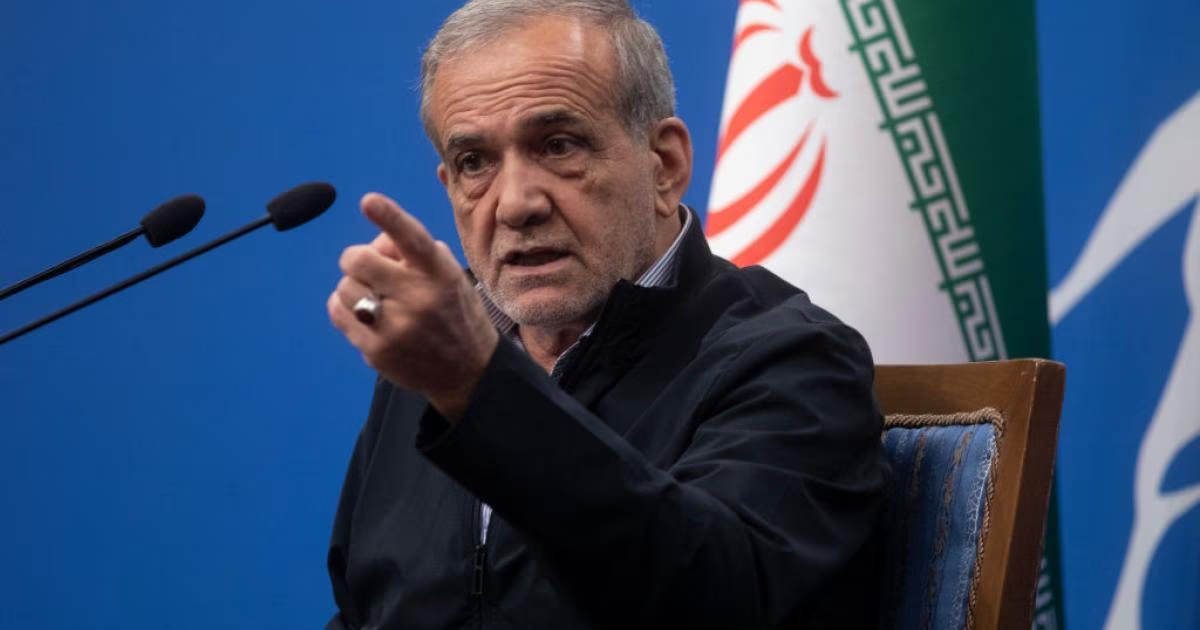
Writer Marash believes that the Peace Council will not be an immediate substitute for international organizations such as the United Nations, nor will it end historical conflicts in the region with a magic touch. But he stressed that the absence of a clear Israeli vision for imposing a temporary military government or defining definitive security objectives is what opened the door for these international initiatives to shape a new reality in Gaza.

Israeli reading of the scene indicates a gap between American ambitions to create a 'pleasant' atmosphere for peace and the field complexities in the Strip. Israeli security, according to this viewpoint, cannot be reduced to meetings held in Washington or diplomatic statements but requires actual control to prevent the rebuilding of military capabilities of the factions.

In conclusion, the 'Peace Council' remains a real test of the ability of international parties to impose a settlement in Gaza away from hardline Israeli desires. While Trump seeks to achieve a quick political accomplishment, the occupation cautiously monitors what it considers 'mines' that may explode in its face if Washington abandons strict security standards in favor of technocratic political solutions.

It is the indecisive Israeli policy towards Gaza that attracts external initiatives that may not align with the security interests of the occupation.

OPINIONS

Thu 26 Feb 2026 9:23 pm - Jerusalem Time

Geopolitical Alliance Redraws the Maps of the New Middle East

Since the fall of Saddam Hussein and the overthrow of his rule, Iraq entered into widespread chaos, then the arena transformed into an ethnic and sectarian conflict, especially with the emergence of ISIS, which began killing, slaughtering, and excluding the 'other' different, exemplified by the bloody events in Mosul against the Christians of Mosul. Afterwards, some of them migrated to Iraqi Kurdistan, where they live under a moderate system that protects all different minorities to this day. Then Iraq entered a sectarian war that established a rift between the Sunni and Shia components, leading to a religious, ethnic, and power struggle between them, which was resolved by sectarian power-sharing in Iraq: Kurds for the presidency of the Iraqi Republic, Shias for the prime ministership, and Sunnis for the parliament speakership. Amidst all these developments that swept the Arab East, and specifically the emergence of ISIS, it laid the foundation for the emergence of an extremist faction in Arab countries that does not accept the 'other' different and excommunicates them, as well as killing the moderate Sunni component that does not align with their extremist principles. Of course, the emergence of the Iranian-backed Shia axis of resistance in the region, represented by the Houthis, Lebanese, Syrian, and Iraqi Hezbollah, and its armed militias loyal to Iran and logistically and economically supported, resulted in an armed Shia axis backed by Iran, parallel to an extremist Sunni axis represented by ISIS and its dormant cells present in several Arab countries, especially in the Arab East, i.e., the Levant previously. Of course, there are several Arab countries like the Hashemite Kingdom of Jordan and the Hashemite rule, which govern with wise, moderate Islam, with its legislation, justice, and respect for the rights of different religious and ethnic components present in one nation, united in a strong and cohesive national unity supported by Hashemite royal initiatives that promote acceptance of the 'other' different and reject hatred and extremism, exemplified by the Amman Message launched by King Abdullah II bin Al-Hussein, may God protect him, in 2004 from the capital Amman. His Majesty also launched the World Interfaith Harmony Week initiative in 2010, which was officially announced to be celebrated every first week of February each year globally (World Interfaith Harmony Week). Politically, in the Arab East region, there are countries considered part of the moderate Sunni axis, such as Jordan and Egypt, and there are other countries currently representing the Shia axis of armed resistance, such as Assad's Syria previously and Iraq currently, and its Iranian-backed militias. The current political phase is characterized by the reduction of the power of the armed Shia axis, as this axis, represented by Lebanese Hezbollah, has been struck. The Lebanese army and the current government, represented by President Joseph Aoun, are seeking to confine weapons to the army and the state and restore its sovereignty over all Lebanese territories, not to mention the harsh blows the party received from Israel, represented by Operation Pager, and recently the strikes and bombing on southern Lebanon. Parallel to these goals, Iraq is also entering a phase of reducing the influence of Iranian-backed Iraqi militias, which are dismantling the sovereignty of the Iraqi state at all political and economic levels and dominating Iraqi oil resources and banks. This is parallel to the internal Iranian crisis and the demonstrations that started from the elite bazaar merchants in several Iranian cities since the beginning of this year 2026 and its ongoing crisis to this day, and recently the renewed momentum of demonstrations, especially from the youth generation around Iranian universities, also breaking the barrier of fear and using their mobile phones to film the events of the demonstrations for the world. Not to mention the American threats to militarily strike Iran, parallel to the intensification of American military buildups and fleets in the region, as well as multiple internal explosions and fires in several Iranian cities and some different schisms in the political and military structure of the Iranian state. All these indicators lead to only one conclusion: the weakening of the Shia axis in the Arab region, which will completely collapse parallel to the fall of the Mullahs' regime in Iran, which will inevitably affect its arms in the region, specifically Iraq, which is also on the verge of explosion, with the presence of ISIS elements who have flocked from Syria and the exacerbated political deadlock in forming a new government and America's refusal to form any government loyal to Iranian-Iraqi factions. All this warns of an explosion of the Iraqi situation internally and the escalation of conflicts into an internal war between ISIS and Iraqi factions, and all developments on the ground warn of this. Also on the Syrian border, where there have been Syrian army buildups throughout the past 72 hours, specifically near the Wadi Khaled area and in several border Syrian villages in the western Homs countryside, and all this also warns of an explosion in the border area between Syria and Lebanon (where the American embassy has asked its citizens to leave Lebanon). All these movements warn of an armed conflict between Hezbollah and the Syrian army and an explosion at any time. Amidst all these political and military developments in the Arab East and Iran, especially the Shia axis that is gradually collapsing day by day, and the repositioning and presence of ISIS in northern Syria and also in Iraq, where recently we observe, especially from Israeli statements, the current endeavor to form a regional alliance that will include moderate Sunni countries, parallel against the two existing extremist axes in the Middle East, i.e., the Shia axis that is on the verge of collapse at any time and the extremist Sunni axis represented by ISIS and similar groups. This alliance, supported by Israel and the United States of America, aims to reshape the new map of the Middle East, consisting of reshaping new alliances that draw new maps of influence in the Arab East region, and creating a Sunni axis for a new moderate rule to become a cornerstone and a pillar of governance in the region for a new strategic alliance (without any extremist religious parties in sight), and its ultimate goal is to create a new Middle East rich in new alliances that will confront any Iranian influence in the region and strive to achieve a new Middle East characterized by stability, peace, and strong new economic alliances, and to impose a new security reality that will inevitably dismantle and fragment old traditional alliances and will radically change the political approach and establish a new economically strong and securely stable Middle East. This desired alliance will include countries in the region and African countries, India, Greece, and Cyprus, where they will unite in security, political, and economic partnerships to confront any radical extremist axes and create a strong alliance that draws new maps of influence, which will translate into economic projects and new anti-Chinese railway links, different from the Chinese Silk Road to revive the ancient Chinese Silk Road. This desired alliance will seek to reduce the influence of BRICS and its alliance with China and Russia and create a strong new alliance with India, economically and politically. The next phase is full of developments in the map of wars and successive explosions, especially in the Iranian scene and the endeavor to overthrow the Mullahs' regime and Reza Pahlavi taking power for the transitional phase in Iran and his joining the new axis, represented by his first step of signing a peace agreement with Israel and replacing the old Iran of the axis of wars with Israel and the Arab East with peace and new economic alliances for the new Iran under the Shah's rule, and ultimately completely eliminating the extremist Shia and extremist Sunni axes in the region. I believe that there is no economic or political stability in the region with the presence of ethnic and sectarian wars and extremism represented by extremist militias in our Arab East. The coming days are pregnant with explosions and developments at all levels, which will ultimately create a new, safe, and stable Middle East characterized by prosperity and economic exchange between the axis of new alliances that will shape the future of the new Middle East.


ANALYSIS

Thu 26 Feb 2026 9:23 pm - Jerusalem Time

The Resilience and Fragility of Systems: How Leaders' Perceptions Shape the Fate of Nations?

The issue of the robustness and fragility of political systems is one of the most pressing in contemporary political science, given its direct impact on global stability and the future of peoples. The book 'Resilience and Fragility of Political Systems,' published by Cambridge University Press, sheds light on the pivotal role leaders play in shaping these perceptions throughout history.

The book's editors, Richard Ned Lebow and Ludvig Norman, believe that major political transformations do not happen suddenly, but are the result of gradual processes influenced by how ruling elites assess the strength of their systems. These assessments are not merely an intellectual luxury, but are the primary driver of political behavior that determines whether a system will solidify or erode.

The book defines political systems as collections of formal and informal institutions and procedures that organize collective life and manage social conflicts. While governments may change rapidly, systems tend to endure, and when they collapse, the consequences are dire and often redraw political maps.

The work reviews prominent historical examples such as the collapse of the Soviet Union and the disintegration of the Ottoman Empire, illustrating how the weakness of central systems led to the emergence of new separatist states. In certain cases, the collapse did not stop at the boundaries of the political system, but extended to encompass the entire state, as happened in Yugoslavia and Libya.

The analysis addresses the fluctuation of perceptions of strength and fragility, where fears of collapse can suddenly appear even in seemingly stable systems. After World War II, there was great optimism about the resilience of democracy, but this optimism receded in the face of waves of coups and political unrest in Europe and Latin America.

In the last decade, pessimism has replaced liberal certainty, and democracy has become threatened even in its traditional strongholds in Western Europe and North America. Researchers attribute this shift to increasing economic inequalities and the emergence of populist movements that question the legitimacy of existing institutions and stable democratic norms.

The United States represents a current example of this concern, with warnings of the collapse of the democratic system escalating for the first time since the Great Depression. The events of the 2020 election and the storming of the Capitol reinforced these fears, making the system's survival a serious question for many analysts.

The book indicates that political leaders assess the strength of their systems based on an uncertain understanding of risks, rather than according to agreed-upon objective standards. While some see the resilience of American institutions in the face of the Trump era crises as evidence of their strength, others see it as an expression of a slow and continuous erosion of the system.

Historically, overconfidence in the resilience of democracy during the 1920s led to underestimating the danger of fascism and Nazism. The 'Weimar lesson' contributed to shaping the consciousness of European elites after the war, as they focused on ensuring institutional stability rather than merely deepening popular participation, which could be fraught with risks.

The phenomenon of misunderstanding events is not limited to democratic systems, but also extends to authoritarian systems, as happened in the Soviet Union under Khrushchev and Gorbachev. Uncalculated reform attempts, or excessive repression, accelerated the pace of collapse instead of protecting the system from disintegration.

In the contemporary Chinese case, the leadership seems to share a constant sense of fragility, which drives it to use brute force against any potential opposition. Analysts believe that this repression may buy the system additional time, but at the same time, it may increase the chances of a resounding fall in the long run.

International systems are also affected by these dynamics, with organizations such as the United Nations and the European Union built on the ruins of past failures. Despite the European project's success in enduring for decades, concerns about its fragility remain strongly present in the discourse of leaders and political actors.

The book concludes that no political system is absolutely robust; all systems lie somewhere on a continuum between resilience and collapse. Fragility is often a latent state whose true degree only becomes apparent when a sudden catalyst leads to the fracturing of the political structure.

Building legitimacy and robustness is a gradual and complex process, while external shocks or internal crises can quickly shift a system from strength to fragility. Therefore, leaders' ability to read reality and avoid self-deception remains the only, albeit uncertain, guarantee for the survival of nations.

Fragility and robustness are not merely objective facts, but are the product of leaders' perceptions that drive them to make decisions that may accelerate the collapse of their systems or grant them additional longevity.

ARAB AND WORLD

Thu 26 Feb 2026 1:28 pm - Jerusalem Time

Pezeshkian confirms Tehran is not seeking nuclear weapons as third round of Geneva negotiations begins

Iranian President Masoud Pezeshkian reiterated that the Islamic Republic does not aim to acquire nuclear weapons in any form. Pezeshkian clarified that this stance is based on a religious fatwa and a firm ideological position announced by Supreme Leader Ali Khamenei, noting that the political leadership does not have the authority to override these religious constants.

These statements coincide with the start of the third round of indirect negotiations between Tehran and Washington in Geneva, Switzerland. These talks, mediated by the Sultanate of Oman, aim to break the deadlock in the nuclear file and find a consensual formula to end the crisis that has persisted for years.

In the context of military warnings, the Iranian President stressed that any American aggression against his country would be met with a firm and strong response. He indicated that targeting the leadership would not weaken the state, but would lead to the emergence of new generations capable of managing and protecting the country, emphasizing the importance of national unity in confronting external threats.

For his part, Iranian Foreign Ministry spokesman Ismail Baqaei stated that the Iranian delegation is entering this round with full seriousness and flexibility aimed at achieving tangible results. Baqaei affirmed that the agenda of the current talks is strictly limited to technical nuclear issues and the lifting of economic sanctions imposed on Tehran.

On the sidelines of the negotiations, Omani Foreign Minister Badr Al Busaidi held a meeting with the Director-General of the International Atomic Energy Agency (IAEA), Rafael Grossi. The meeting addressed the technical aspects of the Iranian nuclear file, in addition to reviewing new ideas and proposals on the negotiation table between the Iranian and American sides.

The Omani Ministry of Foreign Affairs affirmed in a statement the importance of the role played by the international agency in ensuring transparency and credibility during the negotiation process. The statement indicated that Omani mediation seeks to provide a suitable environment for dialogue that ensures the governance of technical procedures related to Iranian nuclear activities.

The current round of talks was preceded by intensive meetings between the Omani minister and his Iranian counterpart, Abbas Araghchi, to discuss new Iranian proposals. Although the details of these proposals were not disclosed, informed sources indicate that they include flexibility in some technical aspects in exchange for clear economic guarantees.

It is worth noting that the current negotiation path resumed in Muscat early this February, after a period of hiatus due to military escalation in the region last year. The current Geneva round is the third in a few weeks, reflecting the parties' desire to avoid sliding into a comprehensive confrontation.

The United States adheres to firm demands, including the complete cessation of uranium enrichment and addressing the issue of Iran's ballistic missile program. In contrast, Tehran rejects these conditions and considers them an infringement on its national sovereignty, accusing Washington of using the nuclear file as a pretext to interfere in its internal affairs.

The negotiation scene in Geneva remains open to all possibilities, oscillating between the desire to reach an agreement that lifts sanctions and the readiness for military options. Regional and international powers are cautiously monitoring the results of this round, given its direct impact on the stability of the Middle East and its balance of power.

Our Supreme Leader has previously declared that we will never possess nuclear weapons, and even if I wanted to pursue that path, I would not be able to do so from an ideological perspective.

PALESTINE

Thu 26 Feb 2026 1:28 pm - Jerusalem Time

Cryptocurrency for Gaza under US-Israeli supervision: A reconstruction plan or a tool to tighten the financial blockade?

International press reports have revealed moves led by the Peace Council, linked to US President Donald Trump, to introduce a new financial system in the Gaza Strip based on stable cryptocurrencies. This step comes amidst the near-complete collapse of the traditional banking system as a result of the ongoing Israeli war for more than two years, which has prompted international parties to search for digital alternatives to manage daily transactions.

This trend is led by Israeli businessman and former reserve officer Liran Tankman, who serves as a volunteer advisor to the Peace Council, where he promotes the idea of a stablecoin as a means to facilitate payments. The project, according to its proponents, aims to find a way out of the suffocating economic crisis and severe liquidity shortage suffered by the residents of the Strip due to restrictions on money movement.

A stablecoin is defined as a digital asset linked to the value of a traditional currency such as the US dollar, which protects it from the sharp fluctuations experienced by other cryptocurrencies like Bitcoin. These currencies are issued by companies that maintain parallel cash reserves, allowing users to conduct transactions through digital wallets on mobile phones without the need to open complex bank accounts.

Informed sources reported that discussions are still in their initial stages, but they involve multiple parties, including the National Committee for the Administration of the Gaza Strip and the office of High Representative Nikolay Mladenov. This currency is expected to be supported by Palestinian and Gulf technology companies with expertise in financial technology, to ensure its reach to the widest possible segment of the population.

Economic experts believe that this proposal carries objectives beyond the humanitarian or economic aspects, as it is feared that it could be a means to deepen the separation between the Gaza Strip and the West Bank. The Palestinian Authority in Ramallah will not have any supervisory or administrative authority over this new financial system, thus cementing an independent political and economic reality for the Strip under external supervision.

Economic analyst Zayan Zawana points out that Israel seeks to employ financial technology as a sophisticated espionage tool to monitor all details of life and financial flows in Gaza. Zawana believes that the intelligence failure in the events of October 7 pushed the occupation to search for technical means that guarantee real-time monitoring of every penny entering or leaving the Strip.

On the other hand, observers believe that the US administration may use Gaza as a laboratory for new monetary and technological experiments without any direct political or financial cost. The success of the stablecoin experiment in a complex environment like Gaza could pave the way for the adoption of similar policies in other parts of the world, or even within the United States itself to counter the decline in confidence in government bonds.

The issue of 'drying up the sources of resistance funding' tops the list of unannounced objectives of this project, as digital control aims to prevent Hamas from using cash liquidity. The parties overseeing the project hope that a complete digital transformation will lead to tracking all financial transactions and banning any wallets suspected of being linked to Palestinian factions.

Euro-Med Human Rights Monitor warned of the danger of this trend, describing digital wallets controlled by parties loyal to the occupation as potentially becoming 'silent weapons of extermination'. The monitor explained that depriving residents of cash liquidity and forcing them into a digital system that can be shut down with the click of a button represents a serious threat to the food and livelihood security of Palestinians.

Despite these plans, analysts doubt the stablecoin's ability to achieve its security objectives, noting that the resistance has proven its ability to circumvent financial restrictions for many years. American reports had stated that resistance factions received tens of millions of dollars through independent encrypted wallets, away from traditional international oversight.

1. The idea of a digital currency in Gaza faces huge structural obstacles, most notably the systematic destruction of power stations and communication and internet networks by the occupation army. Without a stable energy and communication infrastructure, the idea of complete reliance on digital wallets and cryptocurrencies remains mere technical ambitions that are difficult to implement in the tragic reality.

Sources confirm that the regulatory framework for the proposed currency is not yet complete, and there are technical and legal disagreements about how to ensure its stability and secure it from cyberattacks. However, the American and Israeli insistence on pushing this project indicates a desire to change the economic rules of the game in Gaza as part of post-war arrangements.

The question remains about the position of the Palestinian street and local companies on engaging in a financial system led by a former Israeli officer and managed by external parties. Trust in the financial system is the cornerstone of any currency, and in the absence of national sovereignty, the project may face widespread popular rejection that hinders its political and security objectives.

The shift towards 'Digital Gaza' under international supervision represents a new chapter in the conflict, where major powers seek to use technology as an alternative tool to traditional weapons. While some promote the project as a solution to the humanitarian crisis, many in Gaza see it as a new link in the chain of blockade aimed at suffocating the resistance and tightening control over citizens' livelihoods.

Digital wallets under this proposed system could turn into silent weapons of mass destruction by stripping Gaza of its financial sovereignty.

PALESTINE

Thu 26 Feb 2026 12:38 pm - Jerusalem Time

Between Picasso's 'Guernica' and the Gaza Massacres.. A Reading of the Series 'Sahab Al-Ard'

Pablo Picasso's 'Guernica' remains the most prominent witness to art's ability to immortalize victims and confront killers, as it documented the Nazi massacre in Spain in 1937. Today, this artistic icon is revisited in the context of the ongoing Israeli aggression on the Gaza Strip, highlighting the intricate relationship between reality and drama and how art can protect memory from annihilation.

In Ramadan 2026, the series 'Sahab Al-Ard' (Owners of the Land) by director Peter Mimi stands out as the first Arab drama to directly address the recent massacres in the Gaza Strip. Despite the concerns surrounding its production due to time constraints, the work boldly emulated Palestinian reality with striking artistic flair, attempting to break the media blockade imposed on the Palestinian narrative.

The announcement of the series raised many questions about how to approach a current event whose chapters have not yet concluded, especially with Israeli restrictions preventing production teams from entering the Strip. The creators relied on building massive sets that mimic the destroyed neighborhoods of Gaza, focusing on human details that transcend direct political slogans.

Writer Ammar Sabry is responsible for the script and screenplay, having previously participated in writing workshops for successful works, and now presents his first major experience in 'Sahab Al-Ard'. It appears that the work relied on research teams and fact-checking to ensure a realistic portrayal that reflects the complex social and political map of the Gaza Strip under bombardment.

The name of director Peter Mimi raises questions about the political employment of the work, given the association of his previous works with official Egyptian orientations. However, critics believe that the series reflects a shift in Egyptian dramatic discourse towards the Palestinian cause, especially in light of the rejection of Israeli displacement plans aimed at liquidating the issue.

Viewers compare 'Sahab Al-Ard' with the series 'Haret Al-Yahud' (The Jewish Quarter) which aired years ago, showing the difference in the centrality of the Palestinian character. While the Palestinian in previous works was a secondary or 'ghostly' character, in this work, they occupy the heart of the event, expressing their existential struggle to remain on their land threatened with annihilation.

Dr. Salma, an Egyptian doctor played by actress Menna Shalaby, plays a pivotal role in the work through her travel with medical convoys to northern Gaza. Through her eyes, the viewer witnesses the scale of the daily humanitarian catastrophe, where her personal tragedy of losing her son merges with the tragedies of injured children in Gazan hospitals.

Actor Iyad Nassar delivers an exceptional performance as 'Nasser', a character who lives a torn struggle between the desire to protect his family by leaving and his deep-rooted belonging to the land. This conflict reflects the Palestinian existential dilemma that began decades ago, where mere survival becomes a form of resistance and heroism.

The series successfully captured the Gazan dialect accurately and managed to build balanced dramatic arcs that give the characters deep human motivations for integrating into a dangerous environment. The dialogue between the characters shows a deep understanding of major Palestinian concerns, far from the naive stereotyping that prevailed in some previous Arab works.

Prominent Palestinian actors, including Kamel El Basha and Adam Bakri, participate in the series, adding a touch of realism and credibility to the performances. These participations contribute to strengthening the Palestinian narrative within the work and connecting the Palestinian diaspora with the interior through a dramatic platform that reaches millions of Arab viewers.

The first episodes of the series emphasize the role of Egyptian authorities in providing humanitarian and medical aid, which some see as part of directed political messages. Nevertheless, the dramatic treatment maintains high creative standards, making the work an important artistic document that chronicles a pivotal stage in the history of the Arab-Israeli conflict.

The construction of sets mimicking the rubble and destruction in Gaza was not merely a visual backdrop, but an integral part of the dramatic structure that places the viewer at the heart of the suffering. Peter Mimi managed to utilize this environment to create a state of continuous tension experienced by Gazans under the weight of Israeli planes and artillery.

The series faces the challenge of balancing the artistic and the political, as it seeks to avoid crude 'sloganeering' in favor of individual stories and human destinies. By focusing on the lives of a segment representing Gazan society, the work succeeds in transforming the cold numbers of victims into vibrant stories full of life and emotions.

In conclusion, 'Sahab Al-Ard' represents an important step in contemporary Arab drama, as it dares to approach a bleeding wound that has not yet healed. Whether opinions agree or disagree on its political objectives, it remains a serious artistic attempt to immortalize the steadfastness of the 'Owners of the Land' in the face of the war machine, just as Picasso did in 'Guernica'.

'No, you did.' Picasso's response to a Nazi officer who asked him about the Guernica painting, which is embodied today in a drama documenting the annihilation of Gaza.

ISRAELI AFFAIRS

Thu 26 Feb 2026 12:38 pm - Jerusalem Time

Hebrew report warns of depletion of Israeli interceptor missile stock in the face of any widespread Iranian attack

Hebrew press reports indicated that the occupation's security establishment faces a strategic challenge in the form of dwindling interceptor missile stockpiles, especially the 'Arrow' systems designed to counter ballistic missiles. Sources explained that the intensive consumption of these defenses during ongoing confrontations on the Gaza, Lebanon, and Yemen fronts, in addition to previous Iranian attacks, has led to a significant depletion of available defensive capabilities.

Sources pointed out that this shortage has led some of the occupation's warplanes to refrain from launching interceptor missiles in certain situations to preserve what remains of the stock. In light of this reality, the Ministry of War has submitted urgent requests to increase supplies and compensate for the existing deficit, warning that any comprehensive and widespread confrontation with Iran could reveal serious defensive vulnerabilities that cannot be filled quickly enough.

On the other hand, the situation in the United States does not appear to be any better, as Washington suffers from a noticeable decline in 'Patriot' missile stockpiles after large batches were directed to support the Ukrainian front. This shortage has prompted the Pentagon to conclude long-term contracts with major military manufacturing companies such as 'Lockheed Martin' and 'Raytheon' to increase the annual production rate to thousands of missiles, in an attempt to address the growing security gap.

Military estimates indicate that the American strategic reserve will not fully recover its levels before 2028 or 2029, which puts the US administration in a real dilemma regarding resource allocation. Washington finds itself forced to balance Ukraine's urgent needs with the security requirements of the Israeli occupation, while maintaining sufficient reserves to confront potential scenarios with international powers such as China or Iran.

Regarding costs, the intensification of global production is expected to lead to a reduction in the prices of interceptor missiles, as the price of a 'Patriot' missile may drop to about $4.4 million. Although Israeli missiles such as 'Arrow-3' and 'David's Sling' are relatively less expensive, the crisis is not limited to defense only, but also includes heavy offensive munitions such as 'Mother of All Bombs' which the United States currently suffers from limited production of.

The occupation has consumed the majority of its interceptor systems during the current confrontations, making the inventory file a major vulnerability in the event of a direct confrontation with Tehran.

ARAB AND WORLD

Thu 26 Feb 2026 12:36 pm - Jerusalem Time

American-Arab Anti-Discrimination Committee Sues Rep. Randy Fine for First Amendment Violation

Said Erikat

Opinion Writer

Washington – Said Arikat – 2/26/2026

The American-Arab Anti-Discrimination Committee (ADC) has filed a federal lawsuit against Florida State Representative Randy Fine (Republican), accusing him of violating the guarantees of the First Amendment to the U.S. Constitution. The lawsuit, filed in cooperation with the organization Muslim Legal, came after the representative blocked citizen Amjad Massad from his official account on the (X) platform after Massad posted a sarcastic comment criticizing a statement that the plaintiffs considered anti-Muslim.

According to the complaint, Fine used his official account as a public forum to address voters regarding his legislative activities and political stances, while keeping the comment and interaction feature available to the public. However, this openness – as the lawsuit states – did not withstand criticism; the representative quickly blocked Massad after his sarcastic reply, which prevented him from viewing the account's posts and participating in the public discussions initiated by the official himself.

The lawsuit, filed in the federal court in the Middle District of Florida, is based on a well-established constitutional principle that any public official, when using an official platform to communicate about public affairs, does not have the right to exclude dissenting voices because of their differing opinions. The U.S. Supreme Court has previously affirmed that the First Amendment does not permit the creation of a public forum for discussion and then selectively closing it to specific critics.

The complaint indicates that Fine's statement, from an extremist Zionist, which sparked controversy, included inflammatory rhetoric against Muslims, and that blocking Massad was a direct response to his political objection, not to a violation of the platform's terms of use. Thus, the committee believes that the representative engaged in viewpoint discrimination, which is one of the most dangerous forms of restrictions on freedom of speech in American constitutional jurisprudence.

Jannine Younis, the National Legal Director at the Committee, stated that the case goes beyond an individual and touches upon the core relationship between an elected official and the public. She added that anyone who holds a public office and uses their official channels to promote their positions becomes subject to public scrutiny, and does not have the right to "hide behind the office to exclude those who criticize them." In turn, attorney Hassan Shibly from Muslim Legal affirmed that the Constitution does not allow official public forums to be turned into "censorship zones" managed according to the official's whims.

Attorney Malak Afaneh, from the Anti-Discrimination Committee, believed that the matter is legally clear: a government official cannot open a public discussion and then close it to those who disagree with them. She considered that the association of the ban with rhetoric described as anti-Muslim adds a civil dimension to the case related to protecting minorities from deliberate silencing.

This case reveals the escalating tension between freedom of speech and the limits of authority in the digital age. Social media platforms are no longer personal arenas for officials, but an extension of their public offices. When an official account is used to present policies or legislative positions, it acquires the status of a "public forum" with all the constitutional obligations that entail. Therefore, any opinion-based discrimination is not merely a technical measure, but a precedent that affects the essence of political pluralism and citizens' right to hold their representatives accountable without fear or exclusion.

The broader significance of the lawsuit lies in its societal dimension. The case is not only about an individual's right to comment, but also a message directed to ethnic and religious minorities about their place in the public sphere. When members of these communities feel that their criticism may lead to their silencing, trust in democratic institutions erodes. Therefore, a judicial resolution of the matter reaffirms that constitutional protection includes everyone without discrimination, and that public office requires a higher degree of tolerance and openness to criticism, not the opposite.

This lawsuit comes within a long history of work by the American-Arab Anti-Discrimination Committee, founded in 1980 by former Senator James Abourezk, and is the largest Arab-American grassroots organization in the United States. The Committee affirms that its defense of Massad falls within its broader mission to protect the civil rights of nearly 3.7 million Arab Americans, promote public understanding of Arab history and culture, and build partnerships with marginalized communities in support of social justice.

While observers await the court's decision, this case draws clear lines between the right to manage personal accounts and the constitutional duty that accompanies an official when speaking in their official capacity. Freedom of speech, as the First Amendment affirms, is not a privilege granted based on approval, but an inherent right that includes even the most inconvenient opinions for authority.