






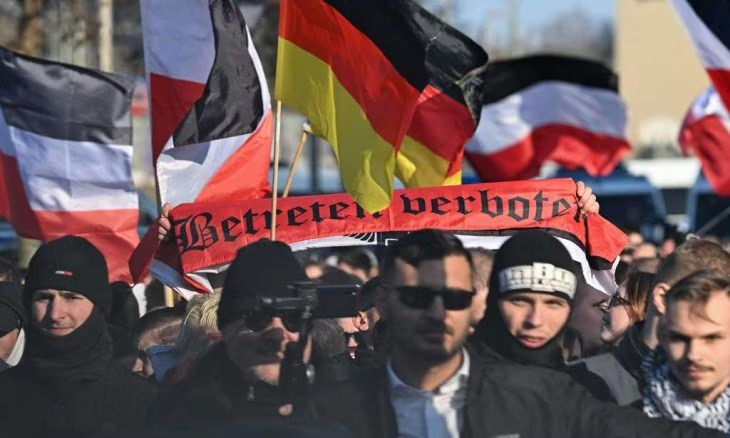
The political and security landscape in Germany is facing a new challenge: the rise of a soft front for the far-right through social media platforms. This front relies on influencers who use religious language and Christian symbols to push emotionally charged political agendas, prompting intelligence agencies to intervene.
The German government confirmed in an official response to parliamentary inquiries that the Federal Office for the Protection of the Constitution (domestic intelligence) has already begun monitoring groups and individuals seeking to spread extremist ideologies under a Christian guise. Government sources clarified that these actors exploit religious discourse to justify hostile stances against specific social groups.
Reports indicate that these influencers, now dubbed 'Christfluencers,' blend religious preaching with right-wing conspiracy theories. A notable aspect of this activity is the clear attempts at networking with official political circles, particularly members of the opposition party Alternative for Germany (AfD).
For its part, the German Green Party emphasized that the security action does not target the Christian religion or official churches that reject racism. MP Marlene Schönberger stated that the far-right uses attractive religious images and narratives primarily aimed at attracting young people through the digital space.
Schönberger added that these influencers have links to international right-wing movements, including the 'MAGA' movement associated with former US President Donald Trump. This overlap between cross-border ideology and local symbols raises serious concerns among decision-making circles in Berlin about the future of societal stability.
Lamya Kaddor, the Green Party's spokesperson for religious policy, called for greater attention to the exploitation of Christian symbols. She considered the transformation of religion from a spiritual domain into a tool for identity mobilization and social segregation a direct threat to the country's values of tolerance and coexistence.
Despite widespread debate, the German government refused to disclose the list of names or groups currently under surveillance. Security sources justified this reservation by their desire to prevent targets from developing defensive strategies that could hinder the collection of sensitive intelligence information.
This issue places the German state in a delicate position, as it tries to balance protecting the democratic system with freedom of religious opinion. Authorities affirm that they are not monitoring conservative religiosity, but rather pursuing those who use religious cover as a facade for incitement against constitutional institutions and liberal values.
Observers believe that the appeal of these symbols to the AfD's audience stems from the party's focus on defending the 'Christian identity of the West.' This discourse resonates widely with segments of the population who fear the effects of immigration and globalization, making digital platforms fertile ground for the spread of these messages.
In a related context, the Christian Democratic Union (CDU) is experiencing a fierce internal debate about how to deal with the electoral rise of populism. Pressure is mounting to uphold the 'firewall' that prevents any form of political cooperation with the AfD in the German states.
Prominent CDU leaders, such as Dennis Radtke, warned that any rapprochement with the far-right would mean the end of the party as a centrist political force. Other officials threatened to leave the party if this ethical and political commitment were broken under the pressure of election results.
On the other hand, voices calling for a different approach have emerged, such as former Finance Minister Peer Steinbrück, who believes that a legal ban on the party may not be an effective solution. Steinbrück instead suggested depriving the most extremist figures of their political rights if their hostility to the democratic system is proven.
These developments reflect a deep dilemma facing German democracy in confronting forces that use the tools of the digital age to revert to old narratives. The religious influencer does not always appear as a direct political actor but begins by talking about family and values before moving on to systematic incitement.
Ultimately, the battle against extremism in Germany remains linked to the state's ability to dismantle these complex digital networks. With crucial election dates approaching, the question remains about the extent to which the 'firewall' will withstand the rising waves of religious and political mobilization.
The problem is not with Christianity or the churches, but with the instrumentalization of religious symbols in the service of an extremist political project that seeks to undermine democracy.

Share your opinion
German Intelligence Pursues Extremist 'Christian Influencers' on Social Media