






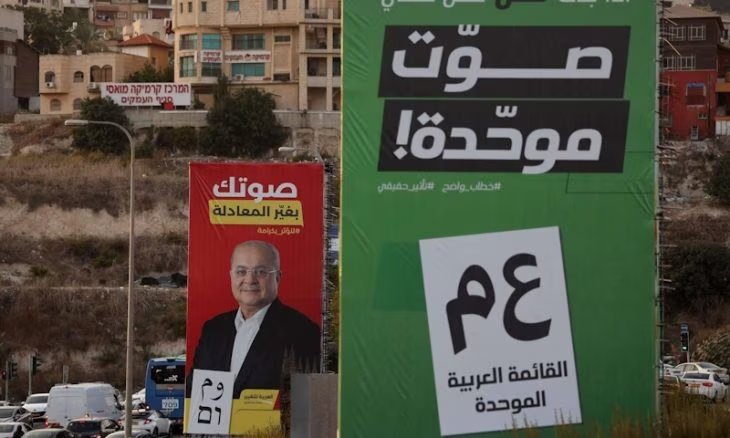
Efforts to revive the Joint List of Arab parties within the 48 territories continue to face complex challenges that have so far prevented a final agreement. Despite repeated declarations of a desire for unity, the last meeting held in Nazareth ended without a tangible breakthrough, necessitating the scheduling of additional meetings this week.
Arab parties agreed to hold two crucial meetings next Tuesday and Thursday, in a final attempt to overcome outstanding differences before it's too late. These moves come under widespread popular pressure demanding unified and strong Arab representation within the Knesset to confront the increasing political and social challenges facing the Arab community.
The core point of contention revolves around the nature of the list, as the parties had previously agreed on a 'technical list' formula. This designation, supported by the National Conciliation Committee, aims to grant each party political freedom of action after the elections, whether by remaining in opposition or supporting a specific government coalition according to its interests and vision.
However, the United Arab List, led by MK Mansour Abbas, expressed reservations about the extent to which the other parties would adhere to this principle in actual application. The United List demanded clear guarantees to prevent its leaders from being subjected to 'treason' campaigns if they decided to join an alternative government coalition, convinced of the necessity of influencing from within decision-making centers.
Conversely, the Hadash, Balad, and Arab Movement for Change parties refuse to make prior commitments to governments that have not yet been formed and whose political features are unknown. These parties believe that pledging political positions now is an unjustified concession, especially given the lack of clarity regarding the stances of opposition Israeli parties on the Palestinian issue and the rights of those within the 48 territories.
The last meeting witnessed heated discussions, with MK Ahmad Tibi directly questioning Mansour Abbas on how to deal with sensitive issues such as the incursions into Al-Aqsa Mosque. Tibi affirmed that the three parties had already agreed to the working paper submitted by the Conciliation Committee, calling on the United List to join it to end the political debate and move on to technical matters.
For his part, Mansour Abbas defended his movement's position, emphasizing that the United List has practical experience in political influence away from grand slogans. He explained that his movement seeks understandings that ensure tangible achievements for the Arab community, considering that political work requires a delicate balance between 'averting harm and bringing benefits'.
Balad issued a statement expressing its deep concern about the continued 'procrastination' in the ongoing negotiations. Balad indicated that returning to proposing prior political conditions brings the negotiations back to square one, undermining the efforts made in recent weeks to overcome obstacles to unity.
Balad stressed that the path towards achieving the Joint List must pass through respecting the independence of the parties and their organizational specificity without imposing political guardianship. It called on all parties to act with national responsibility and avoid proposing new conditions that could lead to the fragmentation of the Arab ranks at a delicate historical stage.
In its response to these criticisms, the United List affirmed that it enters negotiations with a clear vision and specific demands aimed at ensuring the stability of any future alliance. The United List criticized what it described as the 'opposition mentality' that merely rejects clauses without offering practical alternatives that serve the interests of the Arab citizen within the 48 territories.
The United List questioned the usefulness of raising the slogan of overthrowing Netanyahu without a clear plan to support a realistic alternative that guarantees the rights of Palestinians within the 48 territories. It considered that the experience of the previous 'change government' proved the necessity of solid understandings to prevent the far-right from returning to power by exploiting political loopholes.
The National Conciliation Committee, headed by the writer Muhammad Ali Taha, is monitoring these developments with concern, trying to bridge the views between the competing poles. The committee believes that failure to form the Joint List could lead to a state of frustration among Arab voters, which could negatively reflect on overall voting rates.
Intensive behind-the-scenes contacts are expected in the coming days to try to draft a final document that satisfies all parties. Efforts are now focused on finding a linguistic and political formula that guarantees the United List 'political security' and the three parties 'national constants' without direct conflict.
Thursday remains the deadline set by the political forces to definitively decide the fate of the Joint List. Either an announcement of the launch of a broad electoral alliance that restores hope to the Arab street, or going to elections with fragmented ranks that could put Arab representation in the Knesset at real risk.
We cannot determine our position on an alternative government that has not yet been born, and it is not known who its participants are or what its policies are regarding our national issues.



Share your opinion
Joint List Negotiations Stalled: Crucial Meeting Thursday to Save Political Unity at Home