






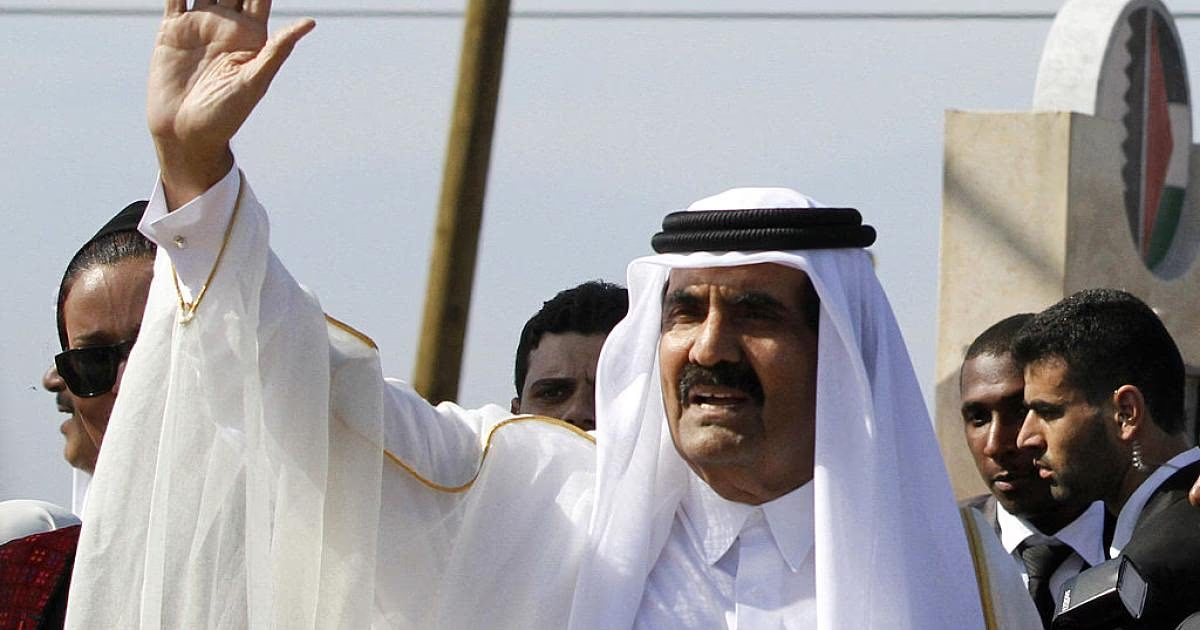
The State of Qatar and the Arab and Islamic nations bid farewell this Sunday morning to the Father Emir Sheikh Hamad bin Khalifa Al Thani, who passed away at the age of 74. The Qatari Emiri Diwan announced the news in an official statement, mourning the leader whose name was associated with radical transformations that made Qatar a formidable player in the international equation.
The deceased was born in Doha in early 1952, growing up in an environment that relied on limited resources before the major gas discoveries. He received his early education in Qatar, then joined the Royal Military Academy 'Sandhurst' in the United Kingdom, graduating in 1971, to return to his country and begin his journey in building the Qatari military institution.
On May 31, 1977, Sheikh Hamad was sworn in as Crown Prince and appointed Minister of Defense, a period that saw the laying of the first cornerstones for the development of the armed forces. His vision from the outset was characterized by a desire for radical change and to transform the country from a state of traditional dependence to the horizons of a modern, integrated state.
Sheikh Hamad assumed power on June 27, 1995, beginning a phase described as the 'great leap forward'. During that period, the country faced difficult economic challenges and a nearly empty treasury, but his will was directed towards unprecedented exploitation of natural resources to secure the future of coming generations.
Sheikh Hamad is considered the true architect of Qatar's gas industry, having decided on massive investments in the North Field despite the financial risks at the time. By 1996, Qatar began exporting its first shipments of liquefied natural gas, becoming under his reign the largest exporter of this clean energy in the world, which provided enormous financial flows used for development.
The renaissance during the Father Emir's era was not merely material; it also included building people and institutions, as he launched the 'Education City' project which attracted the most prestigious international universities. His reign also saw the promulgation of the country's first permanent constitution in 2003, which established the foundations for institutional work and popular participation in decision-making.
On the political front, Sheikh Hamad adopted an independent and active foreign policy, making Doha a center for international mediation and conflict resolution. He sought for Qatar to be an active partner at the international table, not just a subject of discussion, which enhanced its presence in international forums and organizations.
The Father Emir's name was associated with supporting just Arab causes, foremost among them the Palestinian cause, as he was among the first leaders to break the siege on the Gaza Strip. Qatar also played a pivotal role during his reign in the reconstruction of southern Lebanon after the 2006 aggression, and in providing humanitarian aid in various crises.
His years in power witnessed an unprecedented sports and cultural boom, culminating in Qatar's historic win to host the 2022 World Cup finals. This achievement was considered an extension of his vision to place Qatar at the heart of global attention, and to break stereotypes about the Arab region and its organizational capabilities.
In a move described as historic and unprecedented in the Arab region, Sheikh Hamad announced on June 25, 2013, his abdication of power to his son, Sheikh Tamim bin Hamad Al Thani. In his abdication speech, he affirmed that the time had come to open the way for a new generation to lead the building process with a youthful spirit and a renewed vision.
After handing over power, he held the title of 'Father Emir' and remained a national symbol widely respected inside and outside Qatar, continuing the development process he began. His later years were characterized by tranquility and presence at major national events, observing the fruits of his planting that blossomed in all fields.
Sheikh Hamad's vision was distinguished by the ability to balance modernity and authenticity, as he preserved Qatari and Arab identity amidst global openness. Throughout his reign, he sought to raise the income level of Qatari citizens to be among the highest globally, with a focus on quality education and healthcare.
Close sources confirm that the deceased believed that wealth should be a means for national liberation and building independent will, not just numbers in banks. This explains Qatar's bold stances on complex regional and international issues, where dialogue and prioritizing the voice of reason were the adopted approach.
With the passing of Sheikh Hamad bin Khalifa Al Thani, a bright page in Qatar's modern history closes, but his impact will remain etched in the institutions, cities, and projects he built. His memory will forever be associated with the image of the leader who dared to dream and transformed the desert into a global beacon of gas, knowledge, and sports.
Sheikh Hamad's grand project was for the region to be at the heart of the world, not on its periphery, for wealth to be a blessing, not a curse, and for Qatar to possess its own independent decision and voice.

Share your opinion
The Passing of the Father Emir Sheikh Hamad bin Khalifa Al Thani: The Journey of a Leader Who Laid the Foundations of Modern Qatar's Renaissance