






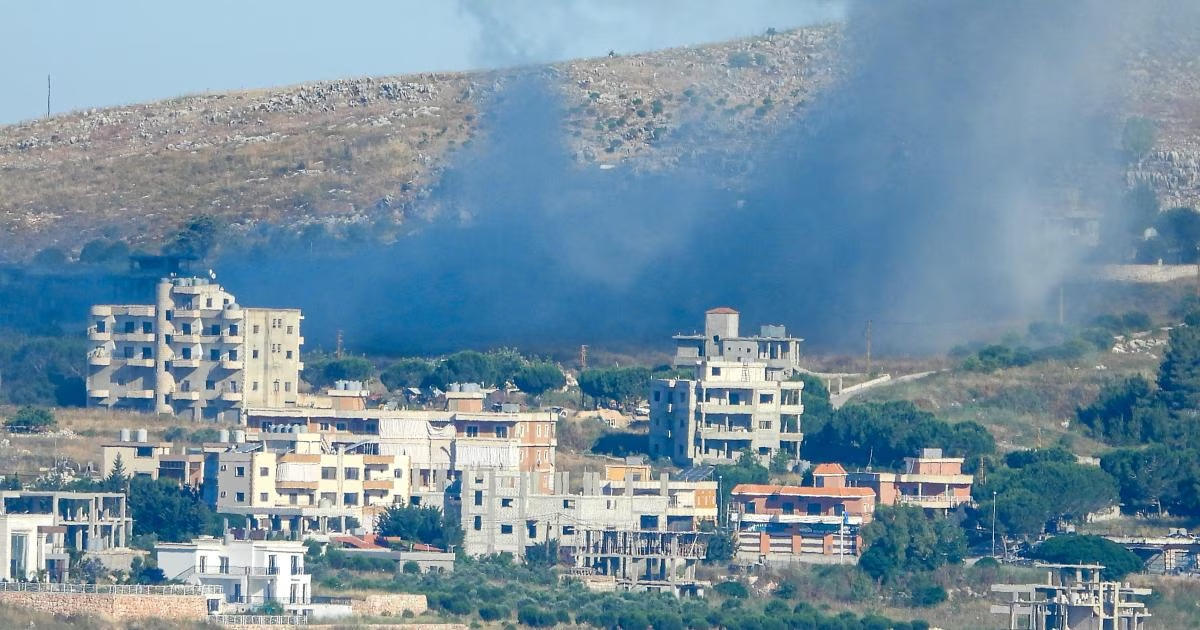
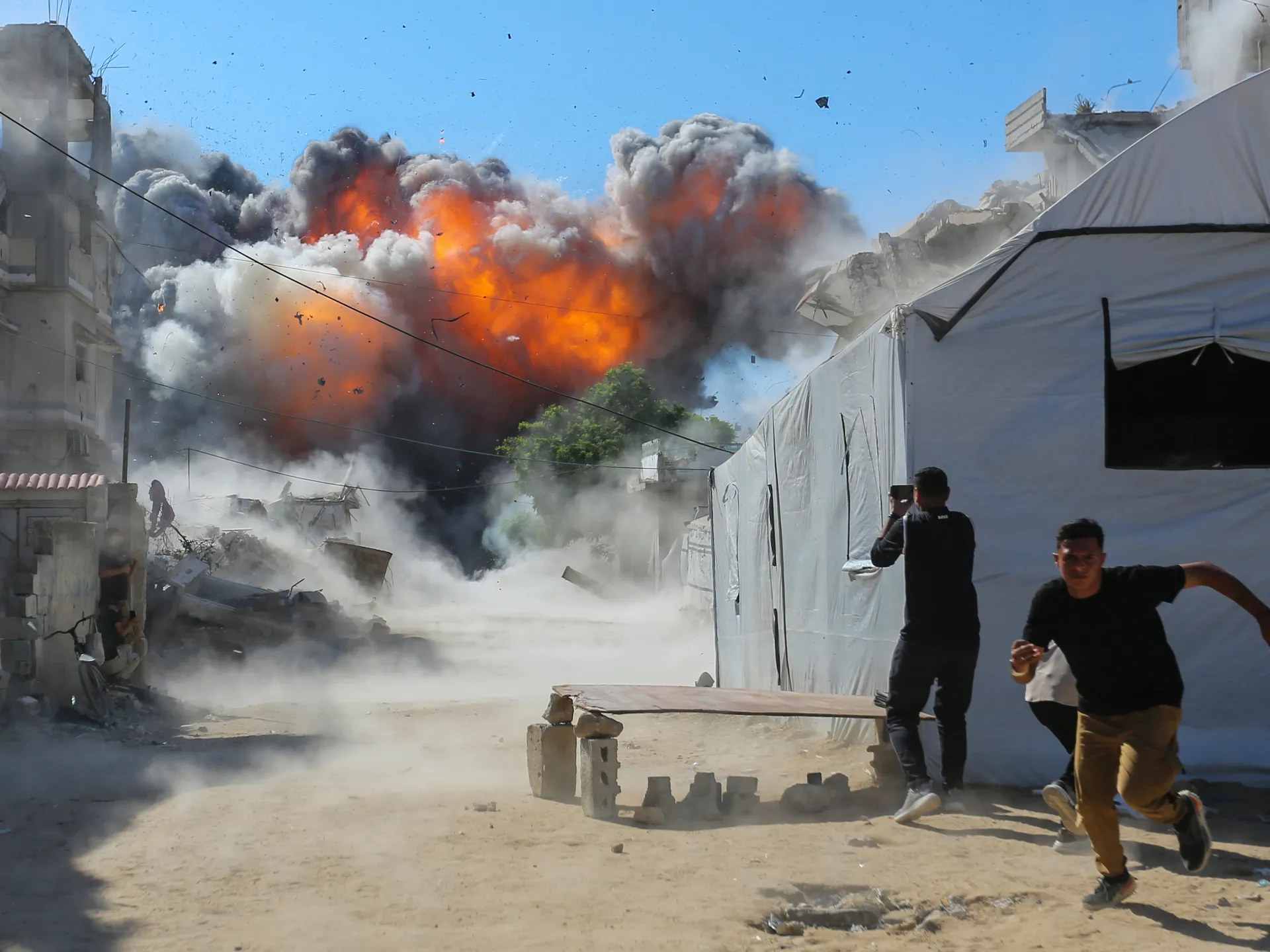
Areas of South Lebanon and the Beqaa witnessed a bloody military escalation on Thursday evening, as Israeli occupation aircraft launched a series of intense raids targeting the towns of Tyre and Nabatieh, resulting in injuries and widespread destruction. Field sources reported that a raid targeted the Al-Masaken area in Tyre, while other attacks hit the town of Baraachit and the Bint Jbeil district, in addition to a drone targeting the Ansar-Koutharieh Al-Riz public road.
In the western Beqaa region, occupation forces committed a massacre in the town of Sahmar, killing 5 civilians after the town was subjected to more than 7 airstrikes in less than half an hour. This shelling coincided with Israeli drones targeting motorcycles and cars in the towns of Maaroub and Douair, leading to the death of one martyr and the injury of others, amidst continuous intensive overflights by warplanes.
For its part, Hezbollah responded by carrying out qualitative military operations, announcing that it had targeted a newly established logistical support site for the occupation army on the outskirts of the town of Yaroun Al-Shaqif using two attack drones. The party also confirmed in a statement the destruction of an Israeli Merkava tank near the historic Beaufort Castle after targeting it with a guided missile, which led to it catching fire and its crew being killed or wounded.
On the political front, Hezbollah surprised by officially informing the Lebanese authorities of its rejection of the results of the negotiations held in Washington between Lebanon and Israel under American patronage. A leader in the party conveyed this position through Parliament Speaker Nabih Berri, emphasizing that the party will not accept any political arrangements imposed on it outside the framework of national and field constants.
Hezbollah Secretary-General Naim Qassem had launched a fierce attack on the draft agreement, describing it as a 'disgrace' rejected by broad segments of the Lebanese people. Qassem considered that what was reached in the fourth round of talks in Washington does not meet the aspirations of the resistance, stressing that the field will ultimately have the final say.
In contrast, a joint statement issued by Lebanon, Israel, and the United States announced an agreement for a complete ceasefire. The agreement stipulates Hezbollah's evacuation of all its elements and equipment from the area south of the Litani River, with the Lebanese army taking full control of those areas to ensure the non-return of unofficial armed manifestations.
Lebanese Prime Minister Nawaf Salam, for his part, warned against any attempts to procrastinate or refuse to implement the agreement, stressing that the opposing parties will bear sole responsibility for the serious repercussions. Salam called for prioritizing the supreme national interest, indicating that practical steps will begin with a trial deployment of the Lebanese army in specific areas as part of a long executive process.
On the Israeli side, there were no signs of de-escalation, as Prime Minister Benjamin Netanyahu stated that military operations in the north would continue until objectives are achieved, likening the situation to what happened in Gaza. Defense Minister Yoav Gallant also affirmed that the army would not withdraw from the strategic positions it had seized in southern Lebanon, including Beaufort Castle.
Also in the field, UNIFIL announced the death of one of its soldiers due to injuries sustained from mortar shells falling near the Marjayoun area, in addition to the injury of two other personnel. This incident highlights the risks faced by international forces amidst the continued intense exchange of shelling between the two sides despite talk of political understandings.
Reports from Washington indicate that the new agreement does not include a clear timetable for the withdrawal of Israeli forces, nor does it obligate Tel Aviv to definitively halt its airstrikes. This has sparked widespread criticism within Lebanon, especially with statements from the Israeli far-right, where Itamar Ben-Gvir described the agreement as a 'historic mistake' and a capitulation to American pressure.
With the death toll reaching 3516 martyrs and over 10,000 injured, the Lebanese street awaits the outcomes of this sharp division between the government and Hezbollah. While Beirut seeks to establish a ceasefire through diplomatic channels, the field continues to ignite amidst Israeli insistence on imposing a new security reality by military force.
What was achieved in southern Israel is what the situation will be in the northern areas, and military operations are ongoing.
Share your opinion
Field escalation and political division: Hezbollah rejects Washington agreement, and Israel continues its raids on the South