







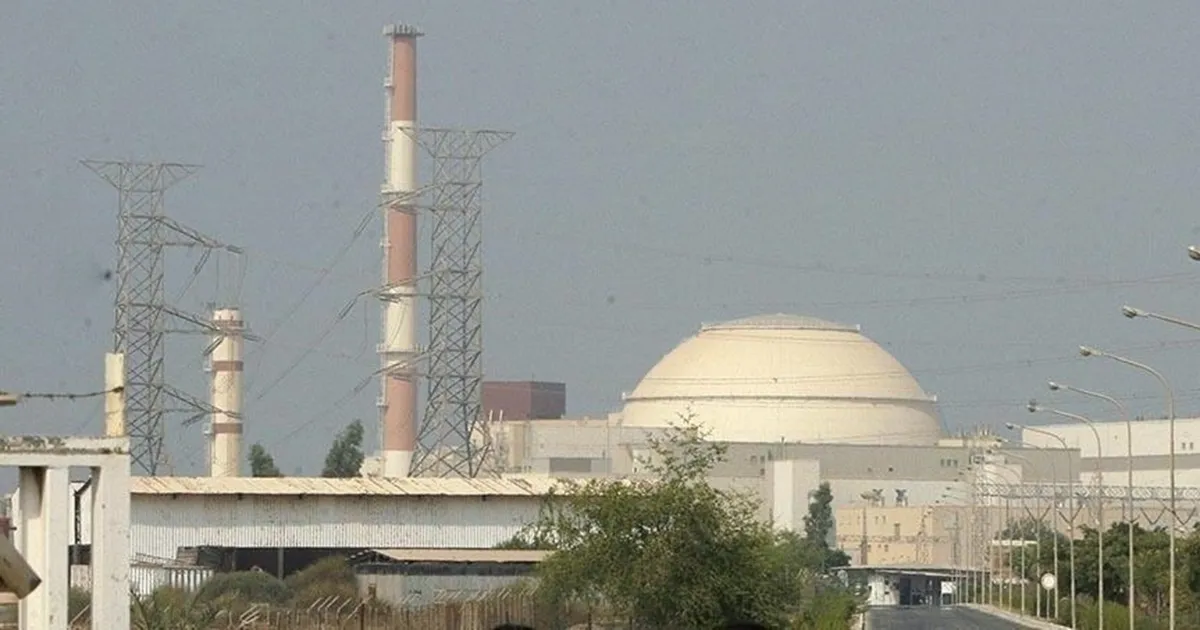
A recent scientific paper issued by Al-Zaytouna Centre for Studies and Consultations revealed the strategic future features of the Iranian nuclear program, indicating that Tehran is approaching the acquisition of full nuclear capability without the need for an official announcement of possessing the weapon. The study, prepared by future studies expert Dr. Walid Abdel Hay, explained that the most realistic path in the coming years is to consolidate the status of a 'threshold state,' a condition that grants the Iranian regime broad deterrent influence without engaging in direct confrontation with the international community.
The foresight approach stems from a precise analysis of the global nuclear system, which has maintained its relative stability since 2006, as the list of the nine-member nuclear club has not expanded. However, the study indicates that the expansion of peaceful nuclear technology has become a technical bridge for some countries to shift towards military uses when security necessities arise, which accurately applies to the Iranian case that blends civilian infrastructure with the latent capacity for armament.
The paper reviewed the historical roots of this file, recalling that its beginnings were under direct American patronage during the Shah's era within the 'Atoms for Peace' program. However, the radical transformation brought about by the Islamic Revolution in 1979 turned the project from an ally of the West into a strategic threat, leading to decades of diplomatic conflict and economic sanctions that culminated after the US withdrawal from the nuclear agreement in 2018.
The study criticized what it described as the 'failure of imminent bomb prophecies' promoted by Western and Israeli political and media circles over three decades. It noted that the repeated warnings issued by Benjamin Netanyahu since the 1990s did not materialize, which necessitates distinguishing between sound scientific assessments and propaganda discourse linked to regional conflicts and attempts to mobilize politically against Tehran.
The study presented four scenarios for the program's future until 2030, completely ruling out the scenario of dismantling the nuclear program, giving it a success rate of no more than 10%. This exclusion is due to the enormous investments made by the Iranian state in this sector, and its consideration as a fundamental pillar of national sovereignty and strategic independence that cannot be relinquished under external pressures.
In contrast, the 'nuclear threshold state' scenario received the highest probability, at 60-65%, as the study believes that this status achieves a delicate balance for Iran. This path provides it with 'deterrence by knowledge,' i.e., the ability to produce the weapon in record time if it faces an existential threat, while at the same time avoiding the harsh legal and political consequences that might result from an announced nuclear test.
As for the possibility of actually moving to weapon production and officially announcing it, the study estimated its chances at 35% to 40%. This radical shift is linked to crucial variables, such as Iranian facilities being subjected to a widespread military attack, or a complete collapse of all diplomatic channels, which might push hardline factions and the Revolutionary Guard to make a decisive nuclear decision to ensure the regime's survival.
The paper also touched upon the 'black swan' scenario, a term that refers to sudden and unexpected events that can turn the tables upside down. These events may include unexpected internal political collapses or major changes in the international and regional environment, making predictions about the nuclear program's trajectory always subject to complex geopolitical variables that go beyond purely technical aspects.
The study used American measurement models, such as the 'Geiger Counter for the Iranian Threat,' which shows Tehran reaching critical levels of readiness. Despite the accuracy of these figures, the researcher warns against institutional biases in these models, emphasizing that Iranian behavior is governed by 'strategic ambiguity' calculations aimed at keeping adversaries in a state of permanent uncertainty about actual capabilities.
The paper confirms that the Iranian nuclear decision is not merely technical, but a political decision par excellence, influenced by the nature of American involvement in the region and the positions of major powers such as Russia and China. Iran's continued presence in the gray area poses a significant challenge to regional powers, especially in light of the continuous escalation with the Israeli occupation, which views these capabilities as a direct threat to its military superiority in the Middle East.
Data indicates that Tehran has succeeded in transforming nuclear ambiguity into a powerful diplomatic tool in its negotiations with the West. The higher the uranium enrichment levels, the stronger Iran's cards at the negotiating table, making it difficult to imagine a full return to the restrictions imposed by the 2015 agreement without major concessions from the opposing international powers.
On the regional level, the study believes that Iran's remaining at the nuclear threshold may stimulate an arms race in the region, as other countries seek to acquire similar technology to achieve balance. However, Iran remains the most advanced and complex case due to its possession of a complete nuclear fuel cycle and local human expertise, making it difficult to eliminate the program through traditional military means alone.
The paper concluded that the scene until 2030 will remain governed by a 'brinkmanship' policy, where Iran approaches red lines without crossing them in a way that would necessitate an all-out war. This tactic allows Tehran to enhance its regional influence and protect its national security, while maintaining a delicate balance with the International Atomic Energy Agency and global powers concerned with nuclear non-proliferation.
In conclusion, ambiguity emerges as one of the most important elements of Iranian power in the current decade, transforming from a mere technical state to an integrated deterrence strategy. Accordingly, the world will have to deal with Iran as a nuclear power 'in fact' even if not 'by declaration,' a new reality that reshapes the balance of power in the turbulent Middle East region.
The most likely scenario is Iran's continued position as a 'nuclear threshold state' capable of producing the bomb within a short period if the political decision is made.
Share your opinion
Foresight Study: Iran Consolidates Its Position as a 'Nuclear Threshold State' Until 2030