






Washington Message
Washington – Said Arikat - 29/5/2026
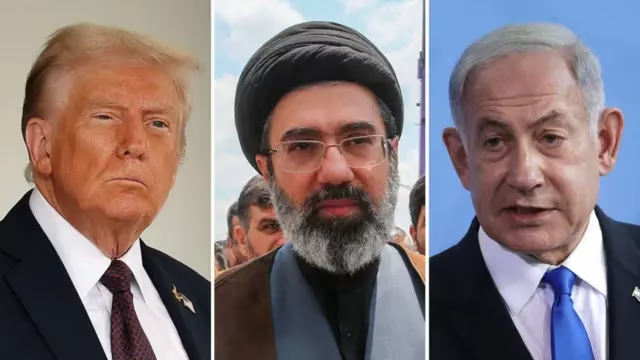
In an attempt to contain the slide towards an open regional confrontation, US President Donald Trump distributed a draft peace agreement for the war with Iran to a number of Washington's allies, including Israel, amidst accelerated efforts to stabilize the fragile ceasefire and prevent its collapse due to continuous military friction in the Gulf and the Strait of Hormuz.
This step comes at a time when political and military paths are intertwined in an unprecedented way, as the US administration seeks to market an interim understanding that eases tension with Tehran, without making strategic concessions that affect the essence of American or Israeli influence in the region. In return, Iran is trying to exploit the state of mutual attrition to extract economic and sovereign gains, especially regarding frozen funds and sanctions imposed on its oil exports.
As an indication of the complexity of the scene, Pakistani Foreign Minister Muhammad Ishaq Dar is in Washington to meet his American counterpart Marco Rubio, as part of an indirect mediation also involving Qatar, with the aim of bridging views between Washington and Tehran. However, field developments still cast a heavy shadow on any political progress, after Iran targeted a US base in Kuwait, in response to a US strike that Washington said targeted an Iranian drone operation near the Strait of Hormuz.
The draft circulating in the corridors of the Middle East indicates an understanding based on reopening the Strait of Hormuz to commercial navigation, lifting the US blockade on Iranian ports, and releasing up to $12 billion in frozen Iranian assets. It also includes the start of negotiations lasting about sixty days on the future of Iran's nuclear program, including highly enriched uranium stockpiles, and a temporary suspension of additional enrichment operations, under the supervision of the International Atomic Energy Agency, in exchange for an Iranian pledge not to use nuclear weapons.
However, the draft, despite its calming nature, seems far from meeting complex Israeli demands, as it does not impose immediate and decisive nuclear obligations on Iran, and also links the stabilization of the ceasefire to Lebanon, which Israel is trying to avoid, considering it an unacceptable expansion of the negotiation arena.
In this context, Western diplomatic sources reveal that Israeli Prime Minister Benjamin Netanyahu is leading an intense and pressing campaign within Washington and through pro-Israel lobbying groups, with the aim of obstructing any potential understanding between the US administration and Tehran. Netanyahu believes that any agreement, even if temporary, will give Iran an opportunity to rearrange its economic and military cards, and will practically cool down the regional front that he uses to justify the continuation of military operations and security escalation. Netanyahu also fears that Trump's success in concluding an agreement with Iran will reduce Israeli influence in shaping US policies for the Middle East, and revive the path of diplomacy with Tehran at the expense of the option of open confrontation pushed by the current Israeli government.
The draft promoted by Trump reveals a clear shift in US policy priorities in the Middle East, from the logic of "full deterrence" to managing balances and preventing a major explosion. The US administration realizes that the continuation of confrontation with Iran threatens the global economy through the Strait of Hormuz, increases the fragility of energy markets, and places US forces deployed in the Gulf under constant security pressure. Therefore, Washington seems to be trying to produce a "temporary settlement" that gives everyone a chance to catch their breath, without resolving fundamental issues, which makes the proposed agreement closer to a strategic truce than to lasting peace.
At the same time, Tehran is trying to use its geographical location as a negotiating leverage. The Iranian Revolutionary Guard reaffirmed its control over the Strait of Hormuz, announcing that the passage of commercial vessels requires prior permission, and warning against considering any crossing through "alternative routes" as an act disrupting navigational security. It also revealed the interception of four ships that tried to pass without operating their tracking devices.
This Iranian behavior reflects a clear desire to establish a new equation: security in the Gulf will only be achieved through understanding with Tehran, not through military pressure on it. However, this approach raises increasing Western and Gulf concern, because it gives Iran direct influence over one of the most important maritime passages in the world.
In this context, the Sultanate of Oman emerged as a key link in the ongoing contacts, after entering into discussions with Iran about the future of navigation in the Strait of Hormuz. But Trump's recent statements, in which he threatened to "destroy" Oman if it agreed to arrangements that include imposing transit fees, sparked anger within Omani diplomatic circles, according to Western reports.
Trump's tone towards Oman also reflects the nature of the approach adopted by the US President, which combines negotiation and political blackmail at the same time. The man wants a quick agreement that gives him a diplomatic achievement, but at the same time he refuses for this agreement to strengthen Iran's economic or sovereign influence in the Gulf. Therefore, his threats to Muscat seem like a double message: the first to Tehran, that Washington will not allow the Strait of Hormuz to become a source of political or financial income for Iran, and the second to Gulf allies, that any regional understandings must pass exclusively through the American umbrella, not through independent arrangements that may reshape the region's balances.
In contrast, the internal situation in Iran does not seem less complex. Iranian Supreme Leader Mojtaba Khamenei called on officials not to turn political differences into internal divisions, warning that the United States and Israel are seeking to "bring the country to its knees" by spreading chaos and division.
These statements come amidst rising criticism within Iran regarding the feasibility of negotiating with Trump, especially after the recent military strikes. Amnesty International also revealed the arrest of more than six thousand people since the start of the US-Israeli attack on February 28, including journalists, lawyers, activists, dissidents, and members of ethnic and religious minorities.
The widespread arrests within Iran show that the Iranian regime is fighting two parallel battles: one external with the United States and Israel, and another internal to control the streets and prevent any political or social cracks. Besieged regimes often resort to tightening their security grip when they feel that external pressures may turn into internal protests. But the paradox is that this approach may weaken Iran's negotiating position instead of strengthening it, because it deepens the image of Iran as a country in internal crisis. In return, Washington exploits this image to justify the continuation of pressure, so that it can obtain a deal that saves President Trump's face.
Share your opinion
Trump promotes fragile deal with Iran… Netanyahu races to thwart it fearing war cessation