






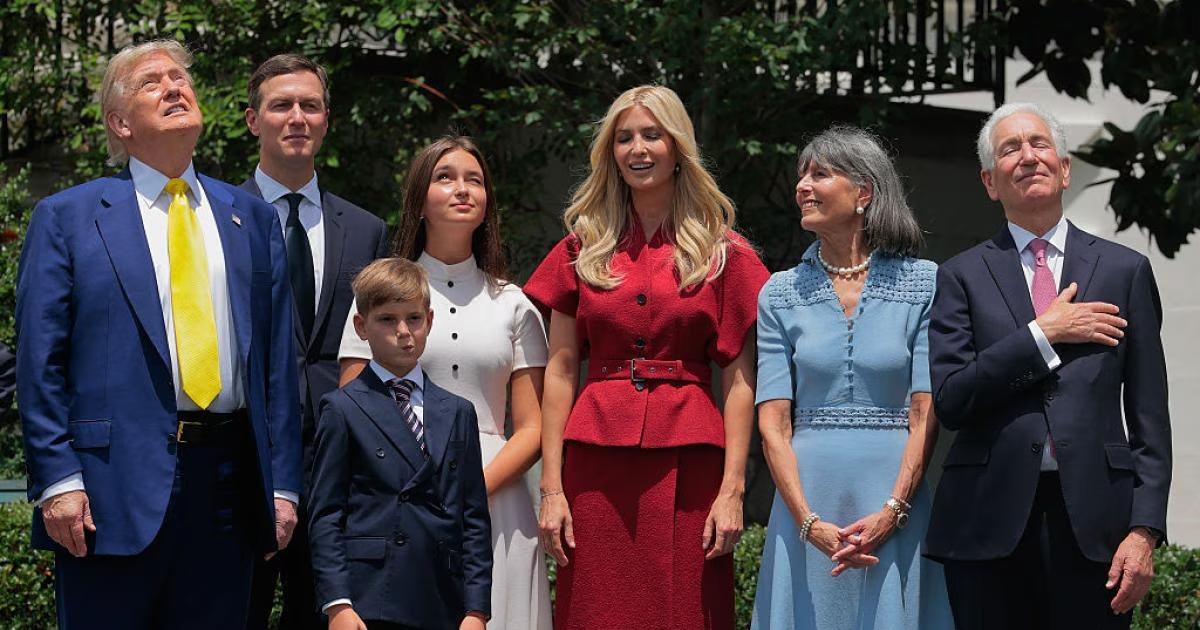
From the very first moment of his inauguration on January 20, 2025, US President Donald Trump revealed the features of a new political era based on reshaping the landscape in Washington. Trump did not content himself with merely arranging the White House; instead, he moved towards building a network of influence that relies entirely on personal loyalty and proximity to the family circle, thereby bypassing the traditional decision-making centers he had often clashed with during his first term.
Trump's second administration is characterized by a notable presence of billionaires, media stars, and figures whose political rise is owed to their direct relationship with the President. This shift reflects Trump's desire to circumvent what he calls the 'deep state' and obstructive bureaucracy, by surrounding himself with individuals he trusts to implement his 'America First' vision without hesitation or complex institutional review.
Trump's family is no longer just moral support; it has become an integral part of the structure of influence and decision-making in Washington. Although some of them do not hold official positions, their influence passes through direct proximity to the President and the ability to manage sensitive files from behind the scenes, which sometimes gives them power exceeding the authority of official ministers.
Jared Kushner, the President's son-in-law, stands out as one of the most influential figures in Middle East affairs despite his absence from the official government structure. Informed sources confirm that Kushner acts as a back-channel communicator and undeclared advisor, leveraging his previous experience in leading the 'Abraham Accords' path to arrange strategic contacts with regional leaders.
In a move that drew widespread criticism, Trump appointed Charles Kushner, Jared's father, as the US Ambassador to France. This appointment comes despite Charles's controversial legal record, reinforcing the impression that family loyalty has become a criterion that supersedes traditional diplomatic considerations in the distribution of high-ranking positions.
Massad Boulos, the Lebanese-American businessman, entered the spotlight with his appointment as a senior advisor for Arab and Middle Eastern affairs. Boulos, who is related by marriage to the Trump family, has become the main link with political and financial elites in the Middle East and North Africa, building on his previous activity during the election campaign.
On the economic front, Trump granted businessmen central executive positions, transforming the 'private sector mindset' into a governmental approach. Howard Lutnick, former CEO of 'Cantor Fitzgerald,' took over the Ministry of Commerce to lead strict tariff policies, especially in the open trade confrontation with China.
At the Treasury Department, Trump enlisted Scott Bessent, founder of 'Key Square Group,' to be the link between the administration and financial markets. These appointments aim to reshape the relationship between the state and the business sector, with a focus on tax policies that serve Trump's protectionist economic vision.
The inclusion of Elon Musk in the administration, through the 'Government Efficiency Management' project, marked the peak of the intertwining of money and power. Although Musk's experience ended with his departure from the position months later due to sharp disagreements, it left a deep impact on how Trump attempted to dismantle the federal administrative apparatus and reduce expenses using confrontational methods.
Conservative media was not absent from the appointments scene, as Trump chose Pete Hegseth, a former Fox News anchor, to take over the Ministry of Defense portfolio. This choice sparked considerable controversy in military circles due to Hegseth's limited administrative experience, but Trump defended him as a voice representing the conservative popular base.
In a related context, Karoline Leavitt emerged as the youngest White House Press Secretary in history, representing the new media face of the administration. Leavitt's mission is not limited to conveying news; she works within a communication apparatus that seeks to bypass traditional media and focus on alternative platforms and influencers close to the President's views.
Supporters of this approach believe that Trump is carrying out a necessary 'revolution' to cleanse Washington of the stagnation and bureaucracy that hinder change. For them, relying on trusted individuals is the only way to ensure the implementation of the electoral program that millions voted for, away from the 'conspiracies' of permanent state employees.
Conversely, critics warn that prioritizing loyalty over expertise weakens American institutions and transforms the state into a private 'fiefdom.' The intertwining of financial and family interests with political decisions raises fundamental questions about transparency and accountability, making it difficult to separate the public interest from the interests of the narrow circle surrounding the President.
Trump's second administration represents an unprecedented test for the American political system and its balance of power. Between the speed of decision-making and the constant clash with existing structures, Washington today seems governed by the rhythm of one man, relying on a closed circle of allies to manage the affairs of the world's superpower.
Trump returned to the White House even more inclined to surround himself with people he considers loyal to his vision and capable of moving institutions in the direction he desires.




Share your opinion
Empire of Loyalty: How Trump Reshaped the Joints of Governance in Washington?