






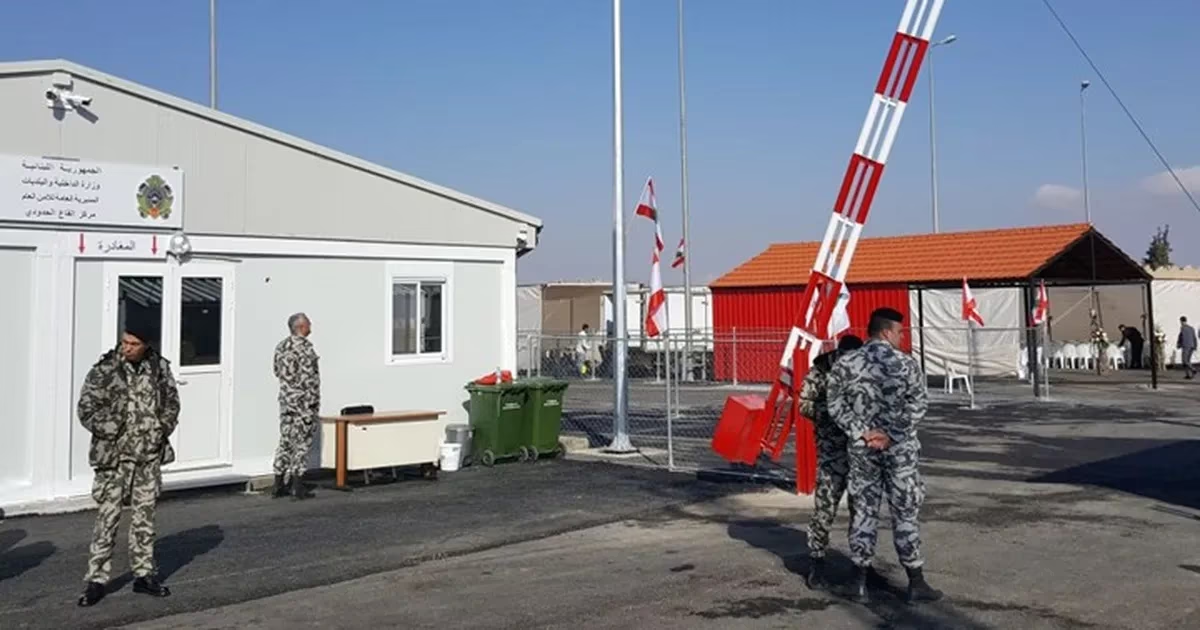
Security and political assessments within Israel have revealed a radical shift in the regional vision towards the Lebanese file, as current readings indicate that the continued inability of the Lebanese state to curb Hezbollah's influence opens the door to unprecedented understandings with Syria. These trends come amid a sharp decline in American and Western trust in official institutions in Beirut, pushing for the search for alternatives capable of imposing a new security reality on the ground.
Hebrew press reports stated that the absence of an effective Lebanese partner, both politically and militarily, has strengthened the conviction among decision-making circles in Tel Aviv of the necessity to find alternative regional paths. Sources explained that American disappointment with Lebanon has reached deep levels, with a growing belief that the Lebanese government has failed to meet the minimum of its security and political obligations towards the international community.
Israeli readings indicate that the Lebanese army is now seen as a force incapable of confrontation, and some assessments go further by accusing it of avoiding direct conflict with Hezbollah. These sources confirm serious concerns about the infiltration of pro-Hezbollah elements into the ranks of the military establishment, making reliance on it in any future security arrangements impractical.
In light of this reality, a conclusion is crystallizing within Israeli circles that ending the threat on the northern front requires a radical treatment of Hezbollah's military structure. Assessments emphasize the need to work towards the complete disarmament of southern Lebanon and to ensure the absence of any armed presence of Hezbollah in border areas that pose a direct threat to Israeli settlements in the Galilee.
In this context, a sensitive vision emerges, suggesting that the only forces capable of effectively confronting Hezbollah are Israel and Syria in its new phase. This approach does not mean building a traditional alliance, but rather a strategic convergence of interests that views the current Syrian leadership as a natural adversary to Hezbollah's influence, making it a potential partner in managing the complex Lebanese file.
The proposed scenario for discussion includes a division of security roles, where the Israeli army takes operational control in southern Lebanon to prevent any border threats, while Syrian forces conduct operations in northern and inner Lebanon against Hezbollah strongholds. This proposal is seen as an alternative option resulting from the failure of all previous diplomatic and political paths that attempted to contain the situation.
Informed sources reported that these understandings may include sensitive border and sovereignty issues, including the Mount Hermon file, within the framework of a broader settlement aimed at reshaping the security environment in the region. Despite the boldness of this proposal, sources confirm that it does not aim to overthrow the Lebanese regime as much as it focuses on definitively neutralizing Hezbollah's military arsenal.
Available information confirms the existence of multi-level dialogue channels between Israel and Syria, taking place away from the spotlight and potentially with American mediation in some aspects. Although these contacts have not yet reached the level of announced official negotiations, they reflect a serious search for practical solutions that go beyond traditional formulas that have proven to be failures over the past years.
Observers believe that this Israeli approach represents an attempt to impose a new reality in the absence of a decisive Western role that provides direct military support to the Lebanese army to confront Hezbollah. According to the Israeli vision, the emergence of serious international action might change these calculations, but current indicators do not suggest an international will for direct intervention in the internal Lebanese conflict.
As for the American position, assessments indicate a state of hesitation, as Washington prefers to avoid this complex path but at the same time no longer relies on Beirut's capabilities. It is believed that American frustration with unfulfilled Lebanese promises may push the United States to implicitly accept these regional understandings if they prove effective in undermining Hezbollah's influence.
Israeli sources emphasize that the ultimate goal is not to control Lebanese territories, but to ensure that they are not used as a platform for launching missile attacks or infiltration operations. Tel Aviv considers that any arrangement that does not guarantee Hezbollah's permanent removal from the borders is a temporary arrangement that will not lead to long-term stability in the northern region.
Ultimately, this scenario remains subject to field developments and the extent to which regional parties respond to these rapid changes. With the escalation continuing, all options remain open to the Israeli decision-maker, who appears ready to break traditional rules in order to achieve his strategic security goals regarding the Lebanese front.
From an Israeli perspective, the only two parties capable of confronting Hezbollah are Israel and the new Syria led by Ahmed al-Sharaa.



Share your opinion
Israeli Assessments Reveal Potential Understandings with Syria to Reshape Security Reality in Lebanon