







Washington – Said Arikat – 3/31/2026
In a stance reflecting Washington's traditional approach to Israeli policies, a senior American official said on Tuesday that his country "respects Israel's sovereign right to enact its laws and determine its penalties for those convicted of terrorism," commenting on the Knesset's approval of a law allowing the imposition of the death penalty on Palestinians convicted of committing deadly attacks. The official, who requested anonymity, added in response to a question from Al-Quds newspaper correspondent that the United States "trusts that these measures will be implemented within legal frameworks that ensure fair trial and its guarantees."
It is worth noting that the official American response came via a brief email sent from the State Department to the accredited press corps at the department.
However, this statement, despite its legal language, ignores a growing debate about the nature of the law itself, which was approved by the Knesset with a majority of 62 votes to 48, with direct push from National Security Minister Itamar Ben-Gvir, and with the support of Prime Minister Benjamin Netanyahu. The legislation stipulates the application of the death penalty in specific cases defined within the framework of "terrorism," with formulations that, according to its critics, indicate targeting Palestinians almost exclusively, especially in areas under Israeli control, including the West Bank.
Ben-Gvir explicitly acknowledged this direction, considering that the law "changes the rules of the game," and that anyone who kills "Jews" will not remain alive in prisons. This rhetoric, which links justice to the national identity of the victims, reinforces fears of using the law as a deterrent tool of a political nature, rather than a neutral legal framework.
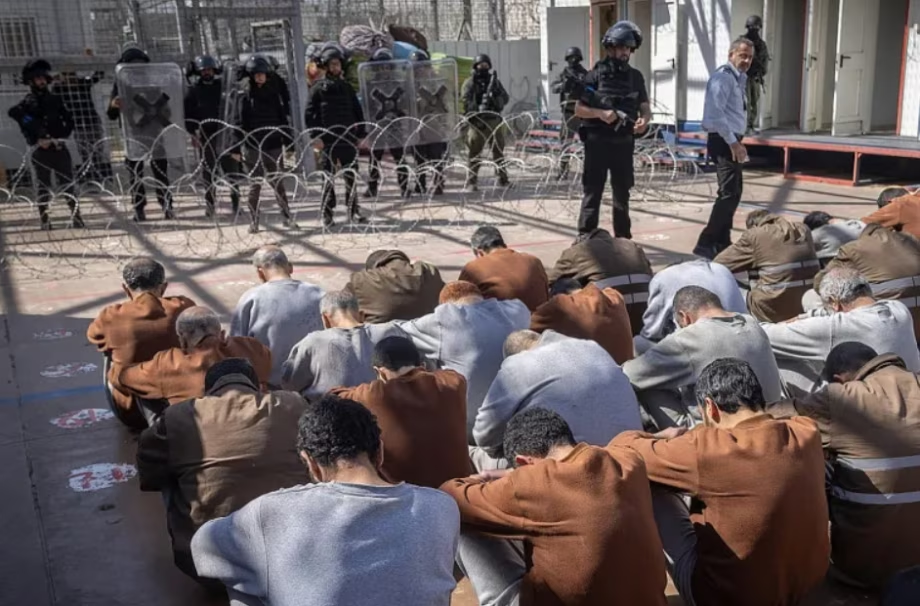
In contrast, the move sparked widespread criticism from human rights organizations, most notably "B'Tselem," which warned that the application of the death penalty would be carried out through military courts that exclusively try Palestinians, and record conviction rates of up to 96%. It also indicated that sentences could be carried out within 90 days without the possibility of pardon, and with limited discretionary powers for judges, which raises serious questions about the standards of procedural justice.
For its part, Amnesty International considered that the law represents a dangerous expansion in the use of the death penalty, at a time when the world is witnessing a growing trend towards its abolition, warning that it undermines fundamental guarantees of the right to life and fair trial, and entrenches a discriminatory legal structure against Palestinians.
_The American position raises questions about the limits of "respect for sovereignty" when it comes to legislation affecting fundamental human rights. Washington, which has long presented itself as a defender of international standards, seems hesitant here to direct any explicit criticism of a law facing serious accusations of discrimination. This contradiction reflects a deeper problem in American policy, where human rights issues are dealt with selectively, depending on geopolitical considerations and strategic alliances, which weakens its credibility on the international stage.
The new law cannot be separated from the broader context of the justice system in the occupied territories, where Palestinians are subject to military courts, while Israeli settlers enjoy civilian courts. This legal duality creates an unequal structure in terms of procedures and rights, and makes the imposition of a maximum penalty such as the death penalty a highly problematic issue. When the justice system itself is in doubt, any escalation in penalties turns into a tool of oppression, not a means of achieving justice or deterrence.
The timing of the law's approval carries political implications that cannot be ignored, especially in light of the escalating right-wing rhetoric within the Israeli government. It seems that the legislation addresses an internal political base that seeks to demonstrate firmness, even if it is at the expense of international legal standards. However, such steps may have adverse consequences, as they fuel feelings of anger and deepen the cycle of violence, rather than deterring it, which raises a fundamental question about the effectiveness of this approach in achieving long-term security.
Share your opinion
Washington supports "Israel's legislative sovereignty" amid criticism of Palestinian execution law