






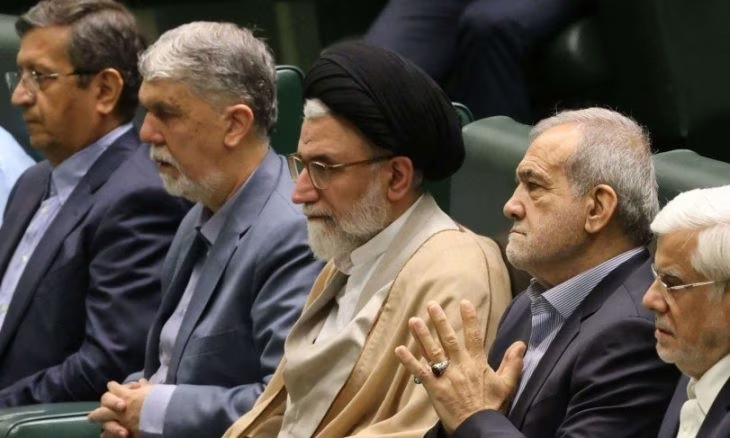
Iranian President Masoud Pezeshkian announced today, Wednesday, the killing of Intelligence Minister Ismail Khatib, following an airstrike carried out by Israeli forces. This official confirmation came just hours after Tel Aviv announced its success in eliminating the Iranian minister as part of a series of operations targeting senior leaders in Tehran.
Pezeshkian condemned in official statements what he described as a 'cowardly assassination,' noting that the attack not only targeted Khatib but also other prominent officials and their families. He clarified that the list of those killed included the Secretary of the Supreme National Security Council, Ali Larijani, and Defense Minister Aziz Nasserzadeh, reflecting the magnitude of the blow received by state agencies.
For his part, Israeli Defense Minister Yoav Gallant revealed details of the operation, confirming that the elimination of the intelligence minister took place during a precise night raid. Gallant indicated that these operations come within a broader strategy to undermine Iranian leadership capabilities and prevent the implementation of any hostile plans against Israeli interests.
Official sources in Tel Aviv confirmed that Prime Minister Benjamin Netanyahu and his defense minister gave the green light to the army to target any high-ranking Iranian official. These new powers include carrying out operations immediately upon identifying the intelligence circle and field targets, without the need to return to the political level for additional approvals.
Gallant stressed that the Israeli security establishment will continue to pursue all Iranian officials involved in planning attacks against it. He added that eliminating any high-ranking leadership cadre is part of Israel's commitment to thwarting threats in their infancy, noting that intelligence operations are ongoing around the clock.
In a related context, Hebrew media considered the assassination of Ismail Khatib to be a security blow no less significant than the elimination of Ali Larijani days earlier. These sources believe that reaching the intelligence minister reflects a significant security breach within the inner circles of the Iranian regime, putting the remaining leadership on high alert.
These developments come amid the widespread offensive launched by Israel since late February, which targeted vital facilities and leading figures within Iran. Field reports claim that military operations have succeeded in neutralizing a large number of military and political leaders, leading to a state of confusion within the security agencies.
These successive assassinations have raised questions about the extent of intelligence penetration within Tehran, especially with the Israeli air force's ability to reach fortified targets. Observers believe that the repetition of these operations indicates deep security vulnerabilities that enabled hostile agencies to accurately track the movements of leaders.
On the internal Iranian front, a state of sadness and anger prevailed following the confirmation of the ministers' deaths, amid calls to strengthen security measures and protect what remains of the regime's symbols. The Iranian government faces increasing pressure to respond to these attacks that have affected the state's prestige in its own backyard.
In contrast, military analysts believe that Israel's assassination policy aims to create a leadership vacuum within Iranian security and military institutions. Tel Aviv is betting that the absence of pivotal figures will lead to a decline in operational coordination between the regime's various arms in the region.
Despite the heavy human losses among the leadership, some readings indicate that Iranian institutions have a structure that allows them to quickly replace leaders. However, the biggest challenge remains restoring confidence in the security system, which appeared unable to protect its highest officials from direct airstrikes.
Field data indicates that the current confrontation has exceeded traditional rules of engagement, as the war has moved directly into the heart of the capital, Tehran. The targeting of the ministers of defense, intelligence, and national security represents a radical shift in the nature of the conflict between the two sides for decades.
In this atmosphere, international circles are awaiting the nature of the potential Iranian response, and whether Tehran will resort to direct military escalation or rely on its proxies. Major powers fear that this acceleration of assassinations could lead to a comprehensive regional war whose consequences cannot be controlled.
In conclusion, the Iranian scene remains open to all possibilities, amid continued Israeli threats to pursue anyone proven to be involved in threatening its security. Recent events confirm that the conflict has entered a phase of major reckoning, where political and military heads have become legitimate targets in the Israeli target bank.
The cowardly assassination of dear colleagues Ismail Khatib, Ali Larijani, and Aziz Nasserzadeh, along with a number of their family members and companions, has plunged us into a state of deep sorrow.

Share your opinion
Pezeshkian confirms the killing of the Iranian intelligence minister in an Israeli raid