







News Analysis
Great powers rarely announce that they are choosing war unnecessarily. Instead, conflicts begin wrapped in urgency, moral clarity, and claims of inevitability. The U.S.–Israeli strike that killed Iran’s Supreme Leader, Ayatollah Ali Khamenei, was presented as a decisive act to eliminate an emerging danger. Yet within days, the operation revealed a deeper truth: the war was less the product of imminent threat than of accumulated anxiety, alliance pressure, and enduring faith in military solutions to political problems. Rather than preventing instability, Washington and Tel Aviv may have triggered a confrontation whose risks were widely understood but insufficiently weighed—a war launched with tactical confidence but without a credible political destination.
The central assumption behind the opening attack was straightforward. Removing the apex of Iran’s political system, its planners believed, could disrupt decision-making, fracture elite cohesion, and possibly accelerate internal change. Leadership decapitation has long appealed to policymakers seeking rapid strategic effects without prolonged occupation. Yet historical experience offers limited support for such expectations. Ideological regimes rarely collapse when leaders are removed; instead, they reorganize under pressure, often emerging more unified and more radicalized.
Iran is unlikely to prove an exception. Rather than dismantling the regime, Khamenei’s assassination may hasten an internal transition already underway: the rise of younger, more hardline figures closely tied to the Islamic Revolutionary Guard Corps. Such actors derive legitimacy not from clerical authority alone but from resistance and security credentials forged through confrontation. The likely outcome is not institutional paralysis but consolidation under leadership less invested in restraint and more willing to embrace long-term confrontation with the United States and its allies.
Equally striking is the absence of publicly demonstrated urgency. Before the strike, Iran represented a persistent strategic rival but not a clearly imminent threat to U.S. territory. The decision to attack therefore marked a shift from deterrence toward preventive war—a doctrine historically associated with miscalculation. Preventive wars promise control over future risks but frequently generate new and unpredictable dangers.
Domestic political dynamics reinforced this shift. President Donald Trump sought to reassure Americans by declaring that the conflict might conclude within “four weeks or less,” while telling The Atlantic that Iranian officials were eager to negotiate and that elements of Iran’s military wanted to surrender. Such optimism echoes familiar patterns in American wartime rhetoric. Short timelines stabilize public opinion but rarely survive operational realities. From Iraq to Afghanistan, early expectations of swift victory repeatedly gave way to prolonged engagement once adversaries adapted.
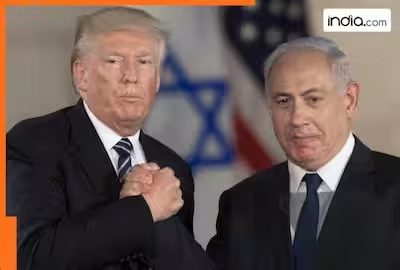
Israel’s influence on the trajectory toward confrontation is central to understanding how the war emerged. Israeli leaders long argued that Iran’s capabilities constituted an existential threat requiring decisive military action. While these fears are rooted in genuine security concerns, their convergence with U.S. policy narrowed Washington’s strategic debate. Preventive force gradually appeared not as one option among many but as the logical culmination of failed diplomacy.
This alignment blurred a critical distinction between allied priorities and national interests. Israel faces immediate regional threats; the United States must balance global commitments, economic stability, and domestic political tolerance for extended war. By embracing Israel’s urgency, Washington risked allowing alliance politics to accelerate escalation rather than constrain it.
The administration’s moral framing of the war further reduced flexibility. Trump cast military action as an ethical duty to protect Americans from a dangerous regime. Such rhetoric strengthens domestic cohesion but complicates diplomacy. When wars are justified morally, compromise risks appearing as betrayal rather than prudence, limiting policymakers’ ability to recalibrate strategy as circumstances evolve.
Yet the most profound strategic gap lies in the absence of a clear political end state. Military power can destroy facilities and weaken command structures, but it cannot independently reshape political order inside a large and resilient nation. Iran’s demographic scale, institutional depth, and strong nationalist identity make externally driven transformation implausible absent massive occupation—an option far beyond American political tolerance.
Instead, the conflict’s most plausible trajectory is prolonged confrontation marked by asymmetric retaliation and regional escalation. Iran retains extensive networks and capabilities capable of extending conflict across multiple arenas, from maritime routes to allied militias. The war therefore risks expanding horizontally even if direct battlefield exchanges remain limited.
The deeper lesson concerns how major powers drift into wars they never fully intend to fight. The present conflict emerged not from a single reckless decision but from incremental escalation, technological confidence, and fear of strategic delay. Each step appeared manageable in isolation; together they produced irreversible rupture.
Two days into the war, the essential question is no longer whether the opening strike succeeded tactically but whether the war itself serves a coherent strategic purpose. Washington and Tel Aviv argue that force was necessary to prevent nuclear proliferation. Yet the conflict may ultimately strengthen Iran’s incentives to pursue precisely the deterrent capabilities the war sought to prevent.
History judges wars not by initial dominance but by their political aftermath. By choosing force without a clearly defined end state, the United States and Israel may have transformed a containable rivalry into an enduring confrontation—one that radicalizes Iran, destabilizes the region, and entangles America in another conflict whose necessity will remain contested long after the fighting ends.
The greatest danger is not military failure but strategic success without political foresight: a war won in battles yet lost in consequences, proving once again that overwhelming power cannot substitute for restraint
Share your opinion
How Washington and Tel Aviv Turned Deterrence Failure Into Strategic Overreach