






https://www.youtube.com/live/jfSr0QPPqGk
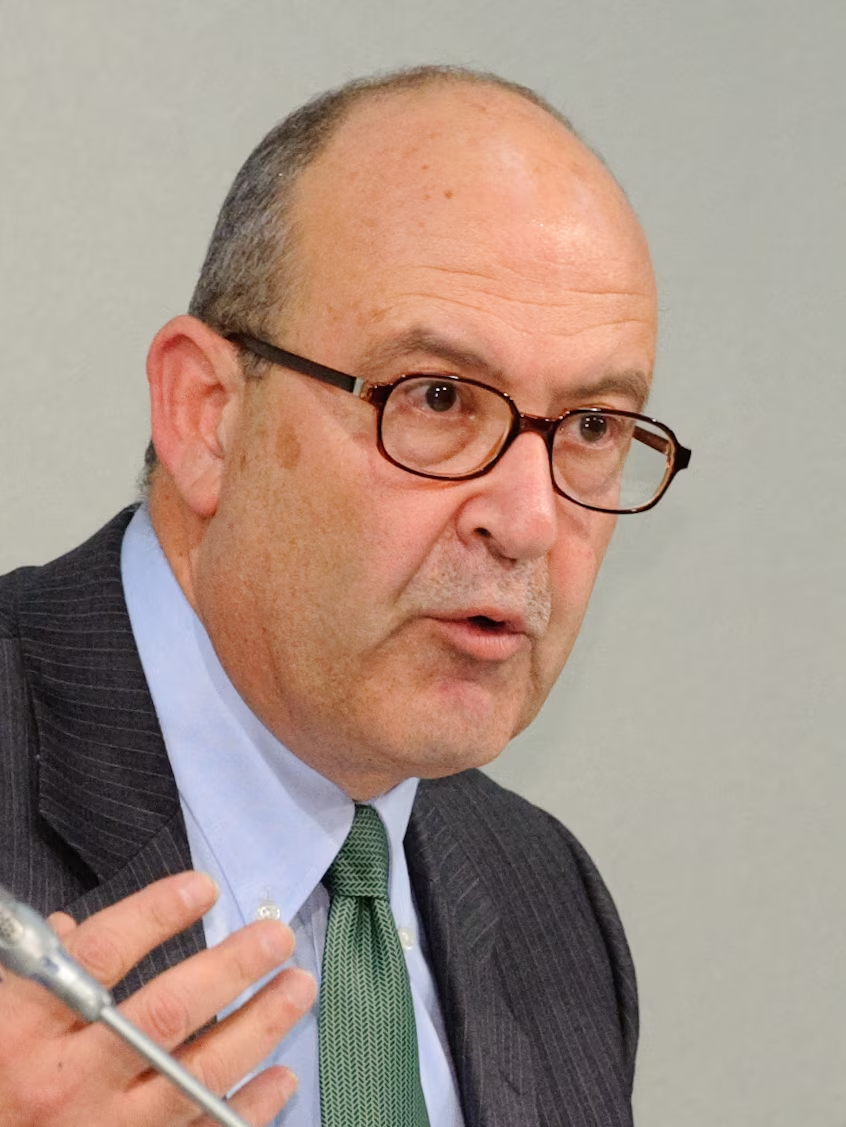
The third session of the "Political Salon: Palestine 2035", with a dialogue titled: "The Regional and International System: Whither Palestine?" The meeting features: Dr. Ali Al-Jarbawi, Professor of Political Science, interviewed by: Mr. Mohammed Daraghmeh, writer, journalist, and director of Al-Sharq Channel's office in Palestine.
The Department of Political Science and the Master's Program in International Relations, Diplomacy, and Global Security, at the Faculty of Law and Public Administration, held the third dialogue of the Political Salon: Palestine 2035, on Tuesday, January 20, 2026, titled "The Regional and International System: Whither Palestine?". It hosted Professor of Political Science Dr. Ali Al-Jarbawi, and was interviewed by the director of Al-Sharq Channel's office in Palestine, Mr. Mohammed Daraghmeh.
Daraghmeh opened the session expressing his happiness at the presence of such dialogues within Palestinian universities, given that the idea of dialogue platforms is missing in the Palestinian academic and journalistic context, in light of the absence of the Legislative Council and the atmosphere of political life.
The International System and the Idea of Positioning
Al-Jarbawi believes that the rules of the international system have not changed but have become exposed. The international system after World War II was built on the basis of the balance of power, not on the basis of international law, but the major powers were concerned with applying and consolidating the idea of international law at that time, as it suited their interests. After the collapse of the Soviet Union, the United States of America has dominated the scene until today, and what we see today in American foreign policy is an attempt to continue its hegemony over the international system in light of the emergence of competing international poles. Al-Jarbawi indicated that the international system currently crystallizing consists of three main poles: the United States of America, which is a military-economic pole, Russia, a military pole, and China, an economic pole.
Al-Jarbawi explained that the current international system is based on the idea of positioning, meaning that America, returning to the Monroe Doctrine, sees the Western part of the world as an exclusive sphere of influence for it, and this explains its behavior towards Venezuela, and what is happening today in Greenland. China considers the South China Sea and Taiwan Island as areas subject to it, just as Russia, in its war on Ukraine and its expansion in the Arctic, is trying to maintain its sphere of influence. Therefore, Al-Jarbawi stressed that those who will pay the price as a result of this competition between the three poles are the countries of the Global South and European countries.
Al-Jarbawi pointed out that the Palestinian issue in the current international community is a file among a group of other files and issues. The Palestinian issue is no longer of the same importance that distinguished it previously, when it played the role of a disruptive force in the region.
The Regional System and the Absence of Arab Influence
Al-Jarbawi considered that the Arab regional system, specifically, contributed significantly to keeping the Palestinian issue alive in the past, when compared to other issues that did not last long, such as the Armenians, Kurds, and others. But today the Arab regional system is weak and divided, lacking a central Arab power, and Egypt's exit from the Arab-Israeli conflict equation after signing the peace agreement had the greatest impact in causing this weakness. He pointed out that Arab countries today are no longer able to carry the Palestinian issue as before, but rather are trying to get rid of it, and the Palestinian leadership today pins its hopes on the Saudi position rejecting normalization with Israel without reaching political solutions that lead to a political entity.
Al-Jarbawi also touched upon the actors of the current regional system in the Arab region, as he saw that there are three central countries that possess political decision-making that affects the situation in the region: Israel, Turkey, and Iran. As for the Arab countries, they are currently playing only functional roles, and Saudi Arabia may be the only exception due to its religious standing among Islamic countries, as well as its material and oil power.
The Palestinian Future and the Center of Political Entity
Al-Jarbawi explained that the establishment of what is called a technocratic government in Gaza is a starting point for transferring the center of the Palestinian entity from the West Bank to the Gaza Strip, and what is happening during this period, such as the formation of the Peace Council and other steps, aims to form a new vision for the Palestinian future, which is being made by external hands, and its political center will be in the Gaza Strip, and the rest of the West Bank will become subordinate to the center. Al-Jarbawi noted that the countries of the world have reached a stage where they want to end the Palestinian file and get rid of this burden, and America is at the forefront of these countries, but the American position does not align with the Israeli position, although it intersects with it, as American interests in the Arab region are not solely dependent on protecting the Israeli presence.
Al-Jarbawi referred to the situation in the West Bank, as he saw that the current political focus is on the Gaza Strip, and there is no mention of the deteriorating conditions in the West Bank. In this regard, Al-Jarbawi believes that focusing on Gaza means allowing the West Bank to Israel and the settlers, and transforming it into something resembling cantons. What hinders the Israeli plan in the West Bank is the population density, which is difficult to get rid of easily.
Internally, Al-Jarbawi affirmed that the Palestinian political level shows complete agreement with the plans on the table, and the Palestinian political system is in a state of clinical death, and Palestinians themselves always link internal problems and setbacks to an external factor, and evade responsibility. Moreover, Palestinian forces today have become narrow factional interest groups, far from possessing a comprehensive national project. He pointed out that the Hamas movement is a pragmatic movement, and therefore it will work to make some changes in its orientations in order to adapt to the new situation, and it will be qualified in the future to be part of the future political entity.
Al-Jarbawi spoke about some of the problems that may arise in the coming period after the formation of what is called the Gaza Committee, as it is likely that this committee will be given powers and funding that exceed those granted to the Palestinian Authority in the West Bank, in addition to the possibility of extending the influence and functions of this committee to reach the West Bank, and this committee is merely a Palestinian facade implementing decisions dictated to it from outside. As for the Palestinian Authority and its institutions, Al-Jarbawi believed that the presence of the Authority during this period does not pose a dilemma for Israel and its policies in the West Bank; on the contrary, the Authority provides what is called the legal presence for Palestinians, represented by passports and Palestinian identity cards, and this hinders the idea of integrating Palestinians into Israeli society and bearing the burden of that for Israel, and thus indirectly pushing for emigration and departure in a way that Israel does not bear legal responsibility, at least.
The meeting witnessed significant interaction from students and attendees, which gave the dialogue session a participatory character in the discussion and the posing of difficult questions.

Share your opinion
The Third Session of the Political Salon titled: "The Regional and International System: Whither Palestine?"