






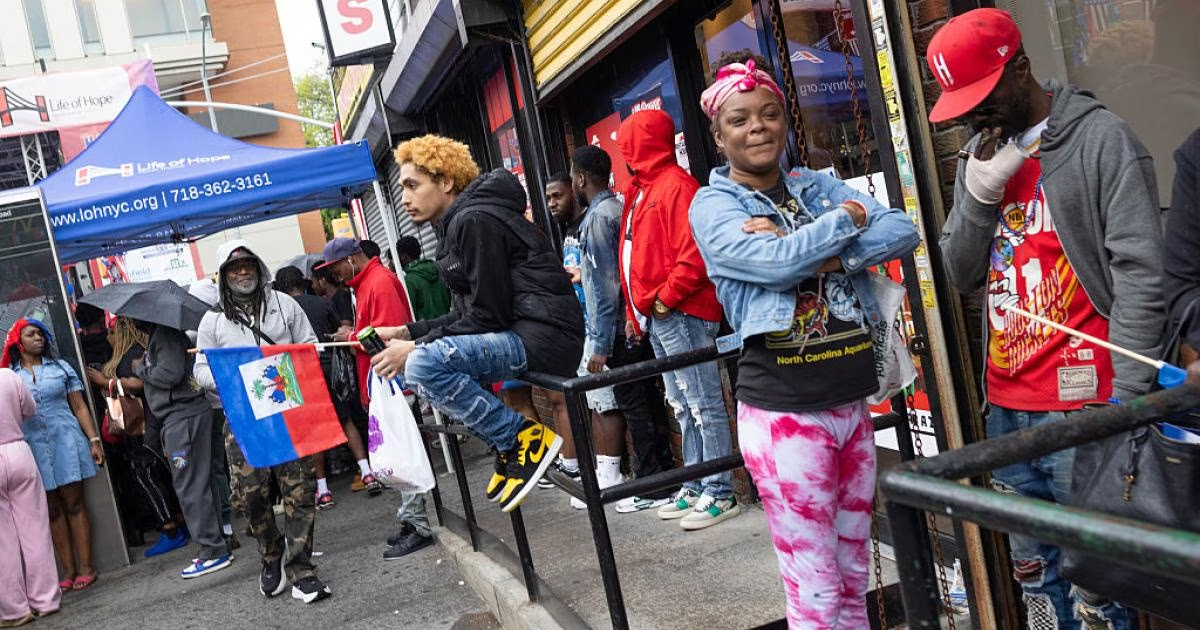
The United States Supreme Court issued a decisive ruling on Thursday, upholding the Trump administration's decision to revoke temporary protected status for hundreds of thousands of immigrants. This measure directly targets approximately 350,000 Haitian and 6,000 Syrian nationals who have resided in the United States for years under the umbrella of this humanitarian program.
The ruling, issued by the conservative-majority court, was supported by six justices and opposed by three. The decision stated that the Department of Homeland Security's procedures for ending protection are not subject to judicial review. This stance represents a legal blow to immigrants whose appeals were based on the instability of security conditions in their home countries, which are suffering from wars and disasters.
In justifying the ruling, Justice Samuel Alito wrote that the statements made by the US administration did not carry an explicit racist character against immigrants, but rather expressed neutral political orientations. The court thus rejected the arguments presented by the affected parties' lawyers, which claimed that the decision to revoke was driven by racial animosity from President Trump towards specific nationalities.
The Temporary Protected Status (TPS) program is a lifeline for individuals considered to be at extreme risk if they return to their home countries due to armed conflicts or major natural disasters. With this new ruling, more than one million beneficiaries of the program from 12 different countries face the risk of deportation, raising widespread concern among international human rights and humanitarian organizations.
In addition to Syria and Haiti, the list of countries affected by this decision includes Yemen, Afghanistan, Venezuela, Somalia, and South Sudan, as well as other countries in Latin America and Asia. The Trump administration had made ending this protection a priority as part of a broader campaign to tighten immigration laws and reduce the number of temporary residents.
Syrian immigrants had obtained this legal status in 2012 as a result of the ongoing war in their country, while it was granted to Haitians in 2010 following the devastating earthquake that struck their island. Despite continued armed violence and extreme poverty in Haiti, the court found that the executive branch has the full right to assess whether or not to continue this protection.
Sources reported that this decision comes at the peak of political activity related to the immigration file, as Trump had previously sparked widespread controversy with his statements about Haitian immigrants during his election campaign. Observers believe that the ruling gives the current administration a green light to proceed with mass deportation plans without significant legal obstacles from federal courts.
The Department of Homeland Security is expected to begin taking procedural steps to implement the decision, placing thousands of Syrian and Haitian families before difficult choices and an uncertain future. These developments confirm a radical shift in US asylum policy, where political and security considerations have now taken precedence over the humanitarian motives upon which the Temporary Protected Status program was founded.
None of the statements attributed to the President or the Secretary of Homeland Security were explicitly racist in nature, and all expressed political orientations.
شارك برأيك
US Supreme Court Upholds Trump's Decision to End Temporary Protection for Thousands of Syrians and Haitians