






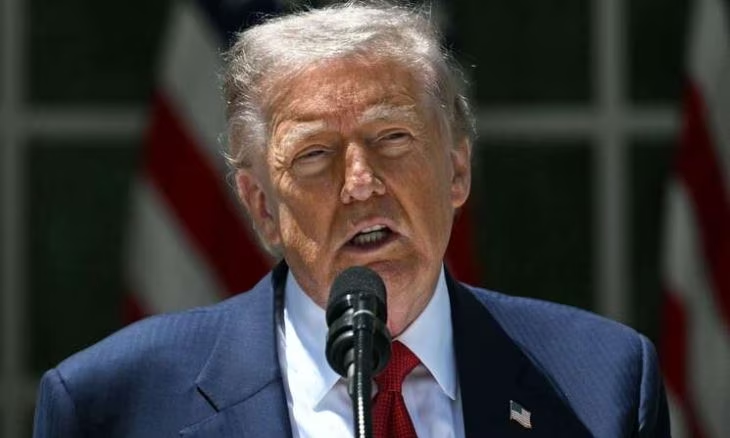
US President Donald Trump issued a series of violent threats against the Islamic Republic of Iran, sparking a wide wave of international criticism and warnings. Observers considered these statements an implicit threat of an unprecedented nuclear attack, especially in light of the stalemate in diplomatic negotiations and the escalation of military tensions on the ground between Washington and Tehran.
During a press conference held in Washington, Trump sent a strongly worded message to the Iranian leadership, indicating that if the ceasefire understandings collapse, the world will witness what he described as a 'great glow' emanating from Iranian territory. The US President stressed the need for Tehran to quickly sign the proposed agreement, threatening them with severe levels of pain and suffering if they refuse.
These dramatic developments come after a direct military exchange of attacks between US and Iranian forces this week, which brought the region to the brink of explosion. Despite White House assurances that the ceasefire agreement is still theoretically in effect, recent presidential statements suggest escalating tendencies that could end this fragile diplomatic path.
The US administration had earlier announced a series of air strikes it described as 'defensive' against military targets inside Iran, claiming its involvement in attempts to target US ships and interests in the Strait of Hormuz. In response, Tehran quickly condemned these operations, considering them a clear violation of the truce and an aggression that warrants a response, which further complicated the security situation in the vital waterways.
For their part, political and human rights circles warned of the danger of the term 'glow' used by Trump, confirming that it clearly refers to the use of nuclear weapons or the comprehensive targeting of vital facilities and energy. Media reports indicated that this rhetoric represents a dangerous shift in US foreign policy, where weapons of mass destruction are openly brandished as a tool for political pressure to achieve gains in negotiations.
In response, the National Iranian American Council issued a strongly worded statement, considering that the threat to make Iran 'glow' represents a premeditated intention to commit a collective war crime against more than 92 million people. The organization affirmed that such statements should not go unnoticed or become part of normal political discourse, given their catastrophic consequences for international peace and security and the lives of innocent civilians.
These threats also raised legal and constitutional questions within the United States about the President's eligibility to make fateful military decisions that could ignite a regional or global war. Human rights organizations called on the international community and the US Congress to deal with these statements with utmost seriousness, warning that silence towards them could be understood as a green light for carrying out devastating attacks that violate all international laws and norms.
It is worth noting that this is not the first such debate, as Trump had previously threatened last month to 'wipe Iranian civilization' from existence, which at the time sparked a storm of anger within the Democratic Party. That previous escalation prompted dozens of representatives to demand the activation of the Twenty-Fifth Amendment to the US Constitution, which allows for the removal of the President if he is proven unfit to perform his official duties.
If the ceasefire with Iran collapses, everyone will see a great glow coming from it... They better sign the agreement quickly, or they will face a lot of pain.
شارك برأيك
Trump threatens Iran with a 'huge glow' and raises fears of an imminent nuclear attack