






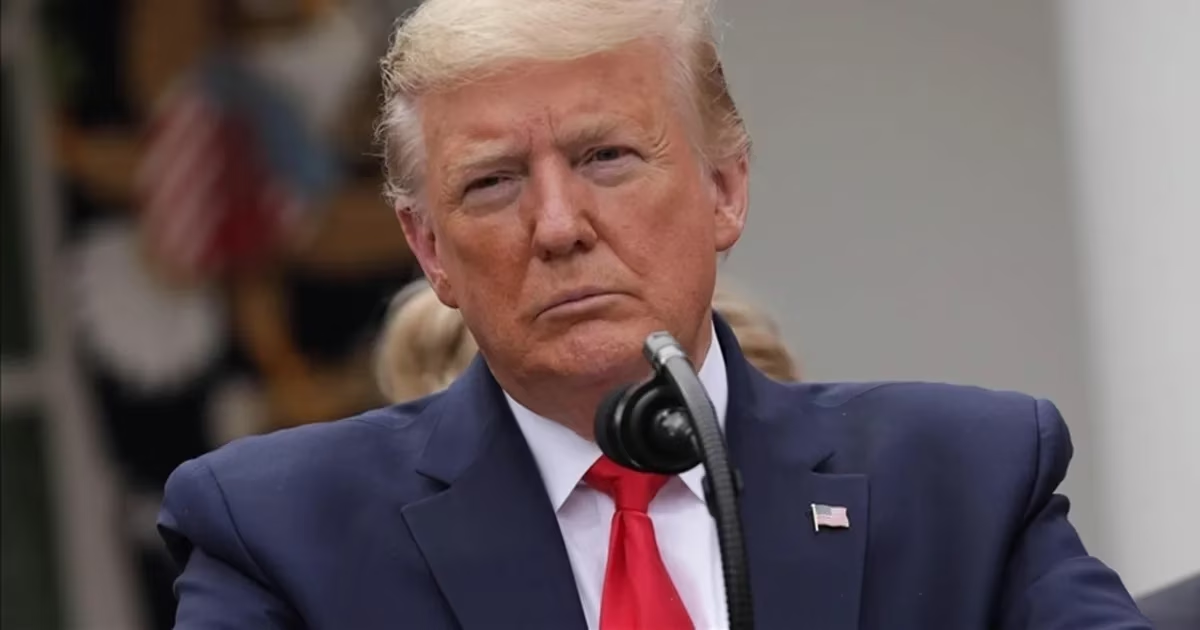
Millions of Americans and Europeans believe that the book 'Prophecies' by the French astrologer Michel de Nostradamus contains references to political events that will be witnessed by countries around the world throughout centuries. In this context, Donald Trump emerges as fertile ground for readings that connect the past and the present, as some see in his political behavior an embodiment of deep crises that have crippled the international system.
Trump has consistently proven through his statements and actions that he represents an exceptional case in American political history, which has led many to invoke the legacy of ancient Arabic satire to describe his situation. From the poems of Al-Hutay'a to the satire of Al-Mutanabbi, the descriptions applied to controversial figures in Arab history find a wide echo when applied to Trump's political and personal characteristics.
The American president failed to fulfill most of the promises he made during his election campaigns, and instead of confronting failures, he habitually blamed his predecessors in power. It even reached the point of accusing Joe Biden of spending billions of dollars on strange experiments involving mice, in an attempt to divert attention from fundamental issues.
In the incident of an American passenger plane crash in early 2025, Trump did not hesitate to blame former President Barack Obama, even though the latter left office in 2017. This behavior reflects a constant desire to create imaginary adversaries to justify any malfunction that occurs during his term, which draws the ridicule of political observers.
Trump often exhibits a wide knowledge gap, where his political experience recedes in favor of statements lacking historical and geographical accuracy. One of the most prominent examples of this is his claim that Spain was one of the founding countries of the 'BRICS' economic group, which is completely contrary to reality.
The 'BRICS' group includes Brazil, Russia, India, China, and South Africa as members, and other countries have recently joined, none of which are European. These cognitive blunders reinforce the impression that Trump's tongue is uncontrollable, constantly putting him in an embarrassing position before the international community.
Regarding domestic policies, Trump's promise to deport six million immigrants during the first three months of his rule was one of the most controversial and alarming promises. He unleashed Immigration and Customs Enforcement forces to carry out widespread raids in various American states, leading to cases of abduction and indiscriminate targeting.
Despite this strict policy towards immigrants, clear contradictions emerged in dealing with some public figures, such as British Prince Harry residing in the United States. Trump justified not forcibly deporting him by stating that he had enough personal problems with his wife Meghan, revealing a double standard in enforcement.
Trump finds no embarrassment in using vulgar and obscene language in public, and often targets journalists with harsh words when faced with questions he dislikes. This innate harshness towards the media reflects a desire to control the official narrative and marginalize any critical voice attempting to uncover the facts.
His critics believe that fabricating crises in international economic relations and attacking historical allies is a tactic used to divert attention from suspicious personal records. Among these records, his past relationship with Jeffrey Epstein stands out, continuing to haunt him like a ghost in his conflict-ridden political career.
The situation represented by Trump has prompted contemporary and ancient poets, by invoking their texts, to express the narrowness of the earth with the existence of such policies that sow hatred. The hatred generated by some of his decisions was not an inherent trait in peoples, but rather a result of hostile policies that began with incitement.
Trump's personality remains rich material for psychological and political analysis, as he combines self-taught ignorance with the ability to rally masses through populist speeches. This mixture has made him a phenomenon worthy of study, not only in the corridors of politics, but also in the fields of literature and sarcastic social criticism.
Ultimately, it seems that history will record Trump's era as a period of cognitive and political turmoil, where facts intertwined with illusions. And satire, whether ancient or modern, will remain the mirror reflecting the ugliness of policies that disregard human dignity and rely on inciting discord.
Articles addressing this figure express the opinions of their authors, but at the same time reflect a general pulse that rejects the decline in the language of political dialogue. And hope remains that global politics will regain its balance away from the language of threats, warnings, and ignorance of the fundamental facts governing the world.
Trump proves through words and actions that he is a virus that has afflicted the entire world with damage and grave misfortunes.
شارك برأيك
Between Prophecies and Arabic Satire: A Sarcastic Reading of Trump's Era and its Contradictions