






By: Said Arikat
April 19, 2026
News Analysis
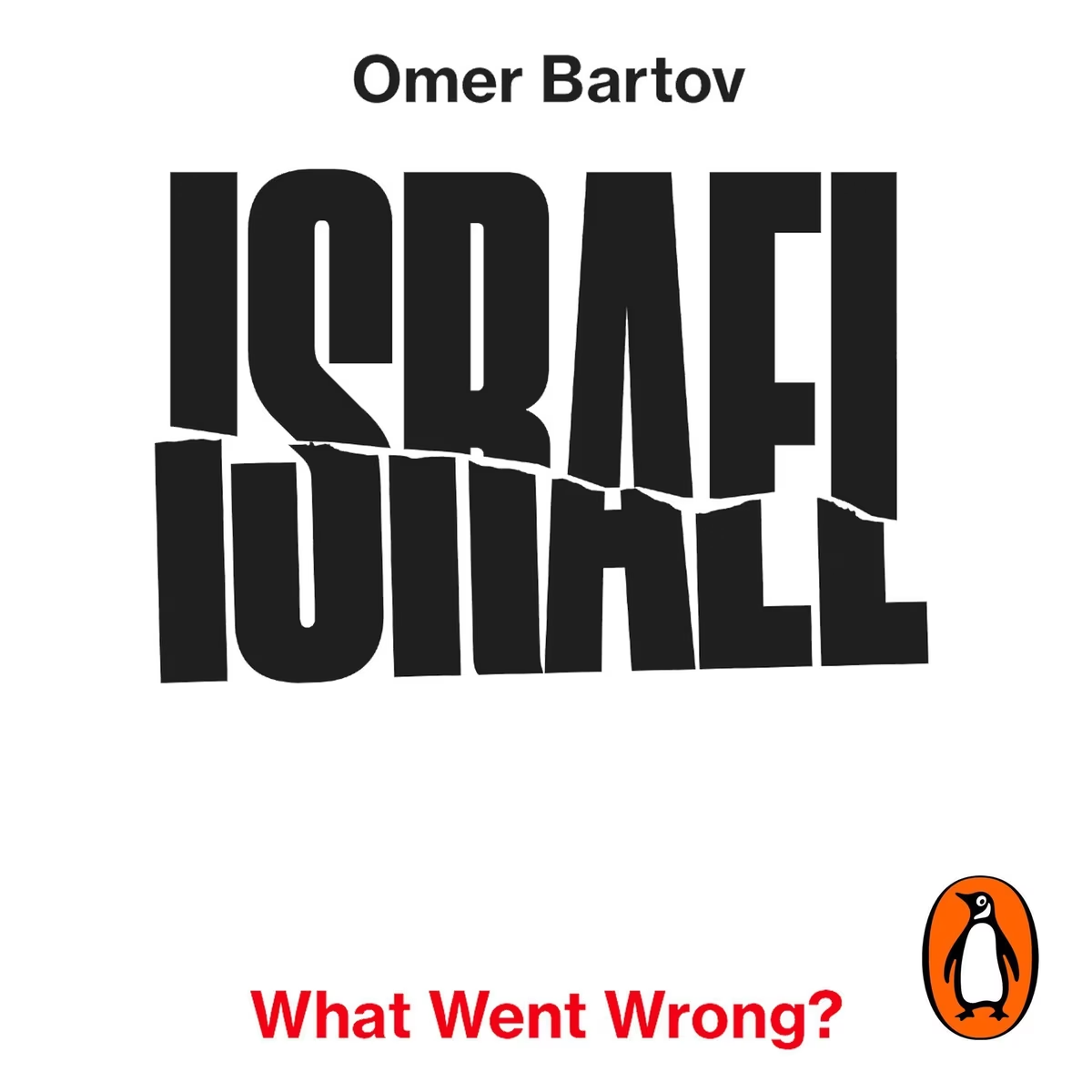
Washington, D.C - Omer Bartov’s Israel: What Went Wrong? is not a gentle meditation on a troubled democracy. It is a devastating moral and political indictment of the Israeli state and the ideology that shaped it. Written by one of the world’s foremost Holocaust historians—an Israeli-born scholar raised on a kibbutz, educated in Tel Aviv, and seasoned in the Israeli army—the book carries the force of insider testimony combined with scholarly rigor. Bartov is not attacking Israel from afar; he is confronting the nation that formed him.
His central claim is stark: Zionism, once conceived as a movement of Jewish emancipation from European persecution, has curdled into a state ideology of exclusion, domination, and permanent violence. The tragedy, in Bartov’s telling, is not simply that Israel lost its moral way. It is that the very state founded in the aftermath of genocide now stands credibly accused of committing grave crimes against another people.
That accusation lands with particular weight because Bartov understands better than most what genocide, dehumanization, and state brutality look like. For decades, he studied Nazi violence and the Holocaust. He knows the language through which societies rationalize cruelty. His decision to turn that lens on Israel is itself historic.
The book dismantles one of the most durable myths of modern politics: that historical victimhood guarantees present innocence. Israel’s founding story has long been anchored in Jewish suffering, culminating in the Holocaust. That suffering was real, immense, and world-shaping. But Bartov insists that trauma cannot serve as a perpetual exemption from accountability. A people that endured catastrophe can still inflict catastrophe.
He traces the roots of today’s crisis to the origins of the state itself. Israel’s “independence” in 1948 was inseparable from the displacement of hundreds of thousands of Palestinians. One nation celebrated liberation while another experienced dispossession. For decades, that contradiction was suppressed beneath triumphant narratives of state-building and security. But suppressed history does not disappear. It returns, generation after generation, in the form of occupation, rebellion, siege, and war.
Bartov appears especially unsparing about the post-1967 era. The occupation of Palestinian territories was not, in his framework, a temporary security necessity gone astray. It became the organizing principle of Israeli political life. Settlements expanded, land was fragmented, rights were stratified, and military rule hardened into a permanent system. The occupation did not corrupt an otherwise healthy democracy from the outside; it revealed what kind of state Israel was willing to become.
Most damning is Bartov’s insistence that this transformation was not imposed solely by extremist leaders. It was enabled by ordinary consent. The synopsis points directly to “support, laced with denial and indifference, of so many of its Jewish citizens.” That is a severe judgment: not merely that governments committed abuses, but that society normalized them. In this view, the problem is structural and civic, not only political.
The war in Gaza gives the book immediate urgency. Bartov asks how a state created in the shadow of extermination can wage what he calls a war of destruction while much of its public accepts or cheers it. His answer seems to be that decades of militarization, fear politics, and ethno-national conditioning have hollowed out empathy. Palestinians became not neighbors or fellow humans, but demographic threats, security targets, or invisible casualties.
Equally provocative is his treatment of Holocaust memory. Bartov does not deny its singular horror; he has dedicated his career to documenting it. But he rejects its political misuse. Memory, he suggests, has been transformed from ethical warning into ideological armor. Instead of teaching solidarity with the persecuted, it is too often invoked to silence criticism and sanctify force.
This argument also implicates Israel’s Western backers. No state sustains indefinite occupation and recurring wars without external sponsorship. The United States and Europe have armed, financed, and diplomatically protected Israeli governments while preaching liberal values elsewhere. Bartov’s critique therefore extends beyond Jerusalem to every capital that enabled impunity.
What makes Israel: What Went Wrong? so unsettling is that it offers little comfort. It does not reassure readers that the problem is a temporary aberration, a single prime minister, or a policy error soon to be corrected. It suggests something deeper: that the crisis is embedded in the state’s ideological foundations and historical refusals.
Yet the book’s severity may also be its moral necessity. Societies rarely reform through flattering myths. They change when illusions collapse. Bartov’s intervention is an attempt to force such a reckoning: to make Israelis, Jews worldwide, and Western allies confront what has been done in their name.
The title asks what went wrong. Bartov’s answer appears uncompromising: domination was built into the project, denial sustained it, and violence became its language. Whether one agrees fully or not, this is not a book that seeks to preserve old narratives. It seeks to bury them.
شارك برأيك
Omer Bartov’s Israel: What Went Wrong? Is Not a Warning—It Is an Indictment