






By : Said Arikat
News Analysis
Washington, D.C- The latest round of negotiations in Cairo—bringing together Hamas, Egyptian mediators, and representatives of the so-called “Peace Council”—is being presented as a serious effort to advance the second phase of a fragile ceasefire in Gaza. In reality, it resembles a familiar diplomatic ritual: one in which the language of peace masks an agenda that entrenches Israeli dominance while extracting unilateral concessions from the Palestinian side. Beneath the procedural language and staged optimism lies a framework that is not only unbalanced, but structurally coercive.
At the center of the talks is a proposal associated with the Council’s high representative, Nickolay Mladenov, which conditions everything—humanitarian relief, reconstruction, and even Israeli withdrawal—on the prior disarmament of Palestinian factions. This is not a technical sequencing issue; it is a political demand presented as a prerequisite for progress. It effectively requires Hamas and other groups to surrender their only meaningful leverage before Israel is required to deliver anything tangible. In any credible negotiation, reciprocity is essential. Here, it is notably absent.
Hamas’s response, as conveyed by sources close to the talks, is comparatively measured given the scale of what is being demanded. The movement is not insisting on maximalist outcomes but on basic procedural guarantees: clear timelines for Israeli withdrawal from Gaza, where Israeli forces reportedly still control more than half the territory; the immediate deployment of a national administrative committee to oversee governance and reconstruction; and, crucially, the full implementation of the first phase of the ceasefire agreement before any transition to the second. These are not excessive demands—they are the minimum threshold for credibility.
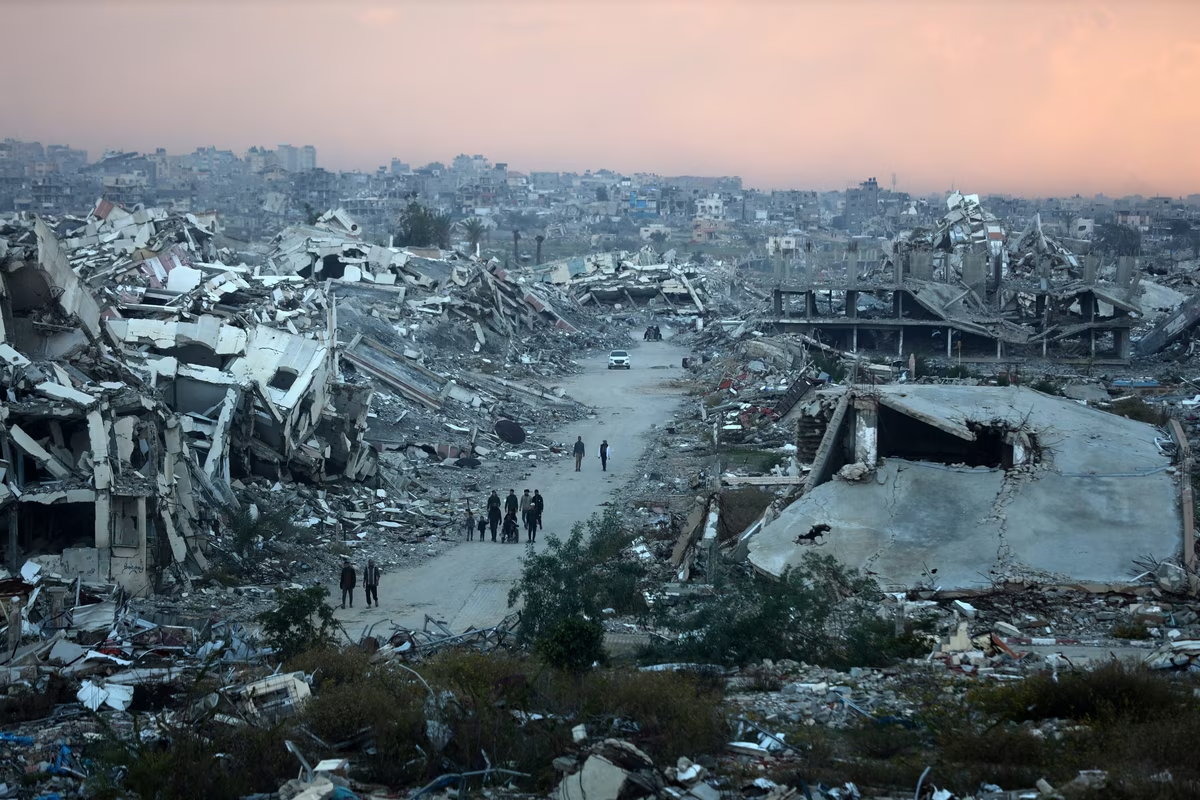
What makes the current proposal particularly problematic is that it treats Israeli violations as secondary concerns rather than fundamental obstacles. Since the ceasefire took effect, Israel has reportedly continued lethal operations, including targeted killings and shelling, while severely restricting humanitarian access. Commitments to allow hundreds of aid trucks into Gaza daily have not been met. Medical evacuations remain tightly constrained. Civilians continue to die under what are supposed to be de-escalation conditions. Yet instead of enforcing compliance with these obligations, the plan shifts the burden onto the Palestinian side to meet new and far-reaching conditions.
This is not mediation; it is managed imbalance. It reflects a longstanding pattern in international diplomacy: Israeli non-compliance is normalized or overlooked, while Palestinian resistance is framed as the central obstacle to peace. Disarmament is treated as a prerequisite rather than a potential outcome of a just and enforceable agreement. The result is a negotiation framework that begins by stripping one side of its bargaining power and ends by asking it to rely on the good faith of a party that has repeatedly demonstrated otherwise.
The demand for disarmament, in this context, is not only unrealistic but fundamentally disingenuous. It ignores the profound asymmetry between a heavily armed state and a population living under occupation and blockade. To insist that Palestinian factions lay down their arms before there is any credible end to that occupation is to demand submission, not compromise. It institutionalizes vulnerability while offering only vague and non-binding assurances in return. Such an arrangement cannot plausibly be described as a path to sustainable peace.
Even more troubling is the sequencing embedded in the proposal: disarmament first, withdrawal later. This inversion raises an obvious and critical question—what guarantees exist that withdrawal will ever occur? The historical record offers little reassurance. Israel has repeatedly entered into agreements only to delay, reinterpret, or fail to implement their terms when it aligns with its strategic interests. Without enforceable timelines and robust international guarantees, promises of withdrawal remain hypothetical, while disarmament would be immediate and irreversible.
The role of the so-called Peace Council in advancing this framework also warrants scrutiny. By aligning so closely with Israeli priorities, it risks abandoning any claim to neutrality. Effective mediation requires not only balancing interests but actively addressing power disparities. Instead, this proposal amplifies them. It places the Palestinian side under sustained pressure to concede, while insulating Israel from meaningful accountability. That is not conflict resolution; it is the management of conflict on terms favorable to the stronger party.
The plan’s governance component—centered on the creation of a national committee to administer Gaza—raises further concerns. While presented as a technocratic solution, it sidesteps the underlying political realities. There is no clear timeline for transferring authority to the Palestinian Authority, no mechanism to ensure that governance structures are locally legitimate, and no acknowledgment that administrative arrangements cannot substitute for political rights. Reconstruction without sovereignty is, at best, a temporary measure rather than a durable solution.
Unsurprisingly, Palestinian factions appear united in their rejection of the plan in its current form. Hamas is reportedly coordinating closely with other groups, including Islamic Jihad and leftist factions, to present a common position. This convergence reflects not ideological alignment but a shared recognition of what is at stake. The proposal is widely seen not as a step toward peace, but as an attempt to reshape the balance of power under the cover of diplomacy.
If the Cairo talks are to yield meaningful results, a fundamental shift in approach is required. The starting point must be the enforcement of existing commitments: a complete halt to hostilities, full and sustained humanitarian access, and clearly defined, verifiable timelines for Israeli withdrawal. Only once these conditions are met can more complex and sensitive issues—such as the future of armed factions—be addressed in an environment where trust is possible and reciprocity is genuine.
Without a meaningful recalibration, the current process is likely to collapse, repeating the failures of numerous previous efforts. More troublingly, it risks intensifying public disillusionment while reinforcing a status quo marked by recurring violence, a deepening humanitarian crisis, and prolonged political paralysis. For Gaza’s civilian population, the consequences are neither abstract nor distant—they are immediate and severe. Their suffering is being exploited as a bargaining tool to extract concessions, rather than treated as an urgent moral imperative requiring decisive action.
There is a persistent illusion in diplomatic circles that process alone constitutes progress—that the mere continuation of talks signals movement in the right direction. But a process without fairness is not progress; it is performance. In Gaza today, that performance is wearing thin. A framework that demands disarmament before dignity, compliance before reciprocity, and trust without accountability is not a peace plan. It is a blueprint for capitulation—one that risks perpetuating the very conflict it claims to resolve.
شارك برأيك
Gaza’s Ceasefire Illusion: A Blueprint for Capitulation, Not Peace