






By: Said Arikat
April 11, 2026
News Analysis
Washington, D.C- The U.S. decision to strike Iran was not the product of a sudden intelligence breakthrough or a sober reassessment of strategic realities. It was the culmination of a decades-long campaign—one relentlessly pursued by Benjamin Netanyahu and ultimately realized under Donald Trump. What changed was not the evidence. It was the willingness to believe it.
For more than thirty years, Netanyahu has worked to draw the United States into direct confrontation with Iran—pressing successive presidents from Bill Clinton to George W. Bush, from Barack Obama to Joe Biden. The pitch was consistent: Iran as an existential threat, military action as both necessary and manageable. But behind the consistency lay a more troubling pattern—an enduring effort to steer U.S. power toward wars that align less with American national interests than with Netanyahu’s own political imperatives and regional ambitions. The intelligence used to support this case has repeatedly been challenged—criticized as exaggerated, selectively framed, or shaped to fit a predetermined outcome. Yet the objective remained unchanged: to manufacture urgency where caution might otherwise prevail.
Until now, U.S. institutions held. Skepticism—however imperfect—served as a brake. War was deferred not because the pressure was absent, but because it was resisted.
What makes this moment different is that the resistance collapsed. After decades of lobbying, warning, and at times outright alarmism, Netanyahu found in Trump a president uniquely susceptible to his methods—receptive to dramatic claims, dismissive of institutional caution, and inclined to view complex realities through the lens of simplified, force-driven solutions. Where previous presidents questioned the premises, Trump embraced them. Where others saw risk, he saw opportunity.
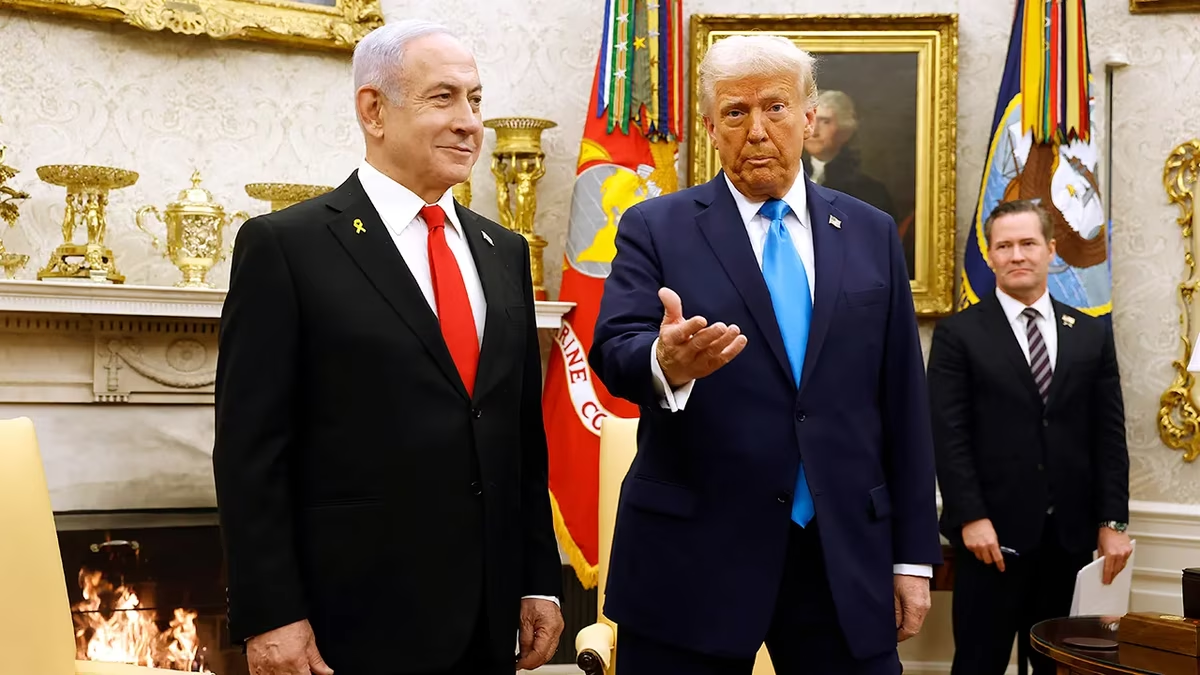
That convergence came into sharp focus during the February 11, 2026 meeting in the White House Situation Room—an extraordinary setting for what amounted to a foreign leader pitching the United States on a war of choice. Netanyahu reportedly presented a sweeping plan for a joint U.S.-Israeli strike on Iran, complete with a vision of regime change, a rapid timetable for dismantling Iran’s missile infrastructure, and even speculative projections of post-strike leadership. The sales pitch was as audacious as it was reductive: Iran could be neutralized quickly, cleanly, and with minimal blowback.
Trump’s reported response—“it sounds good”—spoke volumes. Not a demand for verification, but an instinctive endorsement. Yet within the room, alarm bells were ringing. Senior U.S. officials reportedly dismissed the presentation as “farcical,” a striking internal rebuke that highlighted how far the proposal strayed from serious strategic assessment. The idea that Iran—a complex, resilient state—could be toppled or fundamentally weakened through a limited strike was not just optimistic; it was detached from reality.
The political backlash, while limited, was telling. Ro Khanna denounced Netanyahu’s presence in the Situation Room as a “betrayal of the American people,” warning that U.S. foreign policy was being shaped under the influence of a foreign leader with his own agenda. His critique cut to the core of the issue: this was not merely consultation between allies, but the blurring of lines between national interests—where American military power risked being leveraged in service of another leader’s strategic vision.
Inside the administration, dissent was present but neutered. Intelligence officials dismantled the proposal’s assumptions, concluding that while certain military targets could be struck, the broader ambitions—internal unrest, regime collapse—were implausible. There was no credible pathway from airstrikes to political transformation. No evidence that Iranian society would unravel under external pressure in the way Netanyahu suggested.
But none of that proved decisive. Trump, impetuous and true to form, treated intelligence as a toolbox rather than a boundary—embracing what reinforced his instincts and discarding what complicated them. The result was not a failure of information, but a failure of judgment.
Key figures reflected this dynamic. Vice President J. D. Vance warned of escalation. Pete Hegseth, who’s unqualified for his job according to most assessments, supported military action. Marco Rubio advocated a narrower approach. Military and intelligence leaders outlined risks but stopped short of mounting meaningful resistance. The process gave the appearance of debate, but lacked the substance of constraint.
What emerges is a portrait not just of influence, but of manipulation refined over decades. Netanyahu did not simply advocate for action; he constructed a narrative designed to make war appear inevitable, even prudent. By repeatedly framing Iran as both an imminent threat and an easy target, he compressed complexity into urgency—turning caution into hesitation, and hesitation into danger.
This is not the first time such a pattern has surfaced in U.S. decision-making. The inflation of threats, the sidelining of dissent, the illusion of quick victories—these are familiar preludes to costly wars. The lessons of Iraq were supposed to inoculate Washington against precisely this kind of thinking. Instead, they have been selectively remembered and conveniently ignored.
As reports surfaced of a “rare opportunity” to strike Iranian leadership, the process accelerated. By late February, internal debate had effectively collapsed. Trump’s justification—preventing Iran from acquiring a nuclear weapon—provided political cover, but it also obscured the deeper reality: the decision was less about imminent necessity than about accumulated persuasion, years in the making.
Netanyahu’s long campaign has now borne fruit. Not because he proved his case, but because he wore down the resistance—and ultimately found a president willing to act on it. The more unsettling conclusion, however, is that this outcome was enabled from within. A system that allows intelligence to be bent, dissent to be contained, and external actors to guide decisions of war is not merely flawed—it is vulnerable.
The question now is not how Netanyahu succeeded. It is why the United States allowed itself, once again, to be led down a path where war becomes the product of persuasion rather than necessity—and where the costs, as always, will far outlast the arguments that justified it.
شارك برأيك
Netanyahu’s Long Game—And the President Who Finally Took the Bait