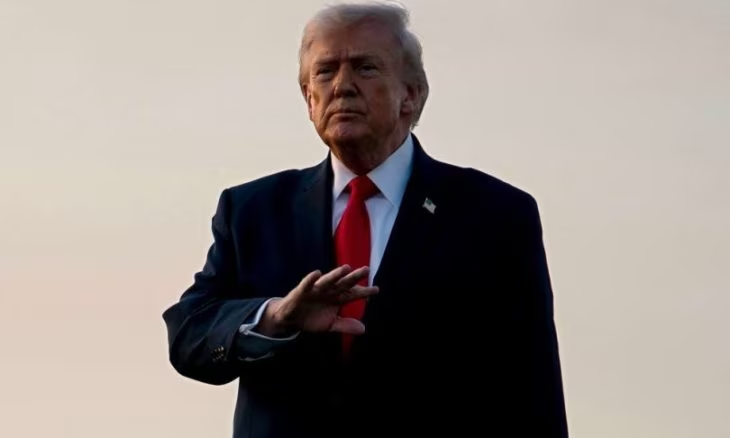







International press reports have highlighted President Donald Trump's behavioral methodology, considering what appears publicly as narcissistic actions or outrageous demands to be, at its core, a well-crafted strategy. Writer Tom Rogers, in an article published by 'Newsweek' magazine, pointed out that Trump follows a consistent pattern through which he aims to extract personal gains in every issue he raises. This behavior, which defies traditional norms, is not merely temper tantrums, but rather a tool to impose absolute control over the American political scene.
This analysis is based on a critical reading of an upcoming book titled 'The Ten Commandments of Trump,' authored by Professor Jeffrey Sonnenfeld, a professor at Yale University and one of the foremost experts in leadership management. The book provides a precise academic dissection of the approach Trump uses to subdue his political opponents and reshape public opinion. The author believes that understanding these behavioral mechanisms is essential to comprehending how Trump manages crises and major deals.
Sonnenfeld's insights gain particular credibility given his long and unique relationship with Trump, which began with a sharp media rivalry over 'The Apprentice' program. Despite their disagreements, Trump expressed admiration for the professor's intelligence to the extent that he previously offered him the presidency of 'Trump University,' an offer that was rejected. This close proximity allowed the author to observe Trump closely and conclude that his actions are not random but rather an 'organized mechanism' applied in various contexts.
Among the ten strategies identified by the book, Trump's aggressive negotiation tactics stand out, which Sonnenfeld describes as a 'punch to the face.' Unlike traditional diplomacy that seeks to build trust, Trump begins any dialogue with a shocking stance or an extreme demand aimed at disrupting the psychological balance of the other party. This initial intellectual terrorism forces the opponent to make concessions they would not have considered under normal circumstances.
When Trump retreats slightly from his initial extreme demand, the negotiating party feels a sense of relief or illusory victory, while Trump has already achieved his real goal. This tactic ensures he secures massive deals on his own terms, while keeping opponents in a state of perpetual confusion. This method is a cornerstone of his dealings with political leaders and businessmen alike.
As for the second strategy, it concerns the creation of public awareness, known as the 'sleeper effect' or continuous repetition until belief. In this context, Trump relies on making certain claims, even if they lack validity, and repeating them with excessive confidence and unwavering certainty. Over time, these falsehoods begin to penetrate media circles and his supportive audience until they transform into undeniable facts.
This approach ultimately exhausts the public's ability to distinguish between truth and fiction, giving Trump the power to reframe reality to align with his agenda. By controlling the media narrative, he is able to neutralize objective facts and replace them with a version of reality that serves his immediate political interests. This tactic is one of the most dangerous tools he uses to manipulate public opinion.
The 'I alone can fix it syndrome' serves as a third strategy to reinforce his image as an epic hero who possesses magical solutions unavailable to others. Trump uses exaggerated preferential language to describe his achievements, attempting to make himself the center around which all national success revolves. This institutional narcissism drives him to try to directly link every public achievement to his personal name, reinforcing his superiority complex.
The article points to real-world examples of this behavior, such as Trump's condition that the historic Pennsylvania Station be renamed after him in exchange for approving its refinancing. This tendency to 'gild everything' and stamp it with his name reflects a deep desire to immortalize his personal legacy at the expense of public institutions. It is a strategy aimed at merging national identity with his personal identity in the minds of citizens.
Rogers believes that understanding these 'commandments' is the only way to decipher what appears to some as a state of madness or psychological instability. Trump is, in fact, a brilliant 'engineer of chaos,' who uses psychological and social rules to impose his control over others. His seemingly reckless actions are actually precisely calculated steps within a political chess game always aimed at enhancing his influence.
Sonnenfeld's upcoming book does not merely observe situations but provides a framework for understanding the future of American politics under Trump. If these behaviors are calculated strategies, then dealing with them requires entirely different tools than traditional political ones. Analysts warn that ignoring this methodology could lead to further erosion of democratic and institutional norms.
The analysis also addresses how Trump always succeeds in turning crises that might end any other politician's career into opportunities to boost his popularity among his solid base. By portraying himself as a victim of a 'corrupt' system, he uses the strategy of repetition to convince millions that an attack on him is an attack on them. This emotional connection makes it difficult for legal or logical facts to penetrate the wall of loyalty he builds.
In conclusion, the article asserts that Trump's 'method of madness' has redefined the concept of political leadership in the modern era. Instead of striving for consensus, Trump thrives in an environment of polarization and conflict, using his psychological tools to ensure he remains in the spotlight. Reading this methodology has become an urgent necessity for anyone seeking to understand the profound transformations in the international landscape.
Sources indicate that this type of academic analysis contributes to revealing the mechanisms by which politics is currently managed in Washington. With the approaching release of Sonnenfeld's book, observers expect it to spark a wide debate about the limits of personality and narcissism in public service. What some see as madness, others see as the pinnacle of political cunning in the 'post-truth' era.
What appears on the surface as madness or random actions from Trump are, in reality, calculated strategies aimed at achieving personal gains and imposing absolute control over the political scene.
شارك برأيك
Academic Analysis Deciphers 'Trump's Madness': Calculated Strategies for Control and Personal Gain