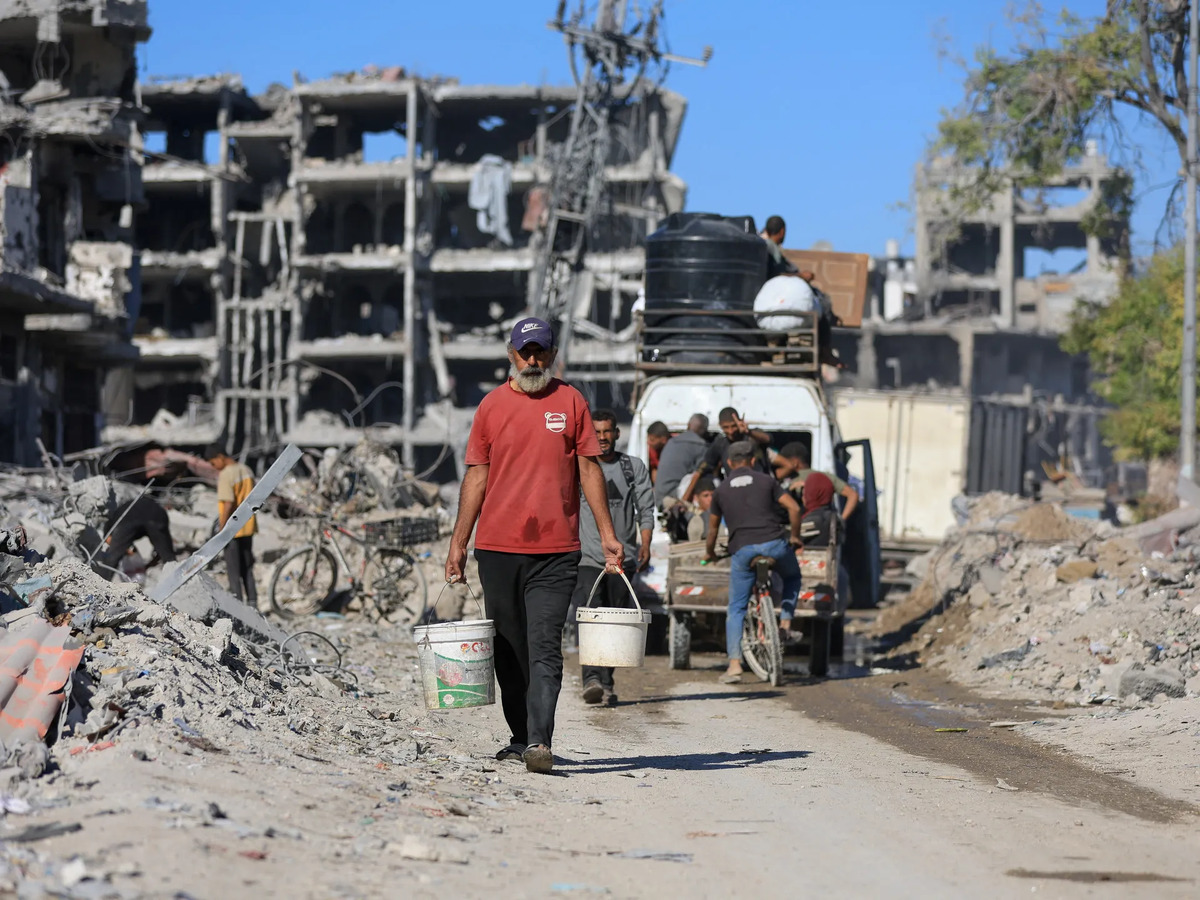







A new report from the Arava Institute for Environmental Studies in Israel warns that the Gaza Strip is facing a comprehensive environmental collapse that threatens its ability to recover after nearly two years of devastating war, noting that the water is polluted, agricultural land is destroyed, and the electricity network is nearly collapsed.
The newspaper quoted the report, which was published by the institute after the announcement of a ceasefire between Israel and the Islamic Resistance Movement (Hamas) mediated by the United States, stating that about 69% of the infrastructure in the sector has been damaged.
Additionally, about 80% of agricultural land has been damaged or destroyed, leading to a tenfold increase in malnutrition rates compared to the situation before the conflict.
The report added that military activities, especially the movement of heavy machinery, have caused severe damage to fertile soil, undermining Gaza's ability to produce its food in the future.
The report explained that Israeli restrictions on coastal waters have made fishing nearly impossible, resulting in the deaths of 120 Palestinian fishermen.
It noted that 93% of households in the Gaza Strip suffer from water insecurity, with the daily per capita share of water not exceeding 8.4 liters, which is below the emergency minimum recommended by the World Health Organization.
All sewage treatment plants have stopped working, causing sewage to flow into the streets and threatening groundwater with contamination and the spread of epidemics.
According to the report, the shutdown of treatment plants has forced residents to discharge wastewater into temporary ponds that threaten to overflow into the streets and homes, and may seep into the shared coastal groundwater, which is the main source of water in the sector.
The capacity to generate electricity has also decreased by more than 80%, with outages extending up to 22 hours a day, relying almost entirely on diesel generators to carry out relief operations.
The report called for a phased strategy for rebuilding Gaza led by the local community, which includes establishing independent networks for water, energy, and agriculture, and embedding concepts of climate resilience and joint resource governance.
The report's authors emphasized that environmental recovery must be an integral part of reconstruction, warning that ignoring it will keep Gaza in a cycle of endless crises.
Environmental recovery must be an integral part of reconstruction, warning that ignoring it will keep Gaza in a cycle of endless crises.



شارك برأيك
Independent: Gaza on the brink of a complete environmental collapse