






By Jamal Mimouni
In Gaza, one of the most shameful chapters in contemporary history is unfolding: a planned famine, methodically imposed by a military power, under the passive gaze of a supposedly civilized world. For more than two months, more than two million Palestinians have been deprived of food, water, electricity, fuel, and healthcare. Gaza has become a laboratory of cruelty, where hunger is measured with administrative rigor—literally down to the calorie—while the major powers watch silently or fuel the fire by providing bombs and diplomatic support.
The calorie is now the unit of cruelty, alongside the bullet and the bomb. Israel no longer even hides its cynical calculation: how many calories per person? How many grams of protein before collapse? How many days before complete starvation? Human suffering is reduced to Excel spreadsheets. This is not a natural disaster, nor even a side effect of the conflict. It is a deliberate act: deprivation as an instrument of war. Gaza is being intentionally starved.
Since March 2, 2025, the total blockade imposed on humanitarian aid has exceeded all previous levels in severity. By May 16, it had become the longest siege ever recorded in the enclave's history. According to UNICEF and the UN Office for the Coordination of Humanitarian Affairs (OCHA), Gaza's survival capacities have been destroyed: farmland has been bombed, fishing zones have been closed, bakeries have been paralyzed by the lack of flour, fuel, and security.
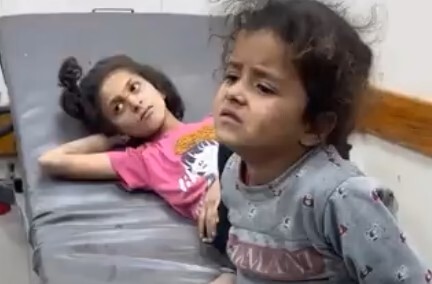
The most vulnerable—children under two and breastfeeding mothers—are the first victims: 92% of them no longer have access to adequate food. And yet, more than 3,000 aid trucks and 116,000 tons of food remain blocked at the borders, barred from entry by Israel, in violation of the injunctions of the International Court of Justice in the South Africa v. Israel case. This refusal to comply clearly shows that famine is not a consequence of war—it has become war itself.
The crime is neither hidden nor silent—it is being broadcast live.
It is not a matter of ignorance. This is not the 1940s. No one will be able to say, this time, "we didn't know." Everything is visible. Every day, on every screen, we see children dying of hunger, hospitals collapsing, mass graves dug with bare hands. The weapon used here is food, or rather its absence, in clear violation of international law, humanitarian conventions, and the most basic human dignity. UNICEF, UNRWA, the World Food Program, OCHA: all these institutions have sounded the alarm. The UN has officially recognized that Gaza has entered a state of famine. And yet, the trucks remain stuck. This is not a simple siege: it is a slow and public execution of an entire people. A war crime committed in broad daylight, under the neutral gaze of cameras and diplomacy.
Silence is complicity.
The scandal is not only that these horrors are taking place, but that they are tolerated, even excused, by the very people who claim to embody the values of international law and human rights. When it comes to other conflicts, some powers are quick to condemn and sanction. But here? Silence. Not even an official reprimand. Much less any concrete action.
Why? Because the culprit is an ally, a strategic partner, sanctified by the European trauma of the Holocaust, to the point of being considered above all criticism. The result: empty words, phrases calibrated to spare the aggressor, and a shameful choreography of diplomatic cowardice.
Can one still be a "Gaza genocide denier" today?
More and more authoritative voices are denouncing what is happening in Gaza. Omer Bartov, a world-renowned expert on genocide and professor at Brown University, describes the situation as "genocidal politics":
"A systematic attempt to make Gaza uninhabitable and to destroy the structures vital to the physical and cultural survival of a group."
He also highlights the moral bankruptcy of Western countries, which nonetheless pose as champions of human rights. He is not alone. Raz Segal (Stockton University) speaks of a "textbook case of genocide," drawing on statements by Israeli officials explicitly calling for the annihilation of Gaza. Dirk Moses (University of Sydney) and Israeli historian Ilan Pappé evoke a logic of progressive erasure, a mechanism of slow and structural extermination.
Some still avoid the word "genocide" because of its political implications, preferring to speak of "genocidal acts." But the criteria are there, clear, established by the 1948 Geneva Convention:
o Mass murder (more than 60,000 dead)
o Intentional deprivation of food and medical care
o Dehumanization in public discourse
o Destruction of institutions vital to collective survival
The pattern is clear. And yet, as in Rwanda in 1994, as in Srebrenica in 1995, we demand "irrefutable proof" while the bodies pile up. Archives, satellite images, and Israeli parliamentary recordings will one day form a damning dossier. On that day, the world will look back—and judge.
"Never again": a promise broken
The once sacred phrase has been emptied of its meaning. If "Never again" doesn't apply to Gaza—where civilians are starving, bombed, and displaced—then it no longer applies anywhere. The moral foundation of the West, forged in the post-Auschwitz era, is crumbling. What remains is only selective indignation, tinged with geopolitical opportunism.
The failure of moral and religious institutions
Major religious institutions have not been up to the task. From the Vatican to ecumenical organizations, reactions have amounted to lukewarm appeals, as if we were witnessing a simple diplomatic dispute, not a campaign of mass destruction. The International Court of Justice has been ignored; its interim measures trampled underfoot, without the slightest consequence.
In Israel itself, public discourse has descended into indecency. Members of the Knesset now dare to rejoice in the starvation inflicted on children. When a humanitarian doctor expresses the hope that no child will be deprived of painkillers, he is met with laughter. What was whispered yesterday—starving a people as a military strategy—is today cynically claimed.
The Abdication of the Arab World
Arab regimes do not escape condemnation. Their inaction, hidden behind symbolic gestures, reveals their political weakness and moral bankruptcy. Prisoners of their alliances, paralyzed by the fear of losing their power, they have abandoned their own people, even in the most unbearable pain.
History is watching
This moment will be judged. Silence will be remembered. The refusal to act will be recorded, not as prudent neutrality, but as active complicity. When Gaza one day raises its head and writes its own history, what will be remembered? What will our governments, our institutions do? What principles will they have agreed upon? For this is no longer just about Gaza. It is about the international order, its soul. And this soul is dying... slowly... down to the calorie.
شارك برأيك
Gaza and the Collapse of the Global Moral Compass