






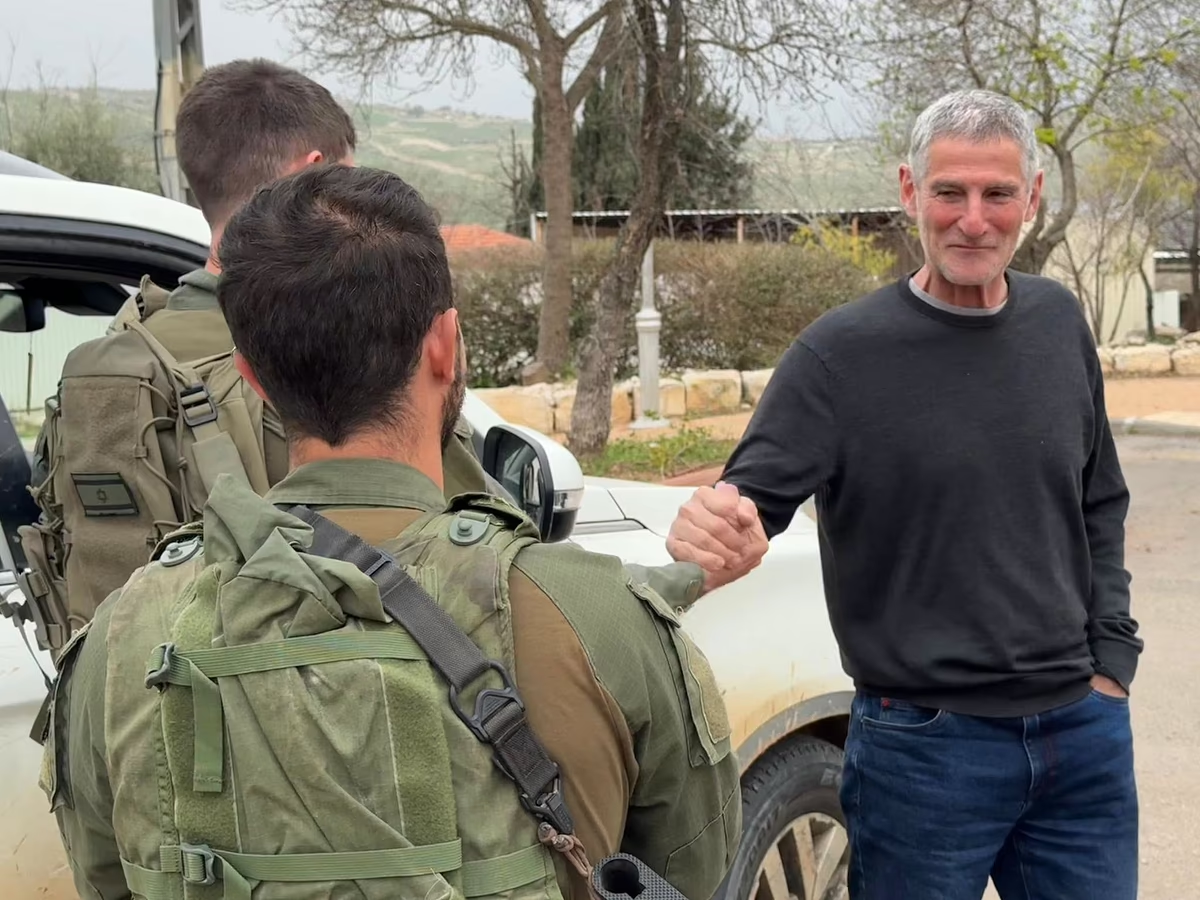
Dr. Khalil Abu Karsh: Most of the statements currently being issued fall within the framework of Israeli electoral bidding, and the upcoming campaign will witness more promises and slogans.Nizar Nazzal: These statements seem closer to political and electoral rhetoric than to an implementable program, given the government's reliance on religious and extremist nationalist parties.Dr. Abdel Majeed Sweilem: The electoral factor is clearly present in Ya'alon and Golan's positions, but this does not negate that both have previously expressed critical positions towards the current government's policies.Hani Abu Al-Siba': Israeli electoral competition has begun to use what is happening in the West Bank and the suffering of Palestinians as material for political conflict and a focus for bidding between the government and the opposition.Dr. Osama Abdullah: The opposition is trying to present itself as more capable of managing the security file and improving Israel's international relations without offering a different political project.Fadi Abu Bakr: Golan seeks to demonstrate his and his political current's ability to enforce the rule of law even on settlers, but this does not reflect a change in the essence of the position on occupation and settlement.Ramallah - Exclusive to "Al-Quds" - Statements by former Israeli Defense Minister Moshe Ya'alon and leader of the Democrats party Yair Golan regarding settler attacks in the West Bank, particularly the events in the village of Tal southwest of Nablus, highlight the division within the Israeli arena over the repercussions of the escalating power of extremist settler groups, and how this can be exploited in the upcoming election battle. Ya'alon described what is happening as "Jewish terrorism," while Golan warned that the current government's policies have turned the West Bank into a "powder keg."Writers, political analysts, and specialists in Israeli affairs, in separate conversations with "Al-Quds," believe that Ya'alon and Golan's positions reflect growing concern within Israeli political and security circles that settler violence could become a burden on the state and its institutions. However, they also come amid an electoral atmosphere in which the opposition seeks to hold Benjamin Netanyahu's government responsible for the security breakdown and present itself as a more capable alternative to manage the file.Despite the importance of these statements, writers and specialists emphasize that they do not represent a shift in the Israeli position on the occupation or the settlement project, as the dispute is primarily limited to the method of managing settlement and controlling extremist groups, with expectations that the issue of settler violence will remain present in upcoming election campaigns as a card for internal Israeli conflict.A stage governed by competition for voters' votesThe specialist in Israeli affairs, Dr. Khalil Abu Karsh, confirms that reading the statements of Yair Golan and Moshe Ya'alon regarding the events in the village of Tal southwest of Nablus and settler violence cannot be separated from the electoral atmosphere that Israel has entered. He believes that understanding the current Israeli scene requires taking into account that the current stage is governed by competition for voters' votes, which is clearly reflected in the nature of political discourse and declared positions.Tension and fear of escalating settler violenceAbu Karsh explains that Moshe Ya'alon's statements are of particular importance because he is a prominent security and political figure who held the positions of Chief of Staff and Minister of Defense, and also led the "Telem" party, which was part of a broader political camp.Abu Karsh points out that Ya'alon's attack on the government and his description of what is happening as "Jewish terrorism," a term commonly used within Israel, reflects the extent of political tension and fear of an escalating wave of violence in the West Bank. He notes that these criticisms offer an Israeli reading of the scene, in contrast to the government and the right's attempt to portray settler attacks as merely individual acts by young people who need social treatment, rather than as organized political violence that enjoys state cover.Abu Karsh emphasizes that there is growing concern within Israel that this violence will spread to the state itself in the future, reflecting a gap between the settler community, with its escalatory tendencies, and the civil and secular state in Tel Aviv, which seeks to preserve its value system.Electoral exploitation of West Bank eventsRegarding Yair Golan's statements, Abu Karsh explains that the leader of the Democrats party, which represents the merger of the Labor and Meretz parties, tried to exploit the events in the West Bank electorally and address his discourse to the center and right-wing public, in light of the continuous shift of Israeli society towards the right, and the declining influence of left-wing parties, which have been subjected to continuous attacks to the point where the term "left" is used negatively in Israeli political discourse.He believes that this attempt harmed the Democrats party and its political narrative calling for a settlement and a democratic Israel, noting that Golan later had to soften his positions after the wave of criticism he faced.Abu Karsh confirms that most of the statements currently being issued fall within the framework of electoral bidding, expecting that the upcoming campaign will witness more promises and slogans aimed at attracting voters rather than expressing implementable policies, as all parties seek to address the public with what they want to hear, without guaranteeing that this will translate into practical steps after the elections.He points out that the importance of the upcoming elections stems from the fact that they come after the repercussions of October 7, 2023, and the war on multiple fronts, in addition to internal changes that included strengthening the influence of the right within the military establishment and reducing the powers of the Supreme Court, making them among the most sensitive elections since the Likud party came to power in 1977.Abu Karsh confirms that the Israeli right seeks to exploit Palestinian blood and the events in the West Bank, including what happened in Tal, to win settler votes, benefiting from the political, legal, and financial cover provided by the current government, which he considered to have given the settlement project something akin to a "golden age" during its years in power.Settler violence is no longer a marginal phenomenonResearcher specializing in Israeli affairs and conflict issues, Nizar Nazzal, confirms that the statements made by Yair Golan, along with the positions of prominent Israeli military and political figures, including Moshe Ya'alon and Ehud Barak, reflect the existence of a current within the political and security establishments in Israel that now views settler violence as no longer a marginal phenomenon, but rather a security and political burden on Israel itself, amid a growing conviction that what is happening in the West Bank has become a government-backed approach rather than merely isolated individual practices.Direct criticism of Netanyahu's governmentNazzal explains that these statements carry several implications. The first is a direct criticism of Benjamin Netanyahu's government and an accusation of providing political cover for settlers and extremist groups, based on the belief among these elites that the attacks carried out by these groups have become part of a government policy that legitimizes their practices.Nazzal points out that the second implication is an attempt to restore the trust of the Israeli public, who feel that the state has lost part of its monopoly on the use of force to armed settler groups. The third implication is to send a message to the international community that there are voices within Israel that reject settler violence, especially in light of escalating international criticism of Israel and its isolation after the war on the Gaza Strip, and the accompanying accusations of genocide and ethnic cleansing. This prompts these elites to try to improve Israel's image externally, in parallel with Golan's attempt to present himself as a statesman capable of restoring the rule of law and the military institution over everyone, including extremist settlers.Political and electoral discourseNazzal believes that these statements, at the current stage, seem closer to political and electoral rhetoric than to an implementable program, given the government's reliance on religious and extremist nationalist parties. In addition, any future government will face political and popular resistance if it tries to dismantle settlement outposts or confront extremist groups.Nazzal points out that Israeli experience over the past years has shown that governments, whether right-wing or centrist, have taken limited measures against some outposts or individuals, but they have not brought about a fundamental change in the settlement project.Nazzal emphasizes that the continuation of the current balance of power makes it unlikely that these statements will be translated into widespread practical policies. Even if a government less dependent on far-right parties comes to power, the most that can be expected is stricter enforcement of the law on some settler groups, without this leading to a radical change in settlement policy or an end to the phenomenon of settlement.Nazzal notes that some Israeli elites have concerns about the repercussions of escalating settler violence on Israel's international standing, and he expects this escalation to continue within the framework of a new policy towards the West Bank that may move towards implementing a new Nakba against Palestinians, similar to what happened in 1948.Statements in the electoral contextPolitical writer and analyst Dr. Abdel Majeed Sweilem confirms that reading the statements of Moshe Ya'alon and Yair Golan regarding settler attacks and what happened in the West Bank cannot be separated from the electoral context in which Israel lives. He explains that election periods usually witness an escalation in political positions, some of which express firm convictions, while others are related to electoral calculations and an attempt to attract voters.Sweilem explains that the electoral factor is clearly present in Ya'alon and Golan's positions, but he stresses that this does not negate that both had previously expressed, before the elections, critical positions towards the current government's policies, especially regarding the practices of the Israeli right. He considers that Ya'alon, specifically, on many occasions, directed fundamental and radical criticisms at the government and warned of the dangers posed by the far-right, including what he described as Jewish terrorism, to the future of the Israeli state and its institutions.The attempt by right-wing forces to ignite the West BankSweilem believes that the positions of the two figures also stem from their rejection of settler practices and attacks, and their belief that these attacks fall within a plan led by far-right forces to ignite the West Bank and lure Palestinians into an armed confrontation, which would allow, according to this perception, to re-present the conflict as a confrontation between Jewish and Palestinian residents, instead of being a conflict resulting from the continuation of the occupation. He considered this an attempt to change the image and nature of the conflict before public opinion.Sweilem believes that the ongoing developments are proceeding according to a systematically prepared plan, and he expects the next stage to witness a greater escalation, given the settlers' belief that the current circumstances represent a favorable opportunity to push the conflict to more dangerous levels.Official support for settler violenceRegarding the possibility of translating these statements into practical steps, Sweilem explains that the government and the ruling coalition provide clear support for settlers and their practices, considering that the coalition is the main driver of these policies, which makes a fundamental change in the short term unlikely.Sweilem expects the Israeli election campaign to witness more positions opposing settler violence, even if not decisive, reflecting a divergence within Israeli society between those who support settlement and settler behavior, and those who see these practices as a danger to the unity of Israeli society, the cohesion of its institutions, and Israel's image, which he described as experiencing a significant decline at the international level.The state of tension at its peakPolitical writer, analyst, and specialist in Israeli affairs, Hani Abu Al-Siba', confirms that the recent developments in the West Bank, particularly the events in the village of Tal in the northern West Bank, have brought the state of tension to its peak, after settlers attacked Palestinian farmers, before a Palestinian, according to the narrative presented, was able to seize a settler's weapon and use it, leading to the killing of two settlers and the martyrdom of the perpetrator and three others. This event sparked widespread debate in the Israeli media and prompted voices from the right and left to demand stricter security measures and accuse the army of failing to impose security in the West Bank.He explains that Israeli discourse initially adopted the settlers' narrative that they were on an outing, but the publication of video clips of the incident, in addition to coverage by Western media, showed that the shooting and assault began on the part of the settlers. This prompted a number of Israeli voices to backtrack on their positions, and also reinforced what Israeli journalist Alon Ben David announced, that the settlers were the ones who went to the village of Tal, and not the Palestinians who initiated the attack, despite prior Israeli calls to erase the village.Abu Al-Siba' confirms that the West Bank is witnessing a continuous escalation in settler attacks, which have led to the killing of dozens of Palestinians as a result of these attacks, and that the widespread presence of armed settlers, while the Israeli army is engaged on several fronts, has made them more vulnerable to targeting.Abu Al-Siba' believes that the chaos of weapons and repeated attacks have pushed Palestinians to try to protect themselves and their property, which was also reflected in the Palestinian Authority's call to form guard committees to protect villages and friction areas.The West Bank as material for political conflictAbu Al-Siba' believes that the statements of the leader of the Democrats party, Yair Golan, in which he held government-backed settlement outposts responsible for turning the West Bank into a "powder keg," fall primarily within an electoral context as the elections on October 27 approach. He seeks to attack Benjamin Netanyahu's government and attract votes from the opposition camp and some Arab voters, at a time when right-wing parties accuse him of adopting anti-government positions.Abu Al-Siba' points out that Israeli electoral competition has begun to use what is happening in the West Bank as material for political conflict, considering that the suffering of Palestinians has become a focus for bidding between the government and the opposition, while the Israeli government continues to support the settlement project and policies of repression in the West Bank and Gaza Strip.Loss of control over settler groupsAbu Al-Siba' notes that the Israeli army's decision to prevent armed settlers from entering some areas without coordination reflects its loss of control over these groups. He points out that the transfer of forces from the Gaza Strip to the West Bank, and the tightening of security measures and the declaration of a state of alert, indicate the military establishment's realization that the West Bank is heading towards a wave of escalation that could erupt at any moment, which was also reinforced by Prime Minister Benjamin Netanyahu's announcement that Israel will not allow, in his words, "terrorism" to raise its head in the West Bank.Deep division in the Israeli arenaPolitical researcher and academic Dr. Osama Abdullah explains that the statements made by Yair Golan, preceded by Moshe Ya'alon's positions, regarding the events in the village of Tal southwest of Nablus and calls for an investigation into settler attacks and the dismantling of what was described as "settler terrorism," cannot be separated from the deep division in the Israeli arena regarding the management of the conflict with the Palestinians, especially after the events of October 7, 2023, and the ongoing war on the Gaza Strip, and the unprecedented escalation in the West Bank that accompanied it.Positions that do not adopt the Palestinian narrativeAbdullah explains that these positions do not reflect an adoption of the Palestinian narrative or an acknowledgment of Palestinian national rights, but rather express growing concern within the political and security establishments in Israel that the policies pursued by Benjamin Netanyahu's government, in partnership with the extremist religious right, are pushing Israel towards an open confrontation that is difficult to contain.Repercussions that may rebound on IsraelAbdullah emphasizes that Golan's description of the West Bank as a "powder keg" comes as a warning of the security repercussions that may rebound on Israel, and not as an expression of a humanitarian approach to the suffering of Palestinians.The dispute over the method of managing the occupationAbdullah points out that the dispute within Israel is not centered on ending the occupation or rejecting settlement, but rather on the method of managing the occupation. Abdullah explains that the opposition current believes that giving free rein to settlers, expanding the establishment of settlement outposts, and providing political and security cover for extremist groups leads to the depletion of the Israeli army, harms Israel's international image, and increases the likelihood of a new intifada or the expansion of the confrontation in the West Bank. Therefore, calls for investigation and accountability of settlers aim to contain the repercussions of these policies, not to review the settlement project itself.Dealing cautiously with these statementsAbdullah believes that, despite the importance of these statements in terms of their political implications, experience with successive Israeli governments requires dealing with them cautiously, as similar positions have been issued previously criticizing settler violence or warning of the dangers of settlement expansion, but they have not been translated into practical measures that limit settlement or end impunity. Instead, settlement expansion has continued, and the protection enjoyed by settlers has continued, regardless of the government's identity.He emphasizes that these statements also carry a clear electoral dimension in light of talk of early Israeli elections and the reshaping of the party map, as the opposition tries to present itself as more capable of managing the security file and improving Israel's relations with the international community, without offering a different political project based on ending the occupation or recognizing Palestinian rights.Abdullah does not expect these statements to lead to fundamental changes in Israel's policy towards settlement, even if the government changes. He believes that the matter will be limited to a limited tightening in dealing with some settlement outposts or extremist groups, such as the "Hilltop Youth," with the aim of re-establishing security and improving Israel's image before the international community, and not as a result of a genuine review of the occupation policies or the settlement project itself.Political repositioning within IsraelPolitical writer and analyst Fadi Abu Bakr confirms that the recent statements made by Yair Golan, preceded by Moshe Ya'alon's positions, regarding settler violence and the situation in the West Bank, fall within the framework of political repositioning within Israel rather than being an indicator of a real shift in the Israeli opposition's stance on settlement or occupation. He considers it necessary to distinguish between the widespread support for the settlement project within Israel and the criticisms directed at the practices of some extremist settlers.Abu Bakr explains that Golan, through these statements, seeks to hold Benjamin Netanyahu's government responsible for the state of security breakdown in the West Bank, and to present himself and his political current as more capable of enforcing the rule of law even on settlers. However, this does not reflect a change in the essence of the position on the occupation or the settlement project, but rather expresses a difference in the method of managing this file, as the dispute focuses on how to control extremist settler groups and prevent their practices from reflecting on Israel's image and interests, and not on ending or retreating from settlement.Competition and internal political polarizationAbu Bakr confirms that these statements are primarily related to electoral competition and internal political polarization, as each camp tries to hold the other responsible for the security, political, and diplomatic crises facing Israel. He believes that Netanyahu focuses on staying in power, even if that leads to deepening internal division and expanding the circle of confrontation, while continuing his alliance with far-right parties, foremost among them the Religious Zionist party.Holding Netanyahu responsible for the failures of October 7Abu Bakr points out that the opposition, including Golan, does not offer a fundamentally different political program, but rather focuses on holding Netanyahu responsible for the failures of October 7, 2023, and the resulting decline in Israel's international image, and presents itself as a more efficient alternative in managing the state, not an alternative that holds a different vision towards the Palestinian issue.Abu Bakr does not expect these statements to lead to fundamental changes in Israel's policy towards settlement, even if the government changes. He believes that the matter will be limited to a limited tightening in dealing with some settlement outposts or extremist groups, such as the "Hilltop Youth," with the aim of re-establishing security and improving Israel's image before the international community, and not as a result of a genuine review of the occupation policies or the settlement project itself.
שתף את דעתך
Statements by Ya'alon and Golan... Critical positions towards the government, even if in the context of electoral competition