






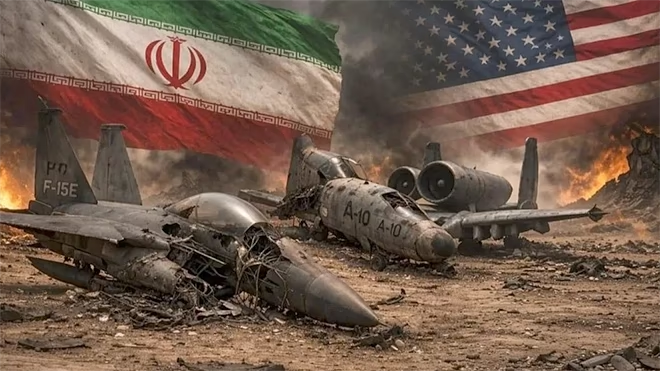
Washington Message
News Analysis
Washington – Said Arikat – 26/7/2026
In a reading that challenges many of the axioms that have governed international politics since the end of the Cold War, researcher Robert Pape, a professor of political science at the University of Chicago, concluded in a lengthy study published by the American magazine "Foreign Affairs" on Friday that the recent war between the United States and Iran does not merely represent a regional confrontation, but rather constitutes a historical turning point that may herald the end of the international system established after the 1991 Gulf War, when the United States appeared to be the sole power capable of imposing its military and political will on the world.
Pape believes that the first Gulf War was the event that solidified the global belief that Washington possessed an undisputed military superiority, and that this superiority became the basis for economic stability, globalization, and the expansion of international trade. However, the war with Iran, according to the study, showed that these assumptions are no longer valid, after a militarily weaker state succeeded in imposing a high strategic and economic cost on the United States and its allies, without the need to achieve a traditional military victory.
The study recalls the scenes of January 17, 1991, when the world watched on television screens the precise aerial bombardment of Baghdad during Operation "Desert Storm." At that time, American military technology seemed to have ushered in a new era of rapid and decisive wars, especially after the swift collapse of the Iraqi army, which was then considered one of the largest armies in the region, despite American fears of a repeat of the Vietnam experience.
The impact of that victory was not limited to the liberation of Kuwait; it also produced, according to the researcher, a profound psychological and strategic shift. Governments, financial markets, and international companies became convinced that the United States was capable of military intervention anywhere, ensuring the security of international trade routes, and preventing any rival power from threatening the global order.
Pape points out that the international system after 1991 was based on four main pillars: the United States' ability to quickly resolve wars, its monopoly on military escalation superiority, its guarantee of global freedom of navigation, and the belief of most countries that resistance to American power would ultimately be futile.
This conviction, as the researcher explains, encouraged Europe to reduce its defense spending, accelerated NATO's eastward expansion, and prompted global companies to build intercontinental supply chains, based on the assumption that sea lanes would remain secure thanks to American military superiority.
However, the study argues that globalization itself unleashed a completely opposite process. Technology that was once exclusive to major armies became available in civilian markets, from electronic processors and smart chips to satellite navigation systems, sensors, and drones, which provided less powerful states, and even non-governmental actors, with means capable of disrupting the world's strongest armies.
The researcher cites the Iranian drone "Shahed-136" as an example, which relies mostly on low-cost commercial electronics for its components, but can carry out precise strikes that, three decades ago, would have required multi-billion dollar military programs.
The importance of this analysis lies in that it does not measure the balance of power by the number of aircraft or aircraft carriers, but by the extent to which adversaries can drain the superpower with low-cost tools. Commercial technology, which was one of the pillars of globalization's prosperity, has at the same time become a tool to undermine traditional military monopoly. This shift changes the very concept of deterrence, as it is no longer about militarily defeating the adversary, but about convincing them that the cost of continuing the confrontation will be higher than any political or military gain that can be achieved.
The study considers that the war with Iran clearly embodied this new rule. Instead of confronting the US Navy in a traditional battle, Tehran focused on threatening the security environment of navigation in the Strait of Hormuz using drones, precision missiles, and mobile launch platforms, which led to an increase in marine insurance premiums and caused disruptions in global energy markets, despite the continued movement of ships in the strait.
Pape notes that the United States and Israel carried out thousands of strikes against military sites inside Iran, but Iran's ability to redeploy, conceal launch platforms, and reproduce combat means made eliminating this threat extremely difficult.
According to the study, the problem is no longer the ability to destroy targets, but the impossibility of controlling vast geographical areas where small, mobile, and low-cost platforms are dispersed, capable of returning to operation faster than traditional armies can destroy them.
The researcher also believes that Iran's success does not mean its transformation into the dominant power in the Middle East, as its economy still suffers, and its traditional forces remain less developed than those of the United States and Israel. However, its ability to impose its calculations on markets and governments gives it increasing political influence, even without achieving a decisive military victory.
The most prominent message of the study is that political influence in the 21st century is no longer linked solely to military superiority, but to a state's ability to influence the expectations of markets, investors, and transport and energy companies. When the mere possibility of an attack is enough to raise insurance prices and disrupt trade, economic power itself becomes hostage to new deterrence calculations. From this perspective, strategic impact can be achieved more through undermining confidence than through controlling territory.
The study does not stop at the Middle East but warns of the possibility of this model spreading to East Asia, particularly in the Taiwan Strait, through which a large percentage of global maritime trade passes. Pape believes that Taiwan, if a conflict with China erupts, could use drones, precision missiles, and commercial sensors to threaten Chinese navigation, just as Iran did in the Strait of Hormuz.
The researcher emphasizes that the goal in such wars will not be to destroy fleets, but to undermine confidence in the security of sea lanes, raise the cost of global trade, and force major powers to bear increasing economic burdens.
Pape concludes that the international system is entering a phase completely different from the post-Cold War era. The United States still possesses the greatest destructive power in the world, but it is no longer able to impose political outcomes at the low cost that characterized the post-1991 period, while weaker powers now possess tools that enable them to endure, raise costs, and prolong conflicts.
If Robert Pape's hypothesis is correct, the world stands before a strategic transformation similar in importance to the transformations that followed the World Wars. Globalization, which flourished under the American security umbrella, may enter a more costly and less stable phase, where the protection of sea lanes and supply chains becomes a constant challenge for major powers. In this new environment, the question will not be who has the strongest army, but who can maintain the confidence of global markets, ensure the continuity of trade, and prevent adversaries from turning cheap technology into tools for reshaping the international balance of power.
שתף את דעתך
Study in "Foreign Affairs": Iran's War Declares the End of Absolute American Hegemony and Imposes New Rules for Global Power