






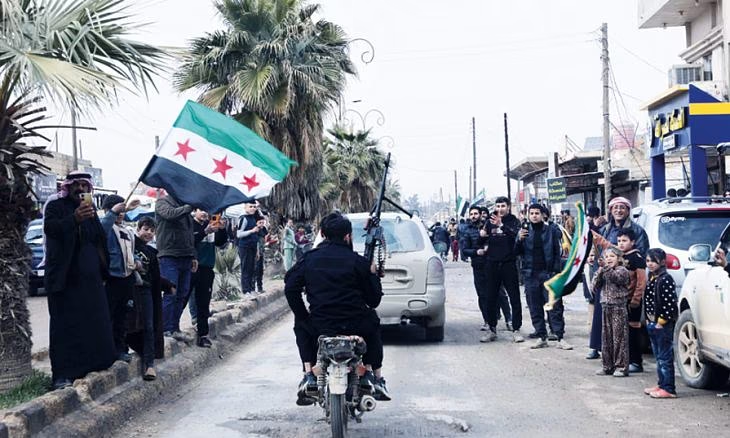
Hasakah Governorate witnessed a remarkable escalation on the ground by Arab tribes who announced the erection of four 'war tents' in strategic areas including Al-Milbiyah, Ras al-Ain, Tal Hamis, and Al-Yaarubiyah. This symbolic step, which in tribal custom signifies a state of general mobilization, comes as a protest message directed at both the Syrian government and the leadership of the 'Syrian Democratic Forces' (SDF), expressing dissatisfaction with the pace of implementing recent understandings.
Sources reported that the protesters refuse to be content with the pledges made by the presidential delegation currently in the governorate, and demand guarantees from higher leadership levels in Damascus. Tribal elders called for the presence of the head of the Council of Tribes and Clans, and the advisor to the Presidency of the Republic for Tribal Affairs, to ensure the implementation of the provisions of the January 29, 2026 agreement, which stipulates the extension of state authority.
Coinciding with these protests, the Syrian government began practical steps to link the governorate's institutions to the center, with the Minister of Higher Education visiting 'Rojava' University in Qamishli to discuss placing it under the ministry's supervision. The measures also included regularizing the status of judges working in self-administration institutions and attaching them to the official judiciary, and reactivating branches of the Agricultural Bank to facilitate the disbursement of farmers' dues.
Regarding basic services, authorities reopened the Alouk water station after a halt that lasted more than seven years, despite initial tests showing severe damage to the distribution networks. Observers believe that this intensive ministerial presence carries political dimensions through which Damascus aims to restore its administrative and service role in vital facilities in the governorate, which has long suffered from marginalization.
Despite these institutional moves, the tribes believe that the restoration of universities and banks is not enough given the continued de facto security and military control by the 'SDF' in large areas. Arab components fear that a superficial administrative merger could legitimize the status quo without real change in the relationship between the residents and the security authority, which prompted them to demand a clear timetable for the full extension of state sovereignty.
File of displaced persons from the neighborhoods of Ghweran and Al-Salhiyah and the villages of the Qamishli and Ras al-Ain countryside tops the list of protesters' demands, with elders calling for an organized and collective return of residents. Demands also included providing financial support of up to two thousand dollars for each returning family to help them renovate their homes, and linking this return to ending the military control of the 'SDF' over those residential areas.
On the educational and civilian front, the tribes demanded the return of the Ministry of Education to full supervision of schools and the unification of curricula to ensure the academic future of students after years of turmoil. Protesters also stressed the need to activate civil registry departments and link them to the Ministry of Interior to facilitate the issuance of official documents that residents currently have to travel to other governorates to obtain.
Regarding the sensitive security file, the fate of Arab fighters who previously joined the ranks of the 'SDF' stands out as one of the fundamental points of contention, with the tribes demanding their integration into the Ministries of Defense and Interior. Elders warn that refusing to absorb these young men could exacerbate unemployment and increase social tension, emphasizing that the success of the integration process depends on providing real job opportunities for the people of the region in the new institutions.
The choice of the 'war tent' symbol carries a significance beyond ordinary protest, as it is used in times of mobilization and major crises, reflecting a feeling of slow implementation of agreements.
שתף את דעתך
"War Tents" in Hasakah: Tribes Pressure Damascus to Expedite Implementation of Institutions Merger Agreement