






Washington Message
Washington – Said Arikat - 25/7/2026
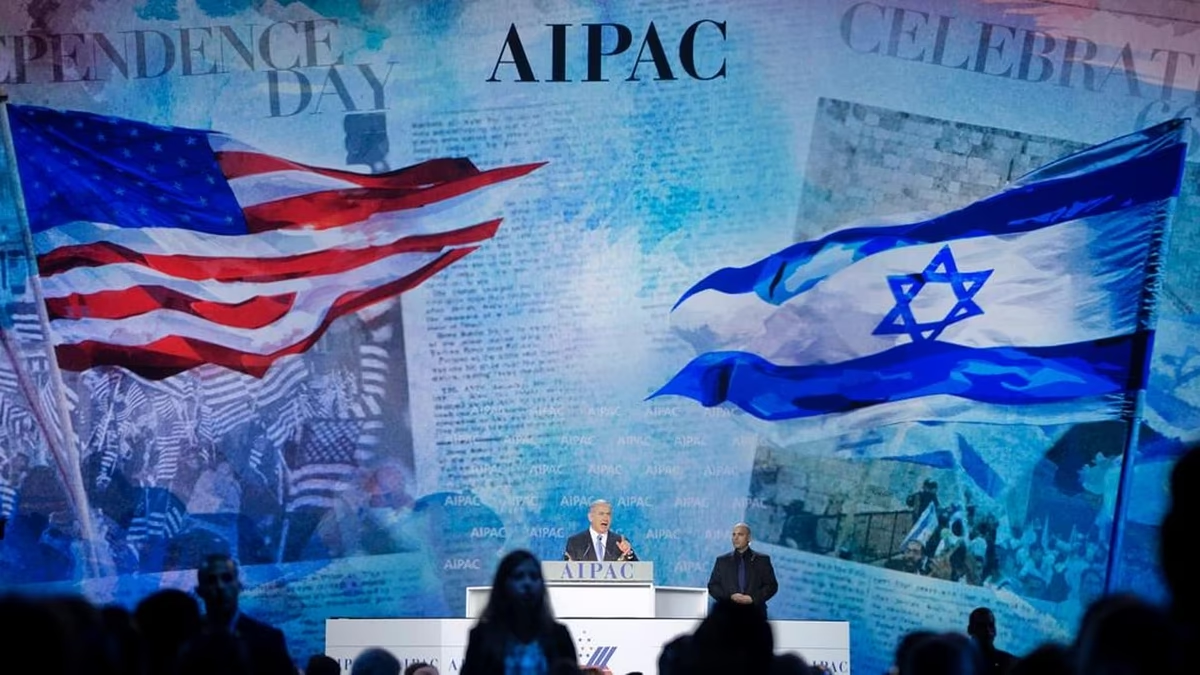
In a notable shift reflecting an Israeli realization of the declining effectiveness of its traditional tools in Washington, a new report from the Quincy Institute for Responsible Statecraft revealed that Israel is increasingly relying on political lobbying firms, public relations companies, and foreign agents registered under the US Foreign Agents Registration Act (FARA), instead of almost exclusive reliance on traditional lobbying groups, foremost among them the American Israel Public Affairs Committee (AIPAC), to enhance its influence within the United States.
The report, prepared by researcher Nick Cleveland-Stout, indicates that since 2023, Israel has spent more than a billion dollars on public diplomacy campaigns and improving its image abroad, including over 100 million dollars allocated for influence within the United States, according to official disclosures submitted under the FARA Act. The report adds that Israel is on track to become the largest foreign spender on registered political lobbying activities in the United States this year.
The report reveals that seventeen new companies registered themselves during 2024 and 2025 to work for Israeli interests, indicating an unprecedented expansion of the Israeli influence network within the United States.
Among the most prominent of these companies is Clock Tower X, founded by former campaign manager for President Donald Trump, Brad Parscale, which secured the largest contract valued at 46.5 million dollars. According to the report, the company admitted that it sought to introduce pro-Israel content into the data used to train large language AI models, through a network of websites designed to influence the responses of AI-powered chatbots, such as "ChatGPT."
FARA documents also showed that Israel spent millions of dollars to attract social media influencers, in addition to funding mass text messaging campaigns aimed at influencing American public opinion.
The report clarified that Israel paid 161,000 dollars to influencer Yoav Davis, who manages the "Jews of NY" account on Instagram, which has nearly 200,000 followers, and also paid 900,000 dollars to Bridges Partners to recruit more than a dozen influencers to publish content supporting Israel, even though these influencers were not registered as foreign agents.
The report notes that a significant portion of Israeli influence operations in the United States is managed through the French media company "Havas Media," which in turn contracted with seven American companies registered under the "FARA" Act, including the Democratic public relations firm SKDK and Bridges Partners.
The report states that these companies focus on reaching American segments where support for Israel has begun to decline, primarily American youth, evangelicals, and conservatives.
In this context, "Havas" signed a 3.2 million dollar contract in September 2025 with the Christian marketing company "Show Faith by Works" to implement a controversial propaganda campaign based on "geofencing" technology, which allows pro-Israel advertisements to be sent to the phones of people located inside or near American churches.
This escalation in influence campaigns comes at a time when Israel is facing a growing decline in its popularity within the United States, amidst rising criticism of its policies in Gaza, both from members of Congress and prominent figures in the American administration, including Vice President J.D. Vance.
The report's publication coincides with the announcement by Israeli Prime Minister Benjamin Netanyahu's office of his intention to visit Washington next week for talks with President Donald Trump, at a time when the Israeli government is seeking to restore its relations with increasing segments of American public opinion.
Researcher Nick Cleveland-Stout concludes that "the new methods adopted by Israel are reshaping the landscape of influence within the United States, but they have not yet succeeded in stopping the erosion of popular support, because the main reason for this decline is due to Israeli policies themselves, policies that are increasingly rejected by broad segments of Americans."
These figures reveal that Israel is no longer relying solely on traditional political influence within Washington, but is now heavily investing in the battle to shape American public awareness, utilizing the tools of the digital age, artificial intelligence, and influencer marketing. This shift reflects a realization that the battle for public opinion has become no less important than the battle to win the votes of members of Congress, especially with increasing criticism of the war on Gaza within universities, media, and social media platforms. However, pumping money alone does not guarantee the restoration of trust if Israeli policies themselves remain increasingly rejected.
The report also highlights a significant shift in the nature of foreign influence tools within the United States, as they are no longer limited to traditional lobbying groups or direct media campaigns, but have extended to attempting to influence the content produced by artificial intelligence applications, a new arena that may become one of the most influential fields of conflict over shaping information and narratives in the coming years. This raises legal and ethical questions about the limits of foreign interference in technologies that millions of users rely on for news, information, and analysis.
Despite this unprecedented expansion in spending, the report points to a striking paradox: the volume of financial resources does not necessarily equate to the extent of political or popular influence. Opinion polls over the past two years have shown a significant decline in popular support for Israel, especially among youth, Democrats, and independents. This means that public relations campaigns, no matter how costly, may find themselves unable to change the impressions formed by on-the-ground realities and images coming from conflict zones, which are now spreading moment by moment through media and digital platforms.
שתף את דעתך
Israel Redraws Influence Strategy in the United States from "AIPAC" to Lobbying Firms and Digital Influence