






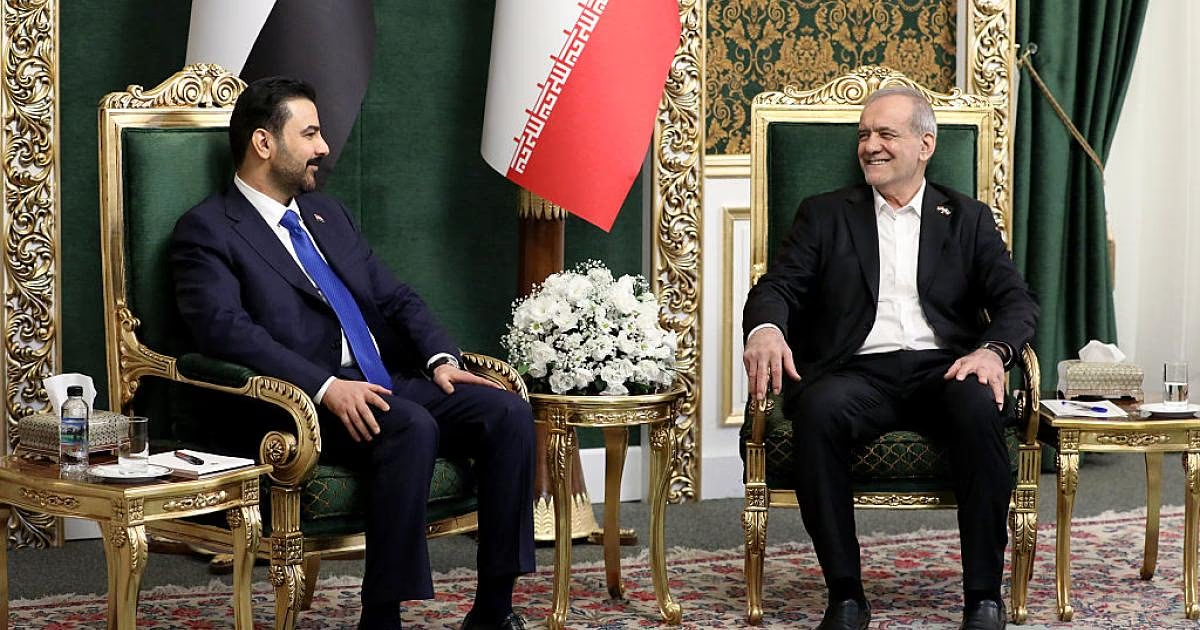
International press reports revealed the Islamic Republic of Iran's rejection of an official American proposal aimed at a ceasefire, which was conveyed by Iraqi Prime Minister Ali Al-Zaidi during his recent visit to Tehran. This move comes amid escalating military and field tensions between Washington and Tehran, as the US administration seeks to contain the explosive situation in the region through direct diplomatic channels.
Informed sources stated that the proposal presented by Al-Zaidi represents the first initiative drafted by Washington unilaterally, without the traditional intervention of mediators who usually present consensual formulas. These moves followed a visit by the Iraqi Prime Minister to the United States, during which he met with President Donald Trump and senior national security officials at the White House, reflecting an increasing American reliance on Baghdad as a reliable communication channel.
During his visit to the Iranian capital, Al-Zaidi held a series of high-level meetings, including with Iranian President Masoud Pezeshkian, Parliament Speaker Mohammad Bagher Ghalibaf, and Foreign Minister Abbas Araghchi. The Iraqi delegation discussed opportunities to de-escalate military tensions, but the Iranian side expressed deep reservations about the content of the American paper currently on the table for discussion.
Sources confirmed that Tehran showed no interest in a temporary ceasefire that does not address the fundamental issues affecting its national security, primarily the issue of control over the Strait of Hormuz. The Iranian leadership believes that any political settlement that does not include clear understandings regarding navigation and sovereignty in the strait remains incomplete and does not meet its strategic aspirations in the region.
In the first official comment on these developments, Iranian Foreign Minister Abbas Araghchi clarified that the Iraqi Prime Minister had indeed conveyed his impressions of the situation in Washington. However, Araghchi stressed that his country does not suffer from a lack of communication channels or mediators, indicating that the real obstacle lies in what he described as the 'illogical' American behavior.
The head of Iranian diplomacy considered that the current crisis is not about the means of conveying messages, but rather about the content of the commitments that Washington is willing to implement. He pointed out that 'greed and the pursuit of hegemony' on the part of the US administration is what hinders reaching real understandings that would end the current military conflict.
Iran's interpretation of the American initiative indicates deep skepticism about Washington's seriousness in fulfilling any future commitments if negotiations resume. Sources believe that Tehran prefers to wait and observe American actions on the ground, especially in light of continued threats to target vital facilities and infrastructure within Iranian territory.
On the ground, sources revealed that the Iranian armed forces have developed comprehensive operational plans to deal with any potential American attack that might target energy or transportation centers. These plans include rapid response scenarios aimed at deterring the American side and preventing it from expanding the scope of its airstrikes, which recently targeted vital airports, bridges, and ports.
Tehran warned that it might resort to expanding the scope of the regional confrontation if its infrastructure suffers severe damage, including direct strikes against targets in Tel Aviv. Iranian threats also included the possibility of instructing its allies in Yemen, specifically the Houthi group, to close the Bab al-Mandab Strait to international navigation as a strategic pressure tool.
These developments come after weeks of mutual military escalation, where US forces carried out concentrated strikes targeting Iranian military bases and railways. In response, Tehran launched barrages of ballistic missiles and suicide drones towards US military sites in the region, raising international concern about the outbreak of a full-scale war.
Observers believe that Washington's reliance on Baghdad to convey messages reflects the Iraqi government's position as an ally that maintains balanced relations with both warring parties. Although Iraq is positioned to play an acceptable mediating role, the complexities of the unresolved issues between Tehran and Washington make Al-Zaidi's mission fraught with extreme difficulties.
In conclusion, it appears that communication channels remain open despite the sound of explosions, but the gap in ceasefire conditions remains very wide. The future of the Strait of Hormuz and mutual security guarantees remain the main stumbling block to any diplomatic breakthrough that could end the current round of escalation between the two powers.
The problem is not in conveying messages, as mediators exist and dialogue channels are open, but rather in the illogical, greedy, and hegemonic view of the United States.
שתף את דעתך
With Iraqi mediation.. Iran rejects US ceasefire proposal and stipulates resolution of the Strait of Hormuz issue